And the comparatively tougher one (and my favorite):

Answers tomorrow.
Yesterday's Answers:

Yesterday's Answers:
 I love Turner Classic Movies.
I wish I had that channel, but if I did I'd be watching it all the time and that's not good.
I love movie posters, too, though lately there haven't been any that I'd like to possess: too much Photoshop; not enough art.
This Summer, TCM is having a "Summer Under the Stars" and to celebrate they've created a series of nicely done, simply designed, artfully created movie posters for classic movies. They're a bit obtuse but you can get the idea from the images.
For example, the example to the upper left is (of course) "Gilda" starring Glenn Ford and Rita Hayworth, and the poster below it is Harold Lloyd's "Safety Last!"
Those are really nice posters. In fact, they're better  than the posters that trumpeted the film when they first opened. All of them, in fact, are nice examples of design and hinting at subject. So much so, that I'm deviating from doing reviews this week and will do a little puzzle of sorts where you (the reader) try to figure out what the title of the movie is from the posters displayed. The next day I'll post the answers (using that film's original posters) and give you two new ones to figure out.
I'll do this through Friday, and return Saturday with the usual scathing review for that day. Sunday will be a "Don't Make a Scene" from either an Oscar winning film or a screamingly entertaining film from the 60's.
So, put on your thinking caps and we'll see how you do. I'll provide an easy one and a tougher one each day.
First, the easy one:
And the tougher one:

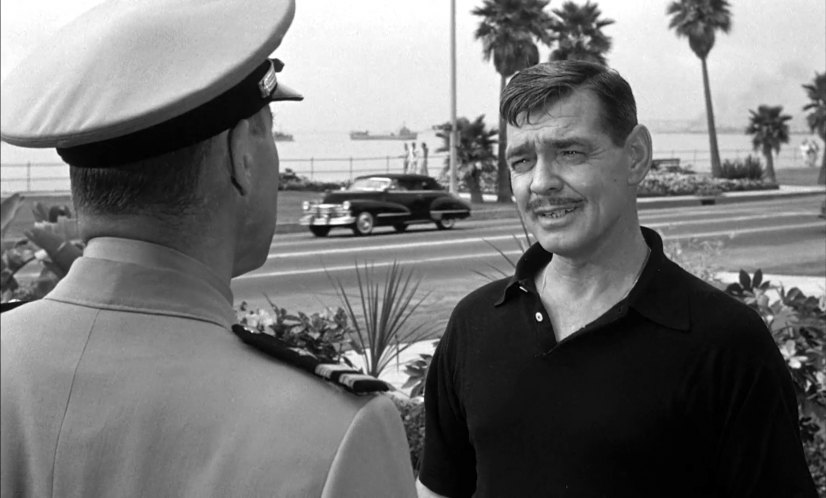
 The Story: Of course, in a movie called "Run Silent, Run Deep the most important things don't get said.
The 1958 sub-movie presents the conflicts of the American and Japanese navies in World War II in microcosm with only a specific area of danger being the focus and returned to again and again. In a further reduction, the warring sides are reflected in the conflicts amid the crew of the Naval submarine Nerka. Some of the men side with sub-mate Exec Jim Bledsoe, while others—after a, to some eyes, successful breaking-in period—defer to the elder Captain Richardson, who's lost one command already, and seems determined to lose another in an obsessive quest for revenge. That he pulled strings to usurp Bledsoe's command of the Nerka has spilled the first of bad blood between the two men, and has caused conflict in Bledsoe himself. That Richardson has also demonstrated canny and unconventional maneuvers to increase enemy tonnage sunk can't be denied, but the risks he takes are also high, and the crew is divisive and Bledsoe...conflicted.
What a way to fight a war. But Lancaster was drawn to the story and its interlocking conflicts and elements of surprise, obsession and strategy. Lancaster was like that, too. "Run Silent, Run Deep" was one of his concessions to the movie business where he would divide the resources of his production company Hecht-Hill-Lancaster between risky prestige pictures (like "Sweet Smell of Success" and "Elmer Gantry") and more crowd-pleasing efforts like this one. And the conflicts? What motion picture was ever made without one?*
But at the helm of the film, with its producer star and its Hollywood super-star at the top of the marquee, was Robert Wise, a journeyman director who, if he didn't find the most artistic way to make a picture, always found the most practical. Wise was able to negotiate shooting in cramped quarters and restricted working-days for Gable to get the maximum effect without any mis-steps. He was, after all, an editor before he was a director, and was credited for editing "Citizen Kane;" he knew what was needed to get the story across.
For this scene, the set works against him. Wise was able to get a good angle on Gable, doing the scene from his bunk, but for Lancaster, the angle was problematic. It's more Lancaster's scene than The King's, but the only way to shoot it would have had Lancaster looking askance at the camera, making him weaker in the exchange and robbing the audience of seeing most of his expression. So Wise shoots Lancaster dead-on, with Lancaster looking below the camera lens to make this important conciliatory scene stronger. The men have to be seen looking at each other and coming to their realizations separately. Their arguments have been made in the open and out loud. Their reconciliation is made silently, and dismissed as unnecessary. They're on the same paqe now—they just got there differently. Actions now, not words.
The Set-Up: Executive Officer Jim Bledsoe (Burt Lancaster) has relieved Captain "Rich" Richardson (Clark Gable) of command of the Naval sub Nerka. Richardson lies in his quarters, suffering black-out's from an injury he's sustained in the torpedo room. Now, with repairs made and the sub headed back to Pearl Harbor from the dangerous Bungo Straits off Japan, the crew has settled down a bit from their previous fist-fights and belly-aching. But a recent broadcast from "Tokyo Rose" naming the Nerka as destroyed and mentioning specific names of the crew has Bledsoe thinking there's more to the story, and more to be done before going home. But first, he has some unfinished business.
Action!
 Captain Jim Bledsoe: How d'you feel?
Captain Rich Richardson: I'm alright.
Bledsoe: Repairs are completed. We're ready to move.
Richardson: The crew must be very happy.
Bledsoe: Uh-huh. Richardson: Aren't you? That's what you wanted, isn't it?
 Bledsoe: That's what I wanted.

 Richardson: (looks at him) I see. You're going back to the Straits. Bledsoe: That's right.
Richardson: (suspicious) What changed your mind? Bledsoe: I found out how they detected us. Those fishing barges along the coast have been picking up our garbage sacks. For the first time, we have a real advantage.
 Richardson: Sure, Jim. I made the same speech. But you and I both know that the odds are still against us. There's always a calculated risk, the unknown factor. Let's not kid ourselves. You're going back 'cause you've been through it. Because you have to go back.
 Bledsoe: You knew all along I would.
 Richardson: Let's say I had a hunch your order to retreat wouldn't be carried out.
 Bledsoe: Okay, Rich. I guess the real reason I came in here was to tell you that I...
 Richardson: Good luck, Jim.


"Run Silent Run Deep"
Words by John Gay
Pictures by Russell Harlan and Robert Wise
"Run Silent Run Deep" is available on DVD from MGM Home Video.
* I dunno, but they must have been pretty dull!
 "Boys With Toys"
or
"We Just Dropped Ten Tons of Dead Robot in the Middle of Nowhere."
As I recall, my three biggest beefs with the first "Transformers" movie was a) it was your basic racial bait-and-switch movie where the story of a repressed class is sublimated by having the story told through the eyes of a bankable star not of that class, b) the action sequences were ultimately boring and c) Michael Bay made every woman look like a hooker.
Other than that, I didn't mind it as some things were done quite well, indicating that Bay might actually become a filmmaker some day, as opposed to being a well-organized ring-leader and money evaporator.
But "Transformers: Revenge of the Fallen"* shows no such progression, and is quite a deal worse than the original. The problems with the first film have not been resolved, and the filmmakers have moved on to ignore more weighty problems like coherent writing, clear visual story-telling, or having a point besides making money and providing jobs for friends.
By now, the five-story high Auto-bots have become known to the military (thanks for noticing) if not the public at large, and should be working arm in cog to ward off alien attack, become an early, early warning system, vaporize garbage or at least become part of the motor pool. But it appears their job is to sit in one those ubiquitous governmental underground bunkers, stay out of the way of lucrative weapons manufacturers and kvetch about the government in charge. In other words, they've become part of the legislative branch with the major difference being that they actually go into battle themselves.**
And their nemeses, the evil Decepticons? They're doing much the same thing, except oiling their wounds, going back to the drawing board and plotting revenge. It would appear they have a long-standing grudge against Earth and its inhabitants, which is why this pan-galactic epic battle seems to be centered here, rather than some other arm of the Milky Way. Maybe we really are the Center of the Universe...and it attracts trouble.***
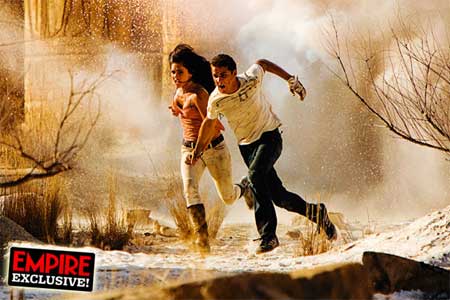
Speaking of self-absorbed monomania, Sam Witwicky (Shia LaBeouf) is off to college, with more beating of breast and patting of wallet by his braying parents (Julie White, Kevin Dunn) who were a welcome relief last time, but are now just wacky walking punch-lines. Then there's the only reason fathers are taking their children—Megan Fox who's achieved a reputation as a Hollywood hottie and probably did a lot of practicing having a cold trying to get out of her contract-mandated participation, and might have done if she were a better actress. Fortunately, she's not required to do much outside of your typical Almay or shampoo commercial, until the latter part of the film where she's required to run in front of large gasoline explosions. I'd be worried for her as her mascara doesn't appear to run at all, but she doesn't lose so much as a false eye-lash.
The movie is built of the spare parts of a lot of past Studio franchises, and as with most out-sourcing a lot of the pieces don't fit. The Decepticons have a tier-structure (the Decepticon Overlord at one point even says "And you will, my apprentice"), a magic bling must save the day, Sam has trouble saying the "L" word, and there are magic scribblings that they have to go to an expert (John Turturro returning to good comic effect), in order to stop the evil erector sets from setting off a device hidden in the Pyramids that will stop the sun (I'm not sure what that would be but I suspect it's some triangular Maytag ice-maker). Take "Transformers," strap on "Indiana Jones," plug in "National Treasure," screw on a pneumatic "Star Wars," some "Gremlins," program in some "DaVinci Code," stir a few thousand times to make it incomprehensible and drop it with a huge clank on "Independence Day."
Ultimately, it's a big mess with Bay setting up a swooping crane shot for every line of dialog, and the screenwriters setting up their expositions over explosions so you can't hear all their mumbo-jumbo. The only time the movie comes to life is an extended sequence on campus when Sam, possessed by a piece of the evil Decepticon-maker freaks out in a classroom and goes all "Beautiful Mind" scrawling encryption's on his dorm-room wall, while also avoiding the predatory come-on's of a sorority sister, who's actually a Decepticon in drag. At that point, the movie becomes giddy and fun with complication piled on complication and LaBoeuf displaying some of the manic energy that makes him interesting to watch.
But that's ten minutes out of two and a half hours of a loud, obnoxious version of "Rock'em, Sock'em Robots." And that's the bottom line of this mess. It was made for the necessities of the Studio making it, not for any artistic need to tell a story. Just as the Studios plan a few years ahead to make "tent-pole" franchises to strategically shore up dividends in the Summer and Christmas, this movie was constructed of sequences dictated by locations cheap enough to shoot in. That, unfortunately, is how the Bond producers have been manufacturing movies for the past two decades: having run out of Ian Fleming titles, they check to see where they can save the most money and set their movies there, and write the script around the location (Hitchcock would utilize locations for material as well). The problem is there's more to a screenplay than "location, location, location." The Bond series perked up only when they had Fleming's "Casino Royale" to provide that film its spine and heart. But there's no point and no inspiration to "Tranformers: Revenge of the Fallen," there is only contrivance, and the makers were scraping the bottom of the scrap-heap to do that. The old "Transformers" series used to kill off characters to encourage kids to buy their new lines of toys. One can imagine the day when "Revenge of the Fallen" will overcrowd the dumpsters of America, as well.
"Transformers: Revenge of the Fallen" is a Waste of Time.
* Jim Emerson had the foresight to alphabetize it as "Transformers: ROTFL"
** Hey kids! There are new Auto-bots based on Smart-cars, but instead of speaking French, they're street-cred hipsters and are as annoying as a weekend with Jar-Jar Binks. In fact, these characters aren't only annoying they're vaguely racist (!!??), but then there's a major disconnect with this movie about its audience. It's aimed at kids, but amid all the cussing and humping dog jokes, I could see more than a few parents putting their heads in their hands at the questioning upturned faces of their kids. It's also aimed at the kids who played with "Transformers" in the 70's and...haven't evolved. They were the ones "huh-huh-huhing" at off-color humor. Hollywood has yet to learn that the AICN crowd are a fickle bunch and won't necessarily open a movie for you. But then, a goodly number of current directors are fan-boys themselves.
*** At one point at an attempt at depth one of the characters says of the robots: "If God made us in his image, who made them?" Hasbro, Einstein! And probably in China.
 "The King of Kong: A Fistful of Quarters" (Seth Gordon, 2007) Interesting little documentary about the sub-world of video-gamers and the clashing ego's of those trying to achieve high scores. It's also a bit like a real-life version of those Anthony Mann/James Stewart Westerns where a newcomer used to doing things his way comes up against an entrenched system with closely held beliefs that serve their own self-interests.
And, of course, those depend on a good villain, and they don't come better (or self-deluded) than Billy Mitchell, the mulleted hot-sauce "king" who has everyone in his limited sphere convinced that he's a genius...when what he is...is very good at video-games. Mitchell has had the reputation since high-school, so it's about there where his maturity ended and he stopped to grow as a human being. Instead of conversation, he spouts vaguely threatening marketing bursts full of brio but without much substance to back himself up. You spend the movie wanting him to take a large fall.
Riding into town comes Steve Wiebe, an over-achiever who's had to contend with disappointment most of his life. Laid off from Boeing, he goes back to school for a Master's and passes time playing Donkey Kong, analyzing the patterns and achieving higher and higher scores. Until one day, he passes Mitchell's. You can't have a mano e mano match without a referee, and the story provides that with Walter Day,* self-styled arbiter of video-game high scores through his company, Twin Galaxies.
Wiebe submits a video-tape of his high-scoring game, but the tape is rejected as insufficient proof, amid speculation by Mitchell cronies that Wiebe's machine has been tampered with by an enemy of Mitchell's—these guys are the wimpiest of paranoiacs. So, to prove his point, Wiebe schleps all the way to the booming metropolis of Laconia, New Hampshire to an arcade where a "live" play of the game can be witnessed and verified. Wiebe does it, but then Mitchell submits a tape (which appears to have glitches in it) of a higher-scoring game, which apparently he just had lying around in case of emergencies. That tape is accepted with no questions asked, and Wiebe becomes aware that he's not just fighting a pixelated Donkey Kong but a system rigged for the benefit of its own 800 lb gorilla.
It's fascinating to see so many "grown" men getting worked up over bragging rights of a video game, and how low they can sink in trying to get "their" way. The Mitchell drones are particularly pathetic, doing service to their dark lord so he doesn't have to make an appearance as witness, or risk anything. That one of them admits in interview (in front of Mitchell, who petulantly seethes silently) that Wiebe's a good guy and a good player is the only satisfaction one gets from the film...other than getting a chance to see this topsy-turvy little fiefdom of gaming.
After the film was released, there were protestations. Both Wiebe and Mitchell have said that they've actually competed before the doc was being filmed, and actually they get along great ("Hey, they're buds'!"), and the film was edited to make the story simpler (something the film-makers admit, and is, no doubt, absolutely true), but one comes away thinking one's seeing a lot of truth in the frame, despite not seeing all of what was recorded. You can manipulate a story with editing, certainly, but you can't make a person say anything they don't want to say on-camera.
Editing lies, but every picture tells a story.
Even though his actions belie it, even Mitchell admits to that in the film.
(And in the interest of public disclosure, I just played "Donkey Kong On-line," and scored 200, before thinking I was wasting my day—five minutes of it—and giving up.
* Day seems like a decent sort, trying to keep track of all the wimp/macho sniping, throwing himself in between the fights going on between ego-driven gamers. Guinness Book of Records recognizes him as an authority. Now, that is an accomplishment.
 "Bad Education" aka "La mala educación" (Pedro Almodóvar, 2005) You immediately begin to snicker when the credits come up; it's Almodóvar in full Hitchcock mode with a Saul Bass-inspired credit sequence that rips across the screen bi-secting it again and again, indicating that the film will be about Hitchcockian dualities. But Almodóvar cleverly takes it a few steps further, dividing and dividing until you're not sure what's real.
It is, after all, just a movie.
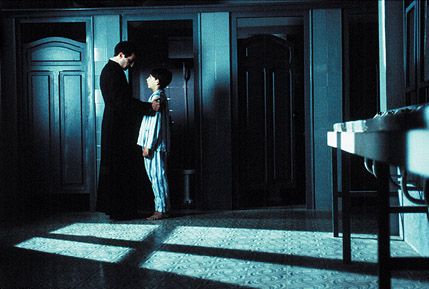
A director (Fele Martínez) is in a creative doldrum, searching through tabloids for a story to inspire a new film. Fortunately, there's a knock at the door and in walks old school chum Ignacio Rodriguez (Gael García Bernal). But more than that, Ignacio was the director's first love in Catholic grade school. Their initial welcome and wave of nostalgia is tamped down when Ignacio tells him he's an actor and has a story to peddle. "There's nothing less erotic than an actor looking for work," says the director after the door has hit his friend in the butt on his way out.
Then he reads the story (illustrated by Almodóvar by changing the film's aspect ratio—not the last time he'll do that in this film). It's of Ignacio's grade school crush on the director and his molestation by lit teacher Fr. Manolo, and Ignacio's further blackmailing of the priest for his past crimes.
Intrigued with the story, and with just a touch of revenge in mind, the director decides to film the script, even allowing Ignacio—who insists on being called by his stage name "Angel"—to star.
Then things get complicated in a very bizarre fashion. For the director, recreating a story twice removed proves complicated. Even more, he finds the exception to the rule of truth being stranger than fiction.
Almodóvar loves film, not only for its story-telling ability, but also as its illustrative of other realities and the imagination, which he exploits in this film to the fullest. But, more, the man loves movies; in "Bad Education" he not only pays homage to Hitchcock and his disciple Brian DePalma (who could have easily made this story), but also Billy Wilder, Jean Renoir, and Mario Camus. That love fosters this movie within a movie within a movie until reality and fiction telescopes down a long rectangular rabbit-hole. At what point do fictions within fictions stop reflecting reality?
As Hitchcock famously said, "Ingrid, it's only a movie!"
* Dillinger's crime career (following his prison sentence by unsuccessfully cold-cocking a local grocer) lasted all of 14 months. "Pretty Boys and Baby Faces: The Romancing of John Dillinger"
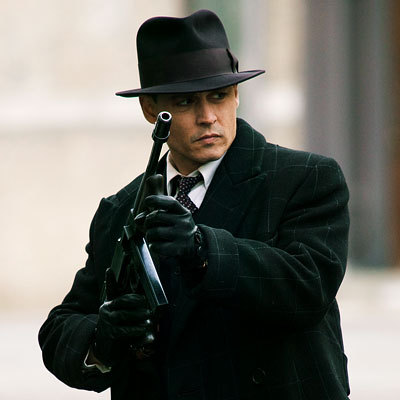
John Dillinger had enough publicity during his short* reign on the Most Wanted List, a lot of it generated by the man himself and his way of painting himself a folk-hero (he even saved his press clippings), so it seems like gold-plating a tommy-gun to make another movie lionizing him (see below). But Michael Mann—the director who created "Miami Vice" and has made a good movie or two ("Manhunter," "The Last of the Mohicans," "The Insider," and "Collateral") felt the need to make a new telling of the Dillinger legend—this one gussied up with Mann's usual stylish flair (although on more than one occasion the stylish suits and the familiar Chicago locations made me mindful of Brian De Palma's "The Untouchables"). Let us put aside for awhile the argument that the movie is morally wrong-headed to paint Dillinger as more sympathetic than his "Public Enemy" in the FBI, Melvin Purvis. Let's just examine where the movie goes wrong.
The opening break-out from the Indiana State Pen portrayed in the film has some relation to truth—guns were smuggled into the shirt-making shop in shipments of thread—but Dillinger wasn't there. He'd been paroled early due his step-mother's imminent death and was sitting in a jail-cell at the time from a small series of robberies that had been planned with his earlier cell-mates at Indiana. He was picked up at his girl-friend's house, which was being staked out by police. That hardly fits the legend of John Dillinger that "Public Enemies" insists on pushing forward.
But then, the movie is less an accurate crime drama than a period romance. The film makes "Billie" Freschette (Marion Cotillard) the love of Dillinger's life—the case could be made for Dillinger's wife who divorced him while he was serving his initial stretch in prison, breaking his heart and subsequently making him distrustful of long relationships with women. The absurdity is taken to an extreme case with a coda that is completely unbelievable, considering that Dillinger was famously gunned down in the company of a new prostitute girlfriend Polly Hamilton (Leelee Sobieski) and madam Anna Sage (Branka Katic)—the legendary "lady in red."** Still, one of the interesting stories about Dillinger is that the FBI staked out his boyhood home, hoping to arrest him the day he brought Freschette home to meet his folks. When the party broke up, three cars left the farm-house. The Feds followed the wrong one. It is true, as the movie shows, that Dillinger watched as Freschette was arrested and "cried like a baby" when he left the scene. He wasn't so broken up that he wouldn't take up with somebody else, though. And last words? Horseradish. Barbara Cartland could have written such sentimental sop.
The problems began from the beginning, when Leonardo DeCaprio was set to star as Dillinger, then when the project stalled, Johnny Depp signed on. Neither of these boy-men make a credible Public Enemy #1. Depp's performance is fine, but wrong-headed, his Dillinger looking more dyspeptic than criminal. It's a romantic's fantasy of John Dillinger, as is the concept of Dillinger being a one-woman man.
Still, Mann does some good things. Shot on video (by Dante Spinotti) the film is crystal-sharp, and looks great, even during its numerous hand-held sequences. The shoot-out at the Little Bohemia Lodge is completely inaccurate—the movie would have you believe that "Baby Face" Nelson died in the action as well as the two FBI agents who were killed—but the sequence is rip-roaring at times with Christian Bale's Melvin Purvis riding the running board firing a tommy-gun at the fleeing bandits.*** There are interesting cameo's—Billy Crudup does a fine impression of a young John Edgar Hoover, pugnacious, brittle and paranoid, and Lili Taylor shows up as Sheriff Lillian Holley. A made-up scene of Purvis and Dillinger taunting each other while the robber's in prison allows the two stars to have a scene together, but sacrifices the fact that Dillinger looked right at Purvis while walking out of the Biograph Theater his last night and did not recognize him.
But the film is as much fiction as fact, getting a lot of period facts wrong (there was no FDIC at the time of Dillinger's robbing career, yet a sign announcing the fact is displayed prominently, probably for comic effect, during a heist sequence) and the story a Disney version of actual events. It's a disappointment, considering a lot of the Dillinger story is stranger than fiction.
"Public Enemies" is a Rental.
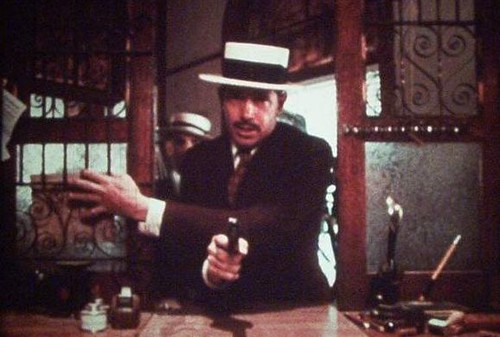
There have been other versions of the story**** "Dillinger" (John Milius, 1973) Produced at a time when American International Pictures was actually putting some money into their films, it gave USC maverick director Milius a chance to direct. There's a lot of "Bonnie and Clyde" in this "Dillinger," and Milius indulges in some Peckinpavian slow-mo blood-spurting, but on the whole it's an interesting account of the Dillinger years. Milius also uses two members of the Peckinpah stock-company: Ben Johnson is too old to play Melvin Purvis, but the man lends considerable weight and history to the role and the movie which made a folk-hero out of Purvis on a par with Dillinger.***** In the title role, there could be no one better than Warren Oates, who not only looked like the real thing, but was a more pragmatic, less idealized version of the gangster. Along with Oates' better performance, Milius' film is a grittier, sparer version of things, not as glossy and feeling much more ambivalent toward both cops and robbers.
And look at that cast! Richard Dreyfuss (over the top as "Baby Face" Nelson), Michelle Phillips (late of "The Mamas and the Papas") as Billy Frischette (though she's present at Dillinger's death), Cloris Leachman as Anna Sage, and a wealth of character actors—Harry Dean Stanton, Geoffrey Lewis, Steve Kanaly, Frank McRae, and Roy Jenson.
This is the one to see, despite (and maybe because of) the protestations of J. Edgar Hoover at the credits' end. "Dillinger" (Max Nosseck, 1945) Low-budget exploitation film that took the Dillinger notoriety and regurgitated the legends, fictionalizing the story and changing names (winning an Academy Award nomination for screenwriting in the process!). The film starred Lawrence Tierney, Hollywood bad boy, who had a long career as a hood-type up to and including "Reservoir Dogs." But there are some good actors on hand like Marc Lawrence, Elisha Cook Jr., and Edmund Lowe. But the film is strictly of the "Calling All Cars" school, laughably simple-minded, with none of the style of the gangster movies of the previous decade, and Dillinger portrayed as a romantic figure—the female lead (Anne Jeffreys) refuses to pick Dillinger out of a line-up because she's got "the hots" for him. Not much to recommend it, other than you can watch it for free on Hulu.
Just to let you know this lionization still exists (as if "Public Enemies" wasn't enough), today is traditionally "John Dillinger Day" and members of the "John Dillinger Died For You" Society will be doing their traditional walk from the Biograph Theater, commemorating his death 75 years ago.
** Even that story's not true—Sage told Purvis she would wear a white blouse and orange skirt—which appeared red in the Biograph's marquee lights. The trio went to the movies to escape a hot apartment and the Biograph was air-conditioned; the movie—"Manhattan Melodrama," a gangster film with Clark Gable, William Powell and Myrna Loy (she's given quite a tribute in "Public Enemies," and Marion Cotillard does resemble her). *** Bale does a good job as Purvis, but he's a bit too dapper to portray the Special Agent. He is, however, one of the few actors who can fire a large caliber weapon without blinking. Purvis' story is an interesting one: charged by J. Edgar Hoover to "get Dillinger," when the press lionized the Agent, Hoover became jealous of the attention paid to him, making life miserable until Purvis left the Bureau a year later. Unable to find further work in law enforcement (due to alleged interference from Hoover), Purvis became a private businessman, married and fathered three sons. He died in 1960 of a gun-shot wound to the head from the revolver given to him by his FBI colleagues upon his retirement from the Bureau. Hoover's FBI ruled it a suicide (and Purvis was suffering from cancer at the time), but others have speculated he was killed accidentally trying to pry a tracer bullet out of the gun. When the legend becomes fact...
**** Not including "Young Dillinger" starring Nick Adams, sort of an "I was a Teen-Age Dillinger."
***** Milius padded Purvis' resume a great deal, having him in charge of the captures of "Pretty Boy" Floyd and Dillinger, but also "Baby Face" Nelson (as does "Public Enemies"), and "Machine Gun" Kelly, "Handsome Jack" Klutis, and Walter Underhill.
 "The Splintered Arc of a Love Affair""
or
"Something as Permanent as a Greeting Card" ("Color My Life with the Chaos of Trouble")
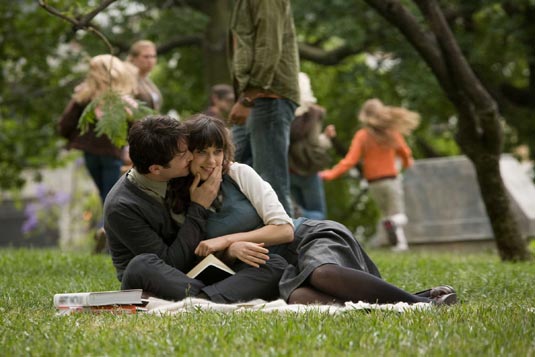
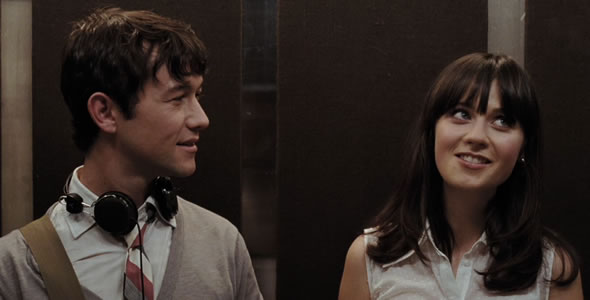
Once in a blue moon a little movie comes along that takes you completely by surprise if you're walking in with low expectations and an objective demeanor. If "(500) Days of Summer" isn't the best movie of the summer season—now seemingly locked into alternating between "tent-pole" franchises and Film-Fest pick-ups, of which this is the latter—then it will do until something better comes along. And halfway through July that looks very unlikely.
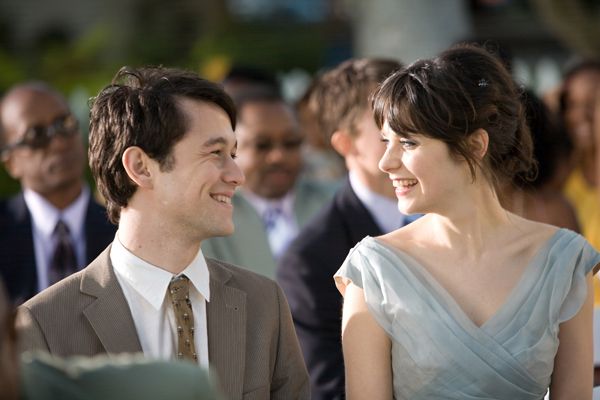
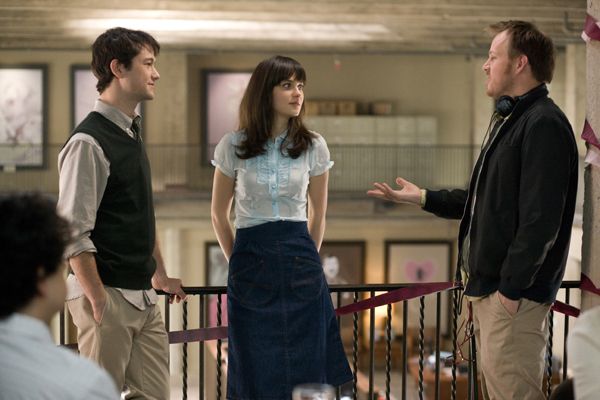
The nice thing about "(500) Days" is that it's hard to classify—romance, comedy, drama, maybe "bromance," but not really—but what it is not is a "chick flick," as, here, the traditional roles in such a froth are reversed. Boy, Tom Hanson (Joseph Gordon-Levitt), a "perfectly adequate greeting card writer" meets Girl, Summer Finn (Zooey Deschanel), assistant to his boss (director Clark Gregg). Owing to what the narrator calls "The Summer Effect" that elicits "18.4 double-takes" on every bus-ride, Tom takes an immediate interest in her and begins a luring, enticing pursuit that to his shock and delight manages to hook the odd, off-putting Summer.
Then, the trouble begins, as it seemingly has before. Tom, you see, is a hopeless romantic—an oxymoron if ever there was one—while Summer doesn't believe in star-crossed romance, soul-mates, "Chasing Amy," or "hikes along the Appalachian Trail." She just wants to be happy, have fun and enjoy herself now, while she can.
This would be dreadful taken chronologically. But director Marc Webb and his scripters Scott Neustadter and Michael H. Weber (who start off with a great touch) shake up the story and spill it out on the screen in a complex timeline that flies back and forth between good times and bad, reflecting the bi-polar extremes of Tom (which veer between music-video exuberance and plate-smashing depression) and the shifting moods of Summer (who runs hot and cold). The juxtapositions are great grist for comedy and the laughs are smart and plentiful. Throughout, Tom is advised by his small posse (Geoffrey Arend, Matthew Gray Gubler) and little sister (Chloe Moretz), all surprising in ways one doesn't expect.
It's the two leads that are exceptional. Zooey Deschanel is a fringe-actress roller-skating the edge of fame and one would hope that this was the role that gooses her career choices. Deschanel has always been good at the atypical waif, but her Summer has a solid spine that makes her the leader in the dance. And Deschanel is just interesting to watch for her choices. During a party scene when asked, "What brought you here?" her brow furrows and her poached-egg eyes rattle through five fast and different expressions before she says anything, in sentences that are eerily elongated on certain words. And as the lovelorn Summer lover, Joseph Gordon-Levitt shows a hither-to unseen range of ways to elicit comedy. If Tom is on a self-imposed short-leash, Gordon-Levitt is given a lot of rope to play with. It's a great, wise, funny performance that belies the actor's Keanu-like outer calm.
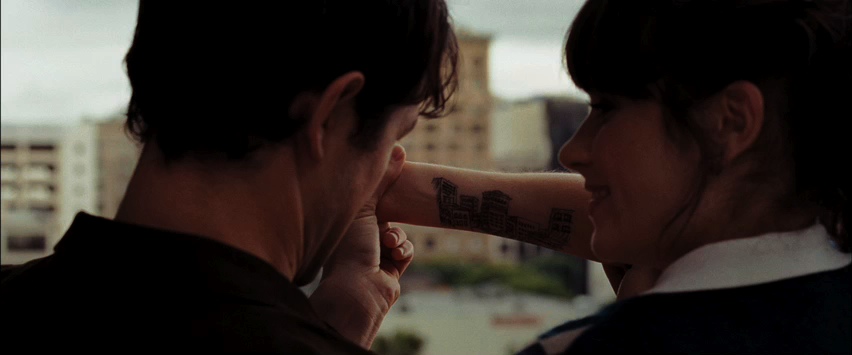
But it's the film-makers at play that finally wins you over—not just in the intricately shifting timeline that a second viewing will only confirm, but in one magical sequence that is so painfully honest and wonderfully cruel to romantic notions that you wonder why someone hasn't done it before. A sequence of Tom going to a party at Summer's split-screens to show his expectations of how the night should go alongside the brutal reality that sends him running into the night backed by an ironic pop-song (of which the film is full). It's a great idea carried off masterfully, as so much of this film is. But technique is one thing. What the film gets brutally right is the anticipation of love, the thrill of receiving it and the abject horror of losing it. And the film cracks wise about it at every step. As Tom says at one point (I believe it's Day 122), "Loneliness. It's underrated."
"(500) Days of Summer," however, is a Full-Price Ticket.

 The Story: I don't know what this scene means. I don't know what any of it means. But I do know "The Big Lebowski" is a Coen Brothers take on the detective stories of Raymond Chandler: it's set in L.A., it's a detective story, the detective is something of an outsider looking in on the fringes of society, and Society has a Problem that the outsider must attempt to solve. Just like in Chandler. Just like Chandler's "slumming angel," Philip Marlowe.
"The Big Lebowski" also has a Narrator, ala Chandler. In Chandler-prime, it is Marlowe himself. In "The Big Lebowski" it is The Stranger (Sam Elliott). And at one point in the story, The Dude and The Stranger meet in a bowling alley, at a point when The Dude is alone and without allies. He's hit the doldrums, with no wind to carry him, and no plot device to steer him by.
Knowing Chandler like I do, could The Stranger be a manifestation of The Dude—an alter-ego? Could this be a format-smashing meeting of the subject and his narrative device—the voice in his head? Could The Stranger be a guardian angel—he seems to be of another time and place, giving hope and encouragement (and an admonishment of language) to The Dude when he seems to be hurling gutter-balls. He's associated with the Sons of the Pioneers song "Tumblin' Tumbleweed;" could he be a lost western spirit drifting, as The Dude drifts? One of my favorite parts of this scene is the introduction of "Tumblin' Tumbleweeds" on the bowling alley P.A. right before The Stranger hoves into view. The Dude cocks his head one way, then t'other, like the ancient grammaphone-dog logo for RCA. You remember the legend?
"His Master's Voice"
But right when the Stranger leaves...there's a phone-call for The Dude. At the bowling alley. Sure, it might strain credulity a bit, but at least it's a lead to pursue.
Like I said, I don't know what it means. But I do know to expect the transcendent from the Coen Brothers—that point where elements coalesce to something more than what's on the screen. A Big Surprise. The Long Thought. A High Meaning of it All.
The Set-Up: "The Dude" (Jeff Bridges)—real name Jeff Lebowski—has been set upon in his house by toughs who give him a porcelain facial and urinate on his carpet. Bummer, man! It was a case of mistaken identity. And "The Dude" in trying to get a replacement carpet (that pulls the room together) has gotten mixed up the other, bigger Lebowski (David Huddleston), whose wife (Tara Reid) has been kidnapped for ransom. The Dude has been chosen to deliver the ransom and, due to the intercessions of his Viet-vet bowling partner Walter Sobcheck (John Goodman), it has all gone horribly, horribly wrong. Now, there are complications with a gang of nihilists (Peter Stormare, Flea, Torsten Voges), a marmot, a missing digit, a bizarre slop-artist (Julianne Moore), a porn-king (Ben Gazzara) and the up-coming bowling tournament. Life's supposed to be easy, man...
Ya know, like...ya know...Action!
 The Dude: My only hope is that Big Lebowski kills me before the Germans can cut my dick off.
 The Dude: Thank you, Walter!
 The Dude: But no, man, I gotta, ya know...
 Donny: They were Nazi's, Dude?
 Walter: Are we gonna split hairs here?
 Walter:....Nihilists....Fuck me!
 Walter: I mean, say what you want about the tennets of National Socialism, Dude, at least it's an ethos.
 Walter: ...that ain't legal, either.
 The Dude: Fuck sympathy! I don't need your fuckin' sympathy, man! I need my fuckin' johnson!
 Donny: What do you need that for, Dude?
 Walter: You have got to buck up, man! You cannot drag this negative energy into the tournament!
 Walter: Fuck the tournament? Okay, Dude, I can see that you don't want to be cheered up here.
 Walter: C'mon, Donny, let's go get us a lane.
 The Dude: Another caucasian, Gary.
 The Dude: Friends like these, right, Gary?


 The Stranger: You got a good sarsaparilla?
 The Stranger: How ya doin' there, Dude?
 The Dude: Not too good, man.
 The Stranger: One o' those days, huh?
 Gary brings him his bottle.
 The Stranger: ....an' sometimes the b'ar, wall, he eats you."
 The Dude: Hmmm. That some kinda Eastern thing?
 The Stranger: Far from it.
 The Dude looks at him. They appraise each other.
 The Stranger: I like your style, Dude.
 The Dude: Uh, well, I dig your style, too, man. Got the whole cowboy thing goin.'

 The Stranger: Thankee.
 The Stranger: There's just one thing, Dude?
 The Stranger: Ya have to use so many cuss-words?
 The Dude: ...the fuck you talkin' 'bout?
 The Stranger: Okay, Dude. Have it your way.
 The Stranger: Take 'er easy, Dude.
 The Dude: Yeah, thanks, man.
 Gary: Call for ya, Dude.

Don't forget! "Lebowski-fest" comes to the Seattle area Tomorrow and Tuesday, so be sure and bring your bath-robe, slippers, stained carpet, severed digit, a marmot, an ethos, and jaundiced view of the world (but leave your urn at home).




.jpg)















_Days_of_Summer/2009_500_days_of_summer_004.jpg)