Our guest speaker: Sir Alfred Hitchcock
Friday, July 30, 2010

Salt
 "Every Man His 007 (And Every Woman, Too) Part 2"
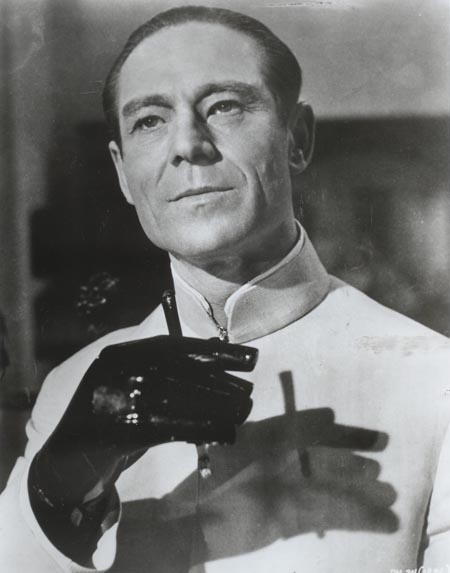
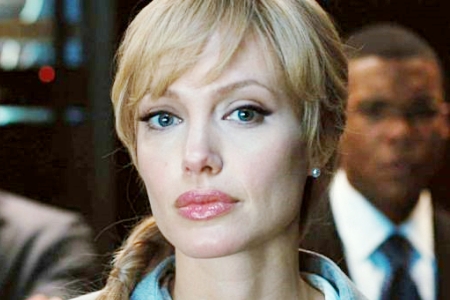
"Salt" is the film that Tom Cruise passed on in order to make "Knight and Day," this Summer's earlier variation on the Bond Formula, allowing Cruise to fulfill a personal goal of playing "a James Bond type," while also creating a lighter version of both the character and his own screen persona. When Cruise went into the "Knight," it was offered, as presumably to many others, to Angelina Jolie, who snatched it up and the script altered to accommodate the sex-change. Jolie had earlier said "Thanks, but 'Dr. No' thanks" to the "Bond-girl" roles subordinate to her "Lara Croft: Tomb Raider" co-star, Daniel Craig, in his first two official 007 outings, joking to Sony Studios Exec Amy Pascal that she would prefer to play "Jane Bond." Both mega-stars got their wish in the switch, playing spies in their own personal quests to "Bond" in the world of espionage, and maybe...just maybe...should the public decide to accept them...start their own franchises.*
So...mission accomplished?
Ehhhhhh...not so much.
First, let me just say that my respect for Tom Cruise made another couch-leap after seeing "Salt" (Good work, Mr. Mapother, even if by omission). Ms. Jolie surely should have passed on this half-baked-at-too-high-a-temperature pot-scalder that appears to be inept at every level except for attracting talent. You look at who worked on this thing in front and behind the camera and you scratch your head that the work of all these really good people could produce such hack-work. This is a terrible movie made by professionals.
Start with the script: Man walks into CIA headquarters.** Says he's a Soviet spy with news of an impending assassination. Oooh. CIA operative Ted Winter (Liev Schreiber) sends in his best interrogator Evelyn Salt (Jolie). Let us forget that we have been told that she spent quite some time in a North Korean prison camp accused of being a spy,*** tortured, and then released in a prisoner-exchange program. Let us forget about Post-Traumatic Stress, Stockholm Syndrome, survivor's guilt, or any other psychological result in THE REAL WORLD that might compromise her work—put it aside. This Soviet agent (suspicious) walks into CIA headquarters (doubtful) talks about an assassination coming up (high suspicion, bordering on incredulity that the CIA might not have got some whiff of it on the cyber-wind) on Russia's own Premier (...what the what?!! Why would Soviet agents want to kill their own...okay, okay, never mind). Then, comes the "hook:" the name of the Soviet-cell agent who will carry out the murder...is Evelyn Salt. Caught red-handed.
Why would said Soviet spy do THAT? Why would he "blow" an already suspiciously compromised assassination by revealing the identity of the culprit? Mis-information? No such complexity, as it turns out. Events reveal a concrete reality to all he says...and that he is the mastermind behind all the eventual mayhem. Some mastermind. Truth to tell, its just absurd script-writing that goes from Dumb Idea A to Dumb Idea Z without any alphabetizing justification for those actions.
Remember "The Menagerie?" It's that two-part episode in the first season of the original "Star Trek" where Spock helps his old commander, Captain Pike, get back to an "illusion" planet to end out his days free of the physical restraints that bind him. They took the original "Star Trek" pilot, put it in the past, and built a present day conspiracy story and mock-trial to present the original pilot as evidence...a neat solution to getting some traction out of recycled material already in "the can." Neat. But absurd. It is ultimately revealed that it is all a distraction (along with "phantom commodore" that everybody's been talking to) to tell the story to Captain Kirk (and the audience). In retrospect, it makes absolutely no sense that all this deep-space chicanery has any purpose other than to waste time and get as much use out of the old material as possible. It is trumped up drama for the sake of trumped up drama. This is what "Salt" does for its entire length: set up an absurd situation that makes no sense to get to "the action." It is the product of a writer-director named Kurt Wimmer, who does a fine business selling scripts to Hollywood and getting them green-lit with top talent. His scripts of the past include the recent "Law Abiding Citizen," "The Recruit," and "Ultraviolet" and "Equilibrium," the latter two he also directed. "Equilibrium" has a "cult" following, and I know a few people who genuinely admire it. I'm not one of them. It's a collection of "dystopian society" film cliches from much better movies (ie. "THX-1138" and "Farenheit 451"), with some distinctive action sequences that look good and might work as distorted fun-house reflections of reality (as might the movie), but has no basis in anything approaching human beings and their motivations. It's a moron's "Matrix" (and I lump the eye-candy empty calories of "The Matrix" in the same Happy Meal), all razzle-dazzle sound and fury, signifying, at best, fantasy environment-as-metaphor. "Awesome!," but absurd.
That's Wimmer's problem. There are no excuses for the rest of the film-makers, other than making a quick buck and being over-payed for the work produced. Phillip Noyce, the director, has made some great movies ("Dead Calm," "Rabbit-Proof Fence," the Harrison Ford Tom Clancy adaptations), but his work for producer Robert Evans, "Sliver" and "The Saint," were, to be kind, so-so. He is only as good as the material he is given. Simon Crane, who coordinated the stunt-work and directed the second unit, has done some exceptional work on the latter day Bonds, but here, his work is piece-meal, more intent on obfuscating the absence of the star in the action than actually making a coherent action sequence. And ace editor Stuart Baird, who cut together the first "Superman" (amazing work, that) and "Casino Royale" can only try and make the joins look less seamless. Such good work has come from these gentlemen in the past that one wonders just what kind of chaos they were working in to provide such below-par work.****
And the cast is cast adrift. Jolie's character is such a cypher, her motives unclear, without a hint a of Manchurian Candidacy, that she relies on her "inscrutable" look (eyes narrowed, mouth slightly amused) for far too much of the movie's running time. One wonders what Chiwetel Ejiofor and Andre Braugher (who is criminally wasted here) saw in the project that they might have been able to bring to it. And Schreiber, who plays Salt's only comrade at the C.I.A., tries to gamely make his operative seem somewhat competent.*****
"Salt" is a festering wound of a movie and the only "smarts" it has is the pain it induces watching it.
After "The Sorcerer's Apprentice," "Salt," and the subject of this Saturday's "Take Out the Trash" post (which, incredibly, beat out today's movie for essential hackery), it is very apparent that we are in the "Dog"-Days of Summer. Approach any and all Friday premieres with caution.
"Salt" is a Waste of Time. For your health, avoid "Salt."
* The results are in for "Knight and Day," and although I thought it was quite good, it bombed disastrously at the box-office, owing to poor reviews (Hey, don't blame me!) that centered—mostly—around its star. There's a knee-jerk reaction (emphasis: "jerk") on the part of some critics; I was summarily dissed on another site for which I write for lauding the movie. primarily because the writer wanted to take a few precious minutes...or hours...to hammer on Cruise. It was evident he hadn't (nor would he) take in the flick, so his criticisms were so much hot air floating above the Earth until it ran out of oxygen. I didn't reply to it, because—really—why bother? As far as a "Salt" franchise, even though the movie ends with her as a fugitive running through a skimpy forest while avoiding detection from circling helicopters with no heat-sensors evidently (!!), the weekend's box-office portends a quiet shuffling of it under the Sony Pictures rug...until Oscar season when there will be ads promoting it for awards. Hope is a thing without feathers.
** That should be a joke-starter, but everything in "Salt" is played with deadly earnest. Hmmm. If only Jim Varney were still alive—"Deadly Ernest" would make a hell of an absurdist action film.
*** Sometimes you get it right, I guess, even if you're North Korea...How's that missile program going, guys? Maybe you should switch to oceanography—that's what you're good at hitting...
**** Do I walk into these things with prejudice? No. All I knew was Jolie, Schreiber, Ejiofor and that Cruise passed on it. I didn't know Noyce directed this until the End Credits (and, frankly, my jaw dropped when I saw his name, as he can be great), that Baird edited, or Crane supervised the stunts. None of this I knew until the end, as I sat in stupefied surprise...these guys, who I admire? Kurt Wimmer's name I didn't recognize...but looking at his credits I saw the through-line. His movies are dumb high-concept polyglots that fall apart if you ask one question. But, somehow he keeps working and attracting good talent. But, then, so does Satan...
***** While in a high-security setting, poised to foil the assassination, his character actually says "If she pulls something here, it'll have to be pretty amazing..." (which, of course, it is). This, after seeing Jolie's Salt play "Frogger" on the tops of 18-wheelers as they rumble through clover-leaves of a highway. Gee, d'ya think?


Tuesday, July 27, 2010
The Girl Who Played With Fire

"If You're Going to Have a Nasty Habit, You Might As Well Do It in Style"
It has been a year since Lisbeth Salander (Noomi Rapace), the multi-hyphenated* titular anti-hero of the "Millennium" series (or "The Girl with the Dragon Tattoo") skipped off with a fortune to travel the world on the run from the slugs of Swedish officialdom who might exact revenge.
As if...
Now, she is pulled back to Sweden, against her better judgement, moving in relative obscurity; her only connection to her partner-in-investigating Mikael Blomqvist (Michael Nyqvist) is virtual, connected to his computer hard-drive. Though she continually scours what he's investigating and reads his columns, there hasn't been contact, e-mail, text, or ping between them in that entire year.
She's been busy enough, though. The events of the first film perpetrated by "The Girl Who Played With Fire" are coming back to haunt her, as she is evidentially linked to the murders of a "Millennium" journalist (Hans Christian Thulin) and his girlfriend, who have been working on exposing Swedish sex-traffickers with some highly placed officials as customers. That those homicides also lead to the murder of Salander's former "guardian" (in name only) Nils Erik Burman (Peter Andersson), on whom Salander exacted a brutally appropriate revenge in the last film, only make the hunt for her more intense.
This time it's personal (as they say in the trailers). And the fascinating Salander becomes the focus of this story that has her confronting her demons while tangentially attempting to clear her name. In the center of the story, while simultaneously watching from the sidelines, Blomqvist can only dog the elusive hacker's trail, learning more about his enigmatic co-hort/lover and what stokes the fire in her belly, a fire that actually turns the calm, collected Blomqvist into one very angry man, staunchly defending her, while coming to grips with the reasons she "despises men who hate women."
"The Girl Who Played with Fire" (directed by Daniel Alfredson) is not as good a film, or as fine a mystery as "The Girl With the Dragon Tattoo," being much less convoluted (and thus intriguing) and a little more by-the-numbers as far as plotting. There's no real mystery here, as opposed to the first film (and book), but it focuses on what fascinated—and made one vaguely uncomfortable—about the first part of what will ultimately be a trilogy: Salander's burning desire to not just see justice done, but to exact her personal revenge—coldly, clinically, savagely. That it has a feminist slant (and one winces at using the word—these are crimes against human beings, sexually and power-abuse based, that just happen to be women) of turning the tables gives it a certain satisfaction, but I've seen too many Eastwood-directed movies (...heh...) to be entirely comfortable with the vigilante justice angle.
What makes it work, finally, are the lead characters, especially the unconventional renegade that is Salander. Her heart's in the right place, even though her soul is damaged, and the mandarin restraint that Rapace brings her is only betrayed a notch here, but even that still ends up breaking your heart. You can't help but root for her, despite the kindling she leaves in her wake.
And she does leave kindling. The violence that made one queasy about the first film is only slightly muted here, and concentrated to the back-end of the story—a set-piece of violence and tension that contains no catharsis but merely stops, unresolved, leaving the fate of Salander up in the air.
Not to worry, though. The last book, "The Girl Who Kicked the Hornet's Nest" rides the top of the New York Times Best Seller List and looks to be there for quite awhile. The third film comes out in the Fall. Can't wait.
"The Girl Who Played with Fire" is a Matinee.
* In my review of the first film I described her thus: "a 22 year old full-time goth-punk chain-smoking, bi-sexual, PTSD'd borderline-schizophrenic, sociopathic, fire-fixated security-investigator-computer-hacker...and part-time judge, jury and executioner. Add to that Blomqvist's inadequate (and slightly hilarious) description of her as "...a very private person."




Sunday, July 25, 2010
Don't Make a Scene: The Godfather

The Story: Even as it's unspooling before your eyes the first time, you know this is a great scene. There are actually two such scenes between the Don and Michael talking over Family matters:* the first one—which was edited out of the theatrical version—is concerned with plot-points and specifics—the Don's vagueness being more pronounced, Michael's bringing up "Sicily and Sonny," the re-iteration that Michael would take the "hit" for the upcoming actions against the Five Families rather than having the Don go back on his pledge "on the souls of my Grandchildren," and ending with the Don saying "there's plenty of time to talk about that now."
This scene couldn't be more different. It's subtler, richer and puts in perspective the entire tragedy of Michael Corleone...and Don Vito. It spells out the main theme of "The Godfather" story—of its destroying what "might have been." It repeats specific plot-points the audience might miss from having been mentioned in passing some screen-time earlier and that would raise questions later.
This scene also wasn't written by Mario Puzo and Francis Ford Coppola. The author is Robert Towne, one of the more gifted script-writers and "doctors" (and directors) Hollywood has known. That Towne was able to take so many threads—"strings," if you will—of this sprawling scenario and distill them into this rich, overarching short scene is something of a miracle of screen-writing craft. Towne gives us this transitional moment between father and son—ultimately, their last moments**—and neatly buttons up plot-points while advancing the story-line, provides information that the audience will need, gives us a deeper insight to the special bond between father and son and how their roles are reversing, and makes it so full of trivial conversational details that it feels real...and, in contrast to that "other" scene, ends it with the devastating reversal of that other unseen conversation with "This wasn't enough time, Michael."
Towne's brevity while allowing so much import belies that statement.
The Set-Up: Michael Corleone (Al Pacino), youngest and most promising of Don Vito Corleone's (Marlon Brando) male children is now "mixed up in the family business" of organized crime, now head of the Corleone Family empire. The Don, suffering from advanced age and an earlier assassination attempt that changed everyone's lives, is now acting as advisor to his son in a time of explosive transition.
DISSOLVE TO:
THE DON'S GARDEN

The Don, older looking now, sits with Michael.


(as the Don drinks from a glass of wine as Michael watches him)

VITO CORLEONE I like to drink wine more than I used to.

VITO CORLEONE Anyway, I'm drinking more...
MICHAEL It's good for you, Pop.

(after a long pause)

VITO CORLEONE I dunno.

VITO CORLEONE Your wife and children. Are you happy with them?

VITO CORLEONE That's good.
(then)

VITO CORLEONE I hope you don't mind the way I...I keep going over this Barzini business...
MICHAEL No, not at all...
VITO CORLEONE It's an old habit.
 VITO CORLEONE I spent my life trying not to be careless.
 VITO CORLEONE Women and children can be careless, but not men.


(then)


VITO CORLEONE You know he looks more like you every day.

MICHAEL(smiling) He's smarter than I am. Three years old, he can read the funny papers


MICHAEL I did it already, Pop.
VITO CORLEONE Ya know, cuz it could be anyone...
MICHAEL Pop, I took care of that.


(after the Don doesn't answer)


(after he sits besides Michael)


DISSOLVE TO:
THE DON'S TOMATO GARDEN – DAY
The Don is with Michael's son, Anthony.
"The Godfather"
Words by Robert Towne (and Mario Puzo and Francis Ford Coppola)
Pictures by Gordon Willis and Francis Ford Coppola
"The Godfather" is available on DVD from Paramount Home Video.
* Don't remember two? Probably because the first was cut from the theatrical version. It aired as part of "The Godfather Saga" when Coppola edited "I" and "II" chronologically for airing on NBC decades ago. It was an interesting experiment, and fascinating to see all the "bits" that had been edited for time, the "Novel for Television" mini-series concept having proved that people would watch an extended story over a series of days if it had some value, ala "Rich Man, Poor Man" and "QBVII." But, the chronological presentation destroyed the intricate cross-cutting of "Part II," which showed the parallel paths of Godfather and Son, as they made their business paths in the world of organized crime: the one, protecting and solidifying his family; the other, losing it in his bid to "protect." Despite the fascinating pieces only previously rumored about—the hospital visit to The Don's old consigliere, a visit in Old time New York by the Don to a gun-smith named Coppola, whose son Carmine (the director's father and music supervisor for the series) plays a flute in the background, Kay (Diane Keaton) lighting candles for Michael's soul, and Coppola's substituting Robert De Niro's voice for Marlon Brando's during the initial zoom shot of undertaker Bonasera's request on the Don's wedding day—the shorter theatrical versions feel like more complete films.
** This scene will dissolve to the Don's death scene—itself, something of a miracle in film-making that almost didn't happen. The Don's death was vaguely scripted, not really worked out, and Coppola on the day of filming was running out of time, sun-light and being pressure by studio reps to just forget the scene, rather than risk going beyond Union mandates for the crew. Coppola held fast, and was able to shoot just enough footage to make the scene, one that was totally dependent on the improvisational skills of his star, Marlon Brando, in dealing with the child actor on-set. That scene is haunting, metaphoric, almost miraculous in what it conveys, while being created under pressure. Astounding craftsmanship under pressure on both sides of the camera.
*** What is Michael saying here? That's a bit controversial. Literally, what he's saying is "pezzo da novanta"—"Another piece of ninety," referring to a 90mm artillery cannon—a "big shot." But, given the context and Pacino's inflection, he's being charitably dismissive of the Don's hopes to attain legitimate power. "Senator Corleone? Governor Corleone?" "Just another big-shot."
Subscribe to:
Posts (Atom)