Tuesday, December 24, 2013

The Hunger Games: Catching Fire

Feeding the Beast
or
To Kill a Mocking-jay

I mocked The Hunger Games rather mercilessly when it came out (as if it would prevent a single sou from entering its coffers) , because even though it was a hot publishing phenom' and a breathlessly anticipated movie, the original concept was a bit derivative without being very divergent (yeah, that's a snark for a future film there).  So now, the second of The Hunger Games films (of four total) Catching Fire has come out (with a new director, Francis Lawrence, of Water for Elephants and I Am Legend as a bit of an improvement over Gary Ross, even with Steve Soderbergh assisting) and this one's a better film.  For one thing. "this time it's political," and the easy targets of reality TV and the excesses of the rich (with an eye towards the Roman Empire and its parallels of bread and circuses) are a bit less strident, although they haven't disappeared.  They're just presented a little better this time.  And the politico's of the Capitol are being a bit more cagey than they were previously.

Katniss Everdeen (Jennifer Lawrence) now finds herself the most watched human in Panem.  Her victory in the 74th Hunger Games along with Peeta Mellark (Josh Hutcherson) has earned her and her family a cushy residence in Victor's Village and the vulture-like scrutiny of Panem's leader, President Snow (Donald Sutherland, as creepily confident as if he were selling you orange juice).  He sees the way that Katniss has reached out to Panem's people and now she's the centerpiece of a swelling revolutionary movement.  A personal presidential visit amounts to a threat that she'd better be convincing in her devotion to the State.  "I'll convince them." assures Katniss.  "No." replies Snow slowly.  "Convince me."


And with that, the stakes are raised.  A "Victory Tour" is planned for the remaining districts (the ones that haven't been nuked), but at each appearance of Katniss and Peeta something happens that brings out the riot police.  At the suggestion of the Capitol's new gamesmaster (check out this name) Plutarch Heavensbee (Philip Seymour Hoffman, keeping a straight face), who comes up with a plan to put more pressure on Katniss and speeding the inevitable moment when the public turns against her.  Then, with the next Hunger Games competition occurring (the 75th), it is decided that, rather than having a "Reaping" lottery among the populace, the competition will be between past Victors, considered by the State now to be potential inspirations and inciters to riot.

So now, the Games are between past champions (including Jeffrey Wright, Jena Malone, and Amanda Plummer), some of whom are just as determined to win, while others are angry at being targeted again, but there will be only one survivor.  


It's a better film with more tricks up its sleeve, and the media manipulation is played by all sides—it may be an illusion but Stanley Tucci's teeth actually look whiter this time—with a terrific set-up for the next films that comes out of left field...if you haven't read the books.  It's an entertaining change-up from the situations of the original, and promises to be even more intersting next time out.


The Hunger Games: Catching Fire is a Matinee. 


Sunday, December 22, 2013

Don't Maker a Scene: The Stunt Man

Another scene from the incomparable Peter O'Toole. This is one of my favorites. Obviously, as it was the first of these I was ever inspired to do.

 
The Story:  Someone asked me recently what the first "Don't Make a Scene" was—what inspired it.  It was this scene, from an unfairly forgotten movie called The Stunt Man, an early indie film that had trouble finding a distributor—the major studios didn't know how to sell it, and it was tested and run, to great acclaim, in Seattle.

For me, it's what the movies are all about—make-believe, with the illusion of reality.  There is nothing "really" real, not even in documentaries.  They are all presentations, manipulations of reality, to present a point of view, a story, "Pieces of Time" in Jimmy Stewart's phrase.  It's all magic, sleight-of-hand, subterfuge, legerdemain.  We are told where to look and to accept it as reality.  Don't look behind the curtain, because you'll see the film-crew, usually with a doughnut in their hands.  

That is the reality.  What they are making?  

Well, that's the magic.

 The Set-up: Cameron (Steve Railsback) is a fugitive on the run. In his flight, he is nearly run down by Bert—a stuntman on a movie—performing a reckless stunt that ends up killing him. Subsequently, Cameron is taken under the wing of the film's director, Eli Cross (Peter O'Toole), who, when the authorities make inquiries about the accident, insists that the new-comer, Cameron, is actually Bert, the late stuntman. Cameron, fearing arrest, plays along. And, when the police leave, they have this conversation.

Action!


ELI CROSS: [Referring to his performance] You did that very well.
CAMERON: Hey, I just listened.

CROSS: There are a few actors only in the entire world who have mastered that art. Anyway, it was a very good audition. And the part is yours.


CAMERON: What? What are you talking about? What part?CROSS: Stuntman. 

[The two climb into the set's crane which rises]

CAMERON: What about the people who work for you? They gonna look at me and go, "Hi, Bert?"

CROSS: Prefer "Hi, Alice?" Don't worry about the people who work for me, my crew. They'll call you anything I wish them to. And I'm not being callous merely. Bert is a bloody tragedy, but there's nothing we can do about it. Nothing. I must have this location for three days and you need a place to hide.

Assistant Director: [Over megaphone] Eli, the crew is waiting. We need the next set-up.

CROSS: [Down to the A.D.] The hand! Close-up of the hand! With you in a minute!
Assistant Director: An "Eli minute" or a real minute?

CAMERON: By tomorrow the cops are gonna know exactly what I look like.

CROSS: Oh, Bert, do stop this worrying. You must have heard of "movie magic?"

CROSS: You shall be a stuntman. Who is an actor. Who is a character in a movie. Who is an enemy soldier.

CROSS: Who'll look for you amongst all those? People like to believe in things and policemen are just people. Or so I'm told.

CROSS: Frankly, our problem is so simple it's almost beneath us. Now, listen to me.

CROSS: [Indicating the door of the hotel where the cast and crew are staying] That door is the looking glass. And inside it is Wonderland.

CROSS: Have faith, Alice. Close your eyes, and enjoy.


The Stunt Man

Words by Lawrence B. Marcus and Richard Rush

Pictures by Mario Tosi, A.S.C and Richard Rush

The Stunt Man is available on DVD through Anchor Bay Entertainment.


Thursday, December 19, 2013

Frozen (2013)

Ice-Ice, Baby
or
(The Cold Never Bothered Me, Anyway...)

Disney's latest animated feature—not in the flat 2-D classic animation, but in the 3-D pixilated version ala Tangled—is "inspired" by Hans Christian Anderson's "The Snow Queen," according to the credits.  That's a whole new interpretation of the word "inspired" because Frozen has next to nothing to do with "The Snow Queen" other than...there's a Queen...and she makes snow.  But Tangled wasn't exactly "Rapunzel," either.

But, it's a quibble (And it's Disney).

Disney, who just put the first female (albeit co-director) on one of their female-dominated animated films. Based on a screenplay by, and co-directed by Jennifer Lee (with Chris Buck), it's another "Princess" movie that will expand the Disney marketing franchise (with two of them), but as with Pixar's Brave it dares to up-end some story-book conventions, making the royal sisters Elsa (Idina Menzel) and Anna (Kristen Bell) the emotional hub the story revolves around, and relegating the two hunky guys that are standard love interests pretty much transportation tools. This is a good thing.  And especially when the movie sets up "the guys" (one prince/one working stiff) as the solution to the problems and then very briskly pulls the cloth-simulated tapestry out from underneath that cliché.  I like that.  And I like how the solution to "the problems" is bundled very tightly in one unexpected moment that, frankly, shocks, and takes one aback emotionally.  I like that even better.

So, it's not "The Snow Queen."  What is it?  Elsa and Anna are princesses in the kingdom of Arendelle and they're by no means twins—Elsa is older by a couple years, and she has the telekinetic power to freeze things and project snow and ice from thin air.  This delights Anna, but a childhood accident forces the King and Queen to seek the assistance of trolls who save Anna's life, but take away her memory of Elsa's power to prevent such a tragedy from ever happening again.  The Royals also lock up Elsa, keeping her from her sister...and everyone, until she learns how to suppress her powers, usually brought on by her emotions.

The two sisters grow up apart under the same roof, even after tragedy strikes the household.  The two don't see each other until Elsa's coronation day as Queen of Arendelle, but the two are distant even when inches apart, and when the scattered Anna becomes enamored of a visiting prince (Santino Fontana), upsetting Elsa and exposing her powers to the Kingdom.  Elsa flees, now that her frightening powers are out there for all to see.  

You couldn't miss it.  She's dropped Arendelle into a permanent winter, with no way to get it out.  It's up to the plucky Anna to go after her and try and mend fences and thaw her relationship with her sister and the town.

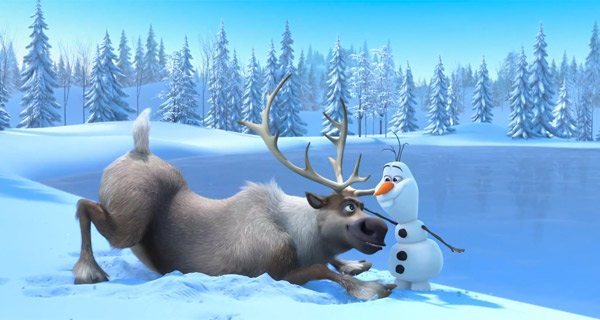
Prince Hans is a love interest, but so is an ice-cutter that Anna finds on her journey (voiced by Jonathan Goff), whose best pal is an anthropomorphized reindeer named Sven.  There's also a walking, talking snowman (created by Elsa) named Olaf.  The revelation of a goofy snowman in the movie was enough to give me a brain-freeze, but, as voiced by Josh Gad (he of "The Book of Mormon"), he's pretty danged funny.  The songs have the same show-connection, as well, as they're a collaboration between Robert Lopez (who co-composed both "Mormon" and "Avenue Q") and wife Kristen Anderson.  That's very much in the tradition of bringing the song-writing team of "The Little Shop of Horrors," Ashman and Menken, to Disney.  The songs are decidedly less Broadway, however, and more "pop" oriented—and will be appearing on the many reality-talent shows on the air in the not-too-distant future—and geared more for a cartoon audience than a theater one.

Again, quibbles.  And if Frozen didn't exactly warm my heart, my brain had some warm thoughts towards it.

Frozen is a Full-Price Ticket (I wouldn't spring for the 3-D, though).


One of three "I Want" songs in Frozen (four if you count Olaf's "In Summer").
Going in...er, "cold," the power-ballad approach makes one cringe, but given the back-story 
preceding it, it's a break-out moment...and a little scary.  In fact, the Elsa character was 
slated to be the villain of the movie until this song's themes of empowerment changed everything.

Wednesday, December 18, 2013

The Hobbit: The Desolation of Smaug

Maintaining Good Working Hobbits
or
A Dense Overlay of Smaug

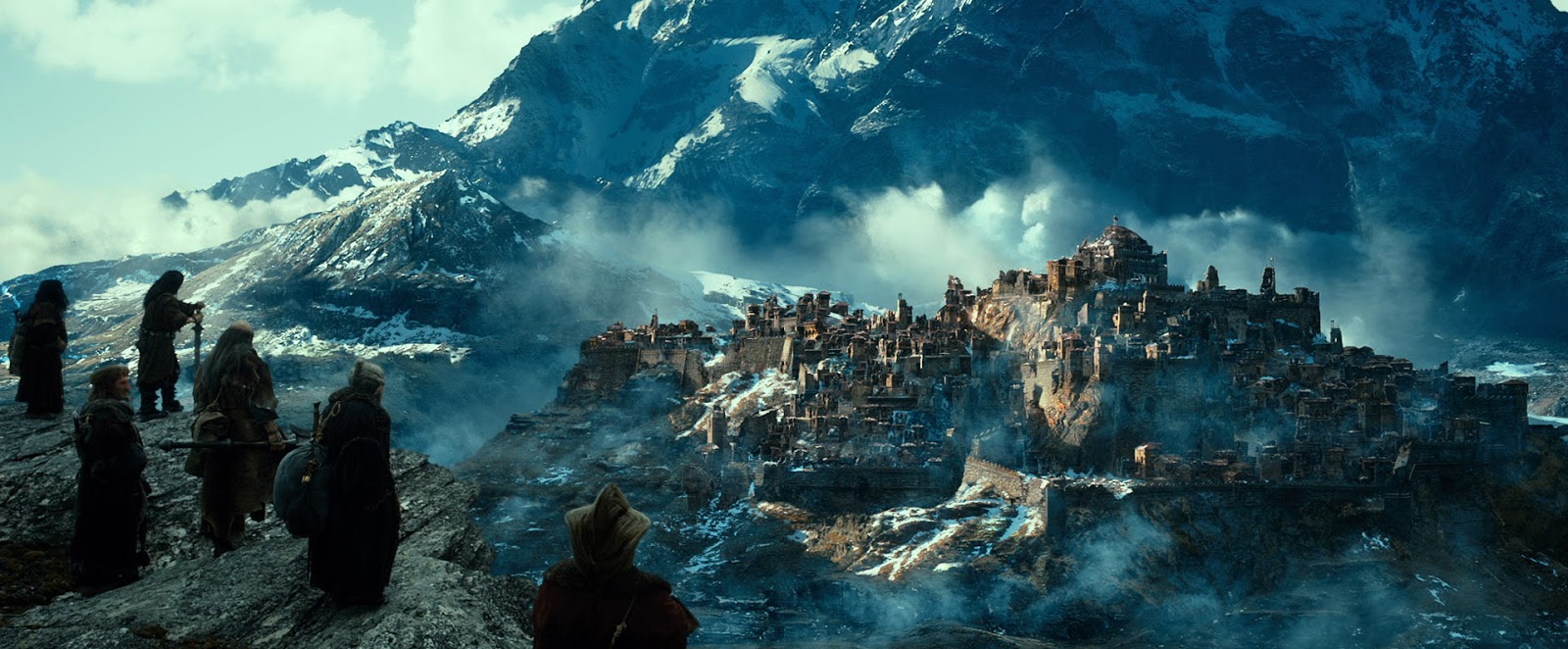
The second of Peter Jackson's three "Hobbit" films, The Hobbit: The Desolation of Smaug is, predictably, more of the same.  It's a three hour ramble, a complication and a darkening of the tone of the first film—as usually happens with the second of a trilogy, so that we, the audience, can climb out of our emotional valley in time for the resolution of conflicts in the third.  Standard Operating Procedure.  We are given a quick recap of the first film—going back in time to when Gandalf the Gray (Ian McKellan) first put the idea into the head of Thorin Oakenshield (Richard Armitage) and getting the dwarf crusade rolling.  Once the summary is done (in brief: Gold, Mountain, Dragon, Dead King, Arkenstone, New King, No Elves Allowed), they skip over An Unexpected Journey and head back to the Gandalf, Bilbo and the dwarves on the path to Lonely Mountain (Sindarin Erebor), orcs still snapping at their behinds and making their way to the entrance of Mirkwood.

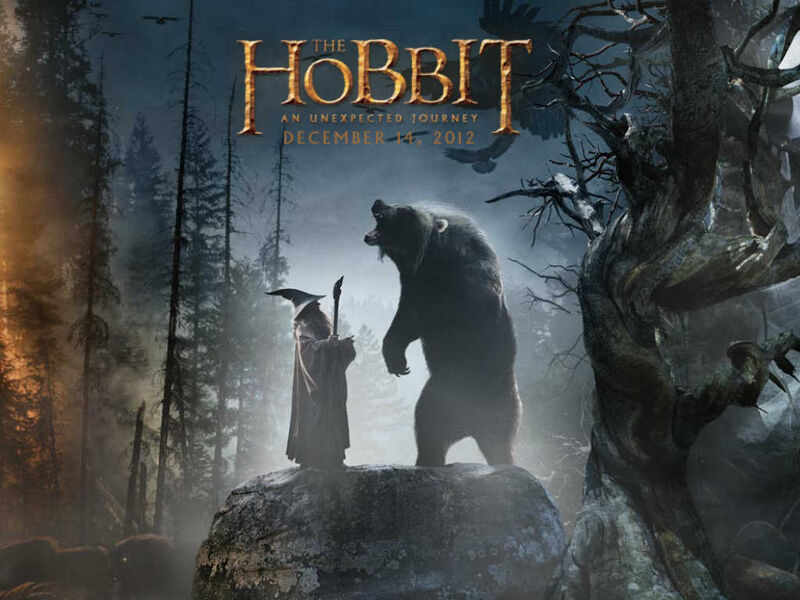
A quick visit to the skin-changer Beorn (Mikael Persbrandt), who usually appears in the form of a bear—not much is made of him, even though he got his own poster with Gandalf last time—and they get to Mirkwood (by pony), at which point Gandalf goes "walkabout"—he does this every movie and they probably split the story to accommodate a "Gandalf disappearance"—so the wee folk must enter the spooky forest alone, with a promise from the wizard that he'll meet them at "the Lookout."


"The Lookout"—he said he'd meet us; he should be easy to find...

Anyone familiar with the book knows that you don't find out where G.theG. goes until the last chapter, and that was after Tolkien had written "The Lord of the Rings" and got continuity-conscious.  But, here, we do get to see where (hint: he went there LAST movie), and Jackson's The Lord of the Rings gets set up all good and proper (except Benedict Cumberbatch is voicing the character now—wonder if Jackson will Lucasize everything to make it all match up).   The dwarves and hobbit are concerned with icky things and splendors that one would associate with a place called Mirkwood, and the ring that Bilbo snatched from Gollum is starting to exert its unholy influence turning the peaceful little guy into a berserker bad-ass.  Travel packages with unruly companions and nasty accommodations with large pests and diffident natives will do that to anyone.  But, Bilbo proves his worth on more than one occasion and eventually they do make it to the Halls of Lonely Mountain, a few shy of a full dwarve-deck and make their way to a meeting with the titular character that's been hoarding all the gold and keeping it for himself—the ultimate one percenter of Middle Earth.

Bilbo above the canopy of Mirkwood
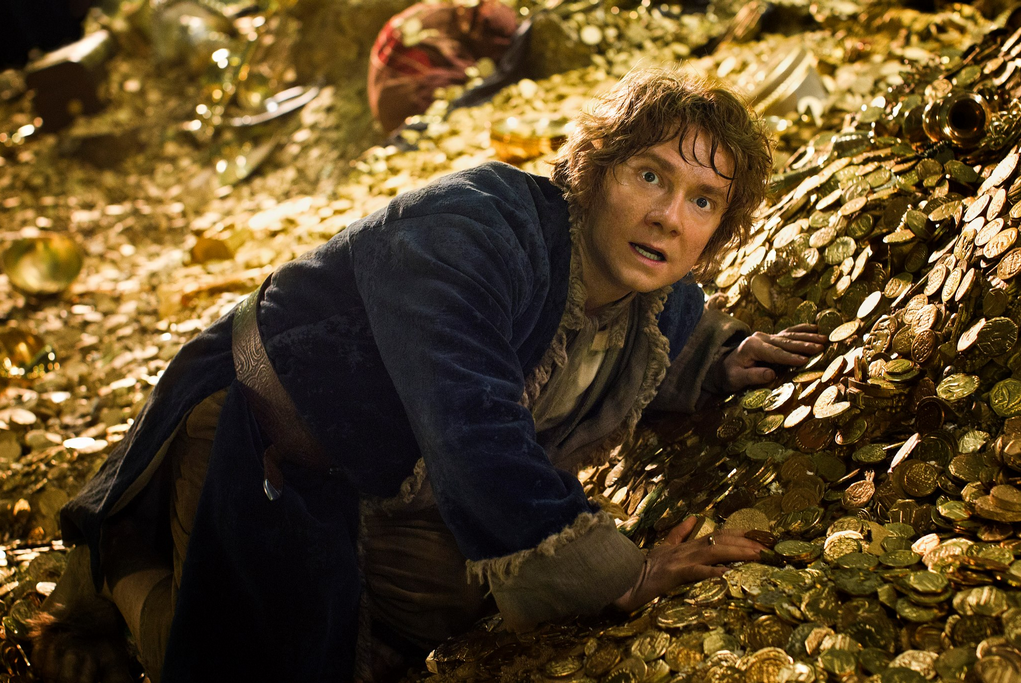
Smaug is the dragon, living in the massive storage caves of the Mountain, and he spends his time, far from desolate, sleeping among the gold and treasures of the dwarves like a big scaled, fire-breathing Scrooge McDuck. When Bilbo's attempts to find the Arkenstone awaken him, there is quite an extensive cat-and-mouse game as the small hobbit scurries around the cumbersome dragon.  Or I should say Cumberbatch, as the ubiquitous actor provides a nicely arch resonant voice to Smaug, which is accompanied by a lip-curling animation to enhance it.  This is where the film shines, as the territory is new, the imagineering of the dragon is fresh, and the surprises are many.  After the previous two hours, that's a bit refreshing.

For if there's a problem with Peter Jackson's version of The Hobbit, it's that, by now, we are so familiar with the way he does things that nothing much really resonates anymore.  The heavily belabored ripostes by the actors seem a bit too predictable—when Bilbo changes his story to gandalf that he found his courage in the goblin caves last movie (rather than The Ring), there's a close-up of Gandalf as he says what half the audience is expecting: "You'll need it." Really, that one and "You should be" are certain candidates for Screenwriting 101 "easy irony" along with "You just don't get it, do you?" and "They're standing behind me, aren't they?"  

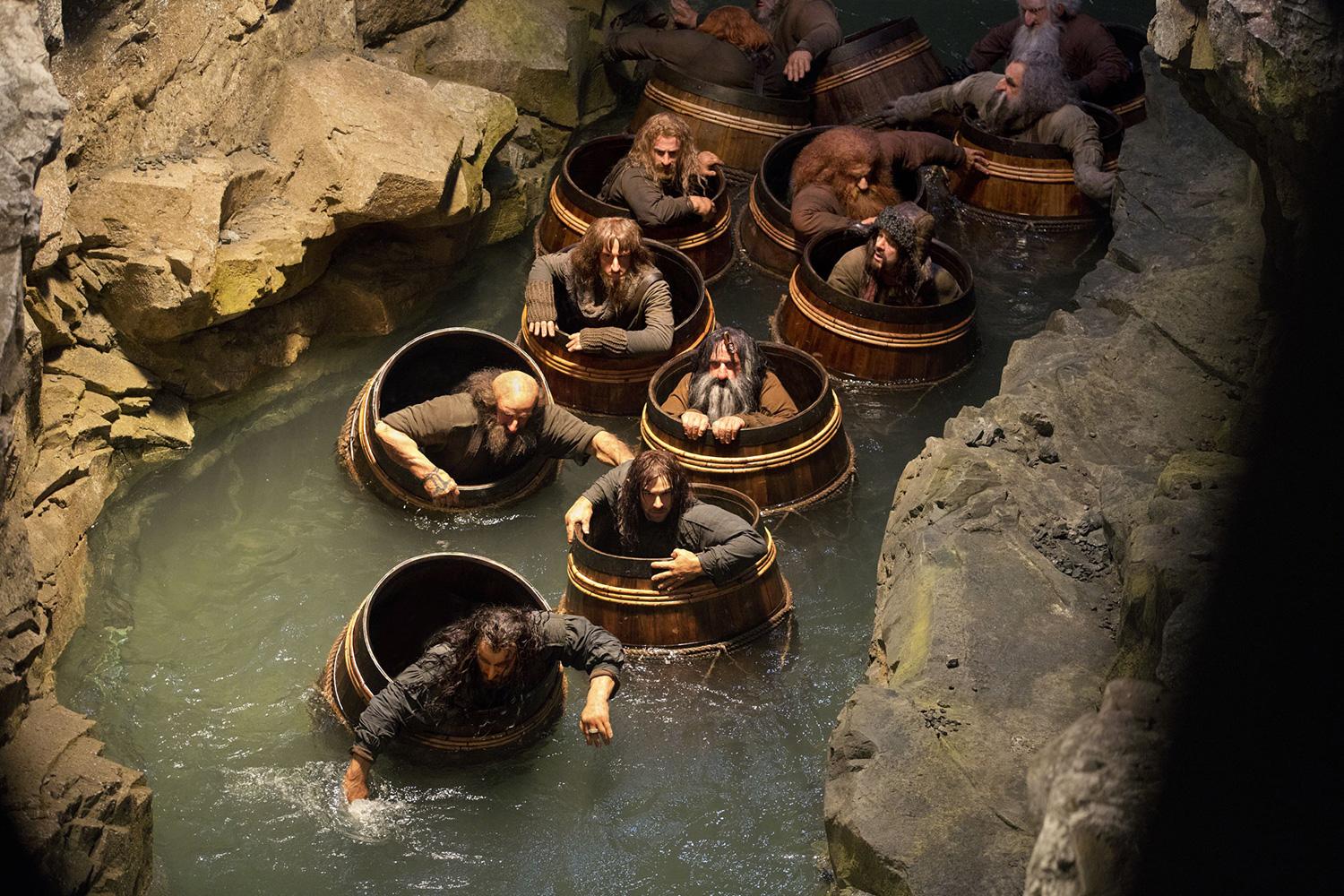
And the action sequences, this time assistant-directed by actor Andy Serkis. go on and on, in ever-increasing silliness.  If last movie set a more rollicking, silly tone than The Lord of the Rings (in part by the influence of Guillermo del Toro), now the joke's wearing a little thin.  Extended fights between orcs and elves are no longer thrilling, they're a demonstration of every possible way you can kill something with an arrow.  An extended rush down a rapids in barrels is accompanied by additional orc-elf fighting, where the barrels are used for any other purpose besides transport, as every tree-limb and branch over-hanging is used as a foot-hold.  Some of this criticism isn't fair, because if this had been the first film in a trilogy of Tolkien adaptations, the marvels of the film would send people off a CGI cliff in amazement.  It might take at least forty-five minutes to tumble down it, though.


One should, however, point out that the "we've been down this glade before" problem didn't occur with Jackson's earlier Tolkien trilogy, where there was enough material to keep things seeming fresh each film, and Jackson and his screenwriters did enough juggling of the narrative to keep things seeming new from film to film.  Their attempts here amount to trying to add a romantic element between the elf warrior Tauriel (Evangeline Lily) and the dwarf Kili (Aidan Turner), much to the consternation of Legolas (Orlando Bloom, back in action).  And while it provides a reprieve from tumbling and shooting and other too-frantic sequences, it does take away from the basic focus on the titular Bilbo Baggins (Martin Freeman) whose story this is.  Freeman's performance is, again, terrific, bringing all sorts of fretting elements to play, and making the transformation of his hobbit into a killer more than a little disturbing.

The vistas are staggeringly rendered, but some short-changing has been done with the characters in action sequences—Orlando Bloom seems to be the chief character robbed of some pixels, here and there, and the attempt to de-age him to a younger self doesn't really work (I've never seen it done convincingly, so far).  the only real surprises come in snatches of casting with Lee Pace, disappearing into the role of the elf Thronduil, Lily's elven warrior, and Stephen Fry's Master of Laketown.   Be on the lookout for some Laketown spies and you might even find Stephen Colbert for a brief second.  Oh, and Jackson gets his own "Hitchcock moment" out of the way very quickly.

Oh.  And SPOILER ALERT there's another movie coming, so this one ends at a rather inopportune time.  You only have to wait another year.

The Hobbit: the Desolation of Smaug is a Matinee.

"Conversations with Smaug" drawn by J.R.R. Tolkien
"Conversations with Smaug" drawn by WETA

Sunday, December 15, 2013

Don't Make a Scene: Lawrence of Arabia

The Story:  "I read the news today, ooooh boy."

Peter Seamus O'Toole died Saturday at the age of 81 years of living life to the full and relishing a career as an actor, communicating that joy with every part.  He was always an "active" actor, investing even moments of thought with a commitment of 110%, making you believe that the brain behind the haunted blue eyes was percolating at a boil, making each moment on stage or on film an event and a master-class in acting at its highest register.  "Magnificent" was never too strong a word for a Peter O'Toole performance.  

And daring. I remember seeing him perform Henry Higgins in an HBO taping of "Pygmalion" and he had the audacity to perform some of it while chomping exquisitely through an apple.  That's my favorite version of the character, revealing an ego so large and so confident in a class system (that he claimed to despise) that even acting like a slob did not diminish his own confidence in his standing or elocution.  It takes a great deal of invention to come up with a way to convey those dichotomies in so simple an act.

There are going to be many, many tributes to the man over the next few days full of the actor's generosity and examples of how he lived his life with a great theatricality.

John Goodman had a good O'Toole story on "Inside the Actor's Studio."  The two were doing a movie together (King Ralph, written and directed by David S. Ward, after the novel by Emlyn Williams) and during a smoke-break, Goodman started looking around for something to put his ashes in.  O'Toole responded with a flourish of arms (I suppose) and a loud, royal air (imitated by Goodman): "Boy, make the WORLD your ash-tray!"

Lovely.  And he had the perfect answer to what he wanted on his tombstone.
 
"Many years ago I had a beloved leather jacket... and I never wanted to throw it away.  I sent it to the cleaners because it was covered in blood and Guinness and scotch and Corn Flakes, the usual.  It went off to the Sycamore Cleaners and it came back with a thing pinned on it: 'It distresses us to return work which is not perfect' - so I want that on my tombstone."

I've had this scene from Lawrence of Arabia planned for awhile, as it contains some fine writing and the single greatest movie edit in the medium's history. I had no idea what I was going to write about it, but it was sitting there on my hard-drive, waiting for meaning and relevance.  And with the news of his passing, his career ended but ever-present to be enjoyed for ages to come.  That edit perfectly conveys the moment of loss (the blowing out of the match) at his passing, and the eternal legacy of his work (the light of a new day emerging, strong and powerful and in perpetuity.

Goodbye, Mr. O'Toole.  "It won't really be...good-bye."

The Set-Up: The film is just beginning, but, at this point, T. E. Lawrence (O'Toole) has been summoned to the office of General Murray (Donald Wolfit) in Cairo, at the request of Mr. Dryden (Claude Rains) of the Arab Bureau.

Action!


26 INT. GENERAL MURRAY’S OFFICE CAIRO
CLOSE SHOT. GENERAL MURRAY is one of those regulation officers whose pride is to appear more regulation than anyone can be. His face is hard and shrewd, his expression exasperated. He is seated at his desk. On the wall behind him is an “Illustrated London News” type pen and ink sketch of heavy artillery on the Western front. On a ledge under the picture is a collection of empty shell cases of varying sizes. GENERAL MURRAY is addressing DRYDEN, a donnish man with a pale, lined, lively face, wearing civilian clothes, who at this moment has his back to us as he stands looking out of a window overlooking the gardens of the Headquarters.

MURRAY: I smell an intrigue! An intrigue between the Arab Bureau and a junior officer of my staff! A very junior officer, an insubordinate junior officer, an officer who, so far as I can gather, has proved markedly incompetent in a very junior post!

DRYDEN turns from the window, smiling a little at the reference to LAWRENCE’s incompetence, and offers a smiling explanation of it.


DRYDEN: He wants to go to Arabia, sir.

He strolls away from the window towards a chair in front of MURRAY’s desk, the CAMERA TRACKING BACKWARDS with him into a medium shot of the two of them. We now see that DRYDEN is carrying a copy of the Arabic newspaper.

MURRAY: I’m aware of that. He’s made application for a posting to Arabia once a month ever since he got here. Very well then, the Arab Bureau comes along and says, “We want an Intelligence man in Arabia. We want you to second us a man in Arabia. We think it should be Mr. Lawrence.”


MURRAY: It’s an intrigue, Dryden, and I don’t propose to let an over-weening, finicking, crass Lieutenant...


MURRAY: ...thumb his nose at his General Officer Commanding,...

MURRAY: ... and get away with it!

He loosens the collar of his shirt as DRYDEN smiles again, and sits in the chair.

DRYDEN:(calmly quizzical) It doesn’t sound as though he’d be any great loss, sir.

MURRAY: Now don’t try that, Dryden. There’s a principle involved.

27 CLOSE UP DRYDEN 


DRYDEN:(suddenly quite sharp—but still calm) There is indeed. He’s no use here in Cairo and he might be in Arabia. He knows his stuff, sir.

28 CLOSE UP. MURRAY. He is a little put out by the moral tone of this, which though a shade spinsterish is not less authentic for that. He grumbles:

MURRAY: Knows the books you mean. (“books” is very contemptuous)
MURRAY: I’ve already sent out Colonel Brighton—who is a soldier—and if Brighton thinks we should send them some small arms then we will.
MURRAY: What mored’you want? 

29 MED. SHOT 


DRYDEN: There would be no question of Lieutenant Lawrence 

giving military advice, sir— 
MURRAY: —My God I should hope not! 
DRYDEN: It’s just that the Arab Bureau wants its own man on the 
spot sir, to ... 
MURRAY:(suspicious) To what? 


DRYDEN: To make our own appraisal of the situation. 

DRYDEN spreads his hands deprecatingly as he says this, as 

one who makes an almost childishly small request. But his 
eyes are ready for conflict—he speaks for the Bureau—and 
MURRAY is uneasy.This is a conflict which has been brewing 
for some time. 

30 CLOSE UP. MURRAY. 


He looks away, fiddles with a ruler. Blurts out: 


MURRAY: I may as well tell you. It’s my considered opinion and 
that of my staff that any time spent on the Bedouin will be 
time wasted. 


MURRAY: They’re a nation of sheep stealers! 

31 CLOSE UP. DRYDEN. 


He raises and lets fall the newspaper. 


DRYDEN: They did attack Medina. 
MURRAY:(off) And the Turks made mincemeat of them. 


DRYDEN: We don’t know that, sir. 

32 CLOSE UP. MURRAY. 


MURRAY: We know they didn’t take it. A storm in a tea-cup, 
Dryden, a side-show— (he broods) 


MURRAY: If you want my own opinion, this whole theatre of 
operations is a side-show. 


MURRAY: The real war’s being fought against the Germans not 
the Turks. Not here, but on the Western Front ... in the 
trenches! 

(his eyes glow and we see for a moment how he longs to be there,

organising mass attacks through mud) 


MURRAY: And your “Bedouin Army” or whatever it calls itself
—would be a side-show of a sideshow! 

33 CLOSE UP. DRYDEN. 

He is smiling again. 


DRYDEN: Big things have small beginnings, sir. *

34 CLOSE SHOT. 

MURRAY darts a quick look at him and rises. 


MURRAY: And does the Arab Bureau want a big thing in Arabia? 


MURRAY: If they rise against the Turks, does the Bureau think 
they’re going to sit down quietly under us when this war’s over?


DRYDEN: The Bureau thinks the job of the moment is to win the 
war.
MURRAY: (flushing, walks back to his desk) Don’t tell me my 
duty, Mr. Dryden.

35 CLOSE SHOT. 

The door is opened by a STAFF MAJOR. Behind him we see LAWRENCE
standing in the outer office. He moves forward as soon as he is 
announced.


MAJOR: Lawrence, sir.
MURRAY: (off) Send him in.

LAWRENCE brushes past the MAJOR and walks into the room.


LAWRENCE: (cheerfully) Good morning, sir.


36 CLOSE SHOT. MURRAY 


MURRAY: Salute!

37 CLOSE SHOT. 


LAWRENCE comes to a halt near DRYDEN and salutes, very badly, 
his legs not quite together, and throws a side-long glance at 
DRYDEN expecting approbation, but DRYDEN shakes his head 
quickly, somewhat to LAWRENCE’s surprise.

38 MED. SHOT. THE GROUP. 


MURRAY has been looking at LAWRENCE, ready to be enraged, but 

with something not unlike caution, but he intercepts the look 
at DRYDEN and explodes.


MURRAY: If you’re insubordinate with me, Lawrence, I’ll put you 
under arrest!
LAWRENCE: (apparently crestfallen) It’s my manner, sir.


MURRAY: (barks, suspicious) What?
LAWRENCE: My manner, sir. It looks insubordinate, but it isn’t 
really.

MURRAY is again baffled by his own lack of imagination and 

LAWRENCE’s apparent innocence. He moves uneasily.


MURRAY: I can’t make out whether you’re bloody bad-mannered or 
just half-witted.


LAWRENCE: (confidentially) I have the same trouble, sir.
MURRAY: (thumping the table) Shut up!
LAWRENCE: Yes sir.


MURRAY: The Arab Bureau seems to think you could be some use 
to them in Arabia. Why, I can’t imagine. You don’t seem able 
to perform your present duties properly.


LAWRENCE: (smiling, he quotes—not mockingly, but as dons do 
quote, en passant) “I cannot fiddle but I can make a great 
state from a little city.”
MURRAY: (suspicious, barks) What? 


LAWRENCE: (delicately helpful) Themistocles, sir. 


LAWRENCE: A Greek philosopher.


MURRAY: I know you’ve been well educated, Lawrence; it says so 
in your dossier.

He pushes back his chair, rises, and walks to a window.


39 CLOSE SHOT. LAWRENCE and DRYDEN. 


LAWRENCE raises his eyebrows and smiles enquiringly at DRYDEN, 

but DRYDEN frowns and gestures with his hand that he is to 
simmer down.

40 CLOSE SHOT.


MURRAY standing looking out of the window. A swirl of dust 
blows by outside. MURRAY’s face is dark with all the extrovert’s 
loathing of the sensitive and introspective. He says, slowly 
and with great sincerity:


MURRAY: You’re the kind of creature I can’t stand, Lawrence ...


MURRAY: ...but I suppose I could be wrong. All right, Dryden.

41 CLOSE UP. LAWRENCE


MURRAY: (off) You can have him for six weeks.

LAWRENCE’s face lights up, but almost immediately he composes 

himself.

42 CLOSE SHOT. MURRAY has turned around eyeing LAWRENCE heavily.


MURRAY: Who knows! It might even make a man of him. (in answer 
to a knock at the door) 


MURRAY: Come in!

43 LONG SHOT. 

The door opens and the STAFF MAJOR enters excitedly with a 
sheaf of bills.


MURRAY: What is it, Hawthorn?
MAJOR: Navy signal, sir. The convoy’s coming in tomorrow night.
MURRAY: (real joy) Is that certain?
MAJOR: Yes sir ... there doesn’t seem to be any artillery.

MURRAY’s joy changes to anxiety. He snatches the paper.


MURRAY: There must be artillery!

DRYDEN and LAWRENCE have been forgotten.


DRYDEN: (firmly) It’s something of an expedition, sir. He has 
got to get to Yenbo, find transport, find the Arabs, and then 
get back. He can’t do that in six weeks.
MURRAY: Two months then.
DRYDEN: Three.


MURRAY: All right, three! Now let me do some work, Dryden. 

And immediately his attention is back on the papers.


DRYDEN: Thank you, sir.


DRYDEN leaves, beckoning to LAWRENCE to follow, but LAWRENCE 

remains. He addresses MURRAY’s bent head. He is sincere and 
correspondingly awkward.


LAWRENCE: I’d like to say, sir, that I am grateful for ....


MURRAY: Shut up and get out.

44 CLOSE SHOT. LAWRENCE. 


His expression is hurt, then viciously resentful; then is 

replaced by his habitual protective mockery.


THE CAMERA PANS with him as he goes to the door and turns:


LAWRENCE: Sir! 

45 CLOSE SHOT. MURRAY and the MAJOR. 

They both look up.

46 CLOSE SHOT. LAWRENCE. 


He performs a slow-motion parody of the regulation army salute
and goes.

47 CLOSE SHOT. MURRAY and the MAJOR.


Even before the door has closed MURRAY is searching rapidly 

through the Bills of Lading. 


He comes to the end and starts again, more and more frantically.
Suddenly he cries out in real distress.


MURRAY: Oh, how can I fight a bloody war without bloody 
artillery?

INT. CORRIDOR


48 CLOSE TRACKING SHOT. DRYDEN and LAWRENCE. 


THE CAMERA IS TRACKING on a CLOSE SHOT of DRYDEN. LAWRENCE 

runs up behind him.

LAWRENCE: Oh, Shabash, Dryden!


DRYDEN avoids him and continues walking.


DRYDEN: (reproving) He’s not a bad chap, Lawrence.


LAWRENCE: No he’s not a bad chap, he’s a fool. 

(grins in anticipation) 


LAWRENCE: How did you do it?

DRYDEN again avoids him and goes on walking.


DRYDEN: You might better ask me why I bothered to. 


At this LAWRENCE falls into step beside him, and although 

his words are still flippant his face begins to assume its 
expression of stiff and bitter withdrawal.


LAWRENCE: Because I’m the man for the job.
DRYDEN: (looking straight ahead) I just wonder about that.
LAWRENCE: Of course I’m the man for the job. 


LAWRENCE: What is the job, by the way?


DRYDEN: (pausing beside a door) Find Prince Feisal.

DRYDEN opens the door and they enter.


INT. DRYDEN’S OFFICE


49 MED. SHOT. This is a room at once similar to but utterly 

different from GENERAL MURRAY’S. It is elegantly furnished and 
carpeted, the room of a cultivated xenophile. There are 
pictures of ancient desert monuments and fragments of carving.


LAWRENCE: Good. And when I’ve found him?


DRYDEN: Find out what kind of man he is. Find out— 
(his gaze wanders some-what) 

DRYDEN: —what his intentions are. 


DRYDEN: I don’t mean his immediate intentions—that’s Colonel 
Brighton’s business, not yours. 


DRYDEN: I mean his intentions in Arabia altogether. 

LAWRENCE appreciates the significance of this. He walks away a 

little and comes to rest with his hand on a fragment of stone.


LAWRENCE: Oh that’s nice 

...DRYDEN agrees. LAWRENCE puts down the piece of stone.


LAWRENCE: Where are they now?


DRYDEN: Anywhere within 300 miles of Medina. 


DRYDEN: They’re Hashemite Bedouins, they can cross 60 miles 
of desert in a day. 

LAWRENCE throws back his head in silent rapture.


LAWRENCE: Oh, thanks Dryden. This is going to be fun:


DRYDEN: Lawrence, only two kinds of creature get ‘fun’ in the 
desert, Bedouins... and— 

(his gaze wanders round the photographs of silent sun-scorched 
figures and the fragments of stone) 

DRYDEN: —gods. And you’re neither. 


DRYDEN: Take it from me, for ordinary men it’s a burning 
fiery furnace.

DRYDEN is irritably tapping a black Russian cigarette for 

himself. 

LAWRENCE steps forward, takes a box of matches and lights it 

for him.


LAWRENCE: (very quietly) No, Dryden, it’s going to be fun.


The set intensity of his expression is in utter contradiction 
to his words.

50 CLOSE UP. DRYDEN. 


He looks from the burning match in LAWRENCE’s fingers to 
LAWRENCE’s face.
DRYDEN: (rather sourly) It is recognized that you have a funny 
sense of fun.


51 CLOSE UP. LAWRENCE. 


He smiles and raises the flame to his lips. 


He blows it out in the normal manner.


DISSOLVE TO

52 SUNRISE IN THE DESERT 


A series of shots taken with an under-cranked camera so that 

the change from grey dawn to brilliant sunlight is speeded. The 
audience should be unaware of the trick process, but from the 
first appearance of the sun over the horizon and the casting of 
the first shadow there should be a constant sense of movement 
as the sun rises higher and higher and the shadows grow shorter 
and shorter. 


Prominent in the composition of almost every shot 
should be the footprints of two camels. We do not see the actual 
camels until the series of under-cranked shots are finished and 
we

CUT TO

53 CLOSE SHOT. THE SUN, now a searing white.

54 LONG SHOT. A brilliantly lit desert vista of sand and rock. 

The tiny figures of two MEN on camels appear over a distant 


Lawrence of Arabia 

Words by Robert Bolt and Michael Wilson

Pictures by Freddie Young and David Lean 

Lawrence of Arabia is available on Columbia Tri-Star Home Video.


The Honorary Oscar given to O'Toole


O'Toole and Vanessa Redgrave from Venus (2006)


* Dryden is quoting Sir Francis Drake: "Sic Parvis Magna" (Thus great things from small things)—the words appear on his coat of arms.   In Ridley Scott's Prometheus, the synthetic "David" (Michael Fassbender), a habitue of the David lean film (he even arranges his hair like O'Toole's in the film), quotes the very same line.