Showing posts with label Essay. Show all posts

Thursday, September 12, 2013

Message in a Bottle

An open letter to the kid on YouTube:


Hello, Alexei:

I found your "I Hate Stanley Kubrick" video (or as it's titled "Kubrick Sucks") on YouTube (last time I looked 187 "likes"; 3,786 "dislikes"),* while I was scanning videos the other day, watched it, and had two reactions: 1) you were reacting in your confusion over the movie, rather than actively thinking about it; and 2) you had nearly the very same reaction that I did when I saw the film for the first time on my 13th birthday, sometime during the Pleistocene Era (1968).  I have great sympathy for you here.  2001 was a very frustrating experience for me, as well.

Now, understand, I was a "space" kid.  I watched television coverage of every mission—Mercury, Gemini, and Apollo—I knew orbiting and rendezvousing strategies, I loved looking at schematics of space capsules, I ate this stuff up.  

But 2001: a Space Odyssey nearly broke me. Okay, I got the "Hal" stuff, that was good.  But what was up with the apes at the beginning?  What was that shrieking slab that kept showing up...all the time? And more importantly, what was all that stuff with the colors and the old guys at the end?  I was frustrated.  And a little irked.  Here was a "space" movie and I didn't "get" it! Part of the frustration was my ego speaking—I didn't get a "space" movie—but part of it was my own ignorance.  It wasn't a "space" movie (even though it got the details right—long travel time, no sound in space, all the stuff that is routinely ignored these days in movies, post Star Wars), it was a movie that partially took place in space, but what it was about...was (and is) something else.

I took it upon myself to find out.  I had no Internet, so I started to read whatever I could get.  I started with Clarke's novel that was published almost simultaneously.  That was a good start, but Clarke deviated from the movie quite a bit—HAL's murder plot was far more elaborate and action-packed, and the ending focused on one of Jupiter's moons, not on an orbiting slab.  But the majority of it was there.  From that starting point, I saw the movie a couple more times, and came to realize that Kubrick made very specific choices about what he was going to show, and what he could show, given the movie-making and special effects technologies at the time.  I also came to realize that Kubrick was grappling with showing in pictures what Clarke could describe with words, thoughts and descriptions—a far easier task. I also came to realize that Kubrick didn't want to nail down things that might not even be imagined—what would extra-terrestrial life far beyond us look like? Any depiction of alien life would be, by necessity, limited—like how Spielberg, and everybody else since, has shown what it might—could—look like, and by doing, raise more questions than they'd answer (could Spielberg's squat little aliens drive the humongous mother-ship in Close Encounters..., for instance?), while at the same time, squeezing some of the wonder and mystery out of the events.

One thing you should know—2001 looks like garbage on video.  The place to see it is in a theater, with a wide-screen—it's much more immersive that way and you can see all the details—like all the people in the rooms—that can't be picked up on the screen.  In a theater, 2001 makes your eyes wander.  On video, it makes your mind wander...usually to the kitchen.

Now let me address a couple of the things you said in your video.  "I don't understand the point of making stuff that doesn't make any sense." Right there with you, brother.  The thing is: It does make sense...but you haven't made sense of it yet.  Let me reassure you, it's all up there on the screen. You just have to stop and consider what is there and why it is being shown. Movies are all about what is there on the screen and what is NOT there on the screen (says Martin Scorsese).  A lot of it is to distract you while creating a realistic view of what "space commuting" would be like. (The answer: just as dull and inconvenient as terrestrial commuting is now, but with better music).

I don't want to go into specifics about what the movie is "about"—I'd be robbing you of the fun of the discovery process (and I fear I've already said too much) and I think it wouldn't be giving you any credit to do so.  But, I would urge you to do a little exploring of your own.  A good starting point is Kubrick and Clarke's starting point—Clarke's short story "The Sentinel" about a lunar team digging up something inexplicable—an artifact buried there far earlier than Man had any designs for achieving a lunar trip—and work backwards and forwards, like they did.

The second point of yours I want to address is your assertion that "A movie is supposed to entertain you."  Uh-huh.  Yes, but not exclusively.  A lot of the entertainment factor is your responsibility as the audience.  Are you accepting of what is there, or are you just a couch potato wanting the movie to do all the work?  We can get into all sorts of McLuhan mumbo-jumbo about "hot" mediums (where audiences have to participate for it to be effective—radio, for instance) or cold mediums (TV and movies, especially the ones that stop every so often, have a character say "You just don't get it, do you?" and summarize everything for the folks who've been getting popcorn or texting—this, by the way, IS lazy film-making...the film-makers are assuming that audiences are basically monkeys and need to be spoon-fed).  

Leave it at this, if all movies did was entertain, they'd be very limited in what they could do other than provoke a reaction. In which case, they're as valuable as a poke in the eye (which can also provoke a reaction).  Sometimes, when they're doing the job right, they can teach, expand your mind and world-view, and take you places in the eye, the mind and the heart that we've been before.  

For me, 2001 was the rosetta stone for understanding how movies work, how they communicate, and what they can achieve.  It led me on a long, rewarding journey that has brought me a lot of fun and a lot of joy.  I hope that for you.

Now, go out there and figure it out.  For yourself.


* I didn't bother with the "Calm Down, Kubrick Fans" follow-up video as it's a waste of time.  Mine and yours.  Haters gonna hate and you can't change that.  And the only reason to do a reply is to generate more controversy and more "hits."  That might be your motivation, but I tend to doubt it.   In any case, you can't change minds for some people. They're entrenched in their dogma and their view-point (and they're shallow enough to get all "high-minded" about it).  That's part of the reason I'm doing this; I don't want you to be one of those people.

Saturday, October 6, 2012

Speculations in the Bond Market


So, who's your favorite actor who has played James Bond (if, in fact, you even give a rip about the series)?  It depends on a lot of factors, and a lot of it depends on the time factor.  There are some who say the first Bond you encounter is your favorite (this is not true for me, as my first Bond experience was On Her Majesty's Secret Service!), and I know a lot of Brits who prefer Roger Moore's Bond to all others, which seems odd to me.  I've also read that as you get older, the first James Bond younger than you has a hard time being accepted (Again, that's not true for me).

Then there's the Bond you're talking about; are you a fancier of Ian Fleming's "book" character or of the one portrayed in the movies?  They differ.  The book Bond is a bit of a stick-in-the-mud professional with a penchant for fast and easy living, owing to his inevitable expiration date.  The movie Bond knows-all, tells-all, is a gourmand, a sartorial snob, and quips...a lot.  He has no expiration date.  The book Bond had a fussy house-keeper.  The movie Bond is the fussy house-keeper.  The book Bond not only smoked and heavily imbibed, but was known to have a benzedrine habit before going out "in the field."  The movie Bond has dropped all but the watery vodka martini's.

Do you see Bond as the cruel-mouthed, scarred resembler of Hoagy Carmichael (right), or is your Bond so male-model-fresh that you can't imagine ever having his perfect nose broken in a scrap?

The Broccoli kids at Eon Productions, Bond's film maker, have maintained their father's code that it's not the actor that audiences come to see, it's Bond (this was useful in salary negotiations).  And one need only look at the track record of each actor's non-Bond films to bear that out.  But in their time in the gun-harness, they had the world's attention, whether they wanted it or not. 

Everyone has their favorite Bond, if they have one.  For our week-long celebration of Bond's 50th year in cinema, I thought I'd do my own personal ranking of the actors and their interpretations of the characters,* as factored in today (tomorrow may be different).  Everytime such a list, and my reasons, have appeared in various places, they've generated controversy. 

This one will be no different.

From least to best:


George Lazenby: There are some who consider Lazenby's one film, On Her Majesty's Secret Service the best Bond film.  Especially "shippers."  I might agree.  But the one thing that keeps it from being a classic (and fronting Bond retrospectives rather than being an after-thought) is the black hole sucking the thing.  George Lazenby is a bit of a stiff as Bond, going through Connery's motions, trying to look casual.  And God knows, director Peter Hunt uses all his editing wizardry and over-dubbing to try to improve his performance.  But, he might have taken the "blunt instrument" description too literally by playing Bond as a block of wood.  He has two really good scenes: the "those girls" confrontation with Blofeld (Telly Savalas) and the post ski-chase confrontation with his boss, "M" (Bernard Lee).  But, the rest of the time he's lost at sea, looking unsure or overly confident.  The man shouldn't have been put in the position—he'd never acted before, while "the other feller" had done Shakespeare and already made his embarrassing moves in ten years of supporting film-roles.  Lazenby's were front and center and bathed in neon for all the world to see.  It was like he was set up to fail. 


Roger Moore: Moore never believed in Bond, but he loved the pay-check. He saw Connery's humorous take on the character and took it even further.  In fact, when Moore roughs up a woman it seems really distasteful—he was much better at seducing (which was always a little too "instant" in the Moore Bonds, his era being marked by the producers relying on a "bond-formula" short-hand in the scripts).  But, he was cool, collected, looked great in suits—even in India, extending the sartorial jokes, despite being in the age of bell-bottom tuxedoes—hit his lines and smirked winningly. He's actually much better than he's been given credit for.  He was the class "A" Brit, maintaining the Colonial Attitude even after the Empire had turned to dust and blown away. That seemed to be part of the joke, too—Moore walked around with an air of superiority through some of the world's grimiest hell-holes, looking elegant.  A fine satiric point for an age cynical about spies and subterfuge.  But Moore's Bond was never Fleming's secret agent. Not when played for laughs.


Pierce Brosnan: If Brosnan had taken over after Moore, he might have continued in the same vein, cut by Remington Steele.  But Timothy Dalton buffered Moore and Brosnan with a more serious, more respectable Bond, and Brosnan built on it, throwing in more elements of humor, while also turning Bond into a round-firing machine.  Despite his male model looks, Brosnan did extraordinarily well, winning back Bond's popularity, and there are moments in each of his Bonds where he does something uniquely his own that I admire.  But, he had a tendency to over-dramatize, and his insistence on making Bond more of a romantic weakened the character.  A Bond made up of elements of his predecessors, ultimately Brosnan's Bond is a little dull and unmemorable, and...generic, his first film, Goldeneye, containing his best performance.  Want to see him at his best?  The Tailor of Panama or The Ghost Writer.


Sean Connery: Yeah, yeah, I know.  Sacrilege. Connery created the screen-Bond. He made Bond in his image and every actor has been chasing Connery's for years. But, I hew to Fleming's Bond, and as perfect as Connery is, he just ain't it. That was part of the humor that director Terence Young ("He should have played Bond" says Connery) and he brought to the role. The effete snob with the soft purr in the voice, and a lorry-driver's hooliganism combine to make Teflon-Bond, who may get a little dusty, a little smudged—only shaken, not stirred. Plus, the violence towards women grates, especially as it's played so jokily in Goldfinger and Thunderball, whirling women into the paths of black-jacks and bullets.  The girls get slapped around in From Russia With Love and Diamonds Are Forever.  And, really, isn't the barn-clinch from Goldfinger a rape (which...excuse me?..turns Pussy Galore "straight" and "good?").  Then, there's the sexual blackmail against the spa nurse in Thunderball.  You could try to defend it as "the times," but the argument doesn't hold up against, say, lynching, also an act of violence.   Connery's Bond makes me cringe at times.  But, as someone wrote about him in the "Total Film" letters section, "There might be better Bonds, but he'll always be the alpha-wolf."  Just so. 


Timothy Dalton:  Maybe he's not as good as I remember him—there was some over-emoting on occassion—but you knew, watching Dalton, that he'd read his Fleming, and made the huge actorly leap of making a 50's hero work in the 80's, even after 15 years of mocking the character through the "Less-is-Moore" years.  I had worries about Dalton.  Before Bond, he was king of the mini-series, the "male" lead, the chiseled pretty boy you couldn't believe had ever taken a blow to the face.  But, Dalton roughed himself up for the role, threw out most of the one-liners, treated the character and the "out-there" situations as real—outlandish, but real (even his Bond can't believe some of them)—and added an element missing from Bond for many years: danger.  Dalton's Bond worried you.  At moments of stress, his Bond might go off the handle and pop a few innocents.  His Bond got angry, could snap, and was a bit of a Byronic cad towards the ladies.  Oh, he was civil, even romantic, but he'd lie like Connery's rug to get information.  He was a stark contrast (and for me, a welcome change) from Moore, but, as it is apparent now, he was ahead of his time, and audiences couldn't make the transition.  Brosnan would provide that, and from Dalton to Brosnan to Craig, the Bonds would build on each other's performances to strengthn the character.


Daniel Craig:  No, he doesn't look like Hoagy Carmichael (well, he does through the nose), but the face and hair are not Fleming's description.  But, damn.  Craig kind of nails it, right down to the dichotomy of Bond acting differently in front of his boss and then loosening up "in the field."  Craig's "soccer-tough" of a Bond makes you believe in the foot-chases, the fast-thinking short-cuts, and the pit-bull-on-two-legs tenacity that has always made those extended chases probable.  And, he's dangerous.  He's the only Bond who kills the way the book Bond does, by strangling a man with his bare hands, gadgets be damned (one can imagine Craig in a "Q" scene, the way they used to be played, with an air of "What is this crap?").  His Bond is impetuous, diffident, an asshole at times, feeling his way through an investigation without trying to feel too much, drinking heavily (and suffering the effects), and keeping the sexual conquests to a manageable level.  The squabbling banter between Bond and Vesper Lynd (Eva Green) in Casino Royale was some of the best dialogue ever written for Bond, and certainly for the "Bond-girl," and reflected the book-Bond's annoyance with women "getting in the way" of the assignment.  Craig's version is full of surprises, sometimes unpleasantly, and is the best thing in his movies, whether the script is good (Casino Royale) or bad (Quantum of Solace).  That's why I think he's the best Bond...today.

Who's your Bond? Take your shot.


* I've excluded the actors who've played Bond in the "non-canon" films outside of the Eon Productions Empire, those being the first Bonds of the first "Casino Royale" adaptations, Barry Nelson and David Niven, and Sean Connery's Bond in "Never Say Never Again" (although he's a bit closer to the book Bond's in it than his others—he drives a Bentley).


Wednesday, February 29, 2012

Oscar, Oscar, Oscar...

There's only one thing more tiresome than the Oscars and that's "the Oscar backlash." Every year, the same criticisms appear over and over.  "The wrong picture won." "There's no acceptance of art in the films." "The wrong actor won." "Oscar's irrelevent." "The wrong actress won." Or, as George C. Scott bluntly put it: "It's just a goddamn meat parade."

And, of course, "the wrong picture won."*

Here's another one for the pile: Tell me something I don't know.

Let's face it, kids, the Oscars were never "relevent" or a definitive statement of what was "The Best" for that particular movie year.  Time and History determines that. 

How Green Was My Valley better than Citizen Kane?  No, although both are great films.   Oliver! the Best Film of 1968?  Compared to The Lion in Winter, Funny Girl, Zefferelli's Romeo and Juliet, even Rachel, Rachel?  Not by a mile (and 2001: A Space Odyssey wasn't even nominated for it—and Mel Brooks' script for The Producers won Best Original Screenplay over Clarke and Kubrick's).

Nope, the Oscars were never about art, or timelessness, or advancing the art of film.  Anybody who takes the Industry for their word that that's what they're doing is drinking the Kool-Aid and having the bad taste (while also proudly displaying their lack of smarts) to say "this poison's not very good..."  Lives can be got outside the red carpet area, people.

"The Oscars" were and always have been about advancing the film industry.  It was about a bunch of self-congratulatory self-made moguls who decided to pat themselves on the back for putting out product.  It was a community circle-jerk to display pride and status when it was considered scandalous and disreputable.  It was a show of industry solidarity at a time when they were busting Unions.  It was about showing off the glamour and high life-style a bunch of pioneers made when they made a desert-town into a mecca of entertainment that attracted tourism and the star-crossed.  It was about saying "Look what we did.  We were immigrants and the sons of immigrants and we made a paradise from a wasteland."

And all by showing the insubstantial flicker of light on a screen...they made millions from a trick of the eye and the mind.  They made the world a theater.

It was all about the party.  And when you throw a party, the result is talk, especially from the folks who didn't get invited (but would love to go).  Plus, there's always a little bit of resentment when you make a show of (as Billy Crystal so sagely put it Sunday) "a bunch of millionaires giving each other gold statues."  There's a Roman excess to it, especially considering the Oscars started the year before the Great Depression.  And it's held, in all its relentless guiltless gildedness, through good economic times and bad.

As for this year's, I can't kick.  Crystal was respectfully disrespectful, as all the good hosts have been (we're talking Hope and Carson and nobody else), and it was fun to watch, especially when catty comments came to mind.  I didn't have a dog in the race, so I can't feel bad about who won or who lost, and The Artist?  Well, I thought the star and director had done some nice, funny work in the "OSS 117" spoofs that was smart, knowing and inspired, but I'd really like to see what they do when they're not genre-bending.   Other than that, it really doesn't matter what The Academy thinks, or what any of the commenters (even me) think.  The industry liked the movie best, statistically, and that—and what makes a good story for the broadcast, like one of those Roone Arledge "up-close-and-personal" asides that is now de rigeur for any televised event in order to gin up the audience caring about the outcome—is all that really matters.

It's like they say: opinions are like that place on people where the sun don't shine.  Everybody's got one, except apparently for the Oscar statue.

* One of my favorite filmed segments from years' past was Chris Rock going to one of the "Magic" Johnson Theaters and asking people what they thought the best movie they saw that year was.  The ones folks chose were not nominated: "Saw;" "Blade;" Horror movies and rom-com's.  So, it could be worse—it could be "The People's Choice..." or "MTV Movie" Awards.

Friday, February 24, 2012

Motifs in Cinema: 11 for '11: Oh, Grow Up!

Perhaps because it’s one of the youngest artistic forms, cinema is often assessed in much different manner that literature, or the visual arts. We discuss it in terms of genre, not in terms of thematic offering. Comparing, for example, Corpse Bride and Up because they’re both animated leads to some dubious discussion especially when – like any art form – thematic elements examined in cinema and the way different filmmaker address them make for some stimulating discussion. Motifs in Cinema is a discourse, across eleven film blogs, assessing the way in which various thematic elements have been used in the 2011 cinematic landscape. How does a common theme vary in use from a comedy to a drama? Are filmmakers working from a similar canvas when they assess the issue of the artist or the family dynamic? Like everything else, a film begins with an idea - Motifs in Cinema assesses how the use of a single idea changes when utilised by varying artists.


Oh, Grow Up!
or
Coming of Age in the Cinema of the Year of Our Lord 2011


11 When I was a child, I talked like a child, I thought like a child, I reasoned like a child. When I became a man, I put the ways of childhood behind me. 12 For now we see only a reflection as in a mirror; then we shall see face to face. Now I know in part; then I shall know fully, even as I am fully known. 
1 Corinthians

"The nuns taught us there were two ways through life - the way of nature and the way of grace. You have to choose which one you'll follow. 

Grace doesn't try to please itself. Accepts being slighted, forgotten, disliked. Accepts insults and injuries. 

Nature only wants to please itself. Get others to please it too. Likes to lord it over them. To have its own way. It finds reasons to be unhappy when all the world is shining around it. And love is smiling through all things."

Narration from The Tree of Life*

Hondo: "I almost killed him a minute ago."
Vittorio: "He very young.  Will learn."
Hondo: "...if he lives..."
Hondo (and other John Wayne films)


In the long journey from childhood to adultitude, the toughest lesson to learn is that everything changes.  Playtime becomes work.  Freedom begats responsibility.  The more we gain, the more we lose.  And in the process (hopefully) we lose with grace and gain knowledge with maturity.  We let go of ignorance and innocence (or it is taken away) and embrace experience with dignity.


Childhood flickers like images across the silver screen and it seems like 2011 saw more of its share of "coming of age" moments, no matter the age of the characters of the age in which they lived; none were more connected than Hugo Cabret (in Martin Scorsese's Hugo) and Oskar Schell (in Stephen Daldry's  Extremely Loud and Incredibly Close)—two fatherless boys on journeys of discovery led by the divining rod of a key...with no accompanying lock.  Yes, they're metaphors for life's journey of the leaving behind for the search anew.  But, the process for both come to less than satisfying resolutions—neither find their answers at the end, so much as answers to questions unasked on the way.


But that's Hugo and Oskar.  The same journey is made by Jack (Sean Penn) in the contemplative The Tree of Life, as he examines his relationship with his brother, father and mother and the bound skeins of his family, however circumspectly Terrence Malick presents it.  Young Joe Lamb (Joel Courtney) of Super 8 finds his coming to grips with his mother's death on the same path as saving an alien's life.  Billy Beane (Brad Pitt) must let go of his own dreams of baseball glory to achieve them for his team in Moneyball.  Even Hal Jordan (Ryan Reynolds) and Steve Rogers (Chris Evans) are brought out of their child-obsessions when, literally, the Universe and Responsibility are presented to them in Green Lantern and Captain America: The First Avenger.**  The path from selfish insularity to becoming a part of something greater than oneself is a common theme of growing up.  Like the Joseph Campbell archetype, it is a process of opening up to "a larger world"...or merely the understanding more fully of the one in which one exists.


Of course, "Coming of Age" is not merely the domain of children (as we've noted with the mention of the arrestedly developed superheoes mentioned above).  2011 also had adults learning valuable life-lessons...in bunches and packs as it turned out: The latest of the "switcheroo" comedies, where two adults trade roles and find that "having is not so pleasing a thing, after all, as wanting" (as the old line from "Star Trek" goes***), and the cluster of rom-coms, where, even "friends with benefits" find love, no matter how hard they try to avoid it.  Even genre pieces like Rise of the Planet of the Apes— where the ape Ceasar puts aside his upbringing by humans, to embrace his inner ape (even as he becomes ever more human, adapting their characteristics—"I am home" is his final words in the film) and leads his "people" against their oppressors—and Harry Potter and the Deathly Hallows, Part 2, where Harry ("The One Who Lived") faces the thing he's been avoiding, though it's been hanging over his head the whole series—his own demise—for the sake of his friends, personally taking on the sacrifice that so many of his family-members and mentors have shouldered for him on his way to maturity thoughout his schooling.  His death is his graduation—truly a "summa cum laude"—and his ultimate triumph.


"With highest honors"

 What inspires such acts?  What creates such sacrifice?  What emboldens empathy, takes one out of oneself to see the world afresh, see ourselves and others as kindred souls to bond and to champion?  What creates empathy, to recognize a relationship with others, if not that need to love others as we would love ourselves?


 1 If I speak in the tongues[a] of men or of angels, but do not have love, I am only a resounding gong or a clanging cymbal. 2 If I have the gift of prophecy and can fathom all mysteries and all knowledge, and if I have a faith that can move mountains, but do not have love, I am nothing. 3 If I give all I possess to the poor and give over my body to hardship that I may boast,[b] but do not have love, I gain nothing.

But where there are prophecies, they will cease; where there are tongues, they will be stilled; where there is knowledge, it will pass away. 9 For we know in part and we prophesy in part, 10 but when completeness comes, what is in part disappears.


The two films I see as this year's best are The Tree of Life and The Descendants: the former for its stream of cosmic consciousness (and unconsciousness), a rumination on the past, even to the cellular level, and speculation on what awaits us all when confronted with corporeal death; the latter, for its well-told tale of the way death makes us confront our past, and embrace an uncertain future.  Both protagonists, Jack and Matthew King (George Clooney), having gone about their lives oblivious to the relationships around them ("I've always been the backup parent," says Matt) reach a crisis point where they must consider the road travelled and the road untouched, and decide to walk the path they've avoided. 

Matt King confronts the death of his wife and the re-birth of his family, and despite living in Hawaii ("Let me tell you about Paradise.  Paradise can go fuck itself..."), learns that "no man is an island." ****


No one is. And part of "coming of age" is the dropping guard, the reaching, the forgiving and forgetting, the letting go, acts of sacrifice, empathy, and generosity—fueled by faith, hope, and love. 


4 Love is patient, love is kind. It does not envy, it does not boast, it is not proud. 5 It does not dishonor others, it is not self-seeking, it is not easily angered, it keeps no record of wrongs. 6 Love does not delight in evil but rejoices with the truth. 7


It always protects, always trusts, always hopes, always perseveres.

8 Love never fails.

And, of course, there are some translations of the Bible that makes that last "Love never dies."  Jack learns that.  So does Joe Lamb.  And Harry Potter.  And Hugo Cabret. 

And the King family.


The Conscience of the Kings

"You learn something new every day" goes the old adage.  Yeah, if you're doing it right.  We are in a never-ending process of learning, growing, coming of age, and becoming something new.  And if the movies of 2011 have taught us anything, it is that, however painful the process of growing, the gaining of wisdom brings us greater rewards.


Whatever doesn't kill us makes us stronger.

If we live. 

Really, truly...live.


* Okay, now take a moment after reading that narration and apply it to, say, X-Men: First Class.  Think of Magneto as Nature.  Think of Professor X as Grace.

** The "Super-hero" story is the story of "growing up" and dealing with the power of being an adult.  Think Superman.  Think Batman.  It's probably why they're having such difficulty coming up with a film for Wonder Woman--family doesn't really enter into it, so much as community, and there's no sacrifice that can generate an origin story. 

*** Spock says it in "Amok Time" for you non-trekkies.

**** There are quite enough quotations in this one, thank you, but the line comes from the very relevant, oft-quoted lines of John Donne:

No man is an island entire of itself; every man
is a piece of the continent, a part of the main;
if a clod be washed away by the sea, Europe
is the less, as well as if a promontory were, as
well as a manor of thy friends or of thine
own were; any man's death diminishes me,
because I am involved in mankind.
And therefore never send to know for whom
the bell tolls; it tolls for thee

Saturday, August 28, 2010

Speculations in the Bond Market


So, who's your favorite actor who has played James Bond (if, in fact, you even give a rip about the series)?  It depends on a lot of factors, and a lot of it depends on the time factor.  There are some who say the first Bond you encounter is your favorite (this is not true for me, as my first Bond experience was On Her Majesty's Secret Service!), and I know a lot of Brits who prefer Roger Moore's Bond to all others, which seems odd to me.  I've also read that as you get older, the first James Bond younger than you has a hard time being accepted (Again, that's not true for me).

Then there's the Bond you're talking about; are you a fancier of Ian Fleming's "book" character or of the one portrayed in the movies?  They differ.  The book Bond is a bit of a stick-in-the-mud professional with a penchant for fast and easy living, owing to his inevitable expiration date.  The movie Bond knows-all, tells-all, is a gourmand, a sartorial snob, and quips...a lot.  He has no expiration date.  The book Bond had a fussy housekeeper.  The movie Bond is the fussy house-keeper.  The book Bond not only smoked and heavily imbibed, but was known to have a benzedrine habit before going out "in the field."  The movie Bond has dropped all but the watery vodka martini's.

Do you see Bond as the cruel-mouthed, scarred resembler of Hoagy Carmichael (right), or is your Bond so male-model-fresh that you can't imagine ever having his perfect nose broken in a scrap?

The Broccoli kids at Eon Productions, Bond's film maker, have maintained their father's code that it's not the actor that audiences come to see, it's Bond (this was useful in salary negotiations).  And one need only look at the track record of each actor's non-Bond films to bear that out.  But in their time in the gun-harness, they had the world's attention, whether they wanted it or not. 

Everyone has their favorite Bond, if they have one.  And to end this week of the 80th birthday of Sean "Big Tam" Connery, I thought I'd do my own personal ranking of the actors and their interpretations of the characters,* as factored in today (tomorrow may be different).  Everytime such a list, and my reasons, have appeared in various places, they've generated controversy. 

This one will be no different.

From least to best:


George Lazenby: There are some who consider Lazenby's one film, On Her Majesty's Secret Service the best Bond film.  Especially "shippers."  I might agree.  But the one thing that keeps it from being a classic (and fronting Bond retrospectives rather than being an after-thought) is the black hole sucking the thing.  George Lazenby is a bit of a stiff as Bond, going through Connery's motions, trying to look casual.  And God knows, director Peter Hunt uses all his editing wizardry and over-dubbing to try to imrove his performance.  But, he might have taken the "blunt instrument" description too literally by playing Bond as a block of wood.  He has two really good scenes: the "those girls" confrontation with Blofeld (Telly Savalas) and the post ski-chase confrontation with his boss, "M" (Bernard Lee).  But, the rest of the time he's lost at sea, looking unsure or overly confident.  The man shouldn't have been put in the position—he'd never acted before, while "the other feller" had done Shakespeare and already made his embarrassing moves in ten years of supporting film-roles.  Lazenby's were front and center and bathed in neon for all the world to see.  It was like he was set up to fail. 


Roger Moore: Moore never believed in Bond, but he loved the pay-check. He saw Connery's humorous take on the character and took it even further.  In fact, when Moore roughs up a woman it seems really distasteful—he was much better at seducing (which were always a little too "instant" in the Moore Bonds, his era being marked by the producers relying on a "bond-formula" short-hand in the scripts).  But, he was cool, collected, looked great in suits—even in India, extending the sartorial jokes, despite the age of bell-bottom tuxedoes—hit his lines and smirked winningly. He's actually much better than he's been given credit for.  He was the class "A" Brit, maintaining the Colonial Attitude even after the Empire had turned to dust and blown away. That seemed to be part of the joke, too—Moore walked around with an air of superiority through some of the world's dustiest hell-holes, looking elegant.  A fine satiric point for an age cynical about spies and subterfuge.  But Moore's Bond was never Fleming's secret agent. Not when played for laughs.


Pierce Brosnan: If Brosnan had taken over after Moore, he might have continued in the same vein, cut by Remington Steele.  But Dalton buffered Moore and Brosnan with a more serious, more respectable Bond, and Brosnan built on it, throwing in more elements of humor, while also turning Bond into a round-firing machine.  Despite his male model looks, Brosnan did extraordinarily well, winning back Bond's popularity, and there a moments in each of his Bonds where he does something uniquely his own that I admire.  But, he had a tendency to over-dramatize, and his insistence on making Bond more of a romantic weakened the character.  A Bond made up of elements of his predecessors, ultimately Brosnan's Bond is a little dull and unmemorable, and...generic, his first film, Goldeneye, containing his best performance.  Want to see him at his best?  The Tailor of Panama or The Ghost Writer.


Sean Connery: Yeah, yeah, I know.  Sacrilege. Connery created the screen-Bond. He made Bond in his image and every actor has been chasing Connery's for years. But, I hew to Fleming's Bond, and as perfect as Connery is, he just ain't it. That was part of the humor that director Terence Young ("He should have played Bond" says Connery) and he brought to the role. The effete snob with the soft purr in the voice, and a lorry-driver's hooliganism combine to make Teflon-Bond, who may get a little dusty, a little smudged—only shaken, not stirred. Plus, the violence towards women grates, especially as it's played so jokily in Goldfinger and Thunderball, whirling women into the paths of black-jacks and bullets.  The girls get slapped around in From Russia With Love and Diamonds Are Forever.  And, really, isn't the barn-clinch from Goldfinger a rape (which...excuse me?..turns Pussy Galore "straight" and "good?").  Then, there's the sexual blackmail against the spa nurse in Thunderball.  You could try to defend it as "the times," but the argument doesn't hold up against, say, lynching, also an act of violence.   Connery's Bond makes me cringe at times.  But, as someone wrote about him in "Total Film's" letters section, "There might be better Bonds, but he'll always be the alpha-wolf."  Just so. 


Timothy Dalton:  Maybe he's not as good as I remember him—there was some over-emoting on occassion, but you knew, watching Dalton, that he'd read his Fleming, and made the huge actorly leap of making a 50's hero work in the 80's, even after 15 years of mocking the character through the "Less-is-Moore" years.  I had worries about Dalton.  Before Bond, he was king of the mini-series, the "male" lead, the chiseled pretty boy you couldn't believe had ever taken a blow to the face.  But, Dalton roughed himself up for the role, threw out most of the one-liners, treated the character and the "out-there" situations as real—outlandish, but real (even his Bond can't believe some of them)—and added an element missing from Bond for many years: danger.  Dalton's Bond worried you.  At moments of stress, his Bond might go off the handle and pop a few innocents.  His Bond got angry, could snap, and was a bit of a Byronic cad towards the ladies.  Oh, he was civil, even romantic, but he'd lie like Connery's rug to get information.  He was a stark contrast (and for me, a welcome change) from Moore, but, as it is apparent now, he was ahead of his time, and audiences couldn't make the transition.  Brosnan would provide that, and from Dalton to Brosnan to Craig, the Bonds would build on each other's performances to strengthn the character.


Daniel Craig:  No, he doesn't look like Hoagy Carmichael...well, he does through the nose, but the face and hair are not Fleming's description.  But, damn.  Craig kind of nails it, right down to the dichotomy of Bond acting differently in front of his boss and then loosening up "in the field."  Craig's "soccer-tough" of a Bond makes you believe in the foot-chases, the fast-thinking short-cuts, and the pit-bull-on-two-legs tenacity that has always made those extended chases probable.  And, he's dangerous.  He's the only Bond who kills the way the book Bond does, by strangling a man with his bare hands, gadgets be damned (one can imagine Craig in a "Q" scene, the way they used to be played, with an air of "What is this crap?").  His Bond is impetuous, diffident, an asshole at times, feeling his way through an investigation without trying to feel too much, drinking heavily (and suffering the effects), and keeping the sexual conquests to a manageable level.  The squabbling bantering between Bond and Vesper Lynd (Eva Green) in "Casino Royale" was some of the best dialogue ever written for Bond, and certainly for the "Bond-girl," and reflected the book-Bond's annoyance with women "getting in the way" of the assignment.  Craig's version is full of surprises, sometimes unpleasantly, and is the best thing in his movies, whether the script is good (Casino Royale) or bad (Quantum of Solace).  That's why I think he's the best Bond...today.

Who's your Bond? Take your shot.


* I've excluded the actors who've played Bond in the "non-canon" films outside of the Eon Productions Empire, those being the first Bonds of the first "Casino Royale" adaptations, Barry Nelson and David Niven, and Sean Connery's Bond in "Never Say Never Again" (although he's a bit closer to the book Bond's in it than his others—he drives a Bentley)


Tuesday, May 25, 2010

'Star Wars' and Me

For some reason, the nation has latched onto May 4th as "Star Wars Day," the forced, lispy association between "May the Force..." and "May Fourth" being the main stretch. Not buying it, not for a "parsec."* "Star Wars Day" is May 26th—the day it opened in 1977, with little fanfare and low expectations, at a handful of theaters (many of them forced to show it) across the country.

I remember it clearly. I was a junior in college, and at the time I was doing reviews for the college radio station, KCMU, on the weekly student union film series and broadcast on a whopping 10 watts of power. My first glimpse of
Star Wars was a preview attached to The Rocky Horror Picture Show, the copy of which was suffering from having the sound swapped out on two of the reels. That preview had no music by John Williams playing underneath it, but a non-descript tension piece. It had few FX scenes, but scenes of the robots, Darth Vader, some Tatooine shots, and the rope-swing across the Death Star chasm.


I was intrigued by it, but I'd been following the career of George Lucas with high expectations since seeing his first film, THX-1138, in the theater (it was the bottom-half of a double-bill with the lackluster Soylent Green). It's odd sociological look at a neutered futuristic society, told in an immersing, non-linear manner, intrigued me. This was intelligent science-fiction on a shoe-string budget where the special effects were ideas rather than matte paintings and super-imposed shots. It's ingenious use of sound inspired me to enter the field of audio post-production which would dominate my life for the next 20 years. Lucas' subsequent film, American Graffiti, also told a story of heroic empowerment seeking a better way of life, but in the milieu of a low-budget high-school film, about a last Summer night where the majority of teens cruised an endless loop of city-streets, symbolizing their own townie instincts—endlessly circling the same comfortable known patterns of their lives. Only one character realizes that to advance, he must escape and leave his past behind.

So, as I say, I was looking forward to it, however odd-looking and "
Wizard of Oz-ish" it looked in the previews.

I wish I could communicate to younger readers what a world before Star Wars was like and how the movie was a game-changer. In one film, Lucas opened up the commercial potential of a space fantasy, while at the same time narrowing the expectations for a film devoting itself to speculative fiction. The ideas took a back-seat to the visual aspects of the story, and subsequent films carried a similar tall-tale aspect that harkened back to the past, rather than imagining the future. Star Wars made more films in the genre viable in the marketplace, and science-fiction less cultish, while also limiting the template. The genre tilted to space-gun swashbucklers that straddled both past and future.

But, there had been nothing with such a flair for the beaten down-exotic: no robots with chemical formula names, the determined combination of fairy tale and sci-fi, wizards of arcane powers, the polyglot of exotic alien life-forms not limited to bi-peds, or the editorial (the way the Death-Star hatches zoomed open and shut) and sonic flourishes (a main character who only communicated through electronic chirps). Oh, one or two of these things might have showed up in a past movie, but Star Wars did something odd every few seconds, and paced it like a long compilation of a D-movie serial. That ingenuity is missing from most modern sci-fi films, where the FX dazzle the eye while the mind goes blank.

But, I put it on my "to-do" list and let a few folks know of my interest and shared what little knowledge I had of it, gleaned from some non-specific articles in "Starlog" magazine. One of my fellow disc-jockeys went to an opening day matinee and came back gob-smacked. He returned to the radio station and babbled at whoever would listen about the creatures, the ships, the fire-fights, the crazy "to-infinity-and-beyond" prologue scroll. It was all "too much information." I got on the phone and called my clutch of high-school buddies. "I'm going to see Star Wars tomorrow at noon. I'm going to be there to stand in line at 10 am and hold places. If you want to see it, find me in line, but I don't think you want to miss this."

The next day, waiting-book in hand, I was among a nerdly few who stood in line at that hour, and, one by one, my friends showed up, and the line grew geometrically as the time to open the theater doors approached until it stretched around the block, and, incredibly, started to form a line for the
next showing. The obsession had already begun, spurred by glowing reviews in the newspaper and a lengthy article in Time Magazine. And the audience I attended it with loved it—the film had an extended run for more than a year.


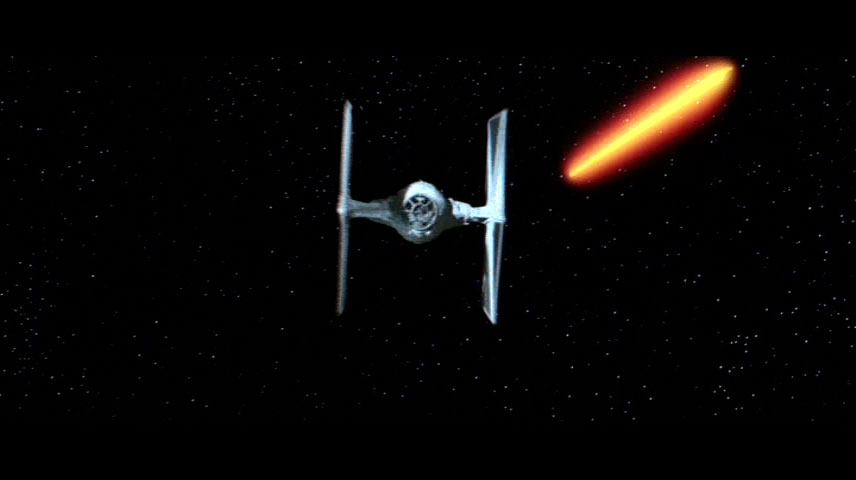
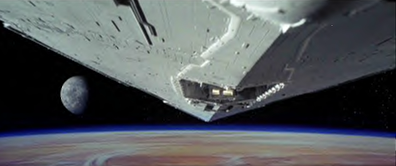
I knew the thing was going to be a ride with its first bravura shot—one of the ballsiest to announce just what its intentions were: panning down from the disappearing chapter head, its fanfarish opening fading to a discrete twinkling as we contemplate the stars, the view descends and narrows its scope while expanding its horizons—taking in a floating moon and then settling on a frame-defining planet's edge. Then a sleek ship zooms over our heads into view with tracing laser blasts flashing from it and towards it, causing flashes of damage. Then, the pursuing ship defines the top of the frame—first a wedge of a bristling ship that expands and expands and expands, with ever-more complex details including a large empty bay. It grows to impossible proportions until finally the vast nozzles of its engines blue-glow into frame, accompanied by the sound of crackling plasma-sounds that pierce the thudding hunter's drums of John Williams' martial music with a romantic's flourish. The intention is to dazzle, and to change our perspective of what is possible in this techno-fairy tale, filled to bursting with arcana, culled from the rich history of cinema and make-believe.

It flew by, with dozens of fun little touches: the blue specters of holograms (merely realized by filming
Carrie Fisher's lines from a variety of angles on low-res video screens—she can still remember that speech), the bones of a dinosaurish creature on the crest of a Tatooine dune while Williams' score recalls Stravinsky's "Rite of Spring," which served as the backdrop for the dinosaur segment of Disney's Fantasia, the hob-goblin Jawas-used "droid" salesmen of the desert, the varieties of robots and aliens, the casual conversations of the stormtroopers, one denizen of Mos Eisley space-port ("You will never find a more wretched hive of scum and villainy") represented by stork-legs that brush by the camera (you never see the whole creature, just a suggestion of it), Alec Guinness' inscrutable wizard, Han firing first and proving his worth by diving out of the Sun like a WWI Ace, the nothing-made-of-it reaction shots between the scruffy Chewbacca and Princess Leia, the dangerous sparking sizzle of whooping light-sabers, the nerve-wracking go-for-broke flights through the trenches of the Death Star, the initial dives into those trenches done with a Wellesian slight of hand, transitioning from long model-shot to three-dimensional close-up by a cut disguised as a blast of laser-fire.

It was stunning. I exited the theater with a stupid kid's smile on my face, the main thought in my head being just wanting to get back in line to see it again...right now. The huge line of people, though, was daunting. An impatient yuppie who'd been in line since I'd entered the theater had to ask me: "How was it? Is it any good?"

I babbled: "Wow...I just...it's absolutely...amazing...it's...it's...it's"

He looked at me piteously. "Are you high?" the guy asked.

Truth is, I was. As high as any really good, ingenious film can make me (and still can).

I dragged friends, family, girlfriends to see it just to see what their reactions would be—I wanted to see their sense of wonder, if there was any. But I also wanted to see it again and again to see if I'd missed anything (telling answer—Nope, only its flaws). And the memory of that Summer day lingers on, like a particularly joyful memory, a force that informed my life.

May the Force (or Something Like it) Be with You. Always.

(And I still have that poster that's perching up there at the top of this article).


* One of my favorite stories about "Star Wars" involves Carl Sagan going on "The Tonight Show" with Johnny Carson and railing about the inaccuracies of "Star Wars." It was the usual stuff—no sound or turning ship flight-paths in space, distance between systems, yadda yadda yoda. But one thing really irked Sagan: "they've got one guy who said he made a trip in parsecs—a parsec isn't a measure of time, it's distance!" This, in turn, really irked Lucas. He knew that. The line was there to show that Solo's not too good with technical details and a bit of a blow-hard—hence Obi-Wan Kenobi's pitying reaction to him saying it. In space, no one can hear you grind your teeth in frustration.