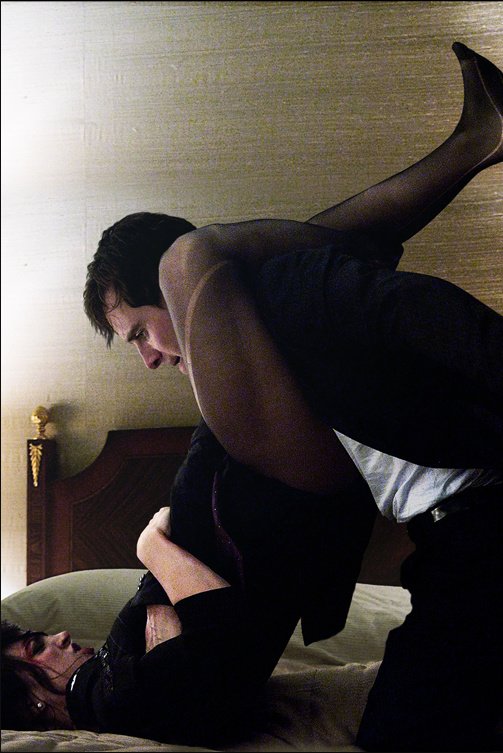
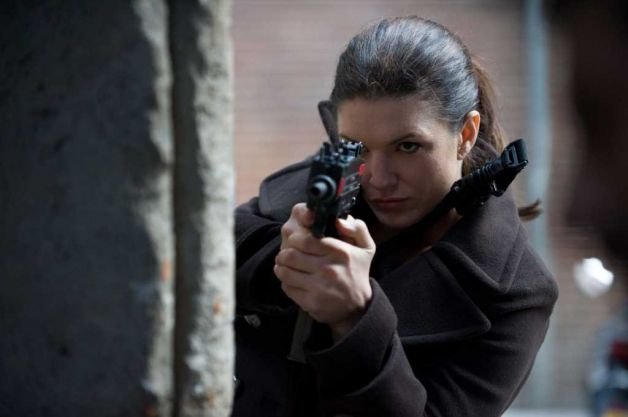
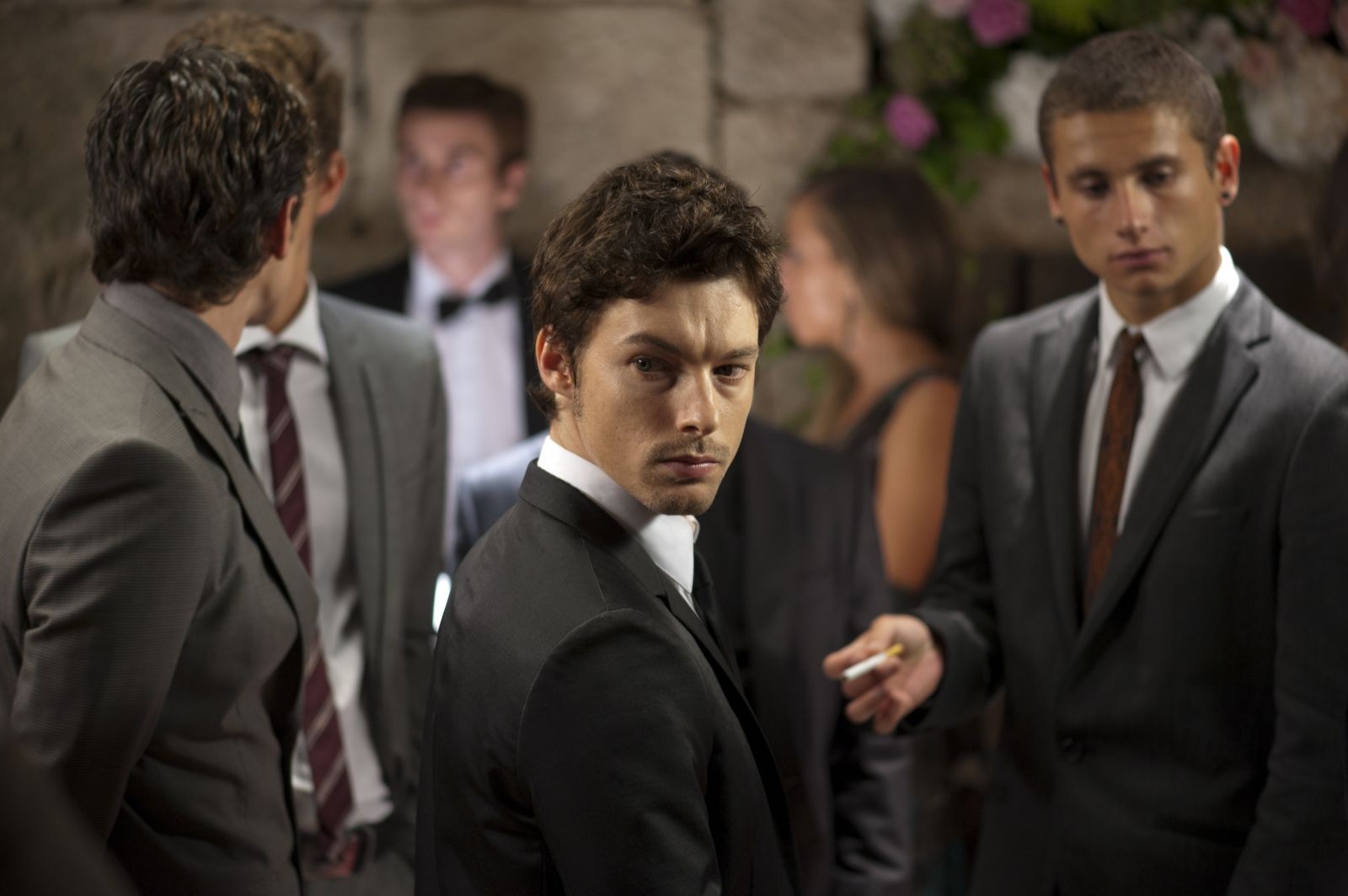
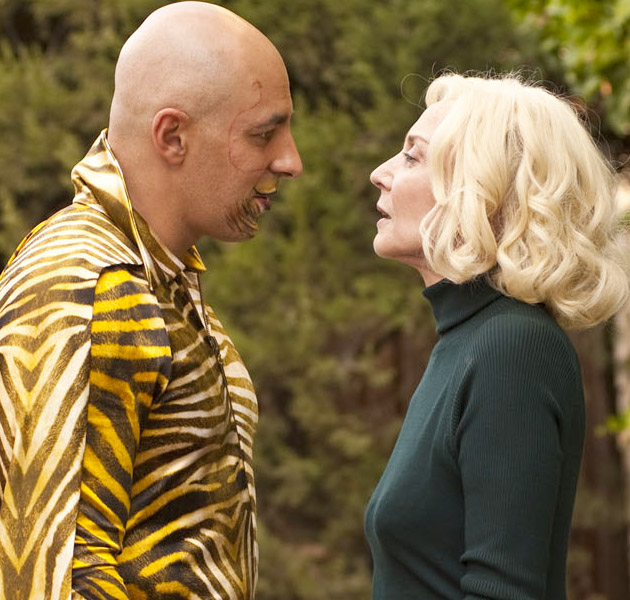
Haywire(Steve Soderbergh, 2011) Fairly standard actioner about a wet-ops unit for hire, and one particular freelancer who's beginning to suspect harmful links between gigs, directed by Soderbergh (written by past collaborator Lem Dobbs), with some unusual qualities of note. For one, the director stages his fights like they were dance sequences from an M-G-M musical—full-frame/full-figure (but without the Lion Studio's "stage" angle on the axis of the central figures). There are no tight shots, tight editing, it's all composed of mis-en-scene, rather than montage, just an angle/reverse angleone-two parrying between perspectives. It's tough, athletic, and the only real reason to cut away is if something goes wrong—a fluffed punch, or bad timing that creates a lull in the fight or a disconnect with "reality." There's no "lull" between hits because the way the altercations are staged you never see the connections, and there's no simulation of connection, because they're composed mostly of gymnastics, wrestling and fast action—the opposite of The Bourne Identity style of rapid cutting and implication of "hits." Soderbergh does something different with this style, while accomplishing the same intensity of the edit-dependent fisticuffs of the last few years. The most critical part, however, is who's doing the fighting, and that's where Haywire is really different and utterly dependent on its athletic lead.
Gina Carano, mixed martial artist—and frequent participant in "American Gladiator"—plays Mallory Kane, and she is disciplined enough to pull off the fight sequences with a savage speed. Any actress can train to look convincing, but Carano has the moves down for her character who is supposed to be a berserker weapon of mass-destruction, so there's rarely a cut-away or an insert shot to betray the use of stunt-doubles. There aren't any. So, Soderbergh (who also shot the film) keeps his camera out of the way and keeps everything and everybody in frame as best he can. We've seen women in fights before—fights with men (Tarantino loves to do that)—but it's slightly unnerving to see these, knowing full well that everything was done in-camera, with few editing tricks. The speed makes it a bit more visual—there's no 1/4 second adjustment/orientation lag between cuts—and more upsetting initially, but one does, as the fighting continues for minutes unabated, used to it (except for the question of what kind of make-up she uses to hide the bruising).
Welcome to the Crazy Club! or The Moon's Just a Cheap Shot Away
And what's good for the goose...
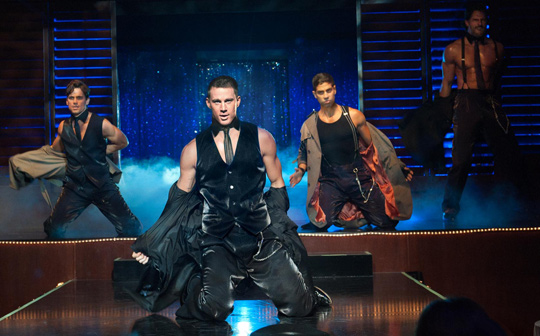
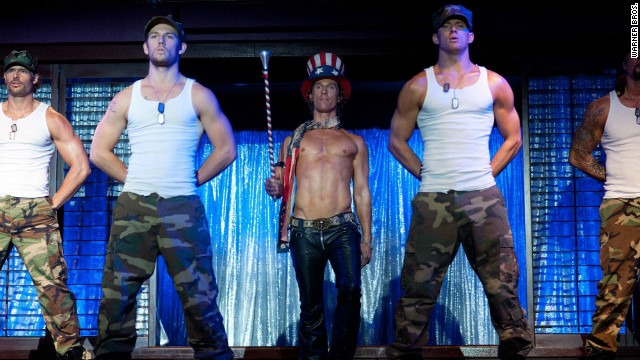
Soderbergh's next film after Haywire (if we don't count his second-unit work for The Hunger Games), also goes against the grain in the traditional genre/gender roles that we come to expect in movies—a dance/backstage drama movie, but with male leads.Magic Mike is Flashdance with testosterone, the only thing missing is the "if you give up your dreams, you die" line. Here, the basic dream is moving out of Tampa, Florida...to a bigger venue, or a better life. The clutch of male strippers each have their own motivations—mostly money—and for them, the gig is a better alternative than slogging through a 9 to 5 job, wearing a tie. So, at night, they dance, flirt, tease, and as club ownerDallas (Matthew McConaughey) "pry the cash out of their purses."
It does, but it could be a lot worse. It could be "Showboys," and in outline form it resembles it, but it avoids the smarmy camp quality of that film by having a sense of humor about itself**and what it is (and what it doesn't aspire to, which is anything with an overt message) and it stresses the economic times that drop the unskilled (but ripped) into such night-work (day-jobs being rather scarce, especially when you party until 4 am) without having any pretensions about suffering for your art. And the performances are fine, especially Tatum and McConaughey, who clearly relishes playing an out-and-out bad-boy with no shame. But, all the men throw themselves into the roles of buck-a-throw sex-objects, with a brio and swagger that's fun to watch—as long as nobody takes it for anything more.
It's the old "show-biz is a rough road, kids" movie, but with a "y" chromosome in the script of its DNA, a morality tale with enough immorality to make it worth watching. And it's a healthy thing for Soderbergh (or anybody) to be turning the tables on these themes with their built-in sexism—even if the tables have some dancing on them.
Magic Mike is an immodestly modest Rental.
The boys break rules (but not twenties)
* Interesting role for her. She plays a woman who plays with Mike like a boy-toy for jollies, but he finds, much to his dismay, that she does not consider him someone to bring home to meet Mom and Dad. Dude...(if I can use the language of the film) Why do you think you never went over to her place?? As they might say in Showgirls "Denial's not just a river in Egypt, honey..."
** Reviews and synopses are saying it's a comedy-drama, though. No. No, it's not. It's a light drama (with sprinkles of heaviness) and some clever writing here and there. Maybe that hyphenate was there to attract the ladies (as if all the beef-cake and pretty boys wasn't enough).
A Tort is a Tort (in Court, in Court) Without It, You Have No Recourse (Of Course) Your Legal Rights were Bought By Force By the Corporate Life We've Led
or
"Warning: Do Not Throw Out Baby With Bath-water."
Just because you're paranoid doesn't mean they're not out to get you. And even if you poo-poo "conspiricism," doesn't mean there aren't organized efforts to circumvent government statutes and foundations.
Like "inalienable" rights. Or the right to confront your accuser.
Hot Coffee is a fascinating, if scalding, little documentary that got sold to HBO, and slowly, but surely, is making its way around to theaters. It's something of a "must-see," not only for how it dispels the simplified myths we're being sold by playing on our emotions (and pocketbooks), but also how that short-term presentation (dare I call it a "fiscal" view?) is crumbling our basic rights for "the bottom line." It's about the corporately structured efforts by our business leaders to quash an individual's rights to sue corporations in court for harmful practices that affect lives. The title derives from the case of Stella Liebeck, whom you might not have heard of, but you certainly knowher court case. It's the poster-child for the tort reform movement and Liebeck has been villified by the corporate world after having the temerity to sue McDonald's Corporation for damages after spilling hot coffee in her lap.*
Just the mention of it probably creates judgments in your mind: "Well, she bought the coffee;" "Of course, it's going to be hot;" "what's she drinking coffee in a car for?" All legitimate questions and all answered in the movie. But, like any court-case, decisions should be based on facts, and not the impressions given in a 10 second news-"blurb." And the evidence is there, in the court records, the hospital procedures, the photographic evidence (which is appalling), and the corporations' own history (700 previous complaints of scalding and burns). It's why a jury of Liebeck's (and your) peers awarded her 2.75 millions dollars. She didn't ask for it. She asked for McDonald's to pay for her skin graft procedures (yes, the burns were that severe). The jury awarded her that sum by taking a minute percentage of McDonald's coffee sales profits and giving her that. It just so happens McDonald's sells a LOT of coffee. The courts further reduced that amount to 1.25 million, and eventually Liebeck and McDonald's reached their own agreement—never revealed—but the damage on all sides was done; the clown at McDonald's had to pay up and the old lady got burned in the court of public opinion—through no fault of her own.
But, it set up an endless potful of corporations (and the politicians funded by them) to call for tort reform limiting the damages a plaintiff can win in such lawsuits. It was one of the rallying cries of George W. Bush's political career (with the help of political weasel, Karl Rove) while first running for Governor of Texas, then President. It set up an all-out assault on the checks and balances of the court system, in which courts were stacked in favor of corporate interests (courtesy of Rove and his cronies flooding out-of-state monies to local judicial campaigns) and the instigation of corporations to fill their legal contracts with stipulations for settling issues through "mandatory arbitrations," rather than the courts—the "arbitrator" hired by the corporation, thus making them a client looking for return business. Good luck with that process.
Scattered throughout the doc are man-on-the-street interviews, there mostly to show everyday folk's ignorance of the situation ("A tort? It's a pastry, right?"), and it's understandable. Everyone hears about frivolous lawsuits, and few—except those addicted to playing the lottery—like them, thinking that the costs get pushed onto them, by rising costs due to crippling judgments. It does. But it will, anyway. If the corporations don't dish out the funds to cover their negligence, it inevitably turns into a Medicaid case—Medicaid, being paid by you, the taxpayer. You pay either way. And claims about tort reform stopping, and even the decreasing the costs of medical insurance hasn't been born out in practice; the state of Texas which, under George Bush, rushed to tort reform and damage caps, has had just as many rate increases and is on a par with non-reform states. You pay either way.
Nobody's saving money here. Nobody benefits except the corporations who pocket the savings garnered by tort reform, and still raise rates. Nice little business you got there.
And the public still buys what the corps are selling. As I said, nobody likes the dumb law-suits. Until they're the ones who get caught in the gears. One of the interviewees ruefully admits to voting for tort reform in his state, only to find out that it affected him when he was in crisis. And we're all affected by it: next time you get a contract for your cell phone, read—actually read—the terms and conditions, or look at your next job application to see if there is a mandatory arbitration clause. More likely than not, it's there.
So, be careful with that coffee. One way or another, you'll get burned.
Hot Coffee is a Full-Price Ticket (but in the interest of "full disclosure, your honor, I saw it for Free).
* The tort reformers might have been better off using the guy who sued McDonald's because eating their stuff made him fat. Some good came of it—you'd've had to pry caloric information out of restaurants from their cold, dead, grease-encrusted fingers if he hadn't—but I think the whole thing would've been solved if the judge just told the guy "Why don't you keep your mouth shut?" (Or go to another restaurant, since he always had one thing corporations would LOVE to take away from us—choice).
A team of three Israeli agents are tasked with bringing a concentration camp doctor, Dieter Vogel (Jesper Christensen) to justice. The team, two men and a woman (Marton Csokas, Sam Worthington—his best film performance, one should say—, and Jessica Chastain) must find the man, who's now an OB/GYN in Berlin, kidnap him, and hold him him until they can transport him out of the country.
It's thirty years later and the three (played by Tom Wilkinson, Ciaràn Hinds and Helen Mirren, respectively) are being feted at an event celebrating the publication of a book in which the incident figures, written by the female agent's daughter. The three are praised, glad-handed and lionized, despite the fact that one of the three is missing.
John Madden is not the best fit for the film, despite his previous television work. But he gets the milieu down, and the layered performances of the principles benefit from his attention to detail (although one doesn't feel that the performances between older and younger selves merge too successfully). Ultimately, the film feels unsatisfying, and not just in the sense of the downbeat subject matter.
One is left feeling next to nothing, except in the uselessness of the exercise—where the mission is to fulfill commitments rather than doing any real good—to exact revenge, rather than justice.
Some lip-service is paid to duty, to country, but one gets the impression that's merely a card to be played in a battle of wills. In the end, its a case of diminishing returns: if justice can't be achieved, revenge will do; if that doesn't happen, the best to do is keep up appearances for morale and PR. If one can accept that such a conspiracy of silence can be maintained for 30 years without corroborating evidence—a not-small consideration (especially given these agents)—the movie still feels empty and unsatisfying.
Almodóvarwill provide the explanation, certainly, in due time (even if we have to wait for the end of the movie, in some of his cases), but the answers will come eventually, making the director a firm practitioner of the mystery genre. But The Skin I Live In also touches on horror themes (with one particular horror film reverberating throughout), with a touch of science-fiction thrown in this time, while still firmly housed in the twisted vine of a villa that house Almodovar's interests: love, sex, obsession, sexual identity, generational influence, and the definition of "self." At the same time, Almodóvar shows once again that he is the true inheritor of the Hitchcock mantle, as he explores many of the same themes of The Master of Suspense, but going places Hitchcock (or even Brian De Palma, for that matter!) wouldn't dare go.
And as great as Banderas is here, though submerged, the lion's share of the movie belongs to, and is shouldered by, Elena Anaya. It's only when the movie's done that you realize the fine line she had to walk, and the issues she had to skirt, in order to make the movie work as well as it does. It's tough to pull off a role this emotional while remaining something of a cypher...and a mystery.
This one will have you thinking for a long time afterwards, and not just in piecing it together. There are themes, sub-themes, and subcutaneous layers that fold and crease and support each other, that will surprise and even crrep you out. And it will make you ask questions. And make you think.
Being Elmo: A Puppeteer's Journey(Constance Marks, 2011) So, you're a kid. You grow up watching "Sesame Street" and (face it) the real reason you watch it isn't for the educational benefits, it's for The Muppets. You fixate on the felt fellas and you wonder (once you realize something's going on beyond frame) "How do they do that?" How do you project personality through the hands and the cloth and create the simulation of life? How do some puppeteers break through and perfect that illusion, while others get by on cute faces and elaborate cloth sculpture? And for that matter, how does any actor—with or without a familiar riding them—do that? By projecting personality through the trappings, just as differing actors produce different results through the exact same make-up and costume. The same goes for voice-acting, too; nobody who's tried to add vocal range to characters once voiced by Mel Blanc can hold a candle to him and are immediately exposed as...different. Not to get too philosophical here (I mean, we're talking about a documentary about Muppets here) but can "soul" be distinguished no matter how it's disguised?
The answer must be "yes" or else the difference wouldn't be so obvious. And to prove the point, The Muppets have struggled, after Jim Henson's death and Frank Oz's career advancements, to re-find the "souls" of their characters, finally emerging with a slightly sassier variation of themselves.*But just as characters evolve over story arcs, so do the people portraying them. Puppets only fade, and cartoon characters are photographed eternally, but the people behind them advance in years, and at some point retire and leave the characters (because...they're jobs) behind. And the kids who were first exposed to their creations grow up with their DNA mutated, brains twisted with experience to their movements and characters, and, if they're very, very lucky or obsessed, they may even take on those characters as second generational spawn. So, the characters begin anew.
Or, perhaps the phrase should be "born again." Born again, as new souls invigorate the old ones, while the outward appearance remains the same.
So, the kid who grows up watching "Sesame Street" puts 2+2 together and sums up that Jim Henson is the guy behind (or underneath? Inside?) "The Muppets" and begins to study everything the man has done in the past, tracing Henson's growth from sock in hands with split ping-pong ball eyes to the more complex constructions. The kid says "I can do this!" and so, the lining of Dad's good coat becomes the skin of a character which the kid has enough talent and personality to fill up.
That's really what this documentary—filmed rather perfunctorily, and one would even say artlessly—is all about. The kid is Kevin Clash, and his inspiration that fueled his great talent, pays off big time for him, when a discarded character (known as "Baby Monster") is literally thrown into his lap by a frustrated "Muppeteer" ("I can't do anything with this guy" is the line), and in his hands (hand?), becomes one of the iconic characters of The Street, surpassing Big Bird and Cookie Monster and all the regulars in popularity. Lucky. But, it's luck fueled with inspiration and great talent and heart...and in a performance, that's only a few BTH's away from rocket-fuel.
Being Elmo is a good show, full of Muppet history, hero worship (on both sides of it), the fulfillment of dreams, and building them anew. Klass' interviews, spoken straight into the camera (just as the Muppets do), are full of amazement, gratitude, and giving, and the cost of it all is only briefly alluded to. One can't help but think that the embodiment (if you will) of Elmo probably doesn't see a dime of the money generated from the merchandising of the character he's created. Oh, sure, he probably has a job for life as an executive at Sesame's "Street" and Workshop, writing, producing, directing, but the hours must be long. His commitments are many, and the toll it exacts from his family is in stark, ironic contrast to the attention he pays to his millions of fans...just by "Being Elmo." Glad to see him get to emerge in front of the camera.
Clash's Elmo clashes with Ricky Gervias-The Outtakes
One of the reasons "Elmo" is so popular is Clash's cheeky charm that keeps
the character from getting too treacly—in the grand Muppet tradition.
* Uh...do I have to reinforce that I'm talking about the creators and not the puppets? Okay, just checking...
Not for the Complacent, or of a Nervous Disposition...
If one were looking for themes in 2011's crop of films picked for Preservation as National Treasures by the Library of Congress' National Film Registry, it is not so much crowd-pleasers as some of the past couple of years have been (see this and this for those more timely breakdowns), so much as crowd provocateurs. This year's films push people's buttons, whether politically—there's a dominance of films about women in society and their emergence from behind corsetting apron strings—but also films that jar us emotionally, whether its the bathos of Chaplin's The Kid, the buzz-kill realities of nature and man-cruelty in Bambi (the inspiration for so many a soothing ice-cream cone), the sadism of The Big Heat...and the combination of most of those elements in the horrific The Silence of The Lambs. These films did not play it safe in their times, and in an era when everybody is tippy-toeing around people's real or imagined sensitivities, prejudices, and ideologies,*I find that rather bracing.
Brace yourself. Here are the National Film Registry's picks for 2011—films chosen for being "culturally, historically, or aesthetically significant".
Allures(Jordan Belson, 1961) Experimental film by pioneering animator Jordan Belson, who passed away last year at the ripe old age of 85. His work inspired many of the special effects for 2001: A Space Odyssey—although he was approached, he did not work on it—and he did some of the more evocative "spacey" shots of the Earth from orbit for The Right Stuff. But, primarily Belson made a living (from 1947 to 2005) making short abstract films of his animated images that accompanied music pieces usually of a spiritual or classical nature. I'd love to put an example of his work up, but Belson objected to having his work "streamed" in a low resolution format, so you won't find a YouTube channel for him. But, his work is innovative, lulling, and precise.
Bambi(David Hand, supervising director,1942) "If you can't say anything nice about Bambi, don't say anything at all." Fortunately, there's a lot of good things to say about Disney's first animated film not to be based on a classic fairy tale. The stringently researched animation based on nature studies is still beautiful, even wondrous to behold, and the story is just as captivating to this day—we know this because it was virtually remade (with Shakespearean overtones) as The Lion King a few years ago. Even though Disney has been cleaning their prints up on a regular basis for a series of DVD releases, this one has been chosen for preservation, so that kids can continue to be traumatized by the fate of Bambi's mother for generations (Steven Spielberg did a very efficient variation on the sequence for his film War Horse). This film was a large leap for the Disney studio, done with assurance and not on wobbly stick legs—new subject matter, new techniques in art and story-telling, and a new sophistication in the story it could tell, a bit more adult (and please, no "stag film" jokes.) but still accessible for all audiences...and not European in origin.
The Big Heat (Fritz Lang, 1953) Classic revenge noir by the German dark master with Glenn Ford as a cop skirting the rules to avenge the violent slaying of his wife (Jocelyn Brando, Marlon's sister) by vicious hoodlums (Lee Marvin—genuinely creepy—and Adam Williams). Noirs are tough by definition, but this one escalates the violence a notch by having a chief weapon of choice being a boiling pot of coffee splashed liberally on the face of the femme fatale (Gloria Graham, who is, as usual, terrific in this). But, as far as noirs go, this one is particularly cynical: Ford's homicide detective may be the only honest cop on a force in league with the crime syndicate (run by Alexander Scourby), which is just as interested in stopping Ford's investigation as the mob is. The other thing about this film is that the women do not end up well, contrarily becoming victims due to Ford's righteousness. Lang was already decrying the pointlessness of revenge before it became fashionable.
A Computer Animated Hand(1972) Rather than describing this early example of computer animation, why don't I just show you? The film is a case-study and demonstration of the process that went into creating a computerized 3-D image of Pixar co-founder Ed Catmull's left hand. You could say he directed and starred in this one.
Crisis: Behind A Presidential Commitment(Robert Drew, 1963) A film-maker is given unprecedented access to the President of the United States to film him "with his back against the wall." Intriguing subject. Even more intriguing when the President is the still enigmatic President John Kennedy, who allowed it to see "if he'd forget the camera." As if he could. Fact is, Kennedy knew better than any President how to "work" the camera. Drew and his four-man crew covered all the angles of the days during the University of Alabama integration confrontations, and in this day of "managed" politicians, to see Kennedy, his brother Robert (acting as Attorney General), and Alabama Governor George Wallace, all allowing the cameras full access, sure of the strength of their convictions—wrong or right—makes one sad that no one would dare do this today. There's bravery here in allowing History to be the judge of actions of conscience of our public servants. Now, politicians never forget the cameras, but forget their previous convictions, beliefs, or actions in order to be elected "at this moment in time." Hmmm. Who's really being managed there?
The Cry of the Children(1912) From the NFR press release: "Recognized as a key work that both reflected and contributed to the pre-World War I child labor reform movement, the two-reel silent melodrama "The Cry of the Children" takes its title and fatalistic, uncompromising tone of hopelessness from the 1842 poem by Elizabeth Barrett Browning. "The Cry of the Children" was part of a wave of "social problem" films released during the 1910s on such subjects as drugs and alcohol, white slavery, immigrants and women’s suffrage. Some were sensationalist attempts to exploit lurid topics, while others, like "The Cry of the Children," were realistic exposés that championed social reform and demanded change. Shot partially in a working textile factory, "The Cry of the Children" was recognized by an influential critic of the time as "The boldest, most timely and most effective appeal for the stamping out of the cruelest of all social abuses."
A Cure for Pokeritis(Laurence Trimble, 1912) Comedic short featuring a lost comedian from the silent era, the portly John Bunny, whose popularity pre-dated Charles Chaplin's. In this one, a gambling habit gets trumped by an intervention of sorts.
El Mariachi(Robert Rodriguez, 1992) Shoe-string budgeted film by a film-maker, who specialized in making a dollar go further than anyone—this one was shot in two weeks for $7,000 while still a college student—the Austin, Texas-based Robert Rodriguez. His career is problematic. The most ingenious of directors (he makes his film's budgets go farther by being a jack of all trades writing, directing, shooting, editing, writing the music and doing the special effects), he chooses to dredge through the muck of exploitation films that are his personal passion (occasionally doing kid's movies, like the fun, snappy "Spy Kids" films), so it's a little hard to draw a bead on his potential as long as he sets the bar so low. But, there's no denying his energy, drive and verve which are apparent with every film. El Mariachi(the first of a trilogy that would eventually star Antonio Banderas) features a man-with-no-name mariachi who is mistaken for a hitman during a border-town drug war. This one starring pal Carlos Gallardo, shows his insouciant humor and vicious timing that would be upsetting if the violence weren't so over-the-top. Even though Rodriguez aims low, he usually hits the mark.
Faces (John Cassavetes, 1968) Actor/writer/director Cassavetes was doing "mumblecore" before mumblecore was cool. He made personal films with fellow "method" actors (frequently featuring his wife Gena Rowland) in films that carried the germs of ideas that he and his actors would flesh out on-set. This one was shot, documentary style, in brutal 16mm black and white and tells the story (with little editorial comment) of the death of a marriage by institutional suicide. John Marley plays a middle-aged businessman, who just wants out of his marriage to Lynn Carlin's character and the two play out scenes of mutually assured destruction. Bleak, frequently ugly, but raw and unvarnished, Faces was a low-budget film so powerful that it could not be ignored, and was nominated for 3 Academy Awards—for writing and for Carlin's and Seymour Cassel's supporting performances. You can watch the full movie here.
Fake Fruit Factory(Chick Strand, 1986) A slice of every day life in the unlikliest of places: the day-to-day exchanges of latino workers making papier mache fruit. Film-maker Strand juxtaposes close-shots of the work being done, with the mundane, frequently irrelevent conversation going on to create a portrait of working conditions that is at once evocative and unexploitive.
Forrest Gump(Robert Zemeckis, 1994) Hmmm. Not a big fan of the Gump, and this one might be a little too early to be considered a classic. But, one can't deny its popularity, the effectiveness of Tom Hanks in the title role (winning him the second of back-to-back Oscars), and the cleverness with which Zemeckis, who loves doing period pieces, inserts Gump into just about every significant event or trend in the 60's and 70's. "Life is like a box of chocolates" is one of the many aphorisms in the script, and Forrest Gump is a fine example—some episodes in it are good, some bad, and some just leave a bad taste in your mouth. Lots of nice performances, too, from Gary Sinise ("Lt. Dan!"), Mykelti Williamson, and Robin Wright Penn, but also from Sally Field, who a few years earlier was playing Hanks' girlfriend, and was now playing his Mother. Ultimately, the movie is, appropriately given its central metaphor, a featherweight, full of recreated incident but not adding muchperspective to any of it, with its "special" hero as much a victim of Fate and the vagaries of Chance. History deserves to be more than a punch-line, as this movie makes it.
Growing Up Female(Julia Reichert, Jim Klein, 1971) From the NFR press release: "Among the first films to emerge from the women’s liberation movement, "Growing Up Female" is a documentary portrait of America on the brink of profound change in its attitudes toward women. Filmed in spring 1970 by Ohio college students Julia Reichert and Jim Klein, "Growing Up Female" focuses on six girls and women aged 4 to 34 and the home, school, work and advertising environments that have impacted their identities. Through open-ended interviews and lyrical documentation of their surroundings, the film strived, in Reichert’s words, to "give women a new lens through which to see their own lives." Widely distributed to libraries, universities, churches and youth groups, the film launched a cooperative of female filmmakers that bypassed traditional distribution mechanisms to get its message communicated."
Hester Street(Joan Micklin Silver, 1975) Silver's black-and-white immigrant story about life at the turn of the century manages to feel authentic, and features a terrific, Oscar-nominated performance by Carol Kane (and another by Doris Roberts, who's very far afield from her work on "Everybody Loves Raymond"). Steven Keats plays the husband, who assimilates quickly with the American lifestyle, rejecting the traditional values that the later-arriving wife clings to. Silver makes it feel real and lived-in, despite a small budget, and the story centered around culture-clash that the new national experience exhibits in one's own family puts into stark perspective an aspect of the immigrant experience that is merely back-story for so many films of similar character. It is ultimately, a story of hope and hopelessness, where the only consistent aspect is "change."
I, an Actress(George Kuchar, 1977) Barbara Lapsey endures the extravagant direction of the director that turns an overwrought monologue into a case of psychosis. But, whose is it? Takes the directorial canard "have fun with it" to a new extreme.
The Iron Horse (John Ford, 1924) The start of a life-long directing career documenting, through fictional film, the story of the building of America. Ford would go "European" every once in awhile, focussing on the island of his immigrant parents' birth, but America would be his focus, and The Iron Horse, and its romanticized story of building the first transcontinental railroad, is as good as any place to start the genesis of this artistic path. Later, he would do films of an earlier era (Drums Along the Mohawk, about the pre-Revolution French and Indian Wars), but, if you discount the Harry Carey Westerns, this is where he started to build stories out of the "taming" of the Frontier. He would take on many perspectives—the settlers of all stripes and faiths, the professional soldiers, even taking the perspective of the Natives, as he got older and wiser—but America and the changing frontier, its shifting borders and sensibilities, would be his subject throughout most of his film-making days. The film stars George O'Brien and Madge Bellamy. Also worth noting is that Ford was one of "those" directors who chose to cast real Natives as Natives (when the studio bosses didn't force contract players on him) and the film features Chief John Big Tree, whom Ford would use again, culminating in a quirky speaking part in She Wore a Yellow Ribbon (which also had a part for George O'Brien). This is the ninth Ford film to make the National Registry.
The Kid(Charles Chaplin, 1921) "6 Reels of Joy" pronounced the poster—it was the very first feature-length comedy, there was no such thing as "feature-length" at the time, so that designation had to do—while the film announces with the title "A picture with a smile-and perhaps, a tear." Chaplin was never content to evoking smiles, but peals of laughter, and so, conversely, a tear wouldn't do when he could pull heartstrings in order to fill buckets. Chaplin is brilliant, of course, in his comedy, but the story—which bravely tackles such serious topics as poverty, unwed motherhood, and the vagaries of Society on the innocent or disadvantaged in the form of The Little Tramp and his charge (played by Jackie Coogan—yeah, he was "Uncle Fester" in the TV-version of "The Addams Family") is positively bi-polar in its mood-swings. At this point in his career, Chaplin, for years making the world laugh, wanted to be taken seriously, too...and with his world-wide fame and prestige was taking himself altogether too seriously. His talent never diminished, but his old ghosts growing up poor kept him psychologically feeling inferior, no matter his achievements, and he kept trying to prove to the world that he was more important than the Little Tramp, despite the power the character had in it to change minds and sway hearts...as this film demonstrates.
The Lost Weekend(Billy Wilder, 1945) Full review here (and a "scene breakdown" here). Wilder's examination of alcoholism and the struggles of a writer whose ambitions are only in the limitations of a shot-glass. More than a movie about a guy with "a drinking problem," it's an exploration of the moral ambiguity of addiction—it's not just the lying (both to oneself and to others), it's the downright deviousness that the weak-willed will resort to in order to get their "fix." Wilder cast Ray Milland in the role of Don Birnam, and it couldn't be a better choice; Milland has always had an interior dignity, whether he was playing good guys or bad guys, and the movie scrapes it away, layer by layer until the character is left with nothing but his bones...all the better of him to see the semblance of a spine. Great movie that treats its subject with empathy...but not a lot of sympathy. The film is always remembered for its horror sequence as Birnam suffers DT's in his apartment, but I always remember the sinister overtones of the detox ward, with an especially scary acting bit by Frank Faylen. The film won four Oscars at the 1946 Academy Awards: Picture, Director, Actor, and Screenplay, winning four of The Big Five (only excluding Best Actress, as Jane Wyman's is rather short).
The Negro Soldier(Stuart Heisler, 1944) Frank Capra's war-time film unit made this film to generate support for the war effort among minorities, and, if anything, the second world war raised the consciousness of whites about the worth of soldiers of color. And the black American fighting man was a frightening challenge to the Nazi scripture of a pure white race. So, this was a fine propaganda tool and its heart is in the right place, there's just not enough heart to go to the next step. Look again and you'll find something missing—there's no integration going on here—the troops shown marching en masse at the end are units composed solely of African-Americans, preserving the myth that delayed the Civil Rights Movement from the seed of the Second World War for another fifteen years—the idea of "separate but equal." "They" made good soldiers, as long as "they" were thought of as "not us." For all the boots on the ground during the war, there was still a lot more marching to do.
Nicholas Brothers Family Home Movies(1930s-40s) The home movies by the Masters of tap and "flash-dancing" from The Cotton Club, Fayad and Harold Nicholas. From the NFR press release: "Highlights include the only footage shot inside the Cotton Club, the only footage of famous Broadway shows like "Babes in Arms," home movies of an all African-American regiment during World War II, films of street life in Harlem in the 1930s, and the family’s cross-country tour in 1934."
Norma Rae (Martin Ritt, 1979) Ritt's Union drama (based on true events of one Crystal Lee Sutton) about a lowly textile worker who, after suffering tough working conditions and management sanctions, decides to stand up—literally in the film's most famous scene—to organize her fellow workers in a silent protest. The title role (passed over by Jane Fonda, Faye Dunaway, Jill Clayburgh) won Sally Field her first of two Best Actor Oscars (and also won for David Shire's yearning folk song "It Goes as It Goes"). Ritt's visual homespun approach serves the rural story well, unglamorized and relatable, and would start an artistic collaboration between himself and Field. The National Film Registry chose Norma Rae for being "less a polemical pro-union statement than a treatise about maturation, personal willpower, fairness and the empowerment of women." The real life plant where the events took place did finally unionize...one year after the picture came out.
Porgy and Bess(Otto Preminger—after Rouben Mamoulian, 1959) Probably the one film most in need of help and attention. Because the rights are owned by the Gershwin family, and because of Sammy Davis Jr.'s restrictive recording contract, getting to see a fully unexpurgated version of this attempt at the classic musical at any time has been next to impossible. Thing is, as stage-bound as the film looks, it has one of the few performances by Dorothy Dandridge on film, an early representation of Sidney Poitier's work, and Davis is "killer" as Sportin' Life. It also features performances by Pearl Bailey and a very young Diahann Carroll. Yes, it's a "negro" musical written by a white guy, and, sure, it's very "Steppin' Fetchit" in its portrayals and ebonics, but, face it, folks..it's a work of art, the music is amazing, and maybe the movie version is a little off-base, along the same lines of the film version of South Pacific, but for the film to be hidden away like an embarrassment—well, it just ain't necessarily so.
The Silence of the Lambs(Jonathan Demme, 1991) Full review here. Just a repugnant film subject, with cannibals, skin-suits and serial killers galore. Not to mention a healthy dose of sexism that only reflects the pervasive violence against women. Jodie Foster won an Oscar playing FBI trainee Clarice Starling, employed to find a butchering serialist named "Buffalo Bill." For research, she seeks the advice and expertise of a serial-killer so dangerous, he is kept behind unbreakable perspex in a dungeon of a cell, former psychiatrist Dr. Hannibal "the Cannibal" Lecter. Lecter was always a fascinating co-star in Thomas Harris' creepy novels, but in this one, he, rather horrifyingly, became a break-out character popular with audiences. The reason, or blame, goes to Anthony Hopkins' intense, sickly giddy, eccentric performance, for which he also won a very deserved Oscar. Still the only horror film to win the Oscar for Best Picture, it is also one of the few films to win all the "Majors" (Picture, Actor, Actress, Director, Screenplay).
Stand and Deliver(Ramón Menéndez, 1988) Based on the true story of Jaime Escalante, whose disciplined math teaching, inspired him to teach calculus in the barrio, Stand and Deliver is the polar opposite of the "inspiring teacher" movies of the past, as there's more focus on the kids' environments, and Edward James Olmos' performance is anything but sentimental. The kids are tough, the accomplishments considerable, and significant enough that they're called into question once the results are in, exposing an inherent racism that not even excellence can overcome. Stand and Deliver stands alone in the many "school" movies that came before and after that treat the subject of teaching and motivating students as "weepy" exercises, whereas this one is as unsentimental as The Blackboard Jungle made 30 years before. The kids are tough, with discipline problems, the teacher has no weaknesses—at least that he'll show to his students—and is as unromantic a characterization as one can find; Olmos betrays no warmth at all and is something of a schlumpy cold fish. But, his dedication and commitment to the students is unquestionable, risking his position for their sake, even when test results are called into question for no good reason other than institutional projudice. Tough, but realistic, Stand and Deliver is one of the best movies about imparting wisdom and responsibility.
Twentieth Century(Howard Hawks, 1934) Knockabout "screwball" comedy with a luminous Carole Lombard (her breakout role), doing what she did best—comedy—and The Great Profile, John Barrymore, letting loose and showing just how talented he was as an actor by doing a part with very little of the dignity he was renowned for on-stage. Stage empressario Oscar Jaffee (Barrymore) svengalis lingerie model Mildred Plotka (Lombard) into a Broadway sensation as "Lily Garland," then overplays his hand, due to his overbearing posessiveness, forcing her to leave, which sends his career into a tail-spin. By chance, they meet again on the 20th Century limited on the way to New York and Oscar plots to 1) get Lily to leave her boyfriend, 2) get her to not star in a rival producer's play on Broadway, and 3) sign with him, instead. Hawks was the one to sign Lombard and was able to get her to "cut loose" to play comedy, winning over a skeptical Barrymore and the two became fast friends. They had to be. Hawks style of comedy is done at a high pace, jamming sentences together and not waiting for the laughs to subside. This is Hawks' eighth film to make it into the Registry.
The War of the Worlds(Byron Haskin, 1953) Produced by George Pal, this adaptation of H.G. Wells' sci-fi classic about an Earth invasion from Mars owes as much to Orson Welles' 1939 Hallowe'en radio broadcast as to the original source. Transplanted away from England to the U.S., Pal and Haskin reimagined Wells' Martian walking tri-pods as metallic, death-ray emitting "skimmers," hovering over the streets like buzzing, flying manta-rays, with blasts from their antenna-like appendages sounding like shrieking machine-guns. The scrupulous model work—one never forgets the destruction of the highly recognizable LA criminal justice building—bridges a gap between fantasy and reality, enough to make one gulp, especially in the randomness of the destruction. Highly influential on the next generation of film-makers—you can see a lot of the same design sense in Star Wars, and Spielberg made his own version with a post-9/11 spin (that included cameos from this film's stars) in 2003—this first filmed version of The War of the Worlds still holds up, despite improvements, refinements and stricter interpretaions over subsequent years.
* Interestingly, there's a documentary on the Film Registry's work called These Amazing Shadows, that offers a nice overview of those films already chosen, but betrays those already-mentioned "real or imagined sensitivities, prejudices, and ideologies" in some of the comments by the talking-head "experts." To those dunderheads sticking to their cliche party-lines, I offer this montage of what might be cinema's "most overused line."
 Haywire (Steve Soderbergh, 2011) Fairly standard actioner about a wet-ops unit for hire, and one particular freelancer who's beginning to suspect harmful links between gigs, directed by Soderbergh (written by past collaborator Lem Dobbs), with some unusual qualities of note. For one, the director stages his fights like they were dance sequences from an M-G-M musical—full-frame/full-figure (but without the Lion Studio's "stage" angle on the axis of the central figures). There are no tight shots, tight editing, it's all composed of mis-en-scene, rather than montage, just an angle/reverse angle one-two parrying between perspectives. It's tough, athletic, and the only real reason to cut away is if something goes wrong—a fluffed punch, or bad timing that creates a lull in the fight or a disconnect with "reality." There's no "lull" between hits because the way the altercations are staged you never see the connections, and there's no simulation of connection, because they're composed mostly of gymnastics, wrestling and fast action—the opposite of The Bourne Identity style of rapid cutting and implication of "hits." Soderbergh does something different with this style, while accomplishing the same intensity of the edit-dependent fisticuffs of the last few years. The most critical part, however, is who's doing the fighting, and that's where Haywire is really different and utterly dependent on its athletic lead.


-picture-MOV_a42eaa10_b.jpg)