M. Night Shyamalan's After Earth opens this week. Here's a look at his directing career...so far.
"Mission Statements"
Manoj Nelliyatu Shyamalan was born August 6th, 1970 in Mahé, Pondicherry, India, as his mother moved back there to be with family during her pregnancy. The family was living in Penn Valley, Pennsylvania, where the director was raised, attending a private Catholic school, Waldron Mercy Elementary for Boys ("for the discipline"), and in his spare time shooting 8mm movies, not unlike his idol, Steven Spielberg. While attending film school at NYU, he made his first film, Praying with Anger, financed by family and friends, and written, produced, directed and starring himself. It was his third film, The Sixth Sense, that propelled him into the A-list category, becoming the surprise hit of the Summer (mostly by audience word of mouth) and garnering six Academy award nominations, including Best Picture, Best Director and Best Screenplay. Heady stuff for a beginning director's third film, and especially for a genre picture, usually ignored by the Oscars. The Sixth Sense was, as was the ability in the movie, both blessing and curse. Night was suddenly a hot commodity, but his skill-sets ran towards "bubble" films, limited in scope, and deeply personal. He could never be accused of going for the "blockbuster" audience, and until The Last Airbender, he didn't try. If one thing unites his body of work, it is that all of his heroes are tasked with a mission, with which they struggle, and from which they learn important life-lessons. He has also suffered from expectations of what "his" films should be, but has shown signs that he's willing to break those ideas in order to expand his craft.
His fun little haunted house of a web-site (which sometimes has the feel of a confessional) is here.
Praying with Anger(1992) Shyamalan wrote, produced, directed and starred in his first film, which puts him in the same multi-hyphenate-league as Orson Welles. His ambitions, however, were far less those on Welles. The story is about a young man of Indian heritage (Shyamalan cast himself) raised in the States, who travels to his homeland and must come to grips with the country and its culture. He comes away, not with a feeling of home-coming, but of belonging nowhere, being different in both countries, and apart. It may be largely auto-biographical as the director made his own pilgrimage there earlier, then went back to make this film, but one shouldn't read too much into the particulars of the story and more on the feelings generated by such an experience. It's rough, but not bad for a student film while still in college. It would be six years before he got his big break.
Wide Awake(1998) "Catholic school is a lot like prison" says young Joshua A. Beal (Joseph Cross) of the Waldron Mercy Academy for Boys. He's on a mission. Not FOR God. But to find him. Not even an alt.news.com search can locate him. "Can we skip the confession stuff?" he asks a priest (Dan Hedaya) "Can we just talk?" The crisis of faith—that causes a ritualistic morning catatonia to delay going to school—comes from the death of his grandfather (Robert Loggia). "A lot of people do what you're doing" says Sister Josephine (Rosie O'Donnell) "but they usually finish grammar school first." This one is decidedly auto-biographical, too, one expects (Night went to the very school where it was filmed), but what reads as a cloying synopsis is, instead, refreshingly light and fanciful for most of its length (excepting a too on-the-nose finale that feels a bit desperate for closure...and rather interestingly could serve as a pilot-light for his next film), with an odd "Peanuts"-like quality where kids talk like adults...and the adults (like Denis Leary and Dana Delaney) are largely non-participatory and confused. Don't let the poster fool you—O'Donnell isn't in it that much, and until the very end, it's quite fun.
The Sixth Sense(1999) Box office sensation that came out of nowhere and lifted the Summer 1999 box-office doldrums of the under-performing ThePhantom Menace and Eyes Wide Shut. No one was expecting this film would be the hit it became, but it effectively revived Bruce Willis' stalled career, made stars of Toni Collette and Haley Joel Osment (another great child performance the director inspires), and made Shyamalan the latest story-telling wunderkint. Not that he really did anything different from a standard "Twilight Zone" episode. It's just that he managed to keep it afloat for two solid hours through sheer directorial sleight-of-hand, then had the brass to go back at the end and show you how he did it. Willis plays a psychologist, whose latest concern is a young boy who sees "dead people...everywhere." His efforts to help the beset child is a bit of a diversion (perhaps too much) from his seemingly-crumbling marriage, where things are a little...distant. For him, the kid is an obsession, and for the kid, what starts out as fear, we soon learn is a mission...to serve as a conduit between the living and the dead to tie up loose ends. The case provides an epiphany for Willis' shrink that you don't see coming and the palpable creepiness that Shyamalan infuses the story with, makes it a superior, even optimistic, horror film, something quite unique and commendably different.
Unbreakable (2000) Given the notice given to the success of The Sixth Sense, Shyamalan was given a bit freer reign and more budget on his next film, which is his "take" on the superhero origin story, but without the capes and spandex. Willis' character David Dunn survives a horrific train-crash that kills everyone but him, and it slowly dawns on him that there might be a reason—he's indestructible and super-humanly strong, and the revelation takes him on a path of self-discovery about his own potential for doing good, as opposed to just getting by. As with most of Shyamalan's movies, Dunn finds himself caught between finding his predestined purpose in life, and the uncomfortable burden it imposes. Every superhero needs an antagonist (it's partially the point of the movie) and Samuel L. Jackson plays his exact opposite, a brittle comic-art dealer, who'll break a bone if you look at him funny. Slow-moving and deliberate with a sense of inevitable foreboding, Unbreakable is a more down-to-Earth spinon the pop-myth-making of comics. In fact, myth-making is a lot of what the movie is concerned with. It didn't do too well at the box-office, but I found it a breath of fresh air in a movie environment that was becoming crowded with super-hero stories that were becoming a bit too similar.
Signs(2002) The aliens are attacking and this time it's personal. Shyamalan manged to keep the budget down by taking out anything more than the local perspective—the alien attacks happen in the background, broadcast on TV—and in fact, Shyamalan really didn't give a rip what the aliens looked like or what they were doing here. No, his interest was how this threat from the Heavens would affect a man of faith who'd lost it through tragedy (elements explored in Wide Awake). Mel Gibson plays a former minister, Graham Hess, a widower, with two oddly precocious kids (Rory Culkin and Abigail Breslin), and a brother (Joaquin Phoenix), whose better days are behind him, and they run a family farm. One morning, mysterious crop circles in their corn-fields without any explanation. Eventually, they realize that Earth is being invaded by aliens and that those crop-circles are navigation markers for the attackers. They barricade themselves in the farm-house, suspecting that the markers will attract the aliens to them, and prepare themselves for what looks like the end of the world. That the story is small-scale, sparse, intimate, and even funny, works to the film's advantage, because, really, what hasn't been done in an alien invasion story before? Eventually, everything gets tied up in a neat little bundle, but it's part of the Shyamalan schema of pre-destination and purpose realized, and the small cast...Gibson, Phoenix, Culkin, and Breslin is uniformly great.
The Village(2004)Clever story, with some very nice intricacies, a good cast (Donald Sutherland, Joaquin Phoenix again, Sigourney Weaver, William Hurt and with a standout first starring performance by Bryce Dallas Howard), about the isolated community of Covington, Pennsylvania that has a secret pact with the violent creatures in the woods surrounding them—none of the villagers will venture beyond their borders, and none of the creatures will invade the village. Howard plays a blind villager who undertakes a desperate mission to venture beyond the woods to get medical supplies for her wounded fiancee (Phoenix), but despite the fine finishes, the movie has one problem—its director is M. Night Shyamalan, who'd just directed three movies with "twist" endings. So when this one came out, everybody expected it. The story, about an ancient village, with very specific rules about not leaving the forest walls lest you be eaten is a fine grim fairy tale, but unfortunately, the villager had made one trip to the well too many—and the audience was way ahead of the game. Shyamalan had lost the audience's respect (seemingly because he kept trying to pull the same trick over and over again, although that "reveal" may have been the least of his concerns), but his next film, he changed tactics, starting to build enormous puzzles—letting the audience in on his pre-production process—and found a clever hook to hang his story on.
Lady in the Water (2006) After "going to the well" of the twist ending too many times, this odd little fantasy about a sea-nymph (Bryce Dallas Howard again) found in the drainage of a condominium swimming pool is refreshingly straight-forward and quirky, with a good cast—Paul Giamatti, Bob Balaban, Jeffrey Wright, Mary Beth Hurt—but two of the characters, Balaban's cluelessly arrogant film critic and a visionary writer (played by Shyamalan himself) rankle, and makes one wonder if the writer-director might be getting a bit of a swelled head after the drubbing that The Village got from critics (and audiences stayed home). Still, after the sameness of structure his previous four films exhibited, the slightly bent children's fantasy set in a world of blase adults needing to fulfill a complicated quest to do some good in the world seemed a breath of fresh air. It's as twee as hell, which, if it had been animated, might have set better with audiences. As it is, just the idea of Paul Giamatti in the traditional handsome prince role makes me happy. Full reviewhere.
The Happening(2008) There's something happening here. What it is ain't exactly clear. For one, people are committing suicide by jumping off buildings. Nature seems to be turning itself inside out to drive people insane and kill themselves. Mark Wahlberg takes his wife Zooey Deschanel to the country to try to escape whatever it is that's going on that's making people act crazy. It could very well be this movie, because Shyamalan is a bit vague about what is "happening," but evidently it has something to do with the wind. Nothing is explained, little is resolved, except on a personal level. In fact, the movie is so obtuse, it might very well be the director's version of Hitchcock's The Birds, but the film has little of that film's sense of dread or helplessness in the face of the natural world turning against humanity. One could search for deeper meanings, but it doesn't feel worth trying, given the film's meager accomplishments. Wahlberg and Deschanel try, but ultimately they're at a loss to make the material rise above what is, essentially, a vaporous concept. Another thing: there are some very clumsy shot set-ups and editorial decisions here that might be explained by circumstances on-set—I'm speaking of the early classroom scenes—but, some of the shots just don't communicate with each other, editorially. Given what he'd done before, with such a sure hand, one began wondering if Shyamalan was paying attention. Full review here.
The Last Airbender(2010) Full reviewhere. Nickelodeon's popular cartoon "Avatar" got the live-action treatment from Shyamalan, (but without the name, as James Cameron got there first) and the result, while starting promisingly, soon bogs down into incomprehensible battles of the elements that are sloppily staged, and dodgily edited. It might have been a case of making do with non-delivered special effects, but this, along with a couple of mis-matched shots in The Happening, lends suspicion that sometimes Shyamalan doesn't plan things out very well. Certainly, given his previous films, with their tightly controlled sets, and limited world-views, this one, given its scope, sets and reliance on elaborate special effects may have been a bit beyond the director's strengths, which have a lot to do with atmosphere, pacing and directing actors, none of which appeared to be relevent to this film. With his new film starring Will Smith and his son, heavily reliant on effects work, it will be interesting to see how he has progressed.
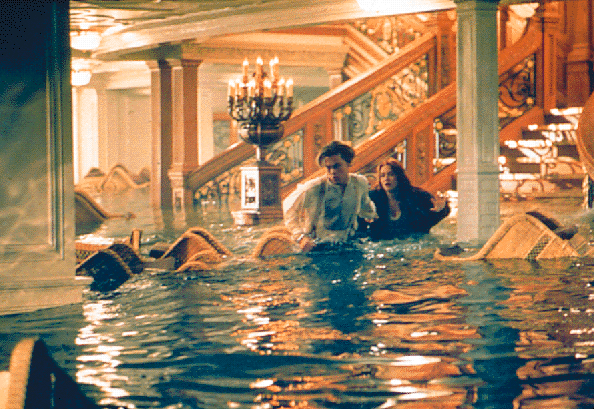
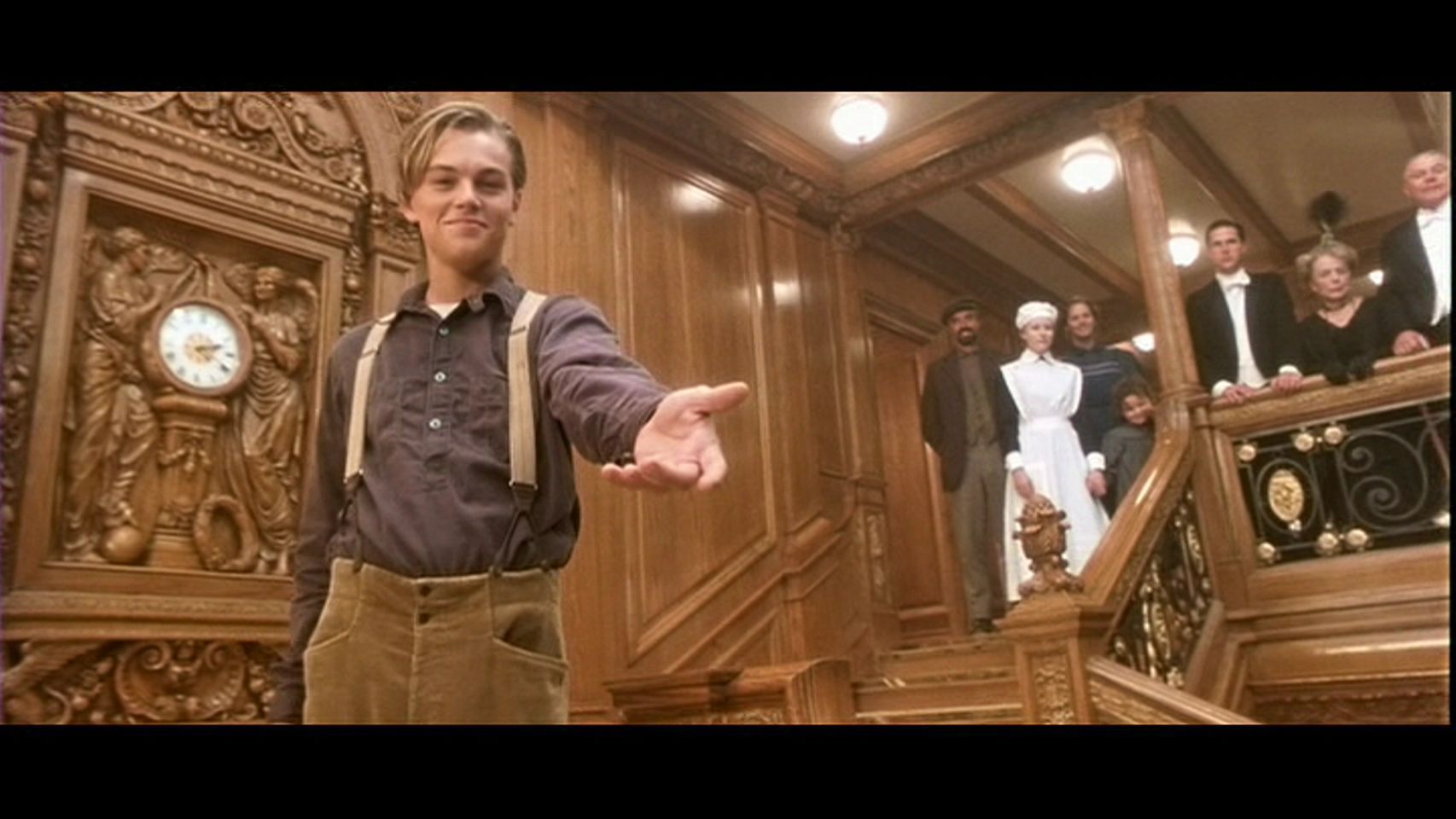
"I'm King of the World!" exulted James Francis Cameron (echoing Leonardo DeCaprio's Jack Dawson) when Titanic swamped the competition at the Oscars. It was an act of brio and braggadocio, as seen by many, but it was essentially true. After years of struggling with the see-sawing success of his films at the box-office ("Terminators" good, any "original" stuff bad) with the profit-dampeners of ever-increasing budgets, Titanic was finally Cameron's break-through.
It was a long time coming. There's an odd dichotomy about Cameron's directorial work. The conception is always with a romantic focus, core-themes deeply felt and imagined. Then the technocrat takes over and Cameron engineers the movie to a buffed polish and high shine that takes the passion out of it. And so, try as he might, Cameron had a hard time hooking a female audience, despite frequently having women as the heroes (or central focus) in all of his movies. There's too much wonk at play in his films to embrace the warm and fuzzy, and that's been the hindrance to his early see-sawing box-office.
Personally, I'd be more respectful of James Cameron's career if he didn't do adaptations (unofficially) so much and if he hadn't done so many films with Arnold Schwarzenegger. The fact that the two men did some of their strongest work together showed a symbiotic relationship. Schwarzenegger needed a strong, manipulative director like Cameron and Cameron needed the star-wattage of the actor-politician if his films were to make back their investment. But, give James Cameron this: the "envelope" thing. He writes to the cutting edge of what is possible and incorporates it in...and if its not possible he'll find a better way to do things so it is possible with a little movie-obfuscation thrown in. Any good director does this, really. But, most will re-write themselves out of a situation. Cameron will push the envelope to the point of tearing and this makes him an ingenious film-maker, who will move the visual aspects of film-making in a practical, if not artistic, way.
Piranha Part Two: The Spawning(1981) Bad tidings for the Caribbean resort, the Hotel Elisium. Seems that old sunken wreck off-shore is hiding a secret—a military experiment combining attributes of piranha, flying fish and, uh...grunion, managing to create something the world really needed: flesh-eating fish who can fly and don't need to stay in the water. Convenient. Dumb, but convenient. That sums up this one—a dollars-oriented follow-up to the first Piranha*—right down to the bone. By all measures, this is a terrible movie, crudely and dumbly exploitative, with performances that run the gamut of passable to just plain incompetent, with some terrible over-dubbing. There are extensive underwater sequences in and around a sunken hulk, but it's more than likely Cameron didn't shoot them—he was fired after 2 1/2 weeks by the producer, who went on to direct and edit the movie, himself (he was contractually obligated to have an American name on the director credit). In fact, except for some of the actors—Lance Henrikson being chief among them—the film has an all-Italian crew and production staff. Cameron doesn't even acknowledge this film, but has joked that it's "the best flying piranha movie ever made." There's plenty of room for improvement.
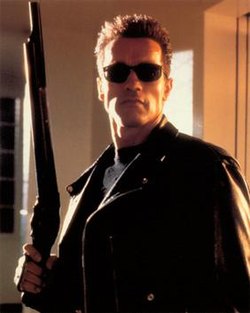
The Terminator(1984) One thing about Cameron: he stretches a budget like gang-busters. The Terminator is a cheap exploitation action film, but Cameron makes it work and makes it look like it cost many times more. A future war between robots and their human masters has come to a head, so the robots send one of their own (Arnold Schwarzenegger) back in time to kill the human leader's mother (Linda Hamilton) to prevent his birth. When word of this gets back to the humans they send a soldier (Michael Biehn) back to dispatch the cyber-assassin before he can kill her. It's a cat and mouse game as the implacable cyborg pursues the two humans through a nightmare landscape of industrialized blight. Despite the relatively low budget ($6.4 million), it's an impressive film, with some imaginative visuals—the orb-like energy field that projects the future warriors, for instance, that cuts a circular slice out of anything it touches—and the film had an inevitable snake-eats-its-tail finale. And Cameron found the perfect robot in Schwarzenegger, whose range was extremely limited, but who had a great sense of dead-pan timing. The movie was a huge (and surprise) hit remaining at the #1 box office spot for two weeks, making the Austrian body-builder (who, previously, had only one marginal box office success with Conan the Barbarian) an unlikely star. Orion Studios agreed to a settlement with Harlan Ellison**that the film was "inspired by" his work for the '60's sci-fi anthology series "The Outer Limits," a corporate decision that has never set well with the director.
Aliens(1986) Cameron seemed like an odd choice to do the expansion of Ridley Scott's esoteric sci-fi monster film, but the result was a thrilling war story taking the fight to the enemy's ground. It had none of the creeping dread of the original, but Cameron made a good choice—the surprises were gone, so now the story had to be taken to a new level—a military assault on the planet and its denizens that, until now, had seemed unkillable, while also creating a new origin for the creatures that flew in the face (if you'll excuse the use of the phrase) of a discarded sequence in Scott's film, making the Xenomorphs a eusocial species, rather than evolutionary in nature. Sigourney Weaver returns as Ripley, with an increased fatalism after the events of the previous film, a determined Ishmael bent on something like revenge, then finding something to fight for. Cameron repeats some gambits from the first film—Lance Henrikson plays the "synthetic" this time—and displays, even more impressively, his ability to stretch a budget with model and wire-work. It's a high-tech war film that feels like a throwback to traditional combat films, with their diverse ethnicities and psyches, but turns into an even more feminist statement than the first film, making Weaver a major star.
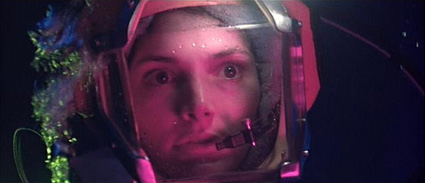
The Abyss (1989) Of all the films with a deep-water scenario that summer of 1989,***Cameron's film was the most forward-reaching—the others, ironically, being more like "Alien Under the Sea." The director had this one long in the works, about a deep-sea work station that finds much more than it bargained for than supervising oil drilling, when a Soviet nuclear sub sinks near their location. "Bud" Brigman (Ed Harris) and his estranged engineer wife (Mary Elizabeth Mastrantonio) battle each other and a team of Navy SEALS (led by Michael Biehn, his third film in a row with Cameron) who determine that they may not be alone down there. It's an impressive film, even more so in Cameron's longer, more philosophical "director's cut" that was later re-fashioned. This was a daunting project with extended underwater sequences, filmed in a flooded, abandoned nuclear silo and with newly-engineered transports and deep-sea suits designed with head-masks that provided full-view of the actors' faces. The release date was delayed to accomodate the extensive special effects, including new work with a CGI-created "water tentacle" that still impresses for its look while being on the cutting edge of what, at the time, was CGI's limited capabilities. Cameron's work has made great leaps and strides since, but The Abyss shows the peak of Cameron's ingenuity and skill as a story-teller and film-maker.
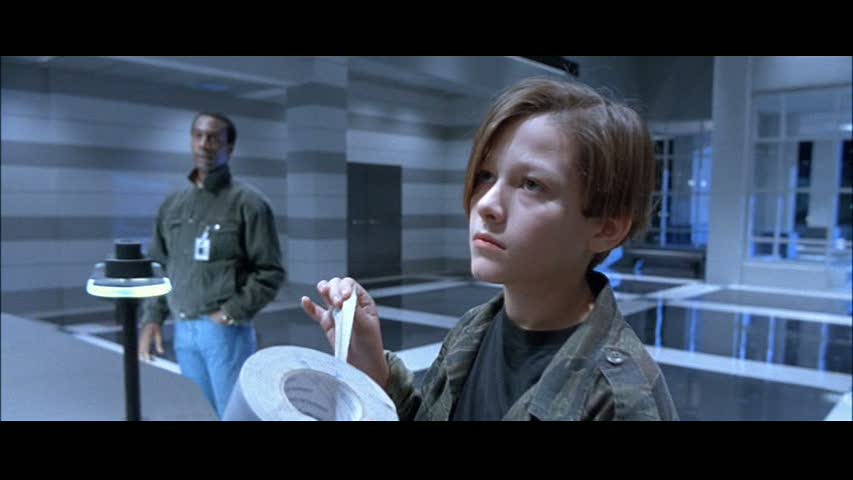
Terminator 2: Judgment Day(1991) The return of the T-800 from the first film with a different mission. It's a few years later than the events of the first film, but those pesky robots are still sending their own back in time to kill human rebel leader John Connor. This time, though, the target is young Connor himself (played by Edward Furlong), a particularly troubled tween—Mom's in a mental institution for her foreknowledge of the coming events and young John is living with the lamest of foster-parents. So, the robots send their latest model, a T-1000 (played by a particularly lizard-like Robert Patrick), a liquid-metal chameleon of a cyborg that can take on any shape and is seemingly unstoppable. Sent back to protect John is another T-800 (Schwarzenegger again) who must battle trust issues with his charges, fend off the T-1000 and destroy the cause of the future Holocaust—purloined parts from the original Terminator assassin. Cameron pulled out all the stops for this one (at the time, T-2 was the most expensive film ever made), but the results are impressive, including the many transformations of the T-1000 (often created by using twin actors—including Linda Hamilton and her sister), and a particularly gruesomedream sequence where Los Angeles is destroyed in a nuclear explosion. Not Cameron's best, but you'll never find a better "Rock 'em, Sock 'em Robots" movie.
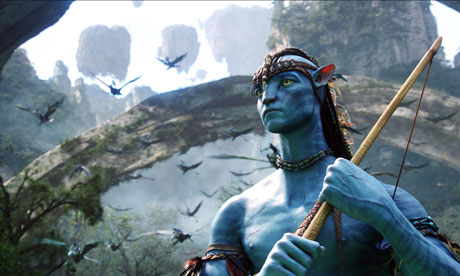
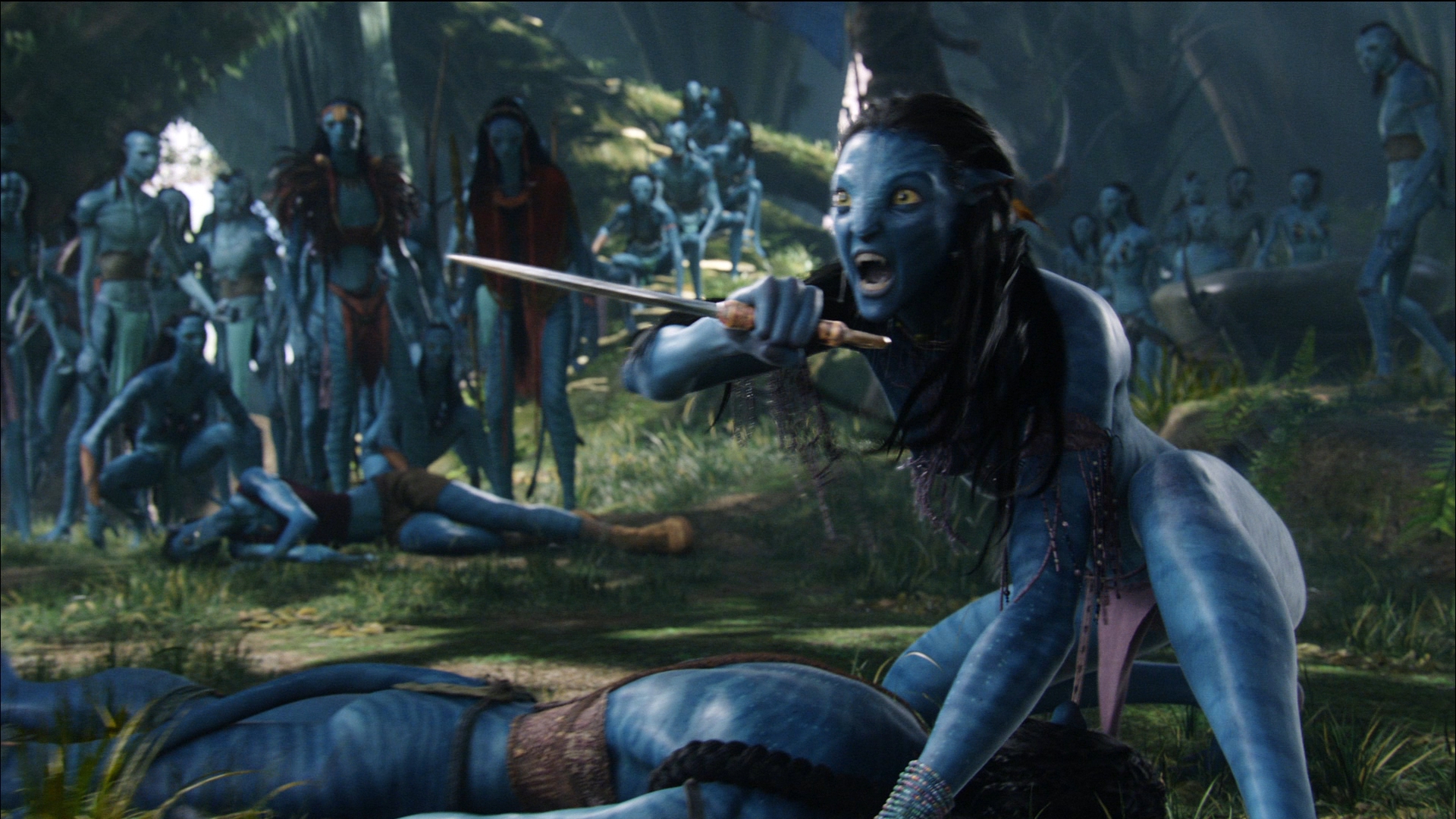
Avatar(2009)Full reviewhere. I'm still not as impressed with it as the rest of the world is. But it sure is beautiful to look at, and the motion-capture work is impressive and extraordinarily expressive, even if the faces are a little uni-dimensional, like monuments. So, while it's nice to look around, the writing doesn't live up to the man-hours and efforts to bring it to the screen. Or maybe all that work was done to make it seem more special. It's just SO damned derivative of the "white guy saves the tribe" story that has been endlessly slopped around in European literature that pretty soon the beauty of it goes away, as you suddenly realize that you're being hood-winked and watching a film version of cotton-candy. Looks nice, tastes fine, but throw a little cold water on it and it vanishes because there was nothing really there to begin with. So, there's lots of interesting elements—I listed them in my review—from many sources******But they end up as one big gooey mess with mixed bleeding heart liberal messages: Nature good. Military bad ("...but look at the cool toys, man!"). Corporations bad. Love good. Mechanization bad ("cool toys" redux), but primitive good, (but...ewww, so primitive). As I mentioned before ("my review," redux) Cameron is the new George Lucas, for good or ill—the idea that he is starting work on Avatar II and III (when things were resolved in the first film) indicates that he might be spinning his wheels (however high-tech they may be) creatively. Time, a factor in so many of his work, will tell.
* That Roger Corman-produced "homage" to Jaws was co-written by John Sayles and directed by Joe Dante, and was admired by Jaws director Spielberg enough that he hired Dante to direct his Amblin-produced Gremlins. ** Those being "Soldier" (about a soldier from the future captured by the military) and "Demon with a Glass Hand" (about time-travelling murderers and the cyborg sent back in time to stop them). I've always thought "Demon" could use a full movie treatment as it's war-with-time-travel story was scaled back for television.
*** The others being , George Pan Cosmatos' Leviathan, and a planned adaptation of Michael Crichton's "Sphere" (which wasn't made until 1995).
**** Interestingly enough, Landau did basically the same thing for Bruce Springsteen—tell him to write a song that would become a Top 10 pop hit. The result was "Dancing in the Dark," the most innocuous of Springsteen's songs, but which became The Boss' first No. 1 song and propelled his "Born in the U.S.A." album to No. 1, as well. Landau's job seems to be to nullify whatever an artist is to make them unique, in order to become popular and rake in the bucks. Commerce over art. One can't argue with success, I suppose, and the popularity of Springsteen's and Cameron's work has allowed decades over less-commercial fare to be produced unimpeded. Is there a down-side to this? I think not. ***** For example Rose's blurting out "Jack! This is where we first met!" as they're clinging to the railing as the ship reaches its zenith, right before taking its final plunge. That point was very apparent visually, but Cameron doesn't trust his own visual sense, or the audience's ability to grasp it and has to take a sledge-hammer to the point to make it obvious. ****** That's a joke, actually. Of COURSE a lot of people like Titanic...before Avatar, it was the all-time box-office champ...Although if you factor in the inflation of ticket-prices, the story is a bit different. If you look at tickets sold, (rather than income generated) Gone With the Wind is still #1, the original Star Wars is #2. The Sound of Music is #3. Avatar is #14. Titanic is #6. At the time of GWTW, ticket prices were 25¢, whereas at the time of Avatar, the top ticket was $14. It is the difference between popularity and income generated. ****** I didn't mention one, however, that the estimable Jim Emerson snarkily pointed out: Na'vi looks like one of the Roger Dean album covers for Yes.
One of the exciting things about seeing movies over an extended period of time is seeing the growth of a genuine artist. Despite reservations about his early output, it was obvious from the outset that Steven Allen Spielberg was a dynamic story-teller and a wizard in communicating with a camera. His training manuals were the classics of the film-makers of spectacle—the David Lean's and Alfred Hitchcock's and Cecil B. DeMille's, the guys who made expansive roadshows that appealed to a mass audience. They made movies of exotic places and large personalities that could fill a Cinemascope expanse with adventure and color and grandeur. They could also manipulate an audience with their technique to fill them with awe and wonder, or propel them out of their seats in an explosion of popcorn. Movies were a thrill-ride, but with better scenery. From the beginning, Spielberg had that impresario spirit to look at an audience as a territory to be conquered: give them bread and circuses and chases. Tell them a story and give them a thrill. Very quickly, he became his own brand: "A Spielberg Film" was something to see.
The events of 9/11/2001 weighed heavily on Spielberg (as it did all of us) resulting in films where the usual sense of wonder was replaced by a loss of innocence. The shocked expressions of Dakota Fanning in War of the Worlds, and the blank look of his "Pinocchio" in A.I. were no longer the awe-inspired faces displayed in so many of his movies. Spielberg's subject matter became darker—even in Tintin—and he seemed to be grasping for stories that illustrated the problems of the world...and how we might best overcome them. At the same time, he became a subtler film-maker, and his collaborators the top of their field.
War Horse(2011) Full review here. Spielberg likes to tell the story of meeting John Ford ("So you want to be a 'picture-maker'") and having Ford make him look at his Remington prints and observe the horizon line of the paintings. "When you're able to appreciate why the horizon is at the top of the picture or at the bottom of the picture, then you might make a pretty good picture-maker. Now get the f#&% outta here!" War Horse proved that Spielberg had learned his lesson and quite a few other things as well. Sure it's a horse story, but it's not like the usual "boy/girl loves horse" type of "growing up responsible" tale. It's gritty, tough and incorporates an Equine Odyssey that displays the best of man's instincts and his worst, and so much of it is done without words (and the words, by Lee Hall and Richard Curtis, are quite well done). Pictorially, it is amazing—lush, full, going from verdant Irish hillsides to man-made trenches of death, with the horse (as it would be, anyway, to the audience) the focal point of the story as his human masters fall in and out of his story. It reads deceptively simple, but Spielberg makes the most of the visual aspects that provide a pictorial sub-text to the story, giving it far more resonance than words on the page could provide. And there is one episode in the story—a brief truce between Germans and Brits during the first World War that is a grimly humorous reminder of the uselessness of war and how a common goal can shatter a war like a disagreement can shatter the peace. War Horse is an overlooked gem.
Lincoln(2012)Full reviewhere. It's still a little too close to my viewing of it (two weeks, but its been on my mind ever since) to have any sort of perspective on Spielberg's long-in-the-planning biography of the almost canonized saint of the U.S. Presidency. With the help of his master craftsmen and his Munich scribe Tony Kushner—who manages to convey what was so special (and so irritating) about the man, managing to cram the last months of Lincoln's life into the film, combining his relationships with his world of his family, compatriots, and enemies at the end of the Civil War, the passage of the 16th Amendment, and his death, while not treading the traditional paths of every other film that touched on the subject—Spielberg doesn't even show Lincoln's assassination at Ford's Theater, choosing instead to show the event through the eyes of his beloved son, Willie. It's a stellar cast, all providing exceptional work but dominated by James Spader's lobby-lizard and Tommy Lee Jones, whose Thaddeus Stevens has reasons for delivering the controversial amendment both ideological and personal. Lincoln is an education in the best sense of the term, providing perspective on the man and his times...and ours.
What's next for Spielberg? Hard to say, as he frequently changes his mind in mid-pre-production about what's "right" to direct (for the longest time he was set to direct Memoirs of a Geisha, then abandoned it). Robopocalypse is in pre-production, and one hesitates to speculate what he'll do with it and just the title made me think about holding off this point as his Senior year (although the artist-maturity is undeniable in War Horse and Lincoln). There's talk of another "Indiana Jones," but it is merely talk. And what of Interstellar, the deep-space sci-fi film he was bandying about a few years ago? One suspects that Spielberg hasn't completely put away childish things—his directorial sense is still infused with a youthful enthusiasm. But his films have grown darker, more considered, and less feeling like contraptions. Whatever his future work holds in store, it will be interesting, provocative, maybe even indelible. Freshman Year (1971-1981) Sophomore Year (1982-1993) Junior Year (1997-2011)
The year was 1973, and in an effort to attract crowds to the decidedly inferior Battle for the Planet of the Apes, the Crossroads Theatre in Bellevue—at that time a single cavernous auditorium (not the glitzy multi-plex it is now), was hosting a single day event: "Go Ape!" with the Planet of the Apes series. All five POTA movies in their Möbius-like timeline would be played in a row starting (and ending, appropriately) with the first, and best, of the films.
My buddies and I talked it over for all of ten minutes—the event was the next day—and we made plans with brown-bag lunches, gallons of pop—and plenty of bananas—to see each film in the continuing (and deteriorating) series. We made it all the way through to the last show, though we were reduced to grunts for communication by that time, proving the premise of reverse-evolution possible (and not that I'm complaining, but if they wanted to end it with a bang they should have re-run the second film as well).
Here is the twisted timeline of the Decline of the Planet of the Apes.
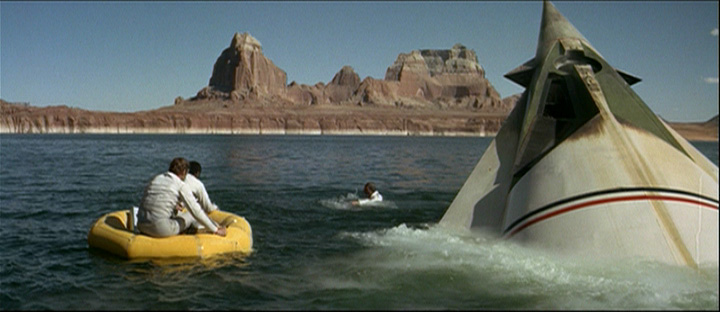
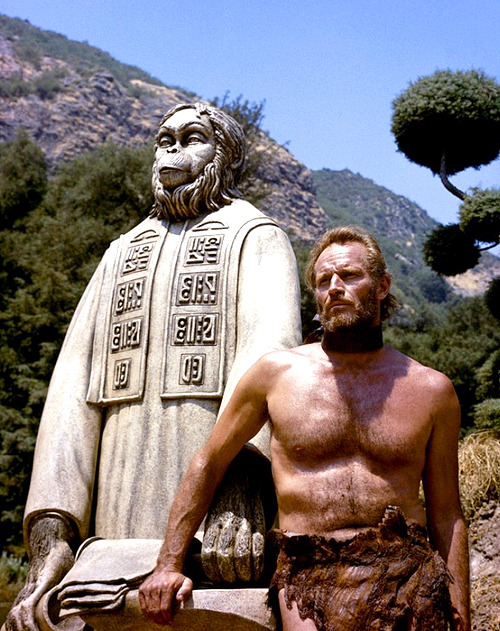
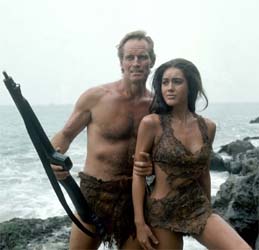
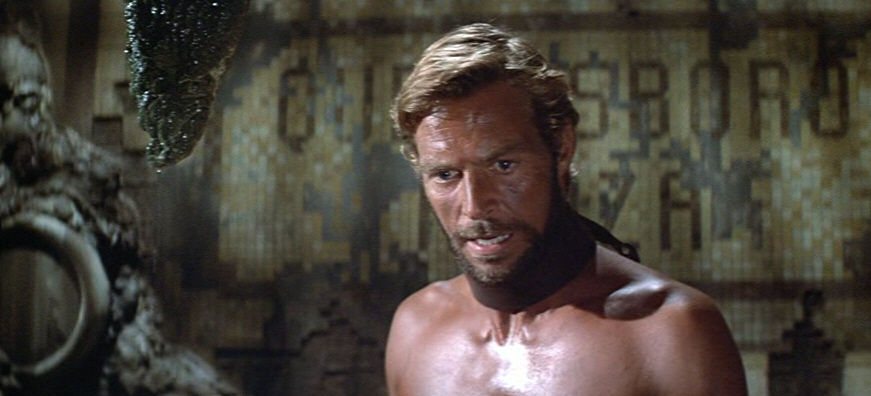
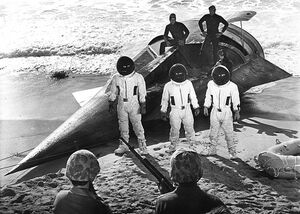
Planet of the Apes(Franklin J. Schaffner, 1968) Four space travellers led by Col. George Taylor (Charlton Heston) journey into deep space for the first time travelling faster than light—but not faster than the psychedelic light-show outside the ship's windows. While the entire crew is in suspended hibernation, the ship crash-lands (luckily, in a lake) on a primitive desert-like planet, forcing the survivors to march across the blasted landscape to find food, if any can be had.
An extreme Franklin J. Schaffner wide-screen composition: Taylor (Heston) and Cornelius (McDowall) are needlessly having a conversation across a very large chasm overlooking a picturesque river-bed. What? They couldn't have done this conversation standing next to each other?
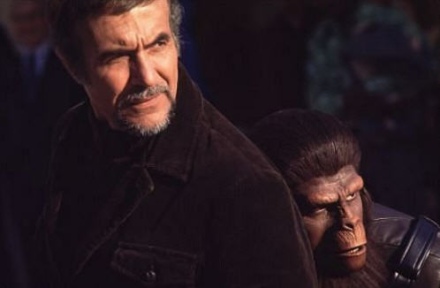
Hasslein, being a German scientist, investigates further by drugging Zira with truth serum and discovering 1) that they came from the future, 2) the apes have overrun humans in the future and 3) Earth blows up in the future, and 4) Zira is pregnant. As he's the guy who got us into this mess, he decides to put the space-time continuum back into the tooth-paste tube, and because he's a German scientist he wants to incarcerate the apes and abort the baby. He and Zaius would get along, I think. Cornelius and Zira escape, she gives birth to baby Milo, and are hidden by the owner of a conveniently travelling-by circus, Armando (Ricardo Montalban). But Hasslein (he's still a German scientist) helps track down the ape-parents and in an example of his countrymen's efficiency, manages to get Zira, the baby, Cornelius...and himself...killed. But, a visit back to Armando's reveals that he has a new baby chimpanzee in his circus—one capable of repeating one word, over and over: "Mama."****
The Lesson: "Even those who know the future are doomed to cause it." You've been warned.
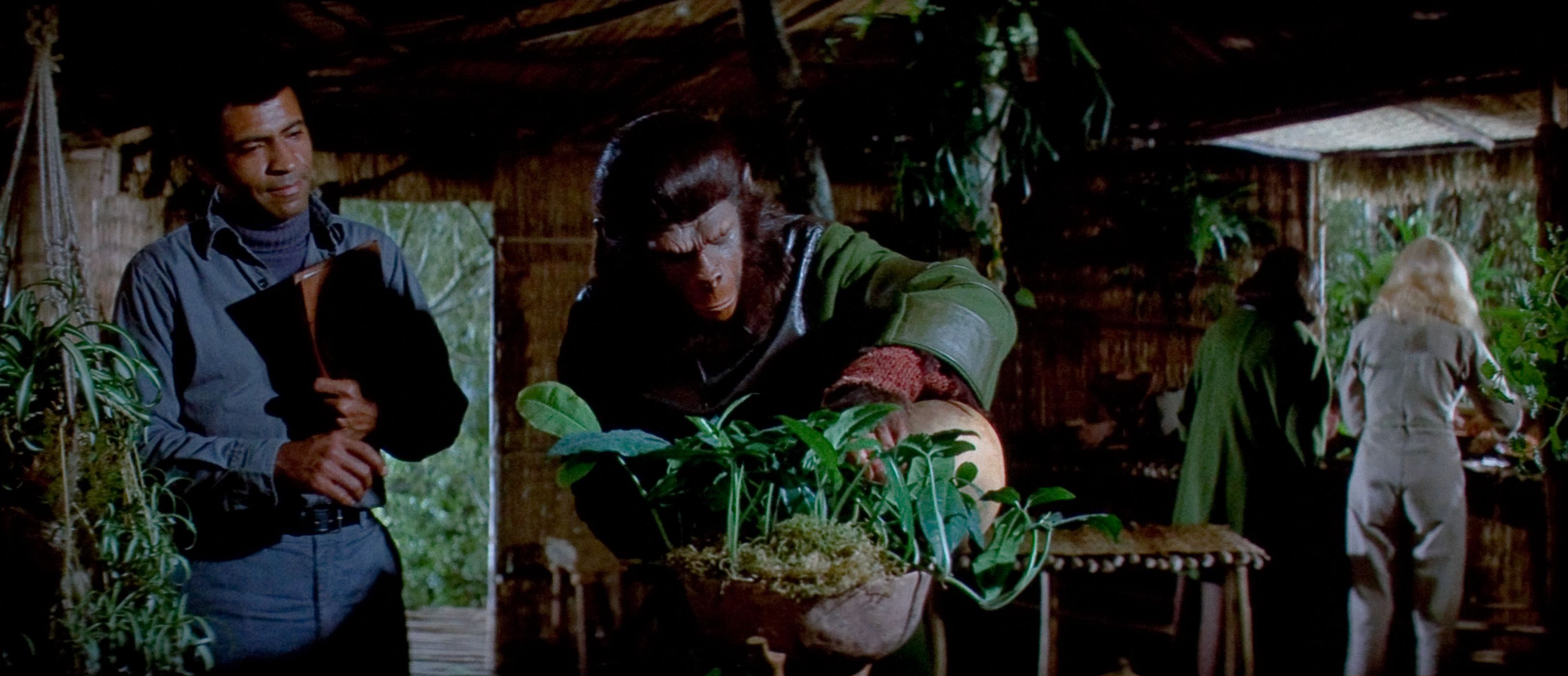
Conquest of the Planet of the Apes(J. Lee Thompson, 1972) Probably the most violent of the "Apes" movies, and, if studio cold-feet hadn't occurred, would have been the most radical. Told that it would be the last of the films, scenarist Dehn decided to connect the dots and reveal (on a limited budget, mind you) how the apes took control of the Planet from men.
We managed to survive the "Go Ape!" marathon, even staying to watch the first film again if for no other reason than to wash our minds of the dreadful Battle... We would have thrown our own poo at the screen as a comment, but it would have been a bit like "gilding the lily." The film-makers had thrown enough as it was.
But the series didn't end there: a Friday television showing of the first film on CBS received such high ratings that it inspired a television series, again starring Roddy McDowall as the chimp Galen, helping two earth astronauts lost in space (Ron Harper and James Naughton) in "Fugitive"-like episodes where they try to avoid capture by the gorillas and orangutans on a planet where they stick out like a sore opposable thumb. It lasted half a season. Then there was a Saturday morning cartoon "Return to the Planet of the Apes" (which can be seen on Hulu). You could blow it to smithereens, cut its budget, and turn it into a cartoon, but you couldn't kill the damn, dirty "Planet of the Apes." Well, maybe you could....
But wait...there's more: tomorrow sees yet another re-imagining of the "Planet of the Apes" story—this time, they're going back to re-do Conquest of the Planet of the Apes as Rise of the Planet of the Apes with the ubiquitous James Franco, Freida Pinto, Brian Cox, John Lithgow, and Tom Felton. Everybody's favorite motion-capture actor, the "precious" Andy Serkis will be playing Ceasar this time out. Rather than having the twisted timeline, it's going to be genetic engineering and "Franken-apes." Here's the (quite enticing) trailer:
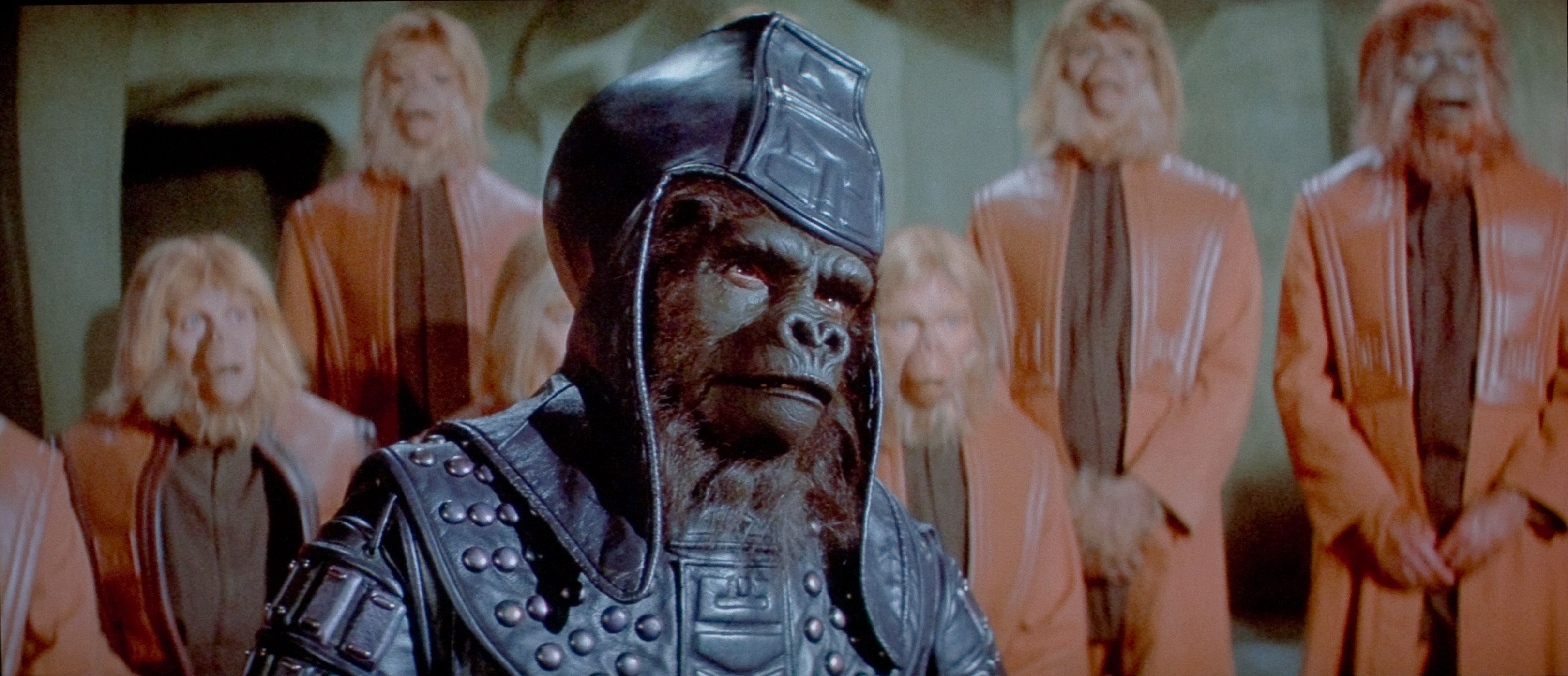
* McDowall, clasically trained and in movies since How Green Was My Valley, appeared in all the first round of ape movies except Beneath as well as the TV series. Easy to see why. McDowall's performance is something of a triumph over the make-up's adversity: scrunched down into a crouch, with an odd half-hopping gait, he could actually convey different emotions through the face covering make-up. His apes smiled with a high cheeked crinkliness, the mouth moved most realistically of the actors during speaking, he'd react in chagrin by bringing the jaw back and the forehead up, and, in irritation, McDowall used the make-up's tendency to go slack into an open-mouthed look of threat. But mostly, as Olivier was fond of saying, "It's all in the eyes, really." McDowall knew how to throw it all out his eyes, and one of the best moments of the series is in the luke-warm (owing to studio cold feet) Conquest of the Planet of the Apes, when McDowall's ape is allowed to pick his name from a book. He paws through a few pages, and jabs his finger at one word: "Caesar." Don Murray's villain-governor sees the gravity of the name and gives the ape a glower and finds "Caesar" giving him a penetrating, somewhat challenging stare. The two actors keep their eyes locked for a looong period of time (and they're not even the focus of the scene at this pont!). It's a funny, uneasy scene that evokes guarded laughter. McDowall was that good.
*** There's a reason Hasslein's name is spelled with two "s's," as he serves the same function as Dr. Zaius in the first two movies—the government representative who distrust the illegal immigrants amd takes matters into his own paws...er, hands. That he's played by the teutonic Eric Braeden (who also starred in Colossus: The Forbin Project) should alert anyone to never give the guy a grant for research of any kind!
**** Ironic because it's also the word that escapes from the baby-doll when its dropped and confirms Taylor's rather chauvinist contention (in the face of all evidence) that humans first ruled the Planet of the Apes.
***** Regardless what I think of them—I happen to like Ed Wood a lot and Mars Attacks slightly less so—they under-performed at the box-office.
There is one "remake" of Planet of the Apes, however that succeeds wildly.
That is the musical version presented on "The Simpsons," entitled
"Stop the Planet of the Apes-I Want To Get Off!" (now in Spanish!)


 Signs (2002) The aliens are attacking and this time it's personal. Shyamalan manged to keep the budget down by taking out anything more than the local perspective—the alien attacks happen in the background, broadcast on TV—and in fact, Shyamalan really didn't give a rip what the aliens looked like or what they were doing here. No, his interest was how this threat from the Heavens would affect a man of faith who'd lost it through tragedy (elements explored in Wide Awake). Mel Gibson plays a former minister, Graham Hess, a widower, with two oddly precocious kids (Rory Culkin and Abigail Breslin), and a brother (Joaquin Phoenix), whose better days are behind him, and they run a family farm. One morning, mysterious crop circles in their corn-fields without any explanation. Eventually, they realize that Earth is being invaded by aliens and that those crop-circles are navigation markers for the attackers. They barricade themselves in the farm-house, suspecting that the markers will attract the aliens to them, and prepare themselves for what looks like the end of the world. That the story is small-scale, sparse, intimate, and even funny, works to the film's advantage, because, really, what hasn't been done in an alien invasion story before? Eventually, everything gets tied up in a neat little bundle, but it's part of the Shyamalan schema of pre-destination and purpose realized, and the small cast...Gibson, Phoenix, Culkin, and Breslin is uniformly great.


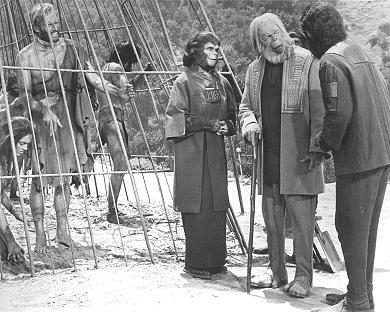 This brings Taylor to the attention of the authorities