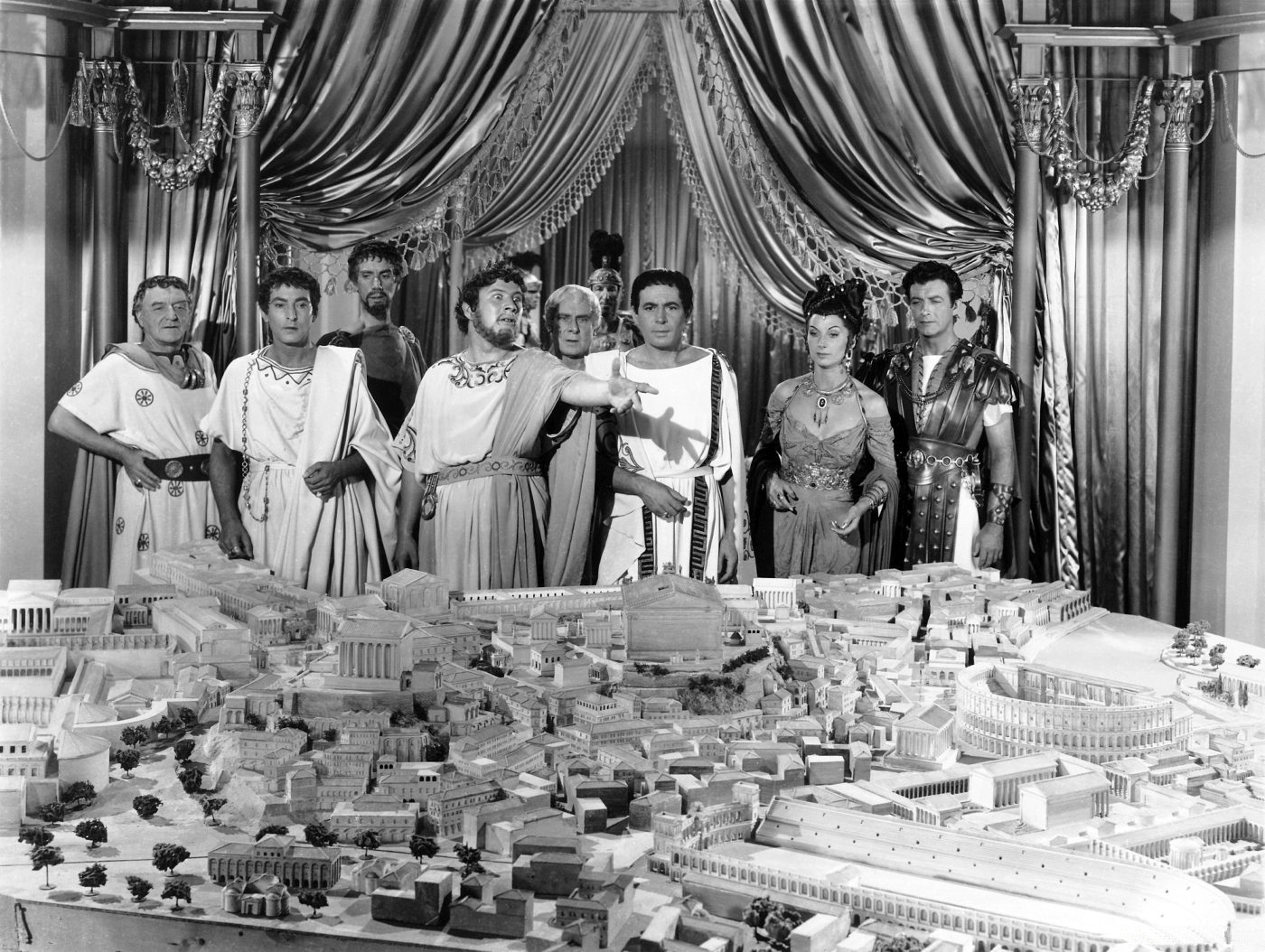
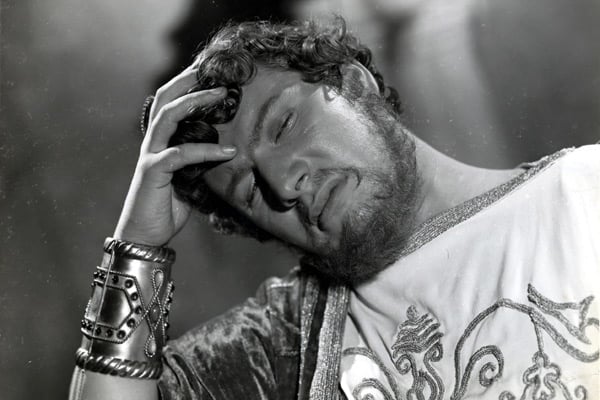
 "Quo Vadis" (Mervyn LeRoy, 1950) This is M-G-M's first big biblical epic in the post-World War II environment, the one that spawned a genre that prospered in theaters for the next twenty years...and that has been revived for these times—you can't have enough bread and circuses for a recessed populace. The studio re-built the war-torn studios of Cinecittà, which would be home to Roman epics for the next two decades. The expansive sets would increasingly overtake the films created, until the out-sized production of "Cleopatra" nearly bankrupted 20th Century Fox.
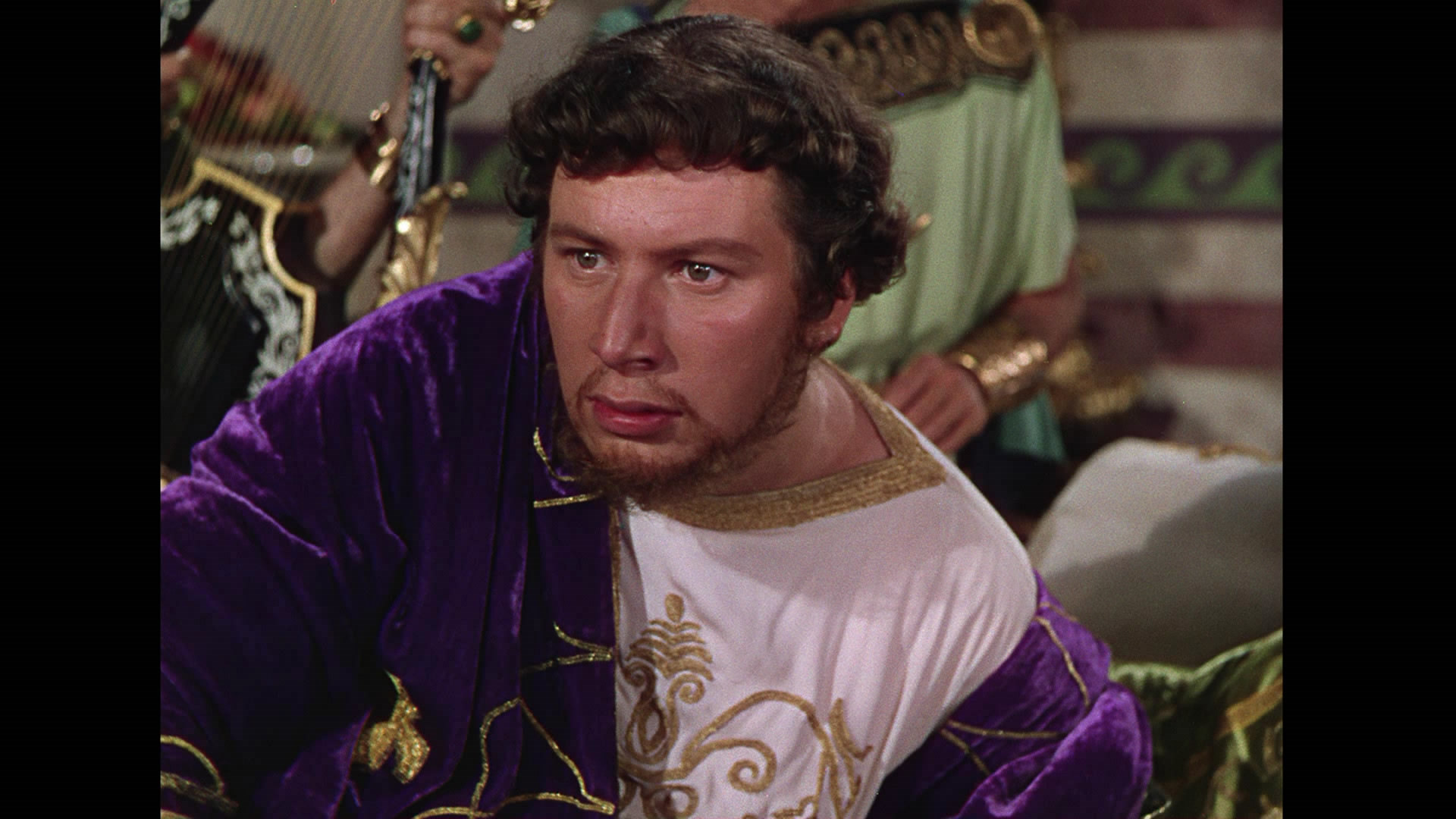
"Quo Vadis" tells two stories—of the Fall of Rome and the Rise of Christianity. Marcus Vinicus (Robert Taylor) returns from the wars to a very different Rome than the one he left; The Emperor Nero (Peter Ustinov) has declared himself a god, and the city is divided by his heinous act of murdering his wife and mother in order to marry the courtesan Poppaea (Patricia Laffan). Now, convinced of his own infallibility, the Emperor indulges his every whim and artistic pretension. That he's not very good at anything does not occur to him; anything a god can do must be significant.
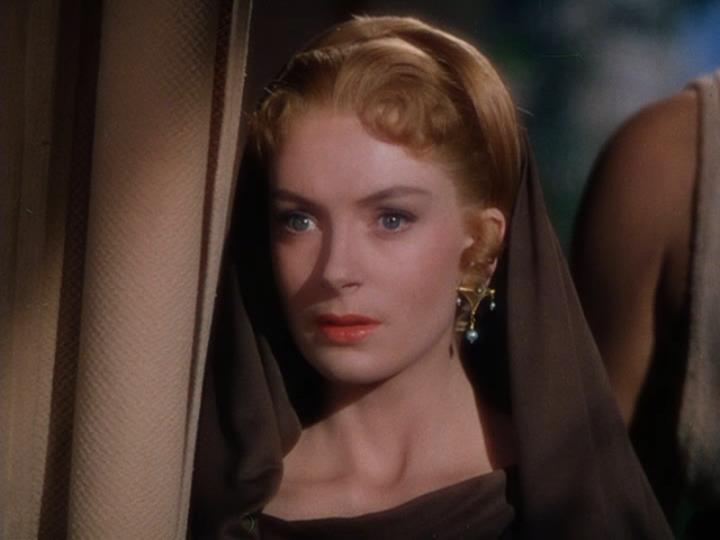
Vinicus, like the rest of Rome, indulges the Emperor—as long as what he does doesn't touch their lives, he can do anything he wants. For the returned tribune, what he wants is wine and wenching; Nero's wife is eyeing his lasciviously, but Vinicus sets his sights on the ward of the Senate, the captured princess of a Roman campaign, Lygia (Deborah Kerr). She is made a gift to him for his duty for Rome, but she initially spurns his advances. She's a follower of the teachings of the martyr Christ, as taught by his followers Paul (Abraham Sofaer) and Peter (Finlay Currie). This merely amuses Vinicus. But, when the Mad Nero decides he's going to design a new Rome in his own honor, and torches the old (without any evacuation plans), Vinicus sacrifices all to save Lygia.
It takes a lot of screen-time to get to that point in the story, and the film still has to have the persecution and throwing of Christians to the lions at Nero's behest, not to mention resolve all the story-tangles. So, the Christianity theme of "Quo Vadis" is given short shrift, despite the fact that the story hinges on it. As it ultimately leads to the establishment of The Church on the very spot where some of the events occurred, it undermines the religious under-pinning of the story.
The acting is a bit arch, as well. Leo Genn does a good turn as one of Nero's sycophants, but Kerr and Taylor are stuck in theatrical star mode, Taylor seems a bit out of place as a Roman Tribune, and doth protest too much when playing the Roman egotist. Peter Ustinov's Oscar-nominated turn as Nero is over-the-top and slobbering, a rare instance when the actor isn't doing precisely the right thing, even though the performance is an amusing one. All these elements lend a falseness to a story that has major significance to history and religion (however apocryphal it may be)
The Latin words "Quo Vadis?" translates to "whither thou goest?" or "where are you going?" It is what Simon Peter, fleeing Rome and its persecution of Christians, asks the passing vision of Jesus he encounters on the road. "Quo Vadis, Domine?" And the reply is "Eo Romam iterum crucifigi" (I am going to Rome to be crucified again), prompting Peter to return and sacrifice himself for his church. It's not a part of the "recognized" "approved" Bible—it is a section of the Apocrypha. And it is dramatised in the film with Christ speaking through the voice of a child. Peter goes back, and when confronted by his tormentors says "To die as Our Lord did is more than I deserve," to which the Roman guard replies in the tough-guy-henchman mode of the movie era, "We can change that." Another example of how this first modern Epic owes as much to LeRoy's gangster pictures as it does to the source material.*
It's always terrible to play the "what if?" game—the movie on the screen is the movie that was made. But in its early stages, it was being developed, and would have been directed, by...John Huston. Huston's historical films are always interesting for their attention to detail, and one ponders what he would have done with ancient Rome with a sad interest. His ironical eye would have been interesting, as well, when it came to Church matters. At that stage, before Huston's run-in's with Louis B. Mayer soured the deal (as reported in Lillian Ross's "Picture"), Marcus Vinicus was to be played by  Gregory Peck and Lygia by Elizabeth Taylor, all of 19 years old. Now, Peck was not the most versatile of actors, but he could be counted on to deliver a prideful manliness with some depth, the kind that Taylor musters up as an oafish braggadocio. Taylor manages to pull off the scenes of Vinicus in distress, but Peck would have provided a younger, more believable protagonist. Elizabeth Taylor would have been able to pull off the vulnerability that Kerr has difficulty providing, while also giving Lygia the same spine of steel as Kerr's. What might have been... One looks at this "Quo Vadis" and wishes things could have been different.
"Whither thou goest?" At this point in the history of the Catholic Church—at this cross-roads it has reached—where it is caught in a choice between Unquestioned Authority and the culpability of its representatives, that question has never been more pertinent.
Quo Vadis? Indeed.
* Nero's last words in the film are the same as Johnny Rico's at the end of LeRoy's "Little Caesar:" Is this the end of (me)?" 
Showing posts with label Missed It By That Much. Show all posts
Showing posts with label Missed It By That Much. Show all posts
Saturday, May 15, 2010
Missed It By That Much: Quo Vadis






Sunday, February 3, 2008
Missed It By That Much: Robin and Marian
Missed It By That MuchA series of analyses of treasured film that are not classics,
though they could have been if only a few elements were changed.
though they could have been if only a few elements were changed.

"Robin and Marian" (Columbia/Tri-Star) 1976

Director: Richard Lester
Screenplay: James Goldman
On paper, it looks perfect. The author of "The Lion In Winter" jumping a few years ahead in the story to tell of the end of Richard the Lionheart's bloody Crusades, and the return of Robin Hood and the loyal Little John to Sherwood Forest, where they find a lot has changed. Directing would be Richard Lester, who had returned to A-list prominence with his extraordinary staging of "The Three Musketeers"/"The Four Musketeers." He was becoming the "go-to" guy for period dramas, finding ways to bring a mature light-heartedness to any dreary point in history (or more appropriately, he would ignore Hollywood sound-stage pretense and show historical periods a bit more accurately--for example, his fly-filled Rome in the otherwise schtick-filled "A Funny Thing Happened On the Way to the Forum"). In the years since, his successes had been spotty: "Juggernaut," his all-star take on the disaster film, sank at the box-office (never mind--watch it!), as did his dream-project "Royal Flash" bringing his "Musketeers" adaptor George MacDonald Fraser's character to the big screen.
 But "Robin and Marian" had that Goldman script (unfortunately, Goldman's other produced screenplay "They Might Be Giants," although good for naming rock bands, also failed at the box-office despite the star-power of a post-"Patton" George C. Scott and Joanne Woodward) and a dream-cast. Goldman wanted Nicol Williamson as Robin and maybe Sean Connery as Little John. Lester got them, but reversed the roles, which Goldman had to admit, worked. Robert Shaw would re-unite with his "From Russia With Love" co-star (and golfing partner) as the Sheriff of Nottingham. Richard Harris would play King Richard, Denholm Elliott and Ronnie Barker (of "The Two Ronnies") would be Merry Men. Ian Holm would appear as the weasley King John. But, with the role of Maid Marian, they hit the mother-lode: after nearly a decade off the screen, producer Ray Stark coaxed Audrey Hepburn to play the older, wiser lost love of Robin Hood.
Filming was done in Spain (Lester's old haunt from "Musketeers" and "A Funny Thing Happened On the Way to the Forum") and completed quickly--Lester's a "one-take" kind of director which always appealed to Connery.
Then things started to go wrong.
The script by Goldman is charming, but often relies, as did "The Lion in Winter" on piquant anachronisms--the kind of "Isn't that funny? They talk like we do!" approach to historical drama that can be a bit cloying. "You never wrote!" complains Maid Marian at one point in the script about Robin Hood's many years away. "I don't know how!" says Robin in perplexed reply.
But there are some nice things--the over-all
 theme of living past your prime or need, combined with Robin's nostalgia for the old days and his childish belief that he can make things right again on all fronts. There are some nice little cliche-bashings. I remember a couple of cut-away shots of Nicol Williamson's Little John looking pained at Robin and Marian expressing affection for each other, and thinking, "Oh Lord, they're going to make Little John gay!" which I thought was a pretty cheap way to bring in relevance to the story. But it proves to be a clever gambit. Later in the film when Marian goes to John and begs him to keep Robin out of battle, she makes the same assumption. "You've always been jealous of me! But you had him all those years!" Williamson beautifully underplays this scene "Yer Rob's lady," he mumbles. "What?" she cries. "If ye'd been mine, I'd never've left." and Williamson chucks the apple he was eating into the night where it arcs and disappears. Nice set-up. Nice turn. As is the ending, recreating the myth of Robin firing one last arrow through the window, telling John to bury Marian and he where it lands. In Lester's last shot, it never falls to earth.
The charm of the script no doubt appealed to Hepburn--she has a speech at the end that most actresses would kill for, though, practically. it slows the film to a crawl at a critical time. There are publicity pictures of Lester and Connery showing her around the set, but Hepburn, given Lester's directorial approach of "You act, I'll shoot" might have been a bit put off by his quick approach and lack of hand-holding.
She made complaints about some of the gristlier aspects to Lester's cut, particularly to his opening the film with a shot of ripe fruit, and ending it, with
 the fruit rotting in the sun. This is a brilliant way to express an aspect of the story--that Robin, and Marian too, have overstayed their usefulness. And the film is gritty. The staging of an opening scene in a burned-out desert fortress feels more like everybody's waiting for Godot rather than King Richard. And Lester keeps his own anachronisms well-chosen, for example Robin Hood's morning routine--waking up in the forest, stretching, brushing his teeth with a fir branch, and reaching for a good ball-scratch until he sees Marian waking up--Connery's hopping attempt to be nonchalant is priceless.
And the violence is rough stuff. People die very badly
 in the film despite the chain-mail and armor, and the wounds they suffer are played up. Lester seemed determined to counter-act any chirpiness in the film by bringing it down to Earth. Maybe this upset Hepburn.
But for whatever reason, producer Ray Stark chose to take control. Initially, Lester employed Michel Legrand, his composer for the "Musketeers" films, to write a period-appropriate score, which was met with much approval, though it wasn't tuneful or romantic in any way. Stark, hearing the score, and not having control over much else, replaced it with a quickly put-together score by John Barry, who'd worked with Lester before and whose James Bond scores for Connery were well-known. He also won an Oscar for the music for Goldman's "The Lion in Winter." Barry's a wonderful composer, but the main-stay of his score is a bucolic love theme that frequently bounces over the scenes and makes them too sweet for a film about
 the passing of youth and the end of days. It's sounds like it would be more appropriate for a film about otters frolicing than "Robin and Marian." Perhaps Stark thought would be enough to soothe the blue-haired ladies going to see Audrey Hepburn's first film in a decade. Given her rather cute performance, maybe it would have been a good idea to re-cast her, too. Perhaps she took the role as a chance to get another Oscar (she won in 1954 for "Roman Holiday"--Katherine Hepburn won for her starring role in "The Lion in Winter"). She didn't get it. Nor did the blue-hairs show up. The film was not a major hit at the box office.
I've never heard the Legrand score, but considering the amazing job that he did scoring "The Three Musketeers" for Lester, the two might have done something very interesting for this film. But we'll never know. "Robin and Marian" is locked in a bizarre nether-world where it's at once too sweet, but also stark and unsentimental. Lester could make misconcieved films, but his approach to counter-point Goldman's sentimentality in a world of hardship was a good one. One would have liked to have seen that version of the film.
Subscribe to:
Posts (Atom)