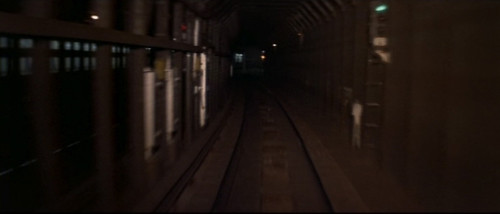
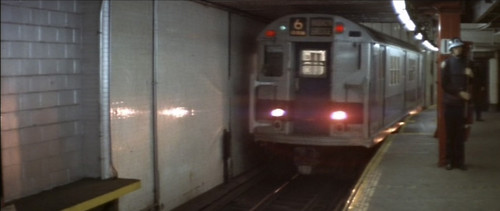
"The Taking of Pelham One Two Three" (Joseph Sargent, 1974) Taut, no-frills caper thriller about the hi-jacking of a New York subway train by a group of color-named conspirators. Veteran director Joseph Sargent and cinematographer Owen Roizman create a gritty landscape of dark passages and harsh fluorescent lighting while the Transit police try to negotiate with the hi-jackers, and the hi-jackers deal with their internal squabbles and a subway car of jumpy New Yorkers. It's like anything: Nothing's easy.
This was the first of more adaptations than necessary (a TV version was broadcast in 1999 with Edward James Olmos and Vincent D'Onofrio, and Tony Scott is making a new one with Denzel Washington and John Travolta) of John Godey's novel, but is the best of the bunch, having the advantage of a witty script penned by Peter Stone, screenwriter of "Charade" and the musical "1776." Stone realized the bare-bones plot of the novel wouldn't sustain a movie, and fleshed out the characters with a jokey, schlumpfy "attitude" that keeps the slow parts entertaining, especially when played by two character actors like Walter Matthau and Jerry Stiller. Matthau gets the advantage of playing a fairly straight character with a muffled humor, while Stiller makes the sarcasm of his dispatcher as dry as Brooklyn dust. By contrast, the hi-jackers (Hector Elizando, Martin Balsam, Earl Hindman, led by Robert Shaw) are twitchy no-nonsense cyphers cloaked in anonymity. It's the cops who are the interesting ones, as they race against time to secure a million dollars in ransom and deliver it before hostages begin being killed.
The direction and lighting take their cues from the documentary style of "The French Connection,"* as does the funky score by David Shire, but Stone's script is the factor that nudges the film beyond its thriller origins and give it a cynical style.
In fact, it is so well done, that one questions the need to do another version.
*Owen Roizman was the DP for that film, as well.
Showing posts with label Robert Shaw. Show all posts
Showing posts with label Robert Shaw. Show all posts
Thursday, August 14, 2008
The Taking of Pelham One Two Three (1974)



Sunday, February 3, 2008
Missed It By That Much: Robin and Marian
Missed It By That MuchA series of analyses of treasured film that are not classics,
though they could have been if only a few elements were changed.
though they could have been if only a few elements were changed.

"Robin and Marian" (Columbia/Tri-Star) 1976

Director: Richard Lester
Screenplay: James Goldman
On paper, it looks perfect. The author of "The Lion In Winter" jumping a few years ahead in the story to tell of the end of Richard the Lionheart's bloody Crusades, and the return of Robin Hood and the loyal Little John to Sherwood Forest, where they find a lot has changed. Directing would be Richard Lester, who had returned to A-list prominence with his extraordinary staging of "The Three Musketeers"/"The Four Musketeers." He was becoming the "go-to" guy for period dramas, finding ways to bring a mature light-heartedness to any dreary point in history (or more appropriately, he would ignore Hollywood sound-stage pretense and show historical periods a bit more accurately--for example, his fly-filled Rome in the otherwise schtick-filled "A Funny Thing Happened On the Way to the Forum"). In the years since, his successes had been spotty: "Juggernaut," his all-star take on the disaster film, sank at the box-office (never mind--watch it!), as did his dream-project "Royal Flash" bringing his "Musketeers" adaptor George MacDonald Fraser's character to the big screen.
 But "Robin and Marian" had that Goldman script (unfortunately, Goldman's other produced screenplay "They Might Be Giants," although good for naming rock bands, also failed at the box-office despite the star-power of a post-"Patton" George C. Scott and Joanne Woodward) and a dream-cast. Goldman wanted Nicol Williamson as Robin and maybe Sean Connery as Little John. Lester got them, but reversed the roles, which Goldman had to admit, worked. Robert Shaw would re-unite with his "From Russia With Love" co-star (and golfing partner) as the Sheriff of Nottingham. Richard Harris would play King Richard, Denholm Elliott and Ronnie Barker (of "The Two Ronnies") would be Merry Men. Ian Holm would appear as the weasley King John. But, with the role of Maid Marian, they hit the mother-lode: after nearly a decade off the screen, producer Ray Stark coaxed Audrey Hepburn to play the older, wiser lost love of Robin Hood.
Filming was done in Spain (Lester's old haunt from "Musketeers" and "A Funny Thing Happened On the Way to the Forum") and completed quickly--Lester's a "one-take" kind of director which always appealed to Connery.
Then things started to go wrong.
The script by Goldman is charming, but often relies, as did "The Lion in Winter" on piquant anachronisms--the kind of "Isn't that funny? They talk like we do!" approach to historical drama that can be a bit cloying. "You never wrote!" complains Maid Marian at one point in the script about Robin Hood's many years away. "I don't know how!" says Robin in perplexed reply.
But there are some nice things--the over-all
 theme of living past your prime or need, combined with Robin's nostalgia for the old days and his childish belief that he can make things right again on all fronts. There are some nice little cliche-bashings. I remember a couple of cut-away shots of Nicol Williamson's Little John looking pained at Robin and Marian expressing affection for each other, and thinking, "Oh Lord, they're going to make Little John gay!" which I thought was a pretty cheap way to bring in relevance to the story. But it proves to be a clever gambit. Later in the film when Marian goes to John and begs him to keep Robin out of battle, she makes the same assumption. "You've always been jealous of me! But you had him all those years!" Williamson beautifully underplays this scene "Yer Rob's lady," he mumbles. "What?" she cries. "If ye'd been mine, I'd never've left." and Williamson chucks the apple he was eating into the night where it arcs and disappears. Nice set-up. Nice turn. As is the ending, recreating the myth of Robin firing one last arrow through the window, telling John to bury Marian and he where it lands. In Lester's last shot, it never falls to earth.
The charm of the script no doubt appealed to Hepburn--she has a speech at the end that most actresses would kill for, though, practically. it slows the film to a crawl at a critical time. There are publicity pictures of Lester and Connery showing her around the set, but Hepburn, given Lester's directorial approach of "You act, I'll shoot" might have been a bit put off by his quick approach and lack of hand-holding.
She made complaints about some of the gristlier aspects to Lester's cut, particularly to his opening the film with a shot of ripe fruit, and ending it, with
 the fruit rotting in the sun. This is a brilliant way to express an aspect of the story--that Robin, and Marian too, have overstayed their usefulness. And the film is gritty. The staging of an opening scene in a burned-out desert fortress feels more like everybody's waiting for Godot rather than King Richard. And Lester keeps his own anachronisms well-chosen, for example Robin Hood's morning routine--waking up in the forest, stretching, brushing his teeth with a fir branch, and reaching for a good ball-scratch until he sees Marian waking up--Connery's hopping attempt to be nonchalant is priceless.
And the violence is rough stuff. People die very badly
 in the film despite the chain-mail and armor, and the wounds they suffer are played up. Lester seemed determined to counter-act any chirpiness in the film by bringing it down to Earth. Maybe this upset Hepburn.
But for whatever reason, producer Ray Stark chose to take control. Initially, Lester employed Michel Legrand, his composer for the "Musketeers" films, to write a period-appropriate score, which was met with much approval, though it wasn't tuneful or romantic in any way. Stark, hearing the score, and not having control over much else, replaced it with a quickly put-together score by John Barry, who'd worked with Lester before and whose James Bond scores for Connery were well-known. He also won an Oscar for the music for Goldman's "The Lion in Winter." Barry's a wonderful composer, but the main-stay of his score is a bucolic love theme that frequently bounces over the scenes and makes them too sweet for a film about
 the passing of youth and the end of days. It's sounds like it would be more appropriate for a film about otters frolicing than "Robin and Marian." Perhaps Stark thought would be enough to soothe the blue-haired ladies going to see Audrey Hepburn's first film in a decade. Given her rather cute performance, maybe it would have been a good idea to re-cast her, too. Perhaps she took the role as a chance to get another Oscar (she won in 1954 for "Roman Holiday"--Katherine Hepburn won for her starring role in "The Lion in Winter"). She didn't get it. Nor did the blue-hairs show up. The film was not a major hit at the box office.
I've never heard the Legrand score, but considering the amazing job that he did scoring "The Three Musketeers" for Lester, the two might have done something very interesting for this film. But we'll never know. "Robin and Marian" is locked in a bizarre nether-world where it's at once too sweet, but also stark and unsentimental. Lester could make misconcieved films, but his approach to counter-point Goldman's sentimentality in a world of hardship was a good one. One would have liked to have seen that version of the film.
Monday, January 14, 2008
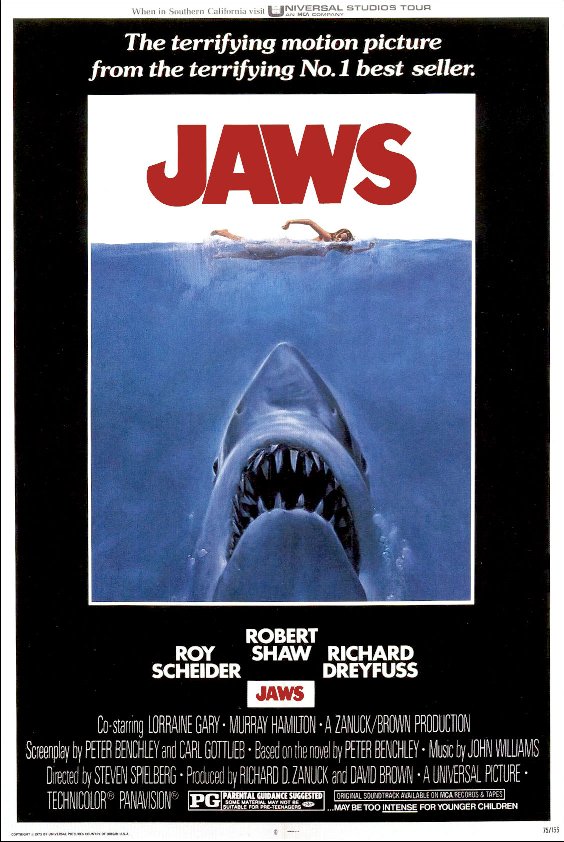
Olde Review - "Jaws"
 I was looking at an old work-book from a UW course I took on Film (Cinema 201-Section AB) way back in 1975. The assignment was to keep a journal of films you saw/film-related things you were doing. And I found this entry for October 5 (with errors intact):
"After putting it off all Summer I went to see the summer's most lucrative film, "Jaws." Despite the fact that it was a matinee showing with what seemed like Western Washington's entire pre-teen population running up and down the aisles, and despite a projectionist whose religion must have prohibited properly framing a film, one was able to glom some sort of satisfaction out of the efforts of Steven Spielberg. I haven't seen much of Spielberg's work on television or theater (I didn't see "Sugarland Express" or many of his "Columbo" episodes) but those I have seen shows him to be a concentrator on montages, and a manipulator of audience reactions through erratic editing.
First of all, I have to say that the movie is a darn sight better than the novel it is based on. Spielberg and his screenwriters Gottlieb and Benchley have taken out the unnecessary sub-plots and gotten down to brass tacks by concentrating on the shark and its influence on the denizens of Amity. The first half of the film deals with the suspicions and final confirmation that there is a chomping monster out there in the water. The second half deals with the attempts of Brody, Quint and Hooper to subdue the beast. The fact that the movie is so clearly divided into two sections leaves them open to be compared with each other. As such, I prefer the first half. In this section, Spielberg moves logically from one incident to the next, playing on the suspense of the viewer. Also in this section is Spielberg's best sequence in the picture. As people mill and swim along the beach, Scheider sits on the beach watching for any shark activity in the water. Using passers-by as a blind to soften the jolt and heighten disorientation, Spielberg cuts closer and closer to Scheider as his (and our) tension mounts. Spielberg cuts back and forth between the various people of interest and Scheider, teasing the viewer with a gliding swimming cap (an example of perverse humor running throughout the film, something totally left out of the book, and an improvement) and some underwater shots of splashing limbs (a previous visual signal that the shark was ready to attack), a piece of wood floating in the water that a now-deceased dog had been retrieving. Spielberg builds until when the shark attacks, Brody's horror is shown in a "Rear Window" type of space ripping that brings Brody closer and the surrounding area farther away, separating him from his surroundings. This final scene might have been done faster for my taste, but that Spielberg thought of using it at all, is to be admired. The whole sequence is well-cooordinated, tightly edited, and completely effective. As such, it is representative of the first half as a whole: logically scripted, meticulously photographed and planned, tightly edited. Of course, in the first half Spielberg concentrates on proof of the shark's existence. We never fully see it and Spielberg plays on our suspense in anticipating another attack.
With the second part, the suspense leaves. Spielberg, in the scenes in (sic) the Orca, Quint's boat, must rely on grotesque shots of the shark's maw, and sheer savagery, such as Quint being chewed alive. Subtlety leaves the picture. So does the execution that was so effective in the first part. Sequences are slip-shod, the editing, ragged and choppy (this for those action sequences in Part 2 to replace the suspense of Part 1). And Spielberg throws crisis upon crisis ("Let's see, is the boat on fire this time or is it taking on water?") Sure, the second part is tense like the first part, but it is also nerve-wracking. I reacted much more differently to Part 2 than to Part 1. The Orca sequences consisted of horrifying images and situations. I reacted with a horror that I also had from watching the various human torches in "Towering Inferno," a very inferior film, that relied solely on such horrors, for its shocks. Part 1 had much fewer than these, and instead of giving us a jolt from an unexpected violent action draws it out by making it expected and making us wait for it. Hitchcock can draw out such a scene expertly. Spielberg shows signs in Part 1 that he can also. But for now, he also must depend on sudden violence for a shock; a common weakness in films today."
Teacher's Remark: "Best treatment of the film I've yet read anywhere."
Well, as generous as that comment is, I still sound like a little snot, reading this. It's interesting to note this was at the beginning of Spielberg's career...long before he became "Dreamworks SKG"...and was still looked on as a novice film-maker, even by one such as me. And I agree with just about everything I said here. But then, Spielberg shot the film this way because he didn't have a working "mechanical shark" that he could use for the majority of the film's shooting, forcing him to use substitutes...like floating barrels, and to shoot an awful lot of peripheral stuff...and when he did use "Bruce," as the "shark" came to be known, well, it just didn't look very convincing. Hence the look and erratic nature of "Part 2"--the Orca scenes. Recall Orson Welles' line: "The enemy of art is the absence of limitations." I also found a paper on "The Godfather" I wrote for the same class that proved controversial. I'll get around to that one one of these days.
Subscribe to:
Posts (Atom)