Showing posts with label J. Show all posts

Wednesday, October 16, 2013

Jour de Fête

Jour de Fête (Jacques Tati, 1949) Tati's first feature length film, featuring the protagonist, François the rural postman (played by Tati), and many of the jokes re-bicycled from his 1947 short The School for Postmen.  Tati expands it with the story of a town's preparations for a big festival, and all the dangers for mayhem that accompany a feature of fun.  

Francois is on his daily rounds, done at their usual leisurely pace, but even more so for all the trouble the slightly officious fâcheux of a mailman can find to distract himself. But, the next day, inspired by an newsreel of how Americans are improving the speed of their mail delivery, he endeavors to increase the tempo of his route.

That's it in a nutshell, but the details, as with most silent comedies (although Jour de Fête isn't silent), are where the enjoyable bits are.  François is a more manic character than Tati's laid-back Mr. Hulot, and has a puppy-like fascination with just about everything and a cat-killing curiosity that gets him into both hot and cold water.  He is everybody's dork with a title, sure of himself and the only one in the room who is.  But his intentions are good.  His results are variable.

Tati filmed Jour de Fête twice, one version in black and white, and another using a color process called Thomson-color, a dicey system and lab that, unfortunately, went out of business before the film could be processed.  The black and white version was released to success, but Tati's dissatisfaction.  In 1962, he re-released it with a sub-plot about a sketch artist making pictures of the festival, and as the artist added colors to his black and white drawings, the colors would appear in the film, hand-tinted onto the film (this is the version of it I saw).  Increasingly, as the day wears on, more and more parts of the fair are tinted, sometimes surprising in what the choices are. 

Thirteen years after Tati's death, his daughter Sophie and French cinematographer Françoise Ede (who'd made a documentary about Tati's Playtime) managed to find the color elements and restore the Thomson-color version for the 1995 DVD release in France. 

It has yet to be released in the U.S.


The Three Lives of Jour de Fête


Black and White
Tinted

Color


Friday, March 16, 2012

John Carter

Forewarned is Four-Armed
or
"Men are for Mars, Women, Curvaceous"

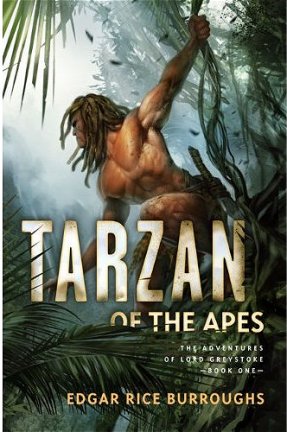
Edgar Rice Burroughs not only created Lord Greystoke (otherwise known as Tarzan of the Apes), but he created another hero who commuted between different worlds, that being John Carter, a Civil War vet, who managed to mentally displace himself from 19th Century Earth to Barsoom, as the natives called it, although we Earthers called it Mars.

The Carter books were solid pulp, but soaring adventures, with lusty Barsoomian princesses, warring political and tribal factions, including a race of 15 foot four armed insectoid inhabitants who were frequently at odds with the more humanoid Martians.  They inspired all sorts of science fiction writers like Bradbury and Clarke (and scientists including Carl Sagan) and film-makers from Lucas and Spielberg to Cameron and any author whose hero leads a Walter Mitty fantasy existence on another continent, planet or Universe. 

It's the 100th Anniversary of JC's creation, and it's about time that somebody made him take the astral projection from book-paper to celluloid...or pixels—not that there haven't been attempts over the years.  The books have rarely been out of print and—probably inspired by the covers painted by Frank Frazetta and Boris Vallejo that neatly made real Burroughs' vivid descriptions—and something's been in the works for the last couple of decades.  Now, finally, Disney took a chance with it—although they don't have a clue how to sell it—with director Andrew Stanton, one of Pixar's shining lights (directing both Finding Nemo and WALL·E).

And, hell, if they don't pull it off, making it work and seem fresh (if highly reverberent, as so many others have borrowed liberally from the series for years), while also recalling the straight-faced brio of biblical epics, combined with the cheese-factor of movie serials.  It's pulpy, old-fashioned, and definitely of the "white-guy-saves-the-natives" school,* but it has fun with it, playing off the duality of practically everybody in the script, reflecting the "two worlds" concepts inherent in the series.**  And why shouldn't Carter have an exploitable advantage over the Martians?  The planet's lesser gravity allows him to bound like a flea across landscapes and from precipitous tower to precipitous tower (although one loses that concept when Carter is shown getting winded climbing up steep hills).  And the Barsoomian concepts of ERB-dom are in full abundance, gathering details from the seriesthe white apes, the Therns (the duplicitous Gods of Mars), Carter's ways of dealing with passage between worlds (and covering up his disappearances on Earth), the participation of "Ned" Burroughs in the telling of the tales, and the environmental struggles of the dying Mars (although the canals of Mars are mostly gone, Stanton and co-screenwriters Mark Andrews and Michael Chabon, have created a gargantuan crawling city of Zodanga that sprawls across the planet's surface, leaving decimation in its wake.

Yes, it's pulpy.  Sure, it's cheesy.  But in the same way that any romance story is, (and Burroughs wrote romance novels for men), and this is boy-hokum space romance fantasy, without much logic to it, but enough momentum and emotion to keep so many of the quibbles at bay, and Stanton has shaped it in a fine, breezy style that kicks the story along at a good clip—check out the economy he uses to make note of Carter's indefatigable fighting instinct in the film's second sequence (the first is a rousing, dis-orientingly brusque Martian air battle) in trying to escape forced re-enlistment at the hands of his former Captain Powell (the now ubiquitous Bryan Cranston), then jumping from Western tropes (filmed in Monument Valley, of course) to Bibical epic trappings, to its own weird amalgamation of the two, with a bizarre twist on familiarity.  Where the movie roars are in the sword fights and hand-to-hand battles that bring to life Frazetta's "berserker" illustrations, that push the envelope of what can be presented in a PG-13 rating.

It's a grand ride, energetically told, imaginatively realized, with a good cast of fine actors, committed to doing it all with a straight face, and selling the fantasy, without any betrayal of the mechanics that had to go into this thing (a tough job to do that has bested others in the last few years).  I've read a few reviews by some critics that strike me as rather cranky about the film being derivative (in a reverse engineering way of looking at things), but, frankly, I don't think they saw the right movie.  Kill me if I ever get that sophisticated I can't have fun at something done well.  To this kid, who grew up reading the Barsoom books, (as Bradbury once wrote) Mars is Heaven.

John Carter (of Mars) is a great Saturday afternoon Matinee.


First edition depiction of John Carter and Dejah Thoris
from the initial hardcover dust-jacket
Frank Frazetta's iconic cover to "The Princess of Mars"
The production design of John Carter owes a little bit to both.


* It was, after all, written in 1912.  What's Avatar's excuse?

** Even the titular Princess of Mars has a nick-name in the film.  Carter calls her "Perfesser."  Carter's Thark name is Dojahr Sojak, but also "Virginia," after a mis-communication in greetings from Tarkus. 

Friday, November 18, 2011

J. Edgar


The F.B.I. (Love) Story
or
"What Determines a Man's Legacy is Sometimes That Which Isn't Seen"

J. Edgar Hoover ruled the Federal Bureau of Investigation for 45 years under the Department of Justice.  Over the course of his tenure, he made the FBI his personal weapon in defending the nation from threats as he saw them, even as they changed form—from Bolshevik radicals to hayseed bootleggers and bank robbers to Communists to Civil Rights Activists to his very bosses.  He did this unsubtly and unequivocally with press-trumpeted raids and whispered-about secret files that, if it didn't make him (as the phrase goes) "the most powerful man in the country," he was certainly the most feared.  It was always assumed that Hoover had "the goods" on everyone, and guaranteed his long-held government post with weapons in manila files.

When he died (in office), Hoover's mug had the well-known face of a haggard bulldog—keeping secrets is something that can age you rapidly—and keeping secrets is something Hoover did best.  Not only those of others, but his own.  Rumors swirled about the nature of his relationship with FBI Associate Director Clyde Tolson—that they were secretly gay lovers rather than "gentleman cops," that Hoover was a cross-dresser, and that the reason Hoover didn't pursue the gangsters of La Cosa Nostra in the '40's and '50's was because of compromising photographs in the hands of Meyer Lansky.  Nothing has ever been confirmed.  It's all just rumor, the smirking kind that the powerful get (but there's never any proof).

Which is why news of a Hoover bio-pic, written by Dustin Lance Black and directed by Clint Eastwood seemed so intriguing.  Eastwood isn't afraid to take chances, turning cliches on their ear and Black's clear-eyed script for Milk garnered an Oscar.  Their film J. Edgar promised "red meat," of the kind that could be delightfully and salaciously chewed.

 And the two men have taken chances...but not with the result you would think.  Rather than being a rant or skreed, J. Edgar is actually a sympathetic look at the FBI director and his peccadilloes and shortcomings.  There's nothing hysterical (save for one fist-fight that breaks out between Leonardo DiCaprio's Hoover and Armie Hammer's Tolson) in script or direction, but it offers a look at a severely closeted man who had to be in the times he lived and with the mantle he carried.  Ambitious, yes.  Paranoid, certainly.  Vain and glory-hunting, without a doubt.  Hoover craved the spotlight and his role in being "Head G-Man," while at the same time operating in the shadows, single-mindedly hoarding the secrets of others, while keeping his own in the height of ironies.   At the same time that he espoused the Bureau ethic for red-blooded American males as agents, one wonders if it is done for appearances' sake, a beard that would mask his own leanings while also serving as a "hiding-in-plain-sight" revelation of his own taste in men.

Black and Eastwood conduct the story-telling in flashback, as Hoover in his latter years, decides to set the record straight, dictating his memoirs to an amusingly rotating number of agent-stenographers who disappear as soon as a point is questioned, or a weakness revealed.  The story is a white-wash, reflecting the man's "official" view of the Bureau's history in a mix of incident and myth.  At many times, J.Edgar is a bit reminiscent of Citizen Kane, with its fracturing point-of-view, shifting perspective, and ironic commentary on some of the incidents.*

It also shares Kane's sense of the unattainable summation of a life.  C.F. Kane's had little to do with "Rosebud," just as Hoover's gay leanings was a small part of his whole story.  It began with a controlling mother (Judi Dench), determined to keep young John Edgar from becoming a drunk like his father.  Groomed to become "the most powerful man in the country," Mother Hoover controls her son's life to make him the image of the perfect son, diction lessons to force past a stammer, impeccable grooming, and the enforcement of all of her prejudices.  And the nullification of any behavior less than manly.  He is made in the image of his Mother's "perfect son," even though that image may be completely counter to reality.  It sets him on a lifelong course of fighting her battles, never really being his own man, as much as posing in the presentation he wanted to project.  A performance.  An actMyth and lies.

It is a story soaked in ironies: the man who kept secrets on everybody, but the biggest being his own; the investigator who saw no harm in exposing other's private lives, while keeping an iron grip on his own; the policeman who targetted and made war on many enemies, the primary one being himself.  Black and Eastwood present a case for sympathy, even empathy, for a man who shaped, and was shaped, by his times, who rose through the ranks of power in society, to not be shunned by it, and who searched for verifiable fact while living in denial, and closeted by the bureau of his own making.

J. Edgar is a Matinee.


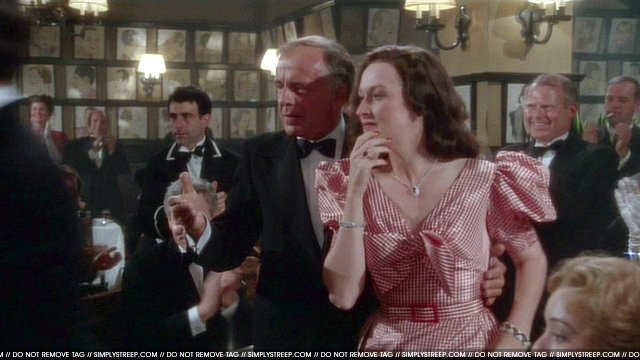
Hoover and Tolson at their regular table at The Stork Club.


* Not to mention that DiCaprio's "old-man" make-up makes him look more like the aged Charles Foster Kane than the jowly Hoover (still, it's better than the never convincing make-up that Hammer sports as an aging Tolson), and the shots of Hoover witnessing the Inaugural parades of Franklin Roosevelt and Richard Nixon are shot from the same angle as the "newsreel" shot of Kane in a balcony appearance with Adolph Hitler.

Thursday, January 13, 2011

Julia


Julia (Fred Zinnemann, 1977) Alvin Sargent's literate, excellent screenplay begins with the aged Lillian Hellman sitting in a boat at twilight, fishing, while over the soundtrack the voice of Jane Fonda  (playing Hellman) talks of the phenomenon of some paintings that reveal earlier paintings below the surface pigments—"pentimento," because the canvas "remembers."

The story that makes the spine of this film is much in dispute.  Hellman swears it occurred exactly as she wrote about it, but that the woman, Julia (Vanessa Redgrave), seems to have disappeared without a trace of documentation that she ever existed, makes one suspect.  Hellman was a writer, above all—a dramatist.  She would not be the first to sacrifice the truth for a better story. It may be a case of a story shining through the layers of artistry, like pentimento.

In the film, Hellman recounts her girl-school friendship with the free-spirited Julia, and how they parted: Julia to study in Vienna, Lily to study in the States and pursue both a writing career and a long affair with writer Dashiell Hammett (Jason Robards).  The two keep in touch, but the free-spirited Julia becomes involved in anti-fascist groups, making her a target for assault.  Hellman uses a world-tour after her Broadway successes to sidetrack to Austria to try to find her friend, who is hiding from the authorities, who, if they catch her, will most assuredly kill her.

It boasts a great cast (both Robards and Redgrave deservedly won Supporting Oscars), with Maximilian Schell, Hal Holbrook, and, in her film debut, a young brunette actress named Meryl Streep.*  Zinnemann's direction is unfussy skipping back in memory, and recounting the desperate times.  The film was edited by Walter Murch, one of his first editing jobs that did not entail working for school-chums like Francis Coppola and George Lucas

This was the favorite film of the girl I was dating in college; we must have seen it five times or so, images, situations and lines of dialogue all burned into my memory, like etchings on a canvas.


* Her blonde hair was dyed for the part.  And she was great, right from the start.  I still remember, burned into my mind, how Streep turned a parting compliment into a dismissal: "You look very slim, Lillian..."

Tuesday, June 22, 2010

Jonah Hex

"Jonah Bloody Hex...Ah'd Recognize that Half-Cooked Pie-Hole Anywhere."

The title of this post says it all: "Jonah Hex," the movie, is "half-cooked" as in half-baked and a "pie-hole" as in an empty void.

Sad, too.  "Jonah Hex" could have been a lot of savage fun if it were truer to the source—the DC comic book, the last semi-regular western title the publisher produces.

Jonah Hex was a confederate officer, who would not take part in a raid that would only produce civilian casualties, and so, he was the ultimate outlaw, trusted by neither the North or the South, and a bounty hunter, with a particularly nasty streak (not counting the melted-flesh scar adorning his right cheek*).

Hex was in a "funny book," although, he had no "powers and abilities far below those of mortal men," except a deadly accuracy with all things kill-making.  Seems that's not good enough for a four-color movie adaption these days, because the character now has a way to commune in the darker places of the spirit-world, awakening the dead with a touch in order to obtain information.  This hooey is a result of being saved from death by the mumbo-jumbo of the Crow Natives, who salved his wounds (but knew nothing from plastic surgery) and snatched his soul back from the after-life.**  Of course, the wounds were CAUSED by Natives in the comics, but consistency is the hob-goblin of little minds, and the pea-brains who made this one decided to air on the side of political correctness—which "Jonah Hex" never was and never should be.

The best of the "Hex" stories (not counting the ones where he was flung into a post-apocalyptic future, as a "Mad Max"-type) were written by a scribe with with his own twisted streak, Michael Fleischer (although don't call him "crazy" because Harlan Ellison implied it in an interview, and Fleischer sued...and lost).  The last issue he wrote had Hex meeting his end, and then being stuffed and mounted for display and the amusement of anyone who'd fork over two-bits.

He should contact his lawyers, because he might have better luck this time; this one's a PG-13 fiasco that's all-hat and no cattle, that tries to be gritty-tough, but doesn't have the powder to show a kill-shot.  A lot of people get killed, roasted, bludgeoned and chopped, but all discretely off-screen, even while its trying to be as nasty as can be, like a bully that talks tough but runs away from a fight.  And anyone who thinks "The A-Team" was poorly directed (guilty) will be amazed at the cluelessness displayed here by director Jimmy Hayward,*** former animator for Pixar and co-director of the very fine "Horton Hears a Who!"****

It's all shot in a snatch-and-grab style, awkwardly staged, with no time to linger over period detail, then settles into a Leone-like formality (with picturesquely ugly extras) that's to a spaghetti western what Chef Boy-Ar-Dee's "SpaghettiO's" is to fine Italian cuisine.  The Main Title fills in some animated back-story (fine), but then the thing hits the dirt like Hoss' played-out horse, with a tricked up story about a Doomsday Weapon about to be lobbed on Washington by Hex's former commander (who happened to murder his family to boot).  At about the half-way point, it looks like someone had seen "Sherlock Holmes"***** and tried to emulate the steam-punkish style, but—(never thought I'd say this!)—didn't have a clue how to match the precision of Guy Ritchie.

The movie's look changes dramatically whenever Megan Fox is on-screen, but that's not to the good.  Instead of the gritty telephoto look of the rest of the film, she looks like someone spent some precise time lighting her, as she's bathed in golden light with roseate high-lights in her hair—it's the reverse equivalent of smearing vaseline on the lens to hide an actresses' wrinkles—it stands apart from the rest of the film almost to a laughable degree—and for no good reason other than it makes her look damned good.  You can't shine gelled baby-spots on her performance, though, which, unencumbered of any modern girly-girl archness (at which she can be quite smart), is delivered in a flat, lazy drawl (sometimes, as she's inconsistent) and suggested to me that she might be this generation's Raquel Welch...or Jill St. John ("Ya look great, honey, just don't speak, okay?  You, too, Keanu").

It's a mess.  The script's bad (by the makers of the "Crank" movies—seems like a "natural" choice to me!), and only matched by the slip-shod film-making—whoever did it, and it could be a bean-counter at Warner for all I know.  The best parts are in the trailer, as the movie's only 85 minutes long (with credits), you're only missing 83 minutes of garbage.

I sat, during the credits, with my own Hex-like sneer on my face, contemplating just how badly this thing was screwed up, when the name of one of the Executive Producers showed up: Akiva Goldsman.  Of course!  The man who wrote the bad "Batman" scripts, who wrote "Lost In Space," "I Am Legend," "Practical Magic," "I, Robot," won an Oscar for "A Beautiful Mind ("schizophrenia can be fun, kids!!"), and adapted both "The DaVinci Code" and "Angels and Demons," and whose only talent seems to be the ability to "crack" a script by taking anything edgy or complicated and dumbing it down to the level of a kindergartner.  If he were a chef, his specialty would be a liquid, runny oatmeal.  His name has so symbolized terrible work that in my most churlish moments (usually after seeing one of "his" movies) I can only refer to him as "Hackiva."  The man should be barred from having control over anything of literary merit, and  consigned to merely working on "Chipmunk" sequels.  He's been pegged to direct the remake of (appropriately) "The Toxic Avenger."  One hopes that he's a better director than he is a writer/producer, and may prove to be with the bar set so low.  I doubt it.  It's tough to avoid the "Hackiva" hex.

"Jonah Hex" is a Waste of Time.


* Among the many flaws of the movie, the prosthetic creating this effect looks a bit plastic—you don't see it on the poster, of course, in another instance of white-washing the movie—but it does have one funny outcome:  Whenever Jonah goes to a bar, he always has to order a double because half of it goes through the open wound in his cheek.

** And, just to pile on the atmospherics, he also seems to be followed around by flocks of crow familiars, which must make it hard to sneak up on people, although he does from time to time. 

*** Okay, to be fair to Hayward—"Horton" IS a great movie and certainly the best of the recent big screen Seuss adaptations—was replaced by Warner execs by Francis Lawrence ("Constantine," "I Am Legend") during re-shoots, so that may account for the film's inconsistent tone and look. 

**** I first suspected hopelessness when the hilarious Will Arnett showed up...in a completely straight-laced role as a government functionary.  What a waste!

***** Both "Jonah" and "Sherlock" are Warner Brothers movies, so, that's a distinct possibility.

Saturday, December 5, 2009

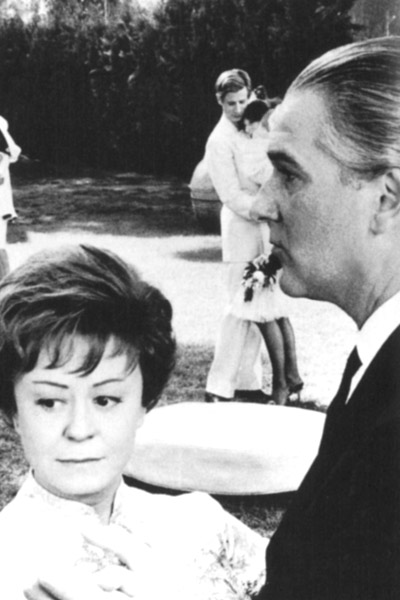
Juliet of the Spirits

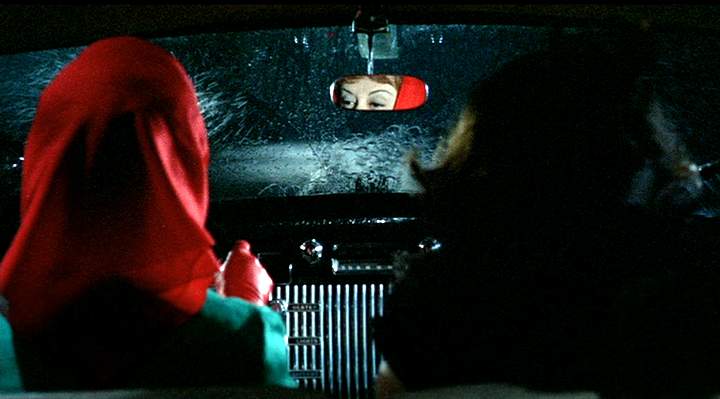
"Juliet of the Spirits" aka "Giulietta degli spiriti" (Federico Fellini, 1965) Any director's first forays into color from black and white are worthy of attention. John Ford filled his palette with startling reds. Stanley Kubrick set his first color film in the black and white world of space-travel and suffused interior spaces with hot red's, pale greens and cool blues. Fellini you'd expect to go somewhat crazy right off the bat.* But then, how colorful can priests and dirty beaches be? Oh, and the circuses. The circuses must be splendente with color.

But, the great Italian director starts conservatively with its dimension of other-worldliness and
earthy matters with a natural palette and muted colors. But as the world of Giulietta (played by Fellini's wife and muse, Giulietta Masina) starts to crush inside and explode outwards, the colors within her reach become more vibrant and exotic, approaching the phantasmagorical as she explores the phantasmic.

On her fifteenth anniversary to roguish businessman Giorgio (
Mario Pisu), Giulietta has a romantic dinner planned, only to have to share it with the clutch of hangers-on and sycophants he drags home with him. She begins to suspect that she's sharing him in other ways as well, and she seeks guidance from the spirit-world and evidence from a detective agency (of priests!) to get the goods on her no-good husband. At the same time, she begins...slowly, reluctantly to move on from her past life to a new one.

Fellini has famously said "All of my movies are really about me."** Of course. He's making them and writing them—creating them—so they'd naturally reflect his thoughts and
obsessions. But the Fellini who earlier collaborated with his wife-star on empathetic films like "Nights of Cabiria" and "La Strada" was now an internationally known and renowned film-maker. His previous films—"La dolce vita" and " "—were international hits, as well as being particularly autobiographical Pilgrim's progresses through the glitterati of a new Italian dynamic. He's still working in that mode in "Giulietta," but he's inserting Masina into the scenario as an outsider looking in on the decadent adventures of the journeying artist and exploiting the pain of the taken-for-granted wife in the story. One could be gossipy and say that Giorgio is Fellini and the entire movie is an invitation to Giulietta into his dream-life of passions, or a cinematic separation telling the world what a stick-in-the-mud his wife is, but given his past empathetic films with Masina, "Giulietta" is a bit dispassionate and curiously cold. And cruel; He's inserted his wife into his collection of grotesques and nubile concubines and finds her wanting.

Masina, too, is a little off-put in her performance. Where, in her previous roles with Fellini, she is passionate and eccentric, even effervescent, here she is withdrawn, and 1/4 into the film, after seeing
the constant tight smile that she has on her facepensive, patient (but only so far), repeated again and again in a medium close-up, you get the impression that she's holding back her frustration. One can hardly blame her; "Giulietta" is caught between two worlds, neither one to her comfort or liking. As she expressed the pain and hope of her characters in the past, one feels her pain with this film.

But you can't argue with a dream.
The colors are eye-popping. The images are by turns, challenging and inviting. The film has the same fascination that a corner holds—what's coming up? What lies beyond? But somewhere, in turning the corner, the journey becomes all-important. The lead character becomes lost in the landscape; lost, or left behind.

* Fellini first experimented with color in his segment of the Omnibus film "Boccaccio '70"—one of the director's "half"-films.

** I've avoided using the exact quote as it comes in two different flavors, depending on which translation you use (and which bumbling entertainment "journalist" translated it): "If I were to make a film about the life of a soul, it would end up being about me," or "Even if I set out to make a film about a fillet of sole, it would be about me." Cosa?

Thursday, December 3, 2009

Jules et Jim

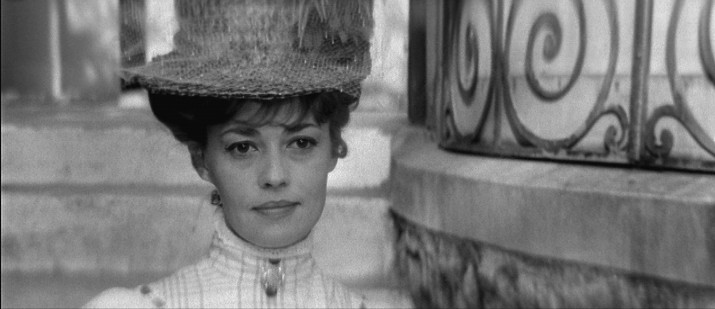
"Jules et Jim" aka "Jules and Jim" (François Truffaut, 1962) If only the folkies who saw "Jules and Jim" in 1962 had read it correctly, maybe the free-love era might not have overcompensated with drugs and disco in the '70's.

But, I'm getting ahead of myself.

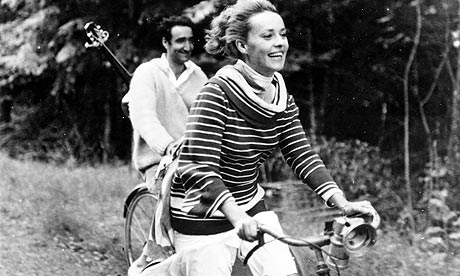
Truffaut's third film is a sprawling time-spanner
that starts in 1916 and falls just short of World War II and tells the story of a menage a trois that can't be managed by the partcipants. Jules and Jim (Oskar Werner, Henri Serre) are two life-long friends, whose friednship is complicated by war and the woman, Catherine (Jeanne Moreau) who comes between them. Their bohemian life-style flaunts society's more's, but living without rules means walking an imaginary line while drunk—even if you knew where you were going, you're unsure of how to get there.

The two boy-men (one French, one Austrian, which makes things difficult during the First World War) live an apparently work-free life pursuing art, until they encounter a Greek statue with a magnetic smile—on a whim they seek it out—
only to see it appear in the flesh on Catherine. Both men are drawn to her, but Jules—the one unlucky in love—wins her, while the non-committal Jim hangs back and observes and, as always, bides his time.

He observes, but he doesn't see.
Catherine is fascinating, but there's a shadow to that smile. She lives in the moment, and her mood can swing with the wind. She carries vitriol (sulfuric acid) for "lying eyes." And it's too soon in the relationship for him to make anything of the fact that she catches her dress on fire while burning love letters. Jim snuffs it out before there can be a complete "Bonfire of the Vanities."

On one of their excursions, Catherine dresses in men's clothing and
draws on a moustache. On this particular outing, she will be a man, living a man's life. But she's already doing it, making her rules, living by them and chucking them when they restrict her, the men following her because they can't keep up with her instincts. It will intensify when she marries Jules after the war, becoming the dominant one in the marriage, Jules almost slavishly putting up with her infidelities, brought on by the yoke of motherhood. For all the perfect happiness they seek outside of conformity, they end up perfectly miserable, and when Jim and Catherine begin an affair, something psychic snaps.

For being a part of the French "New Wave," it is very much a cautionary tale (taken from the novel by
Henri-Pierre Roché), old-fashioned in its insights warning of the dangers of an unconventional life-style.* Made on a limited budget, but with a large scope, Truffaut makes use of news-reels and other period chronicles (and movie-tropes like irises and wipes) to create a multi-media presentation of the period, and Truffaut starts his movie hyper-kinetically to show the puppyishness of youth, then gradually tapers the speed off to show the arc of a love affair and a life.

That arc has only one way to go, and it leaves all three adrift: Jim, his choices taken away from him, Catherine, her freedom from her, and Jules loses the captains of his fate.

Un sourire peut enchanter mais également séduire. Prenez l'attention.

* And, "of course," the woman is "the problem," but she is also the driving force—the vitality—that informs the lives of two rootless and feckless men.

Friday, November 20, 2009

Juggernaut

"Juggernaut" (Richard Lester, 1974) With the letting loose of the whirlwind that is "2012" this week, I thought I'd pay homage to a neglected, but sterling example of the "Disaster Movie"—the modestly budgeted, very smart "Juggernaut." Made in the shock-wave of such star-culling epics as "Airport," "The Poseidon Adventure," "Earthquake," and "The Towering Inferno" that had the gall to ask: "Who Will Survive?" in its posters, "Juggernaut" played the same game. See? All the stars are lined up like ducks in a gallery reading to be pinged, just like those other all-star slaughter fests.

"Juggernaut" plays the game differently, though, while maintaining the conventions. This film is as soapish as the others in terms of interpersonal relationships. But in other disaster movies, people are collateral damage to the epic depiction of crumbling masonry. Lester's film is all about character—the "disaster" is man-made, the people at-risk are portrayed intimately, if not by stars, by strong character actors (
Clifton James, Shirley Knight, Michael Hordern, Cyril Cusack, Julian Glover, Roy Kinnear—Lester's favorite buffoon is given a part to shine in this film—Ian Holm, a pre-fame Anthony Hopkins) you begin to care about. The cast is filled with faces who would become more familiar in later roles, but the two leads are Omar Sharif at his dyspeptic best as the Captain of the threatened ship and Richard Harris, who was never better than he is in this movie.

The cruise ship SS Britannic is half-way across the Atlantic Ocean when the line's president (
Holm) receives a phone call from "Juggernaut" saying there are seven barrels of high explosive rigged to go off the next day at a predetermined time. Unless a ransom is paid, the bombs will go off and the ship will sink. With the ransom, instructions to defuse the bombs will be sent. Any attempt to defuse the bombs will casue them to explode. Holm's president wants to pay the ransom quickly, but the British government threatens to pull his operating subsidy if he negotiates with terrorists. While Hopkins' Scotland Yard detective attempts to find "Juggernaut," bomb expert Tony Fallon (Harris) and his crew are sent out to the Britannic, dropped in the ocean, and clamber onto the boat.

The focus shifts to
Fallon, who sees all defusing jobs as a form of psychology—he's not trying to figure out the bomb, he's trying to figure out the man who made the bomb, and the tense scenes of Fallon examining one bomb to relay instructions to his crew are a whispered monologue of a man on the edge of death attempting to read the mind of the puzzle-maker in a battle of wills.

For director
Lester, who is fond of games and puzzle solving, the film is one of his obsessions brought to life with the bomb design being particularly devious. Given its nature, one is put immediately into the Fallon mind-set that he is battling a man and not a bomb. And it is this interplay, where one man must rely on his skills and his knowledge, rather than the tides of Fate, that make "Juggernaut" sail past the other films in the sub-genre.

Saturday, September 26, 2009

Jennifer's Body

"Cluster-Fox"

The critical drubbing that horror film/High School satire "Jennifer's Body" has endured belies its talent behind the camera. After all, it was critics who first pointed out the particular tenor of Diablo Cody's writing in "Juno" and championed it through its short Film Festival run into theaters (Jason Reitman's previous film "Thank You for Smoking," although a nice piece of film-making with a brain in its head, didn't do well at the box office.) Director Karyn Kusama isn't too shabby a director, although "Æon Flux" was an MTV-ginzu'd nightmare. I was surprised that 2oth Century Fox advertised it as a straight horror movie starring Megan Fox (aiming at—and only at—teenage boys), rather than including girls in the mix. As a result the film "opened soft" (as they say), and the film received decidedly mixed reviews depending on how serious they took it....even serial contrarian Armond White sided with the majority.

But horror films aren't just horror films—they say something about our fears, and more broadly, the "Holy Shite"-geist of society. The proverbially "good" horror movie touches our souls with a chilly finger and reminds us we're all mortal, but whether it's our relationship with God (in "
Frankenstein") or our relationship with sex and guilt ("Halloween"), horror films find our soft underbellies and either tickle us or stab up to the third knuckle.

"
Jennifer's Body" tells the story of Jennifer (Megan Fox) and Needy (Amanda Seyfried), girl-hood friends in the small town of Devil's Kettle who've stayed close depite a Mutt and Jeff relationship in high school. Jennifer is a cheerleader, drop-dead gorgeous and just as likely to tell you...to drop-dead, that is. Needy, by contrast is blond, bespectacled, and Jennifer's beard, of sorts, her "Biff" in "Diablo-Code," able to rein her in if she gets too out of control in their adventures. Unfortunately, one night when the pair go off to a local dive to see an up-and-coming indie band, the place goes up in flames and Jennifer's entranced enough with the lead singer (Adam Brody) to go off in the band's van, leaving Needy behind, in a state of shock.

When Needy gets home,
she finds Jennifer waiting for her, pale, crazy-eyed, smiling through bleeding gums, and vomiting a noxious black bile: she's turned into a succubus from Hell, and where in the past she used to merely chew out aggressive boys, now she chews them out and consumes them, leaving behind what one schoolmate describes as "lasagna with teeth." It's up to Needy to keep her Best Friend Forever from being discovered for the fiend she is, while simultaneously protecting her class-matesa task if she was any good at would effectively kill the movie.

It sounds like very rich material to go over the societal strata of High School with, if the territory didn't have so many skid-marks running through it already.* One could see it as a revenge flick for
all those sosh's who've terrorized the commoners, but Jennifer is as much a victim as anyone, and is an equal opportunity disembowler. And Needy's loyalties are so divided that you begin to wonder just whose side she's on. And the "males as victims of the woman" angle would seem fresh...if it was done 20 years ago.** Ultimately, the message aspect to it is weak and anemic, so ham-strung is the script by its own cross-messages. Good direction would divert your attention from them, but even there, everything comes up short. However cob-webbed the old cliche's, Kusama's rhythm for them is off, with loud bumps in the night that land with a dull thud. Opportunities lurk around every steadi-cammed corner and go unsprung. Then when something happens, Kusama won't cut away until the carnage becomes so much spewing corn-syrup. In trying to do something different and avoid the standard horror tropes, Kusama can't even deliver any chills.

And, despite what you've heard,
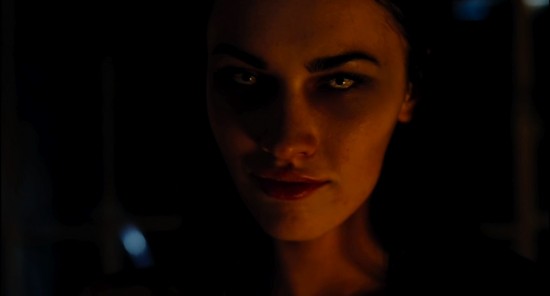
Megan Fox isn't half-bad, showing far more depth and humor than, say, other sex-bomb's like Raquel Welch, have in the past. Fox isn't afraid to not look beautiful, and does so frequently, even if it's just with an "I'm Sooo-C'ra-zy" glint in her eyes, but she has the easier part. Seyfried has to play the "normal" girl, who can be both the ugly duckling and beautiful swan when the circumstances call for it. It shows how weak the material is when J.K. Simmons and Amy Sedaris can't find much inspiration in their parts. There was potential here, but it isn't satirical enough, funny enough, or scary enough to provoke any reaction other indifference. And that's the worst death in a horror film.

"Jennifer's Body" is a Cable-Watcher.

* "Carrie," "Scream," "Species," "Buffy the Vampire Slayer" have all staked out the same territory and potential that "Jennifer's Body" squanders, usually more pointedly and more entertainingly.

** 50 years if you want to cross-categorize with "film noir."