Showing posts with label Anthony Hopkins. Show all posts

Wednesday, November 20, 2013

Thor: the Dark World (and the Comic-Book Movie Matrix)

"I Really Don't Understand What All the Fuss is About"
or
"Is There a Point to All This, Because There Needs to be a Point!"

Marvel's Thor was a necessary part of The Avengers puzzle—the Norse God is a little minor-ish when compared to A-listers like "Spider-man" or "Captain America" (in the comic world, anyway, where the same could be said for Iron Man) and is usually relegated to second row in group shots.   That first movie was a bit "iffy" despite a Shakesperean director (Kenneth Branagh) and a rather breath-taking conceptualization of Vanaheim.  It took Joss Whedon, though, to throw a couple of good lines into Thor's mouth (without him turning into a jokey punster) and making a grand villain out of Tom Hiddleston's Loki—so grand, in fact, that they brought him back for the second Thor movie, Thor: the Dark World.

This film is part of the "Marvel: Phase Two," which I translate to "We take advantage of The Avengers success by trying to make hay on individual characters until The Avengers 2 comes along."  Good strategy, that.  But there's the danger of watering down anticipation of that next film if they don't show some promise in the second installments, which already showed signs of rust in Iron Man 3.  Even if you're Thor, lightning doesn't always strike twice in the same franchise.

Thor 2 (if we can call it that) is quite a bit lighter in tone than the first film, the first one being rather stuffy, as if there was any humor it would blow the Norse mythology segments away in a puff of whimsy.  No, it was taking its playbook from Jackson's The Lord of the Rings trilogy where the heroes are rustic and the villains are really vile looking and the violence is over-the-top, but not so over the top as to risk an "R" rating.


In lieu of a program, clip and save this
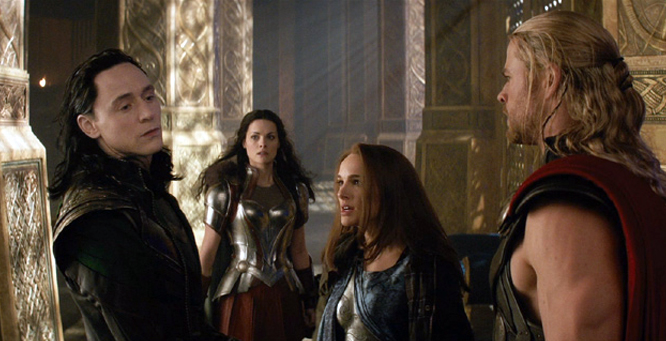
 handy diagram of the Thor Universe
It also compares to TLOTR by sharing the propensity for using the first six minutes or so of the film to shoe-horn as much detailed exposition intoned with doomed gravitas as can be wedged in before the title card.  "Long before the birth of Light," Anthony Hopkins' Odin informs us, "there was darkness. From the darkness, came the dark elves."  That's quite a jump, but then, we have to find out about the Aether (everything in the Marvel Universe seems to be a common term spelled wrong), the Kursed on Svartalfheim, and the 5,000 year configuration of the nine Realms, at which point evil with a capital "E" can take out all nine of them with having to make it a bank-shot.  Malekith (because everybody needs to have a name that sounds like a lisp) and who is played by an unrecognizable Christopher Ecclestonis the leader of the Dark Elves and wants the Aether all for himself, so that he can destroy the nine Realms because...well, I don't know why, it seems like a really dumb thing to do, akin to crapping where you eat.

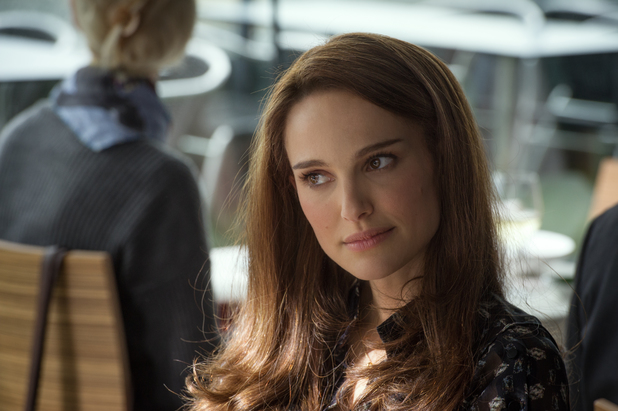
And at that point, I didn't care.  I just wanted something familiar so that I could stand any chance of following the movie.  Now, the last time I saw Thor, he was in The Avengers movie, and some mention is made of "New York," especially by gal-pal Jane Foster (Natalie Portman), who uses it 1) as part of a "why didn't you write me for two years?" hectoring of Thor (Chris Hemsworth, not so stodgy this time) and 2) a chance to lash out at Loki (Hiddleston) as if he personally took out her favorite pizza cart on Fifth (and he gets a chance to do his version of the line from The Dark Knight: "[She's got some fight in her]. I like that.").  Plus, Dr. Erik Selvig (Stellan Skarsgaard) has been acting strangely—making international news by stripping naked with some sort of stick-devices at Stonehenge that are supposed to do some sort of astral plane alignment or something, or maybe nothing as he's a bit of a raving lunatic at this point (His excuse: "I've had a God in my head.  I don't recommend it" Geez, Doc have you watched TBN lately?).


Meantime, the already-mentioned Loki is imprisoned in As-Gitmo, where, when he isn't using his quick-change ability, he's sulking and throwing illusory daggers at people, babbling contradictory dialogue ("You know, I've always loved our little talks because...actually I haven't").  That's some trickster. As with Hensworth's Thor, Hiddleston's Loki actually had become an interesting character in The Avengers movie, and although he's still a little devil, you begin to think that his motivations, if not his brains, are a little scrambled. He does provide a couple of little quick-changes in a walk-and-talk out of Asgard, one of which might be considered a cameo appearance.  He also provides the big "question mark" of the film, that is one of those things that the film-makers will either resolve, or, if they have bigger flounder to fry, will just dismiss with a line somewhere down the road.

Speaking of which, there could be considered three "stingers"—the convention of mid and post-credit "tags" in the Marvel super-hero films—in Thor: the Dark World that have decreasing importance, but increasing complexity (how many of these things are they going to have, not that Brian Tyler's score isn't rather fun to listen to, but sometimes I have better things to do than watch all the credits).  There is the "stinger" that ends the film, and confuses the issue of what was going on; there is the second "stinger," after Blur Studio's main credits, that serves as a preview for another Marvel production**—in this case, Guardians of the Galaxy with a look at Benicio del Toro's "Collector" (and we'll just say two words: "tonal shift"); finally, a third stinger at the very end of the movie that's purely for "shippers" and has an "after-thought" joke, much like the "shawarma" scene from The Avengers.  There's nothing essential to wait for, if you have a ride waiting.


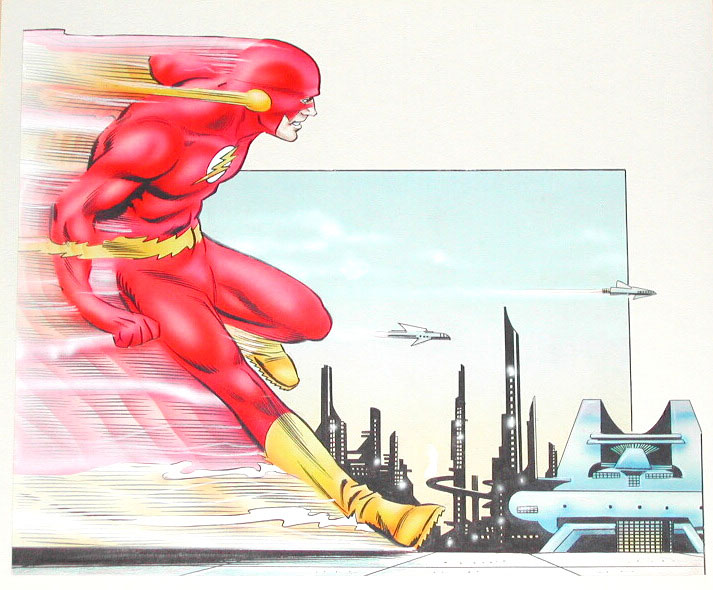
Throw in some ramps and Asgard could look like one of Carmine Infantino's futuristic cities.

So, summing up, Thor: the Dark World is generally more entertaining than the last one, but not entertaining, realm-changing, or artistic enough to make it rise above the Rental category.  Characters are born, characters die, and the Universe is returned to the same point it was at in the beginning of the movie, not unlike episodic TV.  Nothing major is going to happen until somebody's contract runs out.  In the meantime, it looks good, fulfills the action quotient, without going over the line (Hello, Man of Steel) to the point where you think it might be better not to have superheroes "saving the day" but destroying the infrastructure.  It does suffers from the Marvel "I-don't-know-but-it-sure-is-big" syndrome, where there are no rules, and merely randomness in phenomena that just show up, make a big noise and then *poof* go away, leaving us to mull over our shawarma or bowl of "Shreddies." There is no order to the Marvel Universe (as much as the tick-tock clockwork of the art direction says there is), and it's easier to take a page from "The X-Files" and just leave it unexplained.  Or come up with a convenient new super-power like "amnesia kiss" to take care of it.   Sometimes, rather than thinking through a problem, it's just better to hit it with a hammer to make you think it's getting better.

Thor: the Dark World is a Rental. 

"I've won an Oscar; why am I in this Moooo-viiiiie?"

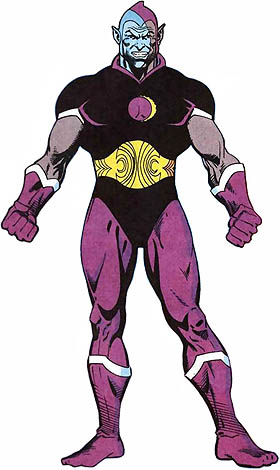
The comics Malekith


* Actually, I recognized him as Eclipso, a character from the DC Universe.  And you'd never recognize him as the Ninth Doctor. "Doctor who?" you ask.  "Exactly," I say.

** Although that's completely arbitrary, nothing is set in celluloid stone, and the solar wind is more stable than the tides of movie marketing—the cosmic villain Thanos appeared in The Avengers, may appear in Guardians in the Galaxy and definitely won't be in Avengers 2.


----------------------------------------------------------------------------------------------------
Now that that's done, one is worried about how to write about super-hero movies in the future.  There is a sameness to them that creeps from film to film—the mythos, the "givens" of selfless good and illogical (and often impractical) evil, the unquestioning quest for revenge, the brooding sky-scapes, the heavy air of portent, and the elaborate CGI.  One feels like they're in the process of grading different brands of chocolate.  They may be bitter or sweet, but they're all chocolate.

So, in the future, as the tent-poles of the franchise circus increase in number, we're going to do reviews of super-hero movies with a basic form—a Comic-Book Movie Matrix, that should distill what the movie's about, where it fits in its own little universe, and how successful it is—as a movie-movie, and maybe as a representative of that character.

Take a look at the list, and if you have any suggestions for what might be a critical consideration, drop a comment.


1) Is the movie version of the character recognizable from the graphic/comics version?

2) Is the plot something that someone who doesn't know the comic can come in and still understand?

3) If not, how complicated is the back-story that is provided in the movie?

4) What's wrong this time, plot-wise?

5) Is the story important enough to deserve its own movie, or is this one just "marking time?"

6) In relation to 5): Major villain or minor villain?

7) Is the back-story and motivation the same as in the graphic/comics version?

8) How radically different is the setting of the movie version to the graphic/comics version?

9) What compromises have been made to the comics version to make it "play" on-screen?

10) Is there a "Noooooooo!" moment? Yes? No?

11) Any easter-eggs for the true fans?

12) Is there a stinger? Is it worth waiting for?  Where does it occur?


Really, this is just to increase my Internet "hits"
Jaimie Alexander as Sif in Thor: The Dark World

Saturday, September 21, 2013

84 Charing Cross Road

84 Charing Cross Road (David Hugh Jones, 1987) You never know where something delightful might come in, like a parcel of unexpected mail that can lighten one's mood, or found money in a not-recently worn garment, or the spurious act of kindness.  The "nice" surprise.  84 Charing Cross is one of those, one of the films I've known about, mostly for its score by George Fenton, and that's about it, save that it starred Anne Bancroft and Anthony Hopkins, both of whom were in a popularity valley, Hopkins doing TV movies at that time (four years away from The Silence of the Lambs), she doing one movie a year, often at the behest of her producer-director husband, Mel Brooks (who produced this one).  

Good property, too.  Brooks tended to bankroll movies from stage-plays (or based on stage-plays), and 84 Charing Cross made it to the boards after being published in book form by author Helene Hanff, documenting her decades long relationship with a London book store.  This was in the day before the Internet, before Amazon, even before Barnes & Noble or Tower Books or the massive retailers who would buy books by the case-load to over-populate bargain bins. These were Mom & Pop operations, or even older, in dark rooms that smelled of dust and yellowing paper, where books had cloth or leather bindings, and even opening one of them was an adventure.  I could spend an entire day in one of these hovels, marveling at what one could find waiting on the heavy oaken shelves.  Before they actually became warehouses, it was the closest thing to a warehouse of information and just following a line across the Dewey Decimal System could lead you to an amazing surprise. 


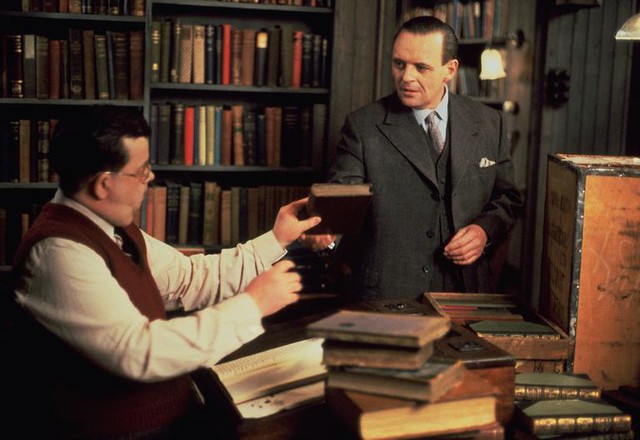
The Marks and Cohen Secondhand Bookseller at 84 Charing Cross Road

The story begins in New York, 1949.  Hanff, an editor by trade a playwright by desire, is looking for specific books around the city and coming up with bupkis. A stray ad in the Saturday Review of Books mentions the bookseller in London, Marks & Co, at the 84, Charing Cross Road address and she writes to the place looking for her treasures.  She is answered by Fred Doel, buyer, who sends her what he has, mentions the price and the two work out a pounds to dollars conversion with some sloppage in change here and there, with a relationship of immediate trust established, and an expertise that Hanff comes to rely on and marvel at.

Before long, her hearing of food shortages in Britain inspires her to send food-stuffs to the store, which are distributed amongst the employees and generally making their life increasingly special.  Before long, everyone is on a first name basis in correspondence and the letters and orders from Hanff become a special treat for the business.  It becomes a long distance love story of mutual kindnesses and respect.

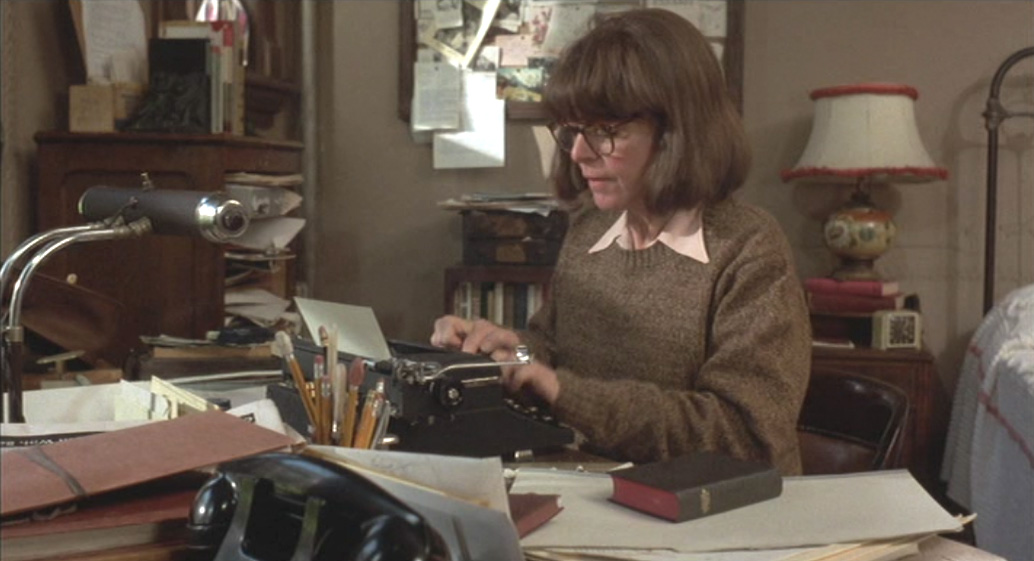
Hanff (Anne Bancroft) leaves a long ash watching Brief Encounter (in a theater, kids!)

Lovely story, and certainly something that anyone who has a favorite place of business or customer for whom business is never usual can relate to.  And it's one of those movies that would particularly appeal to the blue-haired old ladies in matinees for whom the shocks should not be roller-coasterish or beyond community standards.  The performances are comfortable—Bancroft's verbose and brazen, Hopkins, donnish and in that automaton-ically restrained emotionally manner he'd perfect in Remains of the Day, Judi Dench has very little to do as his wife, other than dignified fretting, but does it like with an immediacy and a good-natured bantering with Hopkins that feels right.

If there is one complaint, it is that, after awhile, the director gets weary with the cutting back and forth and gets a little cutesy with the transitions, at one point Hanff addresses the camera which is jarring, and then there is a sequence where both characters are talking to the camera with no pretext of papyrus, writing or reading interpolated as voice-over.  They appear (God help us) to be on Skype, and by that time the illusion and some of the magic disappears. They're not talking to each other anymore, as we've gotten used to.  Instead the fourth wall is broken and they're talking to us, right at us, and, frankly, treating the audience as an unnecessary go-between is rather a step-down from our previous role as omniscient viewer.  I didn't appreciate it much.

But other than that little spoiler, it's fun, nicely unique, and quite refreshing.


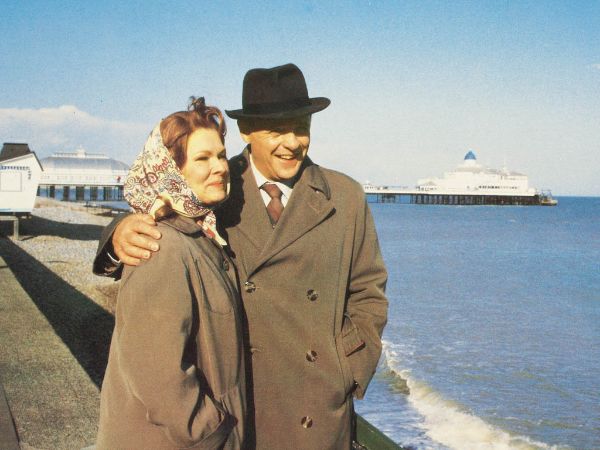
                         Helene Hanff                                                   The Doel family, Frank to the right


Sunday, December 16, 2012

Hitchcock

Hack-job
or 
Making Everyone a little Psycho

Making a movie is a boring enterprise.  Boring and thrilling at the same time.  Lots of sitting around, wasting time, waiting for the crew to be ready for that moment when you can't waste any time, the adrenaline is pumping, and things have to go right...over and over and over again until they do.

For Alfred Hitchcock, the thrill of movies wasn't in the filming (which lots of directors like because it's so social and a "rush"), or in the editing (where so many directors "find" their films), it was in the planning, the story-writing and the story-boarding—making the blueprint for the film that could be followed easily and by-the-numbers.  The best parts of his movies were not in performances (although they could be great*), but in the ideas that shape the film and make it worth watching...and worth watching again.  Watching that process, however, would probably not make a very compelling movie.

The trials and tribulations of the making of his landmark horror film Psycho was detailed in Steven Rebello's fun little read "Alfred Hitchcock and the Making of Psycho," and are now derailed in Hitchcock, a fictional adaptation of the book, which has as much to do with the events of making Psycho, as the film Psycho has to do with the book it was based on, which, truth to tell, Hitchcock never read.**

Well, few people have read Rebello's book, either (which is a shame, really) and so the chief "scenarist" James McLaughlin (who wrote Man of the House and co-wrote Black Swan...hmmm) and director Sacha Gervasi (who co-wrote The Terminal for Spielberg and whose only previous film was the documentary Anvil! The Story of Anvil!) have "written to silence"—as so may of the actual participants are dead—relying on "conventional wisdom" rather than facts to make their odd little combination of docu-fantasy.  Partially, this is because when it comes to movie-making (as opposed to life) truth is duller than fiction, but it is also more complicated and takes longer to explain and so we depend on a futzy short-hand to get to the point faster.  "Conventional Wisdom" in Hollywood is the same as "Based on a True Story."

Oh, don't get me wrong.  There are instances where the facts are there: Hitchcock's wife and collaborator Alma Reville did spot the "blink" (actually it was a throat swallow) in the pull-out from Janet Leigh's face after the murder (requiring a cut to the shower-head) and the "nudity" (which was solved with a black bar at the bottom of the screen); resistance was high to Psycho which Hitchcock chose to fulfill his contract for Paramount Studios—they did want something like North By Northwest, which made a lot of money for M-G-M—but not so much when Hitchcock revealed he was going to do it "for cheap" with his television crew—it's always about return for investment; he did come up with the brilliant advertising campaign for the film (like he'd previously done with his other films); much is made of the financial failure of Vertigo*** (ironic as it's—this year—considered "the greatest film ever made") as well as Hitchcock's insecurities and frailties (which were legion and they're all up there on the screen in his movies) and there are dribs and drabs of trivia sprinkled throughout the film.  But, they are far out-weighed by what is wrong.

What's wrong with this picture?  Oh, where to start?
What it gets wrong would fill another book by Rebello.  The film's obsession with Ed Gein—that is more attributable to author Robert Bloch than Hitchcock—feels wrong and wrong-headed, more to do with the screenwriter's issues than the subject's (I doubt that Hitchcock had the elaborate Gein fantasies that are imagined here).  The emphasis of Alma's collaboration with writer Whitfield Cook (Danny Huston)—who contributed to one good Hitchcock adaptation, Strangers on a Train, and one bad one, Stage Fright—is blown completely out of proportion from a mere consulting gig.  And the twist of the knife is the Hitchcock pathology, especially his treatment of women (the "Hitchcock Blondes," the grey suits, the make-overs, the favorites—Kelly and Bergman) despite the fact that Hitchcock always gave the more interesting parts and special attention to his actresses ("Hitch always threw the picture towards the girls" was Cary Grant's summation), not only for himself...but also his audience.

But what Hitchcock valued was loyalty. So he'd work with the same craftsmen over and over again out of loyalty, out of trust, out of convenience—past collaborators were one less complication to worry about.  And if they failed to deliver, he wouldn't work with them again, without a word of explanation as he hated confrontation.  "He was a coward," as Suzanne Pleshette opined.  Of course, he was.  His movies are naked displays of his phobias, foibles and fantasies.


And the films endure, because his frailties are just like ours.


Hitch is no longer alive to defend himself, but quite a few collaborators are. One wonders why Pat Hitchcock, Alfred and Alma's daughter, who usually runs defense for the Hitchcock Family Legacy, is silent while so many the current gaggle of films—this one and HBO's "The Girl"—are starting to piss on his grave.  But, then, the evil that men do lives after them, the good is oft interred with their bones.  So, let it be with Hitchcock.  His films are a testament to both good and evil, and our ability to rise above.  The films have lived on, decades after the man, and show no signs of falling out of fashion.  That's his lasting legacy.

 
For fans of the director, there is no such thing as bad news, but this movie truly is.  The performances are winning, though, as Scarlett Johansson occasionally convinces you she's studied up on Janet Leigh's mannerisms, although James D'Arcy plays Anthony Perkins as if he was playing Norman Bates and there was more to the man than that (reflecting the film's focus on rumor and gossip, rather than facts), we don't know what Alma Reville was like, as she stayed mostly behind the camera, but Helen Mirren's performance is fun and winning.  Anthony Hopkins' Hitchcock, however, is problematic—although it's not entirely his fault.  Hopkins is a brilliant mimic, and his own rich voice disappears in the deliberate cadence and sibilance of Hitchcock's own.  But (like much of the film), the portrayal is a bit too dependent on Hitchcock's public persona as a droll dead-pan.  This Hitchcock never smiles—perhaps it would have cracked the elaborate make-up Hopkins must wear to even resemble the director—and is entirely too mordant and lines up with "conventional wisdom" about the man, a view that, as Hitchcock himself cultivated it, he's a little responsible for.  As such, the portrayal comes across as a bit one dimensional, and one-sided.


One could get exercised about these things (and I obviously have), but as Hitchcock himself would say, "...it's only a mooo-vie."


Just not a very good one.  The best that can be said about Hitchcock (the movie) is that Alma's influence and great work is now a part of conventional wisdom, instead of the director's best-kept secret.


Hitchcock is a Cable-Watcher.


Yeah, that Hitchcock could be a tyrant on the set, alright...
Hitchcock's Best-Kept Secret: the incomparable Alma Reville


 * Hitchcock was often misquoted as saying "Actors were cattle" as if they were just a commodity to be "herded," when what he SAYS he said was that actors "should be treated like cattle."  Friend and Hollywood cut-up Carole Lombard responded by setting up two bovine pens on the set of Mr. and Mrs. Smith (1941), one for her and another for her co-star Robert Montgomery.

** In his near-definitive interview book "Hitchcock/Truffaut," Francois Truffaut spends a lot of time—too much time, really—going on about how lousy Robert Bloch's novel, "Psycho," is, and Hitchcock dismisses his comments by saying "I never read it.  I read the studio synopsis (the plot summary by studio "readers"), and the only thing I was interested in was the shower sequence and killing off the star half-way through the movie..."  

*** Funny thing.  Tippi Hedren has made what my father used to call "a big stink" about Hitchcock destroying her career after the financial failure of Marnie—never working with her again—and supposedly bad-mouthing her to other directors, producers, and all of Hollywood.  But, after Vertigo "tanked" at the box-office, Hitchcock never worked with James Stewart again, feeling like it was partially Stewart's presence in the film that caused the poor turn-out.  Stewart very much wanted to work on North By Northwest, but Hitchcock made every effort to lure his old collaborator Cary Grant out of his on again/off-again retirement to star in the film.  It was all part of Hitchcock's own ambivalence about hiring "name" actors for "his" projects, as often the dictates of producers and studios did not match the needs of the part.  But, again, that takes a long time to explain...and so we get stuck with "conventional wisdom."

Saturday, May 7, 2011

Thor


"Thor Thubject  (It's Hammerin' Time!)"
or
"Natalie Portman's Post-Oscar Slump, Part 2"

Never having been a fan of the comic, I could approach Thor without bias—I couldn't argue about the graphics on the hammer, or whether they followed the comics-mythology well, whether the casting was appropriate (they do well with what they got for material, and star Chris Hemsworth does a fine bellow just this side of Brian Blessed in his early, primal days).

But, as a movie, there's nothing too fresh about Thor, in fact, it reminded me a lot of Superman II, but with better architecture (designed by Bo Welch) with its super-beings walking through a hick-burgh doing derring deeds (in this case, a Gort like robot with a furnace grate for a face-plate—it's one of the genuinely cool things about this one), some dicey flying sequences that look a little flat and the big plot-holes in story-logic (if he could do that THEN, why couldn't he do it before?), and a little too much Unexplainium in how things happen and why.

By now, the Marvel films have become formulaic, let me count the ways: 1) love interest—which feels a bit tacked onto Thor (shouldn't there be a demi-goddess he should be attached to?); Stan Lee cameo (mercifully short); cross-characterizations and Marvel Universe details (S.H.I.E.L.D. is back with Agent Coulson (Clark Gregg) and a post-credits sneak with Samuel L. Jackson as Nick Fury (which doesn't amount to much, there aren't any other super-heroes in it, and seems bottled up as it involves Stellan Skarsgård's research scientist and Loki, played by Tom Hiddleston), Stark Industries is mentioned a couple times and there's an intriguing sneak peak of another Avenger in the film, (played by an Oscar nominee) and three action set-pieces that involve a lot of hammering, lots of ice-giants who all seem instantly shatterable and not much of a threat, despite some gratuitous growling (Colm Feore is pretty much unrecognizable as the King of the giants), and leaping with single bounds.

Kenneth Branagh directs with a lot of emphasis on swoops over spires for 3-D effects, ornate throne rooms full of pixelated somethings or other, and a curious propensity for dutch angles (I don't believe there's such a thing as Norse angles).  When Thor is at his most boastful, there is a tinge of Branagh's own Shakespearean projection, and Thor's brother Loki serves as an Iago-like presence throughout

But, it ain't Shakespeare.  The script wheels between the flat-nothing desert of New Mexico that seems to attract a lot of things falling from the Heavens (make that "The Seven Realms"—one of which is called "Anaheim") and the castles built on nothingness of the Asgardians, ruled over by Odin Allfather (played by Anthony Hopkins in "elderly King" mode, although he has flashes of interestingness here and there).  Natalie Portman tries her best with the romantic sub-plot, but it's a "nothing-girl-friend" role and her sections have a slight "blah-ness" to them, though they punch it up with some wacky banter from a wacky intern (Kat Dennings).  Thor feels like a second-rate Marvel movie, like the "Hulk" movies or the "Fantastic Four" films (but several steps above Howard the Duck*).  Try as they might to make it relatable, the scale just fails to register as something that humans have an business being a part of...or even caring about.  I found myself uninvolved and not caring.  Thor might be a hit this weekend, but it's more of a myth.

Thor is a Rental.  Thorry.


* Ya know, I'm amazed that George Lucas hasn't done a CG overhaul of HTD.  Yeah, it wouldn't make it any better, but at least it wouldn't look so clunky.

Tuesday, November 2, 2010

You Will Meet a Talk Dark Stranger

"Man Makes Plans. God Laughs."
or
"The 'Thing Without Feathers' Turns Out to be My Nephew."

With a title like You Will Meet a Tall Dark Stranger, you know this won't be one of Woody Allen's autobiographical tales.  The Woodman never strays too far from All Things Woody, his characters usually being scrambled aspects of himself, with one character being a direct comic stand-in.  The likes of Kenneth Branagh, Mia Farrow, John Cusack, Larry David and Edward Norton have all been past dopple-neuroti-gangers for the writer-director.  Rarely has there been a film of his without one.

This is one of those rare films, although one could say this tangled web of London residents could all be aspects of Allen's personality, with the closest being (maybe) Anthony Hopkins' Senior Fool.  One needs a play-book to keep everybody in this rondeau straight, although they are all in each others' orbits.  Start with Hopkins' Alfie—married to Helena (Gemma Jones), parents of Sally (Naomi Watts), wife of Roy (Josh Brolin).  Alfie, going through his "middle-age crazy" period, divorces Helena, sending her to a faux psychic (Pauline Collins) in her grief.  This all upsets Sally, who's trying to make ends meet working for a gallery owner, Greg (Antonio Banderas) while her husband is becoming frayed trying to write a follow-up to his previous publishing success.  Basically, everyone's in the weeds, and it's not long before everybody decides that somebody else's grass in better than their own.  Soon Da is marrying a call-girl/"actress" (Lucy Punch), Roy is pursuing a neighbor he keeps oggling through his window (Freida Pinto), and Sally starts to have feelings for her boss, as her feelings for Roy start to wane.

Allen starts and ends the movie with Leon Redbone warbling "When You Wish Upon a Star," and begins with Helena visiting a psychic, making one think that instead of a rating designation ("R," btw), it should have a sign saying "Abandon All Hope, Ye Who Sit in the Auditorium."  That he equates spiritualism as just a more rigorous form of "hoping against hope" (when the two are merely con-games with different sources—second-hand or internal) is dispiriting, and though it's a continuation of his life-view—"full of loneliness, and misery, and suffering, and unhappiness, and it's all over much too quickly"—there isn't the shrugging whimsey that serves as a warming punch-line this time.

For it may be true, as Emily Dickinson says, that "Hope is a thing without feathers" (and Allen's screwball lateral to that is the second title for this review), and "if wishes were horses, beggars would ride," I tend to take the more optimistic view.  Yes, there will always be poor (because Jesus tells me so) without a nagging destiny, that's no reason that, even though their feet are perpetually on the ground, they shouldn't be reaching for the stars.

Because there will always be stars, too, even if we don't see them, and even if we're not looking for them.  It's why I keep looking up at them.  It's why Woody Allen keeps making movies. 

Maybe his next one will be better.  I hope. 

You Will Meet a Tall Dark Stranger is a Rental. 

Wednesday, June 30, 2010

The Silence of the Lambs

The Silence of the Lambs  (Jonathan Demme, 1994) "I will NOT go see a movie like THAT!"

My client was adamant. I knew what he meant. I was repulsed by the idea, myself. After all, it was based on a novel by
Thomas Harris, the most ghoulish and cruelest of thriller writers. I'd read "Black Sunday" and it had an image I wish I could sand-paper out of my mind. I'd read "Red Dragon" (and seen it's Michael Mann movie adaptation, Manhunter), but I hadn't read "The Silence of the Lambs." After "Red Dragon" I swore off his novels. Harris went places I just didn't want to go...ever...not even in a pulp entertainment.

But the "buzz" about
The Silence of the Lambs was so good, I had to go. My wife didn't want to see it ("UH-uh"). But a female colleague heard I was going (and her husband was "in no way" going to see it), so we agreed to meet up at the theater—almost like a dare—and satisfy our morbid personalities.

See, I'd seen
Manhunter (starring pre-"CSI" William Petersen and Joan Allen), and the most intriguing thing about it was the introduction of a character named Dr. Hannibal Lecter* (played in Manhunter by Brian Cox). Lecter was an über-villain, like Dr. Mabuse. An insane genius psychiatrist, far more twisted than his clients, and he seemed unstoppable, uncontainable. Indeed, he was portrayed as a criminal so dangerous, he was kept in an impenetrable transparent cage of perspex. Cox played him agitated, and as a cannibal, he perpetually chewed gum, as if to satisfy a craving (or to keep his jaw strong).


A study in contrasts: Brian Cox (left) and Anthony Hopkins (below) as their respective Lecters


Anthony Hopkins famously played him in The Silence of the Lambs as an unblinking, supremely confident being of stillness.  When we first see him (after an extended build-up talking about how dangerous he is), the camera slides him into view—and he's already waiting for us.  That's a bravura move (done in silence, purely visually, pure cinema) in collaboration between Hopkins and director Jonathan Demme (who has never been so "to-the-bone" instinctual in his set-ups).  Our first sight of Hopkins is a shock; he's not doing anything. Nor does he have to.  In a dungeon-cage with a tranparent front (not bars, as they're too penetrable, but more like a zoo for observation), he still is in control of the situation and knows it, and his "laser-like intellect" has already begun profiling his prey, FBI Agent Clarice Starling (a bird's name, indicative of small, tremulous life), played by a subtly vibrating Jodie Foster (who's brilliant).


This is a horror movie.  And the best horror movies don't just scare us.  They touch a nerve, grab on tight and slither up into our brains and take root, never leaving us.  They know what scares us, right down to the DNA in our collective alligator brains, and individually to our unbidden (but specially created) nightmares.  And like Jaws, The Silence of the Lambs serves up one of the special horrors to our conqueror species:  fear of being eaten...consumed.  It's not just the dying and the reduction to meat, but it's taking away ourselves, our "souls," our specialness and uniqueness (like Gene Hackman's Sheriff in Unforgiven blurting down the echoing cave of a gun-barrel: "I was building a HOUSE!"). "Deserves got nothing to do with it."

And that's a horror.  A true horror.  A viscerally twisting fear of humankind, that we don't matter, everything that we are, that we do, can't hold off Death.  Any Death.  Every "snuff" makes us just dust in the wind.  And everything we are amounts to nothing.  "Tell her to paint an inch thick.  To this favour, she must come."

"Make her laugh at that."

Sure, it's a horror movie.  But becoming carrion is one thing.  This is about skin-suits. Bad enough to be turned into a meal, yes.  But apparel? 

Yeee-EEE-eee!

So, that's the reason so many people might NOT want to go see The Silence of the Lambs.  What is there, of such value, to see it?  To face your fears and walk into the darkened theater to face these horrors?


There is a subtle sub-text in the film and a not-so-subtle-visual one.  One of the travails of Agent Starling is to go through her rigorous FBI training, the obstacles, the paths, includes making her way through a traditional world (and institutuion) of men.  She is often under-estimated (except by, of all people, Lecter, who is intrigued and challenged by her: "People will say we're in love" is his witty reversal on it) and must point out to the officious males she's dealing with (and it is dealing) that they are treating her in a subordinate manner ("You know, we get a lot of detectives here, but I must say I can't ever remember one as attractive."), even though she calls everyone—her superior Jack Crawford (Scott Glenn), Lecter, even the serial killer she's seeking (the terrific Ted Levine, whose brave work in this film should never be unacknowledged in any review) "sir."  


Foster's Starling is a victim, too, although she won't succumb to victimization.  She fights it.  And she fights the battle for the women whose lives have been lost through the pathological extension of that subjugation, and, with her work, might be saved.  Reduction of the human being is the tough theme that runs through The Silence of the Lambs, and it is perpetrated by serial killers and officials alike, anyone who assumes more authority than they are due.  Or more superiority than they deserve.  We all covet that to some degree.  Look in the mirror.

What looks back?


"The eyes are the window to the Soul" they say (although it's difficult to trace who originally said it).  And director Demme makes sure we see them, both eyes and souls.  Frequently, even in conversations, he will photograph the actors looking straight on, their eyes on a direct axis with the center of the camera lens (and thus, the audience).  A lot of directors do that (Spike Lee and Woody Allen, for instances), but more often than not, those uses are to have the characters speak directly to the audience, breaking the fourth wall between player and played.  Not Demme (and this is what makes Silence unique).  Whole conversations happen, with the actors looking out at us, as if we are the ones having the conversation—we connect with them, those flickering phantoms on the screen, making them more than casual phantoms, the ones we merely observe as if they were any passer-by on the street.  We look into those windows, see the Souls (even those of the Soulless) and immediately those beings have value and worth, not just victims of our gaze, but true intimates, more than the mere shells that envelop their spirits.

And this is what separates The Silence of the Lambs from the many serial-killer/slasher movies that stalk through the genre—separates it a full 180° from the other films, in fact.  So many of those use the POV subjective shot of the killer observing and hunting its prey (and Demme uses it, too, in the nerve-jangling final confrontation between Starling and "Buffalo" Bill).  So many used it, in fact, that it became a cliché of the type, putting us in the uncomfortable position of seeing the world through the victimizer's vision, rather than the victim's—the hunter's, rather than the hunted's—accompanied by the rasping inhuman breath of the coveting, rather than the pleadings of the coveted.  "The Silence of the Lambs" breathes new life into the form, elevating the victim, the genre...and us.  It gives value to the human being, and in so doing, raises itself up, as well.

---------------------------------------------------

"So," the client began tentatively. "I went to go see Silence of the Lambs... 

"And?" I offered. "Wha'd ya think?"

He blurted. "Ya know, that was a REALLY GOOD movie."

Yes, it is.  Still is. Repulsive, still, certainly. But a great movie.


And it still has the distinction of being the only horror movie to win the Best Picture Oscar, and, even rarer, to win the Big Five categories (Best Picture, Director, Actor, Actress, Screenplay), all deservedly so.


* In Mann's film, he's Hannibal Lecktor, a more oral-associated mad scientist name.