Showing posts with label Kenneth Branagh. Show all posts

Friday, January 6, 2012

My Week with Marilyn

The Battle of Mrs. Miller ("Whose Side Are You On?")
or
"What Becomes a Legend Most?"

"We are such stuff as dreams are made on" says Prospero in "The Tempest."  Prospero and Shakespeare run through My Week with Marilyn (the latest confection of young love and fictionalized reality—with appearance by Judi Dench—from the Weinstein Company) like Caliban, a spirit of confused form and intent in Shakespeare's play.  All the revelers in Simon Curtis' film (written—especially well by Adrian Hodges) are real, based on real individuals and events, but how true they are to the source is questionable, given as they are to interpretation and expectations, and to the dreams of the particpants, for whom the movies and fame is a business, an art, as well as personal obsessions.

None more so than Norma Jeane Baker, who inhabited our world and our dreams as Marilyn Monroe, a free spirit trapped in prison bars formed of klieg lights, a vessel that men poured their love and lust onto and women their princess dreams of being the most popular girl in the world.  Heavy, heavy burden, that, and she bore it from the lowliest, sleeziest agent in Hollywood to Kings of the Sports World and Men of Letters.  She also bore it from other film stars, who looked at her fame and wanted a piece of it (and maybe her, as well), including Sir Laurence Olivier, who insisted on casting Marilyn in his production of The Prince and the Showgirl, a trifling movie if ever there was one, despite being written by Terence Rattigan. 

What Marilyn saw in doing the movie was obvious; she was working with the world's greatest Shakespearean actor and director on a film written by an acknowledged writer.  Why Olivier wanted to do this is less so: financial success for his unbarded film; name recognition to draw the crowds for a film out of his metier; maybe he just wanted Marilyn, as so many men did, and the new bride of American playwright Arthur Miller (not the best looking guy in the world) might have provided a world to conquer for the actor who played so much ambitious Shakespearean royalty.  Whatever the reason, Olivier was constantly frustrated with the fragile, neurotic actress, who had other concerns besides working with the exacting director—it was the only film she made outside of her protective home studio, 20th Century Fox, the only film she made outside of the United States, and the first film of her fledgling production company—all unique concerns that might have distracted the actress, on top of her new marriage to Miller and a hushed-up pregnancy during filming that resulted in a miscarriage.

The film that Hodges and Curtis have crafted from the events and a tell-all written about it by filmmaker Colin Clark (played by Eddie Redmayne), is one of the better ones to be made of this type.  Casting has a lot to do with it.  Michelle Williams is not the first person I would picture as Norma Jean, but the versatile actress manages to capture the presence of the human being at the core of the star and suggest the winsomeness that charmed so many in her orbit.   Kenneth Branagh has been linked with Olivier for most of his career, paralleling the legendary thesp by making his own film directing debut with a gritty, strapping version of Olivier's own first directorial effort of Henry V.  His portrayal of Olivier might seem too easy, but there was nothing about the man that was 'easy," and Branagh has a fine time, mixing Olivier voices, accents, and mercurial swings throughout the film—his Olivier is never consistent in mood, manner or method, just as you'd expect a Master Thespian to be (he maximizes the precision of great lines like "Teaching Miss Monroe to ACT is like trying to teach URDU to a BADGER!").  Rounding out the cast are such fine performers as Toby Jones (hilariously indecent as Marilyn's publicist and future Planet of the Apes producer Arthur P. Jacobs), Dench—playing a woman she once acted with, Dame Sybil Thorndike, Dougray Scott as Arthur Miller, and Weinstein go-to girl Julia Ormond as Olivier wife-partner, Vivien Leigh, as well as turns by Zoë Wanamaker, Derek Jacobi, Emma Watson, and one of my favorites, Michael Kitchen.  Redmayne is fine and callow, as he's supposed to be, eyes always a little bit wide at a new turn of events in the film business, and a tentative, crooked half-smile his constant fall-back.

The script is full of great zingers about fame, fortune, the madness of the movie business, and how hard people work to make things look effortless (and on-time), as well as loads of gossipy references for "the blue-hairs."  It also has a nice undercurrent that touches on fantasy and reality—hence the Prospero—and the process by which reality and the illusion of reality can really mess us up...if we believe our own "press."  Sometimes the illusion of reality is nothing more than fantasy—the very stuff that dreams are made on.  And the makers of fantasy are just as susceptible as the rest of us—maybe even more.  My Week with Marilyn brings to the imagination such thoughts, beyond just being a tale of the Myth of Marilyn. 

She did exist in reality.  And her reality had little to do with her fantasy.  The camera loved her.  And that's what killed her. 

My Week with Marilyn is a Full-Price Ticket.


Marilyn...in the wind.
 

Saturday, May 7, 2011

Thor


"Thor Thubject  (It's Hammerin' Time!)"
or
"Natalie Portman's Post-Oscar Slump, Part 2"

Never having been a fan of the comic, I could approach Thor without bias—I couldn't argue about the graphics on the hammer, or whether they followed the comics-mythology well, whether the casting was appropriate (they do well with what they got for material, and star Chris Hemsworth does a fine bellow just this side of Brian Blessed in his early, primal days).

But, as a movie, there's nothing too fresh about Thor, in fact, it reminded me a lot of Superman II, but with better architecture (designed by Bo Welch) with its super-beings walking through a hick-burgh doing derring deeds (in this case, a Gort like robot with a furnace grate for a face-plate—it's one of the genuinely cool things about this one), some dicey flying sequences that look a little flat and the big plot-holes in story-logic (if he could do that THEN, why couldn't he do it before?), and a little too much Unexplainium in how things happen and why.

By now, the Marvel films have become formulaic, let me count the ways: 1) love interest—which feels a bit tacked onto Thor (shouldn't there be a demi-goddess he should be attached to?); Stan Lee cameo (mercifully short); cross-characterizations and Marvel Universe details (S.H.I.E.L.D. is back with Agent Coulson (Clark Gregg) and a post-credits sneak with Samuel L. Jackson as Nick Fury (which doesn't amount to much, there aren't any other super-heroes in it, and seems bottled up as it involves Stellan Skarsgård's research scientist and Loki, played by Tom Hiddleston), Stark Industries is mentioned a couple times and there's an intriguing sneak peak of another Avenger in the film, (played by an Oscar nominee) and three action set-pieces that involve a lot of hammering, lots of ice-giants who all seem instantly shatterable and not much of a threat, despite some gratuitous growling (Colm Feore is pretty much unrecognizable as the King of the giants), and leaping with single bounds.

Kenneth Branagh directs with a lot of emphasis on swoops over spires for 3-D effects, ornate throne rooms full of pixelated somethings or other, and a curious propensity for dutch angles (I don't believe there's such a thing as Norse angles).  When Thor is at his most boastful, there is a tinge of Branagh's own Shakespearean projection, and Thor's brother Loki serves as an Iago-like presence throughout. 

But, it ain't Shakespeare.  The script wheels between the flat-nothing desert of New Mexico that seems to attract a lot of things falling from the Heavens (make that "The Seven Realms"—one of which is called "Anaheim") and the castles built on nothingness of the Asgardians, ruled over by Odin Allfather (played by Anthony Hopkins in "elderly King" mode, although he has flashes of interestingness here and there).  Natalie Portman tries her best with the romantic sub-plot, but it's a "nothing-girl-friend" role and her sections have a slight "blah-ness" to them, though they punch it up with some wacky banter from a wacky intern (Kat Dennings).  Thor feels like a second-rate Marvel movie, like the "Hulk" movies or the "Fantastic Four" films (but several steps above Howard the Duck*).  Try as they might to make it relatable, the scale just fails to register as something that humans have an business being a part of...or even caring about.  I found myself uninvolved and not caring.  Thor might be a hit this weekend, but it's more of a myth.

Thor is a Rental.  Thorry.


* Ya know, I'm amazed that George Lucas hasn't done a CG overhaul of HTD.  Yeah, it wouldn't make it any better, but at least it wouldn't look so clunky.

Wednesday, January 7, 2009

Valkyrie

"Tom Cruise Takes on Adolph Hitler, Single-Handed"

Man, they've been rough on this movie and particularly Tom Cruise. It's been "Nacht der Langen Messer" for a lot of gossip columnists who fancy themselves critics (but had second-hand facts from their "sources").

Among the rumors that were cackled about was Cruise's lack of a German accent (there aren't any in the film and Singer makes a big show of having Cruise narrate the beginning of the film in German--a rather stilted, halting German--before transitioning to English), that he rather grossly takes out a glass eye in the film (he does--with his back turned to the camera), that he does a weird Nazi salute (his character—
the very real Count Von Stauffenberg—gets away with forgoing the usual "nicety" throughout the film until, in one the film's best scenes, the War Minister (Tom Wilkinson) calls him on it—"I would hear you say it, Colonel"—and Stauffenberg, irritated that 1) he can't get away with it and 2) he's being forced to give allegiance to a man he's conspiring to kill, pointedly turns and yells the "Heil" while giving the standard right-handed salute—only he doesn't have a right hand, having lost it in the war, the stump of his arm protruding from his jacket, making a point. Good scene, that.)

Look, I don't like
Tom Cruise, either. His performances have dragged down many a movie, especially the vain-glorious ones. The man seems incapable of portraying more than one emotion at a time, and whenever his character must choose options Cruise falls back on an open-mouthed blank look.* Listening to him in interviews I get the impression that his acting process runs something like: "I have to do this, then I have to do this, then I have to do this, and then I have to do this."

But, though he's the King of Hollywood and the "
Jesus Christ of Scientology," one could cut him some slack; none--none--of those rumors are true in the final analysis, and no one making those rumors is held accountable for them, shoddy and unprofessional as they are. But that's "Entertainment Reporting" for ya.**

Enough about the 800 pound top-gorilla. How's the movie? Good, actually. It is a true story and screenwriter
Christopher McQuarrie and Director Bryan Singer (the team behind, and still trying to top, "The Usual Suspects") lay everything out in a clear time-line, do their best to cast faces that have a 1940's German feel and maintain the illusion that it's that time and place. They keep the tension taut and make the most of the story's quirks and coincidences--the kind that make you say "if it weren't true, you couldn't write this." The fascination of the story is that the German bureaucracy that was running the war (badly in the minds of the conspirators) was just as responsible for the conspiracy coming apart, and Stauffenberg was the only one with the Hoden who would push if there was any chance of success, to his credit and the conspiracy's detriment. It's a real-life version of the "Mission: Impossible" scenario, something that Cruise is all-too familiar with.

What's nice is that the film-makers turn the process of pushing through policy-changes into tense set-pieces that have just as much verve as a pistol shoot-out. In fact, there is a small fire-fight later in the film and getting Hitler to sign a policy-change (
the "Valkyrie" operation of the title) is far more exciting. And the central gambit—there's a satchel with a bomb in it that's set to go off in a room full of men—is the classic Hitchcock example of tension versus surprise.

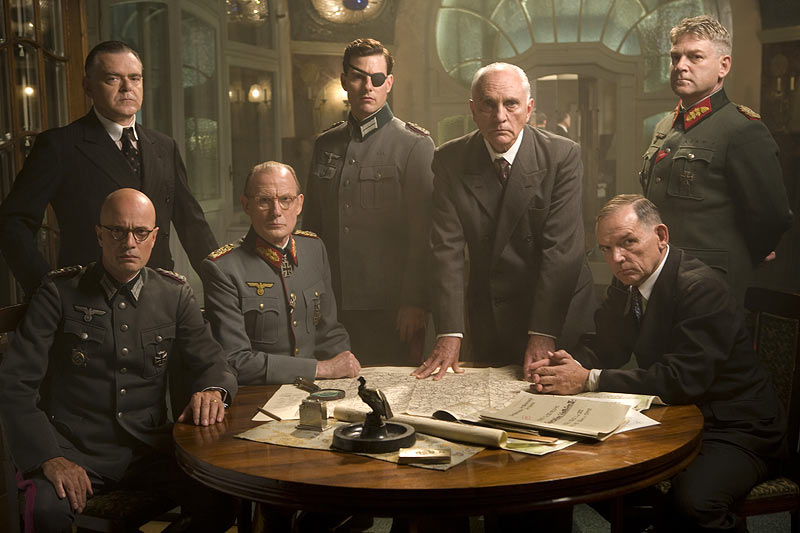
The film is top-heavy with fine British actors: Wilkinson, Terence Stamp (another fine portrait of an ineffectual pol), Bill Nighy, Eddie Izzard (!!), Ian McNeice and Kenneth Branagh. That's a lot of impressive talent for a movie not written by Richard Curtis. And they're all spot-on. Branagh is particularly good as an initial conspirator who is whisked away to the front before the bombing of the Führerhauptquartier Wolfsschanze.

If there's a problem with the movie, it is
Singer's sometimes too-elaborate direction—the most egregious example being a circular camera move that catches up to a record (and it's a 78!) so that it can stabilize on the label to read the word "Walkure" while the rest of the world keeps on spinning—an awful lot of effect for not much return. As such it parallels the story of the movie.*** The film of that story—of conscience over the brutal status quo—is much more successful.

"Valkrie" is a Nachmittagsvorstellung.

* As opposed to Brad Pitt, another Hollywood pretty-boy, but who's managed to pick interesting roles (on occasion) and has grown as an actor of depth and subtlety. Something Cruise used to do. Cruise once was attached to "The Curious Case of Benjamin Button."

** My favorite bit of bone-head journalism from Hollywood came from the "reporter" who asserted that Russel Crowe had gone off the deep-end because he said something about "Bob being his uncle." Shhyeah! Been out of Hollywood much?

*** There is such a rich vein of fascinating stories that came out of the ashes of World War II that would make compelling films. A similar story—of the elaborate civilian aassassination of Hitler's "Golden Boy" (and probable successor) Reinhard Heydrich in 1942 I've always thought would make a compelling story of uprising. But one couldn't tell it without mentioning Hitler's utter crushing of the town of Lidice in reprisal for the attack.

Tuesday, June 3, 2008

As You Like It

"As You Like It" (Kenneth Branagh, 2006) Branagh's films run hot or cold--his "Henry V" and "Hamlet" and "Dead Again" being good, and over-heated messes like his version of "Frankenstein" and 2007's "Sleuth" being where he just can't manage the material, or, in an attempt to light them up a bit, he starts being a bit too fusty with them, bringing in a swooping camera amid histrionic performances. Those are the Branagh movies where you want to grab him by his ascot and say, "why don't we call it a night, let everyone get some sleep and think things over."

Happily, "As You Like It" is not one of those over-baked Branagh's, but it feels a bit underdone as well, where the setting and the text don't seem to mesh as well as the director thought they might.

This Shakespeare comedy is set, by the director, in feudal Japan where a warlord sets another Duke and entourage out into the forest--a classical japanese garden--to talk over matters and wait until the complications abate and everyone can get married and live happily ever after in a nice frothy frolic, very much like his ending for "Much Ado About Nothing." A lot of Branagh's past collaborators are here--Richard Briers, Adrian Lester, and Brian Blessed (playing both Dukes--and far less boisterously than one is accustomed to seeing him), Kevin Kline gets the "All the World's a Stage" speech, Alfred Molina plays Touchstone (looking like Brian Bolland's Mr. Mamoulian), and the lead of Rosalind is played by Opie's kid, Bryce Dallas Howard. Now, Howard has previously been cast in roles where she was merely meant to be frail or other-worldly, so to see her in full command and making "As You Like It" her own is something of a great triumph, acknowledged by Branagh by giving Howard the afterword, as she strolls through the trailers, bottled water in hand, and takes her bow, before going to her trailer.

Now that's updating Shakespeare.

This film never saw a release in America, but instead went directly to HBO, no doubt due to the poor performance of Branagh's "Love's Labours Lost" in theaters. Too bad. Branagh seems to be at his best adapting Shakespeare and breathing some life into it for modern audiences, and at his worst doing something else.

Tuesday, January 22, 2008

Celebrity

" Celebrity" (Woody Allen, 2002) A lot of prominent beautiful people have fun with the outlandish behavior of celebrity in Woody Allen's nebbishy black and white film. Kenneth Branagh plays Woody in this one and you just want to slap him. "Stop with the tic's, already!" It feels a lot like "Crimes and Misdemeanors" and "Hannah and her Sisters," so it's Woody writing "like Chekhov" as one of the characters says. He must have just got done reading "The Grasshopper" on this one. Still its nice to reconnect. The last film I saw was "Manhattan Murder Mystery." Been awhile. Nice to see that not much has changed.

Wednesday, November 14, 2007

"Oh, Wasted 'Sleuth'"

"In Olden Days a Glimpse of Stocking Was Looked On as Something Shocking, now I suppose....Anything Goes"

"Sleuth" started out as a hit play by Anthony Shaffer. It was inevitable that a movie would be made of it, and in 1972, a spit-and-polished version of "Sleuth" hit the screen. Shaffer wrote the screen-play, and it was directed with a rich panache by Joseph L. Mankiewicz (who knew a thing or three about theatricality) and the cast could not be improved--top-lined by Sir Laurence Olivier as mystery writer Andrew Wyke, and Michael Caine as the London hair-dresser Milo Tindle, currently having an affair with Wyke's wife. Mankiewicz's film is devilish fun, a clash between The Old World and The Terminally Hip with the battleground being Wyke's gadget and gee-gaw filled Manor House (designed by Ken Adam). Add to it John Addison's frothy hapsichord score and however dark the film becomes (and Mankiewicz gives it a creepily saw-toothed edge), it is never less than fun to watch, especially seeing Olivier energetically dashing through each scene, precisely mimicking accents and dialects--a brilliant murderous man-child forever playing games and Caine keeping up, trotting warily behind. At the time, that theatricality and staging made everything seem a trifle--a little bon-bon for the rinse-set. But over time, one can't help admiring the energy brought to the fore by Mank and Olivier, defying age and frailty to knock another one out of the park. And Shaffer's play is filled with all sorts of opportunity to...play. It stands as definitive...a champion documentation of the play.

Good Authors too Who Once Knew Better Words, Now Only use Four Letter Words Writing Prose, Anything Goes.

It must have seemed such a good idea to re-do it. With Caine old enough to play the Wyke role, and who else but Jude Law as Tindle, making it "The Battle of the Alfies" (and if you think this is coincidence, a couple of lines makes it obvious it was uppermost in the film-maker's minds). Then, to adapt (at one point Wyke says, cheekily, "You know what the word 'adapt' means, don't you?"), the great Harold Pinter, and to direct, Kenneth Branagh, both men who can mine rich veins out of depleted quarry. And the result? "Sleuth" is still there in skeletal form--it's still Wyke vs. Tindle, but only one line of the original remains*--it's been completely stripped. The fussy old school mysteries Wyke wrote are gone, replaced by "crime novels" that regularly turn up on British telly, exemplified by sweating policemen grilling suspects. Milo's now an actor, who does hair, does the occasional chauffeur job. He plays "killers...sex-maniacs, perverts mostly." Not only is the dialog stripped down to essentials ( and in nice....short little...bursts), so is the attitude. Any veneer of civility from the play has been scraped away, starting in the first moments with the chilly pause before a hand-shake when the two men first meet. No, they start off scrapping and spitting at each other right from "Hello" using all manner of Anglo-Saxon terms for each other, mutual contempt hurled in both directions. Which tends to throw the rest of the play on shaky ground. I suppose the makers didn't think Caine could pull off a stuffy, fusty Brit, and made it two working-class toipes throwing knives between their two sets of blue eyes. It takes the class warfare sub-text completely out of the center of the thing, leaving it all to ring just a bit hollow. The play pretty much runs its course, but the Second Act is considerably shortened, and the Third Act, if you will, is dragged on and on (despite all this, new-"Sleuth" lasts 86 minutes--the first was 2 hr, 18 m-- but seems longer) All this is staged in a hi-tech sterile interior (Wyke had nothing to do with it, he claims which seems...odd). And although there's a lot of bantering and word-play, sometimes annoyingly non-sequitir, it's just NO fun at all. Not a jot. At the end of the original, there is the satisfying finish with two simultaneous wails, along with mocking laughter. Then a curtain comes down. Here, nothing. Silence. Not even the impulse to applaud.

"Sleuth" (1972) is a strong matinee.

"Sleuth" (2007) is a waste of time.

* "The shortest way to a man's heart is humiliation."