Showing posts with label Full-Price Ticket. Show all posts

Thursday, December 19, 2013

Frozen (2013)

Ice-Ice, Baby
or
(The Cold Never Bothered Me, Anyway...)

Disney's latest animated feature—not in the flat 2-D classic animation, but in the 3-D pixilated version ala Tangled—is "inspired" by Hans Christian Anderson's "The Snow Queen," according to the credits.  That's a whole new interpretation of the word "inspired" because Frozen has next to nothing to do with "The Snow Queen" other than...there's a Queen...and she makes snow.  But Tangled wasn't exactly "Rapunzel," either.

But, it's a quibble (And it's Disney).

Disney, who just put the first female (albeit co-director) on one of their female-dominated animated films. Based on a screenplay by, and co-directed by Jennifer Lee (with Chris Buck), it's another "Princess" movie that will expand the Disney marketing franchise (with two of them), but as with Pixar's Brave it dares to up-end some story-book conventions, making the royal sisters Elsa (Idina Menzel) and Anna (Kristen Bell) the emotional hub the story revolves around, and relegating the two hunky guys that are standard love interests pretty much transportation tools. This is a good thing.  And especially when the movie sets up "the guys" (one prince/one working stiff) as the solution to the problems and then very briskly pulls the cloth-simulated tapestry out from underneath that cliché.  I like that.  And I like how the solution to "the problems" is bundled very tightly in one unexpected moment that, frankly, shocks, and takes one aback emotionally.  I like that even better.

So, it's not "The Snow Queen."  What is it?  Elsa and Anna are princesses in the kingdom of Arendelle and they're by no means twins—Elsa is older by a couple years, and she has the telekinetic power to freeze things and project snow and ice from thin air.  This delights Anna, but a childhood accident forces the King and Queen to seek the assistance of trolls who save Anna's life, but take away her memory of Elsa's power to prevent such a tragedy from ever happening again.  The Royals also lock up Elsa, keeping her from her sister...and everyone, until she learns how to suppress her powers, usually brought on by her emotions.

The two sisters grow up apart under the same roof, even after tragedy strikes the household.  The two don't see each other until Elsa's coronation day as Queen of Arendelle, but the two are distant even when inches apart, and when the scattered Anna becomes enamored of a visiting prince (Santino Fontana), upsetting Elsa and exposing her powers to the Kingdom.  Elsa flees, now that her frightening powers are out there for all to see.  

You couldn't miss it.  She's dropped Arendelle into a permanent winter, with no way to get it out.  It's up to the plucky Anna to go after her and try and mend fences and thaw her relationship with her sister and the town.

Prince Hans is a love interest, but so is an ice-cutter that Anna finds on her journey (voiced by Jonathan Goff), whose best pal is an anthropomorphized reindeer named Sven.  There's also a walking, talking snowman (created by Elsa) named Olaf.  The revelation of a goofy snowman in the movie was enough to give me a brain-freeze, but, as voiced by Josh Gad (he of "The Book of Mormon"), he's pretty danged funny.  The songs have the same show-connection, as well, as they're a collaboration between Robert Lopez (who co-composed both "Mormon" and "Avenue Q") and wife Kristen Anderson.  That's very much in the tradition of bringing the song-writing team of "The Little Shop of Horrors," Ashman and Menken, to Disney.  The songs are decidedly less Broadway, however, and more "pop" oriented—and will be appearing on the many reality-talent shows on the air in the not-too-distant future—and geared more for a cartoon audience than a theater one.

Again, quibbles.  And if Frozen didn't exactly warm my heart, my brain had some warm thoughts towards it.

Frozen is a Full-Price Ticket (I wouldn't spring for the 3-D, though).


One of three "I Want" songs in Frozen (four if you count Olaf's "In Summer").
Going in...er, "cold," the power-ballad approach makes one cringe, but given the back-story 
preceding it, it's a break-out moment...and a little scary.  In fact, the Elsa character was 
slated to be the villain of the movie until this song's themes of empowerment changed everything.

Friday, December 6, 2013

Nebraska

Making Things Right
or
And Everything Looks Worse in Black and White

There's a story that Peter Bogdanovich got sick of telling during all the press junkets he did for The Last Picture Show about why he shot in black and white rather than color.  Truth was, that he started test-shots of the Archer City location (author Larry McMurtry's home town) in color, but the town always looked too good, and didn't have the sense of bleakness that he wanted.  The story goes that he went to Orson Welles (who was staying at his house) and mused maybe he should shoot the movie in black and white. "Of COURSE you'll shoot it in black and white!" Welles barked back.  After repeating the story over and over again at press interview after press interview, the last few times Bogdanovich simplified his answer: "Because Orson Welles told me to."

I don't think Alexander Payne shot Nebraska in black and white for that reason, or because it might recall the cover of the same-titled Bruce Springsteen album.  But, I think the bleakness is there, running as an under-current through the film as a view of life—not rosy and pink with vitality, green with verdancy, but shades of gray and the occasional extreme of black or white—the palette for a story of folks with limited choices in the nuances of life...and truth.  But, lest you think this one's about old folks with one foot in the grave, or Alzheimer's or something like that, it's not.  Not really.  It's about living life before you run out of it, and grabbing any kind of dignity out of that life, despite Nature's determination to take it away in any way it can.

And not to mention your relatives and acquaintances.


It's also a damned funny movie, in the same low-key, sometimes painful way that its writer, Bob Nelson, wrote sketches for the late, lamented "Almost Live!" show which seemed to focus more on human dysfunction, rather than Pacific Northwest eccentricities.  The old saw "familiarity breeds contempt" is apt here, as the extended Gates family, long separated (for good reason, apparently), is blandly caustic, bringing up family histories and past imperfections as grist for the family grinding mill.


The Gates clan watch a baseball game: Rance Howard (far left);
Bruce Dern (asleep in the back) and Will Forte (placating, far right)

"Wow, this feels too much like real life" said one of the patrons in Nebraska's audience.

The story's simple and seemingly uneventful, but mindful of David Lynch's The Straight Story.  Woodrow Gates (Bruce Dern) is picked up by the police walking the highway in Billings, Montana.  "Where ya goin'?" says the Sheriff. "Headed down the road there,' says Woody, none too helpfully.

O-kay, there's a little detour to the police station, where his son David (Will Forte) comes to pick him up. "So you told the Sheriff you were walking to Nebraska..."  Woody's wife (June Squibb) won't drive him, he doesn't have a car, and he won't be given money for the bus. The reason he wants to go to Nebraska (Lincoln, specifically) is because he got a certificate in the mail from a magazine promotion company saying that he could have won a million dollars. Woody doesn't "buy" that it's a way to get him to buy magazines; he thinks he's won it, so he's walking to Lincoln to get his million.  Why didn't he just mail it in? "I'm not going to trust the mail with a million dollars."  Makes perfect sense.  Walking, though, doesn't.


There's no sympathy at home.  Wife Kate won't entertain any of this "I didn't know the son-of-a-bitch wanted to be a millionaire!  Know what I'd do with a million dollars? I'd put him in a home!!"  Brother Ross (Bob Odenkirk) thinks Dad's senile and doesn't want to hear of it.  Only David will entertain the notion of driving Woody to Lincoln, if only for the chance to connect with the old man.  They set off with some hitches and fits along the way, eventually stopping at relatives' to get a breather from what would seem to be a continuing series of minor disasters.  But, his old stomping grounds bring no comfort, as word soon gets around that Woody's driving to Lincoln to get a million dollars—a sum that strikes everyone dumb...and a little bit stupid. Old debts are brought up, and quite a few people want a part of that million dollars whether they deserve it or not...and for some reason, nobody thinks twice about how Woody might have come into that money—the amount leaves them a little blinkered.  And envious.  And opportunistic.


For David, it's an opportunity to gain some perspective (just the ability to see Woody's past surroundings adds a little knowledge) and, as he's stuck in a pattern of "getting by," some insight into both Dad and himself.  By the time the two ride off into the last shot—one of the loveliest and most potent of the past year's movies, a black-and-white sunset—a nice, warming resolution has been reached.  But not too warming.  It is a sunset.  And it is in black-and-white, lest it betray any cheer or a rosy sensibility.  Payne, evidently, did make a color version of Nebraska to satisfy some niche contractual requirements for the studio (Paramount Vantage), but has expressed hope that it never sees the light of electronics.

OF COURSE, it won't.  It would be a completely different movie, and a less effective one.

Nebraska is a Full-Price Ticket.

Thursday, November 7, 2013

All is Lost

Redford at Morning/Sailor Take Warning
or
All Departing the Good Ship Hubris (We're Going to Need a MUCH Bigger Boat!)

I have a friend who once expressed an interest in sailing around the world in a small to medium sail-boat. They're a good friend, but I'd heard enough stories about their seamanship, that I could see it was a Bad Idea.  

Fortunately, I didn't have to say anything that might besmirch our friendship.  I was just finishing up Sebastian Junger's "A Perfect Storm" and I left it at his place without mentioning it.

A couple weeks later, that trip never came up again.  Manipulative?  Sure.  But, he's still around.

I should tell him to see this one as a refresher.

Now, All is Lost may have the longest, funniest and seemingly unnecessary scroll of end-credits this year, but that shouldn't discount that it is one terrific movie, with the simplest of plots, only one actor, a minimal of dialogue, and its being the most effective retort to a film-year that has been marooned in digital extravagance but minimal ingenuity.*

All is Lost begins with a "good-bye" letter, read in voice-over.  The letter gives no specific information about what the situation is, other than "all is lost now," that he's finally nearing the end of his ordeal, reassuring us that it wasn't for lack of trying and that he "fought the good fight." He'll says he will miss "all of you."

And that he's sorry.

Fade to black.  "8 days earlier."

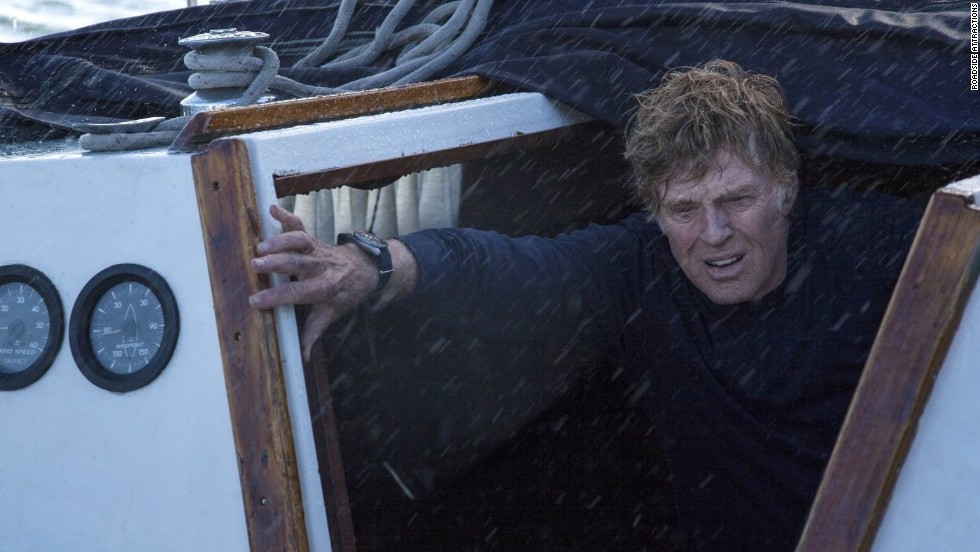
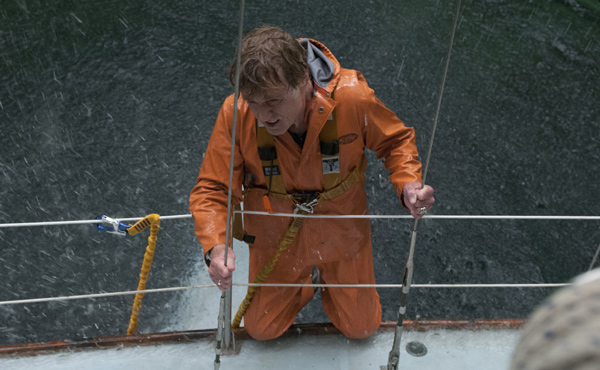
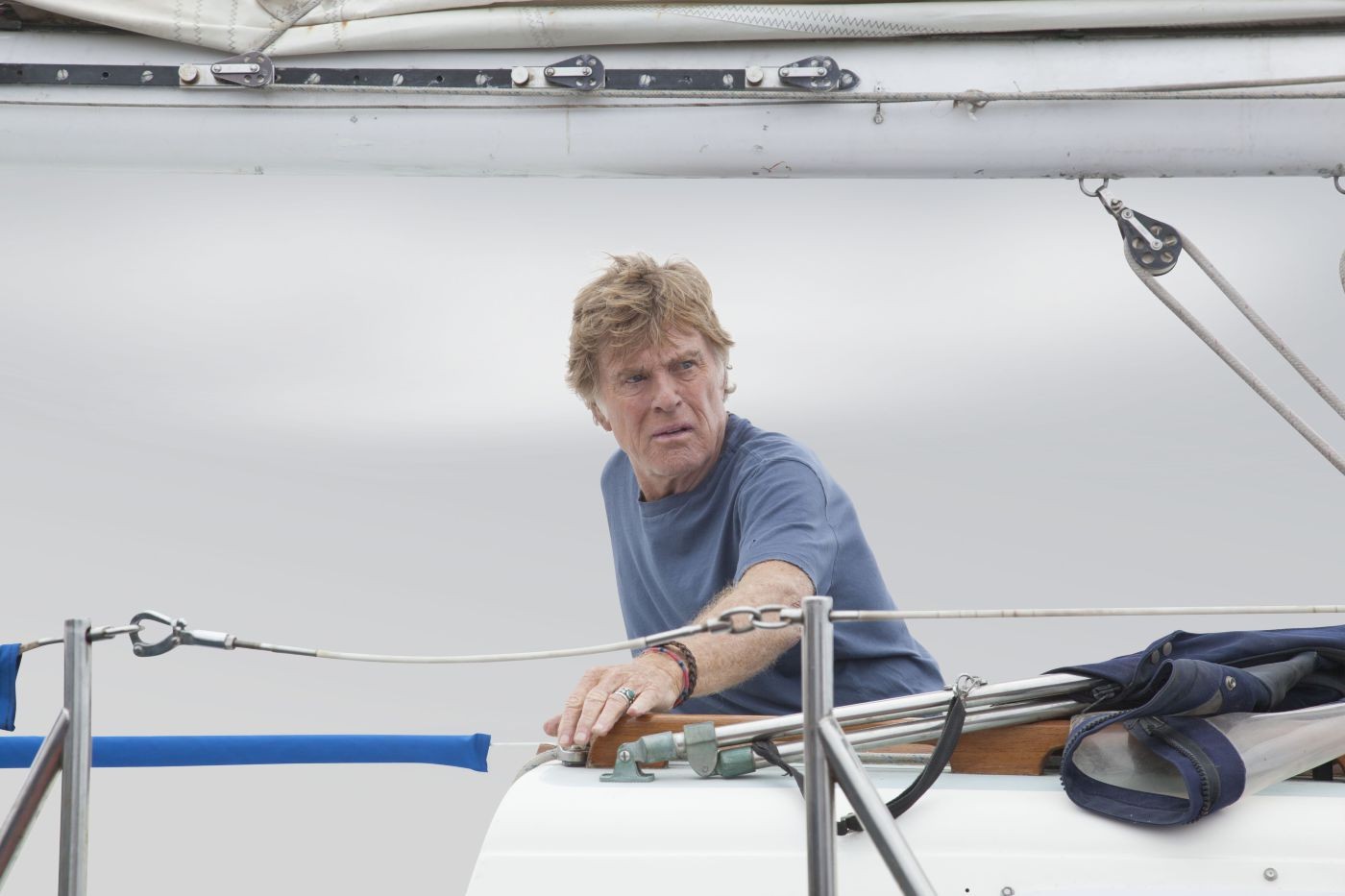
Boom.  "Our Man" (Robert Redford)—as he's called in the credits—is awoken on a boat by a loud bang, and water pouring in.  Lousy way to start the morning.  He goes on-deck and sees that he's been rammed by a large container of unknown origin floating in the middle of the Indian Ocean.  He systematically finds what he needs to anchor the container and steer his boat away from it, so that he can take a look at the gash in the side of his boat and plan his repairs.  He grabs the electronics that have been hit with salt water—laptop, cell-phone, radio—and takes them on-deck.  Deep in some back recess of a cubby-hole he finds the fiber-glass repair kit and reads.  Then he fashions a handle out of an easily broken piece of wood, whittles it to a point and uses it to pump out the flooded cabin and bring the boat enough out of the water to make repairs, then angles his sails over to the side opposite the gash to keep it above the water-line.

Okay, so that's 20 minutes gone by.  The movie presents its protagonist a challenge with several components, which are methodically taken care of, there's no voice-over, no talking to oneself.  It's just "this guy," (and you get over it being Redford very quickly), going through the paces of being alone in the middle of nowhere and trying to maintain his only means of support.  We don't know who he is or why he's out there.  He merely is, and now it appears that instead of sailing around the world, he's up shit-creek without a paddle. Again, no words are spoken, and for the next hour and some odd minutes, there won't be, save for a repeated attempt to hail a presence on the radio, and one long, frustrated "f"-bomb that certainly can be forgiven (and given a PG-13 rating) under the circumstances.

That's everything.  A crippled ship on dangerous seas with threatening weather, no communication, and a grizzled old guy who may be out of his depth.  Toss in a cruel God with a nasty sense of humor, and set to "liquefy."

Redford has never been better.  Frequently, his failing as an actor hasn't been physical, but for some over-thought playing of his lines.  That's not here.  He's basically living this, doing the work, trying to keep the continuity and pull off a two-hour one-man show of "Sisyphus on the Water" where there's no place to hide.  And his lined, haggard face is in that nether-mind-set of showing his thoughts while never betraying them.  It's a performance of instincts, and Redford's instincts have always been impeccable.  He keeps you engrossed and enmeshed throughout the entire movie.


Credit writer-director Chandor for that (his first movie was the excellent Margin Call).  As simple a project as it might be (and the budget's listed as 9 mil') it's still very close quarters to make a movie in.  The movie does pass the suspension of disbelief rule, as espoused by Johnny Carson.**  We're in a limited space no matter where we are, and the only time we're off the boat is when a wide-shot's perspective is needed.  

The end credits are a giggle-fest because the movie is a guy on a boat for two hours, but has such a HUGE list of credits that seem to go on forever (even at one point "thanking" The Pacific Ocean and The Atlantic Ocean).  I was amused at all the ADR credits (there is a voice-over at the beginning, but virtually no dialogue to loop). At. All.

But, that shouldn't take away from the film.  


What does take away is the score by Alex Ebert, which is a disaster, at times, confusing one, dramatically, with music that is sonically inappropriate or merely crushingly over-the-top. "Sonically inappropriate" What do we mean by that?   Well, at one point, a rhythmic thrumming is heard as "Our Man" wakes up.  Is it a ship coming near?  Are we about to be rescued?  Why isn't "Our Man" reacting?  Why?  Because it's only the music...interfering.  We can hear it.  He cannot (and he's the luckier for it). Look, it's a rookie mistake (and it IS a mistake) to throw in some rhythmic percussion or ANY-thing with a repeating chop, because it can be mistaken for a motor moving unnaturally fast and distinctive from the slow lap of a wave.  And when you're in such a limited space, you have to be careful what you do with the music to keep it out of the timbres of the natural sound, ESPECIALLY when the audience is so attuned and taking clues about what's going on from that sound.  To add to the earache, Ebert's end-credit song is a stream-of-consciousness list of cliches that ends with "Amen." "Hallelujah," after all, having been taken.  It might have been better to leave this one scoreless.
But, that music is the only container-sized blunder threatening this movie's ability to float. And hey, if you want a perfect companion for a double bill with Gravity, All is Lost is your movie.


All is Lost is a Full Price Ticket.


* And it will continue: if one is paying attention to previews for the coming months, they are awash with dialogue-tropes that one could recite along with the movie: "I'm not afraid of you"/"You should be..." or "I've got it"/"You're going to need it..."  I'll bet those movies also contain "You just don't get it, do you?" and "They're standing right behind me, aren't they?"

** Carson remarked that he couldn't watch any of the "Survivor" shows because he knew that, just out of camera range, there was a Teamster with a maple-bar in his hand.

Wednesday, October 9, 2013

Gravity

Push-Me, Pull-You
or 
"I'm Tellin' Ya, It's a Hell of a Story"

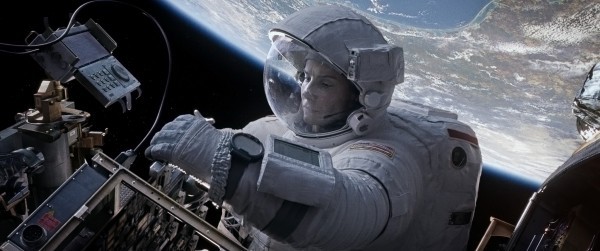
Gravity may just appear to you the shortest movie you've seen in awhile.  It lasts all of ninety minutes, but it rips by, despite long, leisurely takes where nothing much is happening (The opening shot alone is 17 minutes long without a traditional edit).  In that, it gets the yin-yang of space travel just so—floating at a relative leisurely pace while simultaneously moving at 16,000 mph, or as one test pilot describes the job—hours of boredom punctuated by moments of sheer terror.

Gravity pushes that out a bit, with many moments of sheer terror, but without some trumped up space monster hiding in lunar rocks (Apollo 18) or below the ice (Europa Station).  No, it doesn't need anything fancy.  It goes for the basics—a limitless indifferent Universe.

Up in space, aboard a futuristic space shuttle, terror comes by every 90 minutes or so, as a catastrophic collision between old Russian communication satellites causes a debris field hurtling by tearing holes through what ever fragile life-sustaining contraption we can put up there. Director Alfonso Cuarón (and his co-scenarist son Jonás) put the stakes right up front.  "Life in Space is Impossible."

They, then, spend the next 90 minutes destroying whatever faith in technology and science you might have.  It's an evangelist's dream come true.


That debris field starts out with a few little pieces, but like a cosmic game of "Asteroids" every collision creates more junk, sprays of it, and that just makes everything worse.  Space is our garbage field—Cuarón underpins the point by showing us all the junk—pens, screws, cuff-links ("cuff-links??")—floating in zero-g inside the space stations and capsules we put up there in some sort of mad attempt to make normal life in space.  It's a cosmic joke that after years of polluting the Earth, our garbage is making space uninhabitable (as if it ever was), too.

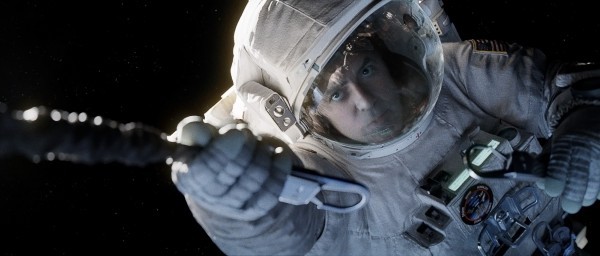
But, that's a lot of deep thought for after the film is over (as are some anomalies and plot conveniences).*  In the watching, Gravity is a fun-ride on so many levels, a visual romp and roller-coaster—the dialogue being mostly tangential and matter-of-fact—as the crew of the shuttle Explorer must deal with the fact that every 90 minutes their equipment is going to take a debilitating series of hits that might burst their protective bubbles just to survive.  The film is in mostly long, swooping stretches (the edits, interestingly, in dialogue situations), floating from one aspect to another, sometimes even violating the space of the astronaut's helmet, moving through the screen to get their perspective.  The novel aspect of this one is that the zero-gravity that science fictions films have recently taken pains to re-create or avoid has no restrictions in this scenario, there are no walls to bump into; if you go, you go until something stops you, slows you down, or retards your progress, and everything you do, pushes you in the opposite direction.  You can swim, but you'd better have an exit strategy for stopping, and spinning in place to turn around isn't going to help, because you're going to keep spinning.  And the series of catastrophes, hardships, and just plain pains-in-the-ass keep piling up one after the other, you would think it was Harold Lloyd up there.



Speaking of which, Gravity, besides the scrupulous pixelization of space, also boasts a dynamite sound experience.  In space, no one can hear dynamite, of course, but also no one can hear your thrusters whoosh-by, either, really. And Gravity is scrupulous about making sure you don't hear sounds in airless space, unless you absolutely have to.  Sounds are restricted to radio chatter (and interference) but also, only those sounds that would transmit through an astronaut's space-suit.  So, there are scenes where they're using power-tools? Only you don't hear the metallic grind of power-tools, you hear the vibration of the power-tools motors spinning.  But that's it.  Satellites get punctured, solar panels are torn off in bursts of shrapnel, but the most you hear is a muffled fwump if something impacts an astronaut, or vice versa.  And the theater I saw it in makes use of a Dolby system called ATMOS that pin-points where to put each particular sound as it careens through the theater.  It truly is an immersing experience in the theater.

For this space kid, despite some hokum here and there, it's the most fun I've had at the movies this year,** and someone is going to have to do something really exceptional to have better sound than this one.
  
Gravity is a Full-Price Ticket (Not only would I spring for 3-D, but try and see it in Dolby Atmos, for one of the craziest sound mixes I've ever heard).


* Three things, quibbles, anomalies, that are SPOILERS: 1) Sandra Bullock's hair is not plastered down on her head, but it's short, and would float around more than we see here (not a big deal, really, just a tech glitch, so the movie could get made); 2) At one point, we spend 10 minutes showing precisely how the whole friction-less world of Newton's laws of motion acts in zero-g, and then creates a cliffhanger situation that completely erases it, unnecessarily; and 3) Every 90 minutes that debris field shows up—IF everybody's in the same orbit, but one is STANDING STILL (which can't happen if you're actually orbiting) or they're going in opposite directions (at which point it would be every 45 minutes and very violently because they're colliding head-on).  As far as the plot conveniences, those are fairly obvious.

** There are some nice little in-jokes along the way.  My favorite: the unseen voice of Mission Control is Ed Harris, who played Flight Director Eugene Krantz in Apollo 13.  I could imagining him having conniption fits down on Earth: "Failure is NOT an option!" "Not on MY watch!"

Thursday, August 29, 2013

Blue Jasmine

Depending on the Kindness (Enabling) of Strangers
or
Being Entitled to Your Opinion

Blue Moon/You saw me standing alone/
Without a dream in my heart/Without a love of my own/
Blue Moon/You know just what I was there for/
You heard me saying a prayer for/Someone I really could care for/
And then there suddenly appeared before me/

The only one my arms will hold/
I heard somebody whisper please adore me/
And when I looked to the Moon it turned to gold
Blue Moon/Now I'm no longer alone
Without a dream in my heart/Without a love of my own


Woody Allen's 21st century version of Tennessee Williams' "A Streetcar Named Desire," Blue Jasmine, is a contemporary version of the play's tragedy in an unsympathetic post-Bernie Madoff/Wall Street Bail-Out world, turning it into a moralistic comedy.  It may seem a little misogynistic to be so mocking to someone as Williams' Blanche DuBois who has suffered a cataclysm, but when the someone is as cluelessly entitled and myopic as Allen's Jasmine (nee Jeanette) Francis (Cate Blanchett), there is a very real glee to see them get their, as the term is used in The Magnificent Ambersons, "comeuppance."

It's a brilliant conceit, combining Allen's love for classic literature and forms, tossing his own hang-dog spin onto it, while, for once, being refreshingly contemporary—something Allen hasn't really done of late, as he's had a depressive's obsession with the past for the past couple of decades (no matter how fresh the cast may be).

Allen starts his film (after the standard black background with white credits backed this time by '30's depression era rhythm and blues) with an (unusual for him) CGI shot of a jet approaching the camera, sailing by and moving away.  Jasmine Francis ("I fell in love with the 'Jasmine.' 'Jeanette' has no panache") is on that jet flying from New York to San Francisco to move in with her sister Ginger (Sally Hawkins—her second film for Allen) for a fresh start after losing everything in her life.  They're both adopted and couldn't be more different (As Sally says "She got the good genes."); Jeanette is all high cheek-bones and au couture, while Sally is low class and all teeth, surrounded by Guido's and roughnecks. Jasmine has suffered a reversal of fortune as her husband Hal (Alec Baldwin) has been caught wheeling and dealing in real estate schemes, ending up in prison, and committing suicide.  Her extended visit delays Ginger's boyfriend Chili (Bobby Cannavale) moving in with her and her two kids by Augie (Andrew Dice Clay), he ex-husband.  There's a bit of a sandpaper quality to Ginger and Jasmine's relationship; when Ginger and Augie were married, they lost a lottery nest-egg investing in one of Hal's "get-rich-quick" investment schemes, something Jasmine forgets when she drama-queens over her own plight, and dismisses entirely when confronted with it.


Jasmine (Blanchett) and Ginger (Hawkins)
So it rankles when Jasmine pulls a Mrs. Madoff and claims victim-hood about the money she's lost. Jasmine has no plans, no prospects, and there are hints of a nervous breakdown after she was found wandering the streets talking to herself.  Now, she's popping Xanax with a vodka chaser and barely keeping ahead of anxiety attacks and comatose fugue states as she barrels through the lower echelons of San Francisco, trying to latch onto opportunities.

She decides to go back to school, learning computers so she can go "into" interior design, taking a job at a dentist's (Michael Stuhlbarg)—for which she is totally ill-suited (anything with the words "customer" and "service" in any combination would be)—to fund the courses.  In the meantime, from her lowly status, she lords it over the family and friends she finds beneath her.  That meaning everyone.


The flip-side to this is that people still find her attractive, as she puts up a great, if shallow, front, speaking of her glory days—which segue into flashbacks of her privileged happy life, only to find that once the flashback has ended, that she's still carrying on the conversation inside the flashback, and whoever she was talking through previously has left.*  It's a clever use of flashback as psychosis, a clever, nearly invisible off-shoot of the film-star (played by Jeff Daniels) stepping out of the film in The Purple Rose of Cairo. Where Allen has been living in the past the last few films, Jasmine is doing the same thing, to her detriment, as, whether in flashback or real life, it comes back to haunt her and take her away from the present and any future she might aspire to.

It's a return to near perfect form without the tricks and conceits that Allen used (during his "earlier, funny" films) and nicely merges the bi-polar extremes of comedy and tragedy that the more mature filmmaker in Allen has aspired to.  It also feels less fussy and musty than the after-taste some of the lesser Allen films have left of late.  After a lifetime of making good films, some classic and some merely pedantic, and eschewing his earlier stylistic tricks, one wonders if, at the age of 78, Allen's best films might still be ahead of him and that's an exciting prospect.


Blue Jasmine is a Full-Price Ticket.


Jasmine in her "fugue" state


* It's a bit like the Larry David monologues-to-the-camera in Whatever Works, only there's no child around to ask "Who's that man talking to, Mommy?"

Wednesday, May 8, 2013

Holy Motors

Rich Man, Poor Man, Beggar-man, Geek...
or
The War of the Grease-paint...

All the world's a stage, And all the men and women merely players; They have their exits and their entrances, And one man in his time plays many parts...
William Shakespeare

You may be an ambassador to England or France
You may like to gamble, you might like to dance
You may be the heavyweight champion of the world
You may be a socialite with a long string of pearls
But you’re gonna have to serve somebody, yes indeed
You’re gonna have to serve somebody
Well, it may be the devil or it may be the Lord
But you’re gonna have to serve somebody
Bob Dylan 


The latest film by Leos Carax, Holy Motors, is a fascinating polyglot of life imitating art or vice-versa, and by the time it's over, you're not sure which.  It's a film brimming over with tantalizing ideas ranging from the rational to the surreal that it puts the brain into over-drive while constantly changing the landscape, shifting gears episodically while maintaining a singular day-in-the-life storyline for its central character Oscar (Denis Lavant), a trouper if ever there was one.  Oscar is an actor of extraordinary gifts.  In a gigantic white-stretch limo, driven by his scheduler Celine (Edith Scob of Eyes Without a Face, which Carax nods to briefly), he applies make-up, dons costumes, prepares for the next gig on the schedule in a rolling tour of Paris, all precincts, all life-styles, and most importantly to Carax, all genres.

In one scene, he's a motion-capture artist in a completely empty studio performing fight moves, running gun-battles, and a bizarre alien love-scene without a clue as to what the finished product will look like.  In another, he's a gangster sent to assassinate his doppelganger. 
On to the next gig—Oscar in Holy Motors
His assignments are given to him in a notebook with all the specs and requirements.  He opens up his kit of make-up prosthetics, ruffles through his rack of costumes, Celine lets him out and he's on-stage.  As the jobs go from one to the other, the questions bubble up: who is he working for—not only for the booking agency, but also, who are the clients?  Reality blurs.  A call from a teenage daughter could be his real daughter, but one suspects not—he's wearing a wig, and she's never seen again.  The gangster segment could be for anybody.  But, how about the segment where he's a disfigured geek who interrupts a photo-shoot with Eva Mendes--is it to throw off the photographer or to transform the model from a fantasy figure into a person of emotional worth, phantom of the opera-style.  And who is the death-bed tableau for, as the woman he plays it with is also an actress (one suspects that it might be for the loyal dog sleeping on the bed).  An encounter with another actress (Kylie Minogue) turns into a musical number, and a wacko marching band-with accordions-could be for anybody.

But, those are the details.  Ultimately, it's a fantasia about the roles we play in our everyday lives.  We adjust, we tinker, take on different suits and attitudes with every situation that crosses our path in the give-and-take of daily life.  We make an entrance, role-play, act-out, ad-lib, pose, and exit stage-right.  All the world's a stage and we all gotta serve somebody, the devil, the Lord, or ourselves.

Holy Motors keeps you guessing and keeps you challenged, and is one of those rare films that elicit bigger thoughts than the whole, leaving questions that anyone can answer, given their respective roles.


Holy Motors is a Full-Price Ticket.
 

Tuesday, January 29, 2013

The Impossible

Disaster Relief
or
The Tides That Bind

It truly is an amazing story, fully befitting the title The Impossible.  The heart-and earth-rending circumstances surrounding the 2004 tsunami are the stuff of nightmares.

The Bennett family* is spending Christmas 2004 in Thailand.  They're Australians living in Japan: she's a wife/mother/home-maker for now, a doctor by trade; he's a something or other, attached to his phone and worried about losing his job.  The kids are twelve, seven, and five, respectively with the oldest, Lucas, a bit of a pre-teen jerk to everybody—little brothers and parents—and has a bad case of the surlies with a lot of growing up to do.

Thailand at Christmastime 2004 is the perfect time to do it.  Their seaside resort is pristine, perfect.  They spend Christmas lightly bickering, worrying, and considering the future.  Man plans.  God laughs.

What they can't anticipate is the earthquake that rocks Southeast Asia, or the resulting wall of water that comes crashing through the resort, pushing everything out of its path, slamming everything up-shore, sucking it back to the ocean and then, hammering them again, turning the tidelands into a raging river in both directions, scattering everything in random paths.


That includes the Bennetts. When Mom Maria rises above the wall of water, battered and bleeding, she sees Lucas being carried away to the ocean.  The two desperately risk safety and stability to connect and stay within reach, despite being tossed about like so much silt.  When the waters subside they scrabble in bare feet amid the carnage of uprooted vegetation, rubble and broken bodies.  Maria's leg is torn apart, flesh ripped from bone.  A makeshift tourniquet keeps her together, and Lucas becomes parent, keeping her focused through her shock and finding high ground and supervising her trip to a triage center, a hospital drastically ill-equipped to deal with the wreckage of such a catastrophe.  What has become of the rest of the family is anybody's guess, but that is for another time, if they can spare it from just surviving.

Director Juan Antonio Bayona (in the credits, he's "J.A. Bayona") manages to keep the focus micro, while presenting a macro canvas.  That in itself is an amazing accomplishment, but he has an amazing talent for making things personal and visceral, the scenes of the struggle swept up in the ocean waves is tough to watch, and the inundation of the victims in the tsunami's path, as experienced by Maria is a surreal nightmare of images, that convey panic and horror simultaneously. The details of everything, especially the personal crises of the peripheral victims is in plain view, as much a part of the story as the Bennett's struggles.  Their crisis is central, but the individuals' own efforts in providing help to other survivors is reflected by the help they get back.  It's a story of one family, but the efforts of all the survivors, native and tourist, to help each other through the overwhelming havoc is knitted throughout the story in an overall arc that is inspiring, and something of a tonic in this movie season.

The Impossible is a Full-Price Ticket.

Watts, McGregor and The Impossible Belon family

* Much has been made of the fact that the Belon's (who are Latinos) are being played by Anglo actors,  something that is much pooh-poohed by Maria Belon.  But, one has to ask: why did a production, headed by Spanish-speaking artists, make such a decision, other than for "sellability?"  I only bring this up, as there is a pattern here, what with the similarly anglicized Argo.  Are Latinos not allowed to be featured in movies because it might hurt the box office (I say this while ruefully noting that a Latino actor and black actor are "inserted" into the all-white Gangster Squad—if one is to be accurate one way, shouldn't one the other—and yet I thought Mackie and Pena were a nice touch, and they're always welcome to see). Yes, as Maria Belon says, the story is "universal"—it has more to do with family than what race that family is.

Wednesday, November 28, 2012

Life of Pi

"The One with the Tiger..."
or
The Ocean in a Universe/The Universe in an Ocean

“The most terrifying thing about the universe is not that it is hostile but that it is indifferent; but if we can come to terms with this indifference and accept the challenges of life within the boundaries of death--however mutable man may be able to make them--our existence as a species can have genuine meaning and fulfillment. However vast the darkness, we must supply our own light.”  -- Stanley Kubrick

"It's a story that will make you believe in God" --Pi Patel

Life of Pi, Ang Lee's new film is the best film I've seen all year, and it will take something very spectacular to displace it (which I doubt will happen).  A children's film that children probably should not see, its themes are so adult—having to do with survivor's instinct (and that only reveals itself at the end)—and is presented with such a visionary sense of wonder that it is quite overwhelming.  It's the most glorious, funny, amazing film that ever made me weep at the end.

Based on Yann Martel's Booker Prize winning novel, it tells of the story of young Piscine Patel, who grows up affluently in Pondicherry, India in a resort-zoo run by his family.  Growing up inquisitively, surrounded by animals, he begins a personal search for God that links him with several religions and interpretations of God.

He'll need all of them on his journey.

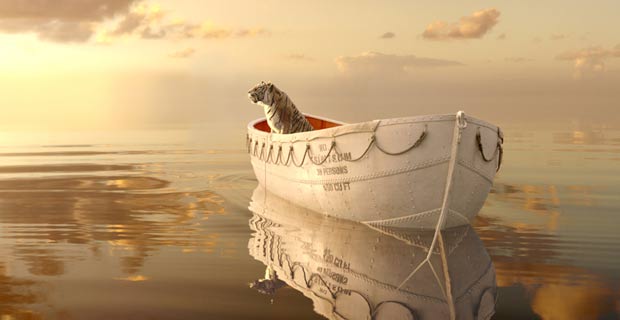
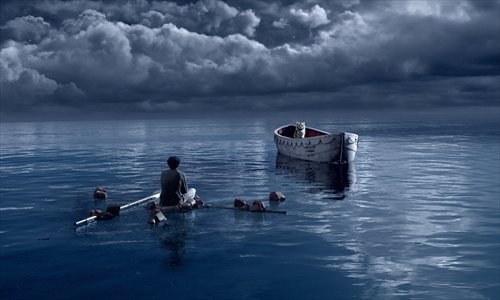
Political struggles in India leads the father to sell the zoo and embark for work in Canada, taking many of the animals with them on a Japanese freighter.  The crossing becomes disastrous, the ship being capsized in a storm, leaving Pi, Ishmael-like, on a life-raft with a few stowaways that he rescues after the sinking.  But, before long, it's just him and a Bengal tiger.

The journey then becomes a struggle for the two to survive, learning to cope with the hardships of surviving, stranded at sea, without killing each other.


That much you can glean from the previews and the poster, and to say anything else will spoil a lot of the charm of the story-telling.  This is Ang Lee playing with film-making in God's paint-box.  Forget that the film is seemingly impossible to pull off with the elements—filming on open water, with animals, some of them dangerous—Lee manages to make an amazingly entertaining film where the real and CGI flow seamlessly together, just as the story elements and philosophical arguments do, and done in such an imaginative way that one is frequently breathless as it unspools before your eyes.  

Lee has done wonders with CGI before, but (like Cameron and Scorsese before him), he also manages to make the 3-D element become an integral and, (this is a surprise), necessary function of the film, weaving it into the narrative, like tapestry, and giving the film a sense of scope and scale across time and space that, frankly, I've never seen anyone try before.


Now, the film is controversial in some parts: the critic for "People" magazine has written they "just hate" the ending, and I've read a few other reviews that have praised the film to the heavens, with some hedging about the ending not fulfilling the promise of the rest of the movie.  They're missing the point, and in their defense, the visuals have a way of seducing and comforting, but also distracting from what is important (like any good belief system).  The ending is part and parcel of what the movie is about, which is finding the path to make peace with the world by any means necessary, even if it is by using a little imagination and the application of myth and story-telling—to see things a little differently and make sense of an indifferent Universe.  Pi's search for God in his youth prepares him for the trials of surviving the ship-wreck, submerging his grief, and the movie's story of his 221 day journey—a speck in the vast ocean—is a fable reflecting the life-journey for all of us, adrift or under sail, whether charting our course by our stars, our God, or our selves.


Life of Pi is a Full-Price Ticket-see it in 3-D.