Showing posts with label Alan Tudyk. Show all posts

Thursday, December 19, 2013

Frozen (2013)

Ice-Ice, Baby
or
(The Cold Never Bothered Me, Anyway...)

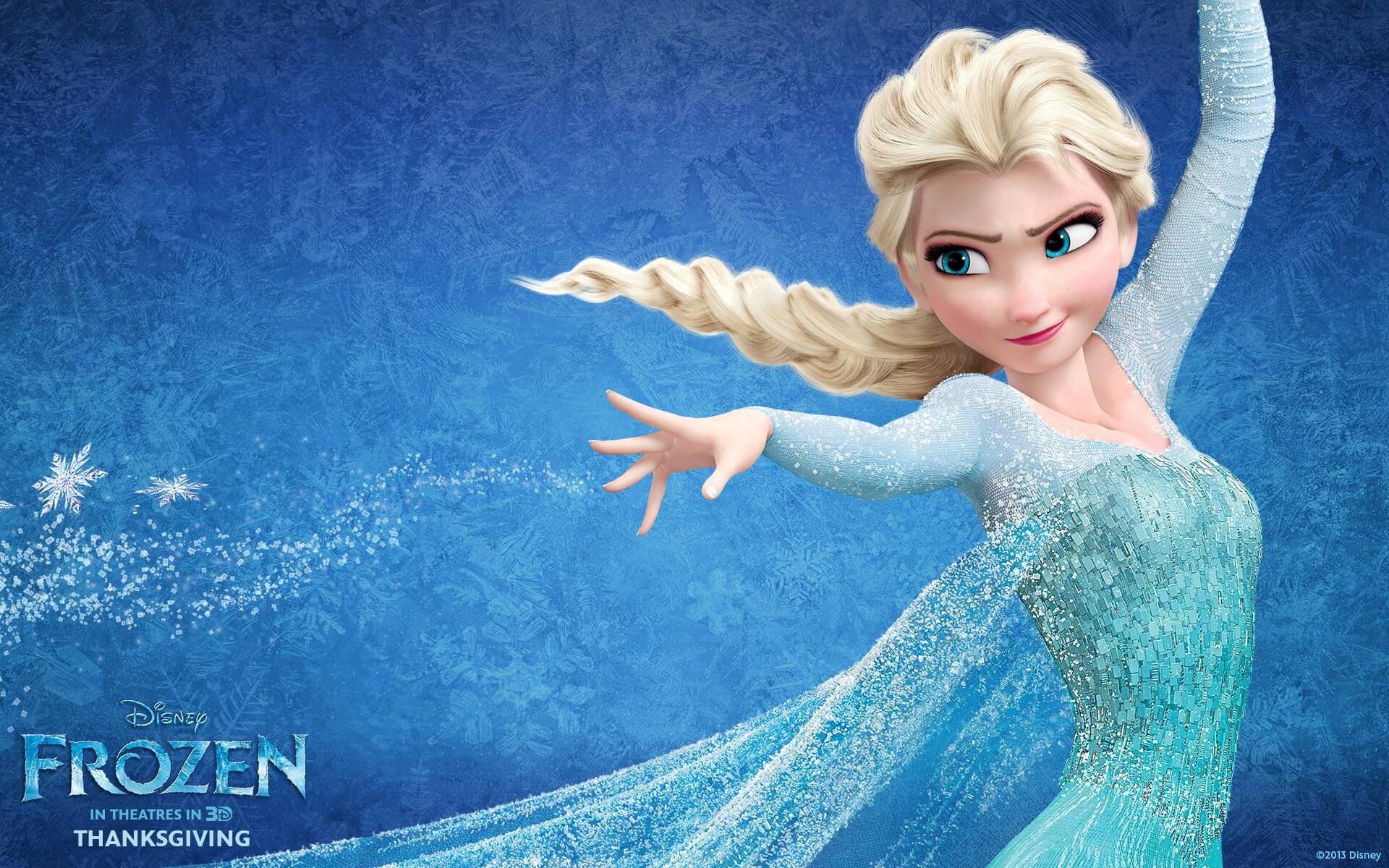
Disney's latest animated feature—not in the flat 2-D classic animation, but in the 3-D pixilated version ala Tangled—is "inspired" by Hans Christian Anderson's "The Snow Queen," according to the credits.  That's a whole new interpretation of the word "inspired" because Frozen has next to nothing to do with "The Snow Queen" other than...there's a Queen...and she makes snow.  But Tangled wasn't exactly "Rapunzel," either.

But, it's a quibble (And it's Disney).

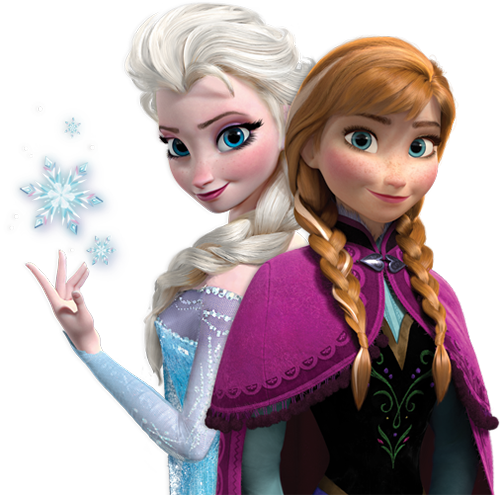
Disney, who just put the first female (albeit co-director) on one of their female-dominated animated films. Based on a screenplay by, and co-directed by Jennifer Lee (with Chris Buck), it's another "Princess" movie that will expand the Disney marketing franchise (with two of them), but as with Pixar's Brave it dares to up-end some story-book conventions, making the royal sisters Elsa (Idina Menzel) and Anna (Kristen Bell) the emotional hub the story revolves around, and relegating the two hunky guys that are standard love interests pretty much transportation tools. This is a good thing.  And especially when the movie sets up "the guys" (one prince/one working stiff) as the solution to the problems and then very briskly pulls the cloth-simulated tapestry out from underneath that cliché.  I like that.  And I like how the solution to "the problems" is bundled very tightly in one unexpected moment that, frankly, shocks, and takes one aback emotionally.  I like that even better.

So, it's not "The Snow Queen."  What is it?  Elsa and Anna are princesses in the kingdom of Arendelle and they're by no means twins—Elsa is older by a couple years, and she has the telekinetic power to freeze things and project snow and ice from thin air.  This delights Anna, but a childhood accident forces the King and Queen to seek the assistance of trolls who save Anna's life, but take away her memory of Elsa's power to prevent such a tragedy from ever happening again.  The Royals also lock up Elsa, keeping her from her sister...and everyone, until she learns how to suppress her powers, usually brought on by her emotions.

The two sisters grow up apart under the same roof, even after tragedy strikes the household.  The two don't see each other until Elsa's coronation day as Queen of Arendelle, but the two are distant even when inches apart, and when the scattered Anna becomes enamored of a visiting prince (Santino Fontana), upsetting Elsa and exposing her powers to the Kingdom.  Elsa flees, now that her frightening powers are out there for all to see.  

You couldn't miss it.  She's dropped Arendelle into a permanent winter, with no way to get it out.  It's up to the plucky Anna to go after her and try and mend fences and thaw her relationship with her sister and the town.

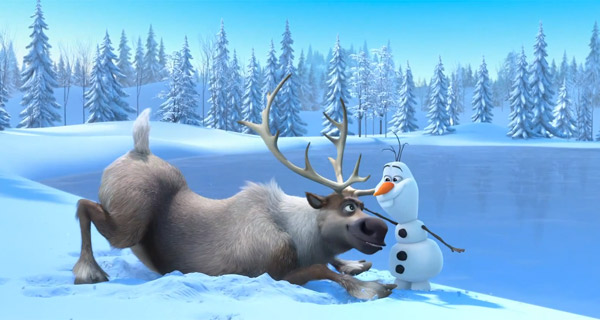
Prince Hans is a love interest, but so is an ice-cutter that Anna finds on her journey (voiced by Jonathan Goff), whose best pal is an anthropomorphized reindeer named Sven.  There's also a walking, talking snowman (created by Elsa) named Olaf.  The revelation of a goofy snowman in the movie was enough to give me a brain-freeze, but, as voiced by Josh Gad (he of "The Book of Mormon"), he's pretty danged funny.  The songs have the same show-connection, as well, as they're a collaboration between Robert Lopez (who co-composed both "Mormon" and "Avenue Q") and wife Kristen Anderson.  That's very much in the tradition of bringing the song-writing team of "The Little Shop of Horrors," Ashman and Menken, to Disney.  The songs are decidedly less Broadway, however, and more "pop" oriented—and will be appearing on the many reality-talent shows on the air in the not-too-distant future—and geared more for a cartoon audience than a theater one.

Again, quibbles.  And if Frozen didn't exactly warm my heart, my brain had some warm thoughts towards it.

Frozen is a Full-Price Ticket (I wouldn't spring for the 3-D, though).


One of three "I Want" songs in Frozen (four if you count Olaf's "In Summer").
Going in...er, "cold," the power-ballad approach makes one cringe, but given the back-story 
preceding it, it's a break-out moment...and a little scary.  In fact, the Elsa character was 
slated to be the villain of the movie until this song's themes of empowerment changed everything.

Tuesday, June 4, 2013

42

Changing the Face of the American Game
or 
The Saint of Swat

One of the great "unmade" movies is the story of Jackie Robinson of the Brooklyn Dodgers, the baseball player who broke the color barrier in the quintessential American game.

Oh, it has been made before: Robinson, himself, older and showing the effects of the strain the game and his task had put on him, starred in a B-movie version, The Jackie Robinson Story, in 1950;   Ken Burns' definitive documentary Baseball made his story the lynch-pin of the parallel stories of The Game and race relations in America in the 20th Century (and will probably always be the best telling of what happened).


But Robinson's story has been kicking the turf of home plate for a couple of decades lately—Spike Lee has been working tirelessly to make a film of his story for that long, and I've always wanted to see his version of it, as his directorial voice would absolutely put a distinctively personal philosophical spin on the heroics of it.  A Spike Lee "joint" might also provide some angry tension that was part and parcel of the Jackie Robinson Story, but could never be expressed, lest the long-delayed abolition of sanctioned (but unspoken) segregation of baseball fail in a double-play of racism posing as informed sports commentary (which still goes on today for some reason).


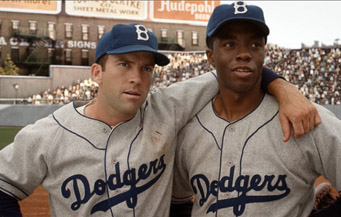
Brian Helgeland's film about Robinson, 42 (the number Robinson wore for the Dodgers and the only number permanently retired in the MLB), doesn't have the inflamed spirit that Lee might have imposed, and is content to stick to the facts, which are enough as the events were charged with over-laying race issues, prejudice posing as business politics, and the uneasy first faltering post-war steps to civil rights legislation.

Make no mistake.  It was a super-human task to be the first black man in an all-white league.  He was a fine hitter, a better runner, and a brilliant strategist who would earn runs without connecting bat to ball, merely by "freaking out" pitchers by stealing bases.  Plus, he had a defiant spirit that would not let prejudice stand.  He wouldn't "just take it."  But, the "handshake" part of his signing with the Dodgers was that he would have to "take it," whatever was thrown his way, be they death-threats, or murderous pitches.  He promised his manager that he would not fight back, show restraint, and be the model player. 


Oh.  The bottom line was that he had to perform, as well.


Robinson and Rickey on the day he signed with the Dodgers
Robinson knew the opportunity that his role would provide, not only for him but also for other "Negro players."  He was described as "a race man," passionate about the lot of African-Americans in a country with Jim Crow laws in place, segregated bathrooms, water faucets and diners, and prejudices not so public under the guise of "tolerance," that actually seemed to take pride in a sentiment like "separate but equal."  And he shouldered it, showing the humility and great generosity of his spirit, always saying the "breaking of the color barrier" was not his story but Branch Rickey's.

But, as dramatized in the film, it was also the story of everyone in the Dodgers organization, especially the players, initially reluctant to allow Robinson in, and upon seeing the rough treatment he was getting from fans, other teams, and previously friendly hotels and restaurants, becoming his ally, team-mate, friend, and first line of defense.  Robinson's imposed tolerance in the face of hate, naked or subtle, inspired empathy with his fellows, and his play raised their game, making all of them better players, and in the words of Dodger announcer Red Barber "better men."

Performances are uniformly excellent.  Harrison Ford is top-lined as Rickey, and Ford chews into the role the way John Wayne jawed Rooster Cogburn, growling and over-playing just a little bit to provide "character," Christopher Meloni of "Law and Order: SVU" does a fine job playing Dodgers coach Leo Durocher, soon replaced by "Barney Miller"'s Max Gail as Burt Shotton, Lucas Black plays Pee Wee Reese and Ryan Merriman plays Dixie Walker, and Nicole Beharie plays the devoted Rachel Robinson with a bracing mixture of grace and spine.  Alan Tudyk surprises with a particularly unsympathetic portrait of Philadelphia coach Ben Chapman, whose taunts on-field But special praise has to be given to Chadwick Boseman's performance as Robinson, which he has down cold.  There's enough footage of his play to copy, but what he nails is Robinson's expression, the enigmatic not-a-smile, and the wary eyes and darkened brow of the already burned and suspicious player, a bit of a caged lion not allowed to roar.

It's a good tribute to the man, if only missing a little bit of the fire that must have burned in the man to accomplish what he needed to, and that needed to be internalized amid so much pressure.  He (with Rickey's patronage) turned the puerile accomplishments of a kid's game (the wins, the records) into something far greater for humankind (American division).  He was the slugger who couldn't hit back, who turned the other cheek and turned America around.  Babe Ruth was baseball's "sultan of swat."  Robinson is its saint.

42 is a Matinee.


As dramatized in the film, Robinson posing with Phillies coach Ben Chapman who was criticized for shouting racial slurs at the player during a game.  This photo op was Chapman's way of trying to fend off charges of "unsportsmanlike conduct." He was fired by Philadelphia in 1948.  Looking at the smile on Robinson, casual and a bit cocky, "helping out" the guy by posing with him, always makes me smile.

Saturday, December 1, 2012

Wreck-It Ralph

Who Framed Wreck-It Ralph?
or 
Being Two-Bit in an 8-Bit World

It's not that I didn't "like" Wreck-it Ralph.  I did.  I just wasn't moved by it, nor did I care one bit about any of it—not the movie, not the characters—any of it.

Oh, there's a lot to admire: the animation is amazing, albeit to a limited world inside a video game (it can't be too complicated in its design as it's supposed to reflect the limited world-view of a flat 8-bit world refracted in 3-dimensions); the expansions and contractions of those worlds are quite cleverly done—the expansions of those environments being of the commingling of those worlds before the lights turn on in the video arcade, the characters commuting in a Grand Central Station hub to their various scenarios, and the contractions being in the limited animation movements of some of the characters.  The voice-acting is fine, headed by John C. Reilly, Sarah Silverman, Jane Lynch, Alan Tudyk, and Jack McBrayer (of "30Rock").  The cameos by various amusement game characters are amusing—the Pac-man ghosts, Sonic, Qbertwhich gives the whole thing a tinge of Who Framed Roger Rabbit,* Disney Animation has done a great job of it under the tutelage of Pixar's Jon Lasseter.

But, as great as it is, it's hardly inspired, the central conceit being all those video game characters have lives and concerns when no one's looking, which is the idea behind the "Toy Story" franchise.  But, instead of that series forming a concept of the toys banding together to get along in The Big Toy-Box, the issues of the segregated video game characters are decidedly trivial and territorial.  They inhabit an 8-bit world, but their concerns are decidedly two-bit, as in the story's central story-line.  "Wreck-it Ralph" is the villain of the game "Fix-it Felix"—inspired by "Donkey Kong" but not (Mario, remember?) and he's dissatisfied with his life as a villain.  He wants to be a hero, but is never given a chance and his intended role keeps him ostracized in the "Felix" community.  He's shunned, gets no respect, and isn't even invited to parties.  His "villain support group" provides no comfort.  So, Ralph decides to expand his horizons (if video games have horizons) and starts visiting other games, like a WOW game with a butch commander in curvy leather (Lynch, of course), then navigates to another game "Sugar Rush" (no doubt coming to a Game Stop near you) where perky princesses race in a candyland world (and one of the racers is voiced by Silverman, not of course).  


There are some wonderful things that could be done here as far as the migration of traditional characters in non-traditional environments, but what's here doesn't have a lot of imagination as far as plot, the complications or the resolution.  Ultimately, it's a bright, pretty snooze-fest (I felt the need to feed myself quarters to keep from nodding off).  But ultimately I just wanted to move on, feeling like I was losing a life—the only one I have!—just waiting for the blessed relief of "Game Over."


Wreck-It Ralph is a Cable-Watcher.


The game-screen of "Fix-It-Felix" and its inspiration "Donkey Kong"©


* ...although you wonder where some other characters are, like Prince of Persia, Mario, Halo, and then you remember "Oh, yeah, they have their own movie franchises" (mostly inactive) and their places are "suggested" by other characters.

Thursday, January 22, 2009

Death at a Funeral

"Death at a Funeral" (Frank Oz, 2007) I grabbed "Death at a Funeral" because, even though he may not choose the best of projects, Oz is a good craftsman who can eke out laughs from fairly flimsy material. And it featured two of my current favorite character actors, Peter Dinklage and Alan Tudyk. Neither one disappoints with (eventually) broad strokes of antic genius. Nor can one be disappointed by Matthew Mcfadyen (the glum Mr. Darcy in Joe Wright's "Pride and Prejudice"), who shoulders the burden of the lead role (as the oldest son who is hosting a service for his late father), as well as Rupert Graves as the ex-patriate brother/successful novelist that brother Daniel admires and envies.*

But it's a funeral, and so complications arise.** There's the powerful psychedelic in the valium bottle, the needy one-night stand who shows up to try and re-connect, the germ-a-phobe, the immobile old guy in the wheelchair, the vicar with other duties to attend to, the family jealousies and petulant arguments, and the stranger in the leather jacket...with the photographs. Just jotting off that checklist will set in mind all sorts of mischievous complications, and they're all there waiting to be uncorked in a room of stiff upper lips and trembling lower ones. If hilarity doesn't ensue, you can at least count on "inappropriate behavior."

Ultimately, it all turns out well for nearly everyone (except, of course, the corpse) and just as old wounds are ripped open, they're also neatly zippered up in the end. It's a pleasant little film that gets there through a lot of sick humor. What more could you want from a funeral?

* Gamers will wonder why Keeley Hawes sounds so familiar—she's the voice of "Lara Croft: Tomb-Raider" on video games.

** Having been to (and host of) a couple of funerals, I wonder why no one ever has done anything with the odd phenomenon of the reactions of a deceased's family (who have had mourning time) to seeing so many old friends (who have not), and those friends' shocked reaction to the bereaved's happy tone at seeing so many familiar, downcast faces. It is a funeral, after all.