Showing posts with label D. Show all posts

Friday, October 4, 2013

Don Jon

Know Thyself
or
The Tissue of Lies in Fantasy-land

Don Jon is going to piss so many people off and throw a wedge into so many relationships it's not even funny.  Don Jon is, fortunately (funny, that is), and that's what makes its nasty streak in saying "There ain't no Santa Claus" to movie audiences palatable.

Written, directed and starring Joseph Gordon-Levitt (guess Lake Bell's In a World isn't a lock for The Orson Welles Award for over-achievement), it's about all sorts of things, but we'll let the show's protagonist, Jon Martello explain the crux of it.

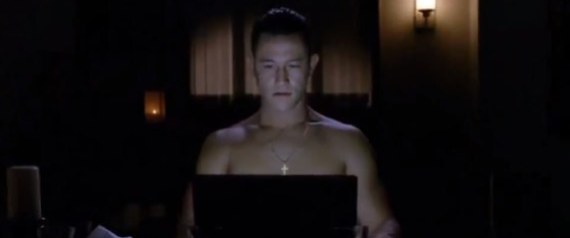
Very early on in the movie he explains himself by voice-over: "There's only a few things I really care about in life. My body. My pad. My ride. My family. My church. My boys. My girls. My porn."

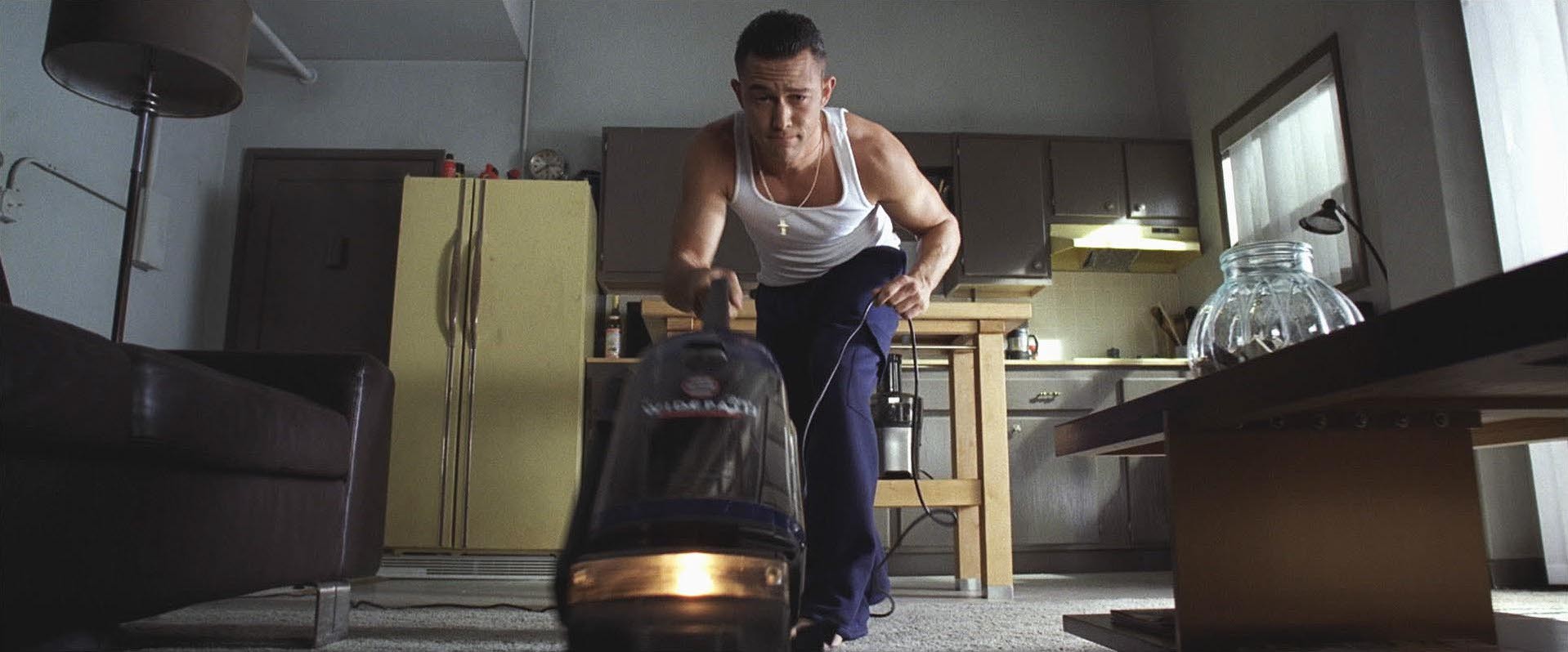
Okay, I know, but hold on, despite the elephant in the room—that last one—look at that description. "My" is the word repeated most often.  How do you spell "narcissism" in New Jersey?  Same way you spell it in the rest of the world, but Jon has nothing to do with the rest of the world, as his sphere is finite.  His work-life is devoted to two shots.  Everything else—the workouts, the church—they're all shot the same, with the same set-up, different clothes, the implication being a comic sameness.  There's not an awful lot of growth here (and the film is just that much more economical by having all the different time-frames throughout the film being covered by the same camera set-up—nice).


His family is a Jersey comic stereotype.  Father and son sit around the table in wife-beaters, Mom flutters around the table, Sister only has I's for her I-phone.  Everybody shouts a lot, and the feeling is you're watching a "Nature" documentary on pecking order and dominance rituals.  His "boys" (who give him the "Don" moniker), are club syncophants or beards or plovers to pick up The Don's rejects.  The club prospects are on the traditional 10 scale, with the unattainable perfect being "a dime," but he'll settle for an 8 or 9 and it's a matter of some cursory chatting up, pre-lim making out and then catching a cab home.

Now, here's where it gets sticky.  Jon's hook-ups are always temporary, and the sex is never satisfying.  Why?  Because it's nothing like what he can find on the Internet on the porn-sites.  For him, that's ultimate, and, just like his lap-top, all it takes for him to turn on is to hear the Apple "chime."  He's hooked, and there's no one in real life who can live up to the fantasy bimbos he can watch on his lap-top. Of course, the odds are stacked here—porn performers are going off script and we're all just winging it, but Jon is waiting for "the one" who is everything he could want in the...flash...in the flesh.


Really, this is just to increase my Internet "hits."
And then he meets Barbara Sugarman (Scarlett Johannson), gum-chewing, Joysey-speakin' "dime" who doesn't roll over as fast as other girls do, and, in fact, can't believe that Jon would think that she would...evah...evah...go home with him from the club.  So, Jon changes the plan of attack.  Meet for coffee, go out a couple times, yadda-yadda....  But, no.  Barbara keeps him on a very tight leash.  Always tell her "the trooth," go back to school, maybe, learn a trade, get a better job than his bar-tending, and maybe...

Jon is going insane over this.  He's made Barbara a project that he wants to conquer, but there is so much "pro quo" before getting to the "quid" and the penance at the confessional he goes to every week is really starting to add up.  But, it's here that Don Jon (the movie, not the guy) gets interesting rather than just prurient.  Barbara likes to go to the movies...

When you're ready...*


End scene.

"Everybody knows it's fake but they watch it like it's real f@#&ing life."  See what Gordon-Levitt is doing there?  He's drawing a parallel between porn and romance movies, and he's right (even if he fails miserably at making a completely "anti-movie" movie).  They're both nearly perfect fantasy-worlds (because you only achieve "perfection" in commercials) in which the dreams and desires of the audience so captivated are achieved and their expectations of real life are fulfilled, while also subsequently raising said expectations impossibly high to the point of nearly science-fiction levels.  I mean, "Bachelorette"-high (after all, that movie they watched—"Someone Special"—stars Channing Tatum and Anne Hathaway**) How can anything (within this economy) match those romantic expectations of "perfect situational love?" And what woman, outside of monetary gain, would ever run the gauntlet of porn?  (One does, after all, have to be able to walk, eventually).  There's got to be a morning after, and nothing can be sustained over time, and may grow tiresome and old with enough rapidity.  With porn and romance movies, you switch partners and the quest for fulfillment and innovation (if we can call it that) begins anew.


Really, this is just to increase my Internet "hits."

Where the humor, sad as it is, comes in Don Jon*** is that he is so insular he sees that quality right off the bat in everybody else, but it takes forever to see it in himself.  And that brings us right to the problem of Don Jon, entertaining as it might be.  Gordon-Levitt spends an awful lot of screen-time presenting the problem (not that the title character ever sees it as anything but a sometimes annoying irritant), but the fairly standard relationship the character has with Julianne Moore's normally neurotic character, Esther**** is barely explored at all.  One can speculate until next Friday why, but the relationship between Jon and Esther is given short shrift, making it feel sketchy and a little desperate to resolve the movie.  It may have something to do with the broad theme of objectification in the fantasy-world, or it illustrates that a relationship should be easier to achieve than the Jon/Barbara example (but that seems rather unnecessary given that we've seen lots of very easy relationships that last one night and that's it) but by JG-L's "hurry-up-and-let's-get-through-with-this" approach, it undercuts the point somewhat.  If there's that point to be made.  And if the film-maker is adept enough to to know that he might be sending mixed signals between form and content.

I don't know.  Maybe he just had to edit in a hurry to get the movie out.

So, as much as one might want to gush about Gordon-Levitt's hat-trick here, and how he's being edgy and honest, one has to wonder if he really knows what he's doing, and if he'll improve the next film out.

Don Jon is a Matinee.


* NSFW!

** Personally, I'd have gone with Ashley Judd or Katherine Heigl.  And I would have used a familiar rock-song title for the movie's title, but hey, it's close enough to the truth....

*** Ya know something?  I gave up on everything sounding like a dirty joke about five paragraphs ago.

**** Am I spoiling this here?  I think not, because for all Gordon-Levitt's honesty about the crock of romantic movies, he still is privy to following the "happily-ever-after" arc, as the film's poster is quick to reveal.

Wednesday, February 6, 2013

Rust and Bone

Last Man Standing
or
You Don't Know What You Got 'Til It's Gone 

Jacques Audiard's new film De Rouille et le D'os  (Rust and Bone, in English) is as far afield from his last film, The Prophet, as could be.  That film was a mini-Godfather, that showed the traps a criminal puts himself into, whether he's in prison or the King of the Hill.  

Rust and Bone, though, is a love story about the transitory nature of selfishness and the numbing vacuousness of complacency, which sounds like it'd be a a dull film, or a pedantic English theme.  Combine it, though, with kick-boxing and killer whales chewing your legs off, and it becomes a different animal altogether.


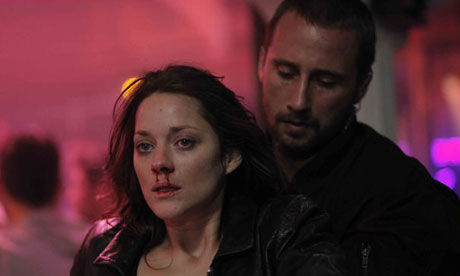
Ali (Matthias Schoenaerts), unemployed father of Sam (Armand Vendure), crashes with his sister in Antibes, while he tries to get his act together.  He jogs, he works out at the gym, dreams of being a kick-boxer, but the best he can do is bounce at a night-club, where he meets Stéphanie (Marion Cotillard), or rather rescues her, from an altercation.  She's a performer with a local Marineland park, directing killer whales through stunts and tricks, before a live audience.  Everything is going well during one performance when an accident happens and, as a result, Stéphanie loses both legs below the knees.  Submerged in depression, contemplating suicide, she calls Ali for help (it would be another of his string of odd jobs to earn money), where he starts to help her with therapy, specifically carrying her down to the wheelchair-inaccessible beach, so she can swim.


Ali is so deeply rooted in his own needs, that almost by osmosisStéphanie begins to care more about herself, and stops living in the past.  The sex helps.  But Ali is entirely self-absorbed and wants to keep things casual.  For further money, he starts participating in paid street-fight competitions, while Stéphanie takes the plunge and decides that she'll invest in artificial limbs and learn to walk again.

It's such a lop-sided story of co-dependency that it may seem like a frustrating film, but the performances of the two leads, Cotillard and Schoenaerts, go a long way in keeping interest.  Cotillard, in particular, seems to be oozing this performance out of some deep, dark place in her core (either that or she didn't sleep for a week) that is painful but fascinating to watch, while Schoenaerts is such a non-expressive performer, you might think that he is so completely internalized that he just walked off the street.  

And it's the performances that balance this film out, making the paths the actors take even necessary to sell the circumstances when the movie veers into melodrama, making an emotional course correction to get to an ending that...well, might have a point, even if a conventional one.

Meanwhile, Audiard does some impressive work with merely images, as the character of Ali is somewhat uncommunicative, and subtle shadows over people's faces suggest a shift in attitude between them.  And the whole Marineland sequences are like a sensory-overload nightmare—music constantly blaring, a robotic response-non-response from the performers to the audience, the pure, dumb folly of it all is quite an amazing sequence of textures and tones that provide a great deal of foreshadowing, even though you don't know what's coming—you just know that the place is on the knife-edge of panic and chaos.

So, an interesting film once it gets started, but then suffers a shift-tone that leads to some mighty convenient changes of heart, and makes Rust and Bone get all gooey inside, without (thank God) anthropomorphizing the whales.

Rust and Bone is a Matinee.


Saturday, January 5, 2013

Django Unchained

What's Black and White and Red All Over?
or
Wasted Away Again in Tarantinoville

One walks into any Quentin Tarantino film warily.  It's going to be a "cheese-fest," for sure, it's just a matter of the quality of presentation—because it is always going to be about cheese.

And it's always going to be about movies, rather than the subject or genre it revolves around.


But, that's all you can count on; one never knows what to expect (which is a good thing).  One also knows that there will be moments, and even whole sequences of clownishness where he can't help going off the rails of a disciplined narrative to succumb to some cackling goonishness.  Tarantino is a bad little kid.  He's also a major league slugger...who likes to aim for the dug-out and, contrarily, hits home runs.  When he pulls off a whole movie, as he has in the past (particularly Inglourious Basterds), it can be a thrilling wallow—challenging and cathartic; he's got such good ideas that nobody has thought before, even while he plunders others' right and left.  It's just that he can't separate good ideas from bad ones, maybe because the originating Tarant-ego can't discriminate which, because they come from the same source.


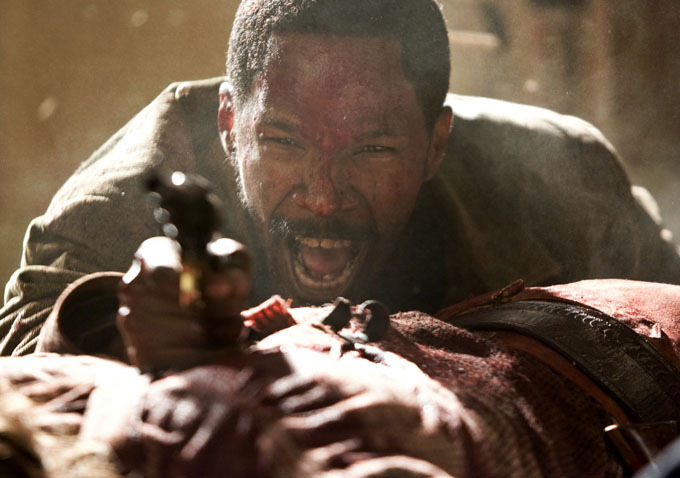
Django Unchained is his latest polyglot of a film, the influences coming from everywhere, the soundtrack a dog's breakfast of styles and eras,* a mixture of high camp, dark humor, and revenge fantasy/wish-fulfillment set once upon a time in the era of slavery, that, even though it rigorously evokes the time and place in design (The South, "1858, two years before the Civil War"), must bow to Tarantino's superficial wishes to what's "cool" in his own head.  There are a couple of scenes that immediately made me think "this is great" (a long, protracted discussion in a bar and a street between Django (Jamie Foxx) and his mentor/patron Dr. King Schultz** (Christoph Waltz) on the similarities between slavers and bounty hunters ("Like slavery, it's a cash for flesh business....Still, I feel guilty about it"), a presentation by Schultz of the Siegfried myth (before a cliff-side proscenium arch that only contains Django as audience), and a bizarre proto-Klan gathering played for Pythonesque laughs.  The set up in the first half of the movie is fine, even intriguing (while the inspirations wheel through your head—not so much Sergio Leone, as The Skin Game, Blazing Saddles, Rosewood), then everything falls apart when, in an effort to rescue Django's wife Broomhilda von Shaft*** (Kerry Washington) we get to Candieland, the plantation owned by the eccentric Calvin Candie (Leonardo DiCaprio), where things seem to go on and on and on and on, the humor dries up, and things turn nasty.  The proclivity towards going overboard while not really advancing the story takes over and becomes paramount, with extended shoot-outs, emphasizing the thinnest of blood exploding out of wounds as if every blood vessel were an artery.  Django Unchained becomes repetitive and, frankly, dull, then a little prematurely self-congratulatory.  

A lot of the problem is that Tarantino has written such a good set-up, that he can't top himself with a finish, and falls back on the action that is neither inspired or clever.  And that is a low-down, dirty shame, especially when it comes to the characters he's spent a great deal of time creating and setting up.  They're inconsistent—ironic, as one of Schultz's major pieces of advice to Django is "during the act, you can never break character."  And yet Schultz ultimately does as does most everyone in the service of getting to the popping blood-bags.  Drama comes from character and most of the individuals in the film break character in ill-considered ways as a quick means to get out of a writerly jam.  The ultimate goal of the piece is foiled by blunt actions  from characters who had previously survived by guile.  That Django must use the same tactics—along with a fistful of dynamite (which, by the way, hadn't been invented yet)  shows an inconsistency in the most important player of the thing, and the star of the show, Quentin Tarantino.  Indulgence is one thing.  Lazy indulgence that trashes the previous good work is quite another.  

Look.  One should never take Tarantino too seriously.  If you do, you're missing a lot of the manic joy of his films for films' sake.  And reverence for such irreverence on his part is more than a little counter-intuitive and weirdly contrary.  But, it is disappointing that the director reached a certain point with this one, and just said "Aw, why work so hard?  Let's blow some shit up" leaving a path of destruction that includes dozens of bodies, and one pretty good idea for a movie, once upon a time.

Django Unchained is a Rental.  
Wilhelm alert @ 00:50:00

Jamie Foxx's Django wears a sun-screening cowboy hat AND shades.
Remember that line from Once Upon a Time in the West
about a man who wears both a belt and suspenders?


* This one is all over the map: start off with Luis Bacalov's song for the Sergio Corbucci western ("with the kind participation of Franco Nero") done in a cross-bred Elvisian/Frankie Laine style, a lot of Ennio Morricone (including a piece that Tarantino thinks is "original" but actually comes from Two Mules for Sister Sara), a piece of Jerry Goldsmith from Under Fire, Verdi's Requiem, and songs like Richie Havens' Freedom, and...most bizarrely, Jim Croce's cheery "I've Got a Name" which he guillotine-edits right before the phrase "And I'm gonna go there free."  Hmm.

** Just realized: "Dr. King."  Heh.

*** See what I mean about Blazing Saddles?  Remember Lili von Schtupp?

Thursday, December 6, 2012

The Dirty Dozen

The Dirty Dozen (Robert Aldrich, 1967) Another one of those films I've had (uh..) dozens of opportunities to see, but never bothered is Aldrich's off-set war-genre film, combining the heroics of The Guns of Navarone with the nihilism of The Magnificent 7.  

The Army chooses a loose cannon, Maj. John Reisman (Lee Marvin) to train and command a squad of brig-rats on a suicide mission behind enemy lines before D-Day.  The inmates are a motley crew of renegades, degenerates and non-com's (as in non-conformists), who need no training to be bad to the enemy.  If they survive, their jail sentences (and for some, death sentences) will be commuted.  If they don't, well, war is Hell.  But it's not a cell.  And these guys have nothing left to lose, given the situation, American kamikaze's, who might just make it to freedom, like any other soldier...if they make it through.


The movie is top-heavy with male character actors.  Besides Marvin, there's Robert Ryan, Ernest Borgnine, George Kennedy, Robert Webber, Richard Jaeckel, and Aldrich's Mike Hammer, Ralph Meeker.  Those are the good guys.  The cons include Charles Bronson, Clint Walker, Telly Savalas, Jim Brown, John Cassavettes, Donald Sutherland, and Trini Lopez (hey, where's Don Rickles and Bobby Darren?)  


Bronson gets a promotion in this one, becoming the Steve McQueen to Marvin's Yul Brynner, Cassavettes has the biggest character arc and the showiest performance (despite underplaying his death scene) winning a Best Supporting Actor nomination, Savalas has the most colorful role as a Bible-spouting psycho, and Jim Brown has the moment everybody remembers-sprinting across a courtyard throwing grenades down air vents, moving so fast the camera crew can barely keep him in the view-finder.


Aldrich—never one to be very conventional no matter what genre he was tackling—manages to make his anti-war, anti-authority statements in the story set-up—these guys have little choice but to hang it all out in combat, and, ironically, they're the best-suited to do all the dirty work, even if nobody is shooting at them in the initial stages.  At the time of its release, the film got all sorts of flack for its violence, which Aldrich manages to get away with by merely suggesting things with quick cut-aways, but it looks extraordinarily tame today (and, in fact, would look tame two years later when The Wild Bunch would take movie violence to a whole new level).  It might even get by with a light PG rating today.


But despite the dirt-dog-grubbiness of the whole thing, the director still manages to throw in some testosterone-laced sentimentality into it, then pulls back during the big action sequence as more and more men fall in battle and the director only affords them quick shots in death.  Pretty soon, you lose track of who made it and who didn't, and a pre-End-Credits roll-call of the dead is the only verification—not everybody gets their death scene, further undercutting any sense of heroics, despite the war-time setting.  And let's face it, most of the deaths occur by trapping the victims (party-guests mostly) in a cellar and burning them alive by drenching them in gasoline, and setting them alight with grenades.  It's never made clear why this might help the Normandy Invasion effort, but one shouldn't look too closely at the movie for authenticity.


Wednesday, October 31, 2012

Dr. Jekyll and Mr. Hyde (Twinned)

Private Joker: I think I was trying to suggest something about the duality of man, sir. 
Pogue Colonel: The what? 
Private Joker: The duality of man. The Jungian thing, sir. 
Pogue Colonel: ...Whose side are you on, son? 
Full Metal Jacket

"(Cocaine) enhances your personality!"  "Well, what if you're an asshole!?"
Bill Cosby from Bill Cosby, Himself

Better living through chemistry?  And whose side, indeed?  This Hallowe'en season we haven't been looking at monsters, and creatures and other outside forces that threaten us and make us come face to face with horror (as we have in the past).  We've been looking at those that attack us from within.  Not at the monsters that peer at us from outside our bedroom window, but the ones that look at us indoors in our very own mirrors.  What special horror it is, when we come face to face with our enemy, and it's our own.  No better example of that came from the pen of Robert Louis Stevenson in the year 1861.

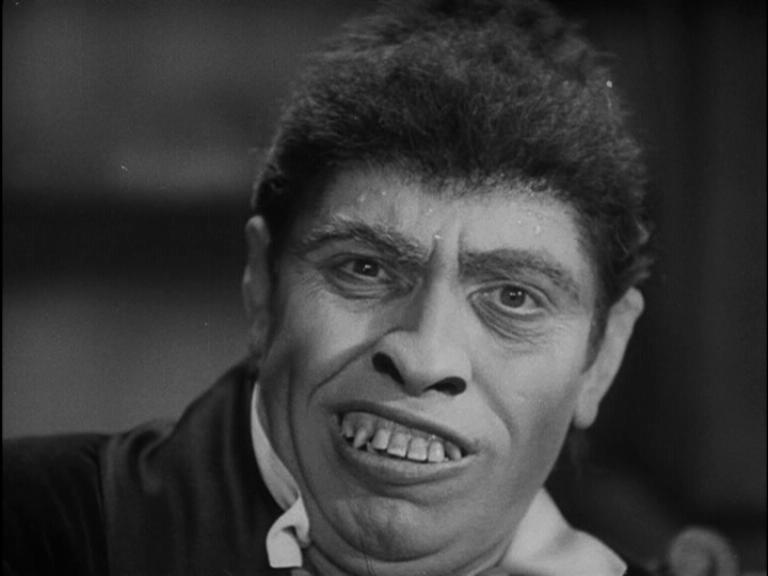
 Dr. Jekyll and Mr. Hyde (Rouben Mamoulian, 1931) A new version of Stevenson's "Strange Case of Dr. Jekyll and Mr. Hyde" seems to crop up every few years.  There've been versions with John Barrymore, Basil Rathbone, Christopher Lee, Spencer Tracy (see below), and TV versions with Jack Palance and even one with Lionel Bart musical numbers that featured Kirk Douglas.  But, this is the one people remember, for many reasons—first being Frederic March's portrayal (which won him an Oscar for Best Actor...in a Horror film, mind you), the effects, the outright sexiness of it (as the film was "Pre-Code,") and for director Mamoulian's stylish treatment—full of straight-on shots of the actors facing the audience, mirrored shots, and all the transformations, each one staged differently (and in a couple of instances using a combination of make-up that only becomes apparent in monochrome when struck by lights colored by different gels—with "Hyde" finally appearing as an ape-like creature in need of radical orthodentia.  March turns in an incredible performance (and he won an Oscar for it, the first actor to do so for a lead in a horror film—the second being Anthony Hopkins in The Silence of the Lambs), his Jekyll (pronounced Jee-kull as the Scottish Stevenson would have it) clearly conflicted but held in check and completely invisible in the form of the obstreperous Hyde, leaping over parapets and loudly enunciating (through those big false teeth) his intentions in a husked gravel.  When first confronting his new image in the mirror he cries "Free!  Free!  At last!"


Now, in Dr. Jekyll and Mr. Hyde (Victor Fleming, 1941) the Dr. Jekyll (pronounced Jeh-kull) played by Spencer Tracy, is far more considering: "So, this is evil, then"  he observes staring at his new countenance in the mirror.

Yes. Yes, it is. Tracy's Jekyll is a thinking, decent man with dark undertones, far less egocentric than the stentorian performance of March; his Hyde is shaggy dark eyebrows and hair, with a curled upper lip like a scar and a direct gaze and uncouthness, despite his pretensions of refinement.  March's Hyde is a proto-human; Tracy's is just a sadistic sociopath.  Jekyll's frustrations with his straight-laced potential father-in-law (Halliwell Hobbs in the first, Donald Crisp in the latter) are buried deep and Hyde releases that pent-up rage.  In the Tracy version, the intelligence is still there (as opposed to March's gleeful monkey-man) but used malevolently—the words are erudite and evenly spoken, but his actions are quick-silver and savage.  


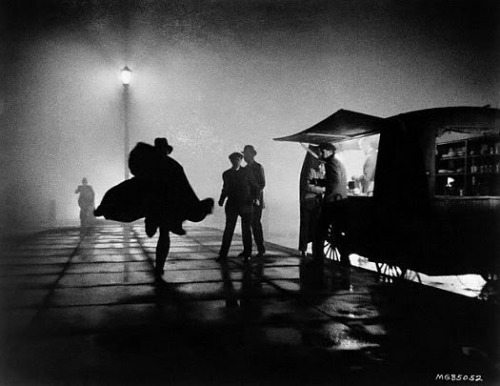
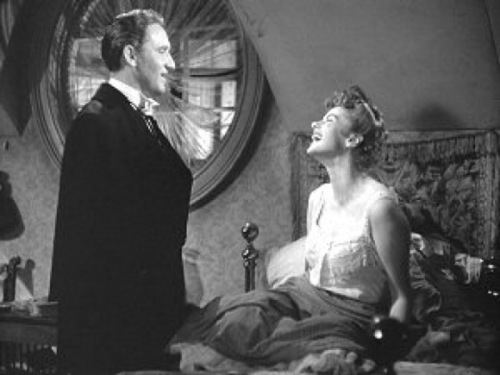
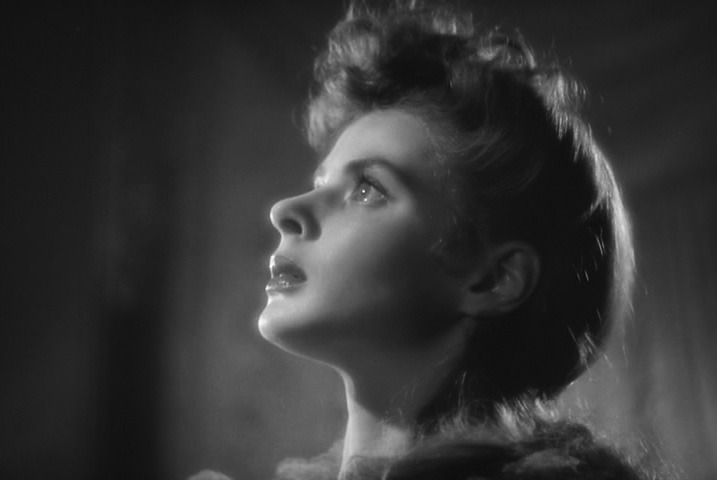
The Tracy version of the character depends less on make-up than the actor's own inventiveness (not that March was any slouch, far from it).  Directed by Victor Fleming, with more emphasis on thick fog effects (where Hyde seems to be allowed to be swallowed in the thick mists, until he disappears like so much water vapor) and the psychology of evil, it is sumptuously produced and veers into the surreal during the transformation sequences.  These are weirdly disturbing, shifting from surfacing lily-pads to Jekyll whipping a team of horses...which then turn into the two women in his life: his faithful fiance (played by a never-lovelier Lana Turner) and a bar-maid (a very early role for Ingrid Bergman, this one preceded Casablanca).  One can only imagine the direction that the director gave his actresses for this sequence and the others ("Okay, Ingrid, you're a wine-cork, but a happy wine-cork!").  Whereas March's Hyde is all simian actions and attitudes, Tracy's is psychologically, adroitly cool, a genuinely mean bastard gleefully tripping up theater managers with his walking stick, and setting up Bergman's Ivy Petersen as a kept woman, scarring her physically and mentally.  Both films stray from Stevenson's narrative, which only implies Hyde's actions, which seem to stay only in the realm of violence, but both Mamoulian's and Fleming's films features the story of the two women who suffer at the man's hands and split personalities.  Bergman's performance is raw and heartbreaking, subtly letting emotions percolate under the surface of her skin, a luminous smile capable of dropping precipitously and tremulously, then escalating into hysteria.  Turner's performance is pitch-perfect, but merely an ingénue role and she's not required too much of the tortured complexity she would display later in her career.


Mamoulian's film is fancy; Fleming's is fanciful, each taking different approaches to what is essentially the same screen-story, deviating just as far off the cobblestone streets of the novella, and each one coming to the same conclusion—different from the story's where Jekyll's fate is left in the air, seemingly condemned to live out his life as the evil Hyde—to satisfy the moralists in the audience, pre-Code or not.  Interesting to see them back-to-back (to-back-to-back) and explore the similarities and differences—a bit like Jekyll and Hyde themselves.


Interestingly, these two Jekyll's, Tracy and March, squared off against each other in the courtroom drama Inherit the Wind.*


* And another parallel: March received his first Oscar nomination for playing the part of actor Tony Cavendish in The Royal Family of Broadway.  The role of Cavendish was based on John Barrymore who had a big success...playing Dr. Jekyll/Mr. Hyde in the 1920 film version.

"...Room for one more, honey?"


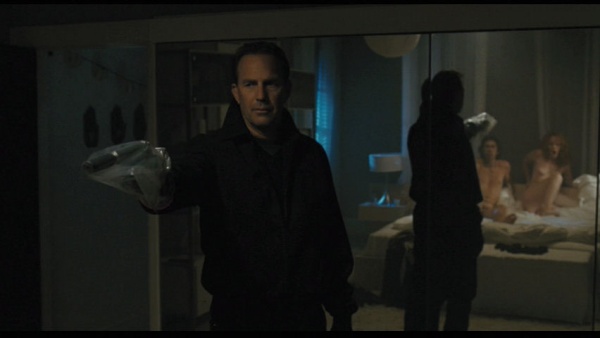
Mr. Brooks (Bruce A. Evans, 2007) A more modern take on the Jekyll/Hyde-in-plain-sight story (we won't talk about the various "Hulk" movies—the superhero version of it) is this creepy psychological thriller about another upstanding citizen and pillar of the community, Earl Brooks (Kevin Costner), CEO of a thriving box-making business.  Brooks has a seemingly normal nuclear family: a loving, doting gorgeous wife (Marg Helgenberger) and a slightly spinning-out-of-orbit daughter (Danielle Panabaker), but the fourth member of the clan is the one with the most fission—the other voice in Brooks' head, Marshall, played by an on-screen William Hurt.  The performances of the two men couldn't be more different: Hurt has the easier one—the all-leering, cackling, lip-smacking Id, while Costner (being in the "real" world) is restrained, cerebral, and calculating on the inside.  Costner really is a fine actor, and his Brooks, in control of most situations unless Marshall convinces him otherwise, every so often goes on a killing binge that satisfies a weird craving.  One entertaining aspect is that Brooks is self-aware enough of his situation to go to AA meetings.  He's an addict and he knows it.  But there aren't enough steps in any program to cure his issues.  He's made enough of a blood-splash to attract the attention of local detectives (Demi Moore leading the investigation) and one fan-boy (Dane Cook) who wants in on the action.  Earl and Marshall are caught in the middle (and with two personalities it gets very crowded in there), yinging and yanging between their two points of view and calculations.  But the creepiest moments—the genuinely chilling ones—are when they combine, joining each other in a sick, twisted laugh for a shared joke, between the two personalities in the one man.  For all the gruesome murders and gouts of blood on display, that's when Mr. Brooks gets really scary.


Tuesday, October 30, 2012

Dead of Night (1945)

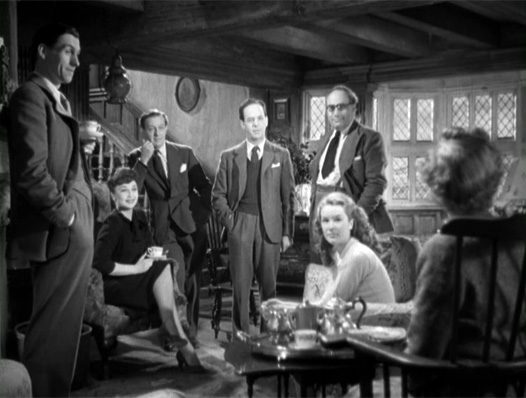
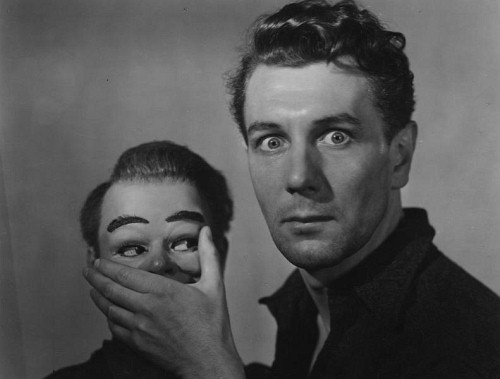
Dead of Night (Alberto Cavalcanti, Basil Dearden, Charles Crichton, Robert Hamer, 1945) British omnibus film from Ealing Studios where four stories of the bizarre are buttressed by a framing device of an architect (Mervyn Jones) invited to a country house that evokes an inescapable sense of déjà vu.  At the house is a collection of strangers with odd stories: a race car driver who barely survives a crash and during a recovery has a strange dream involving a beckoning hearse and driver who says "just room for inside, sir"—a dream that has fateful repercussions later on; a girl (Sally Ann Howes) who recounts a strange encounter at a Christmas party; a woman who buys her fiancé an antiquated mirror with a mind—and a room—of its own; a whimsical tale of of two obsessed golf duffers (Basil Radford and Naunton Wayne) who wager for the affections of a woman over a match; and the last, featuring a ventriloquist (a bravura performance by Michael Redgrave) whose dummy wants to change the act's billing.

Anyone familiar with "The Twilight Zone" will have their own distinct sense of déjà vu watching Dead of Night—the race-driving story is remarkably similar to a Bennet Cerf story that was adapted by Serling as "Twenty Two;" the Christmas story echoes others; the ventriloquist story has been dummied about several times and not just on TZ.  The stories have their own specific atmospheres that cling to their stories like shrouds, and Ealing proudly displays the collection of sets and artistry that made it one of the preeminent studios in Great Britain.

The stories are all decidedly set-bound with some quick outdoor scenes—it was wartime when the film was made and although the tone is fairly nightmarish (pluckily nightmarish), escapism from the rubble and the war news was the intent, and maybe a little tonic from "boogey-man-isms" by having a psychiatrist (Viennese, of course, played by Frederick Valk) popping the bubble of the story-tellers by trying to clinically explain things away.  It provides a fine counter-balance (and a bit of straight-faced comic relief) to the tales of the supernatural, with their underpinnings of hysteria and mental imbalance.  Fun, unsettling and meticulously done.

Friday, September 7, 2012

Dark Journey

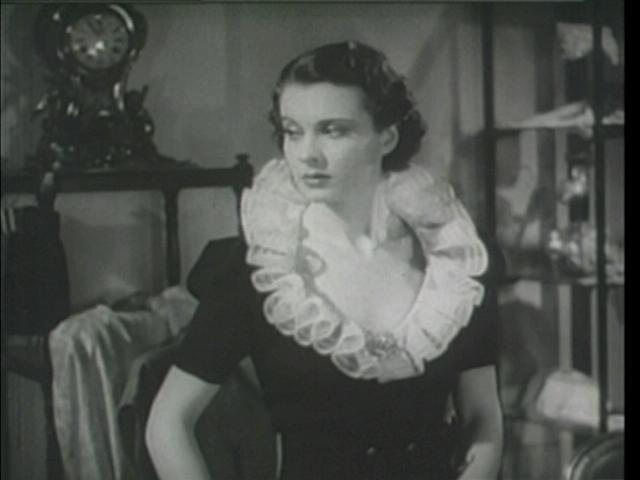
Dark Journey (Victor Saville, 1937) All's fair in love and World War I—but when love and war are running congruently, neck and neck, that's when things really get dicey.  Especially when the warring lovers are spies, spying on each other.  There's Madeleine Goddard (Vivien Leigh) is a designer and couture diva who regularly makes a shopping run between France and Switzerland, cloaking her activities as an agent for the British.  She moves through the hoi-poloi (who never seem aware there's a war going on) attracting all the best customers, none of them suspecting that her decorative scarves and pattern swatches contain secret plans and schematics.  Her assignment—find out who's the head of the German intelligence agency, Section 8.  Enter the snakily charming Baron Karl von Marwitz (Conrad Veit), a German deserter who caddishly trolls the gargantuan supper-clubs with their high ceilings and higher society for the more low hanging fruit of females.  It is through one of his companions that he becomes acquainted with Madeleine, becomes smitten and just a little stalkerish with her.  For some reason, she finds this attractive and the two begin a wary relationship.

Yeah, well, hunt a tiger...and opposites attract, and all that.  It isn't giving away any state secrets that the revelations that ultimately come about are a little less than surprising.  Nor is it surprising that two intelligence agents so visibly hiding in plain sight might not actually be that effective (C'mon kids, it's called "undercover" for a reason).  Imagine the dinner table conversation: "What did you do today?" "Nothing.  And you?"  "Same thing."  Double crossing does not "go" with star-crossing.

Anyway, you thought YOU had a complicated relationship.  This was a few years before Leigh would toss away such behavior with a dismissive "Fiddle-dee-dee."  And it's fun to watch the complications that ensue when the two spies are a little too loose with their lips.  It's amazing that WWI was won at all.

The costumes and sets are lavish (and very un-WWI era).  Leigh and Veidt do very well conveying conflicting loyalties, but the plot is a bit spare in details as to be confusing.  It's never really determined who has the upper hand—is Madeleine basically a "honey-trap" to seduce the German and get him where he can easily be captured, or is it all a misinformation campaign by either side.  Whatever it is, the romance is the least charged of the themes in the film, even though Leigh and Veidt try their damnedest to be anything more than inscrutable.  It's an interesting spy melodrama, it's just that there's not a lot to love.

Wednesday, July 18, 2012

The Dawn Patrol (1938)

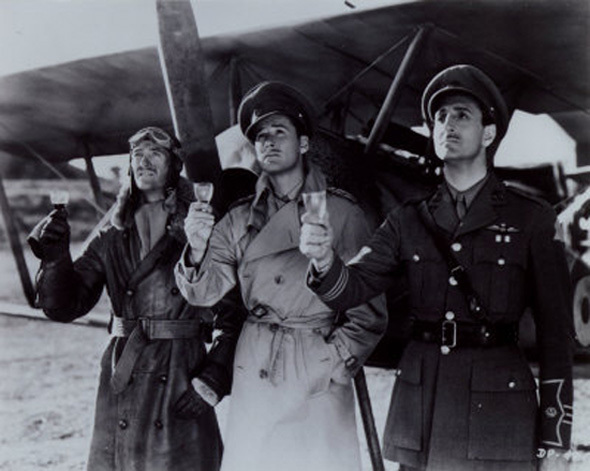
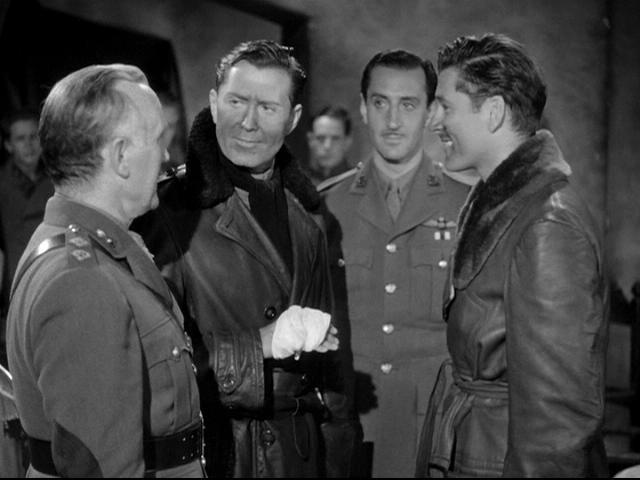
The Dawn Patrol (Edmund Goulding, 1938) Eight years after the silent Howard Hawks hit starring Richard Barthelmess and Douglas Fairbanks, Jr., the same studio released this remake, taking advantage of sound technology to enhance the story, not only in the roar of engines in combat (they even used the same planes from the Hawks version), but also the fellowship of song (a Hawks staple, by the way--I'm very curious to see how the first film got away without it, with no music and no use of the emblematic "Hurrah for the Next Man Who Dies.") This time, it's Errol Flynn as the pilot with the longest shelf-life, reporting to superior Basil Rathbone (who sits and waits, listening for the sound of each plane returning) aided and abetted by Donald Crisp, who does the paper-work, writing the letters home to bereaved families.

Headquarters is a slap-dash dormitory/strategy room with a 24 hour bar (tendered by Barry Fitzgerald)/rumpus room, done in late German atrophy and a blackboard containing the names of the squadron on duty and the chalk-dust that is left of the honored dead.  It's a rotating complement of young men dealing with the pressure cooker (with heavy seasoning) of combat and the existentialism of transitory bonhomie. Very quickly, rookies become veterans and the dreams of youth evaporate in the shots of whiskey and the oil grime that cakes their faces after every sortee.
They're all brothers in the air, dueling and jousting in the machines they pilot, and when they fall, there's enough honor to salute the plummeting.  These pilots are so joined that when a captured German pilot is brought to the barracks, he's welcomed to the party, even though he's just shot down one of their comrades (David Niven) and if someone holds a grudge, well, that's just bad manners, what?

A little odd for a war film,* but an example of Hawksian work ethics—do your job, be a professional, even in war-time.  It's just a grudge-match between nations, anyway, and once everyone's on equal footing—in this case, terra firma—you don't hold a grudge against professionals.  One has to prove oneself worthy, of course, but the general rule is to keep the war in the skies, keep your chin up and your upper lip stiff.

It's not a Hawks film, understand, just an interpretation of Hawks material.    And Edmund Goulding is quite adept at making the material soar, both in the skies and on the ground.  It's a British cast, so the bantering is quite formal with well-defined rules of engagement.  Goulding doesn't match Hawks' trademark at-the-shoulders camera compositions, choosing, instead, a more versatile shooting scheme, which are, at times, artful.  But, it is one odd war movie, removed from the geopolitics, insular and private.  You get the impression that these guys might be doing this, anyway, if it wasn't for the damned turnaround.  But, it is remarkably free of jingoism, glorification and other self-serving sentiments.  War is a hell of job, even in the first light of mourning.


* Odd, yes, but not without precedent, especially given the odd episode of the Christmas truce during WWI (a variation of which Steven Spielberg used for an episode in his War Horse film).  And, in these economic times, there are parallels: I have friends who work in a call center, who oft-times don't see the escorting off the premises of co-workers, while the "new recruits" keep revolving into the ranks to replace them.  I've suggested more than once the idea of a tontine for the "last man standing" from the many cliques that form in such situations.

Tuesday, May 1, 2012

The Debt

The Debt (John Madden, 2011) Remake of the Assaf Bernstein 2007 original out of Israel.

A team of three Israeli agents are tasked with bringing a concentration camp doctor, Dieter Vogel (Jesper Christensen) to justice.  The team, two men and a woman (Marton Csokas, Sam Worthington—his best film performance, one should say—, and Jessica Chastain) must find the man, who's now an OB/GYN in Berlin, kidnap him, and hold him him until they can transport him out of the country.

Things do not go well. 

They manage to grab the butcher, but end up hold up in their apartment with the man, while delays keep the four antagonists in close proximity.  The cops are stepping up the investigation looking for him, rather than having things cool down.  Everyone is trapped like rats, all the better for everyone to get to know each other better.  Then the fun begins.

It's thirty years later and the three (played by Tom Wilkinson, Ciaràn Hinds and Helen Mirren, respectively) are being feted at an event celebrating the publication of a book in which the incident figures, written by the female agent's daughter.  The three are praised, glad-handed and lionized, despite the fact that one of the three is missing.

And the story isn't really true.

John Madden is not the best fit for the film, despite his previous television work.  But he gets the milieu down, and the layered performances of the principles benefit from his attention to detail (although one doesn't feel that the performances between older and younger selves merge too successfully).  Ultimately, the film feels unsatisfying, and not just in the sense of the downbeat subject matter.  

One is left feeling next to nothing, except in the uselessness of the exercise—where the mission is to fulfill commitments rather than doing any real good—to exact revenge, rather than justice.

Some lip-service is paid to duty, to country, but one gets the impression that's merely a card to be played in a battle of wills.  In the end, its a case of diminishing returns:  if justice can't be achieved, revenge will do; if that doesn't happen, the best to do is keep up appearances for morale and PR. If one can accept that such a conspiracy of silence can be maintained for 30 years without corroborating evidence—a not-small consideration (especially given these agents)—the movie still feels empty and unsatisfying.


Thursday, April 12, 2012

Drums Along the Mohawk

When Orson Welles was asked what movies he studied before embarking on directing Citizen Kane he replied, "I studied the Old Masters, by which I mean John Ford, John Ford, and John Ford." For the next three days we'll be looking at little-seen films from The Old Master, each different in tone, temperament and subject matter, but all unmistakably the work of America's storied film-maker, the irascible, painterly, domineering, sentimental puzzle that was John Ford, John Ford, and John Ford.

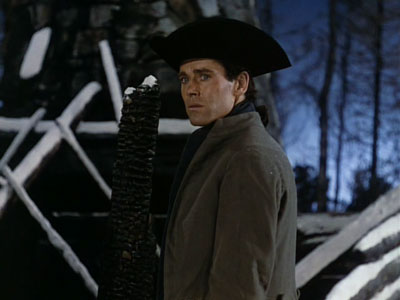
Drums Along the Mohawk (John Ford, 1939) "Every generation must make its own way—in one place or another"—so director Ford caps the start of his career-long history of the United States...with a wedding, for this earliest episode in that timeline.  The year is 1776, but instead of the politicians haggling over language in Philadelphia meeting rooms, he's—again—on the frontier, a couple day's ride from Albany, New York. Gil Martin (Henry Fonda) and his new wife Lana (Claudette Colbert) are embarking on a mission, just as the newly formed states are, "to form a more perfect union."  

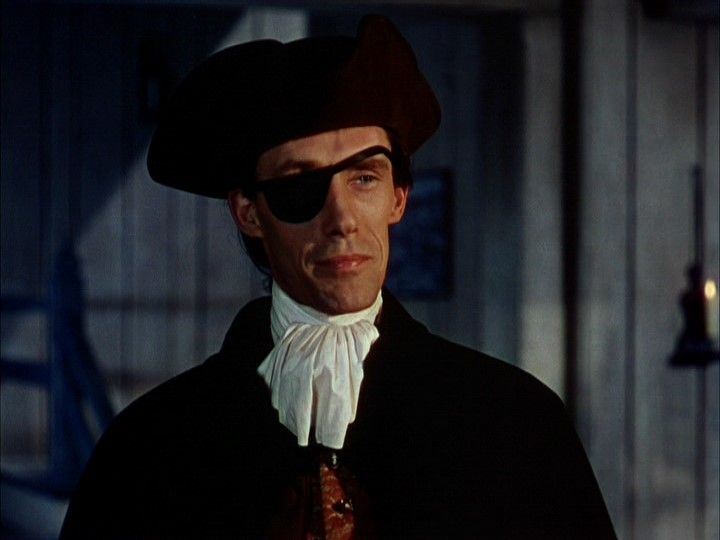
It won't be easy for either organization, with threats, both internal and external.  There are attacks by Natives against the encroaching settlers (but, even here, Ford has them blameless—if brutally opportunistic—as the Iroquois are taking their orders from a Tory agent, played by an eye-patched John Carradine, who is paying the tribe for their berserker destruction of the homesteads, burning everything—buildings, crops and possessions—down to the bare Earth, leaving nothing, not even anything the tribe could steal or profit by), internal strife among the villagers, and the hard-scrabble existence that tests the fiber of the town-folk.

Before long, the citizens are driven to the local fort housing the militia, always at the ready for a call to arms from General Washington.  In the meantime are the struggles to maintain a family, order, and petty grievances that threaten to disrupt the community from within.  But, a shared sense of purpose—community-building reflecting the larger picture of nation-building, pulls the majority of them through.

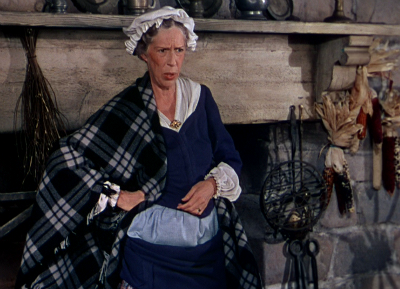
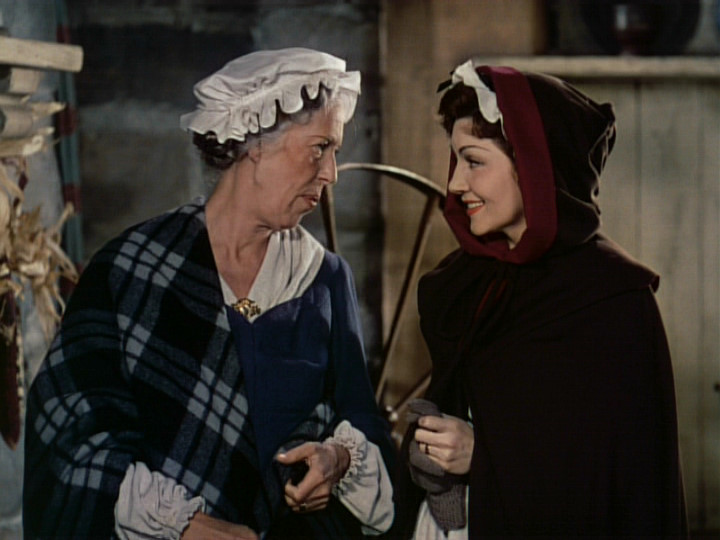
Early on, Gil and Lana are burned out of their humble cabin-home, built by Gil. They take up lodgings with the widow McKlennar (Edna May Oliver) as workers and soon, are back on their feet, on a par with everyone who has suffered hardships.

This is Ford's first film in color, and it's eye-popping Technicolor, and the director, who was discriminating in his choice of which format to use—his last two were in monochrome—fills the screen with detailed color; the very first shot, after the needle-pointed credits, is a pull-out from the bouquet that Lana is holding at her wedding, and there are fiery sunsets and sunrises framed in the same Ford-fashion, with just the right amount of horizon for contrast.  The greens are the most verdant, and fire seems to play an important part of the scheme of things, the flaming colors unnatural against a pastoral backdrop.

Fire figures in a violent double-whammy that strikes one unexpectedly towards the end of the film, as a scout (played by Francis Ford, the director's brother) is wheeled out in front of the fort in a wagon of straw, which is then set alight by torches and flaming arrows.*  Just when that scene is set in the mind, one of the settlers (played by Ford stock-player Ward Bond) is shot in the shoulder with a flaming arrow.  A flaming arrow.  Okay, sure, the arrow is a special effect on a wire, but the fire is real and Bond and his clothing are just as flammable as the next guy and his clothing.  The level of violence is turned up just a notch from what one might expect, and one is taken aback by it.  

Ford could do that—make you feel all-complacent and tear the Navajo-rug out from under you.

But it's a great movie.  Action-oriented, with the only difference being that the significant events—the bigger picture—is all happening off-screen, rather than being part of the tapestry of events.  Ford would be doing that in the future (both in his career and the events that shaped the country), but this is a very fine beginning.


Ford's first film in color—and Technicolor, at that—does not disappoint.


* It works just as dramatically here as it did in 1987, when Kubrick used something similar in Full Metal Jacket.