Showing posts with label Samuel L. Jackson. Show all posts

Saturday, January 5, 2013

Django Unchained

What's Black and White and Red All Over?
or
Wasted Away Again in Tarantinoville

One walks into any Quentin Tarantino film warily.  It's going to be a "cheese-fest," for sure, it's just a matter of the quality of presentation—because it is always going to be about cheese.

And it's always going to be about movies, rather than the subject or genre it revolves around.


But, that's all you can count on; one never knows what to expect (which is a good thing).  One also knows that there will be moments, and even whole sequences of clownishness where he can't help going off the rails of a disciplined narrative to succumb to some cackling goonishness.  Tarantino is a bad little kid.  He's also a major league slugger...who likes to aim for the dug-out and, contrarily, hits home runs.  When he pulls off a whole movie, as he has in the past (particularly Inglourious Basterds), it can be a thrilling wallow—challenging and cathartic; he's got such good ideas that nobody has thought before, even while he plunders others' right and left.  It's just that he can't separate good ideas from bad ones, maybe because the originating Tarant-ego can't discriminate which, because they come from the same source.


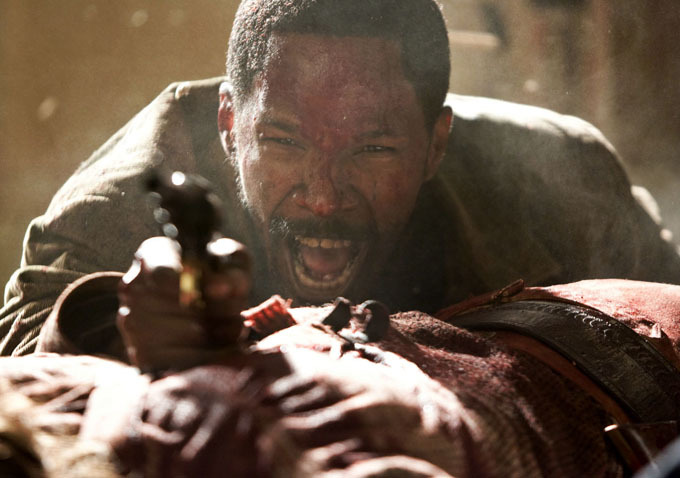
Django Unchained is his latest polyglot of a film, the influences coming from everywhere, the soundtrack a dog's breakfast of styles and eras,* a mixture of high camp, dark humor, and revenge fantasy/wish-fulfillment set once upon a time in the era of slavery, that, even though it rigorously evokes the time and place in design (The South, "1858, two years before the Civil War"), must bow to Tarantino's superficial wishes to what's "cool" in his own head.  There are a couple of scenes that immediately made me think "this is great" (a long, protracted discussion in a bar and a street between Django (Jamie Foxx) and his mentor/patron Dr. King Schultz** (Christoph Waltz) on the similarities between slavers and bounty hunters ("Like slavery, it's a cash for flesh business....Still, I feel guilty about it"), a presentation by Schultz of the Siegfried myth (before a cliff-side proscenium arch that only contains Django as audience), and a bizarre proto-Klan gathering played for Pythonesque laughs.  The set up in the first half of the movie is fine, even intriguing (while the inspirations wheel through your head—not so much Sergio Leone, as The Skin Game, Blazing Saddles, Rosewood), then everything falls apart when, in an effort to rescue Django's wife Broomhilda von Shaft*** (Kerry Washington) we get to Candieland, the plantation owned by the eccentric Calvin Candie (Leonardo DiCaprio), where things seem to go on and on and on and on, the humor dries up, and things turn nasty.  The proclivity towards going overboard while not really advancing the story takes over and becomes paramount, with extended shoot-outs, emphasizing the thinnest of blood exploding out of wounds as if every blood vessel were an artery.  Django Unchained becomes repetitive and, frankly, dull, then a little prematurely self-congratulatory.  

A lot of the problem is that Tarantino has written such a good set-up, that he can't top himself with a finish, and falls back on the action that is neither inspired or clever.  And that is a low-down, dirty shame, especially when it comes to the characters he's spent a great deal of time creating and setting up.  They're inconsistent—ironic, as one of Schultz's major pieces of advice to Django is "during the act, you can never break character."  And yet Schultz ultimately does as does most everyone in the service of getting to the popping blood-bags.  Drama comes from character and most of the individuals in the film break character in ill-considered ways as a quick means to get out of a writerly jam.  The ultimate goal of the piece is foiled by blunt actions  from characters who had previously survived by guile.  That Django must use the same tactics—along with a fistful of dynamite (which, by the way, hadn't been invented yet)  shows an inconsistency in the most important player of the thing, and the star of the show, Quentin Tarantino.  Indulgence is one thing.  Lazy indulgence that trashes the previous good work is quite another.  

Look.  One should never take Tarantino too seriously.  If you do, you're missing a lot of the manic joy of his films for films' sake.  And reverence for such irreverence on his part is more than a little counter-intuitive and weirdly contrary.  But, it is disappointing that the director reached a certain point with this one, and just said "Aw, why work so hard?  Let's blow some shit up" leaving a path of destruction that includes dozens of bodies, and one pretty good idea for a movie, once upon a time.

Django Unchained is a Rental.  
Wilhelm alert @ 00:50:00

Jamie Foxx's Django wears a sun-screening cowboy hat AND shades.
Remember that line from Once Upon a Time in the West
about a man who wears both a belt and suspenders?


* This one is all over the map: start off with Luis Bacalov's song for the Sergio Corbucci western ("with the kind participation of Franco Nero") done in a cross-bred Elvisian/Frankie Laine style, a lot of Ennio Morricone (including a piece that Tarantino thinks is "original" but actually comes from Two Mules for Sister Sara), a piece of Jerry Goldsmith from Under Fire, Verdi's Requiem, and songs like Richie Havens' Freedom, and...most bizarrely, Jim Croce's cheery "I've Got a Name" which he guillotine-edits right before the phrase "And I'm gonna go there free."  Hmm.

** Just realized: "Dr. King."  Heh.

*** See what I mean about Blazing Saddles?  Remember Lili von Schtupp?

Wednesday, May 9, 2012

Marvel's The Avengers

"We've Got a Hulk..."
or
Playing Your "A" Game


This one is The Big Pay-Off.

Back in the day (around about Iron Man) when they started doing teasers at the end of Marvel movies for the idea of an "Avengers" event, one hoped that they could pull it off.  Captain America needed to work (and it did). Iron Man II integrated other characters successfully.  They even managed to make Thor somewhat interesting.  And even though two "Hulk" movies under-performed at the box-office, there was still potential there.  Given the scenario of the "Ultimate Avengers" storyline (a revamp in the Marvel line that started everything over from Origin Story Square One with a decidedly more adult, realistic attitude...and a Nick Fury that looked like Samuel L. Jackson) a case could be made for a good old fashioned Marvel Jam story of the "When Titans Clash!" school.

The problem is all those heroes. It could turn into a mighty cluster, if there isn't a compelling story that slots heroes into appropriate scenarios, a problem with some of the "X-Men" films.  And one also hopes that there's a compelling reason for these guys to be here, that there is some character function going on, even though they have plenty of screen-time in their own series to work on those.

Will The Avengers "assemble" into a well-functioning superhero romp, and make Joss Whedon (who excels at ensembles) an A-list director that fans have been hoping for?

"Yes" to the former and "Maybe" to the latter, although pulling off this one is not an easy feat—so many particular and persnickety stars, so many owned and exploitable characters that corporations (and opposing film studios) want to manage, and so many potential minefields that it would take a superhero (with levitating powers) to rise above and negotiate them.  But Marvel's The Avengers (what they're calling this one to avoid any confusion) manages to be fast-paced, quick-witted, and, although slightly derivative (mostly of Jack Kirby's "Fourth World" series, with hints of The Andromeda Strain in sub-text, and, let's face it, most mythology and comic book tropes), and is, as one character analogizes, "a bag full of cats," fulfills its basic tenet: to be consistently entertaining, with crises every few minutes, wonders to behold (some of the sets are simply amazing), interesting pair-ups in terms of fights (Marvel heroes are always fighting each other—they're very turf-oriented, which is bad because they're all in New York) and dialogue.  

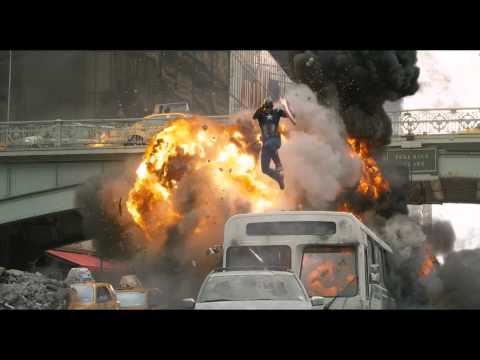
And it does two essential things: keep each individual hero definable in tone and action, and make those fights "followable"—this isn't a hodge-podge of pictures of punches, muzzle-flares and explosions, there is breathing room between sequences and shots, so an audience is allowed to register action and result, something missing from a lot of action movies, where there is either bad direction or a style-disconnect between various "units" filming.  It feels "of a piece," despite the subject of the film being about extraordinary outcasts aligning uneasily.*

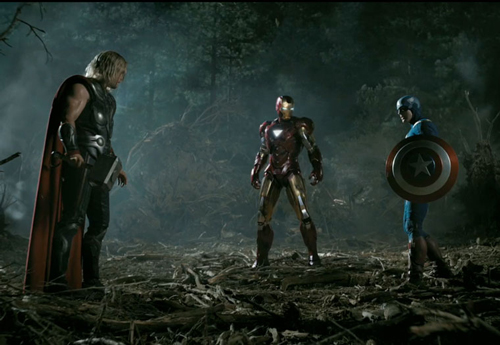
In a pithy line of dialogue between "Iron Man" Tony Stark (Robert Downey, Jr. riffing brilliantly) and villain Loki (Tom Hiddlestone, registering far more than he did in the Thor movie)—everybody gets their Loki scene, The Hulk's being the best—the entire movie is summed up in an adamantium-encased nut-shell: "Yeah, takes us a while to get any traction, I'll give you that one but, let's do a head count here. Your brother, the demi-god; a super soldier, a living legend who kind of lives up to the legend; a man with breath-taking anger management issues; a couple of master assassins, and you, big fella, you've managed to piss off every single one of them."  

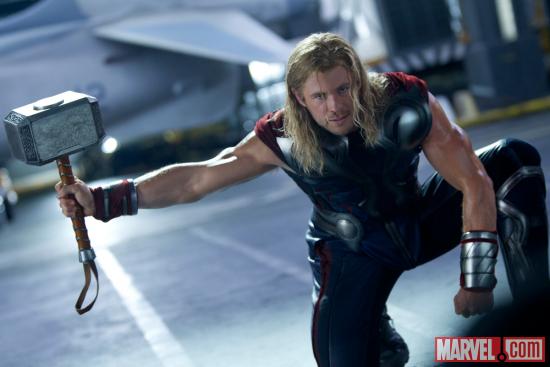
Motivation enough to form a coalition of the willing.  And the disparate styles of the players is well-evidenced-six degrees of declaration: Chris Evans is all un-ironic directness (even though he is perfectly capable of matching Downey snark-for-snark);  Chris Hemsworth is all stentorian brio done with Shakespearean force (he's so much more effective here than in his own movie); Jeremy Renner is as taut as his crossbow wire, Scarlett Johnasson's blank-stared Black Widow is well-suited for her position as a lethal scam-artist, Samuel L. Jackson manages to make even original lines sound like oft-quoted cliches; and Downey, quick and mercurial, dances around the dialogue, adding his own steps.  Each actor has their own way of working with Whedon's words, and Downey's pace has everyone playing their "A" game.

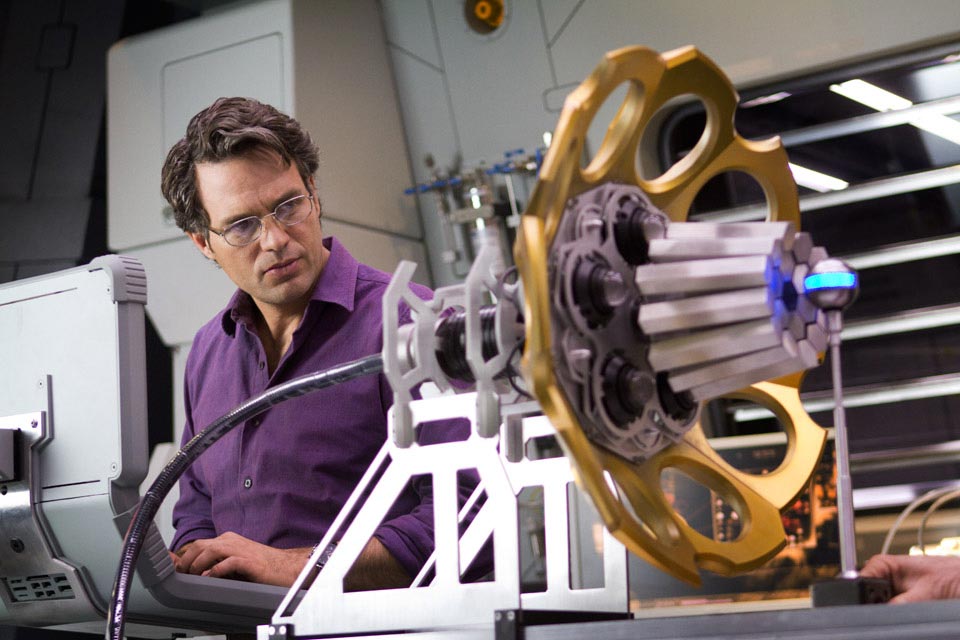
But the best here is Mark Ruffalo, playing Dr. Bruce Banner and (the first time an actor is allowed to, via motion-capture) his altered super-ego, The Hulk.  Two movies and two different actors (Eric Bana and Edward Norton, no slouches) tried to do something with the limited premise and came up short.  However, here, with less screen-time, Ruffalo manages to make Banner as interesting as his comically destructive "Other Guy," his physicist not guarded or fearful or weak (as has been the norm), but ironically bitter, resignedly haunted, the most mysterious of Marvel's "Mystery-Men."  "You really have got a lid on it, haven't you?" says Stark at one point, referring to the Doctor's self-control and the monstrous result of any lack of it.  "What's your secret? Mellow jazz? Bongo drums? Huge bag of weed?"  Maybe The Hulk is such a one-smash pony that he's at his best as a supporting character, rather than the star of a movie series.  One could argue that about all the characters here with the exception of Downey's Iron Man, who is, due to the actor's efforts, a one-man circus.

But, here it's all in the group, nobody's around long enough to drag it down, and it's the interactions that count.  The plot is MacGuffin-oriented in the Marvel-style of "I-don't-know-what-it-is-but-it-sure-is-big:" the doohickey from Captain America and the whatsit from Thor are involved so that a race of advanced aliens can take over l'il old us.  Not sure of the motivation, but who cares? Marvel's The Avengers is big, bold, brassy and breezy, and has the feel and crazy zeal of those Japanese monster movies that combined a lot of characters and smashed them together.

I don't know what it is, but it sure is fun.**


Marvel's The Avengers is a Full Price Ticket.  (Go ahead, see it in 3-D)

All the potential Avengers, assembled by George (every little detail) Perez

* Whedon shows the eventual alliance solidifying in two nicely planned shots, one—used in all the commercials—orbiting the heroes as they "circle the wagons," and a meticulously planned CGI sequence in mid-battle that is the super-hero equivalent of "going around the horn."

** There are TWO codas this time: one after the initial credits (before they get into the detail stuff) and another one that was filmed right after the Hollywood premiere that's odd...but fun.

Friday, August 19, 2011

Do the Right Thing

Do the Right Thing (Spike Lee, 1989)

"Now, watch and I'll show you the story of Life..."

It's been 22 years since Spike Lee launched his "Our Town" in Bed-Stuy, with Rosie Perez's aggressively pneumatic dance to Public Enemy's "Fight the Power." Twenty two years since the critics came out of the screening at Cannes saying that Lee's movie would foment race riots throughout the Summer, rather than cause the orderly lines around the block it did. Twenty two years since Lee debuted his movie about a particularly special day in the battle between Love and Hate: the hottest day of the Summer, the best day that Sal's Pizzeria ever had, the day Da Mayor (the late, great Ossie Davis) did another heroic thing in his life.

The day the music died.


And the worst day that Sal's Pizzeria ever had.

And someone's responsible—
the least responsible member of the community.Do The Right Thing is Lee's version of Thornton Wilder's "Our Town" (but not with slices of middle-American white-bread life) and everyone (but everyone) thinks they're the Stage Manager. It's Charles Schulz's "Peanuts" with attitude, as all the characters have one aspect that defines their personality and, like the strip, something radical has to happen in order for them to break out of their self-inflicted stereotypes.* And maybe grow up.

The diverse, huge cast and series of one act diversions is a culmination of something Lee's been saying since the beginning and folk of all types have been mis-reading. It's not about black versus white versus Latino versus Korean versus Jewish. It's "us" against "them," cop versus citizen, young versus old,
man against woman, and this particular pizza, forged in the heat, can be sliced all sorts of ways, but probably not equally. Because when it comes to hate, there's no such thing as fair.

Except your fair share of it.

What it is is the age-old tribal struggle of the pissing match between privilege and entitlement and who thinks who's got what. Everybody marks their territories with lines of death that no one can cross. And on the hottest day of the year, those lines get mighty stinky.


The last words of Lee's previous film, School Daze, are the first ones in Do the Right Thing: "Wake Up." In the previous film, they are hollered by Dap (Laurence Fishburne) in frustration and desperation, a protest.  In DTRT, it's the reveille of Mister Senor Love Daddy (Samuel L. Jackson) at the start of his shift on We Love Radio, but the context is the same.  Become awake.  Become aware. Don't sleep-walk.  Look alive.  It's a warning, but still a wake-up call.  Open your eyes, people.

The wandering begins along the streets of Bedford-Stuyvesant color-filtered through Ernest Dickerson's floating lens.  Ugly attitudes have never been so beautifully filmed, approaching M-G-M Technicolor in its vibrancy and beauty.  The crowds ebb and flow, clash, curse and break apart, some wander like vagabonds, while others, acting as a Greek chorus, stay planted and observe and trash-talk.  Locations vary between street and stage, at time, sometimes appearing to be aflame with color from the heat...but the constant music (like the American Graffiti soundtrack) emanates from boom-boxes and radios and the nearby station, mixing genres and styles—a polyglot of aural wallpaper, something for everyone. 

Do the Right Thing might not be Lee's most accomplished work—I think that might be Malcolm X, for its breadth and depth—but, it is the one that shows his love of movies.  Take for example, the bling-knuckled demonstration by Radio Raheem (Bill Nunn)of Love and Hate, taken with few differences from The Night of the Hunter:


The Mitchum soliloquy ends with the old woman saying "I ain't ever heard it better told," whereas Lee's Mookie, after an uncomfortable pause, sums it up dead-pan comically ("There it is, Love and Hate") and non-committally (as he is wont to do until the end).  Mookie is the fraying thread that holds the film together, despite his lack of ambition and any sense of active responsibility—Lee habitually plays characters in his films that are morally problematic (as opposed to M. Night Shamyalan's parts in his own films).  He pairs him up with John Turturro's Pino (racist with no dolby and nor squelch and no backbone), when Sal treats Mookie's sister (Joie Lee) as a treasured customer. For both Mookie and Pino, the kindness crosses the line, is suspect and turns the heat up a bit on their attitudes. It's the one thing they agree on, but for different reasons (Pino, because she's black; Mookie, because she's family).

That complexity belies the simple tale of Love and Hate, pointedly, and Lee's entire film offers a tragic counter-point.  It's never sure who to bet on in the fight, as both sides will take rounds and both sides will sustain damage.  And we might not even know when the fight is over.

But I ain't ever seen it better told.

In 1999, The Library of Congress inducted Do the Right Thing into The National Film Registry, just 10 years after its debut, and the first year it was eligible.


* One character—Danny Aiello's top-lined Sal—is consistently inconsistent, due in part to Aiello's ad-libbing  sections of Lee's script, which Lee allowed him to do, perhaps to build dramatic tension about what the man is going to do.  We'll look at a key scene—and how it differs from Lee's script in this Sunday's "Don't Make a Scene."

Saturday, January 17, 2009

The Spirit

"The Spirit is Willing, but the Film is Weak..."

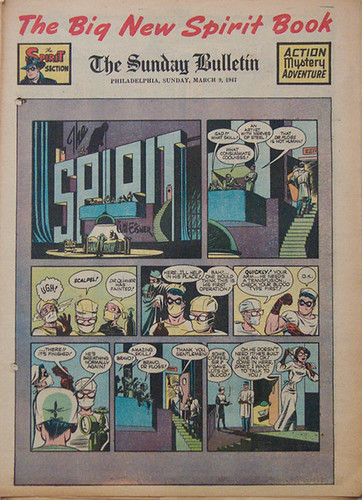
"The Spirit" is one of those "pure" super-hero concepts from the '40's, like Superman and Batman. Created by Will Eisner in 1940, "The Spirit" combined film-noir with masked vigilantes and "Terry and the Pirates" femme-fatales. His origins were always a little murky, but "The Spirit" was the born-again/ reincarnated/ revived corpse of policeman Denny Colt, "killed" in the line of duty. He wore a blue business suit, hat and gloves, a red tie, and (to appease editors' requests for a "super-hero") a mask.

He had no special powers other than being good in a brawl and irresistable to women. Eisner's artwork and story-telling sensibilities were innovative and is credited with being one of the great creators of comics "language" in much the same way that D. W. Griffith established film language.

One of Eisner's "disciples" and students is Frank Miller, whose ground-breaking work on Marvel's "Daredevil," and DC's "Batman" made him a super-star in the field of comics. Miller began his own series of ultra-violent neo-noir black-and-white comics under the banner "Sin City." The stories could have been a bare-bones story-board for a film, and Robert Rodriguez (with Miller as co-director) made a well-received film of a clutch of the Miller stories for his "Sin City" film.*

Given Miller's status as co-director (and his obvious influence in the design of the film) it was only a matter of time before he was given his own directing job, and naturally, in this super-hero season of the movies, it was going to be "The Spirit" as the subject of his debut.

Will Eisner must be trying to emerge from the grave Denny Colt-style to strangle him.

For instead of Eisner's creation, Miller has made a Frankenstein monster of a film that tries to update "The Spirit," making him an indestructible fighting machine with mysterious revivification powers, and the ability to run across telephone wires. In additon the film is...stacked with an assortment of prominent female stars in subsidiary roles—
Eva Mendes as villainess Sand Saref, Scarlett Johansson(terrible!) as Silken Floss, assistant to "The Octopus" (we're saving him for last), Paz Vega as Plaster (of Paris), Sarah Paulson ("Studio 60 on the Sunset Strip") as Ellen Dolan, daughter of the police commisioner; all of these fine actors are capable of doing better work, but you'd never know from the lack-luster performances and awkward timing of the scenes. It's all meant to be sexy, hip and edgy, but rather than re-create Eisner's light-hearted mix of comic and noir, it falls back on the same "camp" qualities evident in the third and worst season of the "Batman" television series, as well as Joel Schumacher's troubling "Batman" films.

Frequently you'll watch a scene with awkward staging, bad timing, knowing full-well it was done in front of a "green-screen" to put in some background that, if they'd thought about it, might have helped the lumbering quality of the foreground actors. Either Miller didn't know how to make it work, or just assumed that it would work, given his expertise with the material. After working in two dimensions for so long, three seems to be beyong him. As it is, it feels like lazy directing--kinf of like Miller's last "Dark Knight" comic where he drew in the foreground figures and let his colorist wife, Lynn Varley, provide the backgrounds. The results look just as cheap and unprofessional in both mediums.

Now, let's save the worst for last: Most egregious of all the performances is Samuel L. Jackson as "The Spirit's" nemesis "The Octopus." Limited to shots of his gloves in the comics, Jackson is all out-front and comic-satirical in this which doesn't work, although he does manage to mine some laughs out of his material. "The Octopus" is saddled with goons, evidently cloned from Curly of "The Three Stooges." They're all morons, but disposable at a moment's notice. At one point, "Sprit" and "Octopus" engage in a mud-pit death-match that has all the sensibilities (and realism) of a "Tom and Jerry" cartoon—at one point "Spirit" is hit over the head with a lead pipe that comes away with a head-shaped U-indentation. Unfortunately, that's what passes for humor in this train-wreck. In fact, a train-wreck would probably pass for humor in it, too.

All in all, for all its creative advancements in "getting it all up there," the "green screen" type of film environment has managed to confound some accomplished film-makers (ie. George Lucas, Robert Rodriguez, hell, even Kerry Conran is more accomplished!) creating impressive computer wall-papers but leeching the drama right out of their movies. Instead of taking movies forward, they've taken them backwards in terms of performance and film-language. If those guys couldn't overcome the awkwardness of the rootless film with no sets, what made Miller think he could? One suspects its the same flaw that plagues so many of the cartoonist's creations: hubris.

"The Spirit" is a Waste of Time. "My Wallet Screams."

One of Will Eisner's block-titled "splash" pages: Now that's "The Spirit"

* Well-received by everybody but me. I thought the literal translation of "Sin City" the comic to "Sin City" the movie showed just how much different information specificity permeates both mediums. And never the twain shall meet. "Sin City" (the movie) didn't work because once you fill in the 23 frames of action that Miller didn't provide in his drawings, the super-human heroics of ordinary people takes on ludicrous overtones. And, conversely, "Sin City" (the movie) exposed just how weak, snuff-pornish, and lunk-headed Miller's original material ("Sin City" the comic) was in the first place. There are some things the "strobed highlights" of comics and graphic novels do very well, that don't work in the movies (and vice versa). Movies based on comics have to be able to translate the four-color flash-cards that comics represent from static two dimensions to moving three-dimensions--which is why "the Dark Knight" for all its plot-holes, conceits and cheats manages to be a good "real-world" representation of the freak-show aspects of Gotham City.