Showing posts with label 2012. Show all posts

Friday, June 14, 2013

Emperor

The Supremes
or
Doing Our Duty While Losing Our Humanity

Like his 2003 film The Girl with the Pearl Earring, Peter Webber's Emperor is the long and involved story behind a single image—a photograph of the U.S.'s General Douglas MacArthur and Japan's Emperor Hirohito in July of 1946.  The image is normal-looking, pedestrian even, if one does not know the back-story, which is extraordinary, without precedent at the time, and represented a brave new world shattering a history of 2,000 years.

Japan had surrendered to the U.S. soon after what  one character describes as turning Japan "into the largest crematorium the world has ever known."  General Douglas MacArthur had been established the "Supreme Commander" of the occupied territory, a role one author has described as making him "an American Caesar."  One of his first tasks is the establishment of blame and war-crimes tribunals, and uppermost in his mind is what "to do" with the Emperor, Japan's supreme leader held to be almost a deity for his people, not to be looked at directly, not to be photographed, not to be touched.  America is calling for his head, but MacArthur, wily politico that he is, ponders what will become of a Japan without its Emperor, if tried, found guilty and hung by the American conquerors.  The "Supreme Commander" sees only chaos and revolt in such a future.  


So, he assigns the task to someone else.


Emperor is the story of that investigation, as carried out by General Bonner Fellers at MacArthur's behest.  In the film, Fellers is conflicted: America is calling for the Emperor's head, but the reality of controlling a defeated nation hinges on his fate; Fellers is a Japan-ophile, and yet the iron bureaucracy surrounding the Emperor makes his job difficult getting answers, and the 2,000 year old traditions are part and parcel of what keeps the shattered country together; he is also looking for a girl that he befriended in the States during college, but her parents demanded she return to Japan, and now he's looking for her in the ashes of the city she was last in; other Army officers are  questioning Fellers credentials to do an unbiased investigation despite his history with Japan, and are pushing for his demotion in their own biased fashion.


The story is based on a novel by Shiro Okamoto, and might be playing with the character of Fellers a bit.  In fact, Fellers was an extreme conservative and a member of the John Birch Society post-war.  He had also been involved in a disastrous tenure in the European front when his reports were intercepted by Axis powers, and the intelligence influenced the outcomes of battles in Northern Africa (entirely due to the Army's insistence that Fellers NOT use coded encryptions to send his reports).  The man portrayed in the film may not be the one doing his duty in Japan, but the outcomes are the same, and that's where the fascination lies.


What Fellers learns in his frustrating investigation does lead to an ultimate decision, and is tied to the character of Emperor Hirohito.  But the layers of protection keep him from learning about the man and his actions in the final perilous days of the war, delaying any decision about the Emperor's implications in war-crimes.  And its wrapped up entirely in tradition, reflected in the protocol id one should ever come face to face (highly unlikely) with the Emperor.  He cannot leave the Imperial palace.  You cannot look him in the eye.  He cannot be touched.  He cannot be photographed. 

And yet, there's that picture, taken in MacArthur's office as the men have their first meeting after Japan's surrender.  And that, to use the old phrase, is worth more than the traditional thousand words, about Japan's supreme leader.

The story is fascinating, but the film telling that story drains a bit of that fascination out of it.  Perhaps, the twists and turns in Fellers investigation are designed to "open up" the movie in terms of post-war conditions, but the "Romeo and Juliet" sub-plot feels forced and a bit "traditional" in movie terms.  In the performances, Jones' MacArthur feels more like reflections of the actor's personality than the public persona the general showed (itself a carefully controlled performance), and as much effort as Fox puts into his role of Fellers, the character comes off as not very interesting, constrained as it is by duty, protocol, and sub-plots.

Still, the movie feels like one of those stories that need to be told, but one wonders if it could be done with a touch more flair, without damaging the content of the truth.

Emperor is a Rental. 


The Supremes

Wednesday, May 8, 2013

Holy Motors

Rich Man, Poor Man, Beggar-man, Geek...
or
The War of the Grease-paint...

All the world's a stage, And all the men and women merely players; They have their exits and their entrances, And one man in his time plays many parts...
William Shakespeare

You may be an ambassador to England or France
You may like to gamble, you might like to dance
You may be the heavyweight champion of the world
You may be a socialite with a long string of pearls
But you’re gonna have to serve somebody, yes indeed
You’re gonna have to serve somebody
Well, it may be the devil or it may be the Lord
But you’re gonna have to serve somebody
Bob Dylan 


The latest film by Leos Carax, Holy Motors, is a fascinating polyglot of life imitating art or vice-versa, and by the time it's over, you're not sure which.  It's a film brimming over with tantalizing ideas ranging from the rational to the surreal that it puts the brain into over-drive while constantly changing the landscape, shifting gears episodically while maintaining a singular day-in-the-life storyline for its central character Oscar (Denis Lavant), a trouper if ever there was one.  Oscar is an actor of extraordinary gifts.  In a gigantic white-stretch limo, driven by his scheduler Celine (Edith Scob of Eyes Without a Face, which Carax nods to briefly), he applies make-up, dons costumes, prepares for the next gig on the schedule in a rolling tour of Paris, all precincts, all life-styles, and most importantly to Carax, all genres.

In one scene, he's a motion-capture artist in a completely empty studio performing fight moves, running gun-battles, and a bizarre alien love-scene without a clue as to what the finished product will look like.  In another, he's a gangster sent to assassinate his doppelganger. 
On to the next gig—Oscar in Holy Motors
His assignments are given to him in a notebook with all the specs and requirements.  He opens up his kit of make-up prosthetics, ruffles through his rack of costumes, Celine lets him out and he's on-stage.  As the jobs go from one to the other, the questions bubble up: who is he working for—not only for the booking agency, but also, who are the clients?  Reality blurs.  A call from a teenage daughter could be his real daughter, but one suspects not—he's wearing a wig, and she's never seen again.  The gangster segment could be for anybody.  But, how about the segment where he's a disfigured geek who interrupts a photo-shoot with Eva Mendes--is it to throw off the photographer or to transform the model from a fantasy figure into a person of emotional worth, phantom of the opera-style.  And who is the death-bed tableau for, as the woman he plays it with is also an actress (one suspects that it might be for the loyal dog sleeping on the bed).  An encounter with another actress (Kylie Minogue) turns into a musical number, and a wacko marching band-with accordions-could be for anybody.

But, those are the details.  Ultimately, it's a fantasia about the roles we play in our everyday lives.  We adjust, we tinker, take on different suits and attitudes with every situation that crosses our path in the give-and-take of daily life.  We make an entrance, role-play, act-out, ad-lib, pose, and exit stage-right.  All the world's a stage and we all gotta serve somebody, the devil, the Lord, or ourselves.

Holy Motors keeps you guessing and keeps you challenged, and is one of those rare films that elicit bigger thoughts than the whole, leaving questions that anyone can answer, given their respective roles.


Holy Motors is a Full-Price Ticket.
 

Wednesday, February 6, 2013

Rust and Bone

Last Man Standing
or
You Don't Know What You Got 'Til It's Gone 

Jacques Audiard's new film De Rouille et le D'os  (Rust and Bone, in English) is as far afield from his last film, The Prophet, as could be.  That film was a mini-Godfather, that showed the traps a criminal puts himself into, whether he's in prison or the King of the Hill.  

Rust and Bone, though, is a love story about the transitory nature of selfishness and the numbing vacuousness of complacency, which sounds like it'd be a a dull film, or a pedantic English theme.  Combine it, though, with kick-boxing and killer whales chewing your legs off, and it becomes a different animal altogether.


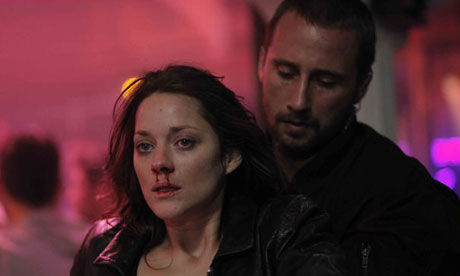
Ali (Matthias Schoenaerts), unemployed father of Sam (Armand Vendure), crashes with his sister in Antibes, while he tries to get his act together.  He jogs, he works out at the gym, dreams of being a kick-boxer, but the best he can do is bounce at a night-club, where he meets Stéphanie (Marion Cotillard), or rather rescues her, from an altercation.  She's a performer with a local Marineland park, directing killer whales through stunts and tricks, before a live audience.  Everything is going well during one performance when an accident happens and, as a result, Stéphanie loses both legs below the knees.  Submerged in depression, contemplating suicide, she calls Ali for help (it would be another of his string of odd jobs to earn money), where he starts to help her with therapy, specifically carrying her down to the wheelchair-inaccessible beach, so she can swim.


Ali is so deeply rooted in his own needs, that almost by osmosisStéphanie begins to care more about herself, and stops living in the past.  The sex helps.  But Ali is entirely self-absorbed and wants to keep things casual.  For further money, he starts participating in paid street-fight competitions, while Stéphanie takes the plunge and decides that she'll invest in artificial limbs and learn to walk again.

It's such a lop-sided story of co-dependency that it may seem like a frustrating film, but the performances of the two leads, Cotillard and Schoenaerts, go a long way in keeping interest.  Cotillard, in particular, seems to be oozing this performance out of some deep, dark place in her core (either that or she didn't sleep for a week) that is painful but fascinating to watch, while Schoenaerts is such a non-expressive performer, you might think that he is so completely internalized that he just walked off the street.  

And it's the performances that balance this film out, making the paths the actors take even necessary to sell the circumstances when the movie veers into melodrama, making an emotional course correction to get to an ending that...well, might have a point, even if a conventional one.

Meanwhile, Audiard does some impressive work with merely images, as the character of Ali is somewhat uncommunicative, and subtle shadows over people's faces suggest a shift in attitude between them.  And the whole Marineland sequences are like a sensory-overload nightmare—music constantly blaring, a robotic response-non-response from the performers to the audience, the pure, dumb folly of it all is quite an amazing sequence of textures and tones that provide a great deal of foreshadowing, even though you don't know what's coming—you just know that the place is on the knife-edge of panic and chaos.

So, an interesting film once it gets started, but then suffers a shift-tone that leads to some mighty convenient changes of heart, and makes Rust and Bone get all gooey inside, without (thank God) anthropomorphizing the whales.

Rust and Bone is a Matinee.


Friday, February 1, 2013

On Second Thought: Beasts of the Southern Wild

Beasts of the Southern Wild (Benh Zeitlin, 2012) Who knows where these things come from?  

This one was inspired by Andrew at Encore's World of Film and TV, who, in his review of Beasts of the Southern Wild, transcribed the inner dialogue he wrestled with, while struggling with his ambivalence towards it.

I had no such issues.  I sorta loved it, even while I didn't quite know why.  Instinctually, my thoughts were positive, tickled by some memory of something else, even if the source was cloudy up there, wispy but in some way comforting.  Andrew's article, and my reaction to it, kept Beasts uppermost in my mind and put my thoughts of it and Andrew's reaction on some back-burner, simmering.

Then, it hit me, what was so familiar, clothed in different subject matter and happenstance, but emotionally playing in the same field.

Andrew's issue with Beasts (among other things) was its depiction of poverty and how it was such a permeating thrust of the film.  I found the poverty irrelevant, both to the characters and to the movies' higher intentions.  The poverty simply "is," and the residents of "The Bathtub" just accept it, and make the most of it—their uses of society's cast-offs is frequently ingenious and a production designer's playground.  In their eyes and minds, however beer-bleery, they're living a good life off the land and the off-islander's detritus, which, given the film's message, is threatened by the crumbling ecology caused by the machinations of the rest of the world.  The child of a protective, frequently absentee father sees these struggles and must process them to a higher truth, a "universal" truth of "man's" place in the universe in stark juxtaposition to his place on Earth.

But, I remember thinking the thought: it was "the poverty is irrelevant just as it is in To Kill a Mockingbird." If I'd had the presence of mind to pusue that, I'd have gotten there sooner, but like Tom Cruise's David Aames in Vanilla Sky, it took me awhile to recognize the form of Atticus Finch when it was sitting in front of me, brooding.


"My only purpose in life is to teach her how to make it."


Because that's what Beasts of the Southern Wild is.  In my review, I posed the question: Is it a child-drama or fantasy, came to the conclusion that it was a little bit of both and left it at that.  But, now I see Beasts of the Southern Wild as a sci-fi 21st century version of To Kill a Mockingbird.  

Oh, I can hear the squelches of the eye-rolling from here, but I can't get the comparison out of my head now.  We have Scout; we have Hushpuppy.  Both are girl-childs of the South, one of the Great Depression and one of the second Greatest Depression.  Money's not the issue.  But the issue is societal in both, and both are about survival.  In To Kill a Mockingbird, it's race—"You don't really know somebody until you see things from his point of view"; in Beasts of the Southern Wild, we've moved beyond seeings in black and white terms, everybody's getting along, no matter race.  Community is key.  That's a good thing.  But, the issue is still this film is talking about is couched in childish terms to understand: "The whole universe depends on things fitting together just right.  If one piece busts, even the smallest piece...the entire universe will get busted."

The Bathtub is dying.  The source of food is going away.  In other parts of the world, the ice-caps are calving, exposing the preserved bodies of extinct animals, raising them from the dead—if that isn't some definition of the Apocalypse, what is?  The matter now is ecology; we're getting along just fine, thank you, but the Earth on which we depend, that sustains us, is turning against us, and its doing it in self-defense.*  Just like in the days of Jim Crow, "we have met the enemy and he is us."  Still us, sawing off the limb that we're sitting on.

For Hushpuppy, she learns from The Bathtub community the questions that she needs answered just as Scout does in Maycomb, Alabama.  But none is more important than her birth-father, Wink, the sole parent in Hushpuppy's life.  What happened to "Mom" is the subject of speculation, but the Father's role is very clear: "It's my job to take care of you, okay?" There are those who will protest that "Wink" is no Atticus Finch—he slaps Hushpuppy at one point—but I would argue they're quite similar: their goals are the same: to raise, to teach, to mold their children for the time when they are adults, no matter the circumstances.  Both are absentee fathers, their kids are largely unsupervised, Wink due to his worsening health, Atticus to his devotion to the law.  But, they both dream of better worlds for their children, at least ones that don't get worse, and they teach their kids for the time when they can confront the demons of the world, and conquer their fears.


"Strong animals know when your heart is weak"

Aurochs and "Boo" Radley a bit of a stretch?  Not really.  They're merely representative of the unfamiliar becoming familiar and the feared unknown seeing the light of day, representative of how the monsters of our imagination can disappear in a puff of understanding from a strong heart.

For me, now, these two films are inextricably linked.  They're the same story, with different social agendas, but the same conclusion.  You gotta grow up, you gotta stand tall, you gotta fill your heart, you gotta survive.  You've got to embrace and not turn away.


  * My favorite ecology "take" is the one of George Carlin's—whose comedy through-line always seemed to hinge on selfishness—who railed against the idea of "Earth Day:" "The planet is fine, the people are f@#ked!"

Tuesday, January 29, 2013

The Impossible

Disaster Relief
or
The Tides That Bind

It truly is an amazing story, fully befitting the title The Impossible.  The heart-and earth-rending circumstances surrounding the 2004 tsunami are the stuff of nightmares.

The Bennett family* is spending Christmas 2004 in Thailand.  They're Australians living in Japan: she's a wife/mother/home-maker for now, a doctor by trade; he's a something or other, attached to his phone and worried about losing his job.  The kids are twelve, seven, and five, respectively with the oldest, Lucas, a bit of a pre-teen jerk to everybody—little brothers and parents—and has a bad case of the surlies with a lot of growing up to do.

Thailand at Christmastime 2004 is the perfect time to do it.  Their seaside resort is pristine, perfect.  They spend Christmas lightly bickering, worrying, and considering the future.  Man plans.  God laughs.

What they can't anticipate is the earthquake that rocks Southeast Asia, or the resulting wall of water that comes crashing through the resort, pushing everything out of its path, slamming everything up-shore, sucking it back to the ocean and then, hammering them again, turning the tidelands into a raging river in both directions, scattering everything in random paths.


That includes the Bennetts. When Mom Maria rises above the wall of water, battered and bleeding, she sees Lucas being carried away to the ocean.  The two desperately risk safety and stability to connect and stay within reach, despite being tossed about like so much silt.  When the waters subside they scrabble in bare feet amid the carnage of uprooted vegetation, rubble and broken bodies.  Maria's leg is torn apart, flesh ripped from bone.  A makeshift tourniquet keeps her together, and Lucas becomes parent, keeping her focused through her shock and finding high ground and supervising her trip to a triage center, a hospital drastically ill-equipped to deal with the wreckage of such a catastrophe.  What has become of the rest of the family is anybody's guess, but that is for another time, if they can spare it from just surviving.

Director Juan Antonio Bayona (in the credits, he's "J.A. Bayona") manages to keep the focus micro, while presenting a macro canvas.  That in itself is an amazing accomplishment, but he has an amazing talent for making things personal and visceral, the scenes of the struggle swept up in the ocean waves is tough to watch, and the inundation of the victims in the tsunami's path, as experienced by Maria is a surreal nightmare of images, that convey panic and horror simultaneously. The details of everything, especially the personal crises of the peripheral victims is in plain view, as much a part of the story as the Bennett's struggles.  Their crisis is central, but the individuals' own efforts in providing help to other survivors is reflected by the help they get back.  It's a story of one family, but the efforts of all the survivors, native and tourist, to help each other through the overwhelming havoc is knitted throughout the story in an overall arc that is inspiring, and something of a tonic in this movie season.

The Impossible is a Full-Price Ticket.

Watts, McGregor and The Impossible Belon family

* Much has been made of the fact that the Belon's (who are Latinos) are being played by Anglo actors,  something that is much pooh-poohed by Maria Belon.  But, one has to ask: why did a production, headed by Spanish-speaking artists, make such a decision, other than for "sellability?"  I only bring this up, as there is a pattern here, what with the similarly anglicized Argo.  Are Latinos not allowed to be featured in movies because it might hurt the box office (I say this while ruefully noting that a Latino actor and black actor are "inserted" into the all-white Gangster Squad—if one is to be accurate one way, shouldn't one the other—and yet I thought Mackie and Pena were a nice touch, and they're always welcome to see). Yes, as Maria Belon says, the story is "universal"—it has more to do with family than what race that family is.

Wednesday, January 16, 2013

Les Misérables (Musical; 2012)

The Song of Angry Men
or
 "To the Barricades!"


I realize I am not the man to do a critical analysis of Les Misérables, the filmed version of the long running staged presentation of the concept album produced by Claud Michel Schönberg, Alain Boublil and Jean Marc Natel, (from the novel by Victor Hugo) for many reasons: 1) I'm not terribly fond of musicals, finding the form unnatural and artificial—the inclination to burst into song having the requirement of being necessitated by the surge of emotion, which, if you do it too much, is a bit unsufferable—but, if the words and music are clever, born out of character and need, my prejudices can be batted away in the sweep of sheer admiration; 2) I’ve never seen “Les Miz” on stage, so this is my first exposure to the material, which I found musically strong, with nice linking strains between songs, but the lyrics, for the majority of it, trite and of the “Moon-June” variety, and the propensity to insert (with a guillotine) moments of light-heartedness in the midst of the most dramatic moments; 3) I have never liked the direction of Tom Hooper (who directed the mini-series “John Adams” with a heavy emphasis on unnecessary dutch angles, tortured compositions, and camera movement “baggage” for its own sake, and then directed The King’s Speech with a somewhat less gaudy eye, but a penchant for “gilding the lily” of competent performances with camera and lens tricks. So, Les Misérables is almost a “perfect storm” of things I don’t like in movies, making me feel a bit uncomfortable about even attempting to discuss it without the need to eviscerate it like an after-meal chicken.  Oh, there are things I thought were marvelous—the grittiness of it, the general down-troddeness of the whole thing, the brio of the effort in dragging it, naturalistically, to the screen, when everything cries out to leave it on the stage where it seems the presentation would be at its optimum.

So, kids, let’s get started.  I’ll leave out the show itself, which has more than silenced its original critical drubbing by becoming the wildly popular “people’s choice” at the box office, entirely appropriate given its liberté/fraternité themes.  Vive “Les Miz” and all that.  But the stage presentation was already an odd ying-yang of performers belting out their inner emotions to the cheap seats, confessing their shame at the top of their lungs.  To then bring it back down to intimacy, forcing powerful song material to be played out with naturalistic emotions—crying, snuffling, doubt—then compounds the confusion by compromising the musical material from its original intentions.
Then, director Hooper further piles on the emotional dissonance by shooting everything in very tight close-up, so we have intimate emotions couched in thundering expressiveness delivered at a timid range right in our faces.  Hooper did no service to his actors here, threatening to expose every mis-step of their performances (which, by the way, was sung and recorded on set in real time) so close that the audience can’t miss it.


How’d they do?  Admirably well, considering.  Anne Hathaway will surely win an Oscar for the “I Dreamed a Dream” sequence alone, finding the right balance of giving the song its due, while also expressing the grief, humiliation and moments of rage in her character.*  Towards the end of the film, Eddie Redmayne pulls off a similar gift with “Empty Chairs at Empty Tables” and, surprisingly, Amanda Seyfried makes the most of her moments with a high, feathery voice that doesn’t betray fragility.  Hugh Jackman and Russell Crowe are other matters.  Both great performers with musical pasts (the former on Broadway, the latter with his vanity band), both are very capable, but the material, production and presentation get the better of both of them, exposing Jackman’s reedy voice (somewhere between Anthony Newley and David Bowie) and Crowe’s pop sensibility to pitch to the note he’s seeking. The unlikeliest successes are Sascha Baron Cohen and Helena Bonham Carter, as the unscrupulous Thénadier couple, because their song is a knockabout one with lots of stage business letting them lose from the trap of Hooper’s tight framing, and because Cohen is allowed to throw in a couple of ad-libs (in beat, mind you) between lyrics, allowing a little bit of fresh air into the proceedings.**
For me, it was a train-wreck that seemed to go on forever, with only a couple of bright spots to give me hope.  But, given the production’s history, I’m sure the people will rise above it all, despite the tyranny of the direction on display.
Les Misérables is a Cable-Watcher…in any language.


* One of the best lines at the Golden Globes was Amy Poehler’s about Hathaway’s performance: “I have not seen someone so totally alone and abandoned like that since you were on stage with James Franco at the Oscars."  
**  The creators of the stage version must have realized this, too, as they keep turning up and their capering has a tendency to undercut the heavy drama.  Entertaining, yes, but at the expense of the rest of the play.
 

Tuesday, January 15, 2013

2012 National Film Registry, Part 2

Conflicts of Interest

Every year since 1989, the Library of Congress solicits nominations for the National Film Preservation Board to select films for the National Film Registry deemed to be "culturally, historically or aesthetically significant" and thus preserved by the LoC.   Unlike most year-end awards shenanigans, this is not a popularity contest, but a way to hold forever the way we looked, the way we thought, and what we thought was important enough to be preserved on film...and eventually preserved for our descendents to contemplate.

Here is the complete list of selected films from 1985 ro 2011.

And here are the films from 2012


“Kodachrome Color Motion Picture Tests“ (1922): The two-color (greenish blue and red) film was the first publicly demonstrated color film to attract the attention of the film industry.


A League of Their Own (1992): Penny Marshall’s box office hit comedy about the All American-Girls Professional Softball League of the 1940s and early 1950s.  Marshall's baseball movie, based on the women's baseball leagues that had a brief surge in popularity, while the male players were in the last innings of WWII.  Marshall had a solid script (by Ron Howard's regular writers Ganz and Mandel) and a solid cast—Geena Davis, Lori Petty, Rosie O'Donnell and Madonna (in their most effective roles), Bill Pullman, Jon Lovitz, David Straithairn, Garry Marshall (Marshall's brother and director), and, in his first attempt to toughen up his image, Tom Hanks as the broken-down drunk of a coach who coined the immortal baseball and movie adage "there's no crying in baseball!"

There are very few rom-com concessions.  It's more about women who loved to compete and had no outlet until the men cleared out.  If the story is ultimately something of a downer, at least Marshall found a way to end it on a high, and inspiring, note, and A League of Their Own is one of the best baseball movies...in any league.


The Matrix (1999): Andy and Lana -- then known as Larry -- Wachowski directed this visually groundbreaking sci-fi thriller starring Keanu Reeves and Lawrence Fishburne. I'm still amazed that a surface-flash kind of movie like The Matrix is as well-regarded and the subject of unquestioning devotion as it is.  Yes, it looks cool, but the "bullet-time" effects displayed (created by the 360° capturing of simultaneous images) had been employed in advertising for ten years by that time.  And the Wachowski siblings' conceit—that we're all just sleeping drones living a fantasy that we're in control of our machine-clockwork society is kind of fun...for about forty-five minutes.  But the movie keeps droning on with unexplained character transformations and a not-so-veiled superhero exo-skeleton.  The action sequences go on forever, even without the benefit of slo-mo, and the characters are non-existent, depending on flat expressions and sepulchral voices.  It has bags of style, but no substance (as was made abundantly clear when the team tried to expand the concepts with ever-deepening contrariness in two vapid sequels.


“The Middleton Family at the New York World’s Fair” (1939): Technicolor industrial film produced for the 1939 New York World’s Fair.


“One Survivor Remembers" (1995): Oscar-winning documentary short about Holocaust survivor Gerda Weissmann Klein.


“Parable” (1964): The Protestant Council of New York produced this controversial, acclaimed silent allegorical Christian film for the 1964 New York World’s Fair.  I remember seeing this film in public school classes as an interpretive study in allegory and religion.   Directed by Rolf Forsberg and Tom Rook, it tells the story of a sadistic circus manager who uses his employees as puppets, until a harlequin arrives on a donkey and. seeing their suffering, takes their place.  It's a direct Christ allegory, but the controversial aspect of it, despite its simple message of sacrifice and redemption which parallels the crucifixion of Christ, is that Jesus is portrayed as a clown.  Controversial, but the message is clear, and so preaching is done without being so tied to the Gospel.  Not to far removed from the Christ technique of parables.  The idea was (oh, let's be kind) "re-imagined," by others in the hippy-dippy 70's as the musical "Godspell."


“Samsara: Death and Rebirth of Cambodia” (1990): Ellen Bruno’siversity master’s thesis documents the struggle of the Cambodian people to rebuild their shattered society after Pol Pot’s killing fields  http://www.brunofilms.com/samsara.html


Slacker (1991): Richard Linklater’s indie comedy follows a group of diverse characters over the course of one day in Austin, Texas.
Linklatter's first commercial success is the ultimate "walk and talk" movie, set in Austin, Texas in one 24 hour period, filled with random acts of...randomness. The format is simple—photograph a conversation down the street, until it's interrupted, either vocally or pictorially, then the camera follows the interrupter, always a new set of people and a new subject.  It's never boring and never cyclical. "This town is full of crazies," says an older anarchist, at one point. "I wouldn't have it any other way."  Less a running gag—more like a "walking gag"—of a town full of underachievers and over-talkers (bloggers without the internet), saturated with conspiracy theories and apocrypha taken as gospel and regurgitated without opposing argument.  Sounds like it'd be dull if it weren't so familiar and universal.  Yes, our lives are like individual houses, but there's an awful lot of spackle in it.

Sons of the Desert (1933): Stan Laurel and Oliver Hardy star in one of their funniest vehicles.


The Spook Who Sat by the Door (1973): Ivan Dixon directed this controversial thriller about an African American who infiltrates the CIA in order to create a black nationalist revolution. "Well, like it or not," says a CIA chief, "looks like we're integrated."  A cynical political move to get votes sparks an initiative to actually hire and train black agents in the all-white intelligence bureau.  Even though the odds are stacked against, one man gets through, Dan Freeman (Lawrence Cook), who ingratiates himself with his superiors, in order to advance through the ranks, until such a time as he begins recruiting radicals to undermine the white infrastructure in key U.S. cities.  Despite the amateurish acting and "Movie of the Week" production values, there are some interesting ideas here, if mightily simplified to come in under 90 minutes, and the film ends on an open-ended note as an armed revolutionary movement spreads throughout the country.


“They Call It Pro Football” (1967): The first feature from NFL Films utilized Telephoto lens and slow-motion to offer a primer on the game.

The Times of Harvey Milk (1984): Academy Award-winning documentary about San Francisco’s first openly gay elected city official who was slain in 1978.  Actually a much better film than the Sean Penn/Gus Van Sant bio-pic of a few years' back, and provides a more concise and passionate explanation and portrait of the gay rights activism in San Francisco that inspired Milk's political career.  Add to that...you get to see the man himself in his own words and in his own times.  The film is available to view on HuluPlus and Amazon.com.


Two-Lane Blacktop (1971): Director Monte Hellman’s existential road picture  "Existential," maybe.  But that may be code for "nothing much happens."  Not even the characters have names, but "identifiers"-"Driver" "Mechanic" "GTO" "The Girl."  You can't even call it a "character study" as the characters are archetypes, albeit played by James Taylor and Beach Boys drummer Dennis Wilson.  They pick up a hitch-hiker (Laurie Bird), and have a cross-country race from Needles, California to Washington, D.C. with worldly wise "older guy" Warren Oates, along Route 66.  It's not far removed from its hip-youth movie roots ala Easy Rider, with generational conflicts played out on the road, and where the emphasis is on competition, rather than finding America.  As such, it's a bit closer to the bone of the American spirit than its "Easy" counterpart.  It's also held up better, with less editing trickery, more disciplined cinematography (a lot of gorgeous landscape work here), and a more professional movie-making sense.  It's become a cult classic, and inspired the "Cannonball Run" competition.


Uncle Tom’s Cabin (1914): This silent adaptation of Harriet Beecher Stowe’s landmark 1852 anti-slavery novel is said to be the first feature-length film that starred an African American actor -- Sam Lucas, who had appeared in the 1878 stage version.


“The Wishing Ring; An Idyll of Old England”“ (1914): Maurice Tourneur’s charming cross-class romance.

Saturday, January 12, 2013

2012 National Film Board Selections, Part 1

Conflicts of Interest

Every year since 1989, the Library of Congress solicits nominations for the National Film Preservation Board to select films for the National Film Registry deemed to be "culturally, historically or aesthetically significant" and thus preserved by the LoC.   Unlike most year-end awards shenanigans, this is not a popularity contest, but a way to hold forever the way we looked, the way we thought, and what we thought was important enough to be preserved on film...and eventually preserved for our descendents to contemplate.

Here is the complete list of selected films from 1985 ro 2011.

Here a first look at the films from 2012 (more on Tuesday):


3:10 to Yuma (1957): Delmar Daves directed this western based on a short story by Elmore Leonard. Full review here. Even after James Mangold remade the thing in 2007, the original still holds up as a superior "psychological" western, giving Glenn Ford the most interesting role of his career, and Van Heflin, his most stalwart.  To save his farm and family, the latter's character must transport a charismatic and crafty desperado and get him on the train to the Marshall's for trial, despite being pursued by Ford's gang from without, and the manipulations of Ford from within.   


Anatomy of a Murder (1959): Otto Preminger directed this courtroom thriller that made headlines for its frankness in language and adult themes. Ya...ya..ya know...this is just about the talkiest courtroom drama ever filmed.  And...and when you got Jimmy Stewart starring that explains the nearly three hour length.  Yeah, it's "frank"...mentioning rape as a motivation for revenge killing and everybody saying "panties" every few minutes.  But the cast does amazing work...it's a thrill to see a passionate Stewart squaring off against the cool-as-a-cucumber fancy-pants prosecutor George C. Scott.  There're also great turns by Ben Gazzara, Leigh Remick, Murray Hamilton (at his weasliest), Eve Arden, and Arthur O'Connell, and the judge is played by Joseph Welch, the attorney who "shamed" Joe McCarthy on national TV.  Plus, there's a fine score by Duke Ellington.  It wasn't really Earth-shaking as it seemed, but Preminger keeps it lively, despite it being a one-room movie.

“The Augustas” (1930s-1950s): A 16-minute film by traveling salesman Scott Nixon, who was a member of the Amateur Cinema League, chronicling some 38 streets, storefronts and cities named Augusta.  Click on the linke above to see the film.


Born Yesterday (1950): Judy Holliday won a best actress Oscar as not-so-dumb-blonde Billie Dawn in this political satire directed by George Cukor.  Holliday is an acquired taste, but she was at her sharpest and craftiest (and was used to her best effect) in this performance, as the dingbat mistress of millionaire Harry Brock (Broderick Crawford), who's in the Nation's Capitol to grease a few politicians' palms.  Worried that "Billie" will make him look bad in front the pols, he hires journalist Paul Verral (a bespectacled William Holden) to teach her manners and "couthness" to avoid a scandal.  It's a comedy, albeit a satirical one, based on the play by Garson Canin (who was friends with director Cukor and, even though he wasn't invited to write the screenplay, he was inveigled to punch up the script a bit).  Directed by Cukor, with his usual non-judgemental tolerance and bite.

Breakfast at Tiffany’s (1961): Audrey Hepburn plays one of her quintessential roles -- the quirky Manhattan call girl Holly Golighty -- in this romantic dramedy based on Truman Capote’s novella.  Can you believe it?  I'm a big fan of the work of Blake Edwards, but I've never seen this cult favorite, adapted very freely (George Peppard plays Truman Capote??) by George Axelrod (although I've watched the final kiss in the rain with the cat hundreds of times and watched Hepburn sing "Moon River" just as many).  It will be interesting to see how it holds up (especially Mickey Rooney's role as a Japanese landlord *shudder*), but it's one of those movie confections made of so many excellent elements and players...Axelrod, Hepburn, Edwards and his comic timing, Henry Mancini's score...that one can forgive the straying so far from the original melancholy material.


A Christmas Story (1983): Humorist Jean Shepherd narrates this classic holiday comedy based on his memoirs of growing up in Indiana and hoping to receive a Red Ryder BB gun for Christmas.  It wasn't a hit when it came out, but it has since became a "Christmas Classic" on perpetual TV rotation around the Holidays, on a par with It's a Wonderful Life.  I'm sure "Shep" is amused by this occurence.  Shepherd worked on the script and narrated, and director Bob Clarke was creative enough to mine the material for as much laughs and nostalgia as possible. He also had a terrific cast in Darren McGavin as "The Old Man" (a role he was born to play given his dramatic/comedic gifts) perpetual Mom Melinda Dillon, and Peter Billingsley, who is the "Chalie Browniest" kid I've ever seen. There's something about Billingsley's dead-pan proto-human I find inherently funny, and as the focus of A Christmas Story—an exhausting role for a kid, to be sure—Clarke found the perfect "Ralphie."   


“The Corbett-Fitzsimmons Title Fight” (1897): Chronicle of the famed boxing match between James J. Corbett -- aka “Gentleman Jim” -- and Bob Fitzsimmons that was held on St. Patrick’s Day in Carson City, Nev.  We talked about Raoul Walsh's film on the life of "Gentleman Jim" last year.  Now, the real life Corbett is immortalized and his ring take-down preserved for all time.

Dirty Harry (1971): Clint Eastwood introduced his iconic role as maverick San Francisco Det. Harry Callahan in Don Siegel’s influential action-thriller.  When it first came out, Pauline Kael called it a "single-minded attack on liberal values" and Roger Ebert decried it for a "fascist moral position."  It was the ultraviolent Christmas movie season of 1971, so they hadn't seen anything yet.  But what peace-nik director Don Siegel was trying to say was that the police were fighting a losing battle trying to keep civilized society civilized.  The film is very pro-police, even if finding them weal and ham-strung by regulations, and anti-criminal (they're cyphers, moving targets, unexplained, unmotivated and unsympathetic.  Andy Robinson's Scorpio (based on San Francisco's Zodiac killer) is pure venality, as unconstrained as the cops are hand-cuffed.  The only way to stop him is to go beyond regulations or people die.  It's why Eastwood's Harry Callahan, that purveyor of aggressive buzz-phrases, tosses away his badge, High Noon-style, at the end of the film.  "Well, do ya, punk?"

“Hours for Jerome: Parts 1 and 2” (1980-82) : Experimental filmmaker Nathaniel Dorsky’s silent tone poem.

“The Kidnappers Foil” (1930s-1950s): Dallas native Melton Barker traveled through the South and Midwest for three decades filming local kids acting, singing and dancing in two-reel films he called “The Kidnappers Foil.” A few weeks after shooting, the townspeople would get a copy of the film for screening at the local theater.