Showing posts with label Anne Hathaway. Show all posts

Wednesday, January 16, 2013

Les Misérables (Musical; 2012)

The Song of Angry Men
or
 "To the Barricades!"


I realize I am not the man to do a critical analysis of Les Misérables, the filmed version of the long running staged presentation of the concept album produced by Claud Michel Schönberg, Alain Boublil and Jean Marc Natel, (from the novel by Victor Hugo) for many reasons: 1) I'm not terribly fond of musicals, finding the form unnatural and artificial—the inclination to burst into song having the requirement of being necessitated by the surge of emotion, which, if you do it too much, is a bit unsufferable—but, if the words and music are clever, born out of character and need, my prejudices can be batted away in the sweep of sheer admiration; 2) I’ve never seen “Les Miz” on stage, so this is my first exposure to the material, which I found musically strong, with nice linking strains between songs, but the lyrics, for the majority of it, trite and of the “Moon-June” variety, and the propensity to insert (with a guillotine) moments of light-heartedness in the midst of the most dramatic moments; 3) I have never liked the direction of Tom Hooper (who directed the mini-series “John Adams” with a heavy emphasis on unnecessary dutch angles, tortured compositions, and camera movement “baggage” for its own sake, and then directed The King’s Speech with a somewhat less gaudy eye, but a penchant for “gilding the lily” of competent performances with camera and lens tricks. So, Les Misérables is almost a “perfect storm” of things I don’t like in movies, making me feel a bit uncomfortable about even attempting to discuss it without the need to eviscerate it like an after-meal chicken.  Oh, there are things I thought were marvelous—the grittiness of it, the general down-troddeness of the whole thing, the brio of the effort in dragging it, naturalistically, to the screen, when everything cries out to leave it on the stage where it seems the presentation would be at its optimum.

So, kids, let’s get started.  I’ll leave out the show itself, which has more than silenced its original critical drubbing by becoming the wildly popular “people’s choice” at the box office, entirely appropriate given its liberté/fraternité themes.  Vive “Les Miz” and all that.  But the stage presentation was already an odd ying-yang of performers belting out their inner emotions to the cheap seats, confessing their shame at the top of their lungs.  To then bring it back down to intimacy, forcing powerful song material to be played out with naturalistic emotions—crying, snuffling, doubt—then compounds the confusion by compromising the musical material from its original intentions.
Then, director Hooper further piles on the emotional dissonance by shooting everything in very tight close-up, so we have intimate emotions couched in thundering expressiveness delivered at a timid range right in our faces.  Hooper did no service to his actors here, threatening to expose every mis-step of their performances (which, by the way, was sung and recorded on set in real time) so close that the audience can’t miss it.


How’d they do?  Admirably well, considering.  Anne Hathaway will surely win an Oscar for the “I Dreamed a Dream” sequence alone, finding the right balance of giving the song its due, while also expressing the grief, humiliation and moments of rage in her character.*  Towards the end of the film, Eddie Redmayne pulls off a similar gift with “Empty Chairs at Empty Tables” and, surprisingly, Amanda Seyfried makes the most of her moments with a high, feathery voice that doesn’t betray fragility.  Hugh Jackman and Russell Crowe are other matters.  Both great performers with musical pasts (the former on Broadway, the latter with his vanity band), both are very capable, but the material, production and presentation get the better of both of them, exposing Jackman’s reedy voice (somewhere between Anthony Newley and David Bowie) and Crowe’s pop sensibility to pitch to the note he’s seeking. The unlikeliest successes are Sascha Baron Cohen and Helena Bonham Carter, as the unscrupulous Thénadier couple, because their song is a knockabout one with lots of stage business letting them lose from the trap of Hooper’s tight framing, and because Cohen is allowed to throw in a couple of ad-libs (in beat, mind you) between lyrics, allowing a little bit of fresh air into the proceedings.**
For me, it was a train-wreck that seemed to go on forever, with only a couple of bright spots to give me hope.  But, given the production’s history, I’m sure the people will rise above it all, despite the tyranny of the direction on display.
Les Misérables is a Cable-Watcher…in any language.


* One of the best lines at the Golden Globes was Amy Poehler’s about Hathaway’s performance: “I have not seen someone so totally alone and abandoned like that since you were on stage with James Franco at the Oscars."  
**  The creators of the stage version must have realized this, too, as they keep turning up and their capering has a tendency to undercut the heavy drama.  Entertaining, yes, but at the expense of the rest of the play.
 

Tuesday, July 24, 2012

The Dark Knight Rises

The Bane of Our Existence
or
"Okay, What Joker Put Yeast in My Dark Knight?"


"All stories end in death, and he is no true story teller who would keep that from you"--Hemingway

"If you want a happy ending, that depends, of course, on where you stop your story"--Welles


So, Christopher Nolan's "Batman" trilogy ends in a nearly 3 hour film that neatly wraps up the story.  How does it end?  That would be telling.  The comics went through a phase where Bruce Wayne ruminated that he was working towards a world where he wasn't needed.  That's a nice little "buttoning up" of the "Dark Knight" story, but it's not complete.  What of Bruce Wayne?  Nolan has the opportunity in his version to really end it—he doesn't have to sell comic books next month—so, he can take it anywhere he wants to go.  And one realizes (if one really wanted to end the story) that the only real happy ending that could be achieved is if Bruce Wayne became the one thing he never knew as a child—a caring, present father.  Anything else makes the story a tragedy, and Bruce Wayne the last victim of the gunman's bullets that killed his parents.  Given this series' downbeat tone (that of the sacrificial martyr) and of the available previews for The Dark Knight Rises, such a scenario does not seem likely.  Given that, Nolan can take the tragedy of his hero in any number of directions.

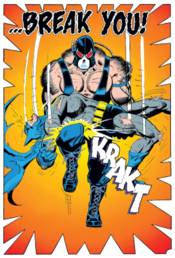
Bane (Tom Hardy here) is the perfect villain to bring into the mix.  A hopped-up minor character, he is best known as the lead antagonist for the "Knightfall" storyline (that seemed to last a couple years).  In "Knightfall," the drug-pumped super-villain released every criminal in Gotham's prison system for The Bat to deal with, while he hung back, biding his time.  Then, when the Batman, weakened and exhausted, finally confronted him, Bane broke his back, leaving Wayne paralyzed and unable to fight on.  It fell to the rest of "The Batman Family" (including the once-and-future "Robin's") to take on the mantle and continue the fight.

Nolan's canvas is a bit broader, taking into consideration the events of the two previous films to create something a bit more apocalyptic, a rumination on the fractious quality of good vs. evil and the slippery slope to Hell that ideology and good intentions can be tilted towards.  Nobody's pure in this one, there's no whack-job with delusions of grandeur behind the assault on Gotham City, with avarice their sole motive.  Everybody, wearing white or black, thinks they're doing the right thing.  And everybody's wrong.


It's eight years since the events of The Dark Knight that resulted in the deaths of D.A. Harvey Dent, Rachel Dawes, and the subsequent disappearance of the man suspected in the killings, the Bat-man (Christian Bale).  Now, Bruce Wayne is an exile in his newly-rebuilt Wayne Manor, walking stiffly with a cane due to some unknown injury (part of me wants to think it was due to him being stabbed by one of The Penguin's umbrellas).  He sees no one, is a recluse, and there are rumors he's turned into a Howard Hughes-style eccentric, apparently due to a massive investment in a clean energy prototype that failed and cost Wayne Enterprises a fortune...or at least half of it.  The chief backer for the project, Miranda Tate (Marion Cotillard) tries to get past the constant guards of faithful butler Alfred (Michael Caine, putting in the most emotional performance he's done in years) and Wayne exec Lucius Fox (Morgan Freeman), who fill the functions of acting as Wayne's heart and brains (and conscience), if not as surrogate Mother and Father.  A rival exec, Daggett, is trying to take over W.E., by any means necessary, in this case, employing a terrorist named Bane, who has his own bones to pick (and break) with Gotham's golden boy.  At the beginning of the film, Gotham in morosely complacent (and obviously filled with exposition), having cleaned up crime by the draconian Dent Anti-Crime Act, which has incarcerated over a thousand criminals in Gotham's Blackgate Prison.


But things are percolating underground, disrupting Gotham's infrastructure.  Bane has an army of misfits and big plans that have outgrown the desires of his patron, and there's a lithe cat burglar named Selina Kyle (Anne Hathaway), who is caught with her hands in the Wayne Manor safe by the man himself ("Oops," she says, not very convincingly).  Yes, she's pilfered Martha Wayne's pearl necklace, but more importantly, Bruce Wayne's fingerprints.  What does she want with those?


It's only one piece in an intricate puzzle of escalating consequences that Batman must unravel if he is, once again, to save Gotham City, and he must confront his past and overcome great injury, physical and emotional, if he is to prevent a catastrophe...one of his own devising.

That's the gist of it, but it is convoluted by elaborate set-pieces that are, frankly, jaw-dropping, and ends up with Gotham isolated from the rest of the nation, in the hands of criminals with big ideologies and little concern for how roughly they're applied.  The police are paralyzed—most of them trapped in the deep infrastructure of the city (a little too conveniently) while Bane initiates a countdown to total destruction.

A countdown of five months.

To quote The Riddler: "????"  Five months?  How suspenseful is that?  And you'd think that somebody, somewhere, would be able to unravel the plot or situation in such a time-frame.  But, it's basically a set-up for what Nolan depends on to generate suspense throughout the movie—the last minute "save," that is usually explosive and comes from nowhere, because the writer-director has made motivations ambiguous enough as to be unreadable.*  Everyone has got a secret that will be revealed at the most opportune moment of drama.  If the mystery was revealed in a drawing room, it would feel like cheating, and the revelations almost psychic.

Speaking of unreadable, Tom Hardy's Bane is hampered by a mask of a morphine dispenser (to keep him from feeling pain), as opposed to the enhancement-juice-pumping-apparatus from the comics (This leads one to ask: if the guy can be stopped by breaking the mask, why does Our Hero employ so many body-blows?  Face-shots, man!!).  He is perpetually muffled by this thing, which Hardy compensates for with an almost jolly Father Christmas speaking style, making a clever, unnerving ying-yang effect for the character.  Ultimately, though, he's something of a vapor-tiger, like Darth Vader, the big bloated bloviator who's merely a "blind," a distraction for the real danger.

But...five months??**

Another thing: Nolan has come out publicly saying that he wants to make a Bond movie (and the snowbound facility infiltration in Inception is a bowler-tip to them).  I would submit that he already has, this film being it.  So much of it is borrowed from Bond that all one needs is a casino scene to make it complete (a costume party has to suffice***).  The opening sequence, the-villain-that-feels-no-pain, the duplicitous females, obligatory "Q" scene, the tick-tock final set-piece and other aspects can be attributable to Bond films of the past.  At least someone is borrowing from the Bond series this time, instead of the other way around.

But, his world of comic-book fantasy is far more gritty and down-to-Earth than any other, and that's what makes "The Dark Knight Trilogy" good; it's relatable, it feels like it could happen, if someone had the will, the wherewithal and the wallet to do it.  It also feels of our time.  There's been a lot of gas about the politics in this film—uninformed, desperate gas—but the whole uprising scenario, the subjugation of the privileged with no benefit to the less fortunate, the breaking down of society and the cleaving of its people is the stuff of water-cooler vitriol and feels like the temper of the times.  The Tea Party AND the Occupy Wall Streeters can both find things to point at and go: "See?"  I'm not going to speculate which side is right, and Nolan is obtuse (and politically slippery) enough to play it right down the yellow stripe of the road.  But, this British director is saying something about the State of the Union with a full child-warbled rendition of The Star Spangled Banner (before a particularly horrific football game) and a shot of American flags in tatters on a city street, deep in the movie.  They're there for a reason, but not for anything specific enough other than "we're a fragile alliance and we're in trouble."

And that we need heroes—selfless ones, for whom profit is not a motive—and that, "anyone can be Batman."**** 

The Dark Knight Rises is a long-afternoon Matinee.

Bane's "big moment" in 1994.


* Case in point:  there's a scene where Catwoman uses a Wayne-supplied bat-bike to blow a hole in a tunnel to make an evacuation tunnel for the sealed-off city, a task initiated by the Caped Crusader.  Following it, Nolan sits on a pull-in shot of Hathaway with an enigmatic smile on her face that communicates...nothing.  Except an odd complacency.  It will only be resolved...if there's anything TO be resolved, later in the film. 

** There are neat touches, and a refresher of both The Dark Knight AND Batman Begins will help.  One nice thing—Nolan recalls a scene from BB when a young Bruce Wayne falls down a tunnel and is subsequently rescued by his father, by having a similar scenario played out here, with the Obi-Wan presence of a dark father figure from his past.  Nice touch.


*** A masked ball at which, like in Batman Returns, Bruce Wayne doesn't wear a mask.  Heh.

**** Just not Nicolas Cage, please...

Thursday, September 8, 2011

One Day

"July 15ths with Emma and Dex"
or
"Same Time Next Year"

Can a man and woman "just" be friends? (the question posed by When Harry Met Sally)  I've gone 'round and 'round with this one. I've said "Yes" for many years, and then that became "No," then back to "Yes," and now, it's something of a toss-up. "It's possible," I say noncommittally (which is the basis for many of the male-female problems, friendship or no).

But anything is possible.
"One Day" was a nifty best-seller by David Nicholls, smart, tight and funny, a romance told in snap-shots of one day that was realistic about the vagaries of life and love and the "yin" and "yang" of both. What makes the novel special gets distilled somewhat in celluloid form, making One Day feel a bit less exceptional, the humor muted somewhat, and given the twenty year time-span of the movie, some of the anniversaries celebrated are given short shrift, skipping to the more complicated "good parts," as opposed to those years when nothing much happens...you know, like "life."*

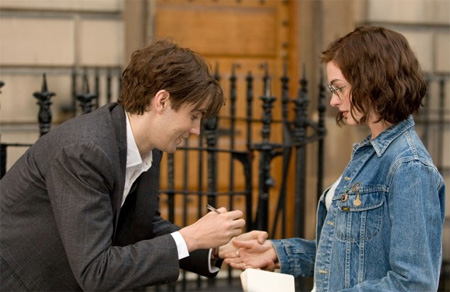
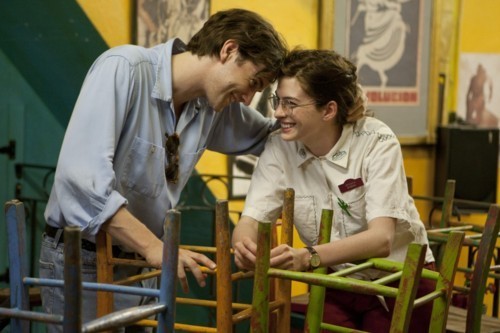
Dexter (Jim Sturgess) and Emma (Anne Hathaway) have "just met" at their graduation as they string along with their mutual friends, a couple.  Emma is bookish, unstylish, a bit of a character—has a "nice personality"—Dexter is boyishly handsome and knows it, and Emma is "crushing."  An awkward "overnight" happens, where it is unclear what transpired, but it's important enough that Dexter is helping Emma move when the next 15th of July occurs, but not important enough that Dexter isn't moving to Paris to teach.

July's come and July's go, as Emma suffers through waitressing at a London Tex-Mex restaurant and Dexter jumps from job to job, eventually becoming  the smarmy host for a late-night dance teen program. Where Emma is a busy bee, droning through know-where jobs until she catches her big break, Dex is a moth attracted to the brightest (or blondest) thing in the room. They're devoted to each other, but only so far. As her star rises, his sets—first Mom (the ever-reliable Patricia Clarkson) dies of cancer, then his fortunes go South, followed by years of over-indulgence. Before you can say "This is Mrs. Norman Maine," he is seeking her out, where she has nearly given up. As traditional as this is, what is nice about One Day is that Emma does just fine without him, she makes her way in the world without a man's help (and frequently, they're a hindrance), whereas in most films of the romantic genre, everything can be solved by anything in pants.

The director, Lone Scherfig, previously made An Education, which, while well-acted and elegantly directed, suffered from a distinct lack of heat and a little too much posh.  The former problem still applies here. The film is decidedly chilly in tone, and while this is a welcome change from the day-glo color, syrupy music rom-coms that chirp incessantly about Moon, June, (premarital) Honeymoon," poking you in the heart-area that "Love is Great, right? RIGHT?" One Day makes it hard to feel anything beyond "Gee...that sucks."

Maybe it's the skipping around from year to year, but there's a distinct lack of focus in the story, as it spreads itself around a bit too thin, the ancillary characters populating the movie to make life difficult for Emma and Dexter, necessary irritants and bothers that will drive them into each other's arms every year.  Plus, the story arcs of the two main characters run precipitously up and down, without any jolts of happiness amidst the gloom, or hurdles to happiness on the ascent.* Things settle down as people "settle" and, although One Day manages to avoid many of the cliches of the romantic genre, it also hasn't found anything as compelling to replace them. Plus, with the mutual reversals of fortune, there seems to be a dramatically required "level of the playing field" in order for things to resolve "the way they should".

One should be grateful that one is asking these questions about a romance movie (haven't done that in a while), so it's nice to see somebody making the attempt. But, one gets the idea that the same old "Love Potion No.9" is being hawked. All they've done is change the shape of the bottle.


One Day is a Rental. 


* One of my favorite quotes is by Anton Chekhov: Any idiot can survive a crisis; it's the day-to-day living that wears you down.

**  Well, that's not entirely true, but we don't want to give anything away. 

Saturday, December 11, 2010

Love and Other Drugs


"An Hour or Two of Relief From Being You"
or
"Life is Pain, Princess.  Anyone Telling you Different is Selling You Something"

Edward Zwick and Marshall Herskovitz—the boys who brought "thirtysomething" to television many dances-by-the-light-of-the-moon ago—have put together (along with co-scenarist Charles Randolph) this adaptation of Jamie Reidy's book from tell-all to rom-com with a bit of a twist:  taking Mary Poppins' advice that "a spoonful of sugar helps the medicine go down," Herskowitz and Zwick use the opportunity to educate a bit about the selling and hooking practices of pharmaceutical companies under the guise of watching Jake Gyllenhaal and Anne Hathaway  cavort semi-nakedly through a noncomittal sexual relationship.  At the same time, they try to inject a message about the pervasiveness of an over-the-top over-the-table drug culture, while also adding to the cocktail by venturing into rom-com territory about commitment and weightier problems than merely Twittering properly, or not being so damned selfish (well, actually, there's a lot of that) that it might actually fool you into thinking it's an adult romance. Symptomatic of too many script-doctors in the room, Love and Other Drugs is one over-prescribed movie, with far too many complications to be healthy. 

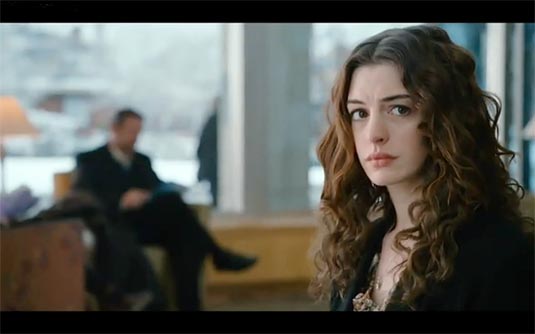
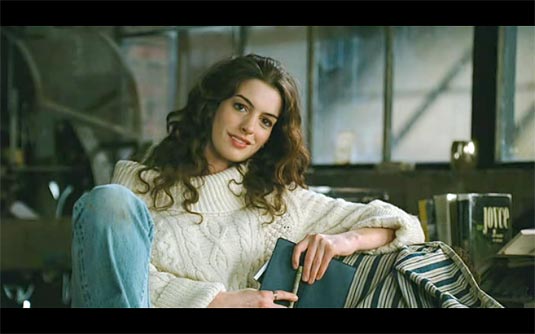
Author Reidy's composite character is Jamie Russell (Gyllenhall), a privileged, entitled son of a well-to-do upper-class family of doctors (headed by George Segal and Jill Clayburgh—her second-to-last role).  Russell was going through medical school, but dropped out, because he was bored (he was diagnosed early with ADD—a Ritalin child) and he didn't want to live up to parental expectations.  He transitions from being a randy electronics salesman (he is...not the electronics) to a randy pharmaceutical salesman for Pfizer, a natural fit as the seduction of doctors begins as foreplay with the receptionists and nurses.  He's a rep for zoloft, which Pfizer is hoping with cut into the considerable market-share of that penny-candy of anti-depressants, prozac.  While sweet-talking a Doc (Hank Azaria) on his rounds "posing" as an internist, he sits in on an appointment with Maggie Murdock (Hathaway), a self-described "drug-slut" not without reason—she's 26 and in the first stages of Parkinson's.  Rom-com's have a way of "meeting cute" and here it's that Maggie has a mark on her breast that she wants examined, only to discover that the internist in the examining room is doing too much examining.  She clobbers him with her bag out in the parking lot when she finds out.

Somehow this turns into a relationship, heavy on the sex, and light on the commitment—she's just out of relationship with a married pharmaceutical rep (quite the coincidence) who just happens to be Russell's chief competitor (QUITE the coincidence!), while he's concentrating on fast-tracking his career.  All well and good, but what starts out clinical and cynical, soon turns sorrowful and needy.  Then, just when you think the movie has settled down to puzzle out the relationship, the game changes again with the introduction of Viagra to Pfizer's list of drug-pushing material.  As it was in the pharmaceutical trade, it's a game changer for Love and Other Drugs

Russell's not the only one with ADD, this movie is showing symptoms (that is, if it would stay consistent for 15 minutes!).

In its attempt to be a cure-all for all movie-goers (remain faithful to the book, but inject a romance:* hit the book's highlights, but try to maintain a storyline), it soon turns into one of those situations where the movie tries to cure its own side effects, rather than what's wrong at the source.  It's competent in every way, and Gyllenhaal does yeoman's work trying to keep his character likable while being predatory, venal, and wildly inconsistent in behavior, while Hathaway, she of the big doe-eyesseemingly always caught in the headlights**—gains sympathy even when she's flaunting the victim card in a variety of diverse and contradictory ways.     

The film tries so hard to entertain everybody, but it's more a placebo effect than the real thing, that you might even be able to fool yourself into thing that, at the end, you feel all warm and gooey inside.

But, there's probably a pill for that, too.  Consult your physician.  Especially if it lasts more than four hours.

Love and Other Drugs is a Rental.


* Yeah, it's sexist, but Hollywood is the epitome of sexism--there has to be a romance in the movie to "attract the ladies."  My favorite story on the subject was contained in a book about the making of John Huston's film of Moby Dick.  In it, one of Ray Bradbury's stipulations to writing the script is that there be no requests for a "romantic sub-plot."  , At a late stage in the scripting, Huston, being an irrepressible prankster, asked Bradbury to write a part for a producer's girlfriend. 

** She's this generation's Liza Minnelli (that's not necessarily a compliment!).

Wednesday, March 10, 2010

Alice in Wonderland (2010)

"Beautiful Soup"

Hesitant, I am, these days. Hesitant, I says.

After rushing
the review for "Shutter Island" and dismissing it as "minor Scorsese," I found it had stuck like a bur in my hair and remained in my thoughts and my brain for a longish time. I went back and changed my rating—it's a "Matinee" now—but not the review, because my complaints are the same. But it's really good "Scorsese" and slots right into the body of his work, despite being unique in its qualities and unlike anything he's done before.

But, I can't tell you why. Curiously, this doesn't stop me from going on and on about it, because it's so rich, and after an essential second viewing, you realize what a dance it is with story-logic and the use of image to show you—and NOT show you—what's going on. It's a trip, and a breathless display of what a master of cinema can do with the form.

Which is why
Martin Scorsese should have directed "Alice in Wonderland" in 3-D. Sure, your kid's head would explode. But it'd be a great movie!

I've been looking forward to
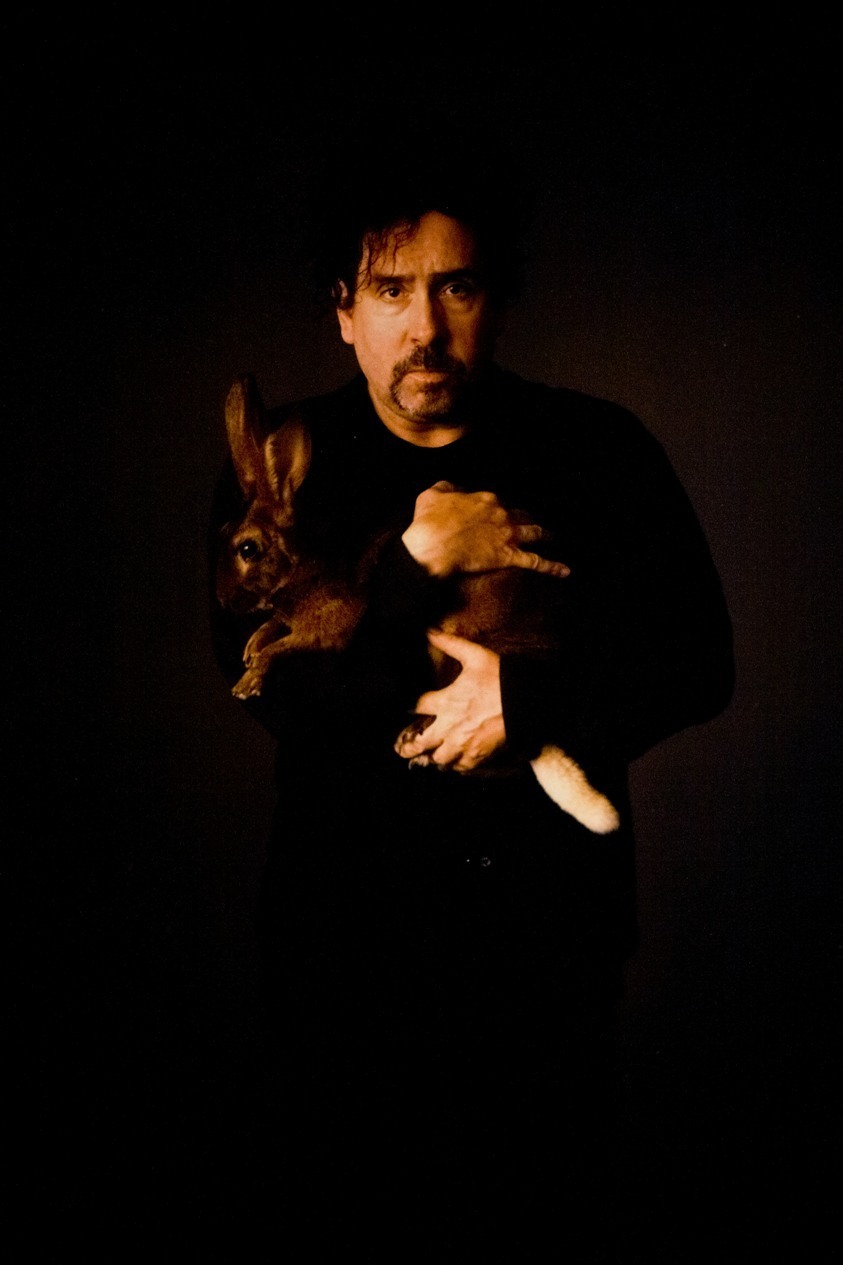
Tim Burton's take on Lewis Carroll. Seems like a match made in anyplace but Heaven. Burton's lapses in story-logic and not playing by the rules in past movies make him the perfect Carroll adapter; he's the "just go with it" director, as he frog-jumps from set-piece to set-piece. If you have to ask questions, you're going to slow the tour-bus down. And his arrested art-student sensibility is so dark that it keeps Alice exactly where it should be—underground with the muck and the weevils and the roots tearing at your extremities.

So it's a MAJOR disappointment that
Disney's "Alice in Wonderland in 3-D" (A Film by Tim Burton) is such a wisp of a movie and—dare I say it—conventional, that it misses the mark of being a great movie (and a good representation of Lewis Carroll) by a hedgehog-croquet slice.*

Here's the problem. The "
Alice" stories are stuff-and-nonsense. Charming stuff-and-nonsense that can make little girls giggle and college professors scratch their heads. Buried deep in its purple marrow is the satire of the vagaries of Society, not of adults, necessarily, but of Society—of class distinctions and petty politics—the Games People Play (when they're not playing games).

It shouldn't make sense. It is full of new words and language that fire the synapses of minds, like when Mommy talks about something called pilates, or you have to find out why you can't steal a base before the pitcher throws. It's all bright and shiny and new and simply incomprehensible, and Carroll is just as fantastical for trussed-up adults as it is for children. The glory of it is children have the upper-hand in connecting with it—they don't have so far to fall down the rabbit-hole.

And Burton (and his screenwriter
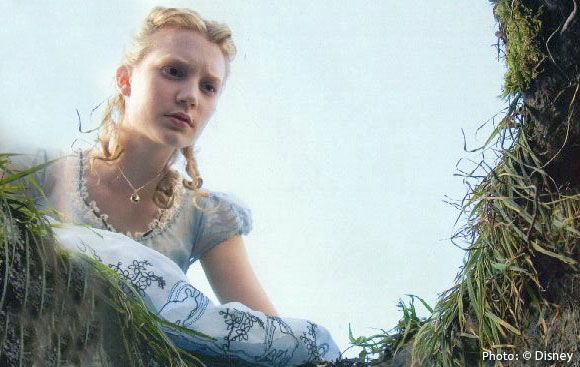
Linda Woolverton, who's worked on several Disney animations) know this to a point. When we first meet 19-year old Alice Kingsleigh (Mia Wasikowska, looking dark-eyed and sallow—a perfect Burton heroine), she has been invited to an engagement party—hers.** It's a surprise, but it's not, and it is not going well for the hostess, Lady Ascot (Geraldine James) the mother of the groom-to-be, as everything is not...perfect. And Alice has this annoying habit, besides being late, of being...unconventional...and distracted by anything. Alice likes to see the Nature of things. The party made by adults just uses Nature as a tightly-controlled back-drop. At the moment the question is popped, Alice excuses herself to the party (as they're all watching, and it's for their benefit more than hers) saying that she "needs a moment." (Did they "need moments" in the 19th?)

This is pretext to Alice wandering off from the party,
in her moment of highest risk of being cosseted, to follow a white rabbit and once more stumble down a rabbit-hole, returning to "Wonderland."***

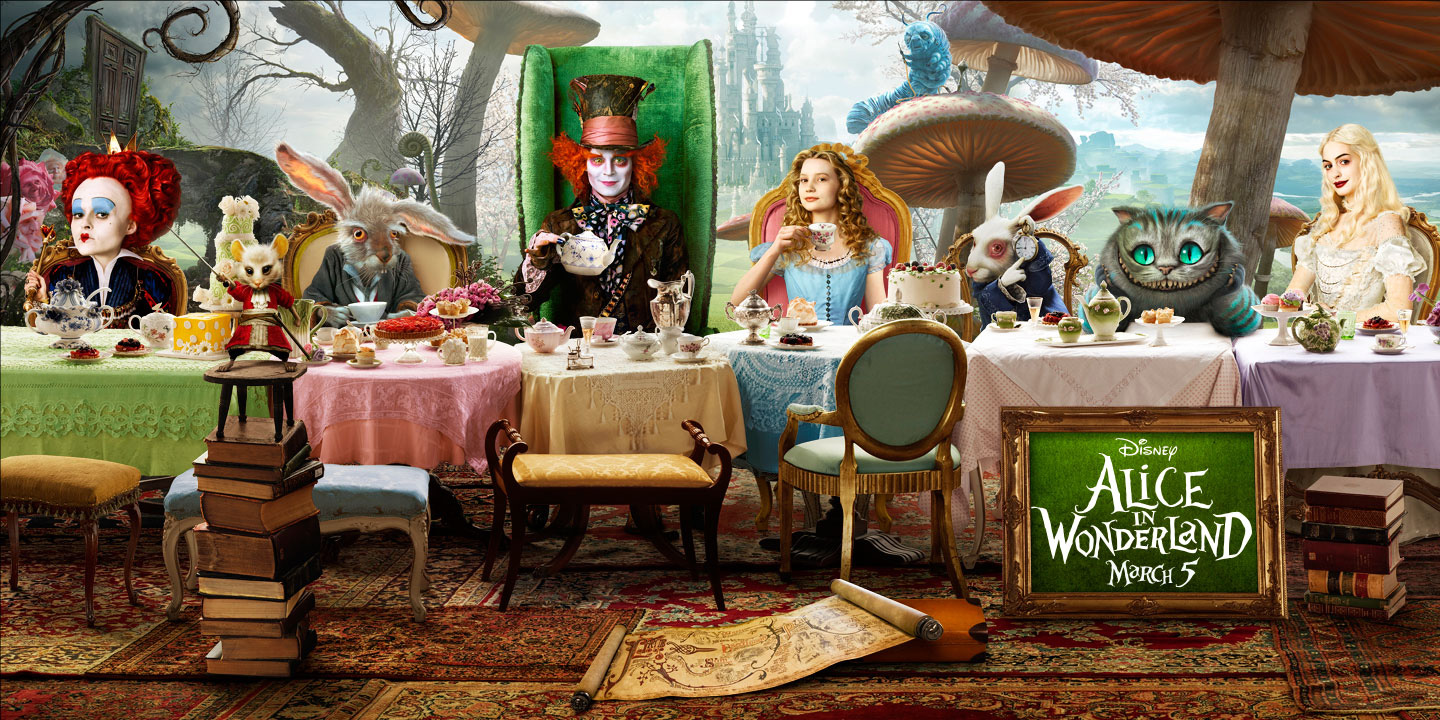
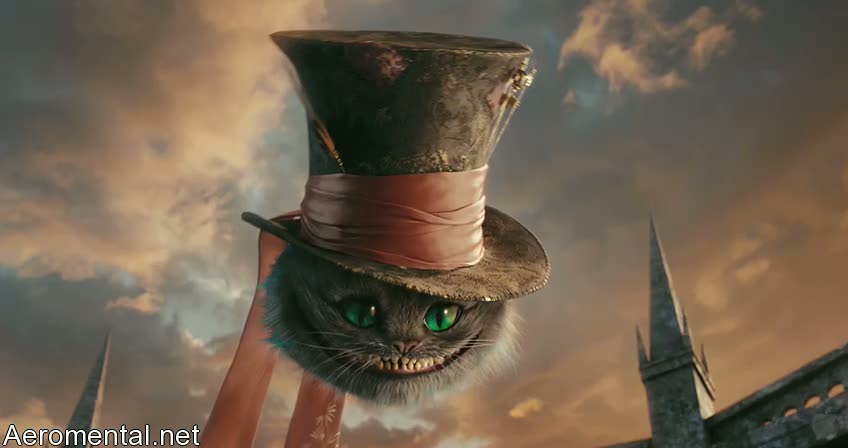
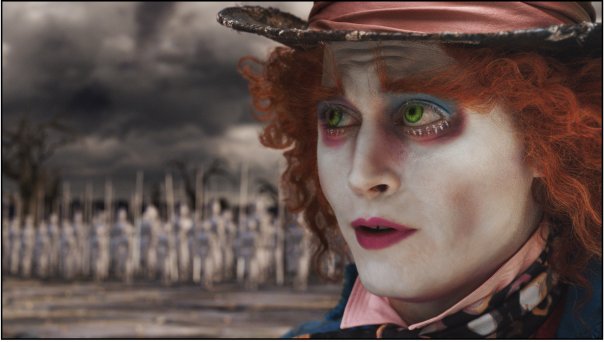
It's here, as you'd guess, that the movie takes off. The colors more vibrant, the effects-work (by four FX houses but primarily Sony) magical, even the 3-D has more depth. The characters adhere to a mixture of Burton and first edition illustrator John Tenniel, and more in that direction than the way the Disney animators drew the characters for their 1951 adaptation. The film is nicely cast with Burton's usual suspects (Johnny Depp—top-lined as The Mad Hatter, Helena Bonham Cartersimply delicious as The Red Queen, the voices of Alan Rickmanthe caterpiller, Timothy SpallBayard the hound, Christopher Lee—as the Jabberwock, Paul Whitehouse—as The March Hare, and Michael Gough—as the Dodo) New to Burton are Stephen Fry as the Cheshire Cat, Michael Sheen as the White Rabbit, Matt Lucas as Tweedles Dum and Dee, but most impressively, Crispin Glover as the evil knave Stayne, and Anne Hathaway as the White Queen. One wonders why Glover has never been in a Burton movie before—maybe Burton thought he was uncontrollable?—but he brings a hissing nastiness to what could have been a typical bad-guy role, and that Burton sets him up against Depp's Hatter is one of those movie match-up's you love to see. And Anne Hathaway proves once again that she's not afraid to explore her dark-side. Her creepy "Liza-Minelli-in-a-straight-jacket" White Queen evokes Burton's long-time exotic paramour Lisa Marie.

Quite the ingredients for a film,
and with Burton doing the stirring, one salivates at the possibilities. There are lots of laughs, moments of exquisite beauty—wispy seeds occasionally enter the frame and at one point, we park in front of a dew-drop hanging underneath a mushroom (Robert Zemeckis would have shoved us through it)—the whole movie is filled with beautiful images and nice ideas to keep you in your seat. But, it has no staying power, and it might be because this "Alice in Wonderland" has the parts, but not the non-sensical sinnew that has made "Alice" a classic.

Wolverton and Burton take the essential pieces and make a typical action-adventure story-line out of it. There is some half-sized satire about political squabbling, but mostly it's a cut-and-paste job, based on "
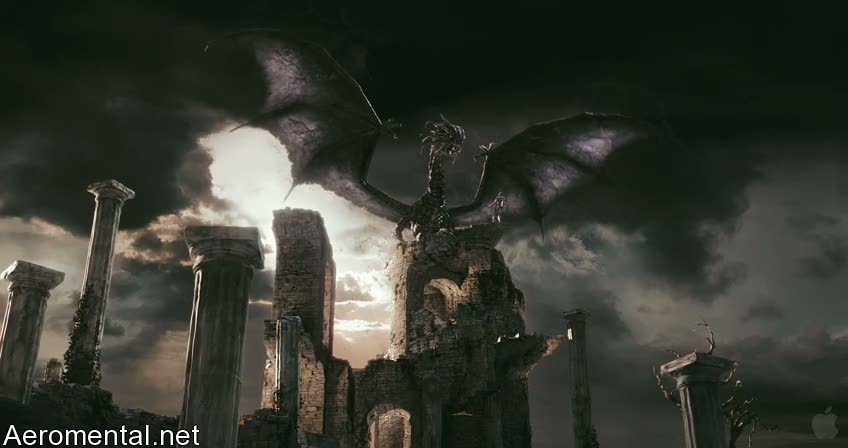
The Jabberwock Poem." That classic piece of nonsense turns into a fable "that will make everything alright." And it involves one of the characters defeating the Jabberwock in battle with "the vorpal sword" to invoke "the frabjous day" and blah, blah, blah. It's a silly poem, people, not a video-game scenario. By the time we get to the climax, there's a "Lord of the Rings" dark-sky battle between the characters, and we could just as well be in "Narnia" for all it matters. And it has an after-school special message to it, that is nice and all, but is a bit like cherry-flavored medicine.****

This is a lot of talk for a movie I'm only luke-warm about, but the bottom-line is, it's fun while it lasts, but it's like eating cotton candy in the rain. So, yeah, take the kids, it's imaginatively done (when it is), and they'll love it. But don't be surprised if they get sullen and whiny an hour after. Rich it may be, but it's mostly empty calories.
Disney's "Alice in Wonderland" in 3-D is a Matinee, but for the details.*****


* Here's the rub: "Alice in Wonderland" dropped out of my head very fast. One trip to the hardware store and *POOF!* it was gone like a puff of hookah-smoke (or was that diesel?). Now, I waited to write this, fearing another "Shutter Island" mis-take, and I found the movie shrinking away—shrinking, shrinking, shrinking, waiting for a cake to say "Eat me" to bring it back to size. Never showed up.

** There's a subtle joke there, as it's mentioned that the party has been in the works for twenty years...but Alice is only 19!

*** Woolverton and Burton add a nice touch that Alice is constantly questioned whether she's the "real" Alice—the Alice that showed up in "Underland" when she was six. She's grown up and the residents hardly recognize her as the strange child who changed the name of the place to "Wonderland." The original story's name was "Alice's Adventure Under Ground."

**** SPOILERS AHEAD: To show you how cookie-cutter this "Alice" is, somebody gets captured and has to be rescued, there's a last-minute save from an unexpected source, a character must claim an essential ingredient by facing danger, and a foe becomes an ally. Oh! And one character's actions provides the method for their eventual freedom. And there's no place like home. I may be a little harsh here, but "Pan's Labyrinth" showed that you could do something different with this sort of myth-weaving and still make a compelling movie.

***** See it in 3-D? I dunno. It will probably be brighter in 2-D, but betray the flatness of the images, and Burton has the same problem as James Cameron of bringing non-essential things on the frame-edge, like ferns and such, too close to prevent double-images. Zemeckis, Dreamworks and the Pixar folks are the champions of 3-D so far.


Friday, August 14, 2009

Becoming Jane

"Becoming Jane" (Julian Jarrold, 2007) Jane Austen is a double-edged sword for Hollywood, a god-send and a nightmare. Her stories make great movies that make quite a bit of coin and their period settings and costuming guarantee that they will receive at least technical Oscar nominations. The only problem is Jane died at the age of 41, having written only six complete novels, those being (say along with me now) "Emma," "Sense and Sensibility," "Pride and Prejudice," "Mansfield Park," "Northanger Abbey," and "Persuasion." They have become their own English cottage industry in the last 20 years or so, and there have been numerous films and BBC series of each of them. I would dare say that Keira Knightley has a shot at appearing in all of them, and if not her, Kate Winslet. Emma Thompson could retire making adaptations of Austen films, so successful was her adaptation of "Sense and Sensibility." But, it's counter-productive to keep making the same six movies over and over (although God knows they've tried*) There have been modern-dress adaptations of them, like "Clueless," and "Bridget Jones's Diary," and "The Jane Austen Book Club."** An obvious solution would be to broaden one's literary horizons and go back to the Brontë sisters (although they're a bit gloomy and have also been well-represented in media).

But instead they've concocted a sort of "Jane Austen Begins" origin story which plays fast and loose with the facts in order to make
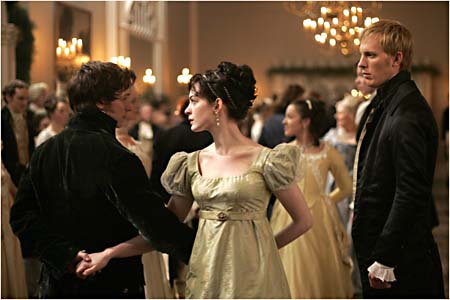
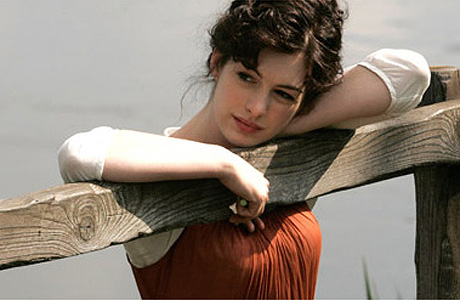
her life play like a Jane Austen novel (but without the "incandescent marriage" or happy ending). It's a great cast with Anne Hathaway as the spunky young Jane, James McAvoy as her would-be love Tom Lefroy, Julie Walters and James Cromwell as Jane's fretting parents, and Maggie Smith and Ian Richardson as the stodgy bumps in the road of romance that are an intrinsic part of any Jane Austen story.

Was there a romance? Well, Jane did write about Lefroy to her sister Cassandra:


"I am almost afraid to tell you how my Irish friend and I behaved. Imagine to yourself everything most profligate and shocking in the way of dancing and sitting down together."

And Lefroy supposedly confessed in his dotage to having "a boyish love" for her. Probably a lot of sighing went on. But "Becoming Jane" blows it up to be the Great Love of her life, the inspiration for her writing, becoming a wish-fulfillment of what could have been. Maybe. But maybe, as it is inconveniently often is, the truth is a bit more complicated than that. "Becoming Jane" would have you believe that she was a great literary success—when the truth is that she was published anonymously as "By a Lady." She enjoyed good sales of her book (two of which were published posthumously), but few knew her identity while she was alive. That flies in the face of what the movie manufactures for a "happy ending."

Still, the filmmakers get to cherry-pick the Austen canon for their story, and carefully insert the few known biographical bits—Wikipedia has this fine quote by a biographer saying that details of her life are "famously scarce." But, they know she ended up writing those novels, so once they know the end-point the authors can start constructing
the path of the creature of "Becoming Jane." Whether that portrait is becoming, doing justice to the author, is open to debate. There's a term that serves as an ad hominem defense for writers making it up in the absence of facts—"writing to silence," in other words, there's no one alive to protest the accuracy. The assumption for the people who wrote "Becoming Jane" is that she wrote what she knew, and that her novels were somewhat autobiographical, negating that most essential of writerly gifts—imagination. If that's not an injustice to any writer, I don't know what is.

* One of my favorite titles for a movie in the last 15 years was the gangster spoof, originally called "Jane Austen's 'Mafia!'" as a knock on how many adaptations of Austen there had been, but the producers chickened out and took her name off before it opened.

** And just as this was to be published, I became acquainted (via PBS) of the British mini-series "Lost in Austen," in which a modern day Austen fan exchanges positions with Elizabeth Bennett of "Pride and Prejudice" (via time portal, and one would assume a fiction/non-fiction bridge) and tries to keep the storyline in place—much like an Austen heroine—while trying to put herself and Elizabeth back in their proper places. Naturally, a movie adaptation is being planned with an executive producer being Sam Mendes...who is the husband of Kate Winslet.

Naturally.

Wednesday, January 28, 2009

Rachel Getting Married

"Just as Long as there's Health"

Dearly Beloved, we are gathered here to join Robert Altman's "A Wedding," James L. Brooks' "Terms of Endearment," Robert Redford's "Ordinary People," and Otto Preminger's "Tell Me That You Love Me, Junie Moon" in a Wholly hand-held digitized Indie Matrimony. Do you promise to love and cherish this movie through Sundance and Award-Season, through Oscar Campaigns and Buzz-Kill. Do you promise to watch over the dodgy home-movie-like photography, the world-music wedding sequences, the roller-coaster ride of joyful scene, painful revelation, funny scene, hysterical over-reaction, calming lull, screaming match, cathartic suicide attempt, reconciliation and subtle revelation?

You do? Really? ....(really?!)

Well...uh...then, may I present
"Rachel Getting Married," a fine film with a good pedigree that manages to unfold slowly like an Altman film, but with a definite point to reach, story-wise and some terrific performances by a great ensemble cast. I've seen lots of culture-clash wedding movies before--they're a good source for forced comedy, always a little too forced. But here, from a script by Jenny Lumet (Sidney's kid), the complicated back-story is revealed organically, when the characters are ready to reveal it, with a protracted amount of time thwacking and hacking through the thicket of recrimination and resentment and nobody talking about "it," they're usually raising their voices about what's happening right NOW! There are moments you want to walk out into the lobby discretely to let them work it all out, which happens quite a bit in this movie.

The tough part in this type of thing is for the actors to carry the history without giving too much away and to prolong the interest, and fortunately,
Jonathan Demme has cast a great range of actors, particularly funny-man Bill Irwin, who is a more interior and less volcanic Robin Williams. When Williams has a plot revelation, it's everything to keep it contained in a burst of hyper-volatility, but Irwin (who goofed with Williams in the "Don't Worry, Be Happy" video) is a more suppressed performer, with the discipline of a mime. Revelations have to be pulled out of him (with an invisible rope!).

As his wife (and support system),
Anna Deavere Smith--a great joy in "The West Wing," and was one of the few actors to come out looking good in "The Human Stain." As Irwin's ex-wife, Debra Winger, and anytime Winger's in a movie, it's an event. Here, she's the mom-harpie that she played against in "Terms of Endearment," and where Shirley MacLaine was show-stopping trooper, Winger submerges it, and lets it out in dribs and drabs, which is the perfect strategy. Rosemarie DeWitt plays the eponymous "Rachel" (and why that title is so important becomes clear in the film) in a role that at the dawn of the indie boom would have been played by Annabeth Gish.

But over-shadowing the movie
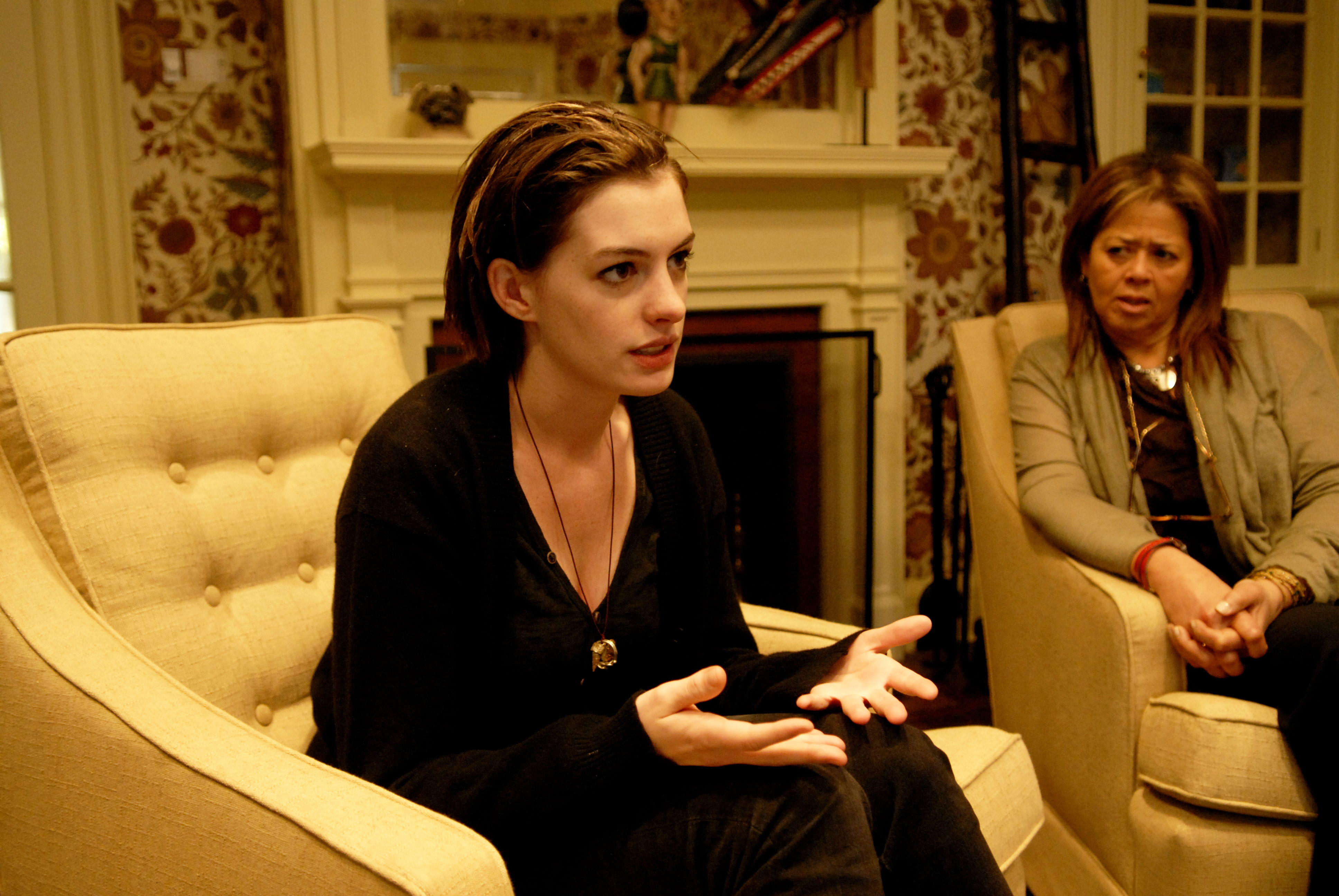
like a little black cloud is Anne Hathaway as the family member with a three day pass from re-hab, who's working on addictions to well, just about everything...booze, narcotics, tobacco, danger, sex, drama, attention ("Hello, I'm Shiva, the Destroyer," she begins her wedding toast).
There's a semi-running gag of her running into people all-too-familiar with her past (A 7-11 clerk sees her enter and brightens, "Didn't I see you on "Cops?"). Hathaway is a little thunderstorm, chain-smoking, machine-gunning dialogue, hyper-needy, guaranteed to say the inappropriate thing, and every scene she's in you wait for the bomb to go off--she's your worst Liza Minnelli nightmare. And when she reaches a moment of relative tranquility, the film loses some of its charge, even though it's nice to have a little "relative" peace and quiet. Don't count her out of the Oscar race.

"Rachel Getting Married" is a Matinee.