Showing posts with label Patricia Clarkson. Show all posts

Thursday, September 8, 2011

One Day

"July 15ths with Emma and Dex"
or
"Same Time Next Year"

Can a man and woman "just" be friends? (the question posed by When Harry Met Sally)  I've gone 'round and 'round with this one. I've said "Yes" for many years, and then that became "No," then back to "Yes," and now, it's something of a toss-up. "It's possible," I say noncommittally (which is the basis for many of the male-female problems, friendship or no).

But anything is possible.
"One Day" was a nifty best-seller by David Nicholls, smart, tight and funny, a romance told in snap-shots of one day that was realistic about the vagaries of life and love and the "yin" and "yang" of both. What makes the novel special gets distilled somewhat in celluloid form, making One Day feel a bit less exceptional, the humor muted somewhat, and given the twenty year time-span of the movie, some of the anniversaries celebrated are given short shrift, skipping to the more complicated "good parts," as opposed to those years when nothing much happens...you know, like "life."*

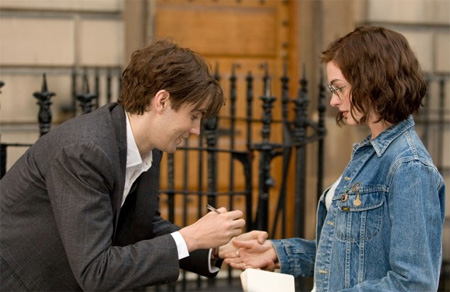
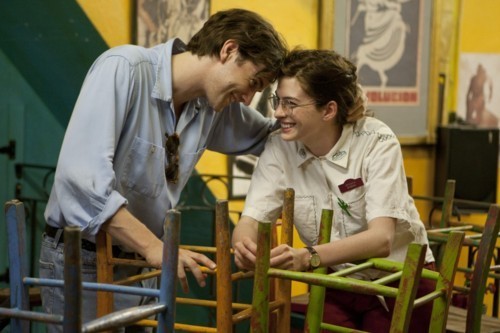
Dexter (Jim Sturgess) and Emma (Anne Hathaway) have "just met" at their graduation as they string along with their mutual friends, a couple.  Emma is bookish, unstylish, a bit of a character—has a "nice personality"—Dexter is boyishly handsome and knows it, and Emma is "crushing."  An awkward "overnight" happens, where it is unclear what transpired, but it's important enough that Dexter is helping Emma move when the next 15th of July occurs, but not important enough that Dexter isn't moving to Paris to teach.

July's come and July's go, as Emma suffers through waitressing at a London Tex-Mex restaurant and Dexter jumps from job to job, eventually becoming  the smarmy host for a late-night dance teen program. Where Emma is a busy bee, droning through know-where jobs until she catches her big break, Dex is a moth attracted to the brightest (or blondest) thing in the room. They're devoted to each other, but only so far. As her star rises, his sets—first Mom (the ever-reliable Patricia Clarkson) dies of cancer, then his fortunes go South, followed by years of over-indulgence. Before you can say "This is Mrs. Norman Maine," he is seeking her out, where she has nearly given up. As traditional as this is, what is nice about One Day is that Emma does just fine without him, she makes her way in the world without a man's help (and frequently, they're a hindrance), whereas in most films of the romantic genre, everything can be solved by anything in pants.

The director, Lone Scherfig, previously made An Education, which, while well-acted and elegantly directed, suffered from a distinct lack of heat and a little too much posh.  The former problem still applies here. The film is decidedly chilly in tone, and while this is a welcome change from the day-glo color, syrupy music rom-coms that chirp incessantly about Moon, June, (premarital) Honeymoon," poking you in the heart-area that "Love is Great, right? RIGHT?" One Day makes it hard to feel anything beyond "Gee...that sucks."

Maybe it's the skipping around from year to year, but there's a distinct lack of focus in the story, as it spreads itself around a bit too thin, the ancillary characters populating the movie to make life difficult for Emma and Dexter, necessary irritants and bothers that will drive them into each other's arms every year.  Plus, the story arcs of the two main characters run precipitously up and down, without any jolts of happiness amidst the gloom, or hurdles to happiness on the ascent.* Things settle down as people "settle" and, although One Day manages to avoid many of the cliches of the romantic genre, it also hasn't found anything as compelling to replace them. Plus, with the mutual reversals of fortune, there seems to be a dramatically required "level of the playing field" in order for things to resolve "the way they should".

One should be grateful that one is asking these questions about a romance movie (haven't done that in a while), so it's nice to see somebody making the attempt. But, one gets the idea that the same old "Love Potion No.9" is being hawked. All they've done is change the shape of the bottle.


One Day is a Rental. 


* One of my favorite quotes is by Anton Chekhov: Any idiot can survive a crisis; it's the day-to-day living that wears you down.

**  Well, that's not entirely true, but we don't want to give anything away. 

Friday, February 19, 2010

Shutter Island

"What's yer Next Move, Boss?"
or
"Tag! You're It!"

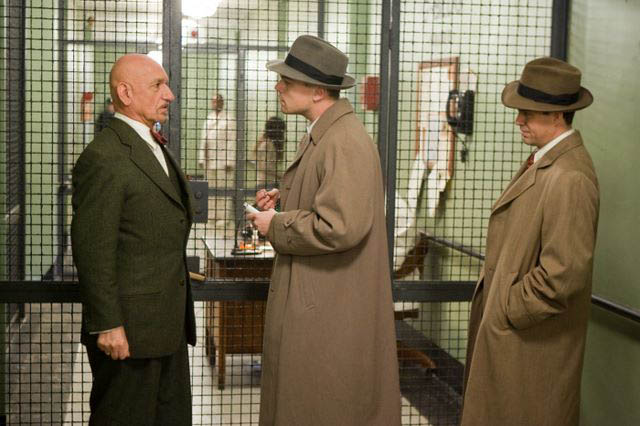
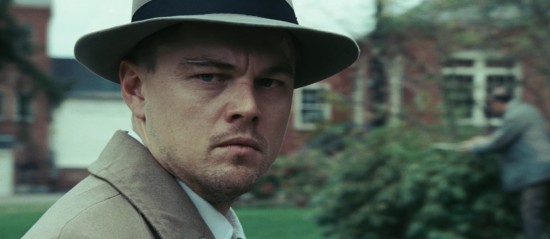
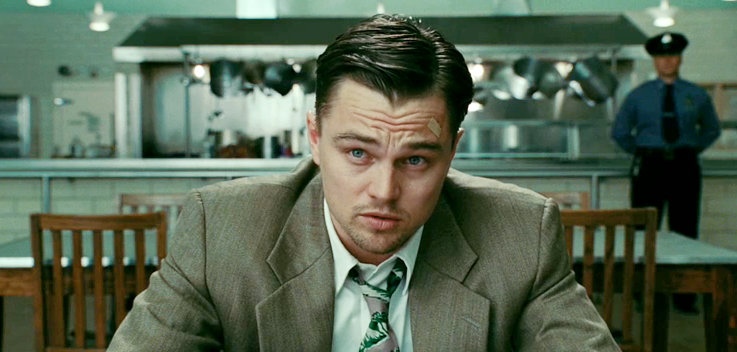
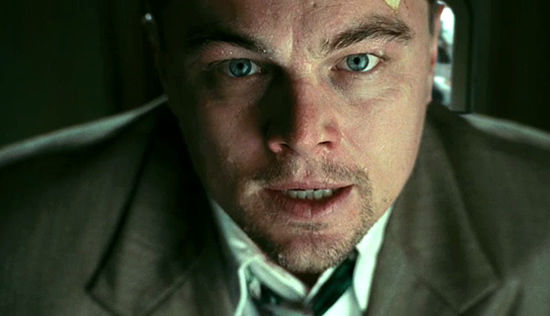
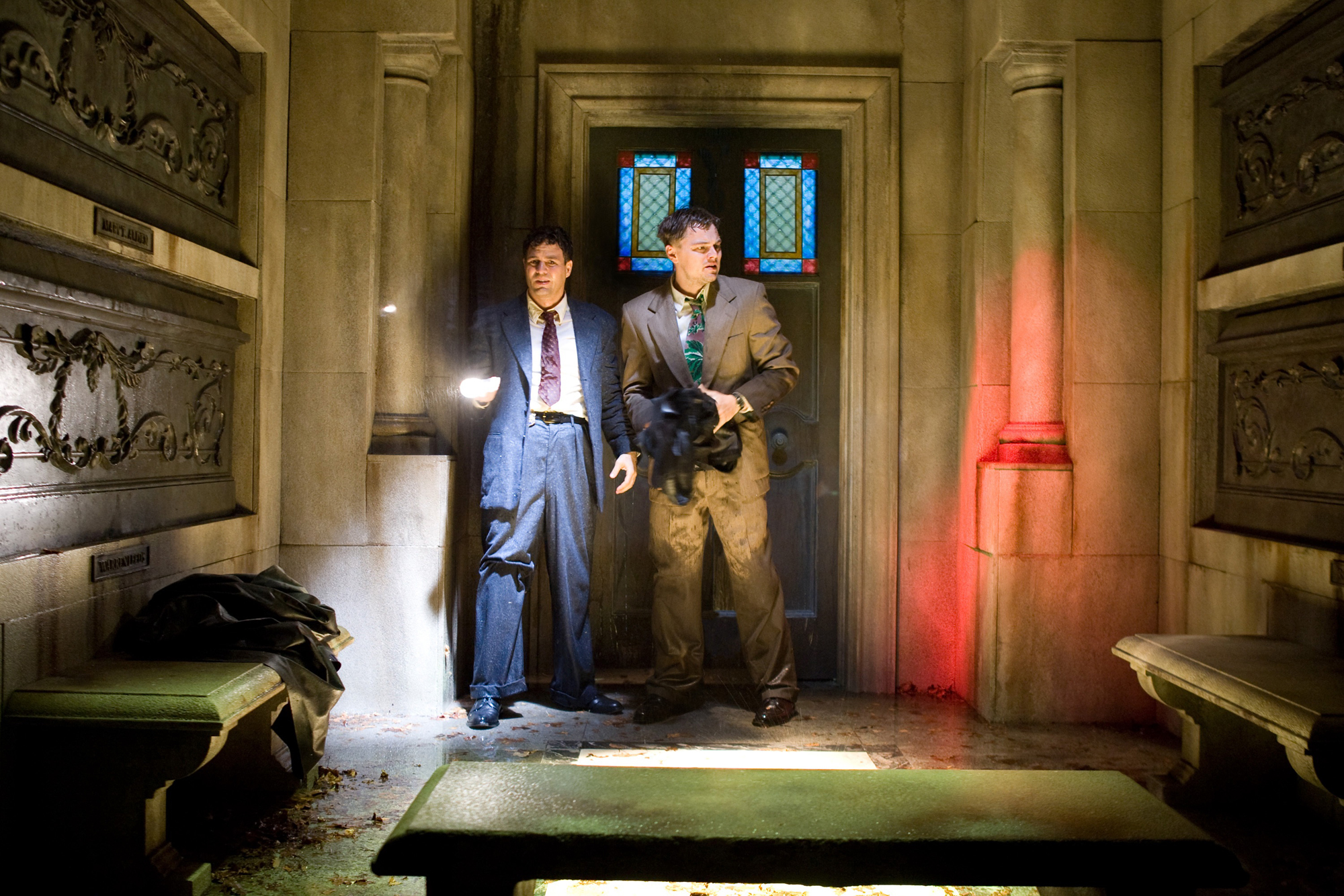
It is 1954, and out of the fog comes a ferry boat carrying two U.S. Marshalls, heading for "Shutter Island", where squats, in various stages of dis-repair, Ashecliffe, an asylum for the criminally insane. In the "head," sea-sick,* is Marshall Teddy Daniels (Leonardo DiCaprio), "the legend" as his partner from Seattle Chuck Aule (Mark Ruffalo, who has a rather thick Massachusetts accent for it) calls him. The two are investigating the disappearance of an inmate from Ward B, the women's section, and right from the get-go, the two are at a disadvantage.

Upon crossing the electrified fence, their weapons are confiscated, security being what it is. "What?" Teddy smirks at the guard "You act like insanity is catching." The guard only smirks back. That should have been his first clue.

The doctors (
Ben Kingsley and Max von Sydow) are helpful to a point, but then they become somewhat diffident and challenging, even obstructing, protective of their "advanced" techniques—"a moral fusion between law and order and clinical care." The missing woman, Rachel Solendo (Emily Mortimer), drowned her kids after her husband was killed during the Normandy invasion and has never acknowledged the act. But she somehow managed to escape from a cell, locked from the outside, and with a guard on duty. Investigating, Daniels finds a cryptic note "The Law of 4. Who is 67?"

But that's all surface.
Daniels volunteered for this case because he wanted to get to Shutter Island for some personal business. He's still haunted by the death of his wife, Dolores (Michelle Williams), who died in a fire that was set by an insane fire-bug named Andrew Laeddis (Elias Koteas**), presently incarcerated in Ashecliffe's Ward C—for the most dangerous criminals. Daniels has done some investigating of the facility, and what he's turned up indicates that radical techniques, from experimental drugs to lobotomies, are being practiced, and as funds are being channelled there from the House Un-American Activities Committee, he thinks the government is working on a secret brainwashing program to infiltrate radicals as double agents. Teddy wants to blow the lid off the place.

That is, if Nature doesn't get the chance first. A hurricane is barrelling down on Shutter Island ("It's like f...ing Kansas out there!"), threatening to cut off power to the electrical systems keeping the prisoners locked up and backed off. If the power goes, there's no back-up generator to kick in.

All of this concerns his partner, Marshall Chuck Aule; Teddy's been doing all this investigating of Ashecliffe, the doctors are resisting co-operating, they have no guns, the facility controls the ferry that's their only way out, and there's a storm coming.
They're stuck on an island with a bunch of crazy convicts and an administrative staff who doesn't like them much, and wouldn't mind if they just...oh, had an accident or something. And Teddy's starting to get sick—plagued by migraines that Dr. Cawley (Ben Kingsley) diagnoses only too quickly with some handy aspirin nearby. Then, there's the German Doctor Naehring (Max von Sydow) who's the co-director of Ashcliffe and chief diagnostician. Teddy was one of the soldiers who liberated Dachau, so he's immediately suspicious of him. "Do you believe in God, Marshall?" Naehring challenges him. "Ever seen a death-camp, doctor?" Teddy sneers back.

There's a lot of story-point to juggle,*** but director
Martin Scorsese focuses on the atmospherics, which is laid down with a heavy hand in the same manner as he directed "Cape Fear." When it comes to working on genre features, Scorsese is never subtle, and the film is filled with dark spaces (with things that go KA-BOOM in the night), blinding lightning strikes, dripping facades and the most suggestive of dream-sequences. Before too much has happened, you begin to question everything you see, and at that point the director throws the continuity girl off the cliff and does whatever he wants, reality having little to do with the movie. The secret to this kind of film-making is keeping audiences guessing and Scorsese stretches it out as far as he can (to the point where some audience members will still be questioning it after they leave the theater).

Which is unfortunate. Because the most important thing about this movie (and story) is another of author
Dennis Lehane's moral quagmires. That is what one should be discussing, as opposed to "What just happened?"

So, call this another in a series of "minor Scorsese films" (but not so minor that it might win a mercy "Best Picture" Oscar), and we hope (again) that we'll see another film from him with more substance than mere style. One wonders how much Scorsese is sacrificing by hitching his film-making wagon to star Leonardo DiCaprio. DiCaprio is a bankable star so studios are only too happy to finance a Scorsese film starring him and this allows Scorsese to keep working in a youth-oriented market in the most profit-based center of film-making, Hollywood. But DiCaprio the baby-faced star (no matter how much he scowls) is the water to Scorsese's boiling oil. There is a sense, and it may only be mine, that DiCaprio is shoe-horned into Scorsese projects for which he is not suited, and perhaps the two should have a trial separation to see what kind of film the mature film-maker will produce without his too-young star. In the first part of his career, Scorsese's non-Robert DeNiro films were "Alice Doesn't Live Here Anymore," and "After Hours," two distinctive films that, even without the director's frequent collaborator, said something about our lives and times prismed through Scorsese's kinetic view-finder. After his tampered-with version of "Gangs of New York," he has produced "The Aviator," "The Departed," and this film, all with DiCaprio, and they are films more like "New York, New York," that accentuate style over substance. Great cinematic rides they may be, but they're flashes in a film-can, that leave you still hungry to see a great movie.

"Shutter Island" is a Matinee.

Post-script: I've changed my rating of "Shutter Island" to a matinee and I'm not so sure it is a minor Scorsese film, as it's stayed with me for more than a week, and the images and intricacies keep popping into my brain to slap me upside the head. "Missed it!" I think the "Decaprio" element still brings the movie down a bit, but a second viewing of "Shutter Island" shows intricacies that in the first viewing one doesn't know they don't know. That's subtle film-making that doesn't wave red flags at the audience, and the film slots into Scorsese's body of work quite smoothly. Trouble is, I can't go into details about it, or I might spoil the movie for anybody else.

Well, we'll just leave that for a piece down the road.

* Teddy is another Mass. cop who has the shakes about water. In "Jaws," Chief Brody's wife tries to be helpful: "There's a technical name for it..." "Drowning" is his quick reply.

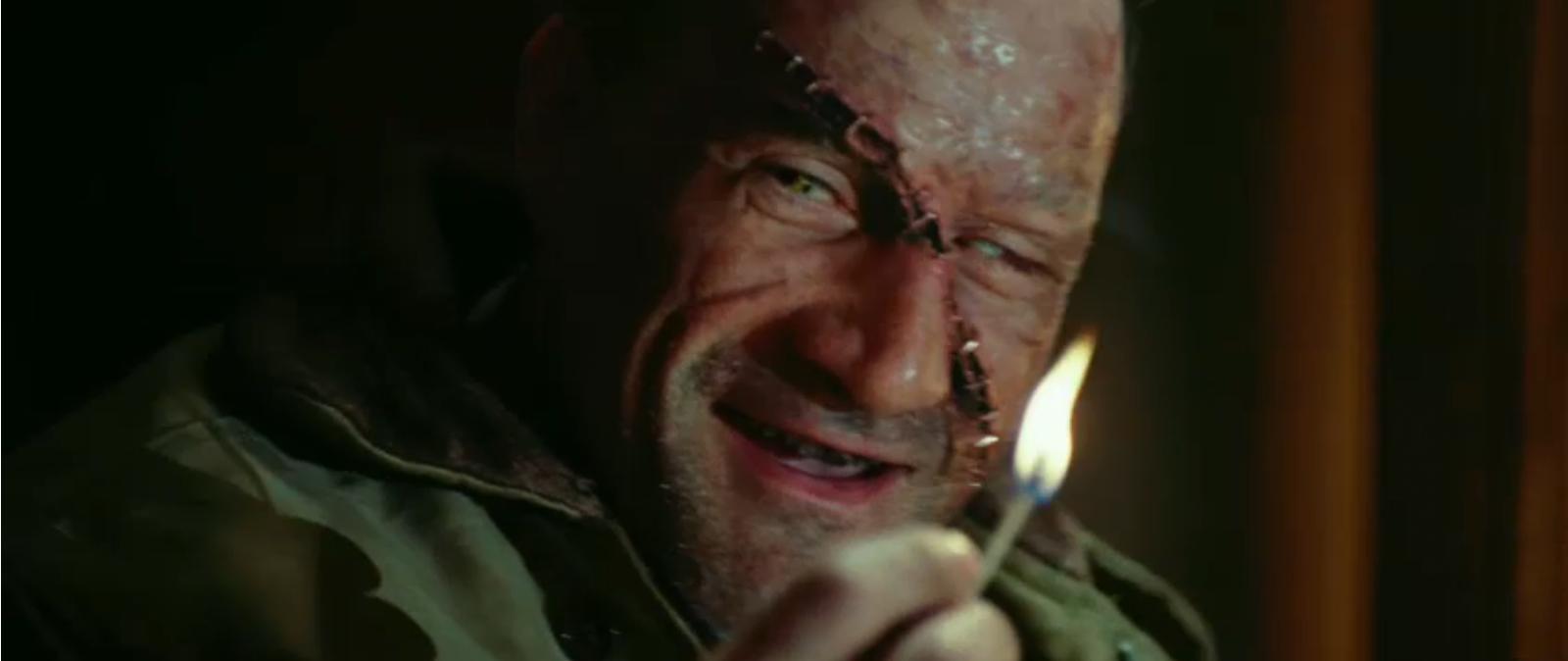
** No, it's not Robert DeNiro, although it looks like him in the trailer. It's Elias Koteas...with a really big scar.

*** The script is by "Avatar" adapter Laeta Kalogridis, who Lehane thought did a masterful job with a difficult assignment. It is.


Friday, July 10, 2009

Whatever Works

"And Sometimes, Finally, a Cliche is the Best Way to Make a Point"
or
"Mommy, That Man is Talking to Himself" ("Come Along, Justin")


Boris Yellnikov (Larry David) is a genius. A misanthropic genius, to be sure, but a genius; he's only too happy to tell you that he almost won a Nobel Prize for his work in quantum mechanics, specializing in string theory. He's also only too happy to tell you that you're sub-normal, a microbe!, an inchworm!, a potzer!, a troglodyte!, a mouth-breather!—and in fact, at a couple points during the film he turns to the audience and turns on them...us...to tell us what he thinks of us. A lot of movies choose to insult its audience these days (sometimes directly, sometimes by what the makers think they can get away with), but Yellnikov has the courtesy of treating anyone who chooses to listen to him the same disparaging way. He has a lot of views about quantum theory, the Heisenberg Principle, but never mentions the Konigsbergian Bubble Theory, in which the world is essentially a sub-set of forty individuals restricted to a single geographical point, 15 of whom have speaking parts.

"Whatever Works" is a return to
Woody Allen's World, and its story of a young girl turning the heart of a beast is familiar ground, coming across as a "Woody's Greatest Hits" film—you'll find bits of "Annie Hall," "Manhattan," and particularly "Hannah and Her Sisters" with its scenes of turmoil in the marriage between intellectual Frederick (Max von Sydow) and sensitive former-student Lee (Barbara Hershey). And "Whatever's" Melodie St. Ann Celestine (Evan Rachel Wood) is the latest in a long string of naive young waifs
portrayed by Diane Keaton, Mariel Hemingway, Mia Farrow, Mira Sorvino, Samantha Morton, Juliette Lewis, and Scarlett Johansson. One could make some excuse about Allen returning to themes he explored earlier in order to form a more perfect coalescence of his ethos and it would be as pretentious as it sounds. Allen says that "Whatever Works" is an early screenplay he wrote in the 70's with the intention of it starring Zero Mostel. When Mostel died, Allen shelved it. So, the truth is Allen has been cherry-picking from this script for years to make some of his earlier, better pictures.

Although this is one stretch of New York City pavement worn a bit thin, there is something unique about it. One thing you can count on in Allen's movies is his autobiographical characters,
the passive aggressive smart-asses played by Allen or a surrogate (past stand-in Woody's have been Mia Farrow, Mary Beth Hurt, Kenneth Branagh, John Cusack and Edward Norton). But Yelnikoff isn't passive at all, and David plays him as he does much of his work...at 110%. This should get tiring, but it doesn't, and that's a very tricky thing to pull off. Mostel could do it, with his razor's edge timing and comic flailing, but David doesn't have his gifts as an actor. David merely sends off "vibes" that he could actually be this self-absorbed (he did create "Seinfeld," after all), and as with George Costanza, the entertainment value is in watching the train wreck. He's the reason to see "Whatever Works" (and his character is of the opinion that's the main motivation of the audience).

So, if you're going to go, go already, but understand that you'll see a lot of the same themes that have come before: of the chameleon nature of personality due to environment, of universal impermanence and the embracing of it, that it's a long, long way from May to December, and that it's not such a stretch for a physicist to move on from string theory, and pursue post-doctorate work on the ties that bind.

"Whatever Works" is a Rental (Better yet, rent "Hannah and her Sisters!")

Saturday, February 14, 2009

All the King's Men (2006)

"All The King's Men" (Steven Zaillian, 2006) The story goes that Robert Rossen, the director of the 1949 version of "All the King's Men" was not happy with his film. Too long, too talky, and too boring, Rossen was unsure of what to cut to get it down to length. A plan was drawn up: he told his editor to take 30 seconds from the beginnings of scenes and 30 seconds from the end. What was left came in under two hours of running time and moved at a jarring pace, but it won Oscars for its star Broderick Crawford, Best Supporting Actress Mercedes McCambridge...and Best Picture.

"
All the King's Men" was already a great film, but there were too many compromises to the Hays Code to get it to the screen. Steve Zaillian (a fine screenwriter, who directed a favorite film of mine "Searching for Bobby Fischer") decided to make a new film of Robert Penn Warren's Pulitzer Prize winning book, and sadly, wasted the opportunity in a film convinced of its own importance.*

From the crack of thunder that appears before the opening credits, to the thudding
James Horner score that telegraphs (with hammers) each imminent plot-point (Horner uses one dirge-like theme which, by its third appearance, I had assigned lyrics "This-is-a-sad-sto-ry/A-bout Lou-i-si-an-na"), to the subdued lighting and the art design in shades of "Godfather" mordant, everything about this movie promises great portent, but merely meanders through its story of how nothing born of corruption can come to any good, be it man, ideals or building materials.

It's a frustrating film to sit through, because the pieces are there given a less respectful (as in funeral respect) presentation. The cast is impressive.
Kate Winslet and Mark Ruffalo and Anthony Hopkins play the well-to-do Stanton clan. Kathy Baker and Jude Law are the blighted Burden clan, and Sean Penn, looking more and more like an young George C. Scott, plays the fictional surrogate of Huey Long, Willie Stark. As his flaks and flunkies, James Gandolfini, Patricia Clarkson and Jackie Earle Haley.

Good cast. But there are problems.
Penn, as he is wont to do, goes over-the-top in his speechifying, his arms waiving wildly in the air, his fingers doing filigreed dances. Where Penn got the inspiration to play it this way is a mystery, as footage of Long in speech-mode (below) shows him much more in control. Not even Adolph Hitler emotes this much. Jude Law, never the strongest of actors, falls into the dreariness of the film, staring at the other actors or nothing-in-particular with sad doe-like eyes.** One suspects editing problems with this film—Zaillian did spend an inordinate amount of time in post-production on it. Subjects are brought up and dropped, like Stark's football-playing son, who figures prominently in the '48 film, is mentioned here and then never heard from again.*** We never do find out how Burden's mother acquires facts to make an accusation against him. Mark Ruffalo's character is left as a dissatisfying enigma.

What we do get is ponderous, and pretentious. Zaillian spends a lot of screen-time trying to show (visually) that the only thing that could unite the "hicks" and gentry of Louisiana is death. Again, that same lesson had been told in better films.


* Given the awards-history of the cast and screenwriter it was assumed that "All The King's Men" would be a top contender come Oscar-season, but its poor box-office reception scuttled those hopes.
** K (who likes Law) kept yelling out "accent-drop!" whenever his "Lawsiana" draw-el moved to Market Street. Anthony Hopkins, the sly old dog, doesn't even try.

*** Sadly, Zaillian, in an attempt to simplify his film, gutted some crucial scenes from it including the sub-plot about Stark's son, and an extended ending that provides the best scenes for Jude Law and Jackie Earle Haley.