Showing posts with label Kate Winslet. Show all posts

Saturday, January 28, 2012

Carnage

Get a Room!
or
Who's Afraid of Nibbles the Hamster?

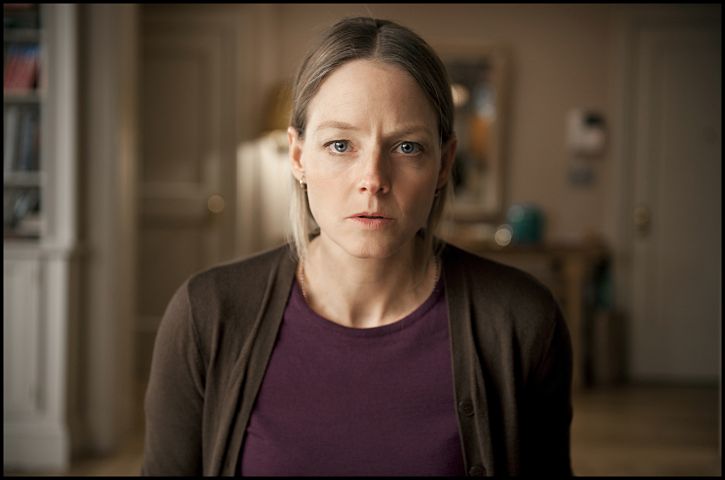
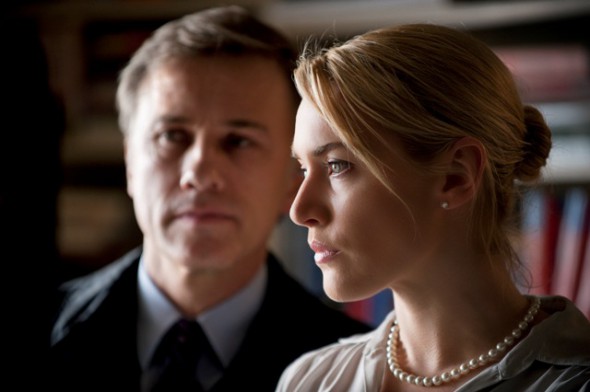
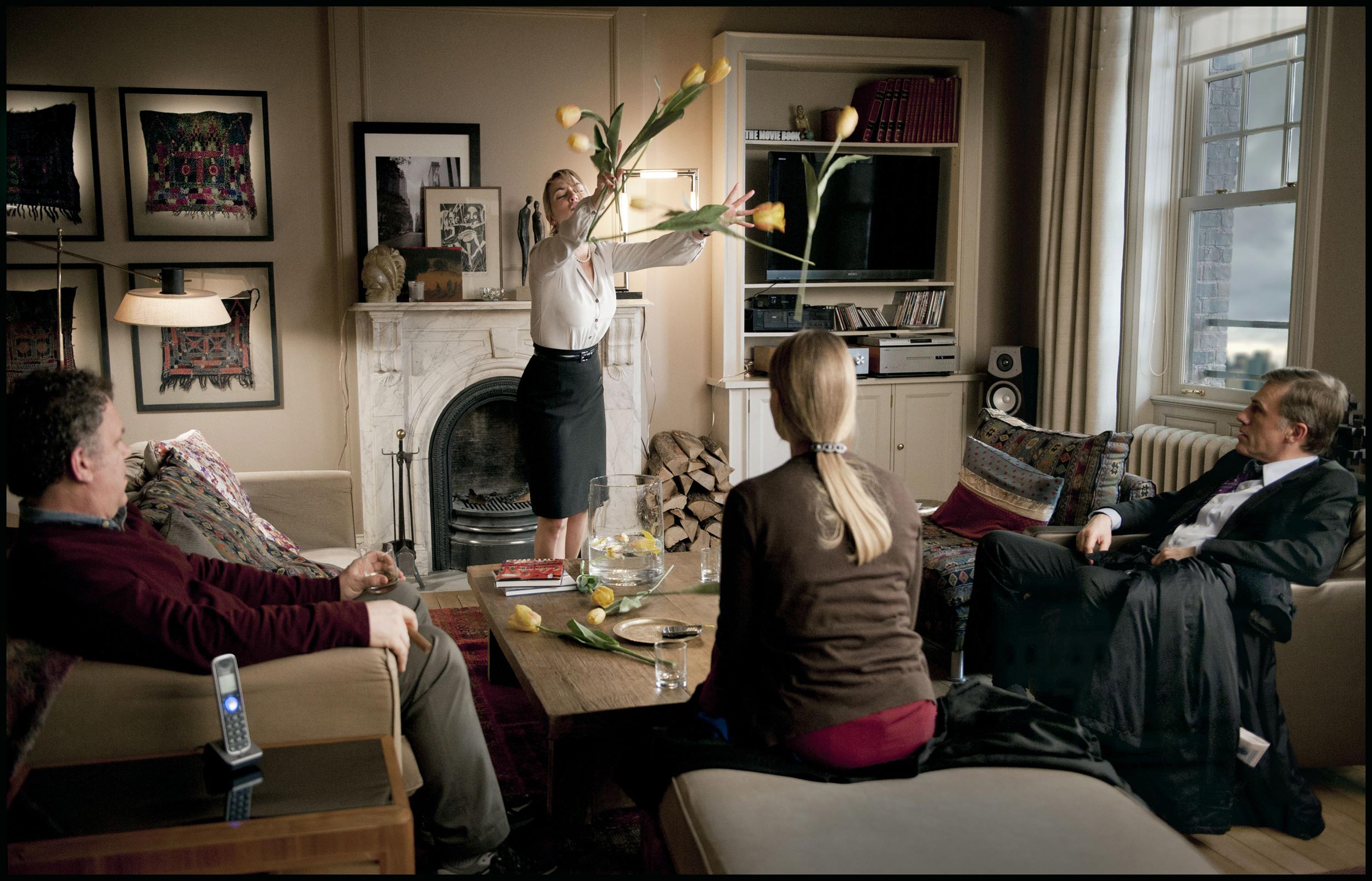
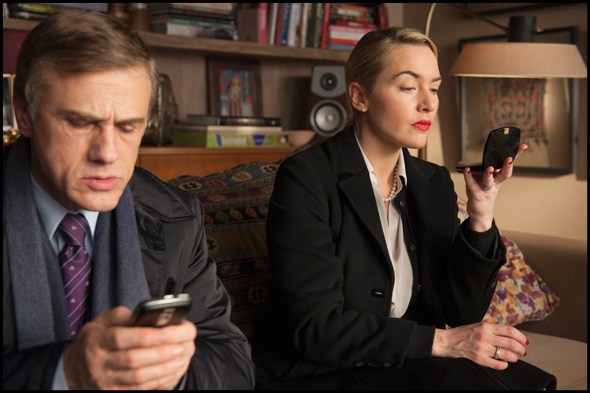
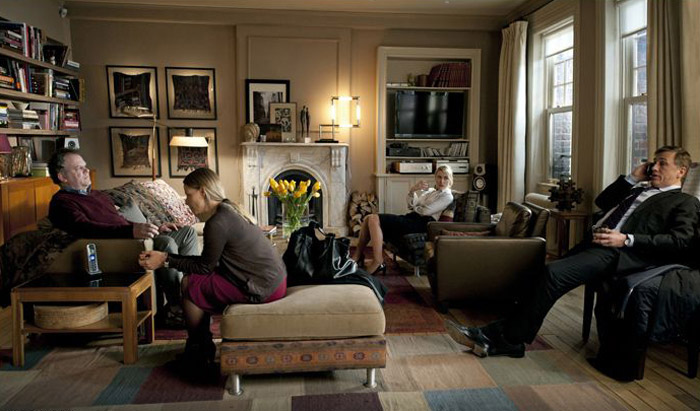
A schoolyard brawl between two kids escalates into a meeting between the parents that only proves the kids are amateurs at it in Roman Polanski's new film Carnage, based on the play by Yasmina Reza.  The meet-and-greet takes place at the New York apartment of Penelope and Michael Longstreet (Jodie Foster, John C. Reilly)— he's in hardware sales and she's an arts afficianado and rights activist, writing a book about African genocide—with Alan and Nancy Cowen (Christoph Waltz, Kate Winslet)—he's in lawyery and she frets.  It all starts well enough: cobbler is served and coffee offered, everyone's uncomfortable and on their best behavior.  But the niceties don't last any longer than the cobbler.  Penelope starts getting self-righteous, Michael, overly conciliatory, while Alan loses his laser-like focus from a series of interrupting cell-calls that from a client with a wonder-drug for high blood pressure that may have all sorts of side effects.

Then, Nancy...well, things go down-hill fast after Nancy...

It's basically a one-joke black-comedy that isn't remotely funny (the anti-punch-line comes at the end) turned up to 11 by an all-star cast and a director confined to a minimal set and probably going a little bit insane day by day.  Bear in mind that Polanski was probably giggling and encouraging extremism all through shooting, but all these terrific actors have their moments of masonry mastication—Foster coming off the worst, and Winslet the best, with Reilly and Waltz being alternately obnoxious and snaky.  Fairly soon, lines are drawn in tasteful carpets and there's a constant tying and untying of boundaries and bonds, that fall along lines of sex, politics and whatever the last subject talked about was. 

There are histrionics galore, and while there are no real baring of souls, there are all sorts of baring of inhibitions and not in the fun way.  These people seem to have absolutely no sense of decorum or restraint or any illusions that their opinions might not be the most pertinent to the proceedings.  It's all out there, vomited at projectile force and with no dolby/no squelch.  That would appear to be the comedy of it, but unfortunately it comes off a little forced and a little unrealistic.  It doesn't matter how set in their ways and high-strung these people are, at some point there is going to be re-assessment and back-pedaling, even if the trajectory is straight down-hill.

Not in this self-contained universe.  There is no tentativeness here, no sticking the toes in to test the waters, everybody belly-flops into the pool from the high-minded-board.  Even "Who's Afraid of Virginia Woolf?" is subtle by comparison, although there are some nice behavioral touches, like Penelope raising her level of discussion to an obviously uncomfortable volume to drown out Alan's phone-call.  Common sense is forgotten along with the kids argument and everything degenrates to a tag-team grudge match between and among the couples.

Ultimately, it's a bad night out that you want to forget about in the morning.

Carnage is a Rental.

Friday, September 30, 2011

Contagion

"Night of the Coughing Superstars"
or
"Please Wash Your Hands Before Exiting the Theater"

It's not nice to fool Mother Nature.  Or even to crowd The Bitch.  Because, sooner or later, she's going to look at all that nice smooth asphalt we've laid across her, and send up some crab-grass to seek out the weak spots and crack it.

"How do you like them pot-holes, Ozymandias?"*

Steven Soderbergh's "pandepic" Contagion fits quite well in the movie medical chest that includes such plague-filled films as Panic in the Streets, The Satan Bug, and The Andromeda Strain (one could also mention "The Stand," I Am Legend and the recent Rise of the Planet of the Apes—even, if we're talking Gaia's uprising, such natural disasters as The Happening (2008) and The Birds)—an organized, technologically advanced, scientifically-disciplined infrastructure is helpless against a simple organism that spreads through the sheer inevitability of exponentiality.**  It also cross-germinates into the "Butterfly Effect" genre (see Babel, 21 Grams, Crash)—you know, where we're all so interconnected that if a butterfly sneezes in China, we'd better cover our mouths in the United States or else we'll keel over into the Stone Age.***  And with so many stars (all very good, actually), it also reminds of one of those Irwin Allen SAG-slaughter disaster movies of the 1970's, that featured tag-lines like: "Who Will Survive?"

Contagion comes a few years after the majority of us could dismiss SARS and H1N1 in the real world with a blithe "where's the pandemic?" (completely dismissing such very real threats as AIDS and the hair-trigger Ebola and Marburg viruses).****  But, it is chilling that with all our research capabilities, we'd still be running behind any new threat, simply because the little suckers can evolve faster in the gut than we can be creationists in the lab.  And Scott Z. Burns (who wrote Soderbergh's The Informant! and is updating "The Man from U.N.C.L.E." for him) has taken an...er...clinical approach with his screenplay, starting moments after "first contact," following the progress of the disease from China, to the United states, its spread and detection by the Center for Disease Control and their efforts to isolate the cause, and, possibly, find a cure.  However fast they go (and it's a process hampered by testing schedules and production runs...and which pharmaceutical companies will profit from it), it's not enough to prevent wide-spread death and a near-collapse of societal structures throughout the world.  "It's figuring us out faster than we're figuring it out," says one of the techs (Jennifer Ehle) to her boss at CDC (Laurence Fishburne)...and it doesn't have a bureacracy to work through.  The drama is situational, so don't go in expecting ambulance chases and LED countdowns to disaster, but situations where families are ripped apart, investigators become victims, and desperation becomes just another symptom.  It's a procedural with a widely-flung spray pattern.

The cast is amazing...Matt Damon, Gwyneth Paltrow, Jude Law, Fishburne, Marion Cotillard, Kate Winslet...and just when you think they've run out of actors, up turns John Hawkes, Elliott Gould, Demetri Martin, and Bryan Cranston...you half-expect the full cast of Ocean's 13 to show up and cough out cameos.  No one dominates, everybody underplays, and the heroics are human and low-key. 

Nicely done, and food for thought, just wash your hands before eating.

Now, if you'll excuse me, I have a 2:00pm appointment for a flu shot.

Contagion is a...*cough*...Matinee. 

* "Ozymandias" by Percy Bysshe Shelley

I met a traveller from an antique land
Who said: `Two vast and trunkless legs of stone
Stand in the desert... Near them, on the sand,
Half sunk, a shattered visage lies, whose frown,
And wrinkled lip, and sneer of cold command,
Tell that its sculptor well those passions read
Which yet survive, stamped on these lifeless things,
The hand that mocked them and the heart that fed.
And on the pedestal these words appear --
"My name is Ozymandias, king of kings:
Look on my works, ye Mighty, and despair!"
Nothing beside remains. Round the decay
Of that colossal wreck, boundless and bare
The lone and level sands stretch far away.'


** We could also mention "The War of the Worlds," but there, the bugs are the good guys.

*** A better example would be: "If Greece doesn't raise its debt-ceiling, should I rollover my 401k into doubloons?"

**** And yesterday, I heard people are dying from Listeria-infected cantaloupes! 

Saturday, February 21, 2009

The Reader

"Thus Conscience Doth Make Cowards of Us All"

I'm quoting Shakespeare, so obviously this is a very "serious", and "important" film. But just to raise the hackles of any Weinstein Co. "readers" out there, here's a snarky little blanket quote to start things off:

Take "
The Summer of '42" and strip all the fun out of it and you have "The Reader."

No, really.
You've got the moony kid, but instead of 40's Nantucket, move it to early 60's Berlin. Instead of said moony kid having friends who provide the comedy relief, this kid is absolutely friendless, so there is no comedy or relief to be found, and instead of the lovely nubile widow-to-be showing him the ways of the world, you have the dour, nubile former SS-guard showing him just about every position in the book (I counted).

Still, I saw "
The Reader" with a nearly sold-out crowd, possibly because it's nearing the end of its run in theaters, but also because Kate Winslet is nominated for an Oscar for it (and is most likely to win).* Stephen Daldry's previous film was "The Hours," and this shares that film's chilly demeanor, and emotional opaqueness. But where "The Hours" resonated over several story-lines to come to a dramatically satisfying conclusion, "The Reader" moves along its clear-cut path, as the principles age, but seem not to mature. One would think that wisdom would creep into any of these creatures at some point, but it is not to be found. One is left to sit in frustration while actions are carried out—or more specifically, not carried out—despite some ample history lessons contained therein teaching the folly of such a philosophy. Relationships do not alter, although a lifetime of experience may be contained within the boundaries of them. And finally, the film makes a mockery of the word "responsible."

One comes away impressed by a line of dialogue every once in a while (
David Hare wrote the script), the period detail seems right, the performances are "correct" (as they both play different ages of the same character, they seem to have found a perfect actor in David Kross who can match Ralph Fiennes for miserableness), but ultimately it's all for naught. This is a film without lesson, without moral, rightly or wrongly, but insists on trying to instill some shred of sympathy for a person responsible for inhuman behavior, based on their shame of a condition that they have the power to change at any time. What a waste.

"The Reader" is a dreary Rental.

* Man, you can get cynical with this, but the part has everything: the character is sympathetic/unsympathetic; has an affliction (illiterate, so no appliance-work, or physical moods to use) and a role that requires a lot of de-glamming make-up, as the character is required to age from 40 to 80. I tell ya, it's got everything to grab the gold...and then there's
this YouTube video, that refers to this YouTube video.

Saturday, February 14, 2009

All the King's Men (2006)

"All The King's Men" (Steven Zaillian, 2006) The story goes that Robert Rossen, the director of the 1949 version of "All the King's Men" was not happy with his film. Too long, too talky, and too boring, Rossen was unsure of what to cut to get it down to length. A plan was drawn up: he told his editor to take 30 seconds from the beginnings of scenes and 30 seconds from the end. What was left came in under two hours of running time and moved at a jarring pace, but it won Oscars for its star Broderick Crawford, Best Supporting Actress Mercedes McCambridge...and Best Picture.

"
All the King's Men" was already a great film, but there were too many compromises to the Hays Code to get it to the screen. Steve Zaillian (a fine screenwriter, who directed a favorite film of mine "Searching for Bobby Fischer") decided to make a new film of Robert Penn Warren's Pulitzer Prize winning book, and sadly, wasted the opportunity in a film convinced of its own importance.*

From the crack of thunder that appears before the opening credits, to the thudding
James Horner score that telegraphs (with hammers) each imminent plot-point (Horner uses one dirge-like theme which, by its third appearance, I had assigned lyrics "This-is-a-sad-sto-ry/A-bout Lou-i-si-an-na"), to the subdued lighting and the art design in shades of "Godfather" mordant, everything about this movie promises great portent, but merely meanders through its story of how nothing born of corruption can come to any good, be it man, ideals or building materials.

It's a frustrating film to sit through, because the pieces are there given a less respectful (as in funeral respect) presentation. The cast is impressive.
Kate Winslet and Mark Ruffalo and Anthony Hopkins play the well-to-do Stanton clan. Kathy Baker and Jude Law are the blighted Burden clan, and Sean Penn, looking more and more like an young George C. Scott, plays the fictional surrogate of Huey Long, Willie Stark. As his flaks and flunkies, James Gandolfini, Patricia Clarkson and Jackie Earle Haley.

Good cast. But there are problems.
Penn, as he is wont to do, goes over-the-top in his speechifying, his arms waiving wildly in the air, his fingers doing filigreed dances. Where Penn got the inspiration to play it this way is a mystery, as footage of Long in speech-mode (below) shows him much more in control. Not even Adolph Hitler emotes this much. Jude Law, never the strongest of actors, falls into the dreariness of the film, staring at the other actors or nothing-in-particular with sad doe-like eyes.** One suspects editing problems with this film—Zaillian did spend an inordinate amount of time in post-production on it. Subjects are brought up and dropped, like Stark's football-playing son, who figures prominently in the '48 film, is mentioned here and then never heard from again.*** We never do find out how Burden's mother acquires facts to make an accusation against him. Mark Ruffalo's character is left as a dissatisfying enigma.

What we do get is ponderous, and pretentious. Zaillian spends a lot of screen-time trying to show (visually) that the only thing that could unite the "hicks" and gentry of Louisiana is death. Again, that same lesson had been told in better films.


* Given the awards-history of the cast and screenwriter it was assumed that "All The King's Men" would be a top contender come Oscar-season, but its poor box-office reception scuttled those hopes.
** K (who likes Law) kept yelling out "accent-drop!" whenever his "Lawsiana" draw-el moved to Market Street. Anthony Hopkins, the sly old dog, doesn't even try.

*** Sadly, Zaillian, in an attempt to simplify his film, gutted some crucial scenes from it including the sub-plot about Stark's son, and an extended ending that provides the best scenes for Jude Law and Jackie Earle Haley.

Tuesday, January 22, 2008

Little Children


"Little Children" (Todd Field, 2006) One I've been wanting to see but avoiding. Again, bad decision. Todd Field has the spirit of Kubrick in him (Field, as an actor, worked on "Eyes Wide Shut" and Kubrick subjected him to "the drill" about his first film, "In the Bedroom"--"Why do you want to make that? What can you bring to it? How can you tell your story more compellingly? Is it worth doing, though?")--but Fields, is a far looser director, and with a much more sure sense of humor, though it was missing in "Bedroom." That razor-like humor helps in this story of a neighborhood not coping well with a convicted sex offender in their midst (he's a flasher). Everyone is on the critical edge of everyday panic and with an aversion to complacency, so everyone seems determined to see how far they can push the envelope before things come crashing around their ears. There is an air of clinical observation to the film that is cruel and humorous, though, for the characters portrayed, everything is of deadly earnest and has complex consequences. And its use of Will Lyman is brilliant. Uniformly the cast is excellent with Kate Winslet, Patrick Wilson (he had the least showy role in HBO's "Angels in America" as the closeted conservative), Jennifer Connelly (restrained and never better), and particularly Jackie Earle Haley as the flasher. Absent from movies for years, Haley now has a cadaverous look like he's being consumed from the inside, and his beady-eyed pressurized work keeps you on pins and needles. He and Winslet received the lion's share of accolades at awards-time last year, but the film itself should have received more attention...certainly more than "The Departed" did. Todd Field is a guy to watch.