 For Want of a Nail....
or
The Sound of Slamming Chadors
With all the talk about Iran's nuclear capabilities, here's a brilliant film about Iran's equally volatile nuclear families.
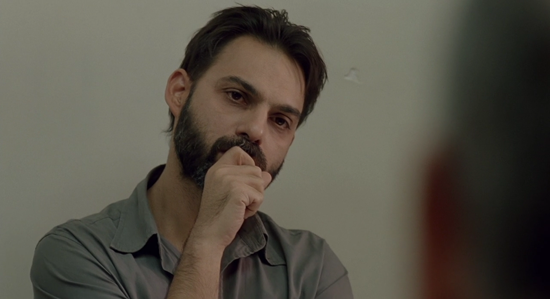
It begins as Nader (Peyman Moadi) and Simin (Leila Hatami) are petitioning for a divorce, bickering over the issues that are causing the rift. Simin wants to leave the country, and finally has the opportunity to do so within a 40 day time-limit. She wants Nader and their daughter Termeh (Sarina Farhadi) to come with her, but he will not—he is chief caretaker for his father, suffering from Alzheimer's, and he will not give up his responsibilities, and as the head of the household, he will not let the daughter leave, either. And yet the whole point of Simin trying to get them out of the country is for Termeh to have a better chance at life, without the bitter subjugation of women and the yoke of Sharia law...not that she can say that in court (of course).
It's a case of "He said/She said" that plays out with complications, obfuscations, deflections, feints, irrelevancies, and opinions posing as facts, and no choices about anything. They have reached an impasse—she wants them to leave, and he feels he can't leave—and so petitioning for divorce is the only way for her to leave, but she must do so without the daughter. He won't let the daughter go, as long as he needs help taking care of Dad, and so...hence, the petition for a divorce.
The scene is played in a long (but complicatedly acted) two-shot of the couple facing the camera explaining the situation, bickering back and forth and pleading their case before an unseen magistrate...or uncaring bureaucrat...and, owing to the camera position, us, putting the audience in the uncomfortable position of sharing that man's perspective. We're hearing all of this for the first time (as is he) and as the mire they're in increases, one wonders how it could possibly be resolved, even if, to the magistrate, it is "a small problem," insufficient to grant a divorce, but enough for the couple to take the matter into their own hands for A Separation (or جدایی نادر از سیمین , or Jodái-e Náder az Simin, or "The Separation of Nader from Simin").
That act complicates things further: Nader has to work, Termeh attends school, and Simin's absence leaves Dad alone and unmanaged for a dangerous amount of time. Simin suggests hiring a care-taker, and they hire Razieh (Sareh Bayat)—poor, pregnant, with six year old daughter in tow, and working without her unemployed husband's permission (he's played, in a tough role to make sympathetic, by Shahab Hosseini)—who, before long, is overwhelmed with her duties, but must continue with them to provide for her family.
Now, bear in mind, I've just described the first fifteen minutes of the movie, which twists and turns into more complications, altercations, and incarcerations, in what seem to be an insolvable cluster of traps within traps involving duty and responsibility, ideology over practicality, patriarchal authority over common sense, and the inexorable demand of law to tidy things up by whatever means seems to be easier and more expeditious at that moment in time, with the volume and volubility increasing over time until the tension is ready to be snapped by anything, like the upsettlingly loud violence suggested by the sound of Nader and Simin's rattlingly concussive front door. If this were a comedy, it would be one of the "incredible mess" variety, where everything collapses of its own weight and complexity, and only when those affected from it emerge, dusty and disheveled and with nothing left to lose, does the madness of the situation become apparent to them.
But, this isn't a comedy. It feels like real life, whether Persian or American, and makes one realize that there's more in common than what separates the two countries, and the whole thing plays out like an expansion of that first scene—unsolvable, intractable, frustrating—not a vicious circle, but a vicious triangulation...with very sharp damaging points.
And it's not a comedy because no one, not anybody, comes to their senses.
It's the stuff of great drama, even tragedy, and were it to originate in the U.S., it might be subject to the dramaturgy that always makes me want to put my head in my hands and burble (half-jokingly) "why doesn't everybody just get a good night's sleep?" But, the thought never crosses the mind watching this understated, deceptively low-key presentation, subtly and artfully processing the hysterics of the situation, and channelling it into Art. It's devastating. And A Separation is right up there with The Tree of Life and The Descendants as one of my favorite films of the year—each taking on the subject of (as Warren Beatty, of all people, described it) "the sanctity of Family" and finding distinct ways to present it.
A Separation is a Full-Price Ticket.
Wednesday, March 14, 2012
A Separation




Tuesday, March 6, 2012
Boomerang! (1947)
 Boomerang! (Elia Kazan, 1947) Not to be confused with the Eddie Murphy vanity project made 45 years later. No, this one is an Elia Kazan film when he was still learning the ropes in film-making and experimenting with what he could do. This one was shot on location in a semi-documentary style and based on a Reader's Digest article (written by the author of The Greatest Story Ever Told and the book the film Boy's Town was based on) about a true incident involving a murdered priest, a vagrant scapegoated for the crime after a public outrage, and a prosecutor ethical enough to not follow "procedure."
Boomerang! tells the story of the murder in Connecticut of a popular minister, gunned down in the street on a pleasant evening. There are many witnesses, but the description—medium-build man in a dark coat and light hat—creates few helpful leads. But, the public outcry for "justice" (or something like it), considering the slow speed of the investigation, fueled by an ambitious newspaper publisher, puts government officials in panic mode, and the resulting pressure on the police department—chief investigator played by Lee J. Cobb—creates too many suspects and the arrest of a drifter (Arthur Kennedy) who protests his innocence.


When the District Attorney (Dana Andrews) goes over the facts of the case for trial, he is unconvinced, but instead of doing the politically expedient thing—try the case on the flimsy evidence anyway and mollify the city—he decides to present the facts of the case as he sees them, in effect shouldering the roles of both prosecutor and defense, attempting to prove that the defendant could not actually have committed the crime.
+3.jpg)
It's an unusual chapter in jurisprudence, but, in reality, it's how the process should work. The norm is for the culprit (alleged) to be in the dock and the prosecutor makes the case, presents the evidence, states the facts of what happened. The defense must refute or explain. But, even if the prosecutor doesn't stand behind the facts, it's only for political reasons, laziness, ego, or protecting his job that would compel the P.A. to go ahead with a flimsy case. By rights, such a case shouldn't even be brought forth, wasting court costs and time. It's only because of the incorruptibility of this D.A. that events unfolded as they did and in a way, demonstrated in court, that paralleled the risks the official was taking in his efforts.
Kazan seems an unlikely director for the project—his penchant for heightened drama only displayed in the citizen's cries for justice, if only trumped-up justice. But, as produced by Darryl Zanuck (for whom story was everything), Kazan takes a docu-drama approach, taking it to the streets, as he would throughout his work in the '50's, emphasizing the grit, even in the well-scrubbed and groomed city-squares of Connecticut. And Kazan assembled a low-key group of character actors—Andrews, Cobb, Karl Malden, Sam Levene, Ed Begley, Kennedy—to underplay the drama. Only Jane Wyatt betrays any genteel theatricality. It ain't noir—too many foot-candles—and it's not cinema verite, as in the style of some of the Fox pot-boilers of this type. No, this one's set on "simmer," but it's a good preamble to the director's work as he transitioned from theater, outside into the real world.
Friday, August 12, 2011
Justify My Shitty Taste: Don't Hate, Hate Hate Me Because I Like Crash
Mike Lippert of the much-read movie blog "You Talking to Me?" is having a blog-a-thon—one of those community drum-circles, where we pound on a theme and and listen to the echoes it creates. I don't participate very often in these, but when something inspires a surge in heart-beats, I plunge in. This time, the theme is "Justify Your Shitty Taste:" find a movie that has been given short-shrift and explain why you like it—defend yourself and your contrary opinion. Well, I had a piece in the hopper that I wrote years ago to a film that has had its share of acclaim—even winning Best Picture at the Oscars—but meets with such condescending sneers every time it gets mentioned in "movie circles" that I've always felt the need to defend it—up to a point...and then I give up. There's only so many times you can hit your head against a brick wall without doing damage to your own exquisite taste (that was written with sarcasm, btw). Here, from the depths of my ignorance (and my ever-growing "Draft" pile) is my justification of Crash.
 Hello, my name is Yojimbo, and I like Crash (Paul Haggis, 2004).
("Hi, Yojimbo")
It's really funny...really funny, to the point of out-loud chuckles...the extreme reactions Crash gets from its many, many detractors. When Jim Emerson mentioned it as one of his least favorite movies (he has, in the past, listed it as one of his "sociopathic barbarites")* in a recent blog post, the comments section went up in arms with lemming-like ferocity. "I HATE HATE HATE Crash!" yelled (caps indicative) one of the comments.**
I don't. I like it. With the same rictus smile that I appreciate other cynical films. And the more extreme the reaction to it, the more I smile, because it only drives home the film's point further, and exposes it as true.
Now, some (but only some) of the hatred of Crash comes from folks who consider Crash the usurper that took the "Best Picture" Oscar from *sigh* Brokeback Mountain (as if the Oscars are ever truly the indicator of quality). Now, I didn't mind "Brokeback"--there was much to admire--the stunning cinematography, Larry McMurtry and Diana Ossana's cruel, no-holds-barred/no-feelings-spared screenplay, and Heath Ledger's performance--someone finally captured the essence of the archetypal head-strong, mumbling western dude (and the guy was Australian, fer cryin' out loud!). Plus, there was something altogether shattering about his memorial to his lost love, in lieu of grave-stone. But, there was nothing in Brokeback Mountain that hasn't been done in every sudsy straight soap of the last eighty years. Nathan Lee of the Village Voice put it far better than I: Ann Proulx's bitter post-Oscar diatribe has a lot of empty fire to it, but, c'mon, honey, you were borrowing Faulkner's pen and you know it. And for anyone who thinks gay cowboys are revolutionary, skip right over the Village People and Jon Voigt for a moment and go directly to Red River. Howard Hawks knew it. Lenny Bruce knew it. Montgomery Clift, no doubt, knew it.
But Crash is the better movie. Crash is the subtler movie, believe it or not. Crash deserved that Best Picture Oscar, because it pulled off a great trick: it pissed off a lot of people, only proving its point.
Let me just say one thing about Crash: It's not "about" racism.
Yes, yes, I know, racism is all over the thing, morally repugnant, down and dirty, pig-ignorant racism. From all sides, and all races. And if racism was all it was about, yeah, some of the hatred for the film might have a point, because all the movie does is say "racism exists, and there's nothing you can do about it," which doesn't make it the Feel-Good Movie of the Year. If it was only about racism, then it would truly be committing that great movie sin "exemplifying what it rails against" like, say, Rollerball that says violence is a terrible thing and then rubs your nose in it for two hours. Or an "anti-war" movie--that relishes its battle sequences. If it were so, 'twas a grievous fault.
But Crash is not just about racism. Racism is a symptom in it, but it's not the "end-all, be-all."Myopia is. The denizens of Crash are all folks (with very few significant exceptions) who've got it all figured out. Entrenched in their lives, in their jobs, in their bureaucracies, they think they've seen it all and they act appropriately. We've seen their type in movies before. Like Bogart's Richard Blaine in Casablanca who "sticks (his) neck out for nobody." Or Jack Nicholson's J.J. Gittes in Chinatown,*** who when asked what he did as a cop down there replies "as little as possible." They're not people of color, they're all gray, walking around with blinders on (which is why the movie's called Crash and not, say, Clash.) They all know "the score" and so they've stopped thinking. They live their cloistered, blindered lives in the grids of L.A. in their own little boxes of assumptions and none of them will try to see beyond them. They are numb to the world, and the cultural clashes are battles over turf, amplified rhetoric and action so (as Don Cheadle—who also produced the film—playing Detective Graham Waters says in the opening line of dialogue) "they can feel something."
Except...except. Haggis has been accused of manipulation (and like, duh, all movies are manipulative, hate to break it to you) but the most egregious examples are the pretty obvious incident of the "invisible cloak." I think every viewer above a third grade education knew what was coming--the kid was going to get "whacked" with her invisible cloak, because, hey, we're all cynics, and the movie has been pretty cynical up to that point--actually the characters IN the movie have been pretty cynical. But not the kid. In an altruistic, completely naive and childlike way, the kid goes beyond what any of the adults would do and makes a sacrifice to save her father. We all assume that to her doom, and Haggis milks the anguish, and delays the inevitable reveal. The kid's not dead. Why? Because the daughter of the angry shop-keeper has also thought outside the box, and bought her old man blank cartridges. Both those individuals have gone beyond the "I stick my neck out for nobody" syndrome, and the synchronicity has pulled off a miracle, or at least, prevented a tragedy, brought on by short-sightedness.
Myopia is all over the movie--even when racism isn't. Because there's more than racism going on. It's blacks against whites, whites against blacks, cops against civilians, politicians against the cops, the bureaucrats against the trench-fighters, upper class against lower class, and the reciprocal vice-versa. Myopia is ever-present, and everybody stops thinking when they reach their assumptions...and look no further. The insurance worker thinks the guy on the line is a dead-beat, the guy on the line thinks she's a bitchy negro. They both have drawn lines in the sand and will go no further. Matt Dillon's bad cop just assumes all the minorities are scum, so he treats them accordingly. Ryan Phillippe's good cop takes the high road and assumes he'll never act like that in any given circumstances. They're both short-sighted fools. And they won't consider any other possibility. They're two sides of the same coin.
For me, Crash plays like a post-modern film-noir, where the world is crummy, people are tarnished (whether they're rich or poor), but there is no "slumming angel" (as Ross McDonald put it) to try and make things temporarily right—all the characters in Crash have that ability if they choose, if they will, and there is no hand-holding narrator or Stage Manager bringing perspective, merely the dispassionate view from on high. The good that people do are mere slats of light in an all-enveloping darkness, not unlike the the noir's traditional backdrop, the venetian blind, or as the de-focused headlights in the film's credit sequence.
Another criticism: Too many coincidences in Crash? Yep, but that's to be expected with an ensemble cast in a limited area whether it's La Ronde, or Grand Hotel, or even...the acclaimed Babel where the coincidences are hemispheres apart (those butterflies are mighty powerful!). But Crash isn't like any of these films. The one I compare it to, both in tenor and reaction is The Rules of the Game, Jean Renoir's condemnation of pre-WWII French society going to its ruin in selfishness and self-involvement. French folk hated The Rules of the Game, too. In fact, riots broke out in theaters, and to try and save his investment Renoir kept cutting it and cutting it to try to assuage the angry mob. As a result, after the war when the hysteria died down, it was difficult to find an unexpurgated version of The Rules of the Game until...1958. The tyranny of the mob had done its damage and its only by the luck and a little hard work that a longer copy of this classic exists. Fortunately Crash hasn't had to go that far. Maybe people are just more passive-aggressive these days, content to HATE HATE HATE in the relative anonymity of a bogus screen-name--like, say, "Yojimbo_5." Maybe that's progress.
So, if I'm in a crowd of people and Crash comes up, and folks get angry about it because it's "about" racism but doesn't "do" anything about it (I suppose a cameo by Rodney King might help...?), I don't say anything. It won't do any good. Folks have already made up their minds about Crash and if I try to point out they might be wrong and consider that possibility...no, no, that won't happen. Their thoughts stop at "racism" and go no further, thus proving the movie's point all over again, and proving, once again, why it's such a good film.
Ultimately it's a tough and pointless duty to watch a film with blinders on. It's no way to see a film, and it's no way to lead a life...as Crash, for all its flaws, so ably demonstrates.
* ...which is a far cry from what he wrote in 2006: "As restrictive as the rules of this cycle may be, “Crash” still manages to be an unusually mechanical instance of it. With numbing predictability, every positive character is revealed to have a negative side (the good, tolerant cop, played by Ryan Phillippe, commits an impulsive, racially-triggered murder), while ever negative character is revealed to have his or her positive (the racist cop, played by Matt Dillon, risks his life to save a black woman trapped in a wrecked car). Just about everyone is an instinctive racist, and just about everyone is a victim of racism, who learns his or her lesson when the tables are turned. Haggis piles up the coincidences that bring his characters together without shame or the slightest restraint; he seems to feel that by emphasizing the contrivances of his plotting, he is in fact revealing a hidden pattern, a secret will, that organizes the world. Turning bad writing into a metaphysical principle is indeed an accomplishment, and one that might well deserve an award – though Best Picture of 2005 is going a bit too far."
From this to "sociopathic barbarity" is quite the change of opinion. The above is reasoned analysis. The latter is just hectoring screed. Hating Crash became easier and more comfortable, then racheted up to the extreme. Now, what was Crash saying again?
Emerson does this at times—I'll be shocked if there is ever a Christopher Nolan film that he will praise, rather than merely dismiss it, and he condemned Clint Eastwood's Flags of Our Fathers (without even seeing it) merely because Haggis had a hand in the screenplay—to his credit, after actually seeing it, he praised it. This may sound like bashing the man, but Emerson's is a great voice in film criticism, and I love reading his output, whether I agree with it or not. His is an essential voice in the understanding of the mechanics of how film can touch the eye and the brain and move the heart. If he ever stops writing, I will mourn that day.
** Which reminds me of the George Clooney retort to the web-site that said he was "GAY GAY GAY:" "Two GAY's, maybe, but the third's a little extreme."
*** Chinatown also makes a point of using prejudice, not just racial, but class prejudice, as a distinctive example of reactive, rather than thinking, behavior.


Thursday, June 16, 2011
Witness for the Prosecution (1957)
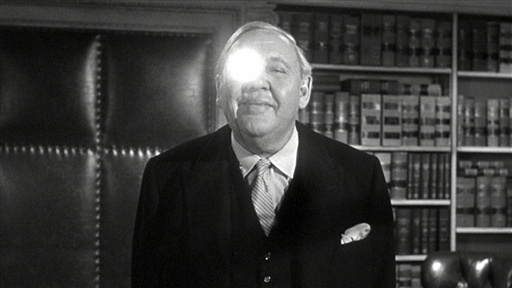
 Witness for the Prosecution (Billy Wilder, 1957) Lady Justice is having some work done as we first approach "The Old Bailey," where the majority of the drama for Witness for the Prosecution takes place. Good thing, too, although some attention should probably be paid to the legal loop-holes that keep cropping up inside the chambers. This Agatha Christie-penned theater chestnut is given a nice presentation by Wilder, who has added much comic-relief in the form of giving brilliant barrister Sir Wilfrid Robarts, QC (Charles Laughton), a nurse after a debillitating heart-arttack (played by Laughton's wife, Elsa Lanchester).*
It was the third re-write of the story in as many adaptations, starting with Christie adding a justifiable coda to her original story for the theater adptation, and Wilder providing further complications in order to have Lanchester's presence, and giving Marlene Dietrich a song and a romantic scene with Tyrone Power in flashback (although both actors can't really pull off playing young at this point in their careers).
And that's an interesting point: the acting is what this one is all about. This is Power's last completed film, and his anguished defendent is an interesting mix of distraught agitation and Big Studio Heart-throb mannerisms. Laughton's performance is hilarious and dry as vermouth, while Lanchester fusses and kvetches.
And Dietrich is as cool as can be. Quite past her prime as a fascinating beauty, she is still fascinating, playing her Christine Vole as cold and aloof—Dietrich excelled at that, but with a simmering quality underneath the surface, especially in her work with Joseph von Sternberg, like an iceberg with a volcano at its heart. She always was just on the edge of camp-sexiness,** but the heavy lidded smoldering eyes always had an air of superiority that were deadly serious. And those eyes are still in play here, never revealing much, and keeping the characters and the audience off-guard...and then on, especially when she turns on the dramatic fire-works in the latter stages of the film.
Laughton and Lanchester were given Oscar nominations for their performances,*** but I'd make a case that Dietrich was robbed of a nomination—maybe because of the stunt-casting, the nature of the part, but also...maybe...because they didn't recognize how good she is.
* Er...she plays the nurse, not the heart attack...
** Her mannerisms were devastatingly lampooned by Madeleine Kahn in Blazing Saddles.
*** He lost to Alec Guinness for The Bridge on the River Kwai, and she to Miyoshi Umeki for Sayonara. Can't argue with the first one.


_01.jpg)


Tuesday, December 7, 2010
Easy Virtue
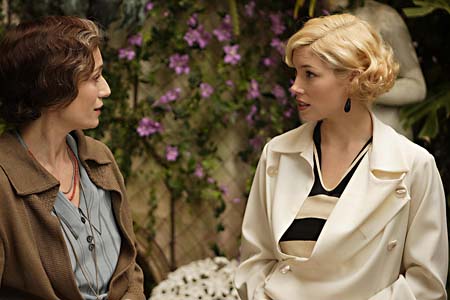
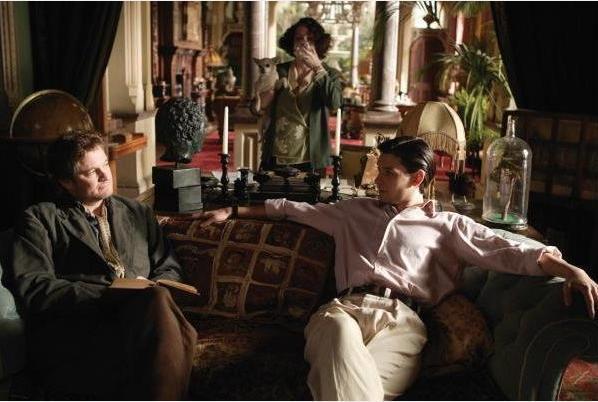
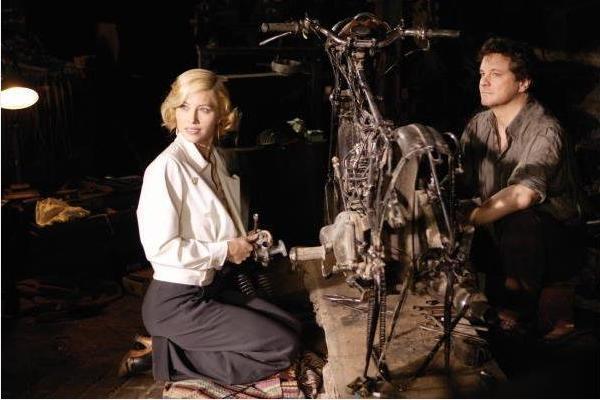
 Easy Virtue (Stephan Elliott, 2008) Okay, it may be a weak recommendation to say this may be the best performance Jessica Biel has ever given, but she holds her own in a good cast that includes Kristin Scott Thomas (as a society woman who has seen far better days) and Colin Firth (the head of the household, who has only returned bodily from WWI), who are quite bent out of their stiff upper lips that their son (Ben Barnes) has married 1) an adventuress, 2) a race-car driver, 3) a widow, and 4) an (gasp!) American—all in the form of a comely Biel.
"What am I to do with this bauble of a woman?" fusses Mrs. Whittaker. "Hang her?" says her barely-engaged husband.
The Noel Coward play has been filmed once before (by Alfred Hitchcock in 1928, during his silent era...consider that, a silent version of a Noel Coward play) and Elliott's version tries mightily to make it more hip, making Biel's Larita Whittaker more of a liberated woman, rather than just a libertine, and her inability to navigate the iceberg-laden chilly waters at the Whitaker residence (which, at their most hapless, resembles something that might appear in Meet the Parents) puts a strain on her puppy-loveish young marriage.
Try as she might to ingratiate herself into the family, it all turns perfectly horrid, with no help from her cluelessly entitled young husband (who thinks he can have it all, and can't fathom why everybody doesn't just get along). Fact is, the Whittaker estate isn't so much a home as a castle, protecting itself from the cruelty of the outside world, and only those touched by that cruelty have the grace to rise above, if they can. Larita gravitates to the unsmiling Mr. Whittaker for advice, his cynicism to keeping up appearances, coinciding with a wish she cannot fulfill for her husband's/his son's sake.
There has to be a better way, if not for the family then for herself. What else can they do to her?
Discover her secrets, maybe.
The two films diverge at this point: Hitchcock's hinges on a portrait done of Larita that colors her husband's death; Elliott's has that portrait, too (amusingly), but comes up with a more modern tragedy for Larita to cover up that wouldn't have "played" in the 20's, when Coward first wrote the play. It gives the film a depth, and distinguishes Larita from the rest of the family-members, and leads to an inevitable conclusion—Coward's way out.
A truffle; a bon-bon; a bauble. Easy Virtue has a grand time sending its message on the clash of the classes, filling it with period tunes (and ending with one out of period, but apt), and a cast making the most of Coward's words. Not one to be dismissed.



Easy_Virtue_5.jpg)







Friday, November 12, 2010
Conviction

Tony Goldwyn was an actor for many years, before turning his focus to directing. Starting with a couple of theater rom-coms, he turned to television where his work matured and focused, to the point where the camera-work disappeared and the story-teller emerged. Conviction benefits from that hard-scrabble television work, where director moves out of the way and good decisions in casting and performance shine through.
The story is "basically" true—as true as Hollywood, given time-constraints and story-focus will allow: local roustabout Ken Waters (Sam Rockwell) is arrested for the brutal murder of a woman in Ayers, Massachusettes, and his devoted sister Betty Ann (Hilary Swank), convinced of his innocence but determined to free him any way she can, works her way through law school to accomplish the task. That struggle compromises her life, her family—her dedication turns her, ironically, into the sort of part-time mother she swore she'd never be—and her resolve. But, with the new circumstance of DNA testing, she finds a flaw in the prosecution's case and pursues original evidence for examination and the back-story of the officer (Melissa Leo), determined to send her brother to prison. All very "Lifetime," except for its depiction of a hard-scrabble existence.


But, its the performances that grab your attention. Lately, I've been smirking at movie-trailers emphasizing the presence of "Academy Award Winner..." and "Academy Award Nominee..." (and Conviction's are particularly guilty of this), but this one benefits from a carefully considered cast emphasizing talent over glamor. Any movie with Rockwell in it is worth seeing, and Swank is always willing to dirty her fingernails for a role, but it is terrific to see smaller roles with great performances, for instance Leo's unflinching portrayal, and Minnie Driver (she played "Jane" to Goldwyn's "Tarzan" in the "Disney version"), as a key collaborator. Driver's been in the background for movie roles for a bit, so it's heartening to remind oneself of what a particularly gifted actress she is, full of interesting choices that take you aback. But, the standout performance is Juliette Lewis, in a small role as a former girlfriend of the brother's, whose testimony damns hims. I've never been a fan of Lewis', her early teen work seeming distraught and hectoring. But, this work, and her recent adult work, is disciplined, unsentimental, and tough. Here, she's just a gnat's eyelash for Brando-ish grand-standing, but the choices are so clever and..."out-there," that one can't imagine anyone else being as good in the role (or would, frankly, want to), and makes one anticipate what work will be forthcoming from this singular actor. It is probably too much to ask to see her name on the list of nominees for Best Supporting Actress, in a film that's full of ones that should be recognized.


Conviction is a Matinee.
 |
| The real Kenny Waters and the real Betty Ann, on the day of his release. |
Friday, October 8, 2010
The Social Network

or
"There's Somethin' Happenin' Here (What It Is Ain't Exactly Clear)"
"O wonder!
How many goodly creatures are there here!
How beautious mankind is!
O brave new world,
That has such people in't!" (The Tempest, Act V, Scene 1)
Maybe it is too early to make a movie about Facebook (out of MySpace and Friendster) and the ramifications of our Brave New World of cyber-relationships.* Maybe it is a little too "street-corner sage" to predict The End of the World As We are Sorta Familiar With it (But Not Really...More Acquaintances, Really). But, it is interesting to see a story about the Frankenstein behind the Monster, if only to see how each reflects the other.
And even though we're secretly rooting for The Monster.
And, at this point in time, there isn't a better team to make "The Social Network" than Aaron Sorkin and David Fincher. Sorkin, the mad savant behind some of the better TV shows of the past decade and a half, has always written about people and their "issues," and how personality impacts policy. Fincher has matured from an ILM tech (who was happy to fly cameras through coffee-maker grips**) to an intricate observer of societal pressures on the psyche. For the two of them to make this particular story is a Friend Invitation made in Hollywood Heaven. "Accept" it. But, you can't "Ignore" it.
The movie begins with a date going badly between Jeff Zuckerberg (Jesse Eisenberg, late of many movies with "...land" in the title) Harvard wall-flower, and Erica Albright (Rooney Mara—she'll play Lisbeth Salander opposite Daniel Craig in Fincher's big-budget version of "The Girl with the Dragon Tattoo"), an acquaintance. Anyone familiar with the machine-gun dialogue that writer Sorkin is known for, had better duck for cover—or wait for this on DVD so you can...play...it...slooooowly—for he now has an automatic weapon for a word-processor, and a co-conspirator in Eisenberg who can milk every nuance out of a line, despite hyperventilating it at debate-competition speed. His Zuckerberg is a "no Dolby/no squelch" type of unreadable conscience, and Eisenberg plays it with a deadness behind the eyes that interprets the world as a problem, if not necessarily a challenge. He's a bit too candid for a first date, and she stomps off, which sends him on a mission, simultaneously trashing her on his blog (LiveJournal) and culling the pictures of every woman on campus to create a "Who's Hotter" web-competition that becomes so popular so instantly that it crashes Harvard's web-infrastructure. He becomes both famous and infamous for the stunt, guaranteeing he'll never get a date in college, and attracting the wrath of the college's board, and the interest of two preppies attempting to create an exclusionary social network on the web. He goes them several steps better, making a system open to everyone on campus that trumps their attempts, and as it gains "friends," expands throughout the college system.
Hindsight is 20/20, and Sorkin constructs the film as a series of depositions after the fact (of Facebook's success) as everyone who thinks they've been burned by Zuckerberg testifies to his vague promises and dealings under the table. *** Of course, they have every right to sue—but they'd only sue if "The Facebook" was a success—and the underpinnings and double-dealings don't resemble a fight for satisfaction, or a Noble Quest, so much as resembling a snake eating its own tail. ****
Which brings us back to Frankenstein and his Monster. The film itself is expertly done—it is a complicated story of hidden motivations and the presentation of masks before public faces—and Sorkin and Fincher manage to navigate us through the maze of the story, even though one feels there is no cheese at the end. The experience is a bit hollow, which may be a part of the point.
Because the Facebook experience is hollow, as well. As hollow as Zuckerberg, as portrayed in this film, is. While it is nice that one has the opportunity to "re-connect" with old friends in a virtual environment and satisfy everyone's need to (as one friend commented on blogging) "talk about what you had for lunch," one wonders why one has to re-connect at all...especially if the relationship wasn't maintained in the first place. Not enough time in the world to meet? Because a "real" relationship takes time, takes effort, "gets messy?" Facebook provides the illusion of "staying in touch," without actually touching. Like Zuckerberg's abortive "date," a lot of time is spent broadcasting, but not interacting. There are, of course, exceptions. But the fact of the matter is Facebook's cyber-community is not a "Brave New World" at all. Just the opposite. It provides a substitute in lieu of commitment. A panacea in a life thought to be full to bursting and without risk. The most precious commodity we can give is time—slices of our lives and our selves. Facebook is a pacifier—a mass-Hallmark card that we can spend a few heart-beats picking out, and send away without a thought and not even sweat the cost of a stamp.
It soon becomes a numbers game—a collection, like the celebration of the 1,000,000th friend portrayed in the film. But who are those million people? Facebook doesn't know or care. It's just a number. A number of casual relationships, that may lead to something else, but probably won't. A collection, nice to look at, but more often, ignored. Trophies, and ones that don't need to be polished or buffed up.
It's a new world of blithely arrested development, in the image of its creator, where love and commitment do not compute, and the only thing close to it is "hope"—translatable as keystroke F5.
"The Social Network" is a self-fulfilling Matinee. Take a date. *****




* And by the way, Aria, Ridley Scott does bloody well "bury the lead" in "Blade Runner" by insisting that Deckard is a replicant! Nyeeeah! :P
** Except for some dodgy freezing breath-work, the biggest special effect will be invisibe to you until the closing credits. Nice.
*** Personally, I'd like to get back all those hours spent on "ZooWorld."
**** An image that kept coming to mind every time I thought of writing this review, where it would subsequently be published...on LNTAM's Facebook page.
***** You won't have to interact during it, either.
Friday, May 8, 2009
Judgment at Nuremberg
 "Judgment at Nuremberg" (Stanley Kramer, 1961) It was Katharine Hepburn who shepherded this film from its origins as an episode of "Playhouse 90" to this version as a three hour epic.* The movie is padded with shots of Spencer Tracy touring the city (still in rubble in 1960, twelve years after the judges trials at Nuremberg**), and background of the characters, including a chaste meeting of minds with a Nazi widow (Marlene Dietrich, still oozing mystery at the age of 60). Screenwriter Abby Mann makes the citizenry complicit in his expanded screenplay, despite their protestations of ignorance. And the military at the time of the trial was in the middle of the Berlin Airlift, their attention now turned to "the Bolsheviks" and cozying up to Germany for strategic advantage, casting the worth and even the result of the trial in question for political expediency. The movie is allowed much more cynicism than the Playhouse 90 broadcast, where the words "gas chambers" were subject to censorship by sponsor The American Gas Association.
The movie threatens to swamp itself with star-power but leavened it by Tracy disappearing into his role. Maximilian Schell repeats his television performance (winning an Oscar in the process, as did Mann for his adaptation). Of the newcomers, the best performances are Montgomery Clift in face and body language denoting a characters damaged by the brutality of the Nazi regime. And Judy Garland, who'd always seemed like a raw nerve in her films, acts merely from the neck up—and that's all that's required. Not as controlled are Richard Widmark, whose prosecutor is a bit too demonstrative in private for a courtroom strategist, and Burt Lancaster, given a great speech but, a weakness of the actor, aware of it. Laurence Olivier was intended to play German Ernst Janning, but dropped out. I'm not sure that would have been an improvement, but it would have been interesting.
Kramer struggles with the material; he would later become an expert on courtroom directing. But here, he's more intent on making the drama look interesting with camera moves by circling witnesses and, most egregiously, using a fast zoom to zero in on a dramatic moment. It's used sparingly, but even that's too much for the material. He would learn to trust his actors and inherent drama of the scene to carry it.
But, "Judgement at Nuremberg" manages to be something that eludes most Kramer films—it's a bit more timeless, especially in regards to the short-sightedness of chipping away at bedrock principles for today's political viability and the future's further erosion. One could be speaking of water boarding as torture in Abby Mann's summation speech.
Read it. Read the whole thing. But linger on the words after the picture below.
Judge Haywood: The trial conducted before this Tribunal began over eight months ago. The record of evidence is more than ten thousand pages long, and final arguments of counsel have been concluded.
Simple murders and atrocities do not constitute the gravamen of the charges in this indictment. Rather, the charge is that of conscious participation in a nationwide, government organized system of cruelty and injustice in violation of every moral and legal principle known to all civilized nations. The Tribunal has carefully studied the record and found therein abundant evidence to support beyond a reasonable doubt the charges against these defendants.
Herr Rolfe, in his very skillful defense, has asserted that there are others who must share the ultimate responsibility for what happened here in Germany. There is truth in this. The real complaining party at the bar in this courtroom is civilization. But the Tribunal does say that the men in the dock are responsible for their actions, men who sat in black robes in judgment on other men, men who took part in the enactment of laws and decrees, the purpose of which was the extermination of humans beings, men who in executive positions actively participated in the enforcement of these laws -- illegal even under German law. The principle of criminal law in every civilized society has this in common: Any person who sways another to commit murder, any person who furnishes the lethal weapon for the purpose of the crime, any person who is an accessory to the crime -- is guilty.
Herr Rolfe further asserts that the defendant, Janning, was an extraordinary jurist and acted in what he thought was the best interest of this country. There is truth in this also. Janning, to be sure, is a tragic figure. We believe he loathed the evil he did. But compassion for the present torture of his soul must not beget forgetfulness of the torture and the death of millions by the Government of which he was a part. Janning's record and his fate illuminate the most shattering truth that has emerged from this trial: If he and all of the other defendants had been degraded perverts, if all of the leaders of the Third Reich had been sadistic monsters and maniacs, then these events would have no more moral significance than an earthquake, or any other natural catastrophe. But this trial has shown that under a national crisis, ordinary -- even able and extraordinary -- men can delude themselves into the commission of crimes so vast and heinous that they beggar the imagination. No one who has sat at through trial can ever forget them: men sterilized because of political belief; a mockery made of friendship and faith; the murder of children. How easily it can happen.

There are those in our own country too who today speak of the "protection of country" -- of "survival." A decision must be made in the life of every nation at the very moment when the grasp of the enemy is at its throat. Then, it seems that the only way to survive is to use the means of the enemy, to rest survival upon what is expedient -- to look the other way.
Well, the answer to that is "survival as what?" A country isn't a rock. It's not an extension of one's self. It's what it stands for. It's what it stands for when standing for something is the most difficult!
Before the people of the world, let it now be noted that here, in our decision, this is what we stand for: justice, truth, and the value of a single human being.
* Probably to give her love and paramour Spencer Tracy another plumb acting role. His health (owing to his tendency to drink to excess) was always improved when he was working.
** Although shots of Richard Widmark driving through the city are obvious process shots.
Saturday, February 21, 2009
The Reader
 "Thus Conscience Doth Make Cowards of Us All"
I'm quoting Shakespeare, so obviously this is a very "serious", and "important" film. But just to raise the hackles of any Weinstein Co. "readers" out there, here's a snarky little blanket quote to start things off:
Take "The Summer of '42" and strip all the fun out of it and you have "The Reader."
No, really. You've got the moony kid, but instead of 40's Nantucket, move it to early 60's Berlin. Instead of said moony kid having friends who provide the comedy relief, this kid is absolutely friendless, so there is no comedy or relief to be found, and instead of the lovely nubile widow-to-be showing him the ways of the world, you have the dour, nubile former SS-guard showing him just about every position in the book (I counted).
Still, I saw "The Reader" with a nearly sold-out crowd, possibly because it's nearing the end of its run in theaters, but also because Kate Winslet is nominated for an Oscar for it (and is most likely to win).* Stephen Daldry's previous film was "The Hours," and this shares that film's chilly demeanor, and emotional opaqueness. But where "The Hours" resonated over several story-lines to come to a dramatically satisfying conclusion, "The Reader" moves along its clear-cut path, as the principles age, but seem not to mature. One would think that wisdom would creep into any of these creatures at some point, but it is not to be found. One is left to sit in frustration while actions are carried out—or more specifically, not carried out—despite some ample history lessons contained therein teaching the folly of such a philosophy. Relationships do not alter, although a lifetime of experience may be contained within the boundaries of them. And finally, the film makes a mockery of the word "responsible."
One comes away impressed by a line of dialogue every once in a while (David Hare wrote the script), the period detail seems right, the performances are "correct" (as they both play different ages of the same character, they seem to have found a perfect actor in David Kross who can match Ralph Fiennes for miserableness), but ultimately it's all for naught. This is a film without lesson, without moral, rightly or wrongly, but insists on trying to instill some shred of sympathy for a person responsible for inhuman behavior, based on their shame of a condition that they have the power to change at any time. What a waste.
"The Reader" is a dreary Rental.
* Man, you can get cynical with this, but the part has everything: the character is sympathetic/unsympathetic; has an affliction (illiterate, so no appliance-work, or physical moods to use) and a role that requires a lot of de-glamming make-up, as the character is required to age from 40 to 80. I tell ya, it's got everything to grab the gold...and then there's this YouTube video, that refers to this YouTube video.


