Showing posts with label Spencer Tracy. Show all posts

Wednesday, October 31, 2012

Dr. Jekyll and Mr. Hyde (Twinned)

Private Joker: I think I was trying to suggest something about the duality of man, sir. 
Pogue Colonel: The what? 
Private Joker: The duality of man. The Jungian thing, sir. 
Pogue Colonel: ...Whose side are you on, son? 
Full Metal Jacket

"(Cocaine) enhances your personality!"  "Well, what if you're an asshole!?"
Bill Cosby from Bill Cosby, Himself

Better living through chemistry?  And whose side, indeed?  This Hallowe'en season we haven't been looking at monsters, and creatures and other outside forces that threaten us and make us come face to face with horror (as we have in the past).  We've been looking at those that attack us from within.  Not at the monsters that peer at us from outside our bedroom window, but the ones that look at us indoors in our very own mirrors.  What special horror it is, when we come face to face with our enemy, and it's our own.  No better example of that came from the pen of Robert Louis Stevenson in the year 1861.

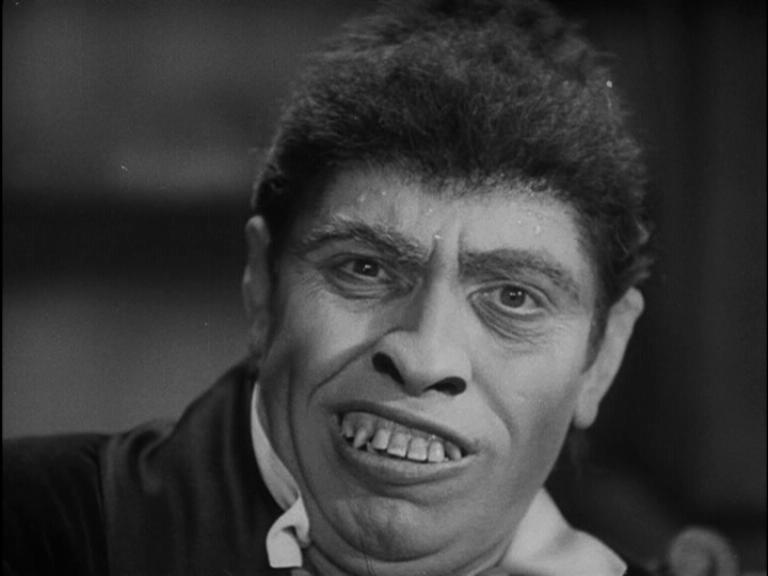
 Dr. Jekyll and Mr. Hyde (Rouben Mamoulian, 1931) A new version of Stevenson's "Strange Case of Dr. Jekyll and Mr. Hyde" seems to crop up every few years.  There've been versions with John Barrymore, Basil Rathbone, Christopher Lee, Spencer Tracy (see below), and TV versions with Jack Palance and even one with Lionel Bart musical numbers that featured Kirk Douglas.  But, this is the one people remember, for many reasons—first being Frederic March's portrayal (which won him an Oscar for Best Actor...in a Horror film, mind you), the effects, the outright sexiness of it (as the film was "Pre-Code,") and for director Mamoulian's stylish treatment—full of straight-on shots of the actors facing the audience, mirrored shots, and all the transformations, each one staged differently (and in a couple of instances using a combination of make-up that only becomes apparent in monochrome when struck by lights colored by different gels—with "Hyde" finally appearing as an ape-like creature in need of radical orthodentia.  March turns in an incredible performance (and he won an Oscar for it, the first actor to do so for a lead in a horror film—the second being Anthony Hopkins in The Silence of the Lambs), his Jekyll (pronounced Jee-kull as the Scottish Stevenson would have it) clearly conflicted but held in check and completely invisible in the form of the obstreperous Hyde, leaping over parapets and loudly enunciating (through those big false teeth) his intentions in a husked gravel.  When first confronting his new image in the mirror he cries "Free!  Free!  At last!"


Now, in Dr. Jekyll and Mr. Hyde (Victor Fleming, 1941) the Dr. Jekyll (pronounced Jeh-kull) played by Spencer Tracy, is far more considering: "So, this is evil, then"  he observes staring at his new countenance in the mirror.

Yes. Yes, it is. Tracy's Jekyll is a thinking, decent man with dark undertones, far less egocentric than the stentorian performance of March; his Hyde is shaggy dark eyebrows and hair, with a curled upper lip like a scar and a direct gaze and uncouthness, despite his pretensions of refinement.  March's Hyde is a proto-human; Tracy's is just a sadistic sociopath.  Jekyll's frustrations with his straight-laced potential father-in-law (Halliwell Hobbs in the first, Donald Crisp in the latter) are buried deep and Hyde releases that pent-up rage.  In the Tracy version, the intelligence is still there (as opposed to March's gleeful monkey-man) but used malevolently—the words are erudite and evenly spoken, but his actions are quick-silver and savage.  


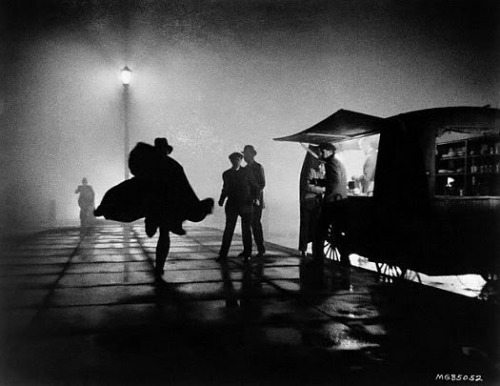
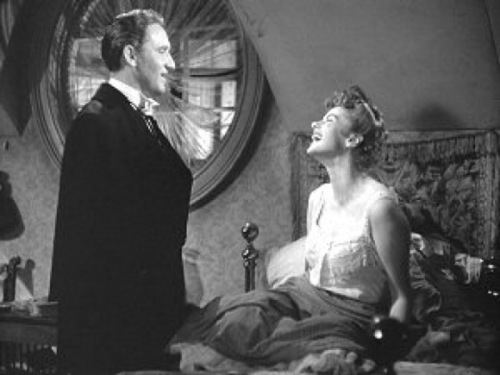
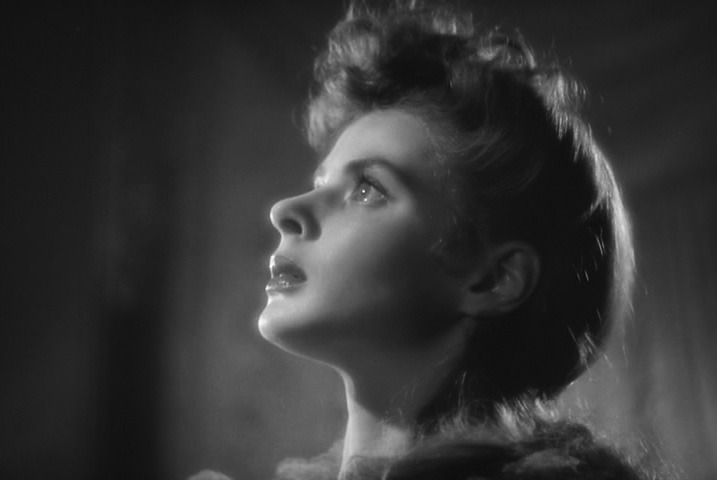
The Tracy version of the character depends less on make-up than the actor's own inventiveness (not that March was any slouch, far from it).  Directed by Victor Fleming, with more emphasis on thick fog effects (where Hyde seems to be allowed to be swallowed in the thick mists, until he disappears like so much water vapor) and the psychology of evil, it is sumptuously produced and veers into the surreal during the transformation sequences.  These are weirdly disturbing, shifting from surfacing lily-pads to Jekyll whipping a team of horses...which then turn into the two women in his life: his faithful fiance (played by a never-lovelier Lana Turner) and a bar-maid (a very early role for Ingrid Bergman, this one preceded Casablanca).  One can only imagine the direction that the director gave his actresses for this sequence and the others ("Okay, Ingrid, you're a wine-cork, but a happy wine-cork!").  Whereas March's Hyde is all simian actions and attitudes, Tracy's is psychologically, adroitly cool, a genuinely mean bastard gleefully tripping up theater managers with his walking stick, and setting up Bergman's Ivy Petersen as a kept woman, scarring her physically and mentally.  Both films stray from Stevenson's narrative, which only implies Hyde's actions, which seem to stay only in the realm of violence, but both Mamoulian's and Fleming's films features the story of the two women who suffer at the man's hands and split personalities.  Bergman's performance is raw and heartbreaking, subtly letting emotions percolate under the surface of her skin, a luminous smile capable of dropping precipitously and tremulously, then escalating into hysteria.  Turner's performance is pitch-perfect, but merely an ingĂ©nue role and she's not required too much of the tortured complexity she would display later in her career.


Mamoulian's film is fancy; Fleming's is fanciful, each taking different approaches to what is essentially the same screen-story, deviating just as far off the cobblestone streets of the novella, and each one coming to the same conclusion—different from the story's where Jekyll's fate is left in the air, seemingly condemned to live out his life as the evil Hyde—to satisfy the moralists in the audience, pre-Code or not.  Interesting to see them back-to-back (to-back-to-back) and explore the similarities and differences—a bit like Jekyll and Hyde themselves.


Interestingly, these two Jekyll's, Tracy and March, squared off against each other in the courtroom drama Inherit the Wind.*


* And another parallel: March received his first Oscar nomination for playing the part of actor Tony Cavendish in The Royal Family of Broadway.  The role of Cavendish was based on John Barrymore who had a big success...playing Dr. Jekyll/Mr. Hyde in the 1920 film version.

"...Room for one more, honey?"


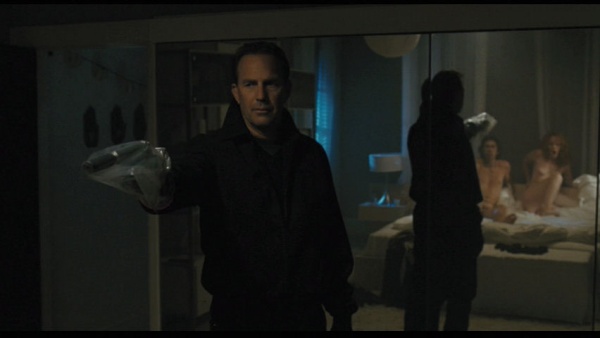
Mr. Brooks (Bruce A. Evans, 2007) A more modern take on the Jekyll/Hyde-in-plain-sight story (we won't talk about the various "Hulk" movies—the superhero version of it) is this creepy psychological thriller about another upstanding citizen and pillar of the community, Earl Brooks (Kevin Costner), CEO of a thriving box-making business.  Brooks has a seemingly normal nuclear family: a loving, doting gorgeous wife (Marg Helgenberger) and a slightly spinning-out-of-orbit daughter (Danielle Panabaker), but the fourth member of the clan is the one with the most fission—the other voice in Brooks' head, Marshall, played by an on-screen William Hurt.  The performances of the two men couldn't be more different: Hurt has the easier one—the all-leering, cackling, lip-smacking Id, while Costner (being in the "real" world) is restrained, cerebral, and calculating on the inside.  Costner really is a fine actor, and his Brooks, in control of most situations unless Marshall convinces him otherwise, every so often goes on a killing binge that satisfies a weird craving.  One entertaining aspect is that Brooks is self-aware enough of his situation to go to AA meetings.  He's an addict and he knows it.  But there aren't enough steps in any program to cure his issues.  He's made enough of a blood-splash to attract the attention of local detectives (Demi Moore leading the investigation) and one fan-boy (Dane Cook) who wants in on the action.  Earl and Marshall are caught in the middle (and with two personalities it gets very crowded in there), yinging and yanging between their two points of view and calculations.  But the creepiest moments—the genuinely chilling ones—are when they combine, joining each other in a sick, twisted laugh for a shared joke, between the two personalities in the one man.  For all the gruesome murders and gouts of blood on display, that's when Mr. Brooks gets really scary.


Tuesday, July 17, 2012

The Sea of Grass

The Sea of Grass (Elia Kazan, 1943) It's Kazan's third feature as a director, playing in Louis B. Mayer's sandbox (literally—the film is shot in-studio at M-G-M, making use of stock-footage of rolling fields already in the can, with some location back-projection), and the founding member of The Actor's Studio has a cast of anybody but—Spencer Tracy and Katherine Hepburn (in their third film together), Melvyn Douglas, Harry Carey Sr. and Edgar Buchanan, all pro movie actors who'd already figured out the best way to project on film, without having to rely on sense-memory for it.

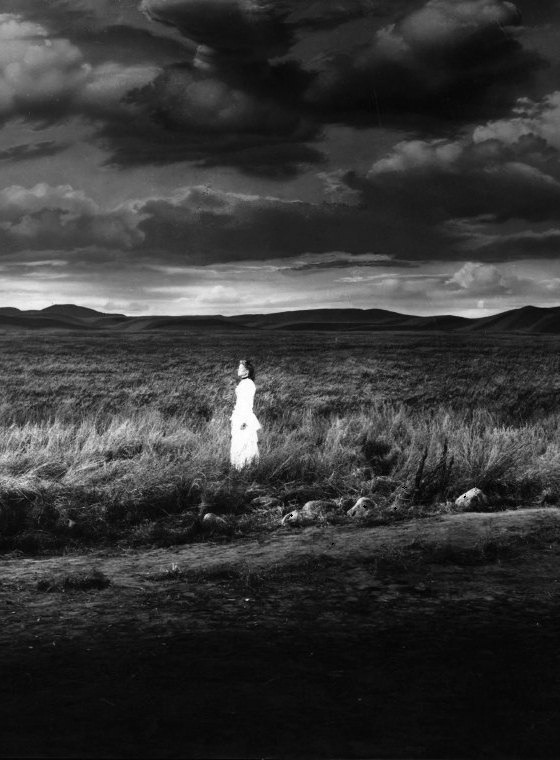
Kazan hated this film and discouraged anybody who'd listen from seeing it.  But, despite its soap-ish tendencies as a romance, it has an underlying ecological message.  Colonel Jim Brewton (Tracy) is a very well-landed cattle baron and resists any efforts by the "guv'mint" towards granting homesteading rights or development on the open range.  For him, its a matter of keeping it unspoiled.  "God's work," as he calls it.  That's his purpose, but he's a might surly, mulish and uncommunicative.  Along comes city-girl Lutie (Hepburn) into his life, and he bends slightly, like the trees she insists be planted at the entrance to their estate, as they sway in the harsh prairie winds. He'll bend with a "wait-and-see" attitude, as in "Wait—you'll see."  He yields to Lutie on her friends's homesteading near his property.  But, a clash is inevitable.  "Fences are a curse word in these parts, he informs her.

There are other complications.  She's a city girl on the prairie and distances between people are daunting.  Then, there's the town lawyer, Chamberlain (Douglas) who has two strikes against him in Brewton's suspicious eyes—he wants the land open to homesteading, and he has his own eyes for Lutie, waiting to pounce whenever there's a crack in the Brewton marriage, which is inevitable.  What his motivations are in both areas are suspect—Brewton Chamberlain are bitter enemies, politically and socially.  Chamberlain just might be making the fight personal and can't help himself.  With both the open fields and Lutie, he can't leave well enough alone.

The rise in Chamberlain's political career (becoming a judge in the district) dooms Brewton's ecological dreams, and soon the prairie becomes home to sodbusters, dependent on weather for their success, and when the rains stop, the crops fail and the farmers leave, the countryside becoming a barren dust-bowl.  It's a hollow, dry victory for Brewton—he's proven right (which no one will admit) and the land goes to waste.  And, in the meantime, Lutie has left, leaving Brewton and cook Jeff (Buchanan) to raise the kids: loyal but neglected Sara Beth (Phyllis Thaxter), and black sheep son Brock (Robert Walker), who it is more than suggested may be Chambelain's child.

One can see why Kazan, Tracy and Hepburn were attracted to the material.  The ecology theme (even if espoused by a bull-headed "protect-what's-mine" cattle rancher) should have been close to the sod of anybody who'd come out of the depression, and the "unbranded scarlet letter" theme must have been attractive to Hepburn who enjoyed tilting at societal windmills.  At this point, Tracy and Hepburn knew each other's tricks on-set.  And it's interesting to see that their personal back-and-forth's in this film are much the same as they are in Guess Who's Coming to Dinner decades later.  She's adoringly passive with a steel spine, and he's remote until his face collapses with emotion.  Kazan would come out of this film feeling compromised—and, indeed, this film about the vastness of open land and the prairie feels like it was filmed inside a glass ball—and would explore other ways to make movies, as opposed to being stuck on the sound-stage.  He'd start insisting on location work and even filming with a documentarian's eye.  His search for authenticity in artifice could not be held behind stage-doors and artificial light.

Saturday, April 28, 2012

A Guy Named Joe

A Guy Named Joe (Victor Fleming, 1943) Wartime fantasy film that was such a favorite of Steven Spielberg's that he remade it as Always in 1989.  One can see why, despite the torturous transition from changing the milieu from World War II bombers to forest fire-fighting.  It has a lot of diverse plot elements and crosses many genres: love story, war story, fantasy, action.  Yet it's also a personal story with a character arc close to Spielberg's heart: a man-child has to learn to grow up.  But, instead of committing to something, here the key to maturity is letting go...making the sacrifice.  Of course, that story is only one dangerous mission away from being told in any war film.  In a story about fire-fighting, not so much.

But, back to Spielbergian motivations—the best reason to remake this movie? The love story doesn't work. Whatever passes between Spencer Tracy and Irene Dunne in this movie feels more like mere tolerance than a quickening flame.  One hesitates to bring Hollywood gossip into discussing the results on film; what is on-screen should be taken at face value, and the situations  and logistics on-set should, if all goes well, be invisible to the casual movie-goer (and Fleming, a yeoman director who skirted the complexities of Gone with the Wind and The Wizard of Oz is better than most at surmounting them).  But, the chemistry between Tracy and Dunne, that is so important to making the rest of the film work is not there.  The two did not get along during filming, and Tracy's entire performance comes off as aloof and "above-it-all," not heartfelt as it should be.  In his update, Spielberg overcompensated, going the other way, Richard Dreyfuss' work being a little too smiley and treacly and trying too hard to be "winning," making his character seem petty and destructively selfish during Always' dark passages.

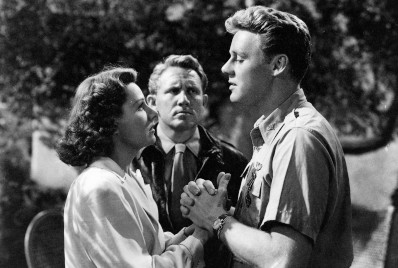
But, the story's a compelling one: Pete Sandidge (Tracy) is a chances-taking bomber pilot in the European theater of WWII.  He's best buddies with Al Yackey (Ward Bond) and sweet on Durinda (Dunne), a pilot in her own right.  During one mission, Pete is killed, and finding himself in the after-life, is tasked by "The General" (Lionel Barrymore) with helping to train a young pilot, Ted Randall (Van Johnson in his first major screen role) in the Japanese theater.  Durinda comes back into the picture, still shattered by Pete's death, but at the urging of Yackey, she ends up nearby, and, though reluctant, finds herself falling for Ted.

For Pete, this is agony, watching their budding romance, and leaves him conflicted about his "mission" and his feelings, and only an extremely melodramatic act of sacrifice forces him to "see the light," as it were.  

The screenplay is by Dalton Trumbo, and he works hard—maybe a might too hard—to balance the conflicting emotions in Pete, and as good as Tracy is, he can't seem to find the right balance to give Pete the depth of character integration to keep the different aspects of his personality together.  The motivations are there in the script, but Tracy, fine in individual scenes, can't seem to make Pete a whole human being, giving a slightly disinterested air to the character.  Some scenes were re-shot later in the studio to find a better balance (which, ironically, might have led to the problem), but the results on-screen don't pay off.  Maybe it's the integration of fantasy elements with a war film that causes the conflict, and although the film comes to a resolution satisfyingly, it leaves one feeling a little melancholy, as if something more could be done.  Partially, that's the film and how its elements might have more fully gelled.  But, it's also the resolution of the film, too.  Realistically (and bear in mind we're talking about a fantasy film here) the proper resolution is to face facts and accept and let go, for spirits on both sides of the astral plane...to accept grief and move on, parting.  A bitter pill, even if for a greater good (which is always suspect).  In the end, it comes down to making the best out of loss, and given the time of strife in which the film was made, that's a heartening statement to make, if superfluous, given the very real individual losses the world was producing during that war.

Interesting film, if not completely successful.  However, three years later, Michael Powell and Emeric Pressburger would take similar themes and turn it into the far superior, and more fantastical, A Matter of Life and Death


Wednesday, August 19, 2009

The Last Hurrah

"The Last Hurrah" (John Ford, 1958) It seems unlikely that two of the most prominent Irishmen in Hollywood—John Ford and Spencer Tracy—would make only two movie together.* Whatever the reasons (and Hollywood legend claims that this one nearly didn't happen**), the two drinking buddies seemed to spark great work from each other.

Frank Skeffington, former governor and current mayor of "an unnamed New England town," has decided to run for Mayor for an unprecedented fifth term.
Ably supported by his mostly Irish Mafia (although other burrough leaders are alluded to, the only one who has any speaking lines is Ricardo Cortez*** playing a Jewish bureau chief), and shunned and reviled by a WASP chamber of commerce (portrayed by veteran actors Basil Rathbone and John Carradine as cantankerous dried-up husks), Skeffington finagles and blarneys his way through getting his way (resorting to blackmail every once in awhile). But Skeffington isn't so full of hubris that he thinks he can go on forever. This campaign, he's decided, is his "last hurrah," and he wants his nephew, newsie Adam Caulfield (Jeffrey Hunter) to get a taste of the "old-style politics" of the glad-hand and the smoked film room before radio and television do away with the personal touch—a prescient idea if ever there was one!

Pointedly, veteran Jane Darwell has more zeal than youngster Jeffrey Hunter

The film ingeniously shows the passing of an era with its scenes of vibrant oldsters and shallow youth and of the personal touch versus the cathode ray tube (Ford has a grand time lampooning staged political broadcasts that are only slightly clumsier than the spit-polished productions of today, a neat summing up of '50's TV usage in politics—everything from Kennedy's carefully cherry-picked history to Nixon's "Checkers" speech). For Ford, approaching his twilight years, emboldened by the fearlessness of age and determined to speak truth, it seemed like a good bet to take on politics and the changing landscape that media played in that change. "The Last Hurrah," directed and produced by Ford, seemed a bit of a return to the old Ford films starring Will Rogers and the film is stacked, overstuffed, with character actors of Hollywood's past parading before the camera—specifically Ford's Hollywood past. Pat O'Brien, Donald Crisp, James Gleason, Jane Darwell, Anna Lee, John Carradine, Wallace Ford, Frank McHugh—all veterans of past Ford films—cast adrift by the failing studio system that kept them employed, in an era of the independent production company. It is not insignificant that a good deal of the film takes place at a boisterous wake.

"The Parade's Gone By" — Skeffington's walk home

Much is made of the long shot of Skeffington's walk home through the park after his election defeat, while in the background a loud celebratory parade for the opposition marches down the street in the other direction, it's klieg lights brashly blasting the camera on occasion. No one could miss that message. But more significant—and more indicative of the kind of deep visual poetry that Ford brought to the screen—is the carefully composed last shot of Skeffington's leaderless contingent, shadows of men, marching up the stairs to pay their respects, but, just as surely, following their leader heavenward.


* Those being "Up the River" (1930), which also featured Humphrey Bogart—I can't imagine Ford and Bogart getting along— and "The Last Hurrah" 28 years later. The two men were under contracts with competing studios until independents in the '50's made their second collaboration possible.

** Orson Welles claimed that John Ford talked to him about playing Skeffington (Welles and Ford were an intense mutual admiration society—their first fires across each others' bows is a story that will wait for another time), but while Welles was out of the country, his agent turned the offer down.

*** Ricardo Cortez played the original Sam Spade in 1931's version of "The Maltese Falcon." In fact, "The Last Hurrah" could be seen as a lot of last hurrah's for many veterans of Hollywood movies. This cast is so top-heavy with so many scene-stealing character actors you'd think you were watching a Frank Capra movie!


The boisterous wake scene for an unloved fellow—all the burroughs are heard from.
Ford might be talking about Hollywood's efficient (but artist-reviled) studio system.

Friday, May 8, 2009

Judgment at Nuremberg

"Judgment at Nuremberg" (Stanley Kramer, 1961) It was Katharine Hepburn who shepherded this film from its origins as an episode of "Playhouse 90" to this version as a three hour epic.* The movie is padded with shots of Spencer Tracy touring the city (still in rubble in 1960, twelve years after the judges trials at Nuremberg**), and background of the characters, including a chaste meeting of minds with a Nazi widow (Marlene Dietrich, still oozing mystery at the age of 60). Screenwriter Abby Mann makes the citizenry complicit in his expanded screenplay, despite their protestations of ignorance. And the military at the time of the trial was in the middle of the Berlin Airlift, their attention now turned to "the Bolsheviks" and cozying up to Germany for strategic advantage, casting the worth and even the result of the trial in question for political expediency. The movie is allowed much more cynicism than the Playhouse 90 broadcast, where the words "gas chambers" were subject to censorship by sponsor The American Gas Association.

The movie threatens to swamp itself with star-power but leavened it by Tracy disappearing into his role.
Maximilian Schell repeats his television performance (winning an Oscar in the process, as did Mann for his adaptation). Of the newcomers, the best performances are Montgomery Clift in face and body language denoting a characters damaged by the brutality of the Nazi regime. And Judy Garland, who'd always seemed like a raw nerve in her films, acts merely from the neck up—and that's all that's required. Not as controlled are Richard Widmark, whose prosecutor is a bit too demonstrative in private for a courtroom strategist, and Burt Lancaster, given a great speech but, a weakness of the actor, aware of it. Laurence Olivier was intended to play German Ernst Janning, but dropped out. I'm not sure that would have been an improvement, but it would have been interesting.

Kramer struggles with the material; he would later become an expert on courtroom directing. But here, he's more intent on making the drama look interesting with camera moves by circling witnesses and, most egregiously, using a fast zoom to zero in on a dramatic moment. It's used sparingly, but even that's too much for the material. He would learn to trust his actors and inherent drama of the scene to carry it.

But, "
Judgement at Nuremberg" manages to be something that eludes most Kramer films—it's a bit more timeless, especially in regards to the short-sightedness of chipping away at bedrock principles for today's political viability and the future's further erosion. One could be speaking of water boarding as torture in Abby Mann's summation speech.

Read it. Read the whole thing. But linger on the words after the picture below.


Judge Haywood: The trial conducted before this Tribunal began over eight months ago. The record of evidence is more than ten thousand pages long, and final arguments of counsel have been concluded.

Simple murders and atrocities do not constitute the gravamen of the charges in this indictment. Rather, the charge is that of conscious participation in a nationwide, government organized system of cruelty and injustice in violation of every moral and legal principle known to all civilized nations. The Tribunal has carefully studied the record and found therein abundant evidence to support beyond a reasonable doubt the charges against these defendants.

Herr Rolfe, in his very skillful defense, has asserted that there are others who must share the ultimate responsibility for what happened here in Germany. There is truth in this. The real complaining party at the bar in this courtroom is civilization. But the Tribunal does say that the men in the dock are responsible for their actions, men who sat in black robes in judgment on other men, men who took part in the enactment of laws and decrees, the purpose of which was the extermination of humans beings, men who in executive positions actively participated in the enforcement of these laws -- illegal even under German law. The principle of criminal law in every civilized society has this in common: Any person who sways another to commit murder, any person who furnishes the lethal weapon for the purpose of the crime, any person who is an accessory to the crime -- is guilty.

Herr Rolfe further asserts that the defendant, Janning, was an extraordinary jurist and acted in what he thought was the best interest of this country. There is truth in this also. Janning, to be sure, is a tragic figure. We believe he loathed the evil he did. But compassion for the present torture of his soul must not beget forgetfulness of the torture and the death of millions by the Government of which he was a part. Janning's record and his fate illuminate the most shattering truth that has emerged from this trial: If he and all of the other defendants had been degraded perverts, if all of the leaders of the Third Reich had been sadistic monsters and maniacs, then these events would have no more moral significance than an earthquake, or any other natural catastrophe. But this trial has shown that under a national crisis, ordinary -- even able and extraordinary -- men can delude themselves into the commission of crimes so vast and heinous that they beggar the imagination. No one who has sat at through trial can ever forget them: men sterilized because of political belief; a mockery made of friendship and faith; the murder of children. How easily it can happen.


There are those in our own country too who today speak of the "protection of country" -- of "survival." A decision must be made in the life of every nation at the very moment when the grasp of the enemy is at its throat. Then, it seems that the only way to survive is to use the means of the enemy, to rest survival upon what is expedient -- to look the other way.

Well, the answer to that is "survival as what?" A country isn't a rock. It's not an extension of one's self. It's what it stands for. It's what it stands for when standing for something is the most difficult!

Before the people of the world, let it now be noted that here, in our decision, this is what we stand for: justice, truth, and the value of a single human being.


* Probably to give her love and paramour Spencer Tracy another plumb acting role. His health (owing to his tendency to drink to excess) was always improved when he was working.

** Although shots of Richard Widmark driving through the city are obvious process shots.

Saturday, December 20, 2008

Bad Day at Black Rock

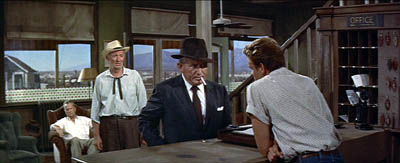
"Bad Day at Black Rock" (John Sturges, 1955) WWII vet John J. Macreedy (Spencer Tracy) steps off the train at Black Rock--the first time the train has stopped in four years. He's looking for a man named Komoko, and he is treated with an inexplicable hostility that he can't fathom and no one will explain. Macreedy, stoically--though increasingly crankily, sets out to find the man he's looking for, and has his life threatened several times by the town toughs (Ernest Borgnine, Lee Marvin and the town "boss" Robert Ryan). And though Macreedy may only have one hand, he's quite capable of using it to defend himself, and discover the town's secret that would force the tiny town's residents to kill.

It's hard to believe that "Bad Day at Black Rock" was considered "subversive" by its studio M-G-M when it was being made but, ten years after the end of World War II, it was considered a hot potato, especially while its production was going on in the waning days of the McCarthy hearings. One couldn't mistake the metaphor of a town cowed by a single man who bends rules to his favor, and harasses outsiders who ask questions.

Right off the bat, one is struck by an over-earnestness that feels false. The wide-screen titles* of a train careening through the Southwest desert is backed by a semi-hysterical Andre Previn score--full of sound and fury and signifying...a train, feels overdone and pointlessly busy.

Previn will keep popping up, goosing the action like a teen-ager playing his radio too loud at a funeral, ** and everything is done with such brutish heavy-handedness and self-importance that one could mistake this for a Stanley Kramer production.

Tracy is reliably lived in as the maimed vet who comes to town, but he's a shade long-in-the-tooth for the role.
Robert Ryan starts subtle and ends up chewing the cactus in much the same way that Lee Marvin and Ernest Borgnine do their dirty work.*** Walter Brennan, Dean Jagger and Anne Francis (the only female in town) round out the cast as sycophants and victims, weak in one way or another.

Ultimately it all comes down to a secret and the conspiracy to keep it that way beyond all reason; obviously, all these guys must have been part of the Bad Rock City Council. There are bursts of action including Tracy taking on Borgnine (I'm part mule, part alligator") with one mutilated hand in his pocket, and the other accomplishing some fancy karate and judo moves, something not often seen in '50's films. But one acknowledges that though the film's heart is in the right place, too much of it has spilled out onto its sleeve.

* Can someone explain to me, for the love of Mike, why this small-scale film about a veritable ghost-town of few actors was filmed in the widest of Cinema-scopes?

** In five years that "goosing" of slow material would pay off like gang-busters with Elmer Bernstein's energetic score for "The Magnificent Seven.

***Ironically, Tracy would be nominated for a Best Actor Oscar that year and lose to...Ernest Borgnine, playing the title role of "Marty."