Showing posts with label John Ford. Show all posts

Thursday, November 28, 2013

Upstream

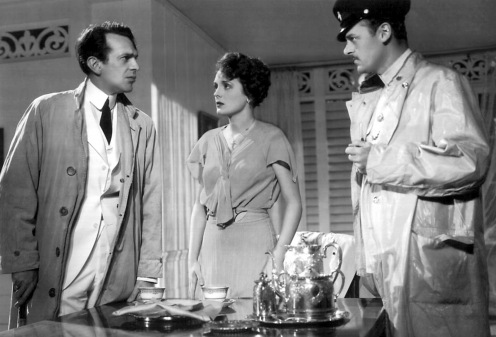
Upstream (John Ford, 1927) Somewhere in New Zealand, there was a film archive that contained a spate of nitrate films that were not returned to the United States after their initial showings in the 20's. They sat there, waiting to either disintegrate or explode in flames, until they were discovered in 2009.  Among the treasures were one of the first films ever to be worked on by Alfred Hitchcock, as well as one trailer and one feature directed by John Ford for the Fox Corporation (before their merger with 20th) that up 'til then had thought to be lost.

Early Ford is still deeply Ford country.  This backstage drama takes place in a players' boarding house, where touring performers could rent lodgings for their seasons in vaudeville houses.  The current residents are a motley troupe: a mother-daughter "sister act," Irish vaudevillians Callahan and Callahan (Ted McNamara and Sammy Cohen—yes, you read that right, it's part of the gag), the faded Shakesperean (Emile Chautard), the medicine show jugglers (and distillers), the "Star Boarder" (Raymond Hitchcock)—his reputation gained by inserting himself into every situation, the least talented member of a famous acting family, the Brashinghams (Earle Foxe), and a knife-throwing act with the Castillian expert Juan Rodriguez—real name Jack La Velle (Grant Withers)—and his lovely target Gertie Ryan (Nancy Nash).  

Any community in a Ford film is complicated and this one is tangled like a cat's cradle.  Jack's in love with Gertie, but Brashingham is on the make as well.  Everybody is in everybody's business, but when one word comes from London that a Brashingham (even a lousy one) must be booked to play "Hamlet," it throws the whole household in an uproar.  The vain Brashingham couldn't act his way out of a wet paper sack, but the experienced thesp' gives him lessons that seem to bring out the best in him as an actor, while bringing out the worst in him as a human being.  There are the various tactics to avoid paying rent with the Landlady, the torn loyalties of Gertie, and the "Star Boarder's" proclivity to flirt with anything in a skirt—it's Ford affectionately poking fun at the phoniness and the keeping up of appearances of show folk, but also of how a disparate group of individuals can still mutually raise each other up.  The performances are remarkably restrained for a silent film (and one about a bunch of hams), and Ford pulls a couple of tricks with a smoothly moving camera that impresses, considering how bulky the things were back then.

Made three years after his landmark The Iron Horse and a year before his first talking picture, Upstream is worth seeing for an atypical prototype of what Ford would produce later in his career.


Emile Chautard, Earle Foxe, and Nancy Nash all have things
that need to be discussed Upstream


Tuesday, October 22, 2013

The Hurricane (1937)

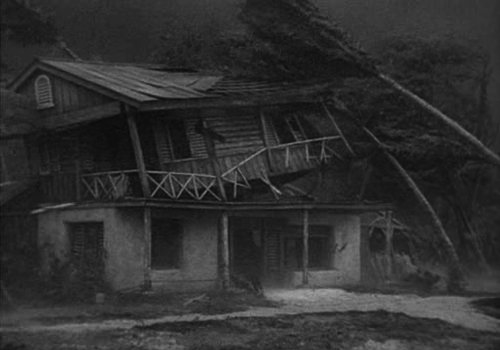
The Hurricane (John Ford, Stuart Heisler, 1937) On a ship sailing through the South Seas, Dr. Kersaint (Thomas Mitchell) waxes nostalgic on the submerged ruins of a building the ship passes, blows it a kiss, and informs a fellow passenger that it was what remains of the island of Manukura, where he lived as a doctor in Paradise, in a time when the Governor was the stuffy bureaucrat DeLaage (Raymond Massey), who was in total contrast to the freer native people.  

Among them is Terangi (Jon Hall), newlywed to Marama (Dorothy Lamour), and who works as first mate of the tradeship Katopua, making a regular run to Tahiti.  On one of those trips Terangi is ordered to leave a bar by a drunk Frenchman and the resulting fight lands him in jail for six months, unable to return to his new family.  The unyielding French governor refuses to pardon him, and Turangi makes one unsuccessful escape attempt after another, only increasing his sentence and his exile.

It's a cautionary tale of race prejudice and imperialism that can only be rectified by an Act of God, and at that point second unit director Stuart Heisler takes over with a sequence of live-action, studio-bound mayhem that's horrific to watch, and head-rattlingly impressive.  It's also acres above the usual "disaster movie" formula in that Ford and screenwriter Dudley Nichols take the time to actually have the audience familiar with the characters in danger, and place them in the absolute worse situation for their survival, given their traits and prejudices.  It's one thing to be wary of an arbitrary natural disaster, but one should always avoid one with a sense of irony (and a sense of reckoning, as well).

Kudos to Ford for actually casting Polynesians as the natives (with the exception of Lamour—who was anything but—and Hall, who was, splitting heirs, half-Tahitian), but the rest of the cast is top-notch with Ford regular John Carradine as a sadistic guard, and an early role for the soon-to-be ubiquitous Thomas Mitchell, who makes an impression with every role.  It's not Ford at his most artistic—nor, frankly, did he need to be, but he manages to make the drama on both sides of the cultural divide matter—and letting God sort it out.

Tuesday, December 25, 2012

3 Godfathers (1948)

3 Godfathers (John Ford, 1948) Ford's version of The Nativity Story set in the very wild West is a remake of his 1919 silent film Marked Men,* which starred Harry Carey. The son of John Ford's first star, Harry Carey Jr made his acting debut in this one as The Abilene Kid, who along with John Wayne and Pedro Armendáriz, play former cattle rustlers up-scaling to bank robbery.  After the meager heist, they escape a posse from Welcome, Arizona (led by Ward Bond's Sheriff B. Sweet, as well as Hank Worden and Ben Johnson) by taking a perilous escape route through the desert (it was filmed in Death Valley)—not the wisest of men or maneuvers.  Their flight leaves them wounded, their water supply draining and quickly losing every means of survival in the desert.

Things get complicated when, looking for water, they come across an established that a tenderfoot, in his ignorance and panic has dynamited in an an attempt to get more water, destroying it.  If that weren't bad enough, he's run off into the desert to find his stock, driven loco by alkaline poisoning, leaving behind his wife (Mildred Natwick) delirious and about to give birth.  Unbeknownst to them, she's the niece of Sheriff Sweet's.  


Armendáriz, Wayne and Carey Jr. don't know nuthin' 'bout birthin' no babies

The leader of the group Bob Hightower (Wayne) can't cope with the intricacies of the situation, leaving "Pete" Rocafuerte (Armendáriz) to deliver the baby, and when the mother dies, leaving the three with a promise to care for the child she has named Robert William Pedro, the three villains must learn the basics of child-care (thanks to a book written by "Doc Meechum"), but with limited supplies they must cross the desert, led by a single star to the town of New Jerusalem (the other choices are Cairo and Damascus).  It isn't long before The Kid tells them it's their Destiny, that they were led to this place, this child, this duty, this precedent.  

It is, after all, almost Christmas.

It's a sweet story, about how the spirit turns with the charge of a newborn, and how even those on a downward spiral can be lifted up by a lack of self.  And Ford, working with screenwriters Frank Nugent (a new find with his Fort Apache script) and Laurence Stallings (with whom Ford and Nugent would collaborate on She Wore a Yellow Ribbon) keeps the sentiment high, and the humor all over the map from leaden to subtle.  Even without its silent roots (Mae Marsh from TheBirth of a Nation has a large role!), the film, in tone, feels like a throwback to an earlier time, like Ford's work in the '30's circa Stagecoach—not a bad time at all.  And, in the timeline of his work this looks like a wave good-bye to his western work of the past, as Ford would subtly move on to the slightly more serious She Wore a Yellow Ribbon to the dire The Searchers within the space of seven years.  

It was about this time that Wayne's performance in Howard Hawks' Red River (playing "old" at 41 years of age) was noticed by everyone, and notably Ford, who had still been using Wayne in co-starring roles.  "I didn't know the big sonuvabitch could act!" Ford groused to Hawks.  3 Godfathers is Wayne stepping into the limelight of Ford's films, where he would stay (mostly) for the rest of Ford's career.  And, as with the humor of the film, Wayne's performance covers a lot of ground, leaden to subtle.  His physical work is unmatched, as usual, casually sitting on a horse as if it was an easy chair,  stumbling through the desert in an alarming drunk march (supposedly holding a baby, which throw some scary drama into it, if you think about it), doing little character things you only notice later, like the way Hightower trudges dumbly through an edge-of-town water collection at the start of the film before it becomes of the utmost importance, and something that seems peculiarly florid and over-the-top but pays off hugely throughout the film: Hightower is something of a jerk and mean-spirited and given to elaborate mock-formality when teasing others, especially the way he takes off his hat and does a too-formal presentation of it.  It looks phony (it is phony for this rough man of the West), but it turns into genuine acts of kindness and civility—the man grows into the gesture and becomes him, a signature of the man he has become through the trails and tribulations that have become the period to a life of bad manners, bad habits and bad choices.  And the film ends with that same gesture, sending the man off to his fate, but promising the return of a better man and a better future.

This is all done with pictures, part of the skein of direction that Ford imposes on the film that, combined with the exquisite cinematography of Winton Hoch, makes this odd, anti-Christmas Christmas film something of a precious gem for the Holidays.


The resonant gesture of John Wayne in its most practical usage:
Thanks to the Way of Seeing blog for noticing this one.


* There is also a harder edged 1936 version starring Chester Morris, Lewis Stone and Walter Brennan, directed by Richard Boleshawski.

Saturday, September 8, 2012

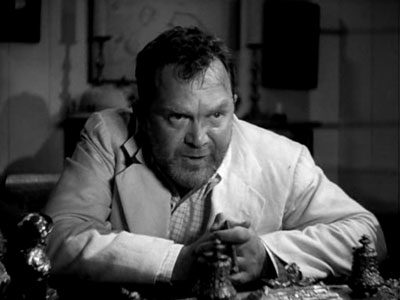
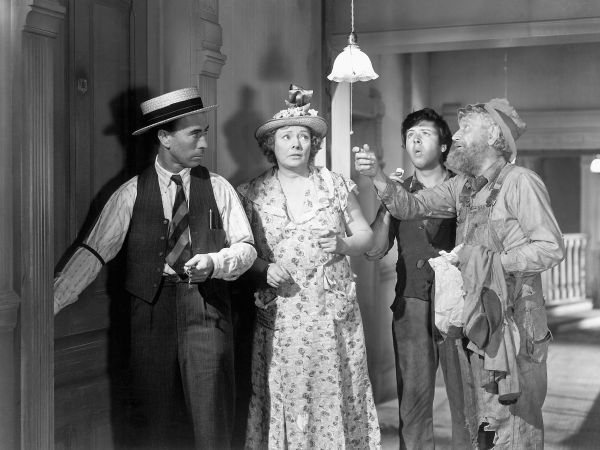
Tobacco Road

Tobacco Road (John Ford, 1941) The same year that Ford made the magnificent How Green Was My Valley (which won the Best Picture Oscar over Citizen Kane, a decision I'm still surprisingly ambivalent about) and after he'd made The Long Voyage Home, he made this oddity, an adaptation of the hit play that, itself, was an adaptation of Erskine Caldwell's scandalously bleak novel about the (to put it mildly) dysfunction among the Georgia poor.  I'm not familiar with either, but the material is so venal and hard-scrabble that with each level of the airing of its dirty laundry, compromises had to be made to reach the stage and the screen.  By the time producer Darryl Zanuck and Ford got hold of it, it was a bizzarro version of their collaborative effort on The Grapes of Wrath, an out-and-out comedy of the "Kettle" variety, with much slapstick and hee-hawing, the novel's displays of greed, selfishness, shiftlessness and hypocrisy and (let's call it what it is) its animalistic depiction of rural poor life, neutered by low comedy and high over-acting.  And to pass the censors and the Board of Review (not to mention the Catholic Legion of Decency), Caldwell's malicious intentions with its 13 year old brides, dead grammas, and apocalyptic "Wrath of God" fire (and no one would think of Gene Tierney possessing a cleft palate) is left by the way-side for lunk-headed males, religious loons, and the wholesale destruction of property.  The effect is to take Caldwell's metaphorical screed...and turn it into "L'il Abner."

It's a little dispiriting.  The material is so compromised as to be toothless, with no bite at all (although one might fear rabies), but any more mean-spirited and one couldn't see Ford—who could have trouble tackling tough subject matter head on—directing it.  It's a bit like how Ford started handling the production of Mister Roberts as a service comedy, rather than a barnacled "rust-and-all" look at the war-Navy.  But here, the strategy was sanctioned by Zanuck and the powers that be, not only at Fox, but at the Breen Office, just to get a hot property on the screen.

Compromise is not new to the movies, it's an integral part, actually (unless you're ideologically fundamentalist on the auteur theory).  But, as it was, the only reason to make this version of the film was to make hay, cashing in on the notoriety it had generated, while still getting away with it, something that must have appealed to the huckster-showman in Zanuck.  The producer loved a good story, liked to push the envelope, but also knew what chances he could take, before bringing down the ire of the blue noses.  And Ford could do comedy—he was better at it when it provided a relief from drama, or as texture inside of it—but he could do it, and economically, in a minimum of footage.

So Tobacco Road was made a comedy, curdled and dusty, and if some of Caldwell's malice got into it, so much the better, better than none at all.  Such compromise brought Maugham to the screen and Faulkner and Hemingway and Fitzgerald.  Not unadulterated, but some of it. 

One could make a case for Ford trying to desanctify his image of "the people," away from the respectful, earnest portrayals of The Grapes of Wrath, but Ford never painted with a wide brush and not all of his "po' folk" were saints.  Far from it, in fact.  So, there has to be some back-story to this one, some vital piece of information, but for now, the "get-it-on-the-screen-any-way-you-can" theory fits Occam's razor.

However, it has had one effect on me.  It's going to be tough to watch Ford's westerns with their solemn funerals with ragged voices singing "Shall We Gather at the River" after seeing what's done with it in this film.

Like I said, "compromise."


Ford still makes it look gorgeous, though.


Thursday, September 6, 2012

Mogambo (1953)

Mogambo  (John Ford, 1953) It's good to be The King.  When you're Clark Gable, King of Hollywood, you can forgive a lot of shortcomings on the acting front.  Mogambo, situated in Africa, and for a large part photographed there, makes Gable the King of the Jungle and no less predatory than some of the denizens.  If the film has a shortcoming, and it has a few, it's that it depends so much on Gable's charisma to carry what is essentially an under-written "man's man" of a role—one who will take a woman in his arms and plant one with a mere change in the barometer, his, hers or Nature's.  Gable's Vic Marswell is so fragile in his moods, he's practically bi-polar, swinging from cranky to rapacious to "I don't care," running hot and cold and more than a little unreadable either way.  And for the women in the film, Eloise "Honey Bear" Kelly (a plucky Ava Gardner), a recklessly adventurous widow, and Lina Nordley (Grace Kelly, still in her neurotic, fragile period), wife of Marswell's current client, it creates a weird triangle that I.Sosceles himself couldn't figure out.  Maybe it's the heat of Africa, or maybe it's the wild life of the wildlife, but both of these women, with lots going for them, still neurotically slam themselves like meteors into Winslow's orbit.  And while the heat and flash are nice, things burn out mighty quick.  And the only explanation is "it's Gable," in a writer's shorthand that defies logic, common sense, or understandable motivation (other than box-office).  It's just assumed that any woman's going to throw themselves at the King, no matter how much of a tiger trap he might be.

That shaky "given" aside, it's a nice adventure entertainment, directed by John Ford with a painterly eye trained on a new canvas.  The Technicolor cinematography—by Freddie Young and Robert Surtees—is absolutely gorgeous, whether in the blinding sunlight of a native village, or the shadowy slats of a "civilized" encampment.  Ford is a long way from the locations he favored in his Westerns, but adjusts, employing his fascination with native culture in the same diversions of including the faces of the tribes, distinguishing them from each other and, in a single set up, putting the flavor of the place on obvious display.  He's truly recharged and energized by Africa, his camera roaming all over, finding the picturesque and telling details.*

And it's interesting to note (to me, anyway) that Ford is essentially making a Howard Hawks movie:  a group of professionals and semi-professionals trying to eke out a living (and a kind of focused community) despite their differences.  Hawks and Ford would knowingly tip their hats to each other in their projects—if it didn't interfere with their own process—and there are a lot of the Hawks hallmarks here—the group sing-along, the loaning and sharing of a cigarette as relationship sub-text, the strong females (one of whom is "just one of the boys"), and the alpha male who has a code, few words, and manages to mangle them around the opposite sex.**

Even if the emotions run a little too high and there's way too much drama to get any real work done, there's a lot in Mogambo to like, that is pleasing to the eye.  The story's not much, but it sure is interesting to see how Ford tells it.

  
Gardner and Kelly-revealed in their environments


* One of my favorite shots is a simple one of Gable and company walking the high grass on a trapping trip, shot at ground level, looking up through the wisps at the party.  How much less interesting would that shot have been from any other angle?  How much less would it have said about the conditions there, while making the most of the surroundings?  Ah, I'm probably getting all "academic" here.  Ford probably shot it that way to avoid seeing a garbage heap in the distance.  

** Hawks made his own version of the "African trapper" story—Hatari—ten years later with John Wayne (although internet sources say Gable was to co-star "but who believes the Internet?") with a more cohesive group (the kids have the relationship problems, not the leader) turning the story into a metaphor for a filmmaking crew).  The differences are night and day—in style and atmosphere—despite the similarities in subject matter.  In Hawks, the relationships are background, while the job is scenter-stage.  In Ford, it's the other way around.  They'd make an interesting double-bill.

Tuesday, July 10, 2012

Directed by John Ford

Directed by John Ford (Peter Bogdanovich, 1971, 2006) Bogdanovich's primer is a "viewer's digest" of some big things that that made John Ford such a powerful director not only in individual films, but also across a career of experience.  Generous clips from throughout his acreer illustrate points, punctuated by talking head clips from the '71 version including Ford himself (who is not very helpful, to say the least—by saying the least*—and is deliberately dismissive of the doing the whole critical analysis thing, much like a comedian hates to explain a joke, or a magician a trick), John Wayne, Henry Fonda, and James Stewart.  The 2006 update folds in Harry Carey, Jr., Maureen O'Hara, and analysis from Clint Eastwood, Martin Scorsese, Walter Hill, and Steven Spielberg, as well as Bogdanovich.  

The update has everything from the original re-jiggered to add more points, but there's more of a "legacy" feel to the thing, now, as the casts Ford depended on have dwindled—Ford was still alive during the first version—and so the next generation who grew up and learned their craft sitting in the theater watching Ford's images talk about "what John Ford means to me."  Also, as the man is gone now, there's a bit more psychological analysis and more delving into the man's irascible personality, already on full display in his interview.


But there is one troubling aspect to this "new" version, something that stuck in my craw when I saw it (and no doubt would result in Ford caning Bogdanovich if he got wind of it).  There is a brief (very brief) examination of Mary of Scotland, Ford's only film with Katherine Hepburn, and the subject of much speculation over what their relationship was.  A sound clip is played of Hepburn's visit to Ford days before his death.  The tape was allowed to run continuously, and their parting words to each other are played, words that they had no way of knowing were being recorded, and words that might not have been said if known they'd been overheard (Ford specifically asks her "Are they gone?").  It's nothing scandalous or huge.  Ford merely says "I love you," and Hepburn says "it's mutual."  But it feels like a violation of the departed by the parties that recorded it and who have re-presented it.  And far too much is made of it (Really?  It was the inspiration for the names of O'Hara's and Wayne's characters in The Quiet Man?) in a gossipy, speculative fashion. These were, after all, words from people who must have known they'd never see each other again, and it's nice and it's lovely. But it's beneath the film, beneath Bogdanovich, and undercuts whatever scholarly impact the film might otherwise enjoy to make anything more of than the sweet parting gesture it is.  The worst part is...there's no one to rebut, no one to protest, no one to defend...or even better yet, to correct the speculation. Even Ford's maxim of "When the legend becomes fact, print the legend" doesn't cover this.

That aside (and it's my quibble, really), it's an invaluable first toe-dip into the films of Ford, and enriches the experience and appreciation of every film of his seen afterwards.  One thing Bogdanovich did right (besides getting Turner Classic Movies to bank-roll it, so more people would see it, the various clips from many sources being very expensive) is he kept the original's essential narration by Orson Welles, Ford fan and student.   The voices and faces and memories out of the past have as much weight and bearing as the films do, reverberating throughout history and time, feeling immortal and universal.


*

Sunday, April 15, 2012

Don't Make a Scene: The Wings of Eagles


The Story: Director cameos are no longer a rare occurrence.  Now, you practically have to pay directors not to show up in their own movies.  Hitchcock, of course, made an "in-joke" of it, after he inserted himself in a scene that needed a couple more extras, and did it for every film after, no matter how elaborately he had to do it—but to his credit, he usually put them towards the beginning of the picture to get it "out of the way."  

Of course, some directors you couldn't keep away from appearing before the camera—Orson Welles, for one—and most actor-directors, once they acquire the power to take "the chair" behind the camera, usually have to commit to appearing in the film in order to get the chance to direct.  John Huston, gets the award for hubris, though, for his work in The Bible: In the Beginning (which he directed), where he played The Narrator, Noah...and God.  Type-casting.

John Ford, never had aspirations to be an actor, although he appeared in some silent films (his brother Francis was the actor in the family).  But, when he made The Wings of Eagles, the life-story of the man who wrote They Were Expendable for Ford (Wead received screen-credit for one other Ford film, Airmail), the story came for Wead's introduction to Hollywood, and the director chose to model the director Wead first works with on himself (the first scripts Wead worked on was for directors George W. Hill and Frank Capra), calling him "John Dodge" (Ford? Dodge? Get it?).  And it's all there—the cantankerousness, the drinking, the ubiquitous handkerchief and pipe, the dark glasses that hide the bad eye, the Western decor (messy), the four Oscars, the contrariness.


The arc of the scene is fun, and subtle in the way most people don't recognize Ford as being subtle.  The set-up and through-line of the joke is that Wayne is paralyzed, and when these "Hollywood types" first see him, they are surprised, solicitous, stopping in mid-"Hollyspeak kiss-off boilerplate" to consider the man and his predicament: Miss Johnson swings open the gate for him (which Wayne gruffly thanks her for, not making a big deal of it); Dodge is stopped in mid-rant by the sight of Wead in the door-way, thinks twice about using his cane-flask for an afternoon libation ("the joke" isn't particularly funny in present company); he tries to offer a hand when Wead starts to struggle off the couch (which is rather crankily refused). Then, when the formalities are over, the agreement made, they abandon him, leaving him with his own resources, wondering what just happened, and make his own way.  Nice.  And it's a statement, and it's funny, and it's character-based, and it's all done with pictures.  Pure Ford.

And Frank Wead.  This is not a typical Wayne performance.  It has all the trappings of "Oscar-bait"—a debilitation, in this case, paralysis, which Wayne carries off nicely, as Wead got around with braces and canes propping up his dead legs.  Think of this: in one scene, Wayne has to pull off an emotional break-up with his wife, with him lying prone on his stomach, his face hidden.  Thing is, he's got such screen-presence, he still manages to pull it off, with no other gifts but his voice (and the considerable help of Maureen O'Hara, one of the few actors Wayne couldn't overshadow).  Here, they dress him up in too-big, loose clothes to make him look frailer, and towards the end, he even appears—for the only time on-screen—without his toupee.  It was a different Wayne role, but one that had the ring of truth to it, printed, of course, legendary to become the truth...in the Ford style.

The Set-Up: Former Navy pilot Frank "Spig" Wead (John Wayne) has had his flying career ended by a fall down a flight of stairs in his home, that has left him paralyzed below the waist.  Encouraged by his buddies, he has still managed to make himself walk with the use of two canes and braces on his legs.  It is this way that he manages to walk into the offices of movie director John Dodge (Ward Bond), who has made Wead an offer to help the Navy get funding, by writing scripts about the Navy for the movies.

Action!


COMMANDER FRANK 'SPIG' WEAD: I’m  Cmdr. Wead.  I think I’m…

MISS JACKSON: I’m sorry, but Mr. Dodge…


MISS JACKSON: I believe, he’s expecting you, Cmdr. Wead.


 WEAD: Thank you.


MISS JACKSON: Cmdr. Wead is here.

JOHN DODGE: Dag…

DODGE: -blast it, “Stonewall,” I told you I was in conference!  

DODGE: I’m not supposed to be disturbed under any circum…


DODGE: Oh.

DODGE: (recovering) Come on in.

DODGE: Come in, come in.  It’s good to see ya.

Dodge goes to shake his hand, but claps him on the shoulder, instead.

WEAD: Fine.
DODGE: Come here.  Sit down.  Make yourself comfortable.

DODGE: Gotta watch that couch.  It’s got a hidden spring in it someplace that surprises you sometimes.

DODGE: Ah.
Dodge grabs his cane.  Looks at Wead.  

He thinks twice about it, but brings it over, anyway, hoping to not offend.  Wead grunts his way onto the couch.

Wead looks at the odd pictures on the wall,* and notices Dodge’s cane, as the director sits down next to him.

DODGE: Watch that door.

Dodge fumbles under the cushion and produces two shot-glasses to Wead’s amazement.


DODGE: Here…

WEAD: Familiar?

DODGE: Ah, Commander.  I find that about this time of the afternoon, a little drink’s very good for ya.

DODGE: Good for the old pump, ya know?
WEAD: Yeah? I used to make excuses when I drank in the afternoon, too.

WEAD: Funny thing is…a man always makes the loudest excuses to himself.
DODGE: Yeah.  It’s a fact.

Dodge dismisses the philosophy and hides the cane under the couch.

DODGE: It sure is a fact.   Alright, Commander...

They clink glasses.

DODGE: There ya are.

They drink.

WEAD: ..."Commander" of a portable typewriter.
DODGE: They can be a lot harder to handle than a battleship.
WEAD: I found that out.
DODGE: Hm.  Well, I know you haven’t had much experience, writing.  And none at all in pictures.

DODGE: But, I’ve heard aboutcha.  It all sounded like you were just the man I wanted to write a story about the Navy.

DODGE: I don’t want a story…just about ships and planes, I want a story about the officers and..
WEAD: Yeah. And the men that run them.
DODGE: That’s exactly it.

DODGE: For example, do you know any Chief Petty Officers?

WEAD: Do I!  Hand me that cane!
DODGE: Sure.
WEAD: No, I’m  kidding…


DODGE: Well, I..I want this story from a pen dipped in salt-water, not dry martinis, you know what I mean?
WEAD: Yeah. “Damn the martinis.  Full speed ahead.”
DODGE: Wouldcha like to take a crack at it?
WEAD: That’s why I’m here.

DODGE: Well, That’s good.  C’mon, let’s go.  Can I give you a hand…
WEAD: No! I’m alright.
DODGE: Oh! I’m sorry. Sorry.


DODGE: I didn’t know this man was injured.  Whyn’t you tell me?  Clean out that office across the way.  See that he gets everything he wants.

DODGE: Commander.  What do they call ya?  “Spig,” isn’t it?
WEAD: That’s right.
DODGE: Mind if I call ya “Spig?”
WEAD: Not at all.

DODGE: This is Miss Jackson. 

DODGE: “Stonewall” Jackson, meet Cmdr. Wead.

MISS JACKSON: Hello, Commander.
WEAD: Hello, Miss Jackson. 

WEAD: Mind if I call you “Stonewall?”
MISS JACKSON: Not at all.
DODGE: “Stonewall” has been with me for 22 years.  She’s my barometer.  

DODGE: If she likes a script, I throw it away. Wouldn’t know what to do without her.  Now, go to work.

Dodge starts to go back to his office, but stops for one last thing. 

DODGE: Oh! You didn’t ask about your salary.
WEAD: Well, I figure you’ll pay me what I’m worth.

WEAD: What you have to worry about is if I’m worth what you pay me.

DODGE: It’s a deal.

WEAD: Well, wait a minute…is that all?
DODGE: Well, whattaya need, pencil and paper?

WEAD: Well, what do I write about?
DODGE: People.  Navy people.

Dodge shuts the office door behind him. "Stonewall" goes to prepare his office and Wead is left to contemplate what just happened.


Not sure, he starts off in the direction of the office.


Pictures by Paul Vogel and John Ford

The Wings of Eagles is available on DVD from Warner Home Video.


The real Frank Wead, and the fake (and real) John Ford

* IMDB's trivia for The Wings of Eagles says that the drawing that keeps showing up around every corner (and hangs on the last shot) is an early head-shot of Wayne.  It's not; Wayne never used that much make-up on his eyebrows.  But that's, for sure, Harry Carey, in the photograph on the left.  No, but, they do make a joke of Wayne sitting on the couch and glancing up at a Norman Rockwell sketch of himself from The Long Voyage Home hanging on the wall of Dodge's office.