Showing posts with label Henry Fonda. Show all posts

Tuesday, July 10, 2012

Directed by John Ford

Directed by John Ford (Peter Bogdanovich, 1971, 2006) Bogdanovich's primer is a "viewer's digest" of some big things that that made John Ford such a powerful director not only in individual films, but also across a career of experience.  Generous clips from throughout his acreer illustrate points, punctuated by talking head clips from the '71 version including Ford himself (who is not very helpful, to say the least—by saying the least*—and is deliberately dismissive of the doing the whole critical analysis thing, much like a comedian hates to explain a joke, or a magician a trick), John Wayne, Henry Fonda, and James Stewart.  The 2006 update folds in Harry Carey, Jr., Maureen O'Hara, and analysis from Clint Eastwood, Martin Scorsese, Walter Hill, and Steven Spielberg, as well as Bogdanovich.  

The update has everything from the original re-jiggered to add more points, but there's more of a "legacy" feel to the thing, now, as the casts Ford depended on have dwindled—Ford was still alive during the first version—and so the next generation who grew up and learned their craft sitting in the theater watching Ford's images talk about "what John Ford means to me."  Also, as the man is gone now, there's a bit more psychological analysis and more delving into the man's irascible personality, already on full display in his interview.


But there is one troubling aspect to this "new" version, something that stuck in my craw when I saw it (and no doubt would result in Ford caning Bogdanovich if he got wind of it).  There is a brief (very brief) examination of Mary of Scotland, Ford's only film with Katherine Hepburn, and the subject of much speculation over what their relationship was.  A sound clip is played of Hepburn's visit to Ford days before his death.  The tape was allowed to run continuously, and their parting words to each other are played, words that they had no way of knowing were being recorded, and words that might not have been said if known they'd been overheard (Ford specifically asks her "Are they gone?").  It's nothing scandalous or huge.  Ford merely says "I love you," and Hepburn says "it's mutual."  But it feels like a violation of the departed by the parties that recorded it and who have re-presented it.  And far too much is made of it (Really?  It was the inspiration for the names of O'Hara's and Wayne's characters in The Quiet Man?) in a gossipy, speculative fashion. These were, after all, words from people who must have known they'd never see each other again, and it's nice and it's lovely. But it's beneath the film, beneath Bogdanovich, and undercuts whatever scholarly impact the film might otherwise enjoy to make anything more of than the sweet parting gesture it is.  The worst part is...there's no one to rebut, no one to protest, no one to defend...or even better yet, to correct the speculation. Even Ford's maxim of "When the legend becomes fact, print the legend" doesn't cover this.

That aside (and it's my quibble, really), it's an invaluable first toe-dip into the films of Ford, and enriches the experience and appreciation of every film of his seen afterwards.  One thing Bogdanovich did right (besides getting Turner Classic Movies to bank-roll it, so more people would see it, the various clips from many sources being very expensive) is he kept the original's essential narration by Orson Welles, Ford fan and student.   The voices and faces and memories out of the past have as much weight and bearing as the films do, reverberating throughout history and time, feeling immortal and universal.


*

Thursday, April 12, 2012

Drums Along the Mohawk

When Orson Welles was asked what movies he studied before embarking on directing Citizen Kane he replied, "I studied the Old Masters, by which I mean John Ford, John Ford, and John Ford." For the next three days we'll be looking at little-seen films from The Old Master, each different in tone, temperament and subject matter, but all unmistakably the work of America's storied film-maker, the irascible, painterly, domineering, sentimental puzzle that was John Ford, John Ford, and John Ford.

Drums Along the Mohawk (John Ford, 1939) "Every generation must make its own way—in one place or another"—so director Ford caps the start of his career-long history of the United States...with a wedding, for this earliest episode in that timeline.  The year is 1776, but instead of the politicians haggling over language in Philadelphia meeting rooms, he's—again—on the frontier, a couple day's ride from Albany, New York. Gil Martin (Henry Fonda) and his new wife Lana (Claudette Colbert) are embarking on a mission, just as the newly formed states are, "to form a more perfect union."  

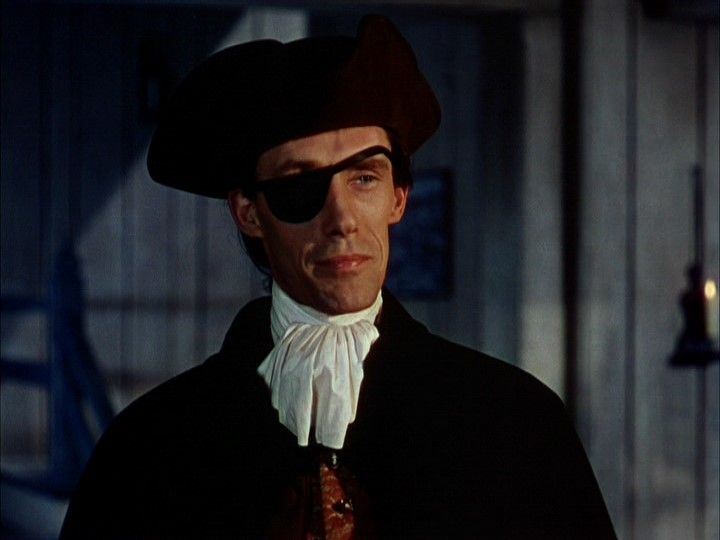
It won't be easy for either organization, with threats, both internal and external.  There are attacks by Natives against the encroaching settlers (but, even here, Ford has them blameless—if brutally opportunistic—as the Iroquois are taking their orders from a Tory agent, played by an eye-patched John Carradine, who is paying the tribe for their berserker destruction of the homesteads, burning everything—buildings, crops and possessions—down to the bare Earth, leaving nothing, not even anything the tribe could steal or profit by), internal strife among the villagers, and the hard-scrabble existence that tests the fiber of the town-folk.

Before long, the citizens are driven to the local fort housing the militia, always at the ready for a call to arms from General Washington.  In the meantime are the struggles to maintain a family, order, and petty grievances that threaten to disrupt the community from within.  But, a shared sense of purpose—community-building reflecting the larger picture of nation-building, pulls the majority of them through.

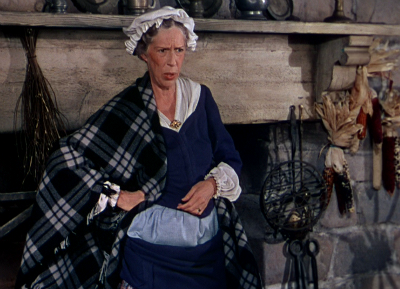
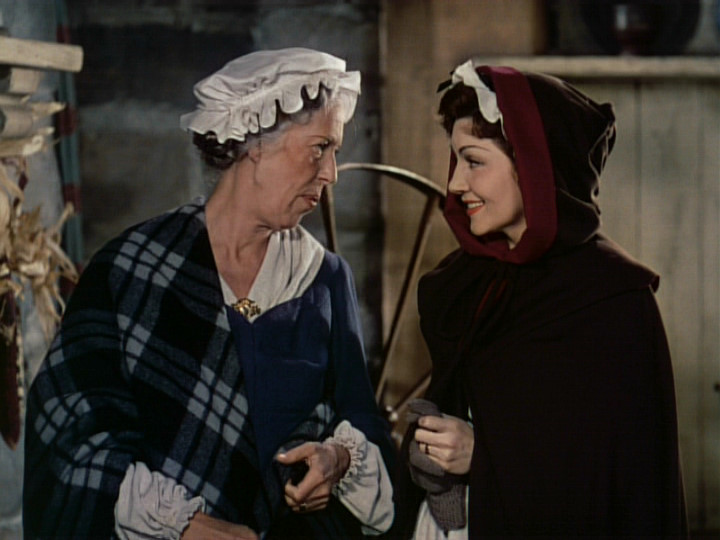
Early on, Gil and Lana are burned out of their humble cabin-home, built by Gil. They take up lodgings with the widow McKlennar (Edna May Oliver) as workers and soon, are back on their feet, on a par with everyone who has suffered hardships.

This is Ford's first film in color, and it's eye-popping Technicolor, and the director, who was discriminating in his choice of which format to use—his last two were in monochrome—fills the screen with detailed color; the very first shot, after the needle-pointed credits, is a pull-out from the bouquet that Lana is holding at her wedding, and there are fiery sunsets and sunrises framed in the same Ford-fashion, with just the right amount of horizon for contrast.  The greens are the most verdant, and fire seems to play an important part of the scheme of things, the flaming colors unnatural against a pastoral backdrop.

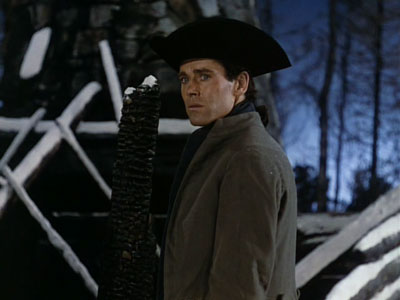
Fire figures in a violent double-whammy that strikes one unexpectedly towards the end of the film, as a scout (played by Francis Ford, the director's brother) is wheeled out in front of the fort in a wagon of straw, which is then set alight by torches and flaming arrows.*  Just when that scene is set in the mind, one of the settlers (played by Ford stock-player Ward Bond) is shot in the shoulder with a flaming arrow.  A flaming arrow.  Okay, sure, the arrow is a special effect on a wire, but the fire is real and Bond and his clothing are just as flammable as the next guy and his clothing.  The level of violence is turned up just a notch from what one might expect, and one is taken aback by it.  

Ford could do that—make you feel all-complacent and tear the Navajo-rug out from under you.

But it's a great movie.  Action-oriented, with the only difference being that the significant events—the bigger picture—is all happening off-screen, rather than being part of the tapestry of events.  Ford would be doing that in the future (both in his career and the events that shaped the country), but this is a very fine beginning.


Ford's first film in color—and Technicolor, at that—does not disappoint.


* It works just as dramatically here as it did in 1987, when Kubrick used something similar in Full Metal Jacket.

Thursday, April 5, 2012

The Ox-Bow Incident

The Ox-Bow Incident (William A. Wellman, 1943)  Guy (Henry Fonda) walks into a bar with his buddy (Henry—nee Harry—Morgan).  He just came off the trail and is a might ornery.  His girl's left town, without a word, he hasn't had a bath in...well, he can't remember...but, the whiskey's good, even if the company ain't.  Then the fight happens; before too long, Fonda's character is just full enough of piss and vinegar (and whiskey, which from the looks of the bar, could be the same thing) that he picks a fight with a local tough (Marc Lawrence) using the bar to support him while delivering a nasty double kick to his head, until the barkeep clobbers him with with a bottle which shatters over his thick skull, and sends him (rather blissfully) into the arms of Morgan, who drags him like a sack of potatoes to a waiting cane-chair.


Welcome to the rough-and-tumble world of "Wild" Bill Wellman, a director of such sensibilities that you can practically smell the sweat coming off the denizens of Bridger's Wells, Nevada.  In a simple scene, Wellman differentiates himself from the more genteel sensibilities of Ford and Hawks, and into his own greasier, meaner, no-nonsense view of the West.  He's the better choice to present an immorality tale like The Ox-Bow Incident. about rough, western "justice" being meted out for the murder of a local rancher by a team of cattle rustlers.  The Sheriff's out of town, the deputy's itching for action, the local judge is ineffective blow-hard, and the posse-in-lynch-mob clothing have motivations, diverse but petty, such as false moral rectitude, mean-spiritedness, opportunism, and just plain boredom.  Truth to tell, they're a pack of wolves waiting for prey to abuse.


They find three mena new rancher nobody knows (Dana Andrews), who's had recent dealings with the dead man, an old, demented hand (Francis Ford, John's brother), and a Latino tough (Anthony Quinn) just corrupt enough to know not to play along...with anybody.  Lip-service is paid to justice, process, and prayers, but ultimately the purpose is to string the three up and get revenge as quickly as possible.  In this court by mob rule, the flimsiest of circumstantial evidence is not as important as the sturdiness of the rope, and waiting for facts just gets in the way of the excitement—it's a necktie party in all senses, except common ones.  The cooler heads are seen as weak, obstructing, or just plain kill-joys.


No good can come of it and Wellman (working with Lamar Trotti from Walter Van Tilburg Clark's 1940 novel) writes a case for due process whatever the cost, even if the only thing wasted is time.  Vigilance is not the same as vigilantism and the two should be frequently opposed.  And if one were to be so foolish to think that Westerns are no longer relevent to the issues of today, you haven't been reading the papers.


This was one of Henry Fonda's favorite films he appeared in, and in 1998, became part of the National Film Registry.

Friday, December 4, 2009

The Lady Eve

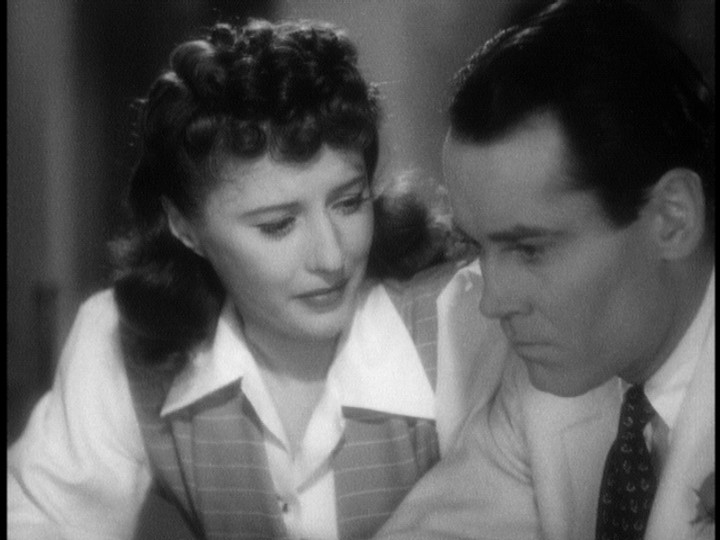
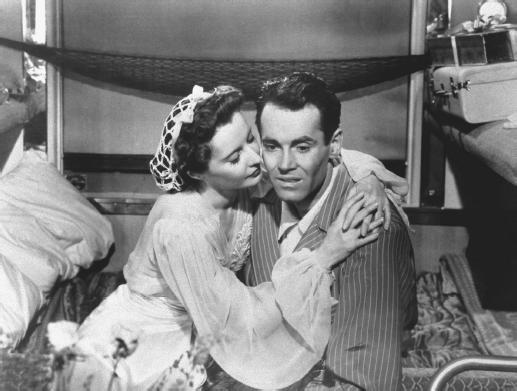
"The Lady Eve" (Preston Sturges, 1941) Ale heir Charles "Hopsey" Pike (Henry Fonda) has been up the Amazon for a year as an ophiologist (emphasis on the "oaf."). It must have been without a paddle because he can't tell two snakey grifters (Charles Coburn, Barbara Stanwyck playing a father-daughter con artist team—the family that preys together...) are trying to collect him...and his dough...on the cruise back to the States. She's already beaned him with an apple as he was boarding ship—it's not exactly Cupid's Arrow, but it'll do, in theory. After he gets hit, well, he's not a lot wiser.

Sturges' third film (and first big hit) is a distillation of every screwball romance that had come down the pike previously. As with the best screwball comedies, the woman has all the power and nobody could play power better or with more cruel humor than the ungainly
Barbara Stanwyck, here as fast as quicksilver and, frankly, a bit tough to keep up with—you want to watch it twice just to see all of her nuances you missed. Her opponent...object of affliction...affection...is a combination of every man-handled man-type that you can have in these comedies. "Hopsey" Pike is well-off, a specialist in his field but a tenderfoot out of it—he can spot snakes in the jungle but not in the grass—somewhat sheltered and clumsy, and saves money on casting Ralph Bellamy by playing his own stuffed shirt. And being on a boat ensures that the ground is never too sure under his feet, the better for the sweeping off of. And the best guy to "take" in a "confidence" game is somebody who doesn't have any.

Confidence, that is.

Henry Fonda didn't play many rubes, as there was always something steely under his baby-blues; you couldn't hide his intelligence and Sturges doesn't try, making Hopsey book-smart, but virginally inexperienced and shy. One would say clumsy, given the right circumstances, which is where Stanwyck's Eugenia comes in, with her foot in the aisle to trip him up, literally. Pretty soon, that becomes Sturges' short-hand for letting you know that "Hopsey" is falling for Eugenia, a 40's comedy substitute for attraction being physically evident.

But the best un-laid plans... Pretty soon, Eugenia is falling for Hopsey, as evidenced by her getting hot and bothered by his chosen field of study. "Slimey snake!" she yells as she wakes up from a nightmare.
Preston Sturges was always one for tweaking the censors, and with "The Lady Eve," he's more than suggesting by associations of culture and psychology what's going on here in a knowing way—the biblical way of knowing, complete with snakes and apples and falls from innocence.

Things get complicated as Eugenia must thwart her father's plans for fleecing the golden boy—she does actually care about him, but when Pike finds out what the two are up to, he breaks off with her, leaving her in a huff. If she was honest with him, he'd probably have done the same thing, so with that moral quandary and his making her feel cheap and all, she plots her revenge, with one of the best lines of spite to come out of Hollywood: "I need him like an axe needs a turkey!" Appropriate vindication mixed with a vindictiveness chaser ensues.

Well worth the time and effort to seek out, "The Lady Eve" is a shining example of how sophisticated and down-and-dirty Hollywood comedy could get. In 1994, "The Lady Eve" became part of The National Film Registry as being "culturally, historically or aesthetically significant."

Funny as the devil, too.


Friday, May 22, 2009

Anytime Movies Reloaded: Once Upon a Time in the West

It's Spring-Break for me. Times are busy. The Summer Movie Season is already begun (and I'll be writing about the new ones) and the Film Festivals are grinding away like creaky mills separating wheat from chaff. It's as good a time as any to re-boot a feature I started years ago, when it was suggested I do a "Top Ten" List.

I don't like those: they're rather arbitrary; they pit films against each other, and there's always one or two that should be on the list that aren't because something better shoved it down the trash-bin.

So, I came up with this: "Anytime" Movies.

Anytime Movies are the movies I can watch anytime, anywhere. If I see a second of it, I can identify it. If it shows up on television, my attention is focused on it until the conclusion. Sometimes it’s the direction, sometimes it’s the writing, sometimes it’s the acting, sometimes it’s just the idea behind it, but these are the movies I can watch again and again (and again!) and never tire of them. There are ten (kinda). They're not in any particular order, but the #1 movie IS the #1 movie.


Landscapes.

That’s what’s featured in
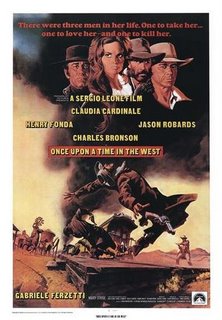
Sergio Leone’s “Once Upon a Time in the West.” Whether it’s the vast, aboriginal spaces of Monument Valley—an affectionate genuflection to the films of John Ford—or the intricately chiseled planes of the faces of Charles Bronson and Henry Fonda—you spend a lot of time looking at both in “Once….”—as well as deep close-ups of the faces of Jason Robards and Claudia Cardinale. There is one shot where Bronson ever so slowly relaxes a smile out of existence. Bronson does it so subtly you don’t know what’s happening until it’s happened. It’s one of the things I look forward to in the Dance of Death of “Once Upon a Time in the West.” Here are some others:


1. “Looks Like We’re Shy One Horse…” The first twelve minutes. A dilapidated train station in the middle of nowhere. Three long-coated bad-men wait for a train. They while away the time, each in their own unique fashion. Driven mostly by sound and filmed in extreme close-ups, the sequence, accompanied by the homely squeak of a windmill—one of the out-sized sound effects typical of Leone’s westerns—and the jokey placement of the credits, rolls on and on until a confrontation ends explosively. It’s an opening of great economy and intricate film-making. Few words are spoken throughout. I’ve shown students this sequence to show just how much presence and atmosphere simple sound effects can bring to a scene. Here’s the ending of the sequence. It’s just the opening gambit in a plot by two men who are playing against each other. It will take the entire movie to explain why.


2. “You Don’t Know How To Play” The gist of “Once Upon a Time in the West” is a chess game with lives and futures as the playing pieces. As scripted by Sergio Leone and his co-scenarists--the soon to be master of Italian horror films Dario Argento and the young Bernardo Bertolucci--the movie is a series of moves and counter-moves by the antagonists, each one trying to tame the frontier in their own way, and taking their own sweet time about it. Each has to make the pieces fall their way. For the first-time viewer it can be maddening following the strategems of the four participants in the story, but by the end the motivations and loyalties—or lack of them—become clear.


3. “People Scare Easier When They’re Dyin’” The villain of the piece is the meanest, rottenest most conniving scumbag to ever walk a dusty street and spit on it. “Frank” is a sadist who smiles when he kills and for the first time in his life he has a patron with a vision—one big enough for Frank to start to see how there might be such a thing as a future, and that one man can own it. He just can’t understand why people are getting in his way.


4. “Instead of Talking, He Plays. And When He Better Play, He Talks.” The composer and the director did it backwards.
Ennio Morricone wrote the music for the film first and Leone built his sequences around the music, playing it on-set to establish mood. There are two spectacular pay-offs--one in the previously mentioned Monument Valley sequence. But the other is at a train station where Claudia Cardinale, has just arrived from New Orleans to find no one to meet her. After a long wait (which is actually mercifully short for a Leone western) she decides to hire passage. Sounds disappear as she is seen through a station window talking to an official, and then the camera HEAVES up and over the roof, and in a burst of music reveals a burgeoning western town full of life and activity. It’s as if all of America is presented in that one astounding crane shot. My wife audibly gasped when she saw the shot in some movie clip program on TV, so stunning is the effect. And more than a little of the power of that shot is due to Morricone’s music and the angelic voice of Edda Dell’Orso, wordlessly cooing an ode to the country and to the protagonist around whom the movie and the future hinges.


5. “Ma’am, It Seems To Me You Ain’t Caught The Idea” For the first time in a Leone western, a woman is the hero, but like her predecessor—"The Man with No Name"—she is flawed and has some learning to do, and it’s up to Leone’s trio of men – another man with no name (going under the aliases of dead men), a wolf-like vagabond-thief, and the villain, Frank—to push, prod, blackmail, challenge and coerce her into a new role. It’s a role each man knows they’ll have no part of, and that, for a time, she is reluctant to fulfill. In the last shot of the film, she is seen bringing water to the railroad work-crew who will be bringing people and prosperity to what will be her town. It may seem a servile role, but as we pull away and follow the disappearing tracks to the frontier, leaving her to her future, she begins to bark orders, to direct and take charge. Her station will become a cornerstone of the push west. “This movie drips with testosterone,” a colleague once told me after a screening. Yes, but Leone includes a healthy shot of estrogen as, for the first time, he is dealing with a story that not only leaves the past behind, but also looks forward to the future.


Once Upon a Time In the West
-Only Angels Have Wings
The Searchers
Chinatown
Mr. Smith Goes to Washington
American Graffiti
To Kill a Mockingbird
Goldfinger
Bonus: Edge of Darkness

Tomorrow: Robots that go clunk!
Sunday: A "Scene" for Memorial Day
Monday: Our annual (now) Memorial Day War Movie review
Next week: We wrap up "Anytime Movies," bid them adieu, and start afresh.

Friday, September 5, 2008

John Ford's "Cavalry Trilogy"

Fort Apache (1948)
She Wore a Yellow Ribbon (1949)
Rio Grande (1950)


"This is the West, sir. When the Legend becomes Fact, print the Legend"

Chronologically, they're out of order. Two are in black and white. The third in glorious Oscar-winning color. Some characters appear in two of the three films. One man's story forms a character arc across two films, but you don't have to see both to know his story. They're all about honor. They're all about duty. They're all about family. They're all about the U.S. Cavalry during the move West. They're about carving civilization out of a rough-hewn wilderness.

And they're about the devastation of the Native people to achieve it. Ford would tackle the subject of the inherent racism behind that tragedy starting with The Searchers five years after the last of these films, then throughout the rest of his westerns. He touches on it in these films, in the duplicity of the white bureaucrats, military men and profiteers and you can see the crack forming in history as it occurred and History as it was presented in text...and the movies, as obvious as the crags etched into the location of all three films-the magnificent Monument Valley on the Navajo Indian Reservation.

And there is a fourth story not told in these films, but behind the scenes, of a film director bucking the studio system, and in so doing, casting a safety net to a civilization whose extinction was being chronicled, and often celebrated, in that system.


Fort Apache (John Ford, 1948)
At Fort Apache, a finger of civilization has poked through the wild west. For the U.S. Cavalry, the isolated post has become home to some of the families of the men, and so tensions are high--there is unrest among the Apaches, led by Cochise--and security is a priority. Brought in to lead the way is Civil War general Owen Thursday (Henry Fonda), an arrogant ideologue and martinet, with his own vision of the West that has nothing to do with reality.

Any similarity to George Armstrong Custer is strongly suggested—this at a time when the legend of Custer was still very much in keeping with his widow's intentions of keeping her husband in the most heroic of lights, aided and abetted by fawning newspapermen, nickel-biographers, covetous land-barons, and even the Anheuser-Busch company.*  Indeed, the "legend" of Custer would extend deep into the 1960's, decades after Ford's film.

Thursday takes no prisoners and no guff from his veteran cavalryman, Captain Kirby York (John Wayne), passed over for command of the fort, and who prefers a policy of negotiation. York doesn't blame the natives for the Apaches' anger, but, instead, the double-dealings of corrupt Indian agents. After watching years of uneasy relations shattered by Thursday's inflexibility, York must grit his teeth and watch as it leads to disaster, and then defend his superior officer's reputation for the good of the Corps.

Years later, in
The Man Who Shot Liberty Valance, the dictum behind York's reactions were spelled out plainly: "When the Legend becomes Fact, Print the Legend." York does what he does for the good of the Cavalry, but by promoting the myth. he is complicit in the further hard-nosed approach exemplified by Thursday and the decimation of the tribes.  The film's triumphant huzzahs to the U.S. Cavalry have a tinge of melancholy to them, as York's words are matched by a shot of riding troops in a pane of glass—a reflection.


She Wore a Yellow Ribbon (John Ford, 1949) Ford was encouraged by Wayne's performance in director Howard Hawks' Red River** to cast him as retiring Cavalry Officer Col. Nathan Brittles, a by-the-book cavalryman who bends rules until they almost snap. That includes personally negotiating with Cheyenne Chief Pony That Walks (Chief John Big Tree) to head off a bloody up-rising. She Wore a Yellow Ribbon is full of Ford's hi-jinx and low humor, with squabbling lovers (Joanne Dru, John Agar and Harry Carey, Jr.), drunken sergeants,*** and the imminent retirement looming. Ford had worked in color before (Drums Along the Mohawk) and his set-pieces are bright contrasts to the red clay of the Monument Valley dirt. There is one unnervingly beautiful sequence of a night-time trek through Monument Valley in the middle of a lightning storm, done over the objections of the Technicolor Consultant, who subsequently won an Oscar for their "work."


Along with Carey,
McLaglen and other members of the Ford stock company, a new face appeared--Ben Johnson, who in 1971, would win an Academy Award for The Last Picture Show. He was a horse wrangler and rider in Ford's productions and proved invaluable on the set. So much so that Ford rewarded him with a speaking part as Trooper Tyree, the Unit's invaluable scout, the first of many roles Johnson would play for Ford.

And it contains one of my favorite Ford moments: Wayne 's Brittles confronting the Chief Pony That Walks , played by Seneca Chief John Big Tree. In a quavering, ancient voice and shouting his dialogue, the old man still holds his own against Wayne, who usually blew other actors off the screen. "Hallelujah, Nathan! I am a Christian!" he shouts in greeting. His appearance must have given strokes to the "suits" in Hollywood. A native! Doing a speaking part! And you can't understand him! Why couldn't Ford get
Anthony Quinn or something?****

And here, we interrupt to tell a tale. An aside, certainly, but on a subject more important than movies. There's a reason Ford consistently shot his Westerns in Monument Valley. Pictorially, it has a lot to do with a representation of vast, uncivilized space--rough-hewn ancient structures that show no sign of man, an unmarked slate. But, practically, it was more than that. Monument Valley sits square in the Four Corners on the Navajo Reservation. And to use that location, Ford had to pay the tribe. If he'd gone to Arches National Park a day's drive away, the money would have gone to the State of Utah. But, Monument Valley, the tribe.

On top of that, Ford and his production team used the Native's as extras, stuntmen, horsemen, consultants--money in the pockets of each tribesman. Those long lines of native riders beading the horizon in Ford westerns? All paid employees. The women and children that stuff the frames of village shots are not merely there for "color." They were all paid to get the tribe through a tough winter in one of the more inhospitable environments on the continent. And the Chief John Big Tree, though he may have had difficulty with his lines (and probably learned them phonetically) was paid the highest scale, merely for speaking lines in the script. There is a reason there is a John Ford tourist center at Monument Valley, and why he was made an honorary chief. Ford's Westerns saved more Indians than were represented to be killed. And his politically incorrect first suggestions of white duplicity in the "taming" of the West (which would culminate in his films
The Searchers and Cheyenne Autumn--in which he endeavored to make a movie about "The Trail of Tears") began to seep the true story behind the "shoot-em-up's" and "Cowboys-and-Injuns" pictures which were a staple of American entertainment.


Ford's color sense and composition has a Master's eye.


Rio Grande (John Ford, 1950) To finance the third Cavalry film (after the $1.6 million budget of Yellow Ribbon), Ford turned to B-movie studio Republic Pictures. Ford yearned to make The Quiet Man there, but studio head Herbert Yates, with no confidence in the script, persuaded Ford to first make Rio Grande.

Rio Grande takes a look at the further career of John Wayne's Lt. Col. Kirby Yorke (he's sprouted an "e" on the end of his name, for one thing). Estranged from his wife (
Maureen O'Hara), posted to the frontier to protect settlers from attacking Apaches, with inadequate forces to do the job, Yorke is feeling a lot of pressure, especially when Phil Sheridan asks him to cross into Mexico to confront the renegades where they're hiding. Then, on top of that, Yorke's son is stationed to his troop. Throughout the course of the movie, Yorke comes dangerously close to becoming the type of commander his old superior, Owen Thursday, was.

Ben Johnson returns as Trooper Tyree, as does Victor McLaglen as now Sgt. Major Quincannon. Harry Carey, Jr. plays another role entirely.

Ford made other western during this time period--
Three Godfathers, his "Christmas Western," with Wayne, "Dobe" Carey and Pedro Armendariz, and Wagonmaster about the Mormon trek to Utah, with Ward Bond, Carey and Ben Johnson. But Ford's next film with a Cavalry presence would be "The Searchers," in which, accompanied by a jaunty Irish tune, the heroes of this trilogy would be responsible for the murder of women and children, and one of the main characters would turn to the other and question them "What'd they kill her for? She didn't hurt nobody!"

In The Man Who Shot Liberty Valance a newspaperman tells Congressman Stoddard "This is the West, sir. When the Legend becomes Fact, print the Legend," "becomes" in the sense of casting a better light on the Truth. Ford filmed his "Cavalry Trilogy" with that maxim in mind, and had even showed its employment in distorting History. Now, in the last part of his storied career, he would tear the Legend away to expose Truth, and show Americans in their entertainment, what was lost in winning the West.


* The beer giant commissioned a painting (below) that was distributed and hung in every saloon that carried their product.


* "I didn't know the dumb son-of-a-bitch could act!" he would remark to Howard Hawks.

** Played by Ford favorite, Victor McLaglen, whom Ford directed to a Best Actor Oscar for The Informer. McLaglen's character Sgt. Quincannon appears in the next Cavalry picture, Rio Grande, as well. There is a Sgt. Quincannon in Fort Apache, played by Dick Foran, rather than McLaglen. McLaglen plays the similar role of Sgt. Mulcahy in Fort Apache.


*** It was a common Hollywood practice to give the most prominent "foreign" role to white actors in make-up, and Ford was as much a victim of the practice as any director. In order to get his "Trail of Tears" epic Cheyenne Autumn made he was forced to use "name" stars such as Latinos Gilbert Roland, Dolores Del Rio, and Ricardo Montalban, and Italian Sal Mineo. Quinn, Mexican-American, has played Latino, Arab, Greek, Italian, Inuit, etc., etc.

Saturday, June 14, 2008

Young Mr. Lincoln

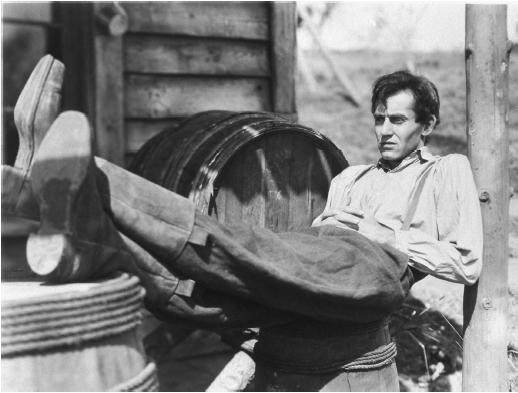
"Young Mr. Lincoln" (John Ford, 1939) Essential "John Ford at Fox" movie about the "jack-legged country lawyer" who would become the 16th President at the time of the nation's sundering. The film is filled to the bursting with fore-shadowing, from Abe playing "Dixie" on a jew's harp to encountering Stephen Douglas and Mary Todd to the penultimate shot of him striding up a storm-tossed hill lit by lightning (more on that later). Henry Fonda, heel-lifted, stiff-gated and nose-puttied plays Abe with a slow "drawrl" and far-away look, the film concentrating on the young Lincoln's learning and early practice of the law in Springfield, Illinois. Along the way he's haunted by the loss of his first love, Anne Rutledge and takes part in a murder case involving an angelic country family that stirs up feelings of home. Ford has a fine time skewering the pomposity of trial proceedings and the airs of high society.

The film is a prime example of the emotional mood swings that energized Ford's films.

But it also showcases the director's eye for composition and use of Nature to re-inforce story points. For example, there's this early scene where Abe and Anne tentatively express feelings. Anne is friendly with Abe, while he is tragically smitten. Ford frames them by a river where a great tree forms an arch extending from Anne and branches out to barely graze Abe.

The scene will end with Lincoln walking under that arch, alone, and throwing a rock into that swiftly-flowing river, its ripples starting a transition in time that will show the river clogged with ice, and a graveyard containing Anne's grave. In the background, a yearning violin piece serves as "her" theme, but also, generally, of memory and loss, as it keeps coming back throughout the film (23 years later, Ford would use it again in the same context in "The Man Who Shot Liberty Valance.")

And there's no denying the power of that almost-final shot (a more obvious studio shot serves as the last one, followed by Lincoln Memorial views) of Lincoln's film-ending hill-climb "goin' on a-piece." The bordering fence forming a barricade and the huge sky rumbling with thunder. It's one of the most beautiful representations of Destiny ever committed to film, from the film-laureate of History and nostalgia with a painter's eye and a poet's command of metaphor.

Monday, January 14, 2008

Once Upon A Time In The West

Landscapes.

That’s what’s featured in
Sergio Leone’s “Once Upon a Time in the West.” Whether it’s the vast, aboriginal spaces of Monument Valley—an affectionate genuflection to the films of John Ford—or the intricately chiseled planes of the faces of Charles Bronson and Henry Fonda, you spend a lot of time looking at both in “Once….”, as well as deep close-ups on the faces of Jason Robards and Claudia Cardinale. There is one shot where Bronson ever so slowly relaxes a smile out of existence. It’s one of those shots where you don’t know what’s happening until it’s happened, Bronson does it so subtly. It’s one of the things I look forward to in the Dance of Death of “Once Upon a Time in the West.” Here are some others:

1. “Looks Like We’re Shy One Horse…” The first twelve minutes. A dilapidated train station in the middle of nowhere. Three long-coated bad-men wait for a train. They while away the time, each in their own unique fashion. Driven mostly by sound and filmed in extreme close-ups, the sequence, accompanied by the homely squeak of a windmill--one of the out-sized sound effects typical of Leone’s westerns--and the jokey placement of the credits, rolls on and on until a confrontation ends explosively. It’s an opening of great economy and intricate film-making. Few words are spoken throughout. I’ve shown students this sequence to show just how much presence and atmosphere simple sound effects can bring to a scene. Here’s the ending of the sequence. It’s just the opening gambit in a plot by two men who are playing against each other. It will take the entire movie to explain why.


2. “You Don’t Know How To Play” The gist of “Once Upon a Time in the West” is a chess game with lives and futures as the playing pieces. As scripted by Sergio Leone and his co-scenarists--the soon to be master of Italian horror films
Dario Argento and the young Bernardo Bertolucci--the movie is a series of moves and counter-moves by the antagonists, each one trying to tame the frontier in their own way, and taking their own sweet time about it. Each has to make the pieces fall their way. For the first-time viewer it can be maddening following the strategems of the four participants in the story, but by the end the motivations and loyalties--or lack of them-- become clear.
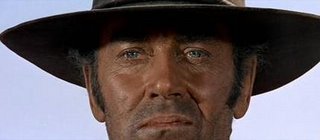

3. “People Scare Easier When They’re Dyin’” The villain of the piece is the meanest, rottenest most conniving scumbag to ever walk a dusty street and spit on it. “Frank” is a sadist who smiles when he kills and for the first time in his life he has a patron with a vision—one big enough for Frank to start to see how there might be such a thing as a future, and that one man can own it. He just can’t understand why people are getting in his way.
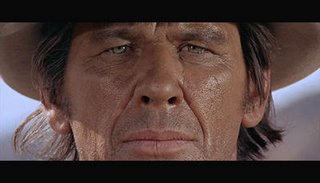


4. “Instead of Talking, He Plays. And When He Better Play, He Talks.” The composer and the director did it backwards. Ennio Morricone wrote the music for the film first and Leone built his sequences around the music, playing it on-set to establish mood. There are two spectacular pay-offs--one in the previously mentioned Monument Valley sequence. But the other is at a train station where Claudia Cardinale, has just arrived from New Orleans to find no one to meet her. After a long wait (which is actually mercifully short for a Leone western) she decides to hire passage. Sounds disappear as she is seen through a station window talking to an official, and then the camera HEAVES up and over the roof, and in a burst of music reveals a burgeoning western town full of life and activity. It’s as if all of America is presented in that one astounding crane shot. My wife audibly gasped when she saw the shot in some movie clip program on TV, so stunning is the effect. And more than a little of the power of that shot is due to Morricone’s music and the angelic voice of Edda Dell’Orso, wordlessly cooing an ode to the country and to the protagonist around whom the movie and the future hinges.
5. “Ma’am, It Seems To Me You Ain’t Caught The Idea” For the first time in a Leone western, a woman is the hero, but like her predecessor—The Man with No Name—she is flawed, and has some learning to do, and it’s up to Leone’s trio of men – another man with no name using the names of dead men, a wolf-like vagabond-thief, and the villain, Frank—to push, prod, blackmail, challenge and coerce her into a new role. It’s a role each man knows they’ll have no part of and that, for a time, she is reluctant to fulfill. In the last shot of the film, she is seen bringing water to the railroad work-crew who will be bringing people and prosperity to what will be her town. It may seem a servile role, but as we pull away and follow the disappearing tracks to the frontier, leaving her to her future, she begins to bark orders, to direct and take charge. Her station will become a cornerstone of the push west. “This movie drips with testosterone,” a colleague once told me after a screening. Yes, but Leone includes a healthy shot of estrogen as, for the first time, he is dealing with a story that not only leaves the past behind, but also looks forward to the future.
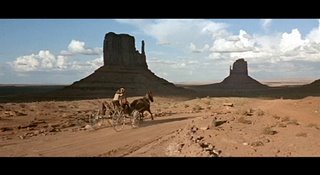

Anytime Movies are movies I can watch anytime, anywhere. If I see a second of it, I can identify it. If it shows up on television, my attention is focused on it until the conclusion. Sometimes it's the direction, sometimes it's the writing, sometimes it's the acting, sometimes it's just the idea behind it, but these are the movies I can watch again and again and never tire of them. There are ten. This is Number 3.


III: Once Upon a Time In the West


IV: -Only Angels Have Wings


V: The Searchers


VII: Chinatown


VIII: American Graffiti


X: Goldfinger