Showing posts with label Spaghetti Western. Show all posts

Saturday, January 5, 2013

Django Unchained

What's Black and White and Red All Over?
or
Wasted Away Again in Tarantinoville

One walks into any Quentin Tarantino film warily.  It's going to be a "cheese-fest," for sure, it's just a matter of the quality of presentation—because it is always going to be about cheese.

And it's always going to be about movies, rather than the subject or genre it revolves around.


But, that's all you can count on; one never knows what to expect (which is a good thing).  One also knows that there will be moments, and even whole sequences of clownishness where he can't help going off the rails of a disciplined narrative to succumb to some cackling goonishness.  Tarantino is a bad little kid.  He's also a major league slugger...who likes to aim for the dug-out and, contrarily, hits home runs.  When he pulls off a whole movie, as he has in the past (particularly Inglourious Basterds), it can be a thrilling wallow—challenging and cathartic; he's got such good ideas that nobody has thought before, even while he plunders others' right and left.  It's just that he can't separate good ideas from bad ones, maybe because the originating Tarant-ego can't discriminate which, because they come from the same source.


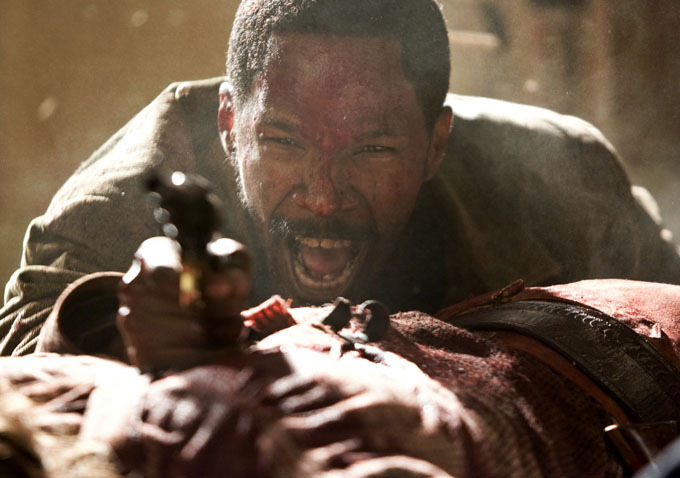
Django Unchained is his latest polyglot of a film, the influences coming from everywhere, the soundtrack a dog's breakfast of styles and eras,* a mixture of high camp, dark humor, and revenge fantasy/wish-fulfillment set once upon a time in the era of slavery, that, even though it rigorously evokes the time and place in design (The South, "1858, two years before the Civil War"), must bow to Tarantino's superficial wishes to what's "cool" in his own head.  There are a couple of scenes that immediately made me think "this is great" (a long, protracted discussion in a bar and a street between Django (Jamie Foxx) and his mentor/patron Dr. King Schultz** (Christoph Waltz) on the similarities between slavers and bounty hunters ("Like slavery, it's a cash for flesh business....Still, I feel guilty about it"), a presentation by Schultz of the Siegfried myth (before a cliff-side proscenium arch that only contains Django as audience), and a bizarre proto-Klan gathering played for Pythonesque laughs.  The set up in the first half of the movie is fine, even intriguing (while the inspirations wheel through your head—not so much Sergio Leone, as The Skin Game, Blazing Saddles, Rosewood), then everything falls apart when, in an effort to rescue Django's wife Broomhilda von Shaft*** (Kerry Washington) we get to Candieland, the plantation owned by the eccentric Calvin Candie (Leonardo DiCaprio), where things seem to go on and on and on and on, the humor dries up, and things turn nasty.  The proclivity towards going overboard while not really advancing the story takes over and becomes paramount, with extended shoot-outs, emphasizing the thinnest of blood exploding out of wounds as if every blood vessel were an artery.  Django Unchained becomes repetitive and, frankly, dull, then a little prematurely self-congratulatory.  

A lot of the problem is that Tarantino has written such a good set-up, that he can't top himself with a finish, and falls back on the action that is neither inspired or clever.  And that is a low-down, dirty shame, especially when it comes to the characters he's spent a great deal of time creating and setting up.  They're inconsistent—ironic, as one of Schultz's major pieces of advice to Django is "during the act, you can never break character."  And yet Schultz ultimately does as does most everyone in the service of getting to the popping blood-bags.  Drama comes from character and most of the individuals in the film break character in ill-considered ways as a quick means to get out of a writerly jam.  The ultimate goal of the piece is foiled by blunt actions  from characters who had previously survived by guile.  That Django must use the same tactics—along with a fistful of dynamite (which, by the way, hadn't been invented yet)  shows an inconsistency in the most important player of the thing, and the star of the show, Quentin Tarantino.  Indulgence is one thing.  Lazy indulgence that trashes the previous good work is quite another.  

Look.  One should never take Tarantino too seriously.  If you do, you're missing a lot of the manic joy of his films for films' sake.  And reverence for such irreverence on his part is more than a little counter-intuitive and weirdly contrary.  But, it is disappointing that the director reached a certain point with this one, and just said "Aw, why work so hard?  Let's blow some shit up" leaving a path of destruction that includes dozens of bodies, and one pretty good idea for a movie, once upon a time.

Django Unchained is a Rental.  
Wilhelm alert @ 00:50:00

Jamie Foxx's Django wears a sun-screening cowboy hat AND shades.
Remember that line from Once Upon a Time in the West
about a man who wears both a belt and suspenders?


* This one is all over the map: start off with Luis Bacalov's song for the Sergio Corbucci western ("with the kind participation of Franco Nero") done in a cross-bred Elvisian/Frankie Laine style, a lot of Ennio Morricone (including a piece that Tarantino thinks is "original" but actually comes from Two Mules for Sister Sara), a piece of Jerry Goldsmith from Under Fire, Verdi's Requiem, and songs like Richie Havens' Freedom, and...most bizarrely, Jim Croce's cheery "I've Got a Name" which he guillotine-edits right before the phrase "And I'm gonna go there free."  Hmm.

** Just realized: "Dr. King."  Heh.

*** See what I mean about Blazing Saddles?  Remember Lili von Schtupp?

Saturday, March 24, 2012

Butch Cassidy and the Sundance Kid

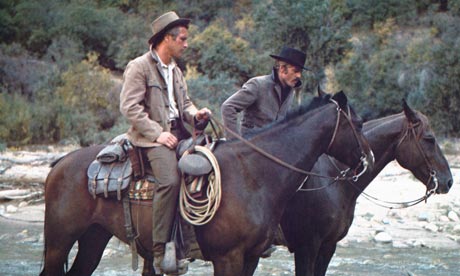
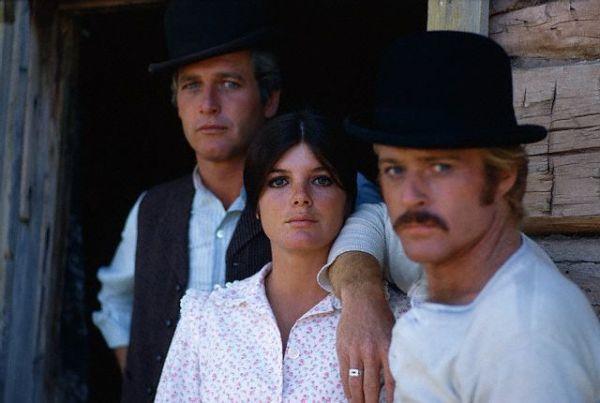
Butch Cassidy and the Sundance Kid (George Roy Hill, 1969)  It is probably for sure that Butch and Sundance were not as entertaining (or as well-scrubbed, with feathered hair) as Newman and Redford, nor that they rode bicycles to Burt Bacharach songs.  But then the originals didn't have William Goldman writing for them, either, and though the script starts by saying "Not that it matters, but most of what follows is true" you can bet that much more of it isn't.  As it is, it's not a history lesson.  It's a grittier version of the previous season's Cat Ballou (which had garnered Lee Marvin his Best Actor Oscar).

And, point of fact, I have a hard time thinking of it as a Western, despite the desert settings, the horse-chases, the posses, the train robberies, the clapboard houses, all the traditional acoutrements of the classic westerns, but done coyly, cutely, and with an eye towards having a good punch-line (but not much point).

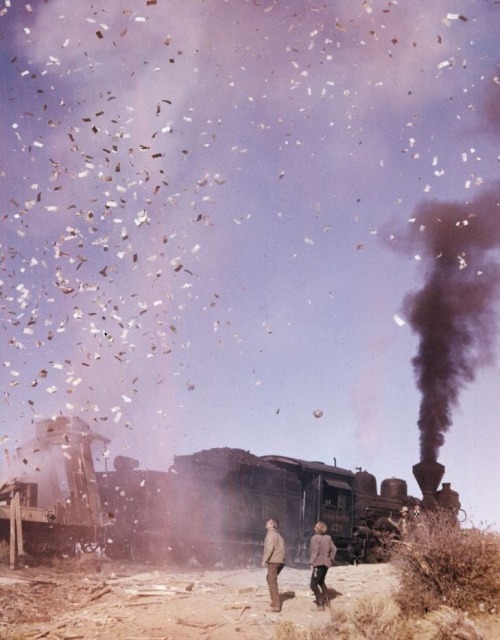
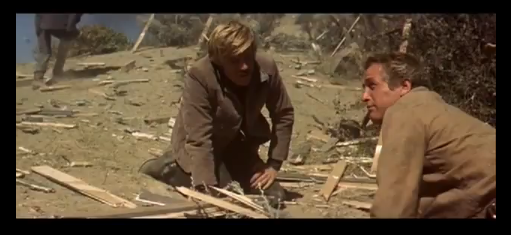
Where it does bear the stamp of a traditional western is its through-line of Butch and the Kid being temporary things, caught in the period between the Civil War and the Industrial Age, where the "old ways," with their easily slipped-through dependence on civilization (and the inherent difficulties achieving it in a frontier environment), are replaced by organization, technology, and machine-like precision that are a threat to outliers, dependent on improvisation and fast getaways.  The advancements of the 20th Century—bicycles and streets and (gulp!) dynamite—while all well and good, are an impending threat to scraping out an existence on the land, even if the way you do it is scraping other people's existence.  And as much as Butch and Sundance try to adapt ("Think you used enough dynamite there, Butch?"), it ends up blowing up in their faces.   It's why Butch's oft-repeated line (that always falls like a lead ballooon and a quizzically raised audience eyebrow) "I've got vision and the rest of the world needs bifocals!" only works in that context, and cluelessly ironically, at that.

No wonder they go to Bolivia.  It's still the Wild West down South, while the U.S. becomes gentrified and outgrows outlaws.  There's a serious thought in there amongst the yuck-lines and the counter-intuitive Bacharach bubba-bubba choruses glossing over action sequences.  As much as Hill, Goldman and Bacharach try to make it larky and fun, it's still doom-laden, without the inherent triumph of civilization over chaos that invigorates—and makes hopeful—most Western films. 

Though never arrested, the Hole-in-the-Wall gang are products of arrested development—a better name might be the "Stuck-in-the-Mud" gang—making the whole enterprise an exercise in feeling sorry for the kids who never grew up, or wised up, making the whole show a pitiable "Peter Pan" picture.

Entertaining?  Maybe.  But kinda dumb, too.

Next week: the story continues in a forgotten, better 2011 film

Friday, November 6, 2009

Gunfight at The Alamo Drafthouse

The state of the contemporary movie-poster is dire; it seems like more posters are being produced for films (for an example, check out all the posters for "Where the Wild Things Are"), but the art direction that goes into them is less than inspired. The fall-back position, the least common denominator for the studios, are a photo-shopped cluster of movie-star heads that say little about the movie, its content or its style (check out the galaxy of posters for this Summer's "Star Trek"). For someone like me that reveled in the work of Bob Peak, Tom Jung, Saul Bass, Frank McCarthy, Bob McGuiness, Howard Terpning, Frank Frazetta, and Richard Amsel, the flood of dismal posters littering movie theaters is too many courses of a bland meal.

But deep in the heart of Texas (the college town/artists' enclave/state capitol of Austin) there is a place where movie poster makers are artists first and press agents second, and that is in the funky movie palaces owned by The Alamo Drafthouse, that still display a showman's glee in presentation.

Including posters. Good 'un's.

Herewith, some unfamiliar posters for some familiar westerns:

Tuesday, September 2, 2008

Olde Review: One-Eyed Jacks

This was part of a series of reviews of the ASUW Film series back in the '70's. Except for some punctuation, I haven't changed anything from the way it was presented, giving the kid I was back in the '70's a bit of a break. Any stray thoughts and updates I've included with the inevitable asterisked post-scripts.

This Saturday's films in 130 Kane Are Marlon Brando's "One-Eyed Jacks" and Robert Altman's "McCabe and Mrs. Miller."

"One-Eyed Jacks" (Marlon Brando, 1961) This one's something of an oddity--it's the only film directed by the greatest "method" actor, Marlon Brando. But what you will see on the screen is really not the film that Brando made. You see, it's one of those stories where nothing really works right. Brando and a number of script-writers worked onthe screenplay for a couple of years. Stanley Kubrick was signed to direct and pulled out.* Then, Brando decided to direct it himself and shot a quarter of a million feet of film over a six month period at a cost of five million dollars. Supposedly, there was about 35 hours of film to edit down to a watchable size. Brando's cut was five hours long, but with some noticeable studio shooting, plot summaries were accomplished and got it down to its current two hours and twenty minutes. So it isn't totally Brando's concept.

What is there in those two hours and twenty minutes? A superbly acted film, based on a script that at times is intriguing and at times is dull cliche. It's a very wierd movie. It's wierd, but it does show that Brando certainly had an artistic eye for shots, camera angles, sequences that sometimes take the breath away. You'll also see excellent performances from a cast of Brando,
Karl Malden (before TV neutered him),** Katy Jurado, Slim Pickens, Pina Pellicer, Elisha Cook, and Ben Johnson..especially Ben Johnson.

Johnson first worked for
John Ford in his westerns and evolved into more than a great actor, but one of those genuine screen presences working in film today. When Johnson and another screen presence, Brando, play off each other in a scene, sparks fly across the screen. Those sparks were expected to fly between Brando and Jack Nicholson in "The Missouri Breaks," and never appeared. To see these two greats square off is one of the joys I had watching this film, and also, this film contains my favorite epitheit in all of cinema....

"Get up, you scum-suckin' pig!"

They just don't write 'em like they used to.

Broadcast on KCMU-FM on November 19th and 20th, 1975

Or over-write them. The parts that you can glean from the current cut of "One Eyed Jacks" (and no one is rushing to restore the full length version, certainly not Paramount Studios) suggest an idiosyncratic western with a gritty, grimy feel, which would have made it unique in the western-glut that was happening across theater and televison screens across America. Brando's fights were inelegant, and people looked like they got hurt. But the film is a cliche about Authority Figures and Oedipal Conflicts--Karl Malden plays a once-friend-turned-lawman named..."Dad." At one point, Brando's character is whipped in the street before a crowd of on-lookers, and if that doesn't convince you he's a Christ-figure, his tied outstretched arms just might.

Ulp! It starts to get so thick with things like that, you need hip-waders out in that desert.

* Kubrick says he quit because Brando was wasting a lot of time, and really wanted to direct it himself, so he moved on to a more worthwhile project.

** Malden was appearing in an American cop series called "The Streets of San Francisco," with a young actor of good parentage named Michael Douglas.


"Get up, you scum-sucking pig!" occurs at 3:55 in this video

Monday, January 14, 2008

Once Upon A Time In The West

Landscapes.

That’s what’s featured in
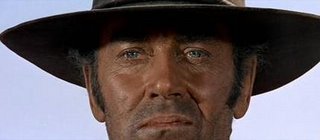
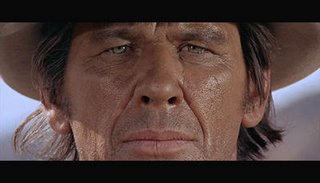
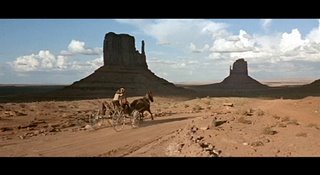
Sergio Leone’s “Once Upon a Time in the West.” Whether it’s the vast, aboriginal spaces of Monument Valley—an affectionate genuflection to the films of John Ford—or the intricately chiseled planes of the faces of Charles Bronson and Henry Fonda, you spend a lot of time looking at both in “Once….”, as well as deep close-ups on the faces of Jason Robards and Claudia Cardinale. There is one shot where Bronson ever so slowly relaxes a smile out of existence. It’s one of those shots where you don’t know what’s happening until it’s happened, Bronson does it so subtly. It’s one of the things I look forward to in the Dance of Death of “Once Upon a Time in the West.” Here are some others:

1. “Looks Like We’re Shy One Horse…” The first twelve minutes. A dilapidated train station in the middle of nowhere. Three long-coated bad-men wait for a train. They while away the time, each in their own unique fashion. Driven mostly by sound and filmed in extreme close-ups, the sequence, accompanied by the homely squeak of a windmill--one of the out-sized sound effects typical of Leone’s westerns--and the jokey placement of the credits, rolls on and on until a confrontation ends explosively. It’s an opening of great economy and intricate film-making. Few words are spoken throughout. I’ve shown students this sequence to show just how much presence and atmosphere simple sound effects can bring to a scene. Here’s the ending of the sequence. It’s just the opening gambit in a plot by two men who are playing against each other. It will take the entire movie to explain why.


2. “You Don’t Know How To Play” The gist of “Once Upon a Time in the West” is a chess game with lives and futures as the playing pieces. As scripted by Sergio Leone and his co-scenarists--the soon to be master of Italian horror films
Dario Argento and the young Bernardo Bertolucci--the movie is a series of moves and counter-moves by the antagonists, each one trying to tame the frontier in their own way, and taking their own sweet time about it. Each has to make the pieces fall their way. For the first-time viewer it can be maddening following the strategems of the four participants in the story, but by the end the motivations and loyalties--or lack of them-- become clear.


3. “People Scare Easier When They’re Dyin’” The villain of the piece is the meanest, rottenest most conniving scumbag to ever walk a dusty street and spit on it. “Frank” is a sadist who smiles when he kills and for the first time in his life he has a patron with a vision—one big enough for Frank to start to see how there might be such a thing as a future, and that one man can own it. He just can’t understand why people are getting in his way.


4. “Instead of Talking, He Plays. And When He Better Play, He Talks.” The composer and the director did it backwards. Ennio Morricone wrote the music for the film first and Leone built his sequences around the music, playing it on-set to establish mood. There are two spectacular pay-offs--one in the previously mentioned Monument Valley sequence. But the other is at a train station where Claudia Cardinale, has just arrived from New Orleans to find no one to meet her. After a long wait (which is actually mercifully short for a Leone western) she decides to hire passage. Sounds disappear as she is seen through a station window talking to an official, and then the camera HEAVES up and over the roof, and in a burst of music reveals a burgeoning western town full of life and activity. It’s as if all of America is presented in that one astounding crane shot. My wife audibly gasped when she saw the shot in some movie clip program on TV, so stunning is the effect. And more than a little of the power of that shot is due to Morricone’s music and the angelic voice of Edda Dell’Orso, wordlessly cooing an ode to the country and to the protagonist around whom the movie and the future hinges.
5. “Ma’am, It Seems To Me You Ain’t Caught The Idea” For the first time in a Leone western, a woman is the hero, but like her predecessor—The Man with No Name—she is flawed, and has some learning to do, and it’s up to Leone’s trio of men – another man with no name using the names of dead men, a wolf-like vagabond-thief, and the villain, Frank—to push, prod, blackmail, challenge and coerce her into a new role. It’s a role each man knows they’ll have no part of and that, for a time, she is reluctant to fulfill. In the last shot of the film, she is seen bringing water to the railroad work-crew who will be bringing people and prosperity to what will be her town. It may seem a servile role, but as we pull away and follow the disappearing tracks to the frontier, leaving her to her future, she begins to bark orders, to direct and take charge. Her station will become a cornerstone of the push west. “This movie drips with testosterone,” a colleague once told me after a screening. Yes, but Leone includes a healthy shot of estrogen as, for the first time, he is dealing with a story that not only leaves the past behind, but also looks forward to the future.


Anytime Movies are movies I can watch anytime, anywhere. If I see a second of it, I can identify it. If it shows up on television, my attention is focused on it until the conclusion. Sometimes it's the direction, sometimes it's the writing, sometimes it's the acting, sometimes it's just the idea behind it, but these are the movies I can watch again and again and never tire of them. There are ten. This is Number 3.


III: Once Upon a Time In the West


IV: -Only Angels Have Wings


V: The Searchers


VII: Chinatown


VIII: American Graffiti


X: Goldfinger