Showing posts with label 1969. Show all posts

Thursday, September 17, 2009

The Butcher

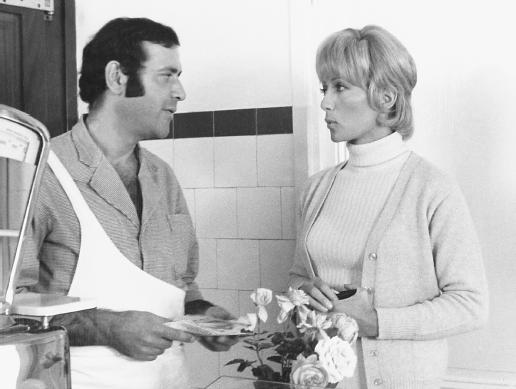
"The Butcher" aka "Le Boucher" (Claude Chabrol, 1969) Life is hardly a banquet if you're a serial killer.

Chilly suspense film of a Hitchcock blond (Stéphane Audran), a schoolteacher in a small provincial town, who strikes up a friendship with the local butcher and begins to suspect him of a series of brutal knife-slayings in the area. Chabrol, a former film critic, knows his film language down cold, and you look at his movies knowing that he's not going to waste a single frame without telling you something important in the process. Taking cues from Hitchcock and Hawks but making them his own, "The Chabrol Code" tells you what you need to know, even if Chabrol the director is holding back information or repressing emotions in his actors.

Chabrol the critic is not making his movies for himself, but for an audience, setting up its own mystery and for those who know why he chooses to shoot through a window (distancing, separating but transparent—an important element in a movie about craving...and carving) to make a point, the film is like a treasure chest of tiny clues to what is going on, even if it appears there's not a lot on the surface.

You have to cut deeper.

There, you'll find an odd romance of predator and prey. But which one is which is the question. Helene is blond, cold, her face impenetrable. The butcher Popaul (Jean Yanne) is tortured, subservient, a combination of both stalker and victim. She suspects him, and he suspects she suspects, and a perverse tango of attraction and repulsion locks them into a relationship that runs deeper than the marriage the town celebrates at the beginning of the film. Who will survive? Chabrol tells us from the opening credits: the fittest. And if the film doesn't exactly keep you on the knife-edge of suspense (all the deaths take place off-screen), it is because Chabrol is much more interested in the compulsions, rather than the actions they inspire. And his essay on the Nature of Man (or Woman), by way of the cinema of the past prismed through his own view-finder, makes "Le Boucher" prime cinema.

Saturday, November 22, 2008

Olde Review: Midnight Cowboy

This is a companion piece to the review of "The Sound of Trumpets" broadcast on KCMU-FM.

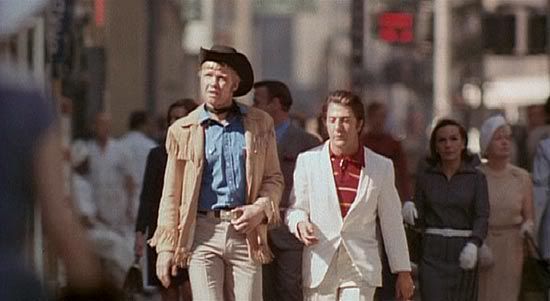
"Midnight Cowboy" (John Schlesinger, 1969) "Midnight Cowboy" is a film that has been vastly over-rated over the years. So has its director, John Schlesinger. I haven't seen one film of his that has been consistent—content-wise, or quality. Admittedly, Schlesinger does do some great things in his films. but never for long, and that goes for "Far from the Madding Crowd," "Darling," his marathon sequence in "Visions of Eight," and especially last year's "The Day of the Locust." Schlesinger couldn't even pull off a simple thriller like "Marathon Man" without laying it over with unnecessary cross-cutting and lead-balloon pretensions.

The problem? Schlesinger is a cold director and this coldness of attitude combined with a certain heavy-handedness in technique bring movement, but not life, to the subject matter. Add to this Schlesinger's off-and-on fascination with grotesques—as in "Midnight Cowboy"—and the situation is nearly impossible.

"Midnight Cowboy" begins well enough, with a rather multi-layered shot of an empty drive-in movie screen overlapped by the sound of thundering hooves. But not from the screen. From a nearby corral. Joe Buck is leaving the farm to go to New York; putting himself out to stud, so to speak. And Joe Buck's bus-trip to New York is very enjoyable with the exception of some coy flashbacks. But once the Big Apple has been reached, Schlesinger begins to feel the need to be...satirical. And his satire has all the subtlety of a brick through a window, as opposed to the subtlety of "The Sound of Trumpets."

Jon Voight gives a fine performance. Dustin Hoffman is all right (but his limp keeps changing, and Schlesinger keeps drawing attention to it!) But, above all, the best thing about "Midnight Cowboy" is the music for the film by John Barry, whose scores include those for the James Bond films and "Born Free." His music provided the best satire, the most feeling, and the best humor in the film. One of these days, I'm going to have to do a tribute to him.


Broadcast on KCMU-FM December 5th and 6th, 1976

That last bit referred to film score tributes, basically three minutes in length that I did for the station. Barry's still alive. His last score being for the Michael Apted film "Enigma." He didn't do the whole film, but he supervised the music, picking and producing the songs, and writing bits and pieces of score that worked gang-busters in the film.

Frequently, when typing up these elderly reviews from a kid I can't remember being, I've always resisted the urge to change them here. Or wished I could go back in time to tell this little twerp what exactly is wrong with his opinion, and I felt that urge this time when I started reading the review. After all, Schlesinger settled down and did some good things later in his career, and "Midnight Cowboy" remains to this day the only X-rated film to win the Best Picture Oscar, and it's still considered a "classic."

But have you sat through it lately? I mean, sat through all of it? It's a mess, jobbing about from one bit to another, and all those parts that are endlessly played on clip shows—"I'm walkin' heyah!," the final bus ride, Joe Buck's walk through the crowded streets of New York, including satire alert-satire alert the guy who's been assaulted (presumably) lying in the street and everybody's walkin' to the tune of "Everybody's Talkin'" (written by Fred Neil, sung by Nilsson) and....that's about it—are the parts that people remember. Maybe, just maybe, people have a better opinion of the film because they're expected to. It's a counter-culture classic, after all, like "Easy Rider" (and we all know what a masterpiece that is!) Reading through this review, I went from "You're being too harsh" to "Yeah, point taken." The things that bug me about "Midnight Cowboy" are the same things that bugged me then, and it had to do with direction, inconsistency, and just the gosh-awful look of some of those sequences. It's like Schlesinger took Mike Nichols' bag of tricks from "The Graduate" and decided to use them poorly. I'm surprised it won Best Picture, actually.

What was nominated for Best Picture that year? "Anne of the Thousand Days," "Butch Cassidy and the Sundance Kid," "Hello, Dolly," and "Z."


.............well, maybe I'm not surprised (though "Z" is a good film).

Tuesday, July 15, 2008

Olde Review: The Wild Bunch

This was part of a series of reviews of the ASUW Film series back in the '70's. Except for some punctuation, I haven't changed anything from the way it was presented, giving the kid I was back in the '70's a break. Any stray thoughts and updates I've included with the inevitable asterisked post-scripts.

This Friday's ASUW films in 130 Kane are Masaki Kobayashi's "Hara-Kiri" and Sam Peckinpah's "The Wild Bunch."


"The Wild Bunch" (Sam Peckinpah, 1969)

"When you side with a man, you stay with him and if you can't do that, you're like some animal! You're finished! We're finished! All of us!"
This is the credo of the films of Sam Peckinpah. Throughout his film career--even before Peckinpah had William Holden speak those words in "The Wild Bunch"--it has been the thread that has bound his films together, formed their basis, given them a purpose. And this credo doesn't just apply to a band of outlaws as it does in "The Wild Bunch," but also to employer and employee (as in "The Killer Elite") or to husband and wife ("The Getaway" and "Straw Dogs") and to former friends, even if they are on opposite sides of the Law, as in almost all of Peckinpah's films. In the realistic morality of Peckinpah's worlds, the combatants, though on opposite sides of their battlegrounds, are neither totally pure or totally evil. They are amoral, with aspects of both, and thus that credo--the credo of loyalty--is the only means we have of separating them and determining the better men.

Peckinpah has always been accused of being nothing but a "macho" film-maker, and though it may be true that he primarily focusses on the male world, I think the term macho is inappropriate. If "The Wild Bunch" are macho, they are blithely ignorant of it. They are not dedicated to their maleness as much as to their survival, and to the spirit of the credo.

Another thing that is popular to hit Peckinpah on is his use of violence--his explicit use of violence. And while "The Wild Bunch" is violent--even by today's standards
**--it might be wise to keep in mind the work of a lot of hacks around these days*** who make more violent films and do so with less imagination and regard for anything. Peckinpah's uses of slow motion violence are not prolonged, they are quick vignettes of an individual confrontation with death, that much like the life itself, is here, then gone, leaving an impression in one's mind no matter how many deaths one sees.

Also, it might behhove you to keep in mind that Peckinpah doesn't just make "Wild Bunch's" and "Straw Dogs'." He has made two recent films which I would urge you to see--"
Junior Bonner" and "The Ballad of Cable Hogue" which are boisterous but gentle, apply Peckinpah's credo, but also celebrates life. Not only are they my favorite Peckinpah films, they are his, too. The reason he doesn't make too many films like them is that they don't make money.

"The Wild Bunch" has an all-star cast, uniformly excellent in their roles:
William Holden, Robert Ryan, Ernest Borgnine,**** Ben Johnson, Warren Oates, Edmund O'Brien, Strother Martin, and L.Q. Jones(who, only incidentally, wrote and directed the film of "A Boy and His Dog"). These are just the stars, but this film is filled with people and faces that you will never forget. Nor will you ever forget the experience of "The Wild Bunch."

Broadcast on KCMU-FM October 28 and 29th, 1975

Tomorrow: "Hara-Kiri"


I'm still a big fan of "The Wild Bunch" and "Junior Bonner" and "The Ballad of Cable Hogue," and "Ride the High Country" and "Cross of Iron" and "Pat Garret and Billy the Kid," and "Major Dundee," now that they've been released in versions that are closer to the way Peckinpah intended them. Producers had a habit of hiring him and then firing him and re-editing his films themselves, and I think that had a lot to do with The Peckinpah Credo about loyalty. He wanted them to know that if you hired him, you'd better trust him to make the film, but there's always disagreement about that when the red ink starts to flow.

I think Sam would crawl into a bottle if he saw how corporate loyalty invaded politics to create administrations of co-conspirators who couldn't think beyond their loyalty to their jobs and bosses. It goes to show that too much of anything can turn into a problem.

"The Wild Bunch" grows more interesting with age as a film about the old guard being unwilling to change in the face of the modern world, and convinced of their own transitory nature, while sticking to their code. It also shows layers of greed, between the outlaws and the members of Ryan's gang that have no moral hedge against body-robbing. There's a very fuzzy moral line there, but Peckinpah's morality could be very fuzzy. As fuzzy as the world lets it, I suppose.

The film was made part of The National Film Registry by the Library of Congress in 1999.

** Not so true today. Nowadays, "The Wild Bunch" looks a bit tame.

***Don't know who I'm thinking of here, but maybe Tobe Hooper, and Paul Bartel.

****I've become convinced that Ernest Borgnine played one of the atypical roles of his life when he played "Dutch" Engstrom--who, from the evidence I see in the film, is gay (Ernest Brgnine?). Dutch doesn't join in with the Bunch's whoring activities, and his cries for Pike Bishop during the finale show a definite emotion more than loyalty. Of course, there have been gay sub-texts before in Westerns, and in the classic ones, long before "Brokeback Mountain" made it seem revolutionary (Well, yeah, if nobody was watching...) Peckinpah snuck it right by--that's why I like the director so much.

Saturday, June 7, 2008

The Italian Job (1969)

"The Italian Job" (Peter Collinson, 1969) The wife's fascination with Mini Coopers led to us to red-enveloping this, the decidedly more enjoyable version of the story that turned morose when brought to the 21st Century. This version has its tongue firmly planted in its British cheek, and its feet cemented in the swinging 60's. Newly released convict Charlie Croker (Michael Caine) is given the chance to carry-out a brilliant plan--seize four million dollars in gold bullion in Italy. Along the way scriptwriter Troy Kennedy-Martin ("Edge of Darkness") and director Peter Collinson throw in a bit of wily commentary, a disdain for foreign cars (more expensive Italian cars are destroyed in this film for the sheer visceral fun of it, and an Aston Martin DB4 trashed in revenge), and the loopiest car-chase in cinema history, all fine and noble reasons to check out this cult favorite.

The film starts disarmingly with a title segment set to a crooning
Matt Monro song (written by film composer Quincy Jones and lyricist Don Black) as a Lamborghini Miura is seen negotiating the hairpin turns of Italian Alps, just as you begin to appreciate the metaphor, the car enters a tunnel, a huge crash is heard, and the Miura is seen exiting the tunnel, wrapped around a bulldozer. Inside the car, the late Roger Breckerman (Rosanno Brazzi) who has been planning a job to steal the bullion sent from China to Turin as a proviso for Fiat to manufacture their cars there. The Mafia, getting wind of those plans, has killed Breckerman before the plan can be finalized, and to destroy the evidence the car is sent careening down the mountainside (the first of many such scenes).

Breckerman's widow recruits Croker to do the job as revenge for his murder, and for financial backing he goes right to the top--Mr. Bridger (the martini-dry Sir Noel Coward), head of a British crime syndicate, which he runs from his prison cell, entirely compromising the warden and staff to his needs. With Bridger's stern approval, the team sets off for Italy with its odd assortment of vehicles to pull off this mission: impossible and prove the superiority of British auto-works craftsmanship over its Italian equivalent.

The job, itself, is absurd but satisfying, the stunts arranged by car-artiste Remy Julienne, the cast headed by Caine, including Benny Hill as a perverse computer expert (good match, that). It's a trifle, but an entertaining trifle, far more satisfying in the memory than in the actual playing (which isn't that bad). That's what makes a cult classic, especially in the self-preservation society.

Monday, May 5, 2008

True Grit

"True Grit" (Henry Hathaway, 1969) Yeah, John Wayne got his Oscar for it, and I could harp that it's a performance both hammy and less disciplined than Wayne's usual output, and nowhere near Wayne at his best, but The Academy, in their sentiment-besotted wisdom, chose this as the film to finally honor Wayne, as they honored Bogart for, of all things, "The African Queen."

At least they acknowledged and honored them.


But it would be easy to dismiss "
True Grit," as just "the film that got Wayne the Oscar." It's a marvellous combination of rough action, gritty Western, social commentary and an Emancipation Tract. It's a post-modern Western that fits into the niche of Peckinpah and Leone (without the attention-grabbing direction and editing), and slots easily into Wayne's output, which is a nifty balancing act to pull off. And it's entertaining as all Hell.

Credit has to be given to
Charles Portis' original novel, with its prissy female narration, it's school-marmish way with the English language ("Jane Austen writes a Western"), and it's abundance of humor given the clash of style and subject matter--when Mattie Ross falls into a snake-pit, breaking her arm and leaving her vulnerable to rattlers, this is Portis' passage "I thought 'I am in a bad way.'" Fact is, Portis' book feels like it was written at the time, and, even though it turns the genre on its maiden-head, it could just as easily stand on the bookshelves with the pulps of the Old West and not reveal its academic pedigree. The actors' peculiar way with pro-nun-cye-ation makes a good dramatical equivalence. (sic)

Credit also the screenplay by Marguerite Roberts (who was black-listed, a fact that Wayne ignored when giving enthusiastic praise to the screenplay), and the no-nonsense, cut-to-the-bone direction of Henry Hathaway. The only fly-in-the-ointment is singer Glen Campbell's acting debut as "LaBoeuf" (heh), but even that works to the film's advantage--Campbell's such a "burr in the boot," his amateurishness "plays."*

Seeing the film as a young lad, I remember the extremely quotable Wayne dialog ("She reminds me of me!," or Wayne's admonition to his horse after having the temerity to fall on in after being shot: "Dammit, Beau...first time ya ever gave me reason ta...cuss ya"), and the near-occassion of violence--the severing of fingers (and it's Dennis Hopper's fingers--his presence, and Robert Duvall's, give the movie added re-visitation enjoyment) made quite the impression on me in a world dominated by Disney and television.
But as an adult, one appreciates Hathaway's eye for grand vista's (framing in the same painterly fashion as he used shadowy urban spaces in the 40's), Elmer Bernstein's mature background score that gooses when it needs to and keens in quiet moments,
Kim Darby's eccentric performance (did she ever play a normal human being?) made even more amazing in that she was deathly afraid of horses, and the latter half of the episode when Wayne takes the edge off Reuben J. Cogburn, and leans back into John Wayne pater-familias territory. My memory retains the image of snake-bit Mattie Ross being administered to at a trading post, and the camera heaving to the door-way holding a silent, unmoving John Wayne, eyes in shadow (of course, one's wearing an eye-patch!) doing nothing but watching not-helplessly, his hand up-raised on the door-frame, keeping danger away. God only knows how long he's stood at that door, or how long he will.

Perhaps that's why they gave him the Oscar--despite all the tinkering with the Western tradition, it still became a "John Wayne movie."

Or, maybe it's just because he wore an eye-patch. The Academy loves disability performances.


* I remember Wayne appearing on The Joey Bishop Show (the talk version) around the time of the movie's theater-run, and Bishop asking him "How was Glen Campbell's acting?," and Wayne paused...a wonderful example of how he used theatrics and his persona...and said, simply "He's a Hell of a singer."

Monday, January 14, 2008

Once Upon A Time In The West

Landscapes.

That’s what’s featured in
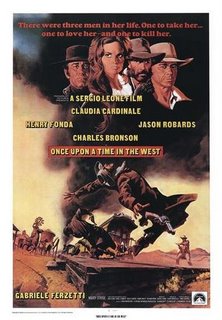
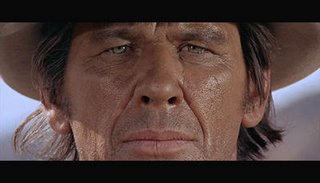
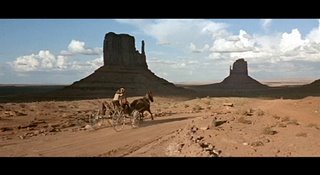
Sergio Leone’s “Once Upon a Time in the West.” Whether it’s the vast, aboriginal spaces of Monument Valley—an affectionate genuflection to the films of John Ford—or the intricately chiseled planes of the faces of Charles Bronson and Henry Fonda, you spend a lot of time looking at both in “Once….”, as well as deep close-ups on the faces of Jason Robards and Claudia Cardinale. There is one shot where Bronson ever so slowly relaxes a smile out of existence. It’s one of those shots where you don’t know what’s happening until it’s happened, Bronson does it so subtly. It’s one of the things I look forward to in the Dance of Death of “Once Upon a Time in the West.” Here are some others:

1. “Looks Like We’re Shy One Horse…” The first twelve minutes. A dilapidated train station in the middle of nowhere. Three long-coated bad-men wait for a train. They while away the time, each in their own unique fashion. Driven mostly by sound and filmed in extreme close-ups, the sequence, accompanied by the homely squeak of a windmill--one of the out-sized sound effects typical of Leone’s westerns--and the jokey placement of the credits, rolls on and on until a confrontation ends explosively. It’s an opening of great economy and intricate film-making. Few words are spoken throughout. I’ve shown students this sequence to show just how much presence and atmosphere simple sound effects can bring to a scene. Here’s the ending of the sequence. It’s just the opening gambit in a plot by two men who are playing against each other. It will take the entire movie to explain why.


2. “You Don’t Know How To Play” The gist of “Once Upon a Time in the West” is a chess game with lives and futures as the playing pieces. As scripted by Sergio Leone and his co-scenarists--the soon to be master of Italian horror films
Dario Argento and the young Bernardo Bertolucci--the movie is a series of moves and counter-moves by the antagonists, each one trying to tame the frontier in their own way, and taking their own sweet time about it. Each has to make the pieces fall their way. For the first-time viewer it can be maddening following the strategems of the four participants in the story, but by the end the motivations and loyalties--or lack of them-- become clear.
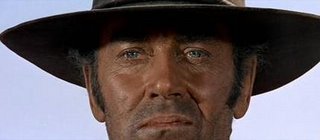

3. “People Scare Easier When They’re Dyin’” The villain of the piece is the meanest, rottenest most conniving scumbag to ever walk a dusty street and spit on it. “Frank” is a sadist who smiles when he kills and for the first time in his life he has a patron with a vision—one big enough for Frank to start to see how there might be such a thing as a future, and that one man can own it. He just can’t understand why people are getting in his way.


4. “Instead of Talking, He Plays. And When He Better Play, He Talks.” The composer and the director did it backwards. Ennio Morricone wrote the music for the film first and Leone built his sequences around the music, playing it on-set to establish mood. There are two spectacular pay-offs--one in the previously mentioned Monument Valley sequence. But the other is at a train station where Claudia Cardinale, has just arrived from New Orleans to find no one to meet her. After a long wait (which is actually mercifully short for a Leone western) she decides to hire passage. Sounds disappear as she is seen through a station window talking to an official, and then the camera HEAVES up and over the roof, and in a burst of music reveals a burgeoning western town full of life and activity. It’s as if all of America is presented in that one astounding crane shot. My wife audibly gasped when she saw the shot in some movie clip program on TV, so stunning is the effect. And more than a little of the power of that shot is due to Morricone’s music and the angelic voice of Edda Dell’Orso, wordlessly cooing an ode to the country and to the protagonist around whom the movie and the future hinges.
5. “Ma’am, It Seems To Me You Ain’t Caught The Idea” For the first time in a Leone western, a woman is the hero, but like her predecessor—The Man with No Name—she is flawed, and has some learning to do, and it’s up to Leone’s trio of men – another man with no name using the names of dead men, a wolf-like vagabond-thief, and the villain, Frank—to push, prod, blackmail, challenge and coerce her into a new role. It’s a role each man knows they’ll have no part of and that, for a time, she is reluctant to fulfill. In the last shot of the film, she is seen bringing water to the railroad work-crew who will be bringing people and prosperity to what will be her town. It may seem a servile role, but as we pull away and follow the disappearing tracks to the frontier, leaving her to her future, she begins to bark orders, to direct and take charge. Her station will become a cornerstone of the push west. “This movie drips with testosterone,” a colleague once told me after a screening. Yes, but Leone includes a healthy shot of estrogen as, for the first time, he is dealing with a story that not only leaves the past behind, but also looks forward to the future.

Anytime Movies are movies I can watch anytime, anywhere. If I see a second of it, I can identify it. If it shows up on television, my attention is focused on it until the conclusion. Sometimes it's the direction, sometimes it's the writing, sometimes it's the acting, sometimes it's just the idea behind it, but these are the movies I can watch again and again and never tire of them. There are ten. This is Number 3.


III: Once Upon a Time In the West


IV: -Only Angels Have Wings


V: The Searchers


VII: Chinatown


VIII: American Graffiti


X: Goldfinger