
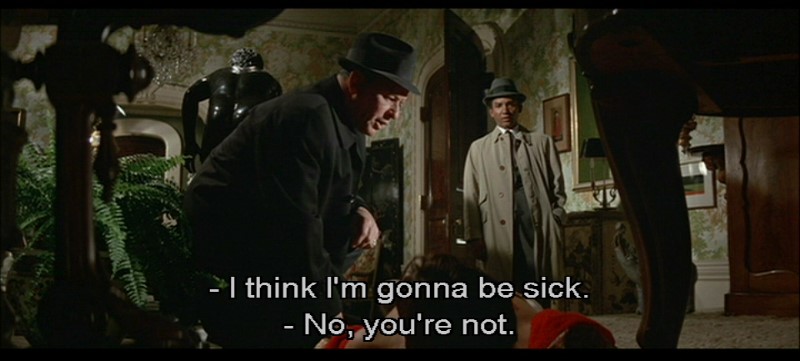
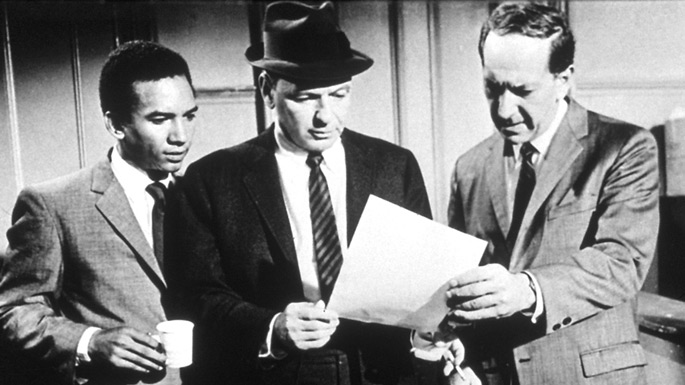
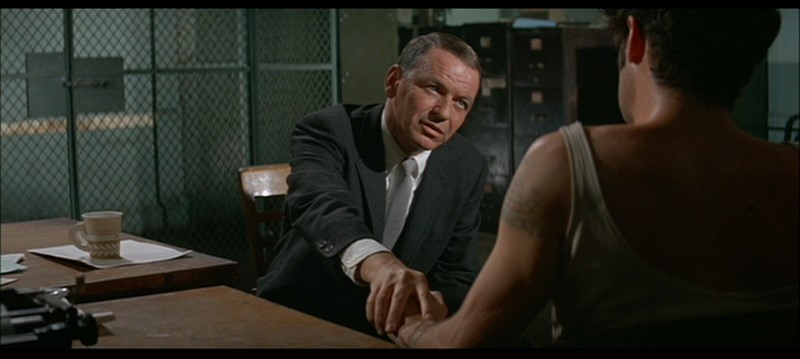
The Detective (Gordon Douglas, 1968) You spend a lot of time looking into the wearily dead blue eyes of Frank Sinatra in this one, as he tries to come to grips with a world he no longer understands, driving in the rain, looking for the clue to
where it all went wrong.
This film hasn't aged well. What was daring and "adult" at the time of the film's release (the forced underground homosexual culture, along with nymphomania) now seems dated and "quaint," even. More compelling, and ground-breaking is the police procedural in the foreground—a murder investigation that has a ritual aspect to it. The victim's house-mate (Tony Musante) is noticeably absent, and Leland leads the investigation to track the man down, leading to his arrest, trial and execution. Textbook, it's thought.
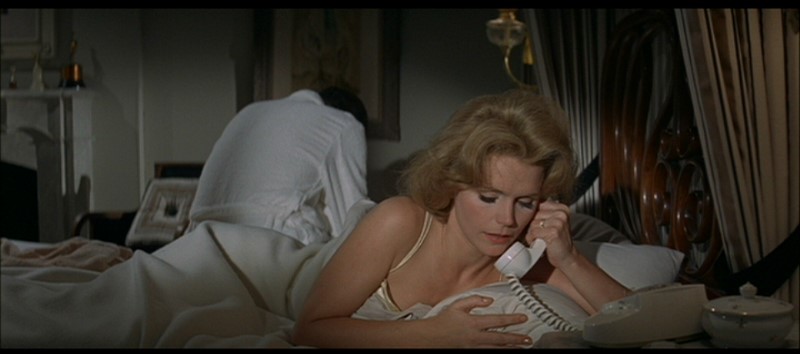
But, later, he's approached by Norma McIver (Jacqueline Bisset) the wife of a prominent suicide (William Windom), who committed the act very publicly, and Leland's investigation leads him to question his earlier actions and those of his authorities. All this, while reconciling his difficulties with his wife (Lee Remick). The fallibility of the cops to follow their prejudices, and pressure from corrupt superiors was something new to the genre. These cops had flatfeet of clay.
The director, Gordon Douglas, was a favorite of star Sinatra, shooting quickly and efficiently, letting Sinatra do his set-up's in the minimal number of takes that he preferred. The cast also has prominent roles for Ralph Meeker, Jack Klugman, Al Freeman Jr. and Robert Duvall as other detectives in Leland's squad.
There were other novels in the "Leland" series by Roderick Thorp, including one, "Nothing Lasts Forever,"in which The Detective tries to save his family from terrorists in a high-rise professional building. That's right, it's the book on which Die Hard was based. Now, just imagine if John McLaine had said "Dooby-dooby-doo" instead of "Yippie-Kye-yay..."
Wednesday, December 29, 2010
The Detective





Thursday, September 2, 2010
Get Low

"The Hell With It. The Hell With Me."
or
"An Old Nutter Attracts More..."
Twain coulda wrote this one: a hermit of 40 years makes his way into town to arrange his own funeral party (which he'd like to attend before it's required, thank you).
That "Get Low," which tells the tale, is based on a true story only makes it that much more enjoyable, even if the film itself turns dark, just as Twain woulda spun it. It is, when all is said and done, about a funeral.
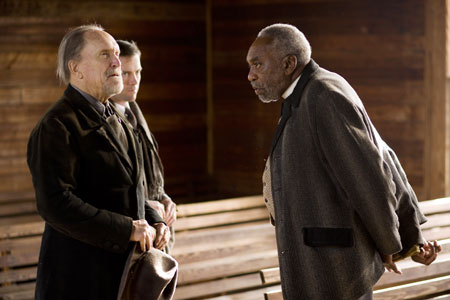
Frank Bush (Robert Duvall), who has lived apart from the Tennesee community, has developed a reputation as a "Boogie-Man"—for Duvall, this role is the push-back book-end to his "Boo" Radley from "To Kill a Mockingbird"—and gets it in his mind to arrange a "living funeral," where anyone who has a story to tell about him can and might. For local funeral home director Frank Quinn (Bill Murray), Bush's odd request is an opportunity to make a big score and arrange an ultimate funeral—whatever it takes, he'll do, even if the arrangements start to get a little bit out of his control. For Murray's Quinn, it's a movie-length warning of "It's your funeral..."
The poster above makes one think that it's a two hander, just Duvall and Murray, but this is an ensemble picture—a very meticulously cast one—with a lot of people, including Lucas Black, Sissy Spacek, Bill Cobbs and Gerald McRaney doing some of their most effective work in years. Spacek, in particular, is a marvel. This isn't one of her "splashy" roles, and she's been purposely de-glammed to take the blossom off her ripe strawberry features, but she still manages to make every define her character by the simplest of gestures, or by the "social smile" under pained eyes. Bill Cobbs plays a prickly minister acquaintance of Bush's, and makes the maximum potential out of a small role—like Duvall used to in his early career—with innate comic timing and a sense of doomed inevitability. His laugh brings a smile to the face. Murray does his best work in years. His Quinn is at heart an opportunist, but makes it look presentable (like any good funeral director!) with the look of feigned dignity and a melancholy elan.
But it's Duvall's picture—he's in most scenes—and one is tempted to call it Oscar-bait for the veteran character actor, as he hasn't had a role this big in years—the arc of the character turning from eccentric to tragic figure without betraying the characteristics on either end of the curve, displaying his capacity to create a living character, able to accomodate the trials and tones of the movie. Speaking in a voice like brittle rice paper, that flakes off bits of sentences at the end, his Bush is a courtly soul in need of definition. The old hermit, after spending 40 years in a self-imposed exile from the opinions of others, initially seeks their judgement, first as audience, and then as performer, seeking some ablution or absolution—a trial-run, if you will, in the court of public opinion, before being forced to succumb to the Final Judgement. It is confession and catharsis, timed with the death of one man, and the return of his widow to her home-town. Duvall's funeral speech is humble, contrite and confused, and the actor provides an amazing sonic counter-point to his recounting of the history that has dominated and colored his existence. His performance haunts, in the display of a haunted man.
Director Andrew Schneider, a previous Oscar winner for his short film work, manages to maintain a visual interest throughout the movie, observing events but never calling attention to itself observing. Characters are sometimes over-whelmed in the surroundings, and the scale of the film is sparingly in line with a small-town closeness. That the tone gradually shifts from quaint eccentricity to Southern Gothic is probably inevitable for a film that climaxes with a funeral, especially one that starts with humble beginnings and turns grandiose and complicated (in a movie turn towards melodrama that had nothing to do with the actual historical events of the real Felix Breazeale). But, without the added mystery, and "the story to tell," the film would have had no depth, and would have felt as shallow as a grave in a pet cemetary. The embellishments give the story added weight, and make the turns of events mean something, as opposed to just being an old man's fancy.
Well worth seeing.
"Get Low" is a Matinee.




 |
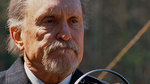
| The real Felix "Bush" Breazeale, attending his funeral in 1938. |
Tuesday, January 26, 2010
Crazy Heart
 "Breaking Bad" (I Used to Be Somebody, Now I'm Somebody Else)
At the end of each filmic year, theaters are filled to their google-plexes with all sorts of movies. Because of the Holidays, there's plenty of people wandering around major areas of assembly with the occasional two hours to kill, so Christmas is as profitable a time to the studios as Summer. Every conglomerate pushes and shoves to squeeze in one more blockbusting crowd-pleaser to blacken the year-end red ink.
Then there are the films that have been positioned to impress the critics' societies and are launched into Los Angeles and New York, so they can be eligible for awards, most pointedly The Oscars. And in that sub-category, there are the waifs—the ones that open in those markets and take a little longer to reach Biloxi, because, frankly, the studios would rather launch heavier weights during the Holiday Crunch, then release the films they feel will have only a niche market, that might have a respectable run in the projection booth, before reaching a more sizable audience in the rental market. The reason they're there is for the Awards, and usually for an acting honor to someone who does consummately good work, but has never played a "disease" role, or worn heavy make-up to win.
I'm talking about films like, recently, "Venus" with Peter O'Toole, "Being Julia" with Annette Bening, even last year's "The Wrestler" with Mickey Rourke. Earnest films with Oscar "buzz" for their stars, the kind that were mocked by Christopher Guest's "For Your Consideration."
This year's it's "Crazy Heart."
The story of an alcoholic country singer-songwriter, on a Southwest tour of what they call (in the biz) "toilets," merely reflects the downward spiral "Bad" Blake (Jeff Bridges) has put himself into. Perpetually boozed up, touring in the same old station wagon (old "Bessie") he used in the early days when he was more successful, his life is comprised of using things up and tossing them away—cigarettes, bottles of booze, ex-wives (five of them, maybe four, he can't seem to remember), he still has the talent—his reporter-inquisitor, a single mother (Maggie Gyllenhaal) from a Santa Fe newspaper that he begins a relationship with, says he can still toss off a song instantaneously that most people would struggle years to write—hasn't completely left him. But, that may be the last thing to go. He hasn't written a new song in years—the writing skills are there, but the inspiration has long ago moved on. It's one more thing taken for granted in a career that brought easy success that couldn't be maintained in the living of it.
The fur-bellied snark in me would say I'd been to this rodeo before in a fine film two decades back called "Tender Mercies," which spotlighted Robert Duvall (and in a mirror reflection, he has a small role in, and executive produced, this feature), and had more of a spiritual nature to it. There's no God in "Crazy Heart" (scripted and directed low key by Scott Cooper), as reality and responsibility is tough enough to fathom for Bad.
But it's a good movie for Jeff Bridges, who is always so good—his small part in "The Men Who Stare at Goats" was a comedic and dramatic gem, he being the only actor in it to quietly evoke deep sympathy, let alone belief—that he's always in danger of being taken for granted in the periphery of other folks' vehicles. This time, though, the spot-light's on him, and he's buttressed by a solid cast of actors lending their own mega-wattage to the brightness surrounding him. That includes Colin Farrell, buried deep in the credits to not attract attention, in a terrific performance that reflects kindly on his "mentor." Another nice thing is that T Bone Burnett and the late Stephen Bruton have composed clever, old-style country songs in the keys of both Farrell and Bridges, so they never seem less than authentic on-stage.
That extends to the story, too, which resists the epiphany lesser hands might have constructed. But like an old country song, the emphasis is on transitioning, rather than succeeding, maintaining rather than overcoming, in being rather than having dreams come true. Sometimes the triumph is in recognizing what one's taken for granted for so long.
Hope he gets that Oscar.*
"Crazy Heart" is a Rental.


* I say that with some caution because I know the "entertainment press" won't be able to resist saying that Bridges won for a "Bad" or "Crazy" performance.
Monday, October 26, 2009
The Natural
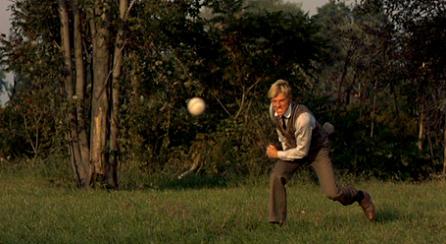
 "The Natural" (Barry Levinson, 1984) Bernard Malamud's novel "The Natural" took America's penchant for mythologizing its sports-heroes, and combined it with Arthurian legend to create one of the great sports novels of all time. The tale of a baseball player, Roy Hobbs (Robert Redford) appearing in Major League Baseball, seemingly effortless of bat and glove, creating miracles in the field, has all the elements of nature and the Divine (his bat, "Wonderboy", was carved from a tree struck by lightning), the contest (he strikes out "The Whammer" (based on "Babe" Ruth), trials (his father's death, a near-fatal shooting, lost love) and battles which weaken him and threaten his reputation. Malamud completes the connection with Legend, by making Roy Hobbes vulnerable to attack from within and without, finally defeated by the passing age and his own failings.
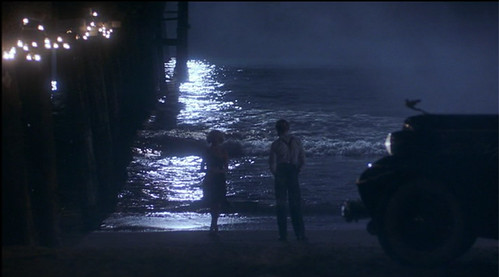
The film made of "The Natural" is all about the myth; Caleb Deschanel's pristine picture post-card cinematography, lovingly back-lit by a dying sun makes a past perfect to the eye. There are few films as lovingly shot as "The Natural," and Barry Levinson, learning to be a pictorial director rather than just a shoot-and-run cast-coordinator of his own material, turns the film into an article of his devotion as a sports lover. In fact, despite the intrusion of some adult material—the hanky-panky with a team "widow" (Kim Basinger) and Hobbes' earlier indiscretions, it is a small child's view of baseball, where grown men playing a kids' game are larger-than-life heroes, miracles happen on one's own efforts and the glories last a life-time. From such a viewpoint—at about the strike-zone—everything looks Legendary.





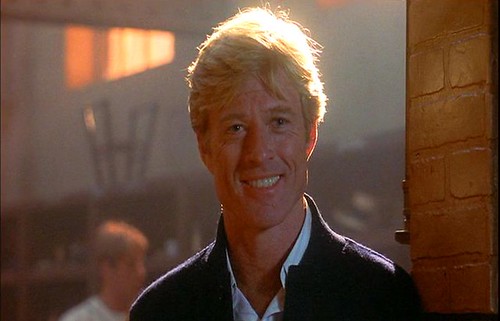
The cast is crowded with good actors doing some great work—not just Redford, whose own mythical presence of Aryan American brings its considerable WASP-ish weight to the story, but also Glenn Close, Wilford Brimley, Richard Farnsworth, Robert Duvall, Barbara Hershey, Joe Don Baker, Darren McGavin and Basinger. Layered over the top of the confection is Randy Newman's score—a combination of boogie-woogie, keening Americana and heraldic brass.*
Front-loaded with so much talent one would think of the natural as a grand-slam, the mythology built up to accentuate suspense** (Will Hobbs hit the game-winning home run? Will it kill him? What about his new-found family? Will the gambling interests destroy him, no matter what?) It comes down to the last pitch and a finale so overblown that the only thing that could top it would be Hobbs ascending into Heaven, forget the impossibility of the stadium-wide natural fireworks display of the type pulled off by Levinson and crew. The crowd I first saw it with burst into spontaneous applause at the denouement, so, obviously it was a hit with audiences, despite what I considered an error on the play. Me? I thought the game was rigged.
For in Malamud's novel, Hobbs strikes out, is damned by the press and public and fades away, a passing moment of the age, when miracles happened unsullied by the evils of the world like the Knights of Olde. Hobbs is defeated by the times. Not the movie-Hobbs, who is given his triumph and more, a return to simplicity, the sinking sun of previous shots now giving him a roseate glow,*** a Disneyfication of Malamud's intent.


* Redford, according to Newman, wasn't fond of the score: "I don't like horns" he was reported to have groused to the composer. Cooler heads prevailed. During an interview broadcast on Bravo, Newman said that there were half-hearted lyrics for the fanfaric Main Theme: "Look at that man/The Nat'ral/As nat'ral a man as can be/He hits the ball/And that's not all/So Na-tu-ral/Is he."
** I would put a "Spoiler Alert" on this review, but, really, the outcome is never in doubt, telegraphed by the score's hushed anticipation, and that everything joyous in the film, is presented in weighty slow-motion. Besides at that point in his career, Redford didn't want his characters to be weak—he had turned down "The Verdict," which pal Paul Newman snapped up and won a Best Actor Nomination.
*** The term used for those hours of twilight and dawn with the sun at its lowest point, providing long shadows, and a rose-colored glow is "Magic Hour."

Saturday, April 18, 2009
The Great Northfield Minnesota Raid
 "The Great Northfield, Minnesota Raid" (Philip Kaufman, 1972) Genre-busting western (following two years after the similarly revisionist "Little Big Man") by Philip Kaufman back in his wild indie days about the splintering of the Younger-James Gang, due to their most notorious crime, the theft of Northfield's First National Bank, "the biggest bank west of the Mississippi." Starring Cliff Robertson and produced by Robertson's production company, the film was obviously massaged as a vehicle for Robertson, if not for the fact that Robert Duvall makes the most of the weirder, more psychotic role of Jesse James, cutting through his scenes like a murderously sharp scythe through prairie wheat. By comparison, Robertson has the more central, but goonier role of Cole Younger—distractedly visionary outlaw cursed with an eye toward "wonderments" and other bright objects that tended to throw him off-task.
The world is on the cusp of change—one of those "wonderments" is a steam-powered organ that proves to be both a blessing and a curse to the Younger-James Gang's ability to fight authority, rob banks, and line their pockets in the process. Jesse can't be bothered with "wonderments;" they get in the way of his "visions" for their exploits, which come upon him in nearly incomprehensible rants. Cole, however, always wonders how the outskirts of the Industrial Revolution can make their burgling business a little easier (he sports a brine-soaked leather vest to protect him from bullets).* Pretty soon, they'll move from banks to trains and the stakes will get that much higher. But for the moment, their targets are stationary, and their tactics not unknown to today's white-collar criminals.**
That it was also the beginning of the end for the gang, with Northfield's populace turning on the bandits during the course of the prolonged robbery, ending their "Robin Hood" reputations, and leaving a couple of the gang dead in the street, shot by civilians. The romance with the criminals would go on (so long as they were dead and not stealing town-folks' money anymore) in fictional pulps (and Cole Younger would survive and go on the lecture circuit...yes, really), but the West changed around them as so many of these "sunset" Westerns of the 70's were showing, making them legends...and you have to past your prime (or dead) to be that. Kaufman's take on it is intermittently fun, long on ideas, but short on entertainment.
* Jesse could be seen as the evangelical, and Cole the scientific , world-views. No wonder they broke up. Jesse died 2 1/2 weeks before Charles Darwin died.
** Before the raid, they prime the pump by encouraging stories of the bank's safety, driving up deposits to ensure they make away with a huge haul. They could work for Enron!


Friday, January 30, 2009
Olde Review: The Conversation
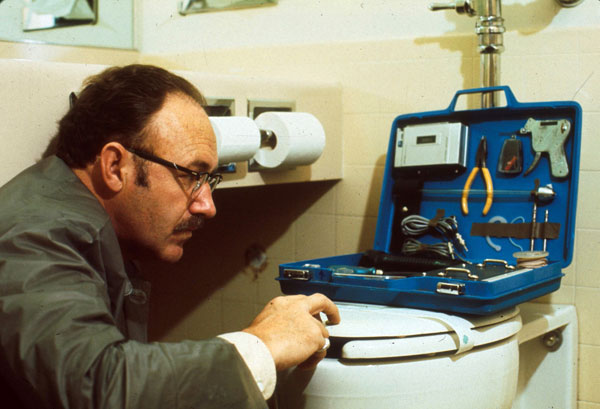
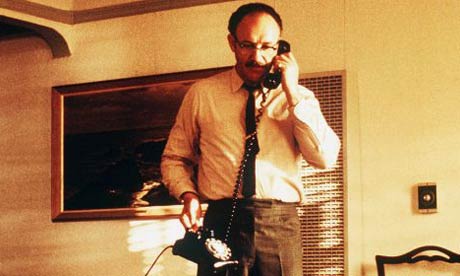
This was part of a series of reviews of the ASUW Film series back in the '70's. Except for some punctuation, I haven't changed anything from the way it was presented, giving the snarky, clueless kid I was back in the '70's a break. Any stray thoughts and updates I've included with the inevitable asterisked post-scripts. "The Conversation" (Francis Ford Coppola, 1975) Harry Caul (Gene Hackman) is an electronics expert dealing in surveillance. His latest assignment is to record a conversation between two very innocent young people in the park. It's a routine assignment, one that Harry handles with a perfectionist's care. But after he has the raw tape—after he has clarified it and re-channeled it—he hears a whispered fear that these two kids may get killed by Harry's employer. Old haunts plague Harry—past assignments he has carried out that led to his victim's deaths. And so he goes to confession to confess what may be a future sin. Confession—where one's private actions that are considered to be sins are revealed to a priest in order to free the sinner of guilt. But this too, is a surveillance—an invasion of one's privacy—ritualized in the name of religion. Surveillance is a part of our lives, then. And privacy is an illusion.
That scene in the confessional is about as close as Francis Ford Coppola comes to really dealing with surveillance in his film, "The Conversation." Despite what many critics have said, Coppola makes no judgements on this subject. Surveillance is simply there as a device to be used for the movie. It's neither good nor bad. It's there to provide Coppola with a means of getting into a rather shallow appearances-are-deceiving mystery story—it's a very weak imitation of Antonioni's "Blowup." When Harry Caul is caught in a surveillance trap ala his own devising, are we supposed to feel some satisfaction in this? Just because he's getting screwed, like he screwed all the others? Is surveillance justified in retribution, in other words? No. How can we take satisfaction in that? For surveillance — the ripping open of one's privacy — is being used, and nothing, really, not even revenge should make us condone it.
Awright, already, W______is it a good movie?
Okay, okay. Yeah, it's a good movie. It's...entertaining, in a shock-lull-shock-lull sort of way. Coppola has made a good movie, despite my reservations as to his morality on the subject. It's an o-k script—a little spare at times—with a lot of loose ends, and his direction is always assured. Gene Hackman manages to flesh out Harry Caul enough to make him an interesting person to watch for the couple of hours we do. And there is fine supporting acting from Allen Garfield, John Cazale (the weak brother, Fredo, in "The Godfather"), Frederic Forrest, Cindy Williams (she's good, despite the fact that she's totally mis-cast) and Robert Duvall (who is on for a very short time and doesn't receive a credit). But, the one thing that is technically outstanding is the sound of the film, produced by the work of its chief editor Walter Murch. Murch also worked on "The Godfathers" for Coppola, and creating what he terms "sound montages" for George Lucas' "THX-1138" and "American Graffiti." His talents with editing and sound mixing are outstanding,and hopefully Murch will, himself, be directing his own films.
Broadcast on KCMU-FM on January 27-28th, 1976
Murch would, indeed, direct one film (so far)—"Return to Oz," in 1985—and it tanked. His intention was to make a genuine adaptation of one of L. Frank Baum's "Oz" books, rather than what the public was expecting—a sequel to the 1939 classic "The Wizard of Oz." And his heart-felt, but scary, recreation of Baum's world didn't click with audiences. One would be sad if Murch didn't then personally supervise the entire post-production process of about one film per year. Films like "Julia," "The Godfather: Part III," "Romeo Is Bleeding," "The Unbearable Lightness of Being," "Ghost," "The English Patient," "First Knight," "The Talented Mr. Ripley," "K-19: The Widowmaker," "Cold Mountain," "Jarhead," and Francis Coppola's latest films. Busy guy. Eclectic talent.
This movie has dogged me my entire career, because it was assumed that, because Harry Caul could electronically filter out steel drums from the background of a murmured recording enough for you to hear what the people were saying that any sound facility could do it, too. No. Not really, you can't. You can tune, you can attenuate, you can try reversing the polarity of a channel to eliminate shared sounds on both channels of a stereo recording, but steel drums? That's a good one. They call that "Movie Magic."
But the kid is right...this is warmed-over "Blowup" without the illusion of film-making, or illusion of illusion that makes that film so compelling. At least it's better than cold, left-over "Blow-Up" like Brian De Palma's "Blow OUT" (in that, film recordist John Travolta must piece together a Chappaquidick-like incident from his sound-recordings and pictures taken from a "Zapruder"-like film--it doesn't pass the incredulity test). And Coppola has to resort to a "cheat"—he changes the actual recording, the one element in the movie that has to be set in stone, to come up with his conclusions. One could make a case...blah blah blah, the fact is, interpretation or not, he planted a card in the deck.
It is, though, a really good paranoid thriller of the type that seemed to be born of the post-Watergate era. And Hackman's insulated Caul is another example of how that actor can take an under-written part (deliberately, I should say--Caul doesn't talk much on purpose) and make him a living, breathing human being you can recognize and, despite his many failings, sympathize with. There is one actor I didn't mention because I didn't really know who he was...yet. He'd made a living doing parts on television, and done a small role in "American Graffiti," but after this film he was about to quit acting and go back to carpentry when a role in a sci-fi movie by Coppola's pal George Lucas changed things for him. Harrison Ford has a small role as "The Director's" menacing assistant.
Oh...the reason I made such a big deal of the confessional scene? I used that to start off the recorded version of this review.
In 1995, "The Conversation" was chosen to be a part of the National Film Registry by the Library of Congress seeing it as "culturally, historically, or aesthetically significant."




Thursday, June 19, 2008
Olde Review: The Godfather Part II
"The Godfather Part II" (Francis Ford Coppola, 1974)
Seanator Geary: "I despise your masquerade. The dishonest way
you pose yourself. Yourself and your whole fucking family."
Michael Corleone: "Senator, we're both part of the same hypocrisy,
but never think it applies to my family"
This Saturday's ASUW film in 130 Kane is Francis Ford Coppola's production of "The Godfather Part II."
Imagine the plight of Francis Ford Coppola. He is hired out of relative obscurity in the movie industry to direct "The Godfather" which becomes the #1 box office draw in history. Not being prone to attempt originality, Paramount Studios asked Coppola to make a sequel. Coppola agreed, stipulating that it be a more ambitious project, but above all else, it had to be necessary to "The Godfather" story.
Incredibly, it is. Part II needed to be told. And it is a better film than the original.
Part II tells two stories, the ones on either side of "The Godfather" time-wise: Before (between 1900 and 1940) when Vito Corleone (Robert DeNiro, played by Marlon Brando in the original) comes to America and rises to power; and After (between 1958 and 1963) when his son Michael Corleone (Al Pacino) is attempting to expand his empire, while, at the same time, losing his family. It is possible to enjoy Part II without seeing the original, but I don't think it would be as rich an experience. But don't worry about it. If you do, you might miss what is on the screen, which is considerable.
Vito Andolini (named Corleone by an uncaring immigration official) comes to America to escape a family-wide vendetta by the Don of Corleone, Sicily. He is only eight years old at the time. A vendetta of this type--the very strong against the very weak was never present in "The Godfather." All wars were between strong men, young and old. But in "The Godfather Part II," the differences between stalker and prey are more apparent, the difference between stalkers less so, for Vito Corleone in avenging his family's death, takes that revenge on the same Don, who has grown old and infirm and helpless.

Coppola perfectly captures the look and feel of New York's Little Italy in this section (which is almost completely subtitled so, again, go early if you want to read them, and understand what's going on)* In the Italian ghetto, families are kept close together, in fact, the community is kept close together by the conditions, and it is upon this unity that Vito Corleone builds his dynasty. He already has a family (an unquestioning wife, and sons who will follow in his footsteps) and friends, for whom he uses his power. Don Vito rises to power for the benefit of his family, his friends and for himself.


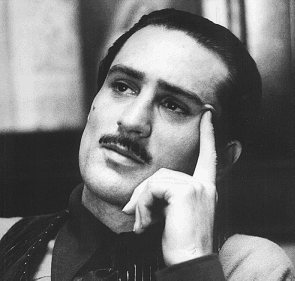
It is not that way for Michael Corleone, Don Vito's favorite son, onto whose shoulders the reign of his father has fallen. It is interesting to note that first Michael became Godfather, and then established his family, as opposed to his father, for the two men, as Coppola wishes to show, are completely different.

Above all else, Michael is a businessman in this film, manipulating everyone in his business dealings. The turnings and twistings of plot in Michael's sequences are subtle, very convoluted, so try to keep the names straight if you want to understand what is happening.

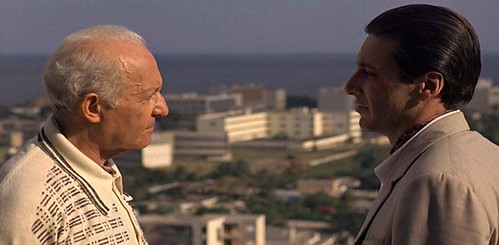
But the main point in Michael's story is that while he may continue his brilliant business career, he does so at a cost. Though he may be able to protect his family from outside forces, he cannot control the forces attacking his family from within. So that, at the end, Michael, though still powerful, probably the most powerful Mafia chieftain, is left alone, to brood over his success...and failure. Coppola who wrote and directed "Godfather II" said this soon after the film was made:

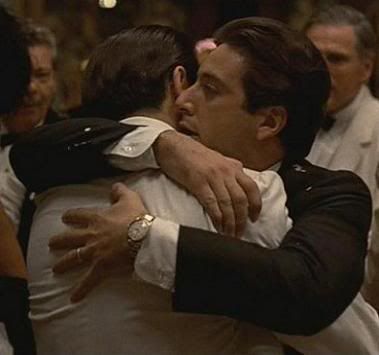
"One of the reasons I wanted to make 'Godfather II' is that I wanted to take Michael to what I felt was the logical conclusion. He wins every battle; his brilliance and his resources enable him to defeat all his enemies. I didn't want Michael to die. I didn't want Michael to be put into prison. I didn't want him to be assassinated by his rivals. But in a bigger sense, I also wanted to destroy Michael. There's no doubt that, by the end of the picture, Michael Corleone, having beaten everyone, is sitting there, slone, a living corpse...I admit I considered some upbeat touch at the end, like having his son turn against him to indicate he wouldn't follow in that tradition, but honesty...wouldn't let me do it. Michael is doomed.
I think we can be thankful that Coppola chose to elevate this film from what it might have been in other hands to tell us something extra about those two men--father and son--about our times, our country, and ourselves.
I wish I could talk more abou this film, but time prevents me. I will say that it is a beautiful fim, visually; done with genuine feeling and just a touch of spectacle. It is also very violent, though not as much as the original, that Pacino and DeNiro, in their respective parts are brilliant...and that it is being shown Saturday, October 9th at 7:30pm.
Broadcast on KCMU-FM October 8th and 9th, 1976
* Though it sounds smarmy and somewhat condescending, I think the issue was the seating at 130 Kane. Sitting in the balcony made it an eye-strain to read sub-titles, so getting a seat on the main floor was preferable.
In a post-"Sopranos" world, it is necessary to re-inforce that the "Godfather" movies weren't supposed to celebrate the Mafia, but cast them in a Shakespearean sense of tragedy. Michael may win his battles, but his descent into his own private Hell, the complete refutation of everything that his father represented, and the annihlation of the life that both father and son envisioned for him. Coppola always wanted to put the screws to Michael; to make him a King with riches but no heirs, and for all his success to lose everything that he should be valuing.
But, a lot of people just saw him winning all his battles. The hell with his family. The hell with his dreams. He was livin' large, man!
So when Coppola was enticed to make "Godfather III," he presented a withered, frail Michael, and tempted him with a clean slate, the re-unification of his family, and maybe a chance at happiness--a pure soul--and snatched it away from him, and closed the book on Michael's life.
But nobody liked that.
It is our custom in this country to venerate our villains. I've noted before that Marlon Brando was appalled when his biker bad-ass in "The Wild One" was embraced by the youth culture. In "Star Wars," Darth Vader was the coolest; in the prequels, when Lucas deconstructed Vader as a tragic figure...and worse, a lackey, it was rejected. Pacino's mui-loco-in-the-cabeza Tony Montana from "Scarface" is an icon now.
We venerate our villains. We tear down our heroes.
What's up with that?
Monday, May 5, 2008
True Grit
 "True Grit" (Henry Hathaway, 1969) Yeah, John Wayne got his Oscar for it, and I could harp that it's a performance both hammy and less disciplined than Wayne's usual output, and nowhere near Wayne at his best, but The Academy, in their sentiment-besotted wisdom, chose this as the film to finally honor Wayne, as they honored Bogart for, of all things, "The African Queen."
At least they acknowledged and honored them.
But it would be easy to dismiss "True Grit," as just "the film that got Wayne the Oscar." It's a marvellous combination of rough action, gritty Western, social commentary and an Emancipation Tract. It's a post-modern Western that fits into the niche of Peckinpah and Leone (without the attention-grabbing direction and editing), and slots easily into Wayne's output, which is a nifty balancing act to pull off. And it's entertaining as all Hell.
Credit has to be given to Charles Portis' original novel, with its prissy female narration, it's school-marmish way with the English language ("Jane Austen writes a Western"), and it's abundance of humor given the clash of style and subject matter--when Mattie Ross falls into a snake-pit, breaking her arm and leaving her vulnerable to rattlers, this is Portis' passage "I thought 'I am in a bad way.'" Fact is, Portis' book feels like it was written at the time, and, even though it turns the genre on its maiden-head, it could just as easily stand on the bookshelves with the pulps of the Old West and not reveal its academic pedigree. The actors' peculiar way with pro-nun-cye-ation makes a good dramatical equivalence. (sic)
Credit also the screenplay by Marguerite Roberts (who was black-listed, a fact that Wayne ignored when giving enthusiastic praise to the screenplay), and the no-nonsense, cut-to-the-bone direction of Henry Hathaway. The only fly-in-the-ointment is singer Glen Campbell's acting debut as "LaBoeuf" (heh), but even that works to the film's advantage--Campbell's such a "burr in the boot," his amateurishness "plays."*
Seeing the film as a young lad, I remember the extremely quotable Wayne dialog ("She reminds me of me!," or Wayne's admonition to his horse after having the temerity to fall on in after being shot: "Dammit, Beau...first time ya ever gave me reason ta...cuss ya"), and the near-occassion of violence--the severing of fingers (and it's Dennis Hopper's fingers--his presence, and Robert Duvall's, give the movie added re-visitation enjoyment) made quite the impression on me in a world dominated by Disney and television.
But as an adult, one appreciates Hathaway's eye for grand vista's (framing in the same painterly fashion as he used shadowy urban spaces in the 40's), Elmer Bernstein's mature background score that gooses when it needs to and keens in quiet moments, Kim Darby's eccentric performance (did she ever play a normal human being?) made even more amazing in that she was deathly afraid of horses, and the latter half of the episode when Wayne takes the edge off Reuben J. Cogburn, and leans back into John Wayne pater-familias territory. My memory retains the image of snake-bit Mattie Ross being administered to at a trading post, and the camera heaving to the door-way holding a silent, unmoving John Wayne, eyes in shadow (of course, one's wearing an eye-patch!) doing nothing but watching not-helplessly, his hand up-raised on the door-frame, keeping danger away. God only knows how long he's stood at that door, or how long he will.
Perhaps that's why they gave him the Oscar--despite all the tinkering with the Western tradition, it still became a "John Wayne movie."
Or, maybe it's just because he wore an eye-patch. The Academy loves disability performances.
* I remember Wayne appearing on The Joey Bishop Show (the talk version) around the time of the movie's theater-run, and Bishop asking him "How was Glen Campbell's acting?," and Wayne paused...a wonderful example of how he used theatrics and his persona...and said, simply "He's a Hell of a singer."