 "Juggernaut" (Richard Lester, 1974) With the letting loose of the whirlwind that is "2012" this week, I thought I'd pay homage to a neglected, but sterling example of the "Disaster Movie"—the modestly budgeted, very smart "Juggernaut." Made in the shock-wave of such star-culling epics as "Airport," "The Poseidon Adventure," "Earthquake," and "The Towering Inferno" that had the gall to ask: "Who Will Survive?" in its posters, "Juggernaut" played the same game. See? All the stars are lined up like ducks in a gallery reading to be pinged, just like those other all-star slaughter fests.
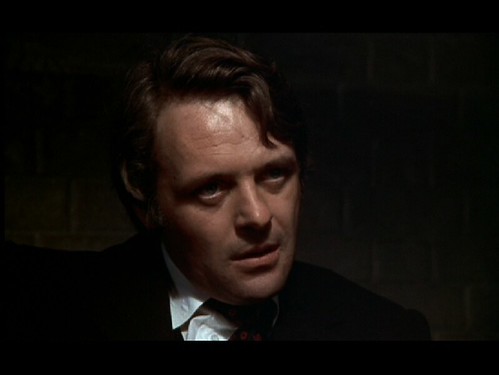
"Juggernaut" plays the game differently, though, while maintaining the conventions. This film is as soapish as the others in terms of interpersonal relationships. But in other disaster movies, people are collateral damage to the epic depiction of crumbling masonry. Lester's film is all about character—the "disaster" is man-made, the people at-risk are portrayed intimately, if not by stars, by strong character actors (Clifton James, Shirley Knight, Michael Hordern, Cyril Cusack, Julian Glover, Roy Kinnear—Lester's favorite buffoon is given a part to shine in this film—Ian Holm, a pre-fame Anthony Hopkins) you begin to care about. The cast is filled with faces who would become more familiar in later roles, but the two leads are Omar Sharif at his dyspeptic best as the Captain of the threatened ship and Richard Harris, who was never better than he is in this movie.
The cruise ship SS Britannic is half-way across the Atlantic Ocean when the line's president (Holm) receives a phone call from "Juggernaut" saying there are seven barrels of high explosive rigged to go off the next day at a predetermined time. Unless a ransom is paid, the bombs will go off and the ship will sink. With the ransom, instructions to defuse the bombs will be sent. Any attempt to defuse the bombs will casue them to explode. Holm's president wants to pay the ransom quickly, but the British government threatens to pull his operating subsidy if he negotiates with terrorists. While Hopkins' Scotland Yard detective attempts to find "Juggernaut," bomb expert Tony Fallon (Harris) and his crew are sent out to the Britannic, dropped in the ocean, and clamber onto the boat.
The focus shifts to Fallon, who sees all defusing jobs as a form of psychology—he's not trying to figure out the bomb, he's trying to figure out the man who made the bomb, and the tense scenes of Fallon examining one bomb to relay instructions to his crew are a whispered monologue of a man on the edge of death attempting to read the mind of the puzzle-maker in a battle of wills.
For director Lester, who is fond of games and puzzle solving, the film is one of his obsessions brought to life with the bomb design being particularly devious. Given its nature, one is put immediately into the Fallon mind-set that he is battling a man and not a bomb. And it is this interplay, where one man must rely on his skills and his knowledge, rather than the tides of Fate, that make "Juggernaut" sail past the other films in the sub-genre.
Friday, November 20, 2009
Juggernaut



Tuesday, May 19, 2009
Anytime Movies Reloaded: Chinatown
It's Spring-Break for me. Times are busy. The Summer Movie Season is already begun (and I'll be writing about the new ones) and the Film Festivals are grinding away like creaky mills separating wheat from chaff. It's as good a time as any to re-boot a feature I started years ago, when it was suggested I do a "Top Ten" List.
I don't like those: they're rather arbitrary; they pit films against each other, and there's always one or two that should be on the list that aren't because something better shoved it down the trash-bin.
So, I came up with this: "Anytime" Movies.
Anytime Movies are the movies I can watch anytime, anywhere. If I see a second of it, I can identify it. If it shows up on television, my attention is focused on it until the conclusion. Sometimes it’s the direction, sometimes it’s the writing, sometimes it’s the acting, sometimes it’s just the idea behind it, but these are the movies I can watch again and again (and again!) and never tire of them. There are ten (kinda). They're not in any particular order, but the #1 movie IS the #1 movie. This is the one of the “Anytime Movies” that falls into the category of “Lost Causes and the Futility of Good Intentions,” but lest anyone think these films are depressing, they’re not.
Well, okay, this one is.
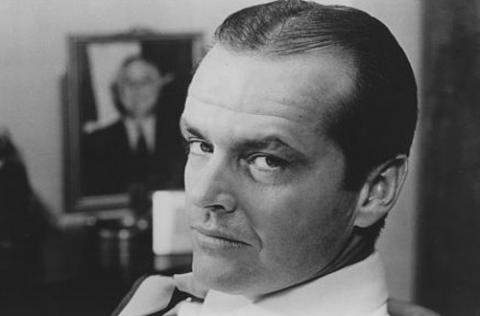
It’s also perfect. Given the nature of the trio of men who oversaw its creation—screenwriter Robert Towne, director Roman Polanski, and producer Robert Evans—the thing could have self-destructed like a fragment grenade. And, in fact, the planned trilogy of films featuring detective JJ “Jake” Gittes investigating three big California crimes (water, land, and nuclear) stopped after the personality clashes that derailed the first attempt at filming “The Two Jakes.” Polanski couldn’t set foot on American soil due to rape charges, and Evans (who was producing and co-starring) and Towne (writing and directing) clashed on the set. The combination of expanded roles and ego following the first film’s success shut down production, and it was only the efforts of star Jack Nicholson, who took over directing, that allowed the film to be made. They say that great films need a miracle – “Chinatown” had it, but “The Two Jakes” didn’t have a prayer.
“Middle of a drought and the water commissioner drown. Only in L.A., huh?”
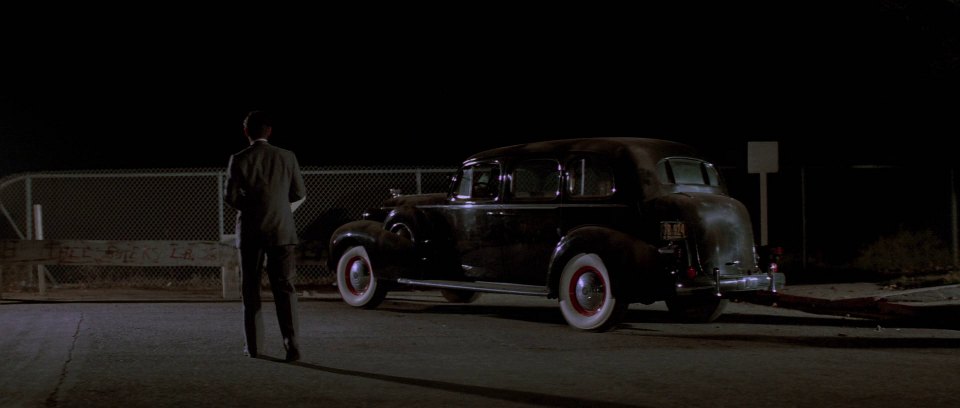
Based loosely on the construction of the William Mulholland designed aqueduct, and the real estate swindles it engendered, “Chinatown” starts out as a mystery even more steeped in the locale of L.A. than Chandler’s Marlowe stories. Here, the very city is a part of the crime and corruption is steeped in its soil and water. Water is the heart of “Chinatown.” Its ebbs and flows are constantly monitored –the original object of investigation is the city’s head of the Department of Water and Power who then becomes the victim of a grisly murder. Water is never too far from the surface of the story. Even Jerry Goldsmith’s shimmering score suggests water in its low harp trills, and the sighing of, yes, water phones.
“Chinatown” gets all its details right—the language, the costumes—Richard Sylbert’s period work is amazing, and a perfect cast makes the most of Robert Towne’s wise-acre dialog. A perfect cast? Right down to the smallest part. There’s a favorite moment of mine when Gittes, after badgering the secretary of the new head of Water and Power, is distracted by an odd squeaking noise. He, of course, has to investigate, and opens the outside door on the two work-men who are scraping the dead man’s name off the door. The one guy looks irritated—the other guy smiles, nods, and as the door is closing shakes his head ruefully—“Happens every time.” It’s a tiny little moment that feels so authentic, so much more than a mere movie might provide, it provides a moment of truth in a continuous string of truths.
But, that is a moment you can appreciate as it happens. “Chinatown” lives on in the memory. After the mystery is solved, moments come back, as the pieces come together and the journey to the conclusion coalesces. They haunt. On repeat viewings, “Chinatown” is a treasure trove of call-backs and foreshadowing’s.* Little things, like the odd cadence of a name, mispronunciations that can be traced back, a birth-mark—lead you downstream to a resolution that you should, in retrospect, have seen all along. Like Gittes, its only at the end that you get the full story. Of course, like him, you follow the most obvious things that seem out of place or arouse suspicions. ** But the world is a more complicated place and long after the film is finished does it strike you that the two most suspicious people while watching the film are actually the most decent and altruistic ones acting with the best of intentions. Of course, in this world they come to a bad end.
“Do you know how long I've been in this business?”
And here’s where that mix of personalities comes in. Towne’s screenplay is very grey—Jake Gittes at the beginning of the film—the very beginning—gets angry and abusive with his moaning client, Curly (In the film, there’s only an impatient irritation). Later dialog casts a sympathetic spin on water magnate Noah Cross. The original screenplay ends with, if not a happy ending, then a triumphant one. Evans loved the screenplay (though he didn’t quite get it), but in one of those odd bursts of inspiration that sustained him throughout an eccentric career as a producer, decided that the film needed a European sensibility, and so, brought in Polanski, who had left the country and Los Angeles following the murder of his wife Sharon Tate by the Manson family. His perverse take on the city and the material focused it, and made a stronger delineation between good that is good and evil that is truly evil—and provided the ending that doomed those most in need of rescuing. “Chinatown” ends in shock, and with a sense of tragic inevitability. That Jake, in a moment of selfishness and hubris, sets up a series of events that ends up completely bollixing up his good intentions, completes a circle and a character arc that had been percolating below the surface the entire time. He ends up ignoring the lessons he learned in Chinatown (the district, not the film), and paying the same consequences. The final words are ironic--“Forget it, Jake. It’s Chinatown.” Forgetting isn’t his problem. Remembering is. Towne would hammer the point home with the last line of “The Two Jakes”—“Kitty! You never get over it.”
But by that time it wasn’t necessary to say.




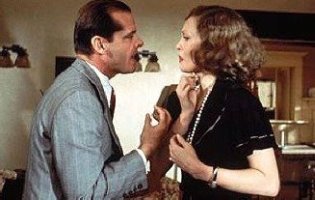
Jake wants the truth.
He can't handle the truth.
** Towne’s screenplay is so fully formed that, unlike Chandler’s Marlowe stories, a first person narrative isn’t necessary. We are always aware of what Gittes is doing, and thanks to Nicholson’s performance, what he’s thinking.
Chinatown
Mr. Smith Goes to Washington
American Graffiti
To Kill a Mockingbird
Goldfinger
Bonus: Edge of Darkness
Thursday, August 14, 2008
The Taking of Pelham One Two Three (1974)
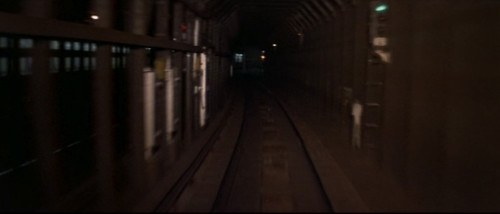
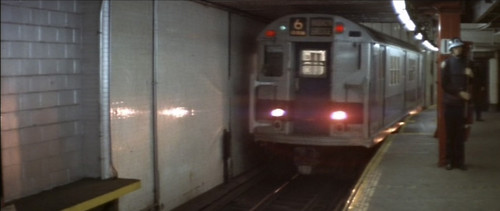
"The Taking of Pelham One Two Three" (Joseph Sargent, 1974) Taut, no-frills caper thriller about the hi-jacking of a New York subway train by a group of color-named conspirators. Veteran director Joseph Sargent and cinematographer Owen Roizman create a gritty landscape of dark passages and harsh fluorescent lighting while the Transit police try to negotiate with the hi-jackers, and the hi-jackers deal with their internal squabbles and a subway car of jumpy New Yorkers. It's like anything: Nothing's easy.
This was the first of more adaptations than necessary (a TV version was broadcast in 1999 with Edward James Olmos and Vincent D'Onofrio, and Tony Scott is making a new one with Denzel Washington and John Travolta) of John Godey's novel, but is the best of the bunch, having the advantage of a witty script penned by Peter Stone, screenwriter of "Charade" and the musical "1776." Stone realized the bare-bones plot of the novel wouldn't sustain a movie, and fleshed out the characters with a jokey, schlumpfy "attitude" that keeps the slow parts entertaining, especially when played by two character actors like Walter Matthau and Jerry Stiller. Matthau gets the advantage of playing a fairly straight character with a muffled humor, while Stiller makes the sarcasm of his dispatcher as dry as Brooklyn dust. By contrast, the hi-jackers (Hector Elizando, Martin Balsam, Earl Hindman, led by Robert Shaw) are twitchy no-nonsense cyphers cloaked in anonymity. It's the cops who are the interesting ones, as they race against time to secure a million dollars in ransom and deliver it before hostages begin being killed.
The direction and lighting take their cues from the documentary style of "The French Connection,"* as does the funky score by David Shire, but Stone's script is the factor that nudges the film beyond its thriller origins and give it a cynical style.
In fact, it is so well done, that one questions the need to do another version.
*Owen Roizman was the DP for that film, as well.


Wednesday, August 13, 2008
Olde Review: Chinatown
"Chinatown" (Roman Polanski, 1974)

As opposed to the whimsy of "The Third Man," "Chinatown" is a film of deadly earnest, a perfect example of what is termed "film noir"-which means, in melodramatic terms "when the streets are dark with something more than night," usually the feeling of purveying evil. That is certainly there in "Chinatown," although it would be hard to pin that evil on the influence of the film's all-encompassing villain, or the influence of its director, Roman Polanski, who incidentally played that strangely accented "midget" with a knife you heard in that tape segment.* Polanski shaped this film into a first-rate thriller, even more, into the best film coming out of a major studio in 1974, deserving of every Oscar that "The Godfather Part II" won that year.** As with most of these films, each and every performance is perfectly played from the starring performances of Jack Nicholson, Faye Dunaway, John Huston and John Hillerman, down to a lowly sign painter.***Gittes: Hello Claude. Where'dja get the midget?
Midget: Yer a nosey fellow, kitty-kat, huh? Ya know what happens to nosey fellas, huh? No? Wanna guess? Huh? No? (slices Gittes' nose). Next time you lose the whole thing. Cut it off and feed it to my goldfish. Understand? Understand?!
Mulvehill: Tell 'im you understand, Gittes.
Gittes: I unnerstand!

Chinatown--a section of Los Angeles inhabited mostly by Asian-Americans due to a suppression of their people.
Chinatown--the former beat of two L.A. patrolmen, J.J. Gittes and Lou Escobar; a beat they think in "bad luck" for "you can't always tell what's going on."
Chinatown--the symbol of all evil to Jake Gittes, private detective, for it reminds him of his own tragic failures.
Jake Gittes is hired by a Mrs. Mul'-wray to investigate her "philandering" husband. But as Jake investigates, he realizes that Mr. Mul-wray' is not what he seems, Mrs. Mul'-wray is not what she seems, and Jake finds himself investigating a larger scandal, one encompassing city-wide fraud and personal tragedy. Jake knows all the moves he is supposed to make while investigating--tailing, picking up clues, following them to the next step--and the whole way, he thinks he has the whole case going smoothly. But he doesn't. It is much too big for him to stop. He ignores those little details that he, and we, only can remember later. And Jake Gittes, when the case is over, relives a tragic part of his past, and can only take consolation in the caring words of an associate--"Forget it, Jake. It's Chinatown."


The ending of "Chinatown" is a complete reversal of what the film had, supposedly, been leading up to. It will undoubtedly shock and disappoint you. Some critics have said it is ill-considered and "tacked on." But it isn't. It is perfect for the film that Roman Polanski made, and it makes the experience of viewing "Chinatown" that much more resonant.
Broadcast on KCMU-FM November 11th and 12th, 1975.
Some revisions should be made to this (if I were making revisions). I was being too much of a "nanny" critic, telling people how they should feel. And I kind of blew any surprise that ending SHOULD have by telling an audience to expect it.
And "Chinatown" isn't "the symbol of all evil" for Gittes. That's giving him too much thought of the place. It's just a place to be avoided. Bad luck. Fool me once, shame on you. Fool me twice--
And Walsh's words to Gittes aren't "caring," he says it because there's nothing more to say. "Get over it. What'd you expect?"
I've written about "Chinatown" more extensively here. But there's more to say. Reading a nearly final script by Towne of this film tells you that Polanski brought more sense of moral rage to the film (interesting, for Polanski). Evil is evil. Good is good. I've always "gotten" the sense that Hollis Mulwray is not only a good man, but practically a saint. There are things implied in Polanski's direction that point even further in that thought. But, in Towne's screenplay, more sympathy is ascribed to the villain. He is not pure evil as the film would have him appear. He is merely weak, and anything can happen in a moment of weakness. Evelyn Mulwray is also less of a victim in that screenplay, though her actions are seen to be a trifle hysterical. There are no easy answers in Towne's early screenplay. Things are not black and white, merely shades of gray. And given Polanski's history--the concentration camps, and his wife, Sharon Tate's grisly murder at the hands of the Manson gang, and his own past films, one would see why he'd tilt it to the side of the devils.
In 1991, "Chinatown" became a part of the National Film Registry.
* Yeah--you don't get the taped segment. Sorry. The transcript will have to do. I've always loved the way Nicholson drawled out "Hello, Claude. Where'dja git the midgit?" It runs a close second to my favorite Nicholson line, from "Five Easy Pieces:" "Don't tell me 'bout the GOOD life, Eldon, 'cuz it makes me PUKE!"
** Although "The Godfather, Part II" also deserved every Oscar it won. Except maybe score. And I don't think that's hyperbole saying the best film coming out of a major studio that year. That's also due to its Executive Producer, the extremely savvy producer Robert Evans. Say what you will about Evans, but under his stewardship, Paramount could not be topped as the dominant movie studio in Hollywood. Look at 'em now, folks.
*** Actually, "Chinatown" is one of the few films where every performance is perfect. And that sign painter--it's one of my favorite bits in movies, because it rings so true. The guy's watching his assistant scrape the name off a door, and that scrape gets detective Gittes to investigate, opening the door. The painters look up at Gittes, who realizing what it is, shuts the door...and AS IT'S CLOSING, the guy in charge replaces his nodding greeting with a rueful shake of his head "Happens every time." Of course it does. But it's the sort of detail "Chinatown" is full of, as so few movies are.
Friday, August 8, 2008
The Three Musketeers/The Four Musketeers
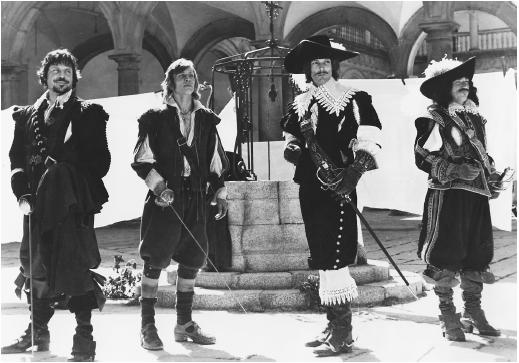
"The Three Musketeers: The Queen's Diamonds"/ Lester surrounds the royalty with games and idle amusements that have a slight tint of mindless cruelty to them, and that extends to the villains, whose machinations involving the Royals are merely extensions of those games, with regime-toppling consequences. And the cast! As the musketeers, Oliver Reed as the surly Athos, Richard Chamberlain as the effete Aramis, Frank Finlay as the clownish Porthos, and Michael York as the young and naive D'Artagnan. As the Royals, Jean-Pierre Cassel as the foppish King Louis XIII, Geraldine Chaplin as the frail Queen Anna of Austria, and Simon Ward as the rakish Duke of Buckingham. As the villains, Faye Dunaway as Lady De Winter, Christopher Lee as the villainous Rochefort, and Charlton Heston in one of his best performances as the Machiavellian Cardinal Richelieu. Rounding out the cast are Raquel Welch as the Queen's seamstress, the accident-prone Constance de Bonacieux,* Spike Milligan as her randy husband, and Lester regular, the great Roy Kinnear as D'Artagnan's man-servant, Planchet. A superb cast, rarely equalled. It's long been contended that the film was supposed to be one movie, but that the Salkind's split it into two to maximize profits. That's the rumor--there is a natural split of the film at the half-way point that feature almost all the actors for a sort-of bow, but it could have been used for an intermission. Certainly, there is less movie in "The Four Musketeers," it being padded with an "up-to-that-point" narrated prologue. But there are two distinct stories of different tones, the first being the intrigue-filled, but relatively light-hearted "The Queen's Diamonds" story (in which Athos, Aramis and Porthos are wounded, but not killed), and the darker "Milady's Revenge" with its beheadings, extended back-story and several prominent deaths. Where Part 1 is rollicking fun with minimal consequences, the stakes in Part 2 are very high, passions flare, and the sword-play becomes deadly. The humor is darker than the first, too. Despite the same cast and crew,** the two are very different in tone. Taken together, they have a moralist's sensibility of the costs of frivolity and duplicity; adventure can be fun, but in a poisonous political atmosphere, one adventure's at one's own risk. You can have a good time watching "The Three Musketeers," but the story is incomplete without the paid dues in "The Four Musketeers." Together, they make one of the finest adaptations of a classic novel ever put to film.
"The Four Musketeers: Milady's Revenge"(Richard Lester, 1974/1975)
These rollicking films, originally planned as a two and a half hour epic (no matter what the Producers say!) may just be one of the best adventure films (and adaptations of a classic) ever filmed, balancing the demands of the story, the tenor of the times in which it was made and the idiosyncrasies of its director.
When approached, Lester (who hadn't made a film since "The Bed Sitting Room" in 1969) wasn't enthused. Then he read the story, and did some research...and heartily agreed. One can see why. For "The Three Musketeers," as Lester and his screen-writer George MacDonald Fraser envisioned it is a story of intrigue in high places carried out by the lackeys and foot-soldiers who live to serve. Forget that the palace-dwellers are either snakes or dullards--they provide an opportunity for income and adventure--two qualities lacking amongst the citizens of France and England, who, at the time are at war. The opportunities for thrills, humor and pointed satire are rich and mined well by the film-makers. 
Lester's direction is masterful--simple set-ups and multiple cameras used during the swash-buckling to make sure there's a glimpse of every buckled swash. And those scenes are choreographed as a group participation so that every Musketeer has "business." Lester also worked to makes sure that the fights were inelegant affairs--not balletic, but more like street-fights, with few rules and the use of landscape and surroundings as equal strategies to the sword technique (and every part of the sword is used, as opponents are sometimes conked with ornate handles).
** except for the score composers--Michel Legrand for "The Three Musketeers" and Lalo Schifrin for "The Four Musketeers."


Wednesday, August 6, 2008
Olde Review: The Phantom of the Paradise
"The Phantom of the Paradise" (Brian DePalma, 1974)
.jpg) Too few people know about Brian DePalma's "Phantom of the Paradise." Too few people know about Brian DePalma. He is one of the best of the young, young crop of film-makers--the under-30 branch*--and he is quite taken with great directors of the past and their great movies. And so, very often, he will borrow a scene from these directors.
Too few people know about Brian DePalma's "Phantom of the Paradise." Too few people know about Brian DePalma. He is one of the best of the young, young crop of film-makers--the under-30 branch*--and he is quite taken with great directors of the past and their great movies. And so, very often, he will borrow a scene from these directors.Foremost among the borrowees is Alfred Hitchcock. In fact, DePalma has made two films almost totally Hitchcockian: 1973's "Sisters,"** and this year's "Obsession."*** "Phantom of the Paradise" came between them, and although it lacks the total Hitchcock commitment, and the many beauties that commitment brought about in "Obsession," "The Phantom" is an altogether enjoyable musical-comedy/horror-satire about the rock industry (kinda whets your interest, doesn't it?) It takes the old "Phantom of the Opera" story into the 20th Century glitter-rock scene, as a young man (William Finley) disappointed in love and betrayed by a rock entrepreneur names Swan (Paul Williams)****, finds himself deformed and deranged, haunting Swan's Paradise Rock Emporium


Swan is played by Paul Williams, and before you make some expectorating noises, I should say he is properly sinister and comic in the role. He also wrote the songs for the film's exemplary score, which covers a variety of rock-styles, none of which sinks to his regular lonely-introspection fare. William Finley, who played a mad doctor in "Sisters" plays the deranged "Phantom," and Jessica Harper,***** who with Diane Keaton participated in the send-up of Bergman's "Persona" in Woody Allen's "Love and Death" (see how all these films tie together?), portrays a young and naive innocent who wants to be a "star(!!)" As "Obsession" borrowed from almost all its ideas from different Hitchcock films, "Phantom" borrows a lot of plots from success-stories of the past, and incidental scenes from "The Godfather," "White Heat," and "Psycho." But DePalma manages to make this pastiche of film totally his own and in a perverse way, totally enjoyable. Go see it. You may just become a Brian DePalma fan.******


Next weekend, The ASUW film series devotes itself to "The Thriller" as interpreted by such cinema staples as W.S. Van Dyke, Bernardo Bertolucci, Roman Polanski, and Lina Wertmuller.*******
Broadcast on KCMU-FM on November 5th and 6th, 1975
Man, I was a big Brian DePalma fan back in the day. Fortunately, he rarely disappointed with his movies. Oh, there are the duds in his CV--"The Fury," "Home Movies" (which he did with a class he was teaching), "Wise Guys," "The Bonfire of the Vanities" (compromised by studio and DePalman cold-feet), and he would grow out of his "Hitchcock" obsession, and just sneak some of the Master's craft into his pictures (like "Dressed to Kill," "Blow Out," "Body Double,""Mission: Impossible," "Femme Fatale," and "Snake Eyes"). He is still a fine film-maker, who pushes the envelope as far as subject matter and technique. His most recent film--"Redacted"--was a raging film against the Iraq War that scared its distributor into quietly burying it in theaters (it opened locally at The Crest, usually the last stop before video). As of this writing, his next film is a long-in-the-works prequel to his very popular version of "The Untouchables"--written by playwright David Rabe this time, instead of playwright David Mamet.
But enough about DePalma! What about "The Phantom of the Paradise?" I have fond memories of it, and was impressed with the soundtrack--Williams did some wicked parodies of song-styles that scored satiric points as well as the film. It was inevitable that someone would take the era of Glam Rock and mix it with Gothic Horror. Across the pond Richard Sherman's "Rocky Horror Show" opened in June 1973, and it's not inconceviable that DePalma might have heard of it. But "Phantom" is rooted in "Faust" and "The Phantom of the Opera," while "Rocky Horror" takes its cue from the RKO horror films and "Frankenstein", and, more importantly, "The Bride of Frankenstein." The fact that both came out on the tails of the "Glam" era were the big influences, with "Rocky" being its step-child, and "Phantom" using it for texture--and "Phantom" is more concerned with the phony excesses of the music biz, while "Rocky" embraces them.
One could make the case that "Phantom" was influenced by "Rocky," but the timing's off--"Rocky Horror" wasn't that huge a hit at the time of "Phantom's" creation (right after DePalma directed "Carrie") and wouldn't be filmed until a year later. So, though they have the same roots, any resemblance is a very specious one.
* DePalma is now 67.
** After "Psycho.
*** After "Vertigo."
****No, really, he's good. Very good. So are the songs he composed for the film.
*****For awhile, Jessica Harper seemed to be in every good movie that came out, and a few bad ones, too. She's still acting, but she's doing more singing and writing for kids. her last movie role to date was in Spielberg's "Minority Report."
****** Just don't go see "Bonfire of the Vanities" after it...
*******Should this cause any confusion, we'll do two next week, and other two after that. (I need to go to "Office Max" and get more asterix's!)
Tuesday, August 5, 2008
Olde Review: Zardoz
This Saturday's ASUW films in 130 Kane are John Boorman's "Zardoz" and Brian DePalma's "The Phantom of the Paradise"

"Zardoz" (John Boorman, 1974)

"Zardoz speaks to you, his chosen ones:
You have been raised up from brutality, to kill the brutals who multiply and are legion. To this end, Zardoz, your God, gave you the gift of the gun"
Ooooo-kay! That little snippet from "Zardoz's" soundtrack* is a perfect example of what is right, and what is wrong with the film.
What we see during that resounding speech is a huge stone god-head floating over lush grass-lands while chanting subjects on horseback an on foot gaze, entranced by it. And it's a beautiful shot--nicely framed, beautifully photographed--even the special effect in the shot is nearly invisible. The sound is nice. The music, mostly the second movement of Beethoven's seventh symphony, is perfectly suited to this movie.

But the words emanating from that nicely modulated voice are really silly.
And so, in a nut-shell, there is "Zardoz"--due to the great abilities of its director John Boorman, whose previous film was "Deliverance" ** (and who is currently working on "The Heretic: Exorcist Part II"),*** it is a beautiful film to look at and listen to, but it is ultimately a very silly movie.
Maybe the script isn't too important. It is possible to ignore it when Boorman is communicating mood through his magnificent images and stately music. It is in the moments of pure image and music that "Zardoz" achieves the kind of epic stature that Boorman obviously wanted. And it is fun while the inspiration lasts, which is about half-way through it. It's about this time that the audience will wonder how in hell the damned thing is going to end. It's obvious by seeing the ending that Boorman wondered himself, and couldn't come up with anything other than a cop-out. Well, all I can say is enjoy what you see--it's quite fantastic. Try to ignore the plot.
And once and for all, maybe you should re-appraise your view of Sean Connery as an actor. It is "Zardoz" that slowly eased him out of the James Bond stereotype he had been mired in for so long, and into his current stream of swashbuckling roles, and in the very difficult role of Zed, the pivotal role of the film, Connery is nothing short of perfect. And so, "Zardoz" is a mixed bag of fine acting, the beautiful image and the hackneyed script.
Broadcast on KCMU-FM on November 5th and 6th, 1975
Um.....maybe the beautiful image. It's hard to say that Connery was doing stellar work running around in thigh-high boots and a red diaper (see below), spouting inane dialog, albeit opposite Charlotte Rampling. Truth of the matter is "Zardoz" is what Boorman made when he wasn't allowed to make "The Lord of the Rings," and Connery played Zed after Burt Reynolds, who was cast, (wisely) bowed out. "Zardoz" is just a stoopid, pretentious fantasy wanna-be, that keeps you guessing about where all this stuff came from--and when it's revealed to be an extremely simplistic (silly) conceit, you want to walk out. It all ends with one of those teen-pleasing Riots Against Authority that were popular "in the day," and sort of sputters to an ending of sorts. It's just a bad, bad film.
So was "The Heretic." Incredibly, someone gave Boorman money to make another film, and though it veers awfully close to the same sort of sophomoric kookiness of it predecessors, his film of "Excalibur" was a stylistic triumph for the director. It's a good thing, too. John Boorman is a fine director, when he has good material (which he can write, as well).
Connery was just coming into his own as his own actor away from 007, with good work in "Murder on the Orient Express," and "The Wind and the Lion." His best work was still ahead. "The Man Who Would be King" would open five weeks after this review was written.
* These reviews were accompanied by sound-clips or music from each of the films. This one started with that pretentious quote. FCC rules kept me from continuing it. Wanna read it? (Well, don't say I didn't warn ya...) "The gun is good. The penis is evil. The penis shoots seeds, and makes new life to poison the Earth with a plague of men, as once it was, but the gun shoots death, and purifies the Earth of the filth of brutals. Go forth . . . and kill!"
** Need to do a review of "Deliverance" one of these days. That is a great film.
*** Well, we won't bring that one up, only to say that Boorman got much better about the subject matter of his films.
 Okay--Connery didn't want to play "Gandalf" because
he didn't understand "The Lord of the Rings"--but he understood this??
Thursday, June 19, 2008
Olde Review: The Godfather Part II
"The Godfather Part II" (Francis Ford Coppola, 1974)
Seanator Geary: "I despise your masquerade. The dishonest way
you pose yourself. Yourself and your whole fucking family."
Michael Corleone: "Senator, we're both part of the same hypocrisy,
but never think it applies to my family"
This Saturday's ASUW film in 130 Kane is Francis Ford Coppola's production of "The Godfather Part II."
Imagine the plight of Francis Ford Coppola. He is hired out of relative obscurity in the movie industry to direct "The Godfather" which becomes the #1 box office draw in history. Not being prone to attempt originality, Paramount Studios asked Coppola to make a sequel. Coppola agreed, stipulating that it be a more ambitious project, but above all else, it had to be necessary to "The Godfather" story.
Incredibly, it is. Part II needed to be told. And it is a better film than the original.
Part II tells two stories, the ones on either side of "The Godfather" time-wise: Before (between 1900 and 1940) when Vito Corleone (Robert DeNiro, played by Marlon Brando in the original) comes to America and rises to power; and After (between 1958 and 1963) when his son Michael Corleone (Al Pacino) is attempting to expand his empire, while, at the same time, losing his family. It is possible to enjoy Part II without seeing the original, but I don't think it would be as rich an experience. But don't worry about it. If you do, you might miss what is on the screen, which is considerable.
Vito Andolini (named Corleone by an uncaring immigration official) comes to America to escape a family-wide vendetta by the Don of Corleone, Sicily. He is only eight years old at the time. A vendetta of this type--the very strong against the very weak was never present in "The Godfather." All wars were between strong men, young and old. But in "The Godfather Part II," the differences between stalker and prey are more apparent, the difference between stalkers less so, for Vito Corleone in avenging his family's death, takes that revenge on the same Don, who has grown old and infirm and helpless.

Coppola perfectly captures the look and feel of New York's Little Italy in this section (which is almost completely subtitled so, again, go early if you want to read them, and understand what's going on)* In the Italian ghetto, families are kept close together, in fact, the community is kept close together by the conditions, and it is upon this unity that Vito Corleone builds his dynasty. He already has a family (an unquestioning wife, and sons who will follow in his footsteps) and friends, for whom he uses his power. Don Vito rises to power for the benefit of his family, his friends and for himself.


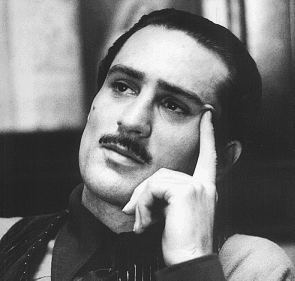
It is not that way for Michael Corleone, Don Vito's favorite son, onto whose shoulders the reign of his father has fallen. It is interesting to note that first Michael became Godfather, and then established his family, as opposed to his father, for the two men, as Coppola wishes to show, are completely different.

Above all else, Michael is a businessman in this film, manipulating everyone in his business dealings. The turnings and twistings of plot in Michael's sequences are subtle, very convoluted, so try to keep the names straight if you want to understand what is happening.

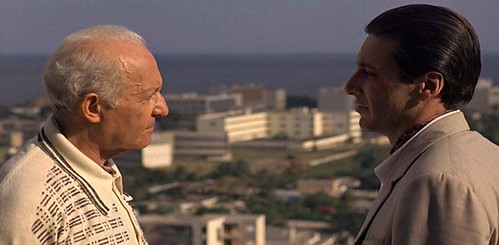
But the main point in Michael's story is that while he may continue his brilliant business career, he does so at a cost. Though he may be able to protect his family from outside forces, he cannot control the forces attacking his family from within. So that, at the end, Michael, though still powerful, probably the most powerful Mafia chieftain, is left alone, to brood over his success...and failure. Coppola who wrote and directed "Godfather II" said this soon after the film was made:

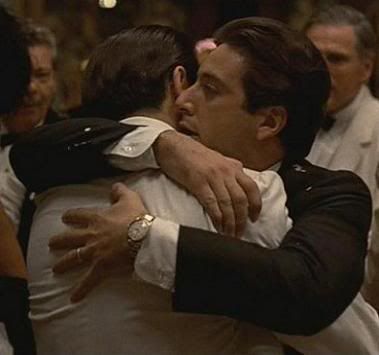
"One of the reasons I wanted to make 'Godfather II' is that I wanted to take Michael to what I felt was the logical conclusion. He wins every battle; his brilliance and his resources enable him to defeat all his enemies. I didn't want Michael to die. I didn't want Michael to be put into prison. I didn't want him to be assassinated by his rivals. But in a bigger sense, I also wanted to destroy Michael. There's no doubt that, by the end of the picture, Michael Corleone, having beaten everyone, is sitting there, slone, a living corpse...I admit I considered some upbeat touch at the end, like having his son turn against him to indicate he wouldn't follow in that tradition, but honesty...wouldn't let me do it. Michael is doomed.
I think we can be thankful that Coppola chose to elevate this film from what it might have been in other hands to tell us something extra about those two men--father and son--about our times, our country, and ourselves.
I wish I could talk more abou this film, but time prevents me. I will say that it is a beautiful fim, visually; done with genuine feeling and just a touch of spectacle. It is also very violent, though not as much as the original, that Pacino and DeNiro, in their respective parts are brilliant...and that it is being shown Saturday, October 9th at 7:30pm.
Broadcast on KCMU-FM October 8th and 9th, 1976
* Though it sounds smarmy and somewhat condescending, I think the issue was the seating at 130 Kane. Sitting in the balcony made it an eye-strain to read sub-titles, so getting a seat on the main floor was preferable.
In a post-"Sopranos" world, it is necessary to re-inforce that the "Godfather" movies weren't supposed to celebrate the Mafia, but cast them in a Shakespearean sense of tragedy. Michael may win his battles, but his descent into his own private Hell, the complete refutation of everything that his father represented, and the annihlation of the life that both father and son envisioned for him. Coppola always wanted to put the screws to Michael; to make him a King with riches but no heirs, and for all his success to lose everything that he should be valuing.
But, a lot of people just saw him winning all his battles. The hell with his family. The hell with his dreams. He was livin' large, man!
So when Coppola was enticed to make "Godfather III," he presented a withered, frail Michael, and tempted him with a clean slate, the re-unification of his family, and maybe a chance at happiness--a pure soul--and snatched it away from him, and closed the book on Michael's life.
But nobody liked that.
It is our custom in this country to venerate our villains. I've noted before that Marlon Brando was appalled when his biker bad-ass in "The Wild One" was embraced by the youth culture. In "Star Wars," Darth Vader was the coolest; in the prequels, when Lucas deconstructed Vader as a tragic figure...and worse, a lackey, it was rejected. Pacino's mui-loco-in-the-cabeza Tony Montana from "Scarface" is an icon now.
We venerate our villains. We tear down our heroes.
What's up with that?
Thursday, June 12, 2008
Olde Review: Alice Doesn't Live Here Anymore
"Alice Doesn't Live Here Anymore
" (Martin Scorsese, 1974)

 is Scorsese's most sedate film as far as camera movement. It lacks the restless aimlessness of "Mean Streets," or the paranoid powerfulness of "Taxi Driver's" tracking shots--but that does not keep it from being dynamic. The power of Scorsese's camera is very much in evidence whether tracking confidently accelerating circles around Ellen Burstyn as she auditions in a bar, or as it takes on a home-movie-ish, jittery energy in a family squabble, the jitteriness due not to a home-movie-maker's inexperience, but seemingly shaken by the ferocious energies thrown out by the domestic combatants.
Scorsese is a director you should watch in the next few years, for, sooner than you think, Scorsese will direct a superb film (his next film, if you can believe this, is a post WWII musical called "New York, New York--the main Scorsese stamping ground--which stars Liza Minnelli and Robert DeNiro?). It's sure to be the first musical in a long time that has an energy to itself, instead of the re-heated left-overs we've been getting from Broadway lately. Scorsese will give it that energy--a bizarre, scary energy that is an essence of the man himself. For the cameo appearances he assigns himeslf to--the punk-assassin who firs the last life/hope-shattering shot in "Mean Streets," and that particular taxi-rider who directs Travis Bickle to a house and to a female silhouette in the window and asks him what he thinks a .38 will do to her head, are bizarre self-roles to be sure.
But enough of Scorsese. There is another creator to "Alice...," its star, Ellen Burstyn, who had the tenacity to get what the producers scornfully refer to as a "women's picture" into production. And when she was in Seattle last year, she made it painfully clear that, without her, the film would have gone woefully wrong-headed in its intentions. The original ending had newly-widowed Alice Hyatt settling down to another life of house-wifely drudgery, instead of letting her continue with an uncertain, but certainly more adventurous future. Thank Ellen Burstyn for that, and thank her for the humanity she imbued in this film, not glossing it over, and bringing out very real performances from the vast majority of the cast. Her humanity, and Scorsese's power combined to make " Alice Doesn't Live Here Anymore a film that not only excites, but also leads to the lesser shocks of every-day recognition.
Yeah, one of these days this Scorsese kid's gonna make a superb film (that would be "Raging Bull" (1980)...and another...and another...and then "Taxi Driver's" going to start looking like the classic that it is, and the guy won't be awarded by the Academy until he does a star-heavy re-make of a Chinese film that was inspired by one of his own films--that being "The Departed," not that great a Scorsese film, but a better than average thriller.
No prescience here, Scorsese was always exciting, and bull-headed enough to stick to his aggressive kind of movie-making and not compromise even during the lean times. Scorsese films never "direct themselves." You're always aware of his hand on your shoulder directing your field of view, not unlike Hitchcock. And the man keeps re-writing the film language which keeps everybody on their toes, and keeps the art fresh and new. If he isn't our Great Director right now, he's One of the Two, and both men eye each other's work, influencing each other's creations, like Ford and Hawks, or The Beatles and The Byrds.
Now, if Scorsese could just lose that DeCaprio kid...
Monday, January 14, 2008
American Graffiti
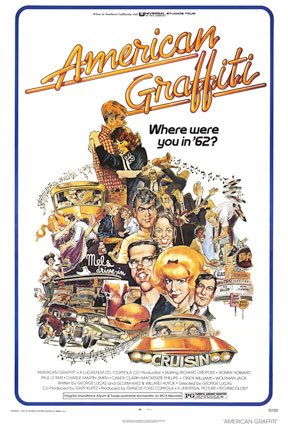 What's George Lucas' best film? For most, it's probably "Star Wars" (I'm sure there's some poor soul out there who likes "Radioland Murders"). There's a lot to like about his charmingly scruffy homage to the Buck Rogers serials. But one wonders what direction his career might have gone if he hadn't felt the need to exploit that first "Star Wars" movie as much as he did. It seems the more he explained about his initial concepts the worse the movies got, and the more rich and famous they made him, the more elephantine and fossilized they became.
For me, Lucas has yet to top "American Graffiti." Made for under a million dollars and filmed mostly at night using a skeleton crew (albeit one headed by Haskell Wexler), it showed just how ingenious Lucas could be when he was strapped for cash. It has the structure and froth of a Shakespeare comedy with the values and budget of an AIP teen flick.
Seemingly aimless, "American Graffiti" follows four storylines of small town kids on the last night of summer before heading to college. Curt (Richard Dreyfuss) has a scholarship to a big university but is reluctant to go, and spends the night bounced around by local toughs, and diverted by his quixotic pursuit of a phantom blonde in a white Thunderbird. Steve and Laurie (Ron "Ronny" Howard and Cindy Williams) are a couple in transition. Class President and Head Cheerleader, they're the Royal Couple of the Sock-Hop. But Steve can't wait to head out of town to conquer new territory, and Laurie-still in high school-knows she'll lose him when he goes. John (Paul LeMat) is a high school drop-out and legendary hot-rodder endlessly cruising the streets of town, looking for the next race. And Terry (Charles Martin Smith) lives a rich fantasy life (that's a kind way of saying he's deluded) where he can imagine himself everything that he's not.
Lives intersect, couples form and break apart, lies are told, misunderstandings abound (to really make it Shakespeare all you'd need is a set of twins), while the majority of kids drive endlessly in circles--not going anywhere, but hoping to, and if not tonight, there's always tomorrow. They're not going anywhere.
In the background are the constant echoes of rock n' roll pouring out of car windows and reverberating down the hallways and back-alleys, broken only by the howls and shrieks of the common thread in their lives, Wolfman Jack. All the kids have their Wolfman myths and he acts as sage, seer, siren and Master of Ceremonies for the evening's adventures. He's also the Fool and "The Man Behind the Curtain." Ultimately the long night's journey leads to his door-step, and in disguise dispenses his wisdom to the seeker.
One thing Lucas always knew was how to make a curtain call and "American Graffiti" is his best. As Curt flies off to college, he is left two signs of passage: the white T-bird reappears one last time to remind him what he's giving up, while locked away in his plane, the sounds of the radio station that have buoyed and sustained all the characters throughout the night fades to static. For the first time in the film there is no music and in the silence that creates, broken only by the drone of the plane we're told the rest of the story. Terry "goes missing" in Viet Nam. Steve is an insurance salesman in town. John is killed by a drunk driver. Curt's a writer in Canada. After that punch in the gut, Lucas unsentimentally hammers it home with one of the cheeriest songs in the Beach Boys catalog--"All Summer Long," dismissed earlier in the film as "surfing shit." Lucas turns the future into a sobering fate--the film is set in 1962. The next year would signal the end of the innocence of the 50's and "American Graffiti" is a sweet farewell to trivial concerns and living in the past.
Lucas has said that he based the boys on different aspects of himself in high school--the intellectual, the nerd, the sosh' and the JD. Lucas' lesson in this, and all of his work seems to be "Advance or Die." It's the lesson of "Graffiti." It is certainly the basis of the story of Anakin Skywalker. So what became of Lucas? Did he follow his own advice? Well, you could say he went to the future with "Star Wars," but he set it in the far-away past. Then he built an Empire of his own...in his hometown.
The Trailer for "American Graffiti"--in the style of Beach Blanket movies
"American Grafitti" touched me two ways. I had already been inspired by Lucas' first film, THX-1138 with its inventive sound-scape, to seek out his work and the work of his sound editor Walter Murch. "Grafitti" was their second collaboration and pretty much sealed my fate for going into sound work. Listening to it now, it's crude and has a lot of holes and bad edits, but the innovations are just as unique 30 years later and just as inspiring. On top of that, the unglamorous portrayal of a radio disc jockey's life (yet romantic in its anonymous/ omnipresent effect on a community) made me think "I could do that!" and I started my sound career spinning discs at a radio station. My last job as such was at a station with a glass window that looked out on the town's "loop." Sort of like watching "American Graffiti" in reverse. That was KEDO-AM in Longview, Washington--long ago bulldozed.
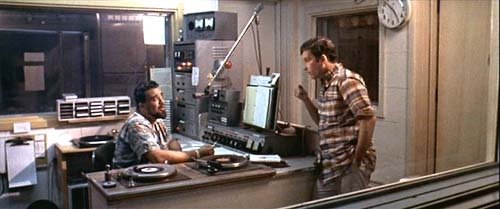
Wolfman Jack explains it all for you, baby
Anytime Movies are movies I can watch anytime, anywhere. If I see a second of it, I can identify it. If it shows up on television, my attention is focused on it until the conclusion. Sometimes it's the direction, sometimes it's the writing, sometimes it's the acting, sometimes it's just the idea behind it, but these are the movies I can watch again and again and never tire of them. There are ten. This is Number 8.
IV: -Only Angels Have Wings
V: The Searchers
VIII: American Graffiti
X: Goldfinger