Showing posts with label Ron Howard. Show all posts

Tuesday, October 15, 2013

Rush (2013)

Winning Isn't Everything...
or
Keep Your Friends Close, But Your Enemies in the Rear-View Mirror (They May be Closer Than They Appear)

The main reason I wanted to see Rush was that it has a script by Peter Morgan, whose work from The Queen, The Last King of Scotland, Frost/Nixon, The Damned United, Hereafter* have all been thought-provoking, literate screenplays and one wondered how he could provide that in a racing film, a sub-genre focused more on visceral momentum and the visual and where the weakest sections have always been those outside of the cars and off-track.

This one, though, it completely opposite in the tradition of Howard Hawks' race-track movies. And it's all true (except for a lie or two).  It tells the story of two (eventual) Formula 1 drivers, Niki Lauda (Daniel Brühl), Austrian, teutonic, disciplined, engineer and James Hunt (Chris Hemsworth), British, louge, seat-of-your-pants, tactician. They couldn't be more different except that both want to be the best and will do anything, risk anything to get there.


And they're both damned good drivers.**

Both are bad boys in their own ways.  Lauda comes from a prominent Austrian family, but does not want to go into the family business, which disowns any acceptance of Niki's ambitions to drive professionally.  So, he finds a race-team going bankrupt, buys it cheap by cashing in his life insurance policy, and takes over, re-building the car's engine from scratch.  Hunt knows a rich boy, Lord Hesketh (Christian McKay) with money to throw away and a party every hour.  In the film, the two despise each other immediately.  The first time Hunt sees Lauda at a Formula Two race (one of those examples of "a lie or two"), director Ron Howard throws a rainbow refraction from Hunt's POV, bringing a mysticism over the moment that might be a bit too much.


That first race, they bump and spin.  Hunt can't pull himself back into the race, his engine conks out, but Lauda, with some difficulty, throws himself the right way and is able to race his way to victory.  Hunt starts to berate Lauda about it, but the Austrian is dismissive—it was the car, not the driver, Lauda had the better car and was able to get back in.  Hunt's still pissed, insults Lauda by saying he looks like a rat, then goes off and parties with Hesketh, the crew and any woman within arm's length, as is his habit.  It's the start of a rivalry that will have its up's and down's, but that is the character-arc that both drivers have, and will have throughout the entire movie.  Their focused competition will push each of them to doing crazy things on and off the track.

It makes a good story.  Except for a lie or two.

It may not seem like much, but it's the Ron Howard way to make movies. Like a good race-track, eliminate any bumps in the road that might add dimension, nuance, or raise a question in the mind that might distract.  If you set up a joke, show the pay-off at the next cut.  If there's a building-up montage, make sure you show the results first thing.  If you want to show the treadmill of being famous, put David Bowie's "Fame" on the soundtrack (released in 1975, it fits the period). 


A shot like this is used quite a bit: it makes you go "hmmm."

In Rush, there's no ambiguity, no wasted shot, not a moment of contemplation or self-doubt.  It runs the rule of every Howard movie (that I've seen, at least, which is all except two) of being so audience friendly that it barely needs an audience, as there is no room for interpretation. At all.

It's not manipulation (all movies are manipulative, even documentaries), so much as keeping it very, very simple—least-common-denominator simple.  It makes a better movie to have Hunt and Lauda just despise each other throughout the movie until the crisis of Lauda's accident.  And even then, the bantering between them has a nice nasty streak running through it.  It would have completely messed up that story through-line if (say) Hunt and Lauda were closer than Morgan and Howard impress...which they were—they were flat-mates for awhile, and enough that Rush would have resembled The Odd Racing Couple if they had shown it—but that would have ruined the all or nothing, go for broke, all-in, simple kind of impression the film-makers are trying to evoke.  If it feels good, why complicate it?  And Howard's films, even the depressing ones, are feel-good movies (I mean, A Beautiful Mind is about schizophrenia and he still managed to bring forth a teary-smile at the end...and won an Oscar for it!).


Really, this is just to increase my Internet "hits."
Olivia Wilde as model Suzy Miller—she's in the film for as long as you're looking at this picture.

So, what am I saying, that it isn't "arty" enough?  No.  It's plenty arty, with a humorous set design and costuming that will make anyone under 30 think we were all mad (and we were, hey, but don't linger at the mirror, yourself). Howard and his cinematographer Anthony Dod Mantle (he bounces between Lars von Trier and Danny Boyle, so of course it's arty), manage to shoot making left turns repeatedly interesting to look at, without becoming fetishistic about it (more Grand Prix than Le Mans, more Frankenheimer, less Katzin), and they have a tendency to repeat a lot of good shots, rather than trying to find every possible angle with which you can photograph a moving car.  So, there's a consistency there of quality over quantity.  And the core of the story—of these two outliers, both unlikable but admirable, racing to the drumming of their own pistons, finding inspiration in each other and realizing it, makes it an interesting movie, and worth seeing.

Rush is a Matinee.


Niki and James, when Lauda came back to racing six weeks after his accident.


*  He was also involved in the early stages of Tinker, Tailor, Soldier, Spy and Skyfall.

** Here's a Lauda quote (a real one) about Hunt:"We were big rivals, especially at the end of the [1976] season, but I respected him because you could drive next to him—2 centimeters, wheel-by-wheel, for 300 kilometers or more—and nothing would happen. He was a real top driver at the time."  That's the sort of admiration Lauda would allow himself—an appreciation of undeniable skill.

Saturday, January 22, 2011

The Dilemma

"Mouth Wide Shut"

I put up a snarky comment on the LNTAM Facebook page that nothing strikes fear into my heart so much as the words "A Comedy by Ron Howard."  A little facetious, perhaps.  I like Splash a lot and Parenthood may be my favorite of Howard's films.  But the director of so many thunderously ponderous dramas does not have the necessary light touch,* at least these days, when it comes to directing comedy.  Instead, he's dependent on the flip style of his stars (like Tom Hanks and Steve Martin) to rise above his heavy hand, and The Dilemma** has no such talent in evidence.

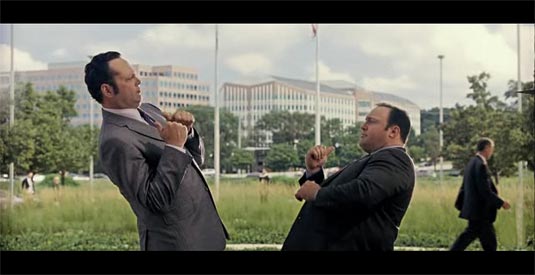
Not that Vince Vaughn and Kevin James don't try, but they're caught in a script so painful in its ramifications that you feel more sympathy for them than any mocking superiority, that might allow some amusement.  It's a "Comedy-of-Errors" story, an "Incredible-Mess" scenario, and wants (wants, mind you) to say something about "the futility of good intentions" as well as "the value of honesty."  But, then goes out of its way to show that one should just avert your eyes and walk away.  The results, and the messages, are mixed.

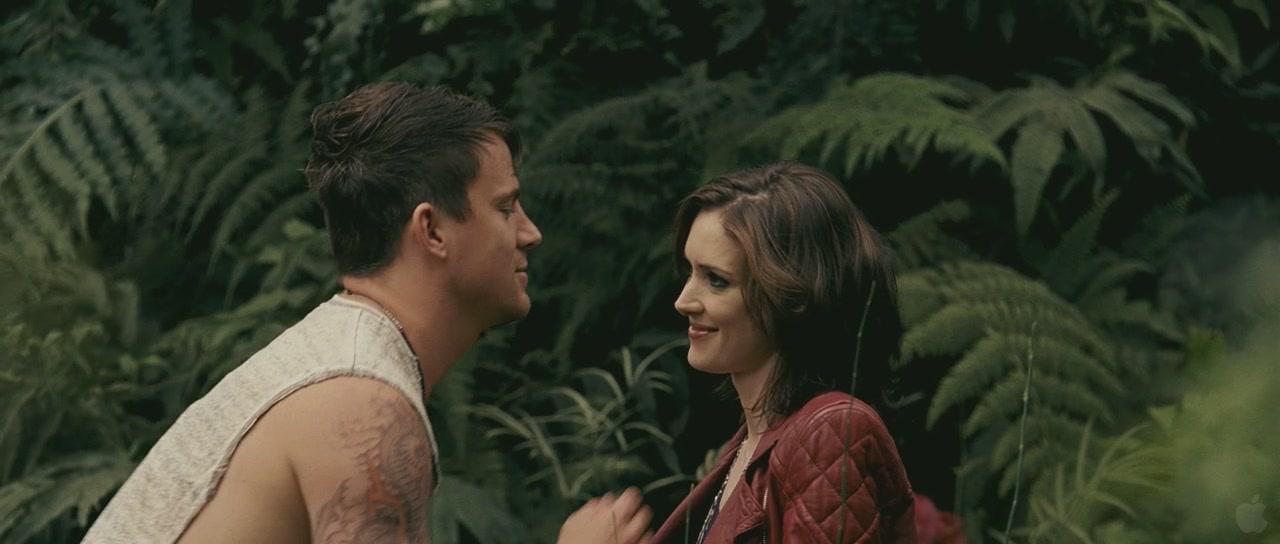
Ronny Valentine (Vaughn) is a gambling addict in denial.  His struggles with the problem have previously derailed a relationship with Beth (Jennifer Connelly), and they're coping with honesty and trust issues, because its easier for Ronny to bull-shit over embarrassing situations with elaborate fictions rather than just stating the truth.  Its a helpful business strategy for him in his business with Nick Brannen (James) in automobile developmenttheir current scheme is to give electric cars the same vibrating muscle power as a gas-guzzlerBut, lately, he's been thinking up elaborate ways to pop the question to Beth.  During one of his scouting forays to an ultimate proposal sight, he is appalled to find Nick's wife, Geneva (Winona Ryder, welcome back), canoodling with a young dude (Channing Tatum), something that a) affects both his personal and business relationship with his college buddy and b) strikes at the core of his fear of entering into marriage with BethNot to add stress to Nick's life, he chooses to add stress to his own by NOT saying anything (except to the duplicitous Geneva, who is ready to make life VERY uncomfortable for Ronny).  This leads to a series of mis-understandings and down-right lies that makes everyone in Ronny's life think that he's back to his old tricks of hiding the truth to cover his gambling habits...and, indeed, by taking the dilemma by the horns, he is gambling with his life and relationships and losing...badly.

Hilarity is supposed to ensue, but nothing approaching a smile cracked my face.  Ronny's habit of lying, fudging and obfuscating makes him an easy mark for any sort of suspicion and the situation he finds himself in is somewhat Kafkaesque.  The former gambler can't win for losing, and the thought that kept pin-balling through my mind was "since the creative Hail-Mary's of over-promising to his potential clients is so integral to his success, how can he effectively keep his salesmanship from entering osmotically his personal life?" (Honestly, that's what I was thinking).  I found it tragic more than comic, and wondered how any person with an addiction can hope to live out a normal life...even after overcoming it.

Pretty depressing thoughts to arise from a comedy.

Maybe such thoughts wouldn't have popped up if I'd laughed more.

Or...at all. 

The Dilemma is a Cable-Watcher.


* I'm omitting, of course, the bright spot of Ron Howard's recent comedy output, his shepherding of the TV-series "Arrested Development," whose crazed blunderbusting of the immaturity of the entitlement class was one of the better comedies of recent years.

** The most interesting aspect of The Dilemma is the spelling of its title.  I'd always learned that it was spelled "D-I-L-E-M-N-A," and would frequently make a joke of too literally pronouncing it "dilem-na."  But, these days spell-checks and my own (previously trusted) Random House Dictionary spells it with the double "m." However you spell it, it's a quandary. 

Friday, May 15, 2009

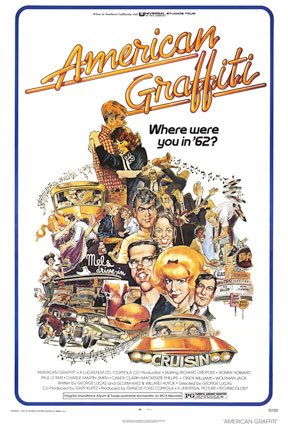
Anytime Movies Reloaded: American Graffiti

It's Spring-Break for me. Times are busy. The Summer Movie Season is already begun (and I'll be writing about the new ones) and the Film Festivals are grinding away like creaky mills separating wheat from chaff. It's as good a time as any to re-boot a feature I started years ago, when it was suggested I do a "Top Ten" List.

I don't like those: they're rather arbitrary; they pit films against each other, and there's always one or two that should be on the list that aren't because something better shoved it down the trash-bin.

So, I came up with this: "Anytime" Movies.

Anytime Movies are the movies I can watch anytime, anywhere. If I see a second of it, I can identify it. If it shows up on television, my attention is focused on it until the conclusion. Sometimes it’s the direction, sometimes it’s the writing, sometimes it’s the acting, sometimes it’s just the idea behind it, but these are the movies I can watch again and again (and again!) and never tire of them. There are ten (kinda). They're not in any particular order, but the #1 movie IS the #1 movie.

What's George Lucas' best film? For most, it's probably "Star Wars" (I'm sure there's some poor soul out there who likes "Radioland Murders"). There's a lot to like about his charmingly scruffy homage to the Buck Rogers serials. But one wonders what direction his career might have gone if he hadn't felt the need to exploit that first "Star Wars" movie as much as he did. It seems the more he explained about his initial concepts the worse the movies got, and the more rich and famous they made him, the more elephantine and fossilized they became.

For me, Lucas has yet to top "
American Graffiti." Made for under a million dollars and filmed mostly at night using a skeleton crew (albeit one headed by Haskell Wexler), it showed just how ingenious Lucas could be when he was strapped for cash. It has the structure and froth of a Shakespeare comedy with the values and budget of an AIP teen flick.

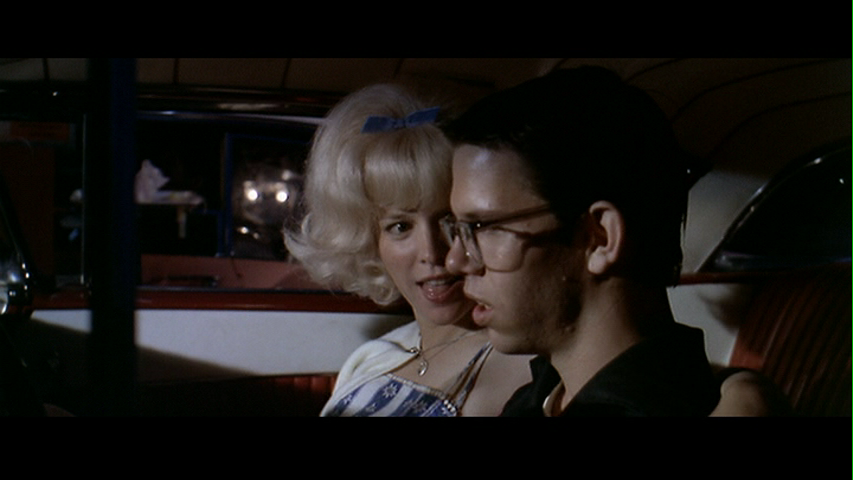
Seemingly aimless, "American Graffiti" follows four storylines of small town kids on the last night of summer before heading to college. Curt (Richard Dreyfuss) has a scholarship to a big university but is reluctant to go, and spends the night bounced around by local toughs, and diverted by his quixotic pursuit of a phantom blonde in a white Thunderbird. Steve and Laurie (Ron "Ronny" Howard and Cindy Williams) are a couple in transition. Class President and Head Cheerleader, they're the Royal Couple of the Sock-Hop. But Steve can't wait to head out of town to conquer new territory, and Laurie-still in high school-knows she'll lose him when he goes. John (Paul LeMat) is a high school drop-out and legendary hot-rodder endlessly cruising the streets of town, looking for the next race. And Terry (Charles Martin Smith) lives a rich fantasy life (that's a kind way of saying he's deluded) where he can imagine himself everything that he's not.

Lives intersect, couples form and break apart, lies are told, misunderstandings abound (to really make it Shakespeare all you'd need is a set of twins), while the majority of kids drive endlessly in circles--not going anywhere, but hoping to, and if not tonight, there's always tomorrow. They're not going anywhere.

In the background are the constant echoes of rock n' roll pouring out of car windows and reverberating down the hallways and back-alleys, broken only by the howls and shrieks of the common thread in their lives,
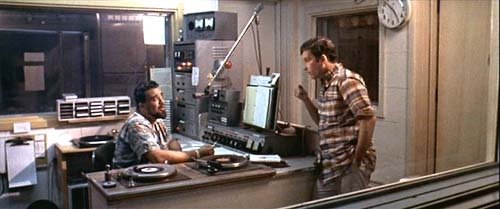
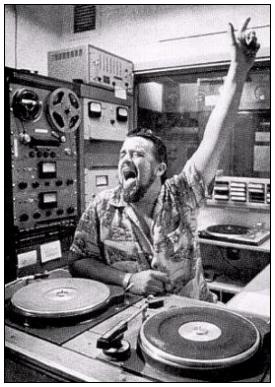
Wolfman Jack. All the kids have their Wolfman myths and he acts as sage, seer, siren and Master of Ceremonies for the evening's adventures. He's also the Fool and "The Man Behind the Curtain." Ultimately the long night's journey leads to his door-step, and, in disguise, dispenses his wisdom to the seeker.

One thing Lucas always knew was how to make a curtain call and "American Graffiti" is his best. As Curt flies off to college, he is left two signs of passage: the white T-bird reappears one last time to remind him what he's giving up, while locked away in his plane, the sounds of the radio station that have buoyed and sustained all the characters throughout the night fades to static. For the first time in the film there is no music and in the silence that creates, broken only by the drone of the plane we're told the rest of the story. Terry "goes missing" in Viet Nam. Steve is an insurance salesman in town. John is killed by a drunk driver. Curt's a writer in Canada. After that punch in the gut, Lucas unsentimentally hammers it home with one of the cheeriest songs in the Beach Boys catalog--"All Summer Long," dismissed earlier in the film as "surfing shit." Lucas turns the future into a sobering fate--the film is set in 1962. The next year would signal the end of the innocence of the 50's and "American Graffiti" is a sweet farewell to trivial concerns and living in the past.

Lucas has said that he based the boys on different aspects of himself in high school--the intellectual, the nerd, the sosh' and the JD. Lucas' lesson in this, and all of his work seems to be "Advance or Die." It's the lesson of "Graffiti." It is certainly the basis of the story of Anakin Skywalker. So what became of Lucas? Did he follow his own advice? Well, you could say he went to the future with "Star Wars," but he set it in the far-away past. Then he
built an Empire of his own...in his hometown.


The Trailer for "American Graffiti"--in the style of Beach Blanket movies


"American Grafitti" touched me two ways. I had already been inspired by Lucas' first film, "THX-1138" with its inventive sound-scape, to seek out his work and the work of his sound editor Walter Murch. "Grafitti" was their second collaboration and pretty much sealed my fate for going into sound work. Listening to it now, it's crude and has a lot of holes and bad edits, but the innovations are just as unique 30 years later and just as inspiring. On top of that, the unglamorous portrayal of a radio disc jockey's life (yet romantic in its anonymous/omnipresent effect on a community) made me think "I could do that!" and I started my sound career spinning discs at a radio station. My last job as such was at a station with a glass window that looked out on the town's "loop." Sort of like watching "American Graffiti" in reverse. That was KEDO-AM in Longview, Washington--long ago bulldozed.


Wolfman Jack explains it all for you, baby!


I'd just done a "Don't Make a Scene" segment for "American Graffiti" and was looking forward to writing new "insights" on this film, but reading it again, no, I pretty much covered them all. Not that "American Graffiti" is that simple—it's just that given Lucas' skimpy out-put, there's not a lot of complexity in his ouvre. It is interesting that Lucas goes the Joseph Campbell route in this film before he actually read "The Hero with a Thousand Faces" and used the "seeker's path" for the construction of "Star Wars." He was already using it here and doing variations of it for the four Lucas-aspects, each with different fates (a cautionary tale, indeed). He also uses the cross-cutting on different fronts that would be his staple in the "Star Wars" films, but interestingly in his first "Star Wars" ("A New Hope") and this film, there is no cross-cutting at the end, everyone is melded into the final story-line, buttoning everything up nice and neat. He wouldn't do that again.

American Graffiti
To Kill a Mockingbird
Goldfinger
Bonus: Edge of Darkness

Tomorrow: The Tropic of Capracorn

Friday, January 2, 2009

Frost/Nixon

"That Was the Crook That Was"
or
"David vs. Go-lie-eth"


Well, it was hardly "An Epic Battle for the Truth." It was a stunt put on by David Frost and Richard Nixon to jump-start their respective careers. I remember those interviews and the hoopla they generated. there was a lot of heat in the media about "checkbook journalism," and it was being kind to call it "journalism"—Frost's go-to question always was "What is your definition of love?"* It was, in fact, the news-equivalent of opening Al Capone's vault, or the Billy Jean King-Bobby Riggs tennis match.

But it did happen, quite a bit of the way "Frost/Nixon" scribe
Peter Morgan presents it. The legal wranglings, the rejection by the networks leading to syndication, the sponsorships by the new-tech "Weed-Eater" and Alpo dog food (Lorne Green was the spokesperson). I remember the stories of the exploding light, Nixon's remarks of Frost being his "Grand Inquisitor," even the "Did you do any fornicating?" line that (although it didn't occur right before taping as the movie would have you believe) Nixon threw at Frost when the cameras weren't running.

But there's enough difference to make it suspect.
The interviews were not as packed with drama as the movie would have you believe (see the video below). They were quite benign affairs, and Nixon didn't betray any secrets that he didn't want to betray--the movie doesn't tell you that Nixon's deal included 20% of the royalties of the syndication, which made him Frost's partner in the enterprise, and the former president knew that throwing in some red meat would garnish more money for him.

The furthest afield that Morgan goes is the most interesting. The playwright/screen-writer invents a late-night phone-call between Nixon (
Frank Langella--after a while you buy him, but his Nixon speaks like a dilletante) and Frost (Michael Sheen—his Frost is vocally perfect) before the final interview, the one involving Watergate. Frost, ill-prepared and feeling in over his head, is caught in a moment of self-doubt when Nixon, with a couple drinks in him, calls and has a heart-to-heart comparing Frost's history to his own—of being shunned by the privileged kids, the ones who got all the breaks. Finally, Nixon builds to a fevered pitch and becomes the ranting monster everyone imagines him to have been, yelling that "all those (expletives deleted) can choke!"

And this is the problem: that phone-call never happened.** It's an invention of Morgan's to transtion Frost from defeated to fighting, and although it dramatically works, it's a cheat. The truth of the matter is that Nixon is never the monster that the dramatists and speculators want him to be—as threats to democracies go, he was a rather dull one, but, as with "Secret Honor," the fictional Nixon, drunk, raving like a bitter lunatic, vengeful and self-pitying (which he was), but dramatically incapable of being Lear, just isn't good enough to square with the man who used his office like a club against his political enemies, and set up his own police force to carry out the dirty work that even J. Edgar Hoover disapproved of. One suspects "The Queen" isn't nearly as accurate a picture of Elizabeth II. Reality just isn't dramatic enough.

Still, it's a great cast with
Kevin Bacon as Nixon's Chief of Staff, Matthew Macfadyen (blonde Beatle-wigged as Frost's producer), Oliver Platt and Sam Rockwell as Frost's researchers, Toby Jones as a perfect Irving "Swifty" Lazar, and the original "Bad Seed " Patty McCormack plays a frail Pat Nixon.

It's certainly
Ron Howard's most subtle film in years—there's no evidence of the grand-standing direction that weakens a lot of his out-put, and his asides and cut-aways aren't distractions, but part of the fabric. He merely provides the arena, and lets the actors do their work. It shows just how good a director he is, when he's not trying to show how good a director he is.


"Frost/Nixon" is a Matinee.

Reality and Fiction: Frost and Nixon and "Frost/Nixon"

* My favorite answer was Richard Burton's: "Love is staying up all night with a very sick child...or a very healthy adult." Barbara Walters' go-to question was "If you were a twee, what kind of twee would you be?"

** And Morgan does some obfuscating on the point: Nixon doesn't recall making the phone-call, although Frost assures him that he did.


Saturday, September 6, 2008

Olde Review: The Shootist

Written August 11, 1976

"The Shootist" (Don Siegel, 1976) I was briefing through the movie reviews of various magazines in the grocery store a year or so ago, when I came across Richard Schickel's review of "McQ" or "Brannigan" (probably "Brannigan"), in which he remarked that a proper bicentennial project would be to come up with a decent script for John Wayne.

I was hoping
'Rooster Cogburn" might be it, but that was a waste..of time...and talent. And besides, as much as I like "Rooster" Cogburn as a character, the acceptance of Wayne's acting that suddenly sprang up smacked a bit too much of "Well, we'll like him as long as the old galoot knows he's a joke." Well, there were times in "True Grit" when Wayne--the Wayne as the screen force--came through. I didn't want to see Wayne made fun of or exploited. I wanted to see him triumph, as of old, in his now twilight years, and as John Wayne, the very fine actor.

So, I am delighted at "The Shootist" and delighted with it. It is about Wayne, as about Books (instant cliché time). Why else would Siegel in his opening use shots of old Wayne movies (and mostly Howard Hawks Wayne films, where Wayne played a character built out of his own persona, rather than playing "honest-to-God" characters ala John Ford) and with young boys---in 'Red River" and "Rio Bravo"--as Wayne the mentor, as he is, in an odd way, in this film.

Siegel is still a little obvious in his handling of things, but the ideas are so good, who cares? He literally numbers Wayne's days. And what a nice idea for a living legend and soon-to-be-immortal legend to have his birthday and the day of his death on the same day, on a gravestone that doesn't mark its day.

Death hangs over this film, in conversation, in song, in thought, in way of life. But this is nothing new. Death has walked with Wayne through many a picture. For a long time. Both were winners in the end, and, as in real life, Death must have his due.


"The Shootist" is the film John Wayne went out on, and as a summation of his career, and a the last ring of the bell, it's nearly perfect, even though the film is a bit flawed. Still, director Siegel did a masterful job of keeping the stars corraled--there was a lot of people wrangling to be in it--and Wayne healthy, although there were times when he was too weak to be on-set (although he was, at that time, cancer-free). And even though Wayne and Siegel got on like a house afire (the two couldn't have been more different, politically) there were still dust-up's about the way Siegel, the most economical and least fancy of directors, would line up shots. Lauren Bacall, who was no doubt reliving her own time of dealing with cancer with husband Humphrey Bogart, braved up through the movie, and provided a steely shoulder for Wayne to lean on. Stewart signed on for a cameo, comprising the most jarring scene; it's Stewart who provides the cancer diagnosis. And Richard Boone, John Carradine and Hugh O'Brian did the same out of respect and love for their old co-star, and Ron Howard, eyes set on a directing career instead of acting, still pursued the juvenile lead one last time. The budget was tiny, but top-heavy with stars...and history.

All those guest stars work against the film and make it lose focus a bit. You can tell that Siegel might not have gotten all the coverage he might have wanted--sequences seem stretched a might' thin. But overall, the film works well.

With time, perspective...and maybe a slight blurring of facts...one can look at "The Shootist" as the death of the Western--a sturdy movie genre for decades. The 60's had slowed it down, made them seem irrelevant, but one could still count on a number of Westerns being shot every year...until John Wayne died. And then...nothing.

A few things crop up here and there. "
Tombstone" and its cousin "Wyatt Earp," Eastwood's classic (and Oscar-winning) "Unforgiven," and "Silverado," which reminded how good a time an intelligent Western could be. "Deadwood" is a wickedly nifty updating of the "Gunsmoke" stories of a frontier town, and "3:10 to Yuma" this year briefly revived interest in the Old West and its ways. But a case can be made that without Wayne in the saddle, green-lighting a Western became a difficult proposition.

Why bother? Wayne kept the genre alive for so long, but with his passing, they became less viable.

They might still come back. Turner will do a period piece, a
Zane Grey adaptation, once in awhile, "Lonesome Dove" certainly proved popular, and even "Brokeback Mountain" made a contribution. But that "3:10 to Yuma" popularity was certainly encouraging.

Then there's the curious phenomenon of the Western morphing into another genre--Science Fiction, precisely. The "
Back to the Future" series capped off with an Old West yarn, and it was easy to see the gun-slinger in Han Solo in "Star Wars," the fight in the bar, etc. and, Joss Whedon created a future Western in the "Firefly" series, and its movie-spin-off, "Serenity." It's funny. Just as the western was a broad enough genre to encompass all sorts of morality plays that would reflect today's society, so, too does the Science Fiction story. The two overlap, and share much the same elasticity, that frequently it turns into a case of "You got Science Fiction in my Western/You got Western in my Science Fiction."

Maybe the Western hasn't rode into the sunset just yet.

Maybe it's just waiting for a new dawn.

Or a new star to guide her.


Monday, January 14, 2008

American Graffiti

What's George Lucas' best film? For most, it's probably "Star Wars" (I'm sure there's some poor soul out there who likes "Radioland Murders"). There's a lot to like about his charmingly scruffy homage to the Buck Rogers serials. But one wonders what direction his career might have gone if he hadn't felt the need to exploit that first "Star Wars" movie as much as he did. It seems the more he explained about his initial concepts the worse the movies got, and the more rich and famous they made him, the more elephantine and fossilized they became.

For me, Lucas has yet to top "
American Graffiti." Made for under a million dollars and filmed mostly at night using a skeleton crew (albeit one headed by Haskell Wexler), it showed just how ingenious Lucas could be when he was strapped for cash. It has the structure and froth of a Shakespeare comedy with the values and budget of an AIP teen flick.

Seemingly aimless, "American Graffiti" follows four storylines of small town kids on the last night of summer before heading to college. Curt (Richard Dreyfuss) has a scholarship to a big university but is reluctant to go, and spends the night bounced around by local toughs, and diverted by his quixotic pursuit of a phantom blonde in a white Thunderbird. Steve and Laurie (Ron "Ronny" Howard and Cindy Williams) are a couple in transition. Class President and Head Cheerleader, they're the Royal Couple of the Sock-Hop. But Steve can't wait to head out of town to conquer new territory, and Laurie-still in high school-knows she'll lose him when he goes. John (Paul LeMat) is a high school
drop-out and legendary hot-rodder endlessly cruising the streets of town, looking for the next race. And Terry (Charles Martin Smith) lives a rich fantasy life (that's a kind way of saying he's deluded) where he can imagine himself everything that he's not.

Lives intersect, couples form and break apart, lies are told, misunderstandings abound (to really make it Shakespeare all you'd need is a set of twins), while the majority of kids drive endlessly in circles--not going anywhere, but hoping to, and if not tonight, there's always tomorrow. They're not going anywhere.

In the background are the constant echoes of rock n' roll pouring out of car windows and reverberating down the hallways and back-alleys, broken only by the howls and shrieks of the common thread in their lives,
Wolfman Jack. All the kids have their Wolfman myths and he acts as sage, seer, siren and Master of Ceremonies for the evening's adventures. He's also the Fool and "The Man Behind the Curtain." Ultimately the long night's journey leads to his door-step, and in disguise dispenses his wisdom to the seeker.

One thing Lucas always knew was how to make a curtain call and "American Graffiti" is his best. As Curt flies off to college, he is left two signs of passage: the white T-bird reappears one last time to remind him what he's giving up, while locked away in his plane, the sounds of the radio station that have buoyed and sustained all the characters throughout the night fades to static. For the first time in the film there is no music and in the silence that creates, broken only by the drone of the plane we're told the rest of the story. Terry "goes missing" in Viet Nam. Steve is an insurance salesman in town. John is killed by a drunk driver. Curt's a writer in Canada. After that punch in the gut, Lucas unsentimentally hammers it home with one of the cheeriest songs in the Beach Boys catalog--"All Summer Long," dismissed earlier in the film as "surfing shit." Lucas turns the future into a sobering fate--the film is set in 1962. The next year would signal the end of the innocence of the 50's and "American Graffiti" is a sweet farewell to trivial concerns and living in the past.

Lucas has said that he based the boys on different aspects of himself in high school--the intellectual, the nerd, the sosh' and the JD. Lucas' lesson in this, and all of his work seems to be "Advance or Die." It's the lesson of "Graffiti." It is certainly the basis of the story of Anakin Skywalker. So what became of Lucas? Did he follow his own advice? Well, you could say he went to the future with "Star Wars," but he set it in the far-away past. Then he
built an Empire of his own...in his hometown.


The Trailer for "American Graffiti"--in the style of Beach Blanket movies

"American Grafitti" touched me two ways. I had already been inspired by Lucas' first film, THX-1138 with its inventive sound-scape, to seek out his work and the work of his sound editor Walter Murch. "Grafitti" was their second collaboration and pretty much sealed my fate for going into sound work. Listening to it now, it's crude and has a lot of holes and bad edits, but the innovations are just as unique 30 years later and just as inspiring. On top of that, the unglamorous portrayal of a radio disc jockey's life (yet romantic in its anonymous/ omnipresent effect on a community) made me think "I could do that!" and I started my sound career spinning discs at a radio station. My last job as such was at a station with a glass window that looked out on the town's "loop." Sort of like watching "American Graffiti" in reverse. That was KEDO-AM in Longview, Washington--long ago bulldozed.

Wolfman Jack explains it all for you, baby


Anytime Movies are movies I can watch anytime, anywhere. If I see a second of it, I can identify it. If it shows up on television, my attention is focused on it until the conclusion. Sometimes it's the direction, sometimes it's the writing, sometimes it's the acting, sometimes it's just the idea behind it, but these are the movies I can watch again and again and never tire of them. There are ten. This is Number 8.


IV: -Only Angels Have Wings

V: The Searchers


VIII: American Graffiti

X: Goldfinger