Showing posts with label John Wayne. Show all posts

Tuesday, December 25, 2012

3 Godfathers (1948)

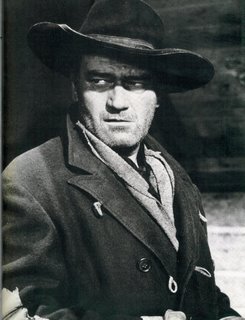
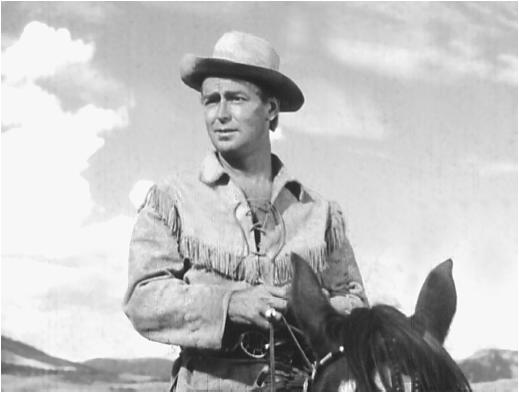
3 Godfathers (John Ford, 1948) Ford's version of The Nativity Story set in the very wild West is a remake of his 1919 silent film Marked Men,* which starred Harry Carey. The son of John Ford's first star, Harry Carey Jr made his acting debut in this one as The Abilene Kid, who along with John Wayne and Pedro Armendáriz, play former cattle rustlers up-scaling to bank robbery.  After the meager heist, they escape a posse from Welcome, Arizona (led by Ward Bond's Sheriff B. Sweet, as well as Hank Worden and Ben Johnson) by taking a perilous escape route through the desert (it was filmed in Death Valley)—not the wisest of men or maneuvers.  Their flight leaves them wounded, their water supply draining and quickly losing every means of survival in the desert.

Things get complicated when, looking for water, they come across an established that a tenderfoot, in his ignorance and panic has dynamited in an an attempt to get more water, destroying it.  If that weren't bad enough, he's run off into the desert to find his stock, driven loco by alkaline poisoning, leaving behind his wife (Mildred Natwick) delirious and about to give birth.  Unbeknownst to them, she's the niece of Sheriff Sweet's.  


Armendáriz, Wayne and Carey Jr. don't know nuthin' 'bout birthin' no babies

The leader of the group Bob Hightower (Wayne) can't cope with the intricacies of the situation, leaving "Pete" Rocafuerte (Armendáriz) to deliver the baby, and when the mother dies, leaving the three with a promise to care for the child she has named Robert William Pedro, the three villains must learn the basics of child-care (thanks to a book written by "Doc Meechum"), but with limited supplies they must cross the desert, led by a single star to the town of New Jerusalem (the other choices are Cairo and Damascus).  It isn't long before The Kid tells them it's their Destiny, that they were led to this place, this child, this duty, this precedent.  

It is, after all, almost Christmas.

It's a sweet story, about how the spirit turns with the charge of a newborn, and how even those on a downward spiral can be lifted up by a lack of self.  And Ford, working with screenwriters Frank Nugent (a new find with his Fort Apache script) and Laurence Stallings (with whom Ford and Nugent would collaborate on She Wore a Yellow Ribbon) keeps the sentiment high, and the humor all over the map from leaden to subtle.  Even without its silent roots (Mae Marsh from TheBirth of a Nation has a large role!), the film, in tone, feels like a throwback to an earlier time, like Ford's work in the '30's circa Stagecoach—not a bad time at all.  And, in the timeline of his work this looks like a wave good-bye to his western work of the past, as Ford would subtly move on to the slightly more serious She Wore a Yellow Ribbon to the dire The Searchers within the space of seven years.  

It was about this time that Wayne's performance in Howard Hawks' Red River (playing "old" at 41 years of age) was noticed by everyone, and notably Ford, who had still been using Wayne in co-starring roles.  "I didn't know the big sonuvabitch could act!" Ford groused to Hawks.  3 Godfathers is Wayne stepping into the limelight of Ford's films, where he would stay (mostly) for the rest of Ford's career.  And, as with the humor of the film, Wayne's performance covers a lot of ground, leaden to subtle.  His physical work is unmatched, as usual, casually sitting on a horse as if it was an easy chair,  stumbling through the desert in an alarming drunk march (supposedly holding a baby, which throw some scary drama into it, if you think about it), doing little character things you only notice later, like the way Hightower trudges dumbly through an edge-of-town water collection at the start of the film before it becomes of the utmost importance, and something that seems peculiarly florid and over-the-top but pays off hugely throughout the film: Hightower is something of a jerk and mean-spirited and given to elaborate mock-formality when teasing others, especially the way he takes off his hat and does a too-formal presentation of it.  It looks phony (it is phony for this rough man of the West), but it turns into genuine acts of kindness and civility—the man grows into the gesture and becomes him, a signature of the man he has become through the trails and tribulations that have become the period to a life of bad manners, bad habits and bad choices.  And the film ends with that same gesture, sending the man off to his fate, but promising the return of a better man and a better future.

This is all done with pictures, part of the skein of direction that Ford imposes on the film that, combined with the exquisite cinematography of Winton Hoch, makes this odd, anti-Christmas Christmas film something of a precious gem for the Holidays.


The resonant gesture of John Wayne in its most practical usage:
Thanks to the Way of Seeing blog for noticing this one.


* There is also a harder edged 1936 version starring Chester Morris, Lewis Stone and Walter Brennan, directed by Richard Boleshawski.

Tuesday, July 10, 2012

Directed by John Ford

Directed by John Ford (Peter Bogdanovich, 1971, 2006) Bogdanovich's primer is a "viewer's digest" of some big things that that made John Ford such a powerful director not only in individual films, but also across a career of experience.  Generous clips from throughout his acreer illustrate points, punctuated by talking head clips from the '71 version including Ford himself (who is not very helpful, to say the least—by saying the least*—and is deliberately dismissive of the doing the whole critical analysis thing, much like a comedian hates to explain a joke, or a magician a trick), John Wayne, Henry Fonda, and James Stewart.  The 2006 update folds in Harry Carey, Jr., Maureen O'Hara, and analysis from Clint Eastwood, Martin Scorsese, Walter Hill, and Steven Spielberg, as well as Bogdanovich.  

The update has everything from the original re-jiggered to add more points, but there's more of a "legacy" feel to the thing, now, as the casts Ford depended on have dwindled—Ford was still alive during the first version—and so the next generation who grew up and learned their craft sitting in the theater watching Ford's images talk about "what John Ford means to me."  Also, as the man is gone now, there's a bit more psychological analysis and more delving into the man's irascible personality, already on full display in his interview.


But there is one troubling aspect to this "new" version, something that stuck in my craw when I saw it (and no doubt would result in Ford caning Bogdanovich if he got wind of it).  There is a brief (very brief) examination of Mary of Scotland, Ford's only film with Katherine Hepburn, and the subject of much speculation over what their relationship was.  A sound clip is played of Hepburn's visit to Ford days before his death.  The tape was allowed to run continuously, and their parting words to each other are played, words that they had no way of knowing were being recorded, and words that might not have been said if known they'd been overheard (Ford specifically asks her "Are they gone?").  It's nothing scandalous or huge.  Ford merely says "I love you," and Hepburn says "it's mutual."  But it feels like a violation of the departed by the parties that recorded it and who have re-presented it.  And far too much is made of it (Really?  It was the inspiration for the names of O'Hara's and Wayne's characters in The Quiet Man?) in a gossipy, speculative fashion. These were, after all, words from people who must have known they'd never see each other again, and it's nice and it's lovely. But it's beneath the film, beneath Bogdanovich, and undercuts whatever scholarly impact the film might otherwise enjoy to make anything more of than the sweet parting gesture it is.  The worst part is...there's no one to rebut, no one to protest, no one to defend...or even better yet, to correct the speculation. Even Ford's maxim of "When the legend becomes fact, print the legend" doesn't cover this.

That aside (and it's my quibble, really), it's an invaluable first toe-dip into the films of Ford, and enriches the experience and appreciation of every film of his seen afterwards.  One thing Bogdanovich did right (besides getting Turner Classic Movies to bank-roll it, so more people would see it, the various clips from many sources being very expensive) is he kept the original's essential narration by Orson Welles, Ford fan and student.   The voices and faces and memories out of the past have as much weight and bearing as the films do, reverberating throughout history and time, feeling immortal and universal.


*

Thursday, June 30, 2011

The Big Trail

The Big Trail (Raoul Walsh, 1930) Wow, this one is kinda fun.  Made in 1930, in the transition between the silent and sound eras,* The Big Trail is a big sprawling "wagon train" movie filmed in 65mm and stereo sound (although it only played that way in New York and Los Angeles—it was filmed twice by Walsh,*** in this format and in the standard Academy approved box format,** where more traditional close-ups were employed), the wide screen taking advantage of large vistas of horizon in gen-u-ine outdoor locations and long meandering lines of properly scrabble-wood wagons and hastily improvised buildings—there isn't a right angle in any of the construction along the route—and the buck-skin and gingham costumes look lived in, sweat-stained and grubby.  It actually has a more authentic feel than later films that covered the same territory.  As films progressed, the pains director Walsh took to create that realistic thread-bare look were replaced by the studios' efforts to make everything well-scrubbed and travel-worthy.  But here, everything is in a state of chaos in need of some permanence.  That'll happen when everything stops moving.


But, at this juncture, less than a hundred years after such odysseys actually occurred, the portrayal of the way west feels more real, despite the simplistic story, the "Big Misunderstanding" love story (the path of love, like cross-country trails, never runs smooth) and some quite amazing set-pieces.  Fording a river actually looks dangerous with cattle swimming downstream with the swift current, and overturning wagons featuring some inelegant (because it wasn't planned) stunt-work.  And there's a sequence, unscripted and jerry-rigged, of lowering wagons and cattle down a cliff-side by ropes, that is just fascinating to watch, especially when things literally go "south" (Walsh and his cameraman managed to to catch the mayhem as some knots slipped).


Along the way, we see every sort of terrain: plains, desert, rivers, cliffs, mountains and forests, and because the trip takes a year, four seasons of various weathers, all giving Walsh a new impediment to the travellers to exploit for drama, from blistering desert heat to nearly white-out conditions of snow—and there's one torrential down-pour that bogs wagons, horses, and men alike in a constant slick of mud.  Who needs melodrama when God and Nature are throwing everything in the pioneers' path to slow them down?  For a film of this era, it is amazing to see the efforts made to bring it all to the screen...and with the added use of on-set sound—in the outdoor settings—it is quite the stunning achievement.

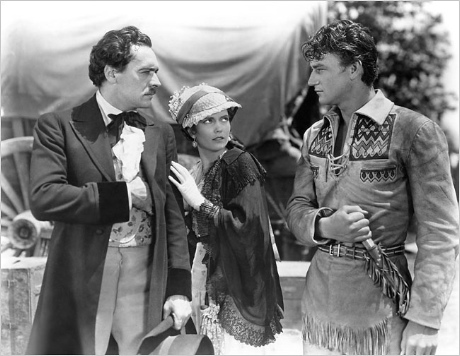
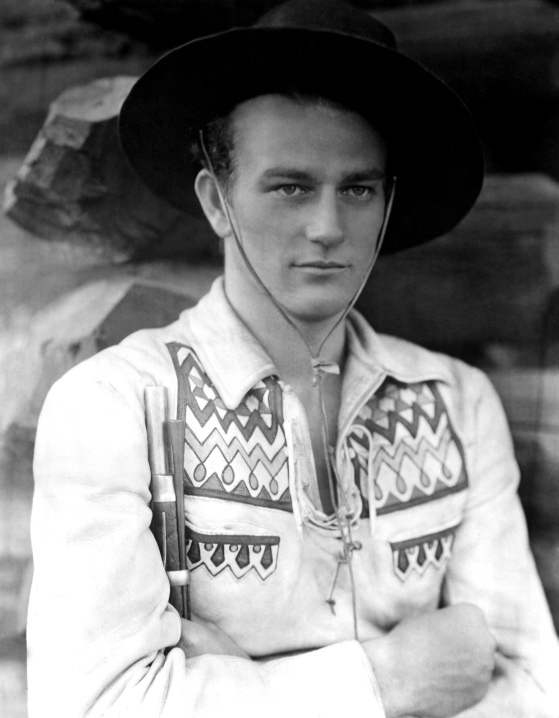
But, there's one other thing The Big Trail is known for: It is also the first starring role of a full-time prop-master and part-time bit player named Marion Morrison, who, starting with this film would operate under the name given him by director Walsh, "John Wayne."


Interesting to watch this kid who would become a screen legend.  He had yet to learn the pausing cadence that would give his sentences more weight, and there's a tendency to put a little too much of everything into the role, the glowers, the tightening jaw-muscles, the "hail-fellow-well-met" jocularity—if you want to see how Wayne plays it, there's a lot of similarity to how Ricky Nelson ambled through the role of "Colorado" in Hawks' Rio Bravo).


But, the casualness is there, always was.  Even here, his first starring role, there is the informal grace of how he'd just lean back in a scene.  There's a sequence where Wayne is talking to a large group of elders—because of the primitive sound equipment in camera trucks, everyone is encouraged to shout the dialogue a bit as it was filmed outdoors—while he sits cross-legged on a horse, as naturally as if he was draped over a dining room chair, the horse shuffling nervously despite having steadying hands on him, and Wayne balanced effortlessly, not missing a beat, even swinging his foot in conversation.


There are things that are a little wince-inducing: it's all very white hat/black hat with the bad guys (Tyrone Power Sr., Charles Stevens, and Ian Keith all pushing villainy at the top of their lungs that you almost think there should be a "hiss" track whenever they walk on-screen), Marguerite Churchill is a trifle too "fiddle-dee-dee" for my taste, and there's some rather antiquated humor about mothers-in-law, and goofy ethnics (hard to place...Swedish?) that's just a step away from the "gag-men" antics of the silent era.

But, I spent the majority of the movie goggle-eyed at the incredible shots by Walsh and his cinematographer Arthur Edeson**** (a mainstay at both Fox and Warners, Edeson has an impressive list of credits, in which he managed to squeeze in among the B-pictures and programmers Frankenstein, The Maltese Falcon, The Old Dark House, and Casablanca) that take advantage of the western locations and The Big Sky (still remarkably free of air-traffic), artfully composed as if they were framed by Frederic Remington.


Look past the dated material, and some of the more vaudevillian (and vaude-villain) moments and there are many visual wonders to behold here, brought about by one of the great directors who doesn't get nearly enough attention: Raoul Walsh.


* Transitions are handled by the insertion of title cards anticipating the action of the next episode.

** In addition, there were foreign language versions shot at the same time—Spanish, French and German—with different casts.

**** The first outdoor sound film—In Old Arizona—was made the year before, photographed by Edeson and planned out by Walsh, who was set to star (as the Cisko Kid, no less) and direct until the traffic accident (a jackrabbit smashed into his windshield) that cost him his right eye.


***


Wednesday, September 16, 2009

The Man Who Shot Liberty Valance

"The Man Who Shot Liberty Valance" (John Ford, 1962) Even the mention of the title invokes a cynical irony for those who have seen it. This crowning glory in the long accomplished (dare one say legendary) career of director John Ford, 68 at the time of its filming, is a bitter pill of a film and a meditation on the inexorable march of time and the brutal boots of history.

It is about "becoming"—not just in the strictest sense of transitioning (although the town of Shinbone, in which it is set, is in the midst of leaving its old West roots behind to take its place as part of the Union of States), but also in the less used sense: of reflecting favorably on the subject to its advantage.

It is also about, as so many of
John Ford's films over the years, the taming of a wilderness, and the creation of a society. And the unbecoming truth that to create the veneer of civility, sacrifices must be made, just as sure as Sunday dinner.

Senator Rance Stoddard and his wife Hallie (
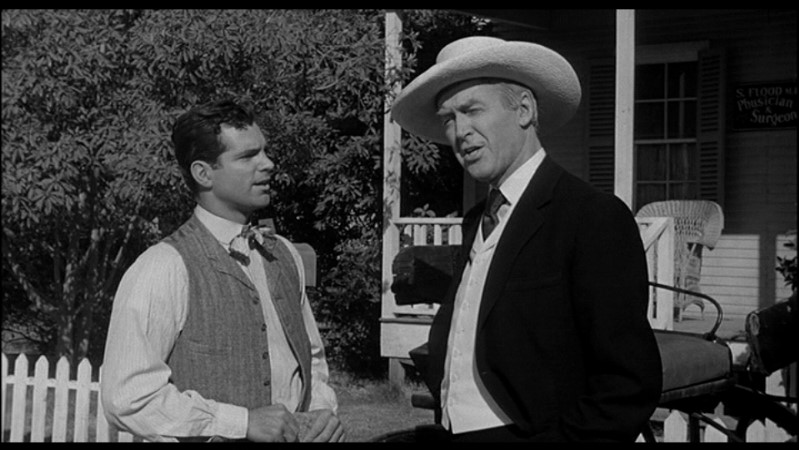
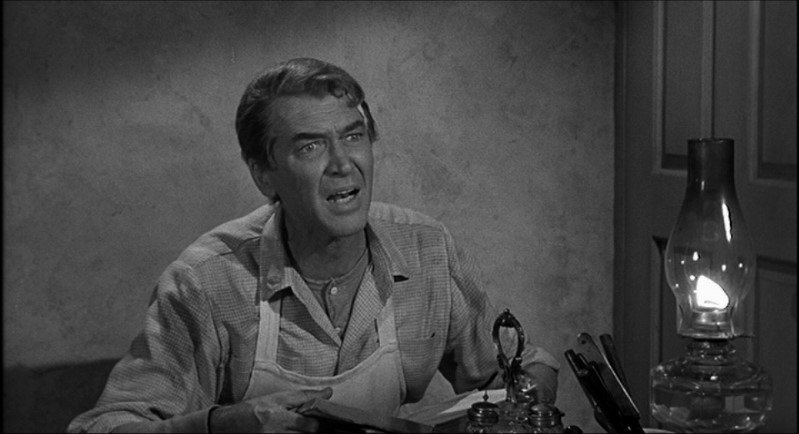
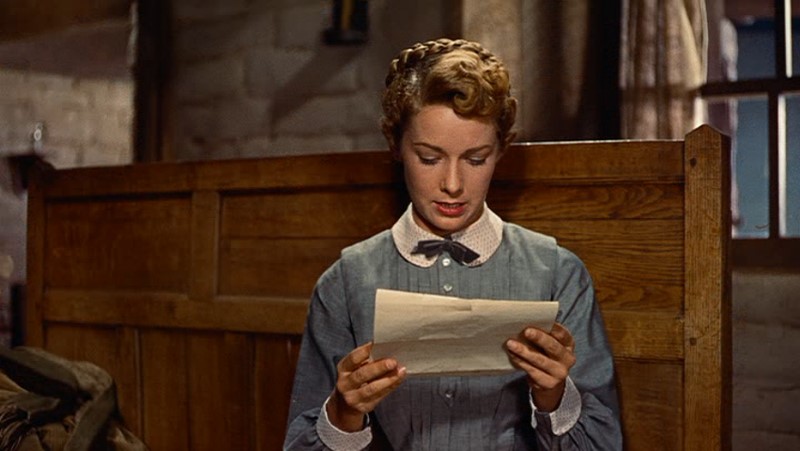
James Stewart, Vera Miles) return to the town of Shinbone to much hoopla. It is their home-town, of course, but as the Senator now spends all his time in Washington he doesn't get back there much. So the press start nosing around to get the wherefore's of why "The Man Who Shot Liberty Valance" (and rode that acclaim into politics), is there now. The occasion is a funeral for a man nobody knows (or has little regard for), but he's very important to the Stoddards—he is, after all, the man who brought them together. And as Hallie places a cactus on Stoddard's plain pine coffin, Stoddard relates the tale, one that blows away the Senator's folksy bluster with a scouring truth.

The Senator talks of his first coming to Shinbone as a greenhorn lawyer* and his run-in's with
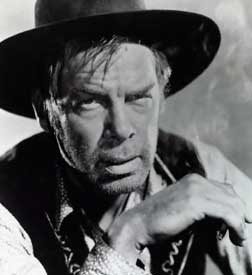
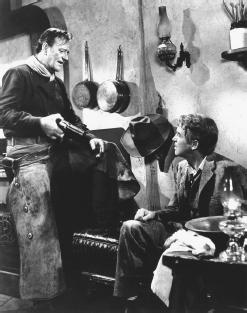
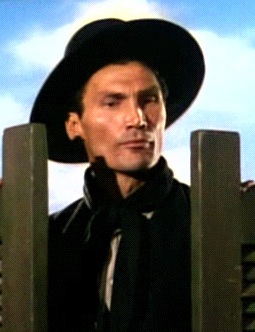
local bandit Liberty Valance (Lee Marvin, gloriously over-the-top), a malevolent thief and enforcer for the cattle industry who has the small town of Shinbone afraid to come out of their houses. Beaten and bleeding, Stoddard is brought to recover under the roof of the Ericson's (Jeanette Nolan, John Qualen, Miles) by Tom Doniphon (John Wayne), who's sweet on Hallie and is building a house for the two of them outside the city limits. Doniphon is contemptuous of Stoddard's belief in law and order (calling him "Pilgrim," only one of two films where Wayne used that oft-parodied term), believing that the only way to stand up to anarchists like Valance is a loaded pistol.

I say "anarchists" pointedly, because "
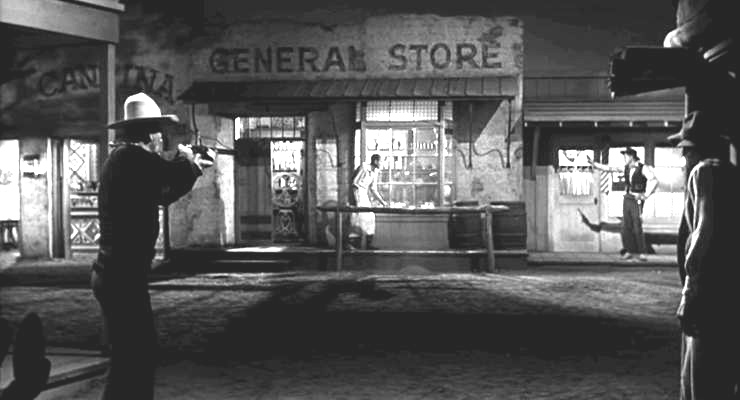
The Man Who Shot Liberty Valance" (Get it? "Liberty" Valance?) is as much about politics as it is a story about a love triangle in the Old West. You have the anarchistic, irresponsible Valance on one side and you have the "book-larned," law-and-order, taming-the-West-by-education-and-civics Stoddard on the other. In between, you have Doniphon, who's all for government (far as it goes) but in his time, you tame the West with bullets and hard work. But that time is passing. Doniphon is late to realize that that taming means the passing of the bad guys who will disrupt, but also good guys with a sense of entitlement. Ford chooses sides, and it's for civilization—because anything else is stagnation and waste. For all the talk of "Freedom" and "Rights," those are granted only under the auspices of control and Law. Because Valance represents not only unbridled freedom, but also the seeds of despotism. As a rancher, Doniphon knows those seeds will take over unless something stronger, hardier is planted in its stead.

Even if it means the death of his way of life.

Sacrifices must be made.

By the time the tale of Stoddard and his benefactor/mentor and rival
is told, a bloom has, impossibly, appeared on the cactus, because like Stewart's lack of youth in the flash-backs and the old-age make-up for the young actors in the present, Ford is also playing with time, even going to his own past, using a piece of music from 1939's "Young Mr. Lincoln" (that put a melody to Lincoln's loss of his first love Ann Rutledge) for the scene of Hallie regarding Doniphon's burnt-out homestead. And so, the telling of the tale of a lifetime is enough time to ensure new life in movie terms.

In "The Man Who Shot Liberty Valance," Ford goes so far as to state outright something he'd been alluding to throughout his career as a film-maker, story-teller and chronicler of the United States. Given a choice between printing the unvarnished truth or a myth for the common good, the newspaperman says," This is the West, sir. When the legend becomes truth, print the legend."

There was never a better-stated justification of film-making.

It's a definitive statement of Ford's career directing movies. But "Liberty Valance" is also a bridge from Ford's early Westerns to the "modern" "oaters" of the 60's as Valance's wormy toadies are portrayed by
Lee Van Cleef (of Sergio Leone's "Dollar" trilogy) and Strother Martin (part of Sam Peckinpah's stock company). Those film-makers were inspired by Ford, and in their own revisionist methods of "printing the truth," made their own legends.

And so the film is its own truth, summarizing one director's past as a pioneer and presaging the future of the Western film, on the edge of its demise, both "becoming" even in the depth of their cynicism.

* One of the criticisms of the film is that both Stewart and Wayne are playing young men when the two were both in their 50's. Wayne can get away with it (as he always plays old...and other reasons), but Stewart doesn't come across as a man in his 20's. I have something to say about that towards the end of the review.

Friday, June 19, 2009

Hondo

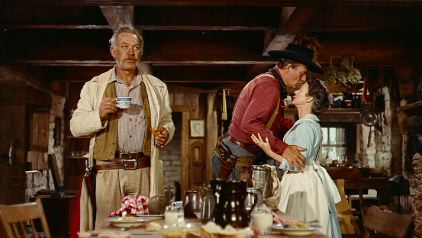
"Hondo" (John Farrow/John Ford, 1953) Out on the prairie, it's a tough life for Angie Lowe (Geraldine Page in her film debut), but evidently not a lonely one...or a quiet one. First Hondo Lane (John Wayne) lopes in, horseless and all too full of advice. Then Apache Chief Vittorio (Michael Pate) stops by, befriends her son (he likes the way he draws down his next-in-command), and makes him part of the tribe...and gives her a lot of advice.

Already you start thinking that Hondo and his player on the other side have a lot in common. They test each other, and when the other doesn't give the answer they want to hear, well, that just means you can trust 'em to speak the truth. Hondo's part Native, speaks the patois,* and in a past life lived among them. He also knows that the U.S. Government made a treaty with the Apache that Ulysses S. Grant has already broken. "The Apache don't have a word for 'lie,'" he says, with a curled lip, so he knows they're going to attack the settlements. That doesn't mean he has to like it, and it doesn't mean he's going to betray either side doing it.

There's a lot of "
Yojimbo" in "Hondo" for the adults and a bunch of "Shane" for the kids—that is, if Alan Ladd had killed Van Heflin. Truth to tell Hondo Lane is a cross between Ladd's Angel and Jack Palance's Devil. Hondo's only attachment is to his dog Sam and he won't feed Sam, knowing the animal will fend for itself. "He's independent. It's a good way to be." That doesn't mean he won't shoot a man for threatening Sam, and then kick the dog for getting in the guy's way in the first place. He's described as a "mean ornery son-of-anything-you-wanna-call-him." They were oblique back in the days of the West, they didn't use the word "conflicted."

"Hondo" was financed by Wayne's Batjac Productions,** made on the cheap in Mexico by director
John Farrow (father of Mia, and director of "The Big Clock" and "Ride, Vaquero!") and, for the climactic action sequences, by John Ford (which is readily apparent—they look like sequences from "Stagecoach"). It was also shot in 3-D, with a minimum of arrow-in-your-face shots (except by Farrow in a not-too-convincing knife fight, but Ford goes to town making sure his stunt riders fall right in front of the camera, kicking dust into the lenses). It would be interesting to see it in that format, but "Hondo" has been monocular since its first road-house presentations.*** But never say "never:" a restored 3-D version of "Hondo" had its American premiere at the Samuel Goldwyn Theater in Hollywood. Give it a look-see.

"...man oughta do what he thinks is best"


* The language in "Hondo" is a bit more colorful than in most westerns—it's not afraid to lose its audience with a colloquialism. For instance, you don't holster a pistol, you "leather" it.

** The original cast was supposed to be Glenn Ford and Katherine Hepburn, but Ford had a bad experience working with Farrow that he didn't want to repeat, and Hepburn didn't like Wayne's right-wing activities at the time. By the time of "Rooster Cogburn" she had changed her mind.

*** And I've been reminded that "Hondo" was shown nationwide in 3-D..on television...in 1991.

Thursday, June 11, 2009

100 Years of the Duke

John Wayne died 30 years ago this day, and I have vivid memories of that. It was a Saturday, I was living in Longview Washington working as a disc jockey and driving home from my shift when the news came over the radio. Death. Cancer. Long fight. I was so swept up in grief that I had to pull off to the side of the road and weep. I'd lost my father a couple years before and was probably sensitive to loss at the time. But this one, this time, was John Wayne. I had no connection to him other than his roles on-screen, although there was ample opportunity to have met him when he was in Seattle filming "McQ"* or come up to the Sound for one of his frequent fishin'-and-drinkin' sortee's...in a converted mine sweeper! The marina he tied up to is named in his honor.

This was written on the centennial of John Wayne's birth. He was ranked #1 by Quigley Publications' annual poll of the Top Ten Money Making Stars, 19 times from 1949 to 1972. Only one other Hollywood actor has surpassed that popularity--Clint Eastwood at 21. Wayne died of stomach cancer June 11, 1979.


Marion Morrison would have been 100 years old today.

Two stories to start--one certainly apochryphal, one probably true.

Story one: George Stevens was directing "The Greatest Story Ever Told" and in one of the egregious examples of "stunt-casting" that mars that movie is John Wayne as "The Centurion." Wayne was dressed improbably in Roman armor, and when Jesus "commends his spirit" and the heavens open, Wayne had one line, looking at the cross--"Surely this was the Son of God!" They did a take and Stevens wasn't satisfied. "It needs more, John! This is Jesus and he's just died...I need more awe...can you put more awe in it, John?" Take two: Wayne looks up at the cross and says...."Awww, surely this was the Son of God!"

Story two: Ward Bond was a member of director John Ford's stock company of players. He was in the great majority of Ford's movies playing many different roles. He was also, like Wayne and Walter Brennan, a vitriolic right-winger and anti-communist, who in the hey-day of the 50's red-scare would brow-beat members of cast and crew into signing loyalty oaths. A crew-member came up to Ford and complained bitterly about Bond's behavior. "Yeah!" Ford growled. "Bond's a son of a bitch, alright! But he's our son of a bitch." As in: "He's a jerk, but forgive him." As in "We've all got our faults." As in: "Let he who is without sin cast the first stone."

I love John Wayne. And I despise John Wayne. But I love John Wayne.

I love John Wayne movies, and admire greatly the performances of John Wayne in them. That George Stevens story is funny...and plays into the myth of Wayne being a poor actor...something Wayne was only too quick to contribute to. "I don't act. I re-act," he would say. It never hurts to lower expectations, I guess. But one need only look at how directors could only cast him against strong co-stars--if they didn't, Wayne would blow everybody away like a prairie mist. Wayne had to work with players wise with their own tricks before the camera--the Clifts, the Brennans, the O'Hara's, the Mitchums and Douglases and Holdens and Marvins--or he'd walk all over them with a simple glare. All Wayne had to do to make his point was NOT look at an actor. Even sick and weak, Wayne in "The Shootist" had to be balanced with a cast top-heavy with strong actor-personas: Jimmy Stewart, Lauren Bacall, Richard Boone, Harry Morgan, Hugh O'Brian. They had to be--for Wayne's last film they were playing against Wayne and his legend. I'm completely unapologetic in saying that John Wayne was a master of his craft and the more I see of his work, the more I believe it.

I also think John Wayne was an immature man with a false sense of what being a man was: he was a bully, a bone-head, and a complete fake, espousing Great American Ideals, while holding to none of them personally. The actor who portrayed "America's Fighting Man" never joined the military, opting to stay out of World War II claiming marriage, and because he didn't want to go in "as a private" (and with most of Hollywood's leading men off to war, commission or no--it allowed a vacuum that Wayne was only too eager to fill--he feathered his nest very well during the war). John Wayne, American, was married three times and all three times his marriages were contentious, and rumored to be abusive. John Wayne, hero of the West, was never a rough and tumble cowboy, but a football player and actor who grew up in California, and lived a very priviledged life. It was all a charade. But I love him in those movies, and I can't get enough. A John Wayne movie can even bring a tear to my eye.*

I love John Wayne. And I despise John Wayne.

And Marion Morrison? Well, now, there's the mystery.

Because Marion Morrison of Winterset, Iowa, born 100 years ago today, was a football player who worked on John Ford's crew and did the occasional line on-camera until Raoul Walsh picked him to star in "The Big Trail" and changed his name to John Wayne. And though Marion Morrison appeared in many many films, his greatest role was as "John Wayne," actor and patriot--the persona that never really existed but was portrayed as if it did, an American Myth. And even that role I admire and wonder at--the performance of a lifetime--though the things said in that guise could be alarmingly knuckle-headed. God and Country, sure. But "the Indians shoulda got out the way...they were selfish," how retarded is that? Still, when the Harvard Lampoon invited him to accept their bogus "Brass Balls" award, Morrison went...as Wayne...and bowled them over with his, by-now, well-learned self-deprecating humor. It was a day to show up and not take anything too seriously. He got as many laughs as jeers from the Hah-vahd boys, and there's something great about that. "Brass Balls," indeed.

And then there are the stories that keep popping up. New truths punctuating the Myth. How "John Wayne" would publicly rail against communists and want them to all go back to Russia...but when Carl Foreman, blacklisted writer-producer, came back from self-exile producing films in Europe, and encountered Morrison at a dinner party he was astonished when Wayne came over to his table and gushed and made a fuss over him in front of Foreman's kids...like they were old buddies. Effusive in his praise and admiration. By-gones. There's the rabble-rouser John Wayne who would carouse and whore on-set, but who won the admiration of that most judgemental of actresses, Katherine Hepburn. There's the Marion Morrison who got along famously with wildly liberal director Don Siegel (who would needle Wayne on "The Shootist" set by wearing a peace medallion) and send Siegel's mother in hospital fresh flowers every day. There's the Marion Morrison, who read black-listed author Marguerite Roberts' screenplay for "True Grit" and declared it "perfect." Marion Morrison had less bluster than "John Wayne" did.

I encounter those stories more and more and marvel at them. And marvel at how Marion Morrison maintained "John Wayne" all those years. How he became greater...improbably greater...than himself in that persona. How he "sold" the myths and made you believe. There's real artistry there...beyond the screen roles.

So, I marvel at Marion Morrison...at John Wayne...and the dichotomy, and the contradictions
...the complications embodied there in the one man. And wonder what's Myth and what's Truth. A little bit of both, as we all are. Just bigger. Broader. In gifts, and in failings.

And I go on contemplating that as I watch him stride across the screen in that walk that made him look like he was balancing on a ledge...or maybe a tight-rope. And I smile and admire him, despite everything else, say what you will about him.

But he's our son of a bitch.

-----------------------------------------------------------------------------
* I did have conversations with an actor who'd work with him on "McQ," and got the usual: "Bigger than life," Big man," "Gregarious, always laughing" and this..."He had tiny feet!"

** I'm not alone here. Director Jean Luc Godard hated everything about Wayne, but there's a moment in "The Searchers" that so moved Godard that it "filled him with love" for the actor.


Wednesday, May 20, 2009

Anytime Movies Reloaded: The Searchers

It's Spring-Break for me. Times are busy. The Summer Movie Season is already begun (and I'll be writing about the new ones) and the Film Festivals are grinding away like creaky mills separating wheat from chaff. It's as good a time as any to re-boot a feature I started years ago, when it was suggested I do a "Top Ten" List.

I don't like those: they're rather arbitrary; they pit films against each other, and there's always one or two that should be on the list that aren't because something better shoved it down the trash-bin.

So, I came up with this: "Anytime" Movies.

Anytime Movies are the movies I can watch anytime, anywhere. If I see a second of it, I can identify it. If it shows up on television, my attention is focused on it until the conclusion. Sometimes it’s the direction, sometimes it’s the writing, sometimes it’s the acting, sometimes it’s just the idea behind it, but these are the movies I can watch again and again (and again!) and never tire of them. There are ten (kinda). They're not in any particular order, but the #1 movie IS the #1 movie.

It’s a film that chills me right down to my bones and makes me cry every single time. It throws itself into the deepest pits of despair and within moments, prat-falls into low comedy. It’s a western…about race relations, and in the house of mirrors of a “genre” piece deflects the self-righteous tone of a sermon. It stares into the soul of people at their worst, and exults in their best.

It is arguably
John Ford’s best film (and he made many great ones). It is inarguably John Wayne's finest performance on-screen, while completely working against the image that Marion Morrison built as “John Wayne.”

Oh no. We’re talking about
The Searchersa “western” made during the somnambulant 50’s …and with John Wayne, ferchrissakes! How corny can you get?

Back up, pilgrim.

“The Searchers” has just been re-released (to mark its 50th anniversary) in a
gloriously re-mastered DVD, and has come under critical review for being too corny, too obvious, and more than a little dated. Worse still, it has been branded a “film-school darling” that has skated too long on an undeserved reputation as a masterpiece.

Bullshit.

Like Pauline Kael’s faulty detective work dissecting “Citizen Kane” and Elvis Mitchell’s naïve un-analysis of “2001,” the work in Slate smacks of a critic either looking for something to write about or make a name for themselves bucking “conventional wisdom.” Having to spend a summer reviewing the third X-Men movie, the fifth “Superman” opus AND an entirely superfluous “Pirates of the Caribbean” sequel is bound to make anyone crabby.

But it shouldn’t lower one’s standards, and there’s enough slip-shod work in the article to indicate that’s the case. At the very least, it’s a terrible gloss-over.

“The Searchers” is a masterpiece—the culmination of decades of film-making experience that John Ford had accumulated since the silent era—while crystallizing Ford’s growing disenchantment with the Myth of the West. In a time when westerns were still basically built around the simplistic formula of “Cowboys vs. Indians,” Ford was starting to speak out more explicitly for the latter sixteen years before such accepted “consciousness-raising” films as “Little Big Man” or “Soldier Blue.” Like any masterpiece, it displays the sum of a body of work and breaks new ground, paving the way for the future.

“The Searchers” tells the story of an obsessive 10 year hunt for a lone family member taken in a violent Comanche raid. It’s led by the worst person possible: the child’s uncle--a hate-obsessed confederate soldier, self-exiled from his family, who still carries his saber on his hip, bitterness in his soul and his heart on his sleeve. Mix in a venomous race-hatred for all non-whites and you have the most flawed anti-hero to appear in movies. Ethan Edwards starts his search to bring his niece back alive, but as the years pass and she matures, he gives her up as one of the Enemy, and sets out to kill her. At the center of the film’s black heart is that most archaic and useless word: miscegenation.

It’s rough stuff. Rougher still are the attitudes of the settlers towards the Indians that border on hysteria. There’s a haunting scene late in the film where Edwards and his fellow traveler (played by future Captain Pike and “Teenage Jesus,”
Jeffrey Hunter) ride into a fort on the Trail of Tears to inspect some white women who have been captured by the Cavalry. “It’s hard to believe they’re white” a sergeant says. “They ain’t white,” spits Edwards, and at the sound of a shriek from one of the women, he turns to look at her. Ford trucks in the camera fast onto Wayne’s face (mirroring the shot he used to introduce Wayne in their first film together, “Stagecoach”) and it’s amazing. Wayne was always blessed with a mug that the camera loved*—it could read every emotion that played across it--and in a performance minus the “hero façade” and that turns on the full after-burners that usually blew his co-stars off the screen, this one quiet moment radiates a combination of hate, disgustand abject fear. No words need to be said to make the point.

And yet, for all its depths of despair amid bloodshed and the race-hysteria, Ford tries to balance it with entertainment. That’s quite the tight-rope walk. But then, it’s not a sermon. It’s a Western. Ford was never so pretentious to be caught lecturing. He’d say if you want to send a message, use the Pony Express. Better to sneak the lessons into the fabric of the story, and distract with shenanigans about wayward lovers, goony old men, and green cavalrymen with pointy swords. One of the incidents involves the unintended marriage of Hunter’s character to a portly Indian maid. It’s the source of raunch comedy in the vein of Ford’s “The Quiet Man”—all roughhouse and bad taste. But when Ford’s good guys “The Cavalry” decimate a Native village and the luckless character along with it, Hunter is left to ask “What’d they have to kill her for? She never hurt anybody!” The question hangs in the air with indictments all around.

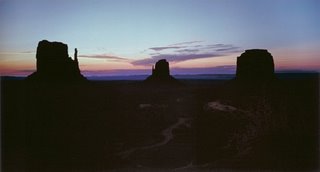
“The Searchers” begins and ends with a black screen. In the beginning, the blackness gives way to the vast magical vista of Monument Valley (which figures in two of my anytime movies. If God lives anywhere on Earth, I think it’s on that vast acreage of land overseen by the Navajo) that to Garry Wills suggests an irising lens, but to these eyes seems more of a proscenium arch. At the end it shuts out Ethan Edwards who is left out of the warmth of a family embrace to wander the desert (Of course, Wayne’s character is going to come in eventually and eat…but Ford chooses to leave Edwards outside). His prejudice does not belong with home and hearth...and society…and Civilization. Yet it is also Ford’s choice to leave the character alive, the wolf always at the door.

It’s as if having made his plea for tolerance, Ford cautions us that it will always exist, somewhere.

Will we ever lose the hate?

“That’ll be the day.”

* Screenwriter Robert Towne has a better term for it, the "camera-love" phrase implying a happy accident that doesn't give enough credit to the actors, their craft and experience. He says that actors like Wayne, Henry Fonda, and Gary Cooper are "ruthlessly efficient" in that they can communicate differing emotions with an economy of expression. Those words are particularly apt for Wayne's performance in "The Searchers."


The Searchers
Chinatown
Mr. Smith Goes to Washington
American Graffiti
To Kill a Mockingbird
Goldfinger
Bonus: Edge of Darkness

Saturday, September 6, 2008

Olde Review: The Shootist

Written August 11, 1976

"The Shootist" (Don Siegel, 1976) I was briefing through the movie reviews of various magazines in the grocery store a year or so ago, when I came across Richard Schickel's review of "McQ" or "Brannigan" (probably "Brannigan"), in which he remarked that a proper bicentennial project would be to come up with a decent script for John Wayne.

I was hoping
'Rooster Cogburn" might be it, but that was a waste..of time...and talent. And besides, as much as I like "Rooster" Cogburn as a character, the acceptance of Wayne's acting that suddenly sprang up smacked a bit too much of "Well, we'll like him as long as the old galoot knows he's a joke." Well, there were times in "True Grit" when Wayne--the Wayne as the screen force--came through. I didn't want to see Wayne made fun of or exploited. I wanted to see him triumph, as of old, in his now twilight years, and as John Wayne, the very fine actor.

So, I am delighted at "The Shootist" and delighted with it. It is about Wayne, as about Books (instant cliché time). Why else would Siegel in his opening use shots of old Wayne movies (and mostly Howard Hawks Wayne films, where Wayne played a character built out of his own persona, rather than playing "honest-to-God" characters ala John Ford) and with young boys---in 'Red River" and "Rio Bravo"--as Wayne the mentor, as he is, in an odd way, in this film.

Siegel is still a little obvious in his handling of things, but the ideas are so good, who cares? He literally numbers Wayne's days. And what a nice idea for a living legend and soon-to-be-immortal legend to have his birthday and the day of his death on the same day, on a gravestone that doesn't mark its day.

Death hangs over this film, in conversation, in song, in thought, in way of life. But this is nothing new. Death has walked with Wayne through many a picture. For a long time. Both were winners in the end, and, as in real life, Death must have his due.


"The Shootist" is the film John Wayne went out on, and as a summation of his career, and a the last ring of the bell, it's nearly perfect, even though the film is a bit flawed. Still, director Siegel did a masterful job of keeping the stars corraled--there was a lot of people wrangling to be in it--and Wayne healthy, although there were times when he was too weak to be on-set (although he was, at that time, cancer-free). And even though Wayne and Siegel got on like a house afire (the two couldn't have been more different, politically) there were still dust-up's about the way Siegel, the most economical and least fancy of directors, would line up shots. Lauren Bacall, who was no doubt reliving her own time of dealing with cancer with husband Humphrey Bogart, braved up through the movie, and provided a steely shoulder for Wayne to lean on. Stewart signed on for a cameo, comprising the most jarring scene; it's Stewart who provides the cancer diagnosis. And Richard Boone, John Carradine and Hugh O'Brian did the same out of respect and love for their old co-star, and Ron Howard, eyes set on a directing career instead of acting, still pursued the juvenile lead one last time. The budget was tiny, but top-heavy with stars...and history.

All those guest stars work against the film and make it lose focus a bit. You can tell that Siegel might not have gotten all the coverage he might have wanted--sequences seem stretched a might' thin. But overall, the film works well.

With time, perspective...and maybe a slight blurring of facts...one can look at "The Shootist" as the death of the Western--a sturdy movie genre for decades. The 60's had slowed it down, made them seem irrelevant, but one could still count on a number of Westerns being shot every year...until John Wayne died. And then...nothing.

A few things crop up here and there. "
Tombstone" and its cousin "Wyatt Earp," Eastwood's classic (and Oscar-winning) "Unforgiven," and "Silverado," which reminded how good a time an intelligent Western could be. "Deadwood" is a wickedly nifty updating of the "Gunsmoke" stories of a frontier town, and "3:10 to Yuma" this year briefly revived interest in the Old West and its ways. But a case can be made that without Wayne in the saddle, green-lighting a Western became a difficult proposition.

Why bother? Wayne kept the genre alive for so long, but with his passing, they became less viable.

They might still come back. Turner will do a period piece, a
Zane Grey adaptation, once in awhile, "Lonesome Dove" certainly proved popular, and even "Brokeback Mountain" made a contribution. But that "3:10 to Yuma" popularity was certainly encouraging.

Then there's the curious phenomenon of the Western morphing into another genre--Science Fiction, precisely. The "
Back to the Future" series capped off with an Old West yarn, and it was easy to see the gun-slinger in Han Solo in "Star Wars," the fight in the bar, etc. and, Joss Whedon created a future Western in the "Firefly" series, and its movie-spin-off, "Serenity." It's funny. Just as the western was a broad enough genre to encompass all sorts of morality plays that would reflect today's society, so, too does the Science Fiction story. The two overlap, and share much the same elasticity, that frequently it turns into a case of "You got Science Fiction in my Western/You got Western in my Science Fiction."

Maybe the Western hasn't rode into the sunset just yet.

Maybe it's just waiting for a new dawn.

Or a new star to guide her.