Showing posts with label 1948. Show all posts

Tuesday, February 5, 2013

The Three Musketeers (1948)

The Three Musketeers (George Sidney, 1948) Every few years, a new generation has to put their imprint on Alexander Dumas' adventure tale on the chicaneries and hidden agendas during the rule of King Louis XIII and Cardinal Richelieu, when it seems everyone was challenging the rule of theocracy masquerading as monarchy.  Every time, a group of four actors can be found to collaborate rather than hog the show, a new version is produced and a different spin is put on the first part of the d'Artagnan Romances, telling of a sword-skilled Gascony bumpkin who goes to Paris to join the King's Musketeers of the Guard—knights on the cusp of a new technology who prefer their battles to be sharp and personal—and learns the ways of the world in love, loss, and politics and how they all cross swords.

My favorite version is still Richard Lester's one-and-a-half film epic The Three Musketeers: The Queen's Diamonds and The Four Musketeers: Milady's Revenge for their bawdy humor, down and dirty sword fights and occasional stunt-casting, breezily written by George MacDonald Fraser, lovingly photographed by David Watkin, and (for the first one) cheekily scored by Michele LeGrand in his mock heroic style.

But there have been so many others, going back to the silent era.  One of the oddest, despite being a fairly straight adaptation is the Technicolor M-G-M version from 1948, starring Gene Kelly as d'Artagnan, high in the step and long in the tooth, where the fights are choreographed more as dance in natural settings.  All movie fights are choreographed to some extent, but the '48 version of "3M" has a particularly dancerly feel with Kelly.  There's a "lark" aspect to the whole thing, with a winking feel as if to say "isn't this all preposterous?"  It feels even more so in Kelly's love scenes with June Allyson playing Constance, confidante to the Queen (Angela Lansbury) and daughter (in this one) of his landlord.  Their scenes have a campy, artificial leaning, layered over with a version of Tchaikovsky's "Romeo and Juliet" theme, which was probably a cliche for love in '48.  It makes any emotional investment in the romance so much embarrassing vapor.

Impressive cast, though, with Lana Turner top-lined (probably to assuage her fears that it was a secondary role) as the villanous Milady deWinter, Vincent Price is finely oily as Prime Minister Richelieu (evidently he was defrocked for the film, owing to pressure from the Catholic Church), Van Heflin a good, but not great Athos, Gig Young as Porthos, and Keenan Wynn providing comedy as d'Artagnan's servant Planchet.

And it has one scene that makes the highlight reels—Kelly's tribute to Douglas Fairbanks, vaulting over French roof-tops to rescue his lady-love.  It's nicely staged athleticism, marking a sharp contrast to the play-acting of the rest of the film.

Tuesday, December 25, 2012

3 Godfathers (1948)

3 Godfathers (John Ford, 1948) Ford's version of The Nativity Story set in the very wild West is a remake of his 1919 silent film Marked Men,* which starred Harry Carey. The son of John Ford's first star, Harry Carey Jr made his acting debut in this one as The Abilene Kid, who along with John Wayne and Pedro Armendáriz, play former cattle rustlers up-scaling to bank robbery.  After the meager heist, they escape a posse from Welcome, Arizona (led by Ward Bond's Sheriff B. Sweet, as well as Hank Worden and Ben Johnson) by taking a perilous escape route through the desert (it was filmed in Death Valley)—not the wisest of men or maneuvers.  Their flight leaves them wounded, their water supply draining and quickly losing every means of survival in the desert.

Things get complicated when, looking for water, they come across an established that a tenderfoot, in his ignorance and panic has dynamited in an an attempt to get more water, destroying it.  If that weren't bad enough, he's run off into the desert to find his stock, driven loco by alkaline poisoning, leaving behind his wife (Mildred Natwick) delirious and about to give birth.  Unbeknownst to them, she's the niece of Sheriff Sweet's.  


Armendáriz, Wayne and Carey Jr. don't know nuthin' 'bout birthin' no babies

The leader of the group Bob Hightower (Wayne) can't cope with the intricacies of the situation, leaving "Pete" Rocafuerte (Armendáriz) to deliver the baby, and when the mother dies, leaving the three with a promise to care for the child she has named Robert William Pedro, the three villains must learn the basics of child-care (thanks to a book written by "Doc Meechum"), but with limited supplies they must cross the desert, led by a single star to the town of New Jerusalem (the other choices are Cairo and Damascus).  It isn't long before The Kid tells them it's their Destiny, that they were led to this place, this child, this duty, this precedent.  

It is, after all, almost Christmas.

It's a sweet story, about how the spirit turns with the charge of a newborn, and how even those on a downward spiral can be lifted up by a lack of self.  And Ford, working with screenwriters Frank Nugent (a new find with his Fort Apache script) and Laurence Stallings (with whom Ford and Nugent would collaborate on She Wore a Yellow Ribbon) keeps the sentiment high, and the humor all over the map from leaden to subtle.  Even without its silent roots (Mae Marsh from TheBirth of a Nation has a large role!), the film, in tone, feels like a throwback to an earlier time, like Ford's work in the '30's circa Stagecoach—not a bad time at all.  And, in the timeline of his work this looks like a wave good-bye to his western work of the past, as Ford would subtly move on to the slightly more serious She Wore a Yellow Ribbon to the dire The Searchers within the space of seven years.  

It was about this time that Wayne's performance in Howard Hawks' Red River (playing "old" at 41 years of age) was noticed by everyone, and notably Ford, who had still been using Wayne in co-starring roles.  "I didn't know the big sonuvabitch could act!" Ford groused to Hawks.  3 Godfathers is Wayne stepping into the limelight of Ford's films, where he would stay (mostly) for the rest of Ford's career.  And, as with the humor of the film, Wayne's performance covers a lot of ground, leaden to subtle.  His physical work is unmatched, as usual, casually sitting on a horse as if it was an easy chair,  stumbling through the desert in an alarming drunk march (supposedly holding a baby, which throw some scary drama into it, if you think about it), doing little character things you only notice later, like the way Hightower trudges dumbly through an edge-of-town water collection at the start of the film before it becomes of the utmost importance, and something that seems peculiarly florid and over-the-top but pays off hugely throughout the film: Hightower is something of a jerk and mean-spirited and given to elaborate mock-formality when teasing others, especially the way he takes off his hat and does a too-formal presentation of it.  It looks phony (it is phony for this rough man of the West), but it turns into genuine acts of kindness and civility—the man grows into the gesture and becomes him, a signature of the man he has become through the trails and tribulations that have become the period to a life of bad manners, bad habits and bad choices.  And the film ends with that same gesture, sending the man off to his fate, but promising the return of a better man and a better future.

This is all done with pictures, part of the skein of direction that Ford imposes on the film that, combined with the exquisite cinematography of Winton Hoch, makes this odd, anti-Christmas Christmas film something of a precious gem for the Holidays.


The resonant gesture of John Wayne in its most practical usage:
Thanks to the Way of Seeing blog for noticing this one.


* There is also a harder edged 1936 version starring Chester Morris, Lewis Stone and Walter Brennan, directed by Richard Boleshawski.

Tuesday, May 8, 2012

I Was a Male War Bride

I Was a Male War Bride (Howard Hawks, 1948) Hawks doing what he does best in a comedy—taking the finely chiseled speci-man that is Cary Grant and reducing him to a frustrated, humiliated wreck, robbing him of everything—dignity, decorum, manhood and sleep...mostly sleep.

In this one, Grant plays a Belgian in the French Army (in the same way he plays an American...as Cary Grant) in post-war Germany (it's actually based on a memoir—"I Was an Alien Spouse of Female Military Personnel en route to the United States Under Public Law 271 of the Congress" by the fellow this happened to) trying to break a black market operation with the help (and frequent hindrance) of Ann Sheridan.  They have history and start out loathing each other.  Along the way, he suffers bumpy rides in a motorcycle sidecar—in a rainstorm, no less—is nearly vaulted and scrunched by a barricade, paddles on the brink of a waterfall, climbs a pole (only to find that the sign, in German, says "Wet Paint"), is knocked off an awning from the second floor of a hotel, tossed in jail, and, in general, is made to suffer every indignity known to Man.

War is Hell, with several levels of humiliation, and its an everyday occurrence in this man's (and this woman's) Army.  If it's not a battle of the sexes. its a battle with bureaucracy, or the everyday battle with being a stranger in a strange land.  It is constant frustration, and Grant, outwardly so unflappable, is the master of its comic equivalent (as evidenced by such Hawks-Grant pairings as His Girl Friday, Bringing Up Baby, and the non-Marx Monkey Business.  Grant was the perfect test-subject for emasculation and the break-down of the cool customer.

As is typical Hawks, the camerawork is nothing fancy; set the camera up at chest-level and let the actors go and just try to keep up with everyone jumping over roadblocks, whether made or wood or red tape.  Typical situation—getting married.  She's American.  He's Belgian.  They're in Germany.  So, there are three wedding ceremonies and so many "I do's" that there's no time for a honeymoon—leaving him with one big "I don't" ("Get some sleep" says one of the hoteliers to him, to which he replies "That's ALL I'm getting," which is a pretty racy comment for the time, but Hawks always liked to push the envelope and tweak the censors)—plus, she's getting re-assigned to America, while he's fresh out of the Army, something that he'd been looking forward to but is now complicated by...all the complications.  But the mark of a professional in the Hawks world is the ability to punt, to improvise, and heal quickly...and move on, or around.  It was a constant with this director, in front of and behind the camera.  To persevere, do the job, despite set-backs and soldier on was the measure of a man...or a male war bride.

Friday, October 8, 2010

The Red Shoes

"The Red Shoes" (The Archers, 1948) A film considered by many toilers in the field (including Brian DePalma and Martin Scorsese) to be the most beautiful film ever made. It's also one of the most ingenious and ambitious (typical of of the writer-director-producer team of Powell and Pressburger), combining Hans Christian Andersen's story of a compulsively dancing set of ballet slippers (told in dance form) that takes over the soul of a woman, and couching it in a modern re-telling of the story, where magic is replaced by ambition, and the story parallels the real-life story of Russian impresario Sergei Diaghilev and his relationship with a British ballet dancer, Diana Gould.  Fantasy becomes psychology, and the Fates stay the same; that's a pretty bold statement on the power of myth and myth-making, both in the worlds of fairy-tales and The Arts.  And it's the kind of Deep Thought that Powell and Pressburger brought to the conception of their films.  Modern audiences may find them overwrought (and TOO "British?"), but that's missing the forest for the trees.  Let's agree to call it hyper-theatricality.  The Archers made exquisite films of subtlety and sophistication, and imaginatively bridged the fine cinematic line between reality and fantasy...and sanity and madness.*

The story is an expansion of Andersen's tale of a woman who loves to dance, is given a pair of magical shoes that fulfills her desires...only too well...finally dancing her to her doom.  Here, Vicky Page (the vivid...there's no other way to say it...Moira Shearer) is a dancer of great ambitions, but circumstances bring her into the orbit of ballet impresario Boris Lermontov (Anton Walbrook), who, impressed by her devotion to "The Dance" brings her into his company.  Given the chance to be a prima ballerina, she is also torn by her love for young composer Julian Craster (Marius Goring), who composes her signature ballet ("The Red Shoes," natch') for her, specifically.  The pressures of touring, and the constant strains both physical and emotional, spurred on by the controlling Lermontov, conflict with her love for Julian, but it's a metaphor, as much as "The Red Shoes" is, she is conflicted between her love of dancing and her love for the man. 

And then, there are the images:


They are startling.  Each frame could be hung on the wall of a gallery.  With the deep tones of a black-and-white film, but in eye-popping, arresting Technicolor, composed with equal attention to composition and detail.  Each advances the story-line, but moves deeper into the very psychology of the actors on stage.

But, they're moving in three-dimensions, and each edit to another shot is a new revelation that startles and pleases the eye.** This is incredible, sumptuous film-making using the combined skills of art and photo-chemistry. Every time I hear someone extolling the virtues of today's digital bleaching and leeching of color, I know they haven't seen this film and its full-to-dripping palette.


Choices that hurt the brain: In the middle of a performance, reality and fantasy merge in the conflicted heart of dancer Victoria Page (Moira Shearer).  The stress in the face is manifested by the dancer's physical exertions by beads of sweat and welling tears.
 
In one of the most startling images/special effects in "The Red Shoes," Vicky, in performance, imagines an image of her composer-lover, which she rushes to and falls through, a dream-like nightmarish image of the traps of love.

Lermontov (Anton Walbrook), a dark figure in the shadow of the wings


The conflict in a single image


The body of a dancer must be that of an athlete's. Strong, focused, and tough, as tough as the soles of their feet...as calloused as their toes. But what can come of that pirouetting figure, spinning, when it is in mortal conflict between a romantic heart and an artistic soul for possession of the self? Which ever way the music turns, love conquers all.  That is the heart of "The Red Shoes," and like the cautionary folk-tale that inspired it, that does not necessarily mean that everything ends "happily ever after."

One of those movies you should see before you kick, balletically or not.


* I can't help but think that Darren Aronofsky's up-coming Natalie Portman ballerina psycho-drama "Black Swan" will have also been massively influenced by this film, as well (although, given the trailer's theme of "You Must Find Your Passion," it sounds a bit more like "Red Shoe Diaries"), but one lives in hope that Aronofsky's dark sensibilities (and dabblings in theory, both mathematical and sociological) will be the dominant underpinnings.


** Yeah, yeah, I know. The previous sentences are as generic as they could be; that is what film-making SHOULD be, after all. Unfortunately, as the better the technology has become, the fundamentals of film-making as ticked off in those sentences seem to be lacking in most product. "The Red Shoes" is a shining (one might even say, glowing) example of taking the art to a new level.

Tuesday, March 17, 2009

He Walked By Night

"He Walked By Night (Alfred L. Werker, 1948) It's funny the things you find. You go down the twisted, dark corridors of the film noir genre and once in a while you find a gem shining in the black, one that has many facets and goes beyond its origins and haunts.

"He Walked By Night" is one of those. Picked up at the Socialist Book Collective (Your Public Library) for free, it looked to be a modest little film. It starred Richard Basehart and Scott Brady, an actor so anonymous they had to bill him with a past movie as a middle name—Scott "Canon City" Brady.* It's a low, low budget film that looks like a million bucks because it was photographed by one of the great cinematographers in Hollywood history, John Alton. Alton painted in black and white and his intricate screens of shadow are works of art, made quickly and with little money. He worked often with director Anthony Mann who is rumored to have directed parts of this film (and sections of it look like Mann's "T-Men," one of the best film-noirs). But credit goes to Alfred L. Werker, a director who toiled in the "B" and "C" strata of movies, working with such talents as Laurel and Hardy, even Disney, and directed the second (and I think best) of the Basil Rathbone Sherlock Holmes films: "The Adventures of Sherlock Holmes" (1939).


But "He Walked By Night" is a different detective story entirely. Based on a "true" LAPD investigation, ** it's a police procedural that details the work the force went into to capture a cop-killer and criminal who "seemed to be one step ahead of" them, all the way. The case drags on for months, and its only the dogged determination of one dedicated cop that leads to the case being solved. It boasts that beautifulAlton cinematography, L.A. locations, and a sense of realism that even precludes the use of a musical score. The film begins with a city-wide dragnet and ends with an incredibly well-done chase and fire-fight in the cavernous drainage system, the gun-fire echoing endlessly through the concrete corridors.


Performances are stalwart throughout, with Richard Basehart given the chance to shine through as the creepy killer, and slate-voiced B-actor Whit Bissell as the best lead witness who gets more than he bargained for.


Then down the credits is a thin, odd little actor who plays the CSI expert—or as it would become known "One of the Lab-Boys"—with a perverse sense of humor: Jack Webb. If "He Walked By Night" comes off as seeming a little familiar, that's the reason. Although having only a minor memorable role, Webb managed to strike up a relationship with technical adviser Marty Wynn, who suggested a radio series based on the crime-files of the LAPD. Webb ran with the idea and debuted the radio series "Dragnet" four weeks after this film premiered. The blue-print is here: the no-nonsense narration with the city as character and even the well-worn phrase "the names have been changed to protect the innocent." It's not exactly "Dragnet"—Webb drained the emotion out of it and did it on an even more thread-bare scale, but it's the facts, ma'am. This is where "Dragnet" started.


Why not look for yourself? "He Walked By Night" has slipped into the Public Domain, and you can watch it for free here.

* Not so anonymous, really. Brady was one of those crusty dependable actors who could do just about everything and did, playing spokesmen, governments agents, cops, people in authority, but strictly blue-collar. You'd know his face if you saw him. He had a rough-hewn authenticity and credibility that was used to its full advantage as the nuclear plant worker who vindicates Jack Lemmon in "The China Syndrome." He was also the more successful brother of actor Lawrence Tierney. There's a resemblance.

** Well, that's stretching it. A lot. Some of the particulars are used--the electronics genius, the use of the L.A. storm drain system for escapes, the meticulousness, the murders. But the truth is far stranger, and not so neat and tidy.

The story is based on the career of Erwin "Machine Gun" Walker, who returned from WWII slightly unhinged by survivor's guilt and the death of a friend at Leyte Island—a death he felt responsible for. He began a series of robberies to fund--I kid you not--a project to create an electronic "death-ray." This led to the murder of Officer Loren Roosevelt, who was gunned down attempting to question Walker after seeing him casing a store.

Instead of technologically-savvy, dogged police work, Walker's undoing was bragging about his crimes to his catholic girl-friend, who mentioned the story in confession, and the priest informed police—there goes the story of sanctity of the confessional.

Walker pleaded insanity for his crimes—he wasn't tracked down in the drainage system and killed—but was captured in a raid on his home (like the one depicted in the film) and wounded in the arrest. Citing insanity in his family and his war trauma, he made his plea, but was found competent and sentenced to death. 36 hours before his execution, he was found nearly strangled with an electrical cord, a suicide attempt—his father had killed himself six months earlier.

The suicide attempt led to Walker being declared insane and his execution postponed for 12 years, while he was remanded to various mental health facilities. In 1959, he was deemed "cured," but, reasoning that it might provoke another suicide attempt, his death sentence was commuted to life imprisonment.

Then, he was granted a re-trial, and because it ruled his initial confession at the time of his arrest was coerced, he was set free.

Rather than being cut-down in a melodramatic blaze of gun-fire as in the film, Erwin "Machine Gun" Walker walked.


Friday, December 19, 2008

The Naked City

"The Naked City" (Jules Dassin, 1948) It started with Weegee. The homunculous photographer of New York's gritty, seemy side published a book of his night-time photos of back-alley rendezvous, police-work, wet and dry, and New York's underbelly (fleas and all) bathed in the harsh glow of neon or Weegee's harsher strobe. The book had the provocative title "Naked City," so, of course, it became a best-seller.

Producer
Mark Hellinger bought the rights to make a movie of it with the intention of making a pot-boiler with the city of New York as the focal point and star. No big stars, just character actors would appear in it, and it would reflect Weegee's photography with the story of a police investigation of a lurid murder amid real New York locations. He hired screenwriters Albert Maltz and Malvin Wald for the screenplay, and to direct he brought in director Jules Dassin, whose prison drama "Brute Force" showed he had an unsentimental flair for that material.

"Ladies and Gentlemen, the motion picture you are about to see is called 'The Naked City.' My name is Mark Hellinger. I was in charge of its production. But I may as well tell you frankly that it's a bit different from most films you've ever seen. It was written by Albert Maltz and Alvin Wald, photographed by William Daniels and directed by Jules Dassin. As you see, you're flying over an island. A city. A particular city. And this is the story of a number of people. A story, also, of the city itself. It was not photographed in a studio. Quite the contrary, Barry Fitzgerald our star, Howard Duff, Dorothy Hart, Don Taylor, Ted deCorsia and the other actors played out their roles in the streets, in the apartment houses, in the sky-scrapers of New York itself. And along with them a great many thousand New Yorkers played out their roles, also. This is the city as it is. Hot city pavements. Children at play. The building in its naked stone. People without make-up."

And for the most part, they succeeded. Dassin can be quite "arty" in his direction, but restricted to real locations in the New York in the middle of the day, he sometimes had to get what shot he could any way he could—hiding the camera in trucks, newsstands, anything that would keep from drawing a sizeable crowd. A gawking clutch of citizenry would ruin the effect of a real story being played out. With the exception of a couple of process shots inside cars, the film pretty much keeps its promise.
But there is a disconnect. Despite the verisimilitude of the staging, the actors are still very much acting. The script, especially in its dialogue, is a bit too clever, and follows the conventions of Hollywood story construction exactly to code. This type of film had been done before with "The House on 92nd Street" directed by Henry Hathaway, during the noir/cost-cutting days of the studios, and would be done again with "Panic in the Streets," directed by Elia Kazan. The city may be New York in 1948, but the story takes place somewhere between reality and artifice.
Hellinger, who also narrates the film (in a grand-standing display of ego that would only be equalled by Cecil B. DeMille, and less so, by John Huston and Orson Welles), succumbed to a heart attack when the film was being previewed, at the age of 44, ending a colorful career as newspaperman, screenwriter, producer, film executive, and New York gad-about. Despite the number of classic films with his name attached, Hellinger may be best remembered for the last line of his last film, which has endured and entered the pop culture.

"It is one o'clock in the morning again and this is the city. And these are the lights a child born to the name of Petori hungered for. Her passion has been played out now. Her name, her face, her history were worth five cents a day for six days. Tomorrow, a new case will hit the headlines. Yet some will remember Jean Dexter. She won't be entirely forgotten. Not entirely. Not altogether. There are eight million stories in the Naked City. This has been one of them."
Last year, "The Naked City" was chosen by the Library of Congress to be a part of the National Film Registry.

There are 475 movies in the Film Registry.
* "The Naked City" is one of them.

* They're listed here. This year's films will be announced at the end of the year.

Friday, October 31, 2008

Abbott and Costello Meet Frankenstein

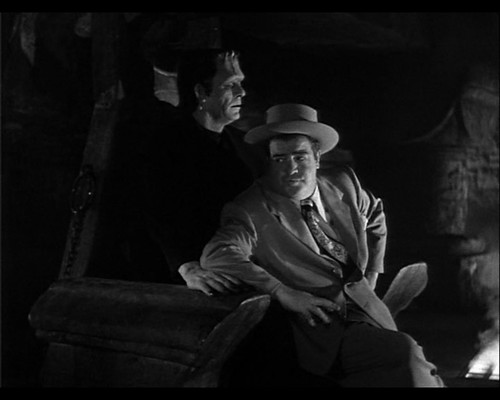
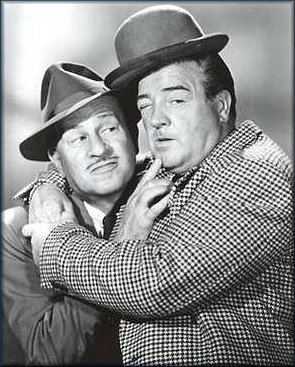
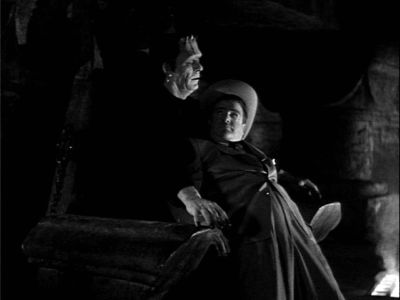
"Abbott and Costello Meet Frankenstein" (Charles Barton, 1948) The full title is "Bud Abbott and Lou Costello Meet Frankenstein" (as they all had the same production studio, Universal Pictures). But even that mouthful leaves out two major characters in the film: Bela Lugosi re-stakes his claim as Count Dracula, and Lon Chaney, Jr. plays poor S.O.B. Larry Talbot, aka "The Wolfman,"* who turns lycanthropic whenever the moon is full (sort of an eternal frat-boy)** The unholy trio of Universal met long-time companions Bud and Lou for some hi-jinks and low horror. The boys are warehouse workers who have the bad fortune to be dealing with two crates of European antiquities bound for the local museum--Dracula's coffin (with an "occupado" sign on it) and the inanimate Frankenstein Monster (victim of a dead battery). Talbot's in the neighborhood, as he's tracking the shipments for some reason.

The plot revolves around Dracula's ambition to re-animate the Monster, but replace its criminal brain with a more compliant, simpler brain, and Lou's character, Wilbur Grey, is the perfect candidate. This film was a favorite of the kids in my neighborhood, and when it aired (around Hallowe'en, after "The Brakeman Bill Show"), it was the sole topic of conversation for two weeks, and endlessly recreated on the streets and playgrounds. All the Great monsters--in one movie!! Of course, it'd be great!

And it was: giddy fun with enough strangeness, horrible deeds, and the slapstick and repartee that Bud and Lou were good for. Maybe it's "Mom's Apple Pie Syndrome,"*** where the tastes of childhood circumvent our better instincts later in life, but a re-appraisal of "A + B = F" in adulthood found me admiring its competence, humor and basic story-telling construction (circuitous, though it is). It's good stuff--strictly "B" material, but when did that ever get in the way of Big "E" Entertainment?

And it had Monsters. The Bestest Monsters. The ones that represented our Id's and haunted our dreams. Given the content of my previously sex-obsessed reviews of "Frankenstein" and "Dracula," what, then, can we glean from "A + B = F?" well, despite my "longtime companion" crack, Bud and Lou were room-mates who were 'into" dames. In fact, as if to counteract the threats of homosexuality (Frankenstein) and rapacious heterosexuality (Dracula) the Monsters represent, they are SO hetero, that Lou's Wilbur has two women vying for his attentions, though "bad girl" scientist Dr. Sandra Mornay only wants him for his mind. Bud and Lou are "safe" examples of "normal" sexuality--ya know, dancing and going to parties and dressing up and nothing further than "First Base."

"Who?"

Now, don't get me started....

Wait a minute....Bud Abbott's character's name is "Chick." Hmmm.


* Chaney, son and heir-apparent to the make-up master of the Silent Era, claimed that he also stood in for Glenn Strange as The titular Monster, when the latter actor suffered an ankle injury.

** Vincent Price also makes a cameo non-appearance as "The Invisible Man!"

*** "Mom's Apple Pie" Syndrome usually rears its ugly head when dealing with "fanboy favorites," like the Star Wars films, or the Indiana Jones series, (ie. "You think the serial-mugging/teddy-bear warfare of "Return of the Jedi" was better than the recent Trilogy?" or "You seriously think the thuggish, racist and puppetoon "Temple of Doom" and slap-dash "Last Crusade" were "classics" compared to "Kingdom of the Crystal Skull?")

Friday, September 5, 2008

John Ford's "Cavalry Trilogy"

Fort Apache (1948)
She Wore a Yellow Ribbon (1949)
Rio Grande (1950)


"This is the West, sir. When the Legend becomes Fact, print the Legend"

Chronologically, they're out of order. Two are in black and white. The third in glorious Oscar-winning color. Some characters appear in two of the three films. One man's story forms a character arc across two films, but you don't have to see both to know his story. They're all about honor. They're all about duty. They're all about family. They're all about the U.S. Cavalry during the move West. They're about carving civilization out of a rough-hewn wilderness.

And they're about the devastation of the Native people to achieve it. Ford would tackle the subject of the inherent racism behind that tragedy starting with The Searchers five years after the last of these films, then throughout the rest of his westerns. He touches on it in these films, in the duplicity of the white bureaucrats, military men and profiteers and you can see the crack forming in history as it occurred and History as it was presented in text...and the movies, as obvious as the crags etched into the location of all three films-the magnificent Monument Valley on the Navajo Indian Reservation.

And there is a fourth story not told in these films, but behind the scenes, of a film director bucking the studio system, and in so doing, casting a safety net to a civilization whose extinction was being chronicled, and often celebrated, in that system.


Fort Apache (John Ford, 1948)
At Fort Apache, a finger of civilization has poked through the wild west. For the U.S. Cavalry, the isolated post has become home to some of the families of the men, and so tensions are high--there is unrest among the Apaches, led by Cochise--and security is a priority. Brought in to lead the way is Civil War general Owen Thursday (Henry Fonda), an arrogant ideologue and martinet, with his own vision of the West that has nothing to do with reality.

Any similarity to George Armstrong Custer is strongly suggested—this at a time when the legend of Custer was still very much in keeping with his widow's intentions of keeping her husband in the most heroic of lights, aided and abetted by fawning newspapermen, nickel-biographers, covetous land-barons, and even the Anheuser-Busch company.*  Indeed, the "legend" of Custer would extend deep into the 1960's, decades after Ford's film.

Thursday takes no prisoners and no guff from his veteran cavalryman, Captain Kirby York (John Wayne), passed over for command of the fort, and who prefers a policy of negotiation. York doesn't blame the natives for the Apaches' anger, but, instead, the double-dealings of corrupt Indian agents. After watching years of uneasy relations shattered by Thursday's inflexibility, York must grit his teeth and watch as it leads to disaster, and then defend his superior officer's reputation for the good of the Corps.

Years later, in
The Man Who Shot Liberty Valance, the dictum behind York's reactions were spelled out plainly: "When the Legend becomes Fact, Print the Legend." York does what he does for the good of the Cavalry, but by promoting the myth. he is complicit in the further hard-nosed approach exemplified by Thursday and the decimation of the tribes.  The film's triumphant huzzahs to the U.S. Cavalry have a tinge of melancholy to them, as York's words are matched by a shot of riding troops in a pane of glass—a reflection.


She Wore a Yellow Ribbon (John Ford, 1949) Ford was encouraged by Wayne's performance in director Howard Hawks' Red River** to cast him as retiring Cavalry Officer Col. Nathan Brittles, a by-the-book cavalryman who bends rules until they almost snap. That includes personally negotiating with Cheyenne Chief Pony That Walks (Chief John Big Tree) to head off a bloody up-rising. She Wore a Yellow Ribbon is full of Ford's hi-jinx and low humor, with squabbling lovers (Joanne Dru, John Agar and Harry Carey, Jr.), drunken sergeants,*** and the imminent retirement looming. Ford had worked in color before (Drums Along the Mohawk) and his set-pieces are bright contrasts to the red clay of the Monument Valley dirt. There is one unnervingly beautiful sequence of a night-time trek through Monument Valley in the middle of a lightning storm, done over the objections of the Technicolor Consultant, who subsequently won an Oscar for their "work."


Along with Carey,
McLaglen and other members of the Ford stock company, a new face appeared--Ben Johnson, who in 1971, would win an Academy Award for The Last Picture Show. He was a horse wrangler and rider in Ford's productions and proved invaluable on the set. So much so that Ford rewarded him with a speaking part as Trooper Tyree, the Unit's invaluable scout, the first of many roles Johnson would play for Ford.

And it contains one of my favorite Ford moments: Wayne 's Brittles confronting the Chief Pony That Walks , played by Seneca Chief John Big Tree. In a quavering, ancient voice and shouting his dialogue, the old man still holds his own against Wayne, who usually blew other actors off the screen. "Hallelujah, Nathan! I am a Christian!" he shouts in greeting. His appearance must have given strokes to the "suits" in Hollywood. A native! Doing a speaking part! And you can't understand him! Why couldn't Ford get
Anthony Quinn or something?****

And here, we interrupt to tell a tale. An aside, certainly, but on a subject more important than movies. There's a reason Ford consistently shot his Westerns in Monument Valley. Pictorially, it has a lot to do with a representation of vast, uncivilized space--rough-hewn ancient structures that show no sign of man, an unmarked slate. But, practically, it was more than that. Monument Valley sits square in the Four Corners on the Navajo Reservation. And to use that location, Ford had to pay the tribe. If he'd gone to Arches National Park a day's drive away, the money would have gone to the State of Utah. But, Monument Valley, the tribe.

On top of that, Ford and his production team used the Native's as extras, stuntmen, horsemen, consultants--money in the pockets of each tribesman. Those long lines of native riders beading the horizon in Ford westerns? All paid employees. The women and children that stuff the frames of village shots are not merely there for "color." They were all paid to get the tribe through a tough winter in one of the more inhospitable environments on the continent. And the Chief John Big Tree, though he may have had difficulty with his lines (and probably learned them phonetically) was paid the highest scale, merely for speaking lines in the script. There is a reason there is a John Ford tourist center at Monument Valley, and why he was made an honorary chief. Ford's Westerns saved more Indians than were represented to be killed. And his politically incorrect first suggestions of white duplicity in the "taming" of the West (which would culminate in his films
The Searchers and Cheyenne Autumn--in which he endeavored to make a movie about "The Trail of Tears") began to seep the true story behind the "shoot-em-up's" and "Cowboys-and-Injuns" pictures which were a staple of American entertainment.


Ford's color sense and composition has a Master's eye.


Rio Grande (John Ford, 1950) To finance the third Cavalry film (after the $1.6 million budget of Yellow Ribbon), Ford turned to B-movie studio Republic Pictures. Ford yearned to make The Quiet Man there, but studio head Herbert Yates, with no confidence in the script, persuaded Ford to first make Rio Grande.

Rio Grande takes a look at the further career of John Wayne's Lt. Col. Kirby Yorke (he's sprouted an "e" on the end of his name, for one thing). Estranged from his wife (
Maureen O'Hara), posted to the frontier to protect settlers from attacking Apaches, with inadequate forces to do the job, Yorke is feeling a lot of pressure, especially when Phil Sheridan asks him to cross into Mexico to confront the renegades where they're hiding. Then, on top of that, Yorke's son is stationed to his troop. Throughout the course of the movie, Yorke comes dangerously close to becoming the type of commander his old superior, Owen Thursday, was.

Ben Johnson returns as Trooper Tyree, as does Victor McLaglen as now Sgt. Major Quincannon. Harry Carey, Jr. plays another role entirely.

Ford made other western during this time period--
Three Godfathers, his "Christmas Western," with Wayne, "Dobe" Carey and Pedro Armendariz, and Wagonmaster about the Mormon trek to Utah, with Ward Bond, Carey and Ben Johnson. But Ford's next film with a Cavalry presence would be "The Searchers," in which, accompanied by a jaunty Irish tune, the heroes of this trilogy would be responsible for the murder of women and children, and one of the main characters would turn to the other and question them "What'd they kill her for? She didn't hurt nobody!"

In The Man Who Shot Liberty Valance a newspaperman tells Congressman Stoddard "This is the West, sir. When the Legend becomes Fact, print the Legend," "becomes" in the sense of casting a better light on the Truth. Ford filmed his "Cavalry Trilogy" with that maxim in mind, and had even showed its employment in distorting History. Now, in the last part of his storied career, he would tear the Legend away to expose Truth, and show Americans in their entertainment, what was lost in winning the West.


* The beer giant commissioned a painting (below) that was distributed and hung in every saloon that carried their product.


* "I didn't know the dumb son-of-a-bitch could act!" he would remark to Howard Hawks.

** Played by Ford favorite, Victor McLaglen, whom Ford directed to a Best Actor Oscar for The Informer. McLaglen's character Sgt. Quincannon appears in the next Cavalry picture, Rio Grande, as well. There is a Sgt. Quincannon in Fort Apache, played by Dick Foran, rather than McLaglen. McLaglen plays the similar role of Sgt. Mulcahy in Fort Apache.


*** It was a common Hollywood practice to give the most prominent "foreign" role to white actors in make-up, and Ford was as much a victim of the practice as any director. In order to get his "Trail of Tears" epic Cheyenne Autumn made he was forced to use "name" stars such as Latinos Gilbert Roland, Dolores Del Rio, and Ricardo Montalban, and Italian Sal Mineo. Quinn, Mexican-American, has played Latino, Arab, Greek, Italian, Inuit, etc., etc.

Monday, August 25, 2008

Hamlet (1948)

"Hamlet" (Laurence Olivier, 1948)

This is the story of a man who could not make up his mind" intones
Laurence Olivier at the beginning of his Production of "Hamlet" (L.O. gets the opening card over Wm. Shakespeare).

Well, yes, that's an easy way to look at it. And while it's essentially true, it negates the fact that Hamlet is struggling with the moral implications of killing, especially since the object of all the daggers he's throwing out with his eyes is, himself, a murderer, traitor, and is sleeping with his mother.* Hamlet tries every trick in the book to expose the treachery, even takes a stab at killing him himself (with collateral damage**) Hamlet is wrestling with his conscience the whole way--while depressed, grieving--and with not good reason: his quest is based on the flimsiest of evidence--the word of a ghost. A ghost that even his
Spock-like friend Horatio saw, to be sure (or not to be), but a ghost nonetheless. Such evidence would never stand up in the Court of Elsinore. The Dark Prince must also wrestle with the consequences of his actions--from his father he knows of the existence of Hell and the damnation murderous actions would lead to.

"Couldn't make up his mind." He wanted to slit the King's throat, not his own.

Every production of "Hamlet" must wrestle with the text
*** that ballooned with many versions, asides, and blind alleys. Olivier stripped it bare: No Rosencrantz, no Guildenstern, no Fortinbras, no battle on the plain in Denmark and so, no "Let my thoughts be bloody" speech. Hamlet does not compare his plight with the futility of war, and in 1948, considering his "rally-the-troops" version of "Henry V," an anti-war statement must have seemed in bad taste, after surviving the blitzkrieg.

And just as every Hamlet must pick and choose what sections to explore, every actor playing Hamlet must contend with ghosts;
**** not the play's, but the players of the past. Like baseball veterans chasing old records, each Hamlet is a reflection of the past, and a portent to other Princes. The current crop of actors taking on the role must have considered Olivier's take, or Richard Burton's, or Nicol Williamson's, just as Olivier must have thought about John's Gielgud and Barrymore. Olivier does take chances given the film medium. His "Frailty, the name is woman" speech is done in voice-over with some choice epithets that burst out of him on-set. That's a good choice for the scene, where Hamlet is in a public space following a celebration and could conceivably be overheard by some hanger's-on. He is much more verbal in his further monologues when he is thought to be crazy, or alone. The "To Be or Not To Be" speech is performed on a parapet overlooking the sea, with dagger in hand. It's a good concept to have the prince "on-edge" at that juncture.


The unique staging of that speech is one of those elements that absolutely separate the filmed Hamlets from each other.***** To me, there are three others: the presentation of the Ghost of the murdered Old Hamlet, the use of Polonius, and the approach to Ophelia. Here's how Olivier treats them.


The Ghost: Olivier wraps him in vapors of the real and optical variety, dressed in his battle armor, looking sepulchral, and emaciated, like a classic death figure, with a low-whispered voice--supplied by Olivier and played back slowly.

Polonius: As played by Felix Aylmer, and directed by Olivier, Polonius is a comic figure, whose verbosity is played for laughs, and most treat him with a feigned patience, and wish he'd get to the point.

Ophelia: As played by the 18-year old Jean Simmons, Ophelia is very much the traditional Ophelia as delicate flower. She goes crazy with the loss of Hamlet, the death of her father, and no Laertes to bolster her. She is an Ophelia too frail to stand on her own and crushed by the whirl of events, and her cracked sanity is portrayed by a far-away gaze and "fairy-princess" demeanor. How influenced she is by Hamlet's shifting moods is hard to say. But she is "ingenue-as-victim" in the Hollywood tradition.

The other thing I hear about Olivier's "Hamlet" is that it is somehow a "film noir" interpretation of the play. Except for some fine deep-focus black and white photography, I don't see it. No play of shadows--in fact, everyone is extremely well-lit. And the movie's very set-bound; nobody's walking down the "mean streets" of Elsinore.


Laurence Olivier's "Hamlet" won the Best Picture Oscar in 1948, with Olivier winning Best Performance by an Actor. He was the first person to ever direct himself to an Oscar-winning performance. Only one other actor has done it: Roberto Benigni.

* Gertrude. One of the interesting things to note about the various "Hamlet's" is the varying ages between mothers and sons. They're starting to get it right, but it wasn't always thus: In the 1990 Hamlet, Gertrude (Glenn Close) is only nine years older than Hamlet (Mel Gibson). In this one, Gertrude (Eileen Herlie) is fourteen years younger than Hamlet (Olivier)! I guess it's an improvement when your realize in the original stagings Gertrude was probably played by a man! And incidentally, Herlie also played Gertrude to Richard Burton's Hamlet--he was five years younger.

** I've always called "Polonius," the verbose father of Laertes and Ophelia, "Collateralous."

***Unless you're Kenneth Branagh, whose 1996 all-star "Hamlet" used the second Quatro version (1604) (with additions from the First Folio version), clocked in at 4 hrs., 2 mins., was filmed in 70mm, with 6 track Dolby sound, but at least had Rosencrantz, Guildensterm, Fortinbras, the "Let my thoughts be bloody" speech, and had a Gertrude who could have conceivably (heh) been Hamlet's mother!

**** There are other ghosts at Elsinore if one is to believe Olivier's camera-work. Elsinore is an enclosed castle with labyrinthine corridors and vast open emoting spaces. Between acts, we flit down corridors and up spiraling staircases as if the audition is, itself, an apparition, seeing everything in turn with an omniscient view-point. And in a reversal of stage tradition, we go to the actors, rather than them coming to us.

***** Most actors address the audience on-stage. Mel Gibson's Hamlet performs it in a burial catacombs, Kenneth Branagh, while looking in a mirror, and Ethan Hawke, at the video store.