Showing posts with label Anthony Mann. Show all posts

Tuesday, December 18, 2012

The Man from Laramie

The Man From Laramie (Anthony Mann, 1955) "Hate's not becoming on a man like you." Hmm.  Then, they shouldn't have put this star and director again, as hate, obsession and (sometimes) disfigurement were the order of the screenplay. The last of the James Stewart-Anthony Mann pairings (the others being Winchester 73, The Far Country, Bend of the River, and The Naked Spur, all superior disturbing Westerns) that pushed Stewart's psychological boundaries in the Old West by pushing the traditional physical boundaries in the Old West.*

Stewart's Will Lockhart rolls into the town of Coronado with his small transport business delivering merchandise to the general store.  Along the way, he stops from his day job to indulge in his hobby—seeking revenge for his younger brother whose cavalry unit was ambushed by Apaches who were brandishing repeating rifles, too many to be acquired on raids.  The Apaches are another story.  He's after the man who sold them those rifles.

Coronado, though, is hardly welcoming.  He can't take a few steps into the street without being warned to leave the town the same way he went in—under his own power.  That advice, with intentions good or bad, stems from the town's controlling interest, a cattle baron by the name of Alec Waggoman (Donald Crisp), one of those autocratically protective father-figures who like things the way they are, are suspicious of any changes, and is a bit blind to how others see it.  He's particularly near-sighted when it comes to his entitled son Dave (Alex Nicol, in a thankless performance, rather dimly performed), a bully who's next in line to run the ranch—probably into the ground given his business acumen—and (as John Wayne used to put it) "if he lives."  To prevent those eventualities Waggoman has installed the only picket-wire he might approve of, his chief ranch-hand Vic Hansbro (Arthur Kennedy, who often provides the counterbalance in the Mann-Stewart westerns) as a nanny to keep Dave under control.


But Vic, with so much responsibility to the Old Man, always seems to be a day late and a dollar short, unable to keep Dave from single-handedly destroying Lockhart's business, burning his wagons and killing his mules, a rather contrary manner of getting him to leave town, by destroying the means.  And, of course, it just inspires Lockhart to get all-cussed and motivates him to stick his nose in everybody's business and his fists in Dave's mid-section.  Things don't get any better when Lockhart decides to take a job ranching for Waggoman's rival Kate Canady (Aline McMahon), a crusty woman-rancher who won't give an inch on territory or principle, or one hoof of cattle to the larger concern.


From any angle Lockhart is caught in the middle, guaranteeing a rise in tensions and an escalation of grievances.  And if the elder Waggoman wanted peace and quiet, he should have looked for the anarchy running wild in his own midst.   So, there's that familial element running through it.  And Mann and Stewart, through their collaborations, were exploring psychological depths that weren't mentioned between the gun-shots in the standard shoot-'em-up. All of their westerns involved Stewart's character going through a trial by fire—he's actually dragged through a campfire in this one—facing humiliation and crippling at the hands of the Waggoman's, the confrontations with the clan making up the best part of the film, with only Stewart's rather half-hearted interplay with Waggoman's neice (Cathy O'Donnell) seeming like time wasted, although it provides one more conflict for Lockhart to be distracted by.  Mann's use of location shooting is always imaginative and compositionally interesting, and he uses the Vistavision format to get as much horizon into the frame as possible.  Certainly worth a look-see, just don't go expecting Shakespeare.**

Maurice Thomas' Stewart portrait for some of the film's poster art.


  * The two also worked on the non-westerns Strategic Air Command and The Glenn Miller Story.

** Curiously, Shakespeare is on a lot of people's mind when they see this film, comparing it to "King Lear."  Um, okay, not the "King Lear" I'm familiar with, although there's a thematic string in there (actually there's a Shakespearean string in just about everything, isn't there?).  Actually, there's more "King Lear" in "Bonanza" than here (except that everybody gets along).   And, of course,  the movie Legends of the Fall has more than a bit of both in it.

Friday, January 8, 2010

Winchester '73

"Winchester '73" (Anthony Mann, 1950) One in a thousand. That's how many perfect Winchester rifles were produced. One in a thousand so perfect of bore and rifling that a man using it need not compensate for anything except that thrown at him by God. Men would fight for one. Men would kill for one. And the Winchester '73 that Lin McAdam (James Stewart) wins in a marksman's contest probably ends up a little less than perfect as it goes from hand to hand, and is even used as a shield and a club in the long circuitous route of the movie. But, as the repeating rifle has become the difference between life and death in the heady days after Little Big-Horn, the Winchester is the weapon of advantage in skirmishes on the plains.

The first of five westerns Stewart made with Anthony Mann in the 1950's that deepened and darkened the Stewart persona from the "aw, shucks" townie to a complex, psychologically challenged character who could be pushed to undisciplined anarchy, "Winchester '73" has more going on in it than most of the other Stewart-Mann films, which had more straight-forward story-telling through lines. This one is practically episodic, as McAdam and fellow-traveler "High-Spade" (the terrific Millard Mitchell*) start in Dodge City with run-ins with Wyatt Earp (Will Geer, before the blacklist got him), Bat Masterson and a stranger-in-town named Dutch Henry Brown (Stephen McNally) before winning the perfect Winchester in a shooting match.

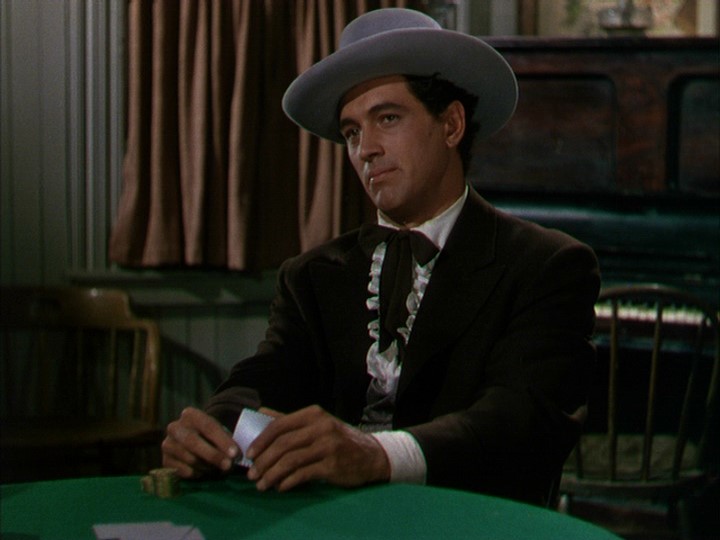
He doesn't have it for long as the stranger beats McAdam up and steals it from him. From there, it falls into the hands of an unscrupulous Indian trader (John McIntire), a Sioux warrior (Rock Hudson--you read that right), briefly in the hands of horse-soldiers Jay C. Flippen and Anthony—soon to be Tony—Curtis), then to an untrustworthy homesteader (Charles Drake) and finally, the possession of desperado Dan Duryea. Quite the cast (where's Harry Morgan?), and add in Shelley Winters as the saloon-girl trying to make good, and even if you didn't have Mann's steady hand with action, you'd have a movie full of good character parts.

Duryea is at his hipster best, playing an outlaw determined to out-laugh all of his opponents, McIntire is nicely droll as the Indian giver/trader, and Shelley Winters gives off an "I'll deal" vibe that endears you to her immediately. In one of the little authentic touches Mann inserts to show how rough the West really was, Winters nearly bounces off a buck-board dangerously careening through the desert, and when McAdam hesitates when giving her a gun to defend herself during a Native attack, she gives him a toothy grin and says, "I understand what the last one's for..."

I want that girl on my side.

It is capped with a mountain shoot-out between old-antagonists-with-a-past McAdam and Brown that is a primer for any action director to clue an audience to the strategies and complications that a fight for advantage in the mountains can entail. Add to that Mann's experiments with light in landscape far outside and past the urban noir settings he had bathed in shadow and slivers of light in the post-war 40's.

But in the same year as Stewart and Delmer Daves dared make a western that showed the First Peoples' side of things ("Broken Arrow"), Mann and Stewart** (and Stewart and other directors) began a decade-long exploration of the cracks in Western civilization's veneer that showed the fragility of the individual—how, in a so-called "decent" society, there's only an angel's breath of morality distinguishing a maverick and a psychopath. Everyone can be pushed over the edge. And the only advantage is how many rounds you can fire off before the other guy feels the first one. The repeating fire-arm was the great leveler when it came to fighting. But it was also what prevented letting cooler heads prevail. Cooler heads don't have a chance against hot lead fired by a cold heart. It's how the West was taken...and still is. The chances of surviving it to build something decent?

Probably one in a thousand.

* Mitchell has a great stoved-in character face and a likable self-deprecating manner that are also on display in his other prominent movie role-in "Singin' in the Rain." He died in 1952.

** One of the joys of the current DVD version of "Winchester '73" is a rare commentary track by the elderly Stewart who goes into detail about the filming and his working relationship with Mann and the other actors. It's done without the "Stewart persona"--he's just watching the film and answering questions--but at the end, you can't help but smile when he blurts "Ya know, I'm just really impressed with this laser-thing."

Tuesday, August 11, 2009

Bend of the River

"Bend of the River" (Anthony Mann, 1952) "Any man can make a mistake" Take Glyn McLintock (James Stewart). He's scouting a trail for a wagon-train of farmers, led by Jeremy Baile (Jay C. Flippen) in the Northwest territories when he comes across an impromptu necktie-party and Emerson Cole (Arthur Kennedy) is the guest of dishonor. Maybe it's his sense of honor. Maybe it's the itch he feels in his neck. But he rescues Cole and finds that they're two peas in a morally questionable pod: both men have reputations loud enough to follow them through the virginal Oregon territory. They think the same, completing each other's sentences, they fight the same, pulling each other's fat out of the fire many a time—the two of 'em together is deadly. Put 'em at odds—over a girl or a deal—and the results could be equally deadly if the modicum of good shared between the two didn't delay the inevitable.

They're both likable bad men, looking for a good future away from civilization. It just depends how close their pasts follow them.
Baile has his own ideas on the subject: "A man like that don't change." McLintock hopes he's wrong, but just in case, he's going to keep that kerchief around his neck tied tight. Daughters Laurie (Julie Adams) and Marjie (Lori Nelson) think that the right woman can change a man. Gambler Trey Wilson (Rock Hudson, very good in an early role) who's "fast on the draw, but soft" and "not the marrying kind," thinks that's long odds. But the time will come when the two men so evenly matched are going to have to choose sides. And when they do...

You see a lot of Howard Hawks' "Red River" in "Bend of the River." That's because they share the same script and story-writer, Borden Chase. A lot of incidents and lines of dialogue reflect each other. Hawks joked his way out of "Red River's" volatile climax, but there's no chance of that here, even though both movies do share a heroine who gets hit, literally, with an arrow when they meet the man they're going to fall in love with. And where John Wayne found underplaying the line "One day you'll look back and I'll be there" most effective, James Stewart seethes it through his teeth. The Mann-Stewart Westerns had complicated psychologies with Stewart exploring his dark side in each of them (although not so much in their other collaborations in the '50's, "The Glenn Miller Story" and "Strategic Air Command"). "Bend of the River" is one of the best of them, with a vengeful Stewart picking off his enemies one by one, without a mind to the morality of an ambush.*

It is that razor's edge of sanity and judgement that makes "Bend of the River" interesting. At any time, one can imagine Stewart losing the veneer of good-guy and killing in hot blood or cold. It is that sense of real danger that Mann and Chase and Stewart bring to the conflict of being in a tight spot with no way out that makes "Bend of the River" one of the better Westerns ever made, and one that feels timeless in a genre considered past its time.


There's something you don't see every day: A cold-blooded Jimmy Stewart

* Oh, now here's a scary thought—the movie could play as a Westernized "Rambo"

Friday, July 17, 2009

The Far Country

"The Far Country" (Anthony Mann, 1954) During the 1950's, James Stewart had two close director collaborations: one with Alfred Hitchcock (producing "Rope," "Rear Window,""The Man Who Knew Too Much," and "Vertigo") and Anthony Mann, with whom he made four westerns ("Winchester '73," "Bend of the River," "The Naked Spur," and "The Man from Laramie") that explored Stewart's range as an actor as he approached middle age, bringing a psychological depth to a genre that usually had the depth of a layer of dirt. Stewart's characters became practical men of dubious moral strength who would have their sense of loyalty and justice tested by circumstances, their balance frequently upturned by a burning desire for revenge.

When we meet Jeff Webster (Stewart), he's just finished bringing a herd of cattle to Seattle for his partners Ben Tatum (
Walter Brennan, without his teeth this time) and perpetual souse Rube Griffin (Jay C. Flippen). They're booking passage to Skagway, Alaska to deliver beef to the prospectors looking for gold. There's just this little problem of Webster having killed two of his wranglers over the course of the trip, which has the interest of the Seattle police who want to detain him for questioning. Some physical hi-jinks and the intervention of fellow passenger Rhonda Castle (Ruth Roman) and partners and cargo are heading up the passge.

But once in Skagway, they run afoul of the local constabulary in the form of Sheriff-Judge Gannon (
John McIntire, showing just how great he could be given a meaty part), who maintains an absolute authority over the territory—nothing gets done without his say-so, and that's just the sort of thing that can make Webster angry and defiant, two things not tolerated in Gannon's jurisdiction. You just know people are gonna get hurt, and there's only so much a Stewart character can take "before a man's gotta do what a man's gotta do."

Anthony Mann was a director who filled his screen, whether he was making intricately-shadowed film noirs, or here, where the mountains and glaciers fill the screen, providing a dramatic backdrop for the power-plays being carried out in mid-close-up. His westerns with Stewart featured a dangerous West, where the rules were whatever someone with power determined them to be.*** And Stewart's characters were loners who played by their own rules, the conflicts with the power-brokers escalating into a frightening violence when the stakes got too high. Mann and Stewart were pioneering a new frontier in exploring the psychology of coming to grips with the new territories and their struggles for civilization in which the spaces and emotions were untamed.

"The Far Country" also benefits from early appearances by Harry Morgan, Royal Dano and Jack Elam, all distinctive character actors able to play good or bad.

Tuesday, March 17, 2009

He Walked By Night

"He Walked By Night (Alfred L. Werker, 1948) It's funny the things you find. You go down the twisted, dark corridors of the film noir genre and once in a while you find a gem shining in the black, one that has many facets and goes beyond its origins and haunts.

"He Walked By Night" is one of those. Picked up at the Socialist Book Collective (Your Public Library) for free, it looked to be a modest little film. It starred Richard Basehart and Scott Brady, an actor so anonymous they had to bill him with a past movie as a middle name—Scott "Canon City" Brady.* It's a low, low budget film that looks like a million bucks because it was photographed by one of the great cinematographers in Hollywood history, John Alton. Alton painted in black and white and his intricate screens of shadow are works of art, made quickly and with little money. He worked often with director Anthony Mann who is rumored to have directed parts of this film (and sections of it look like Mann's "T-Men," one of the best film-noirs). But credit goes to Alfred L. Werker, a director who toiled in the "B" and "C" strata of movies, working with such talents as Laurel and Hardy, even Disney, and directed the second (and I think best) of the Basil Rathbone Sherlock Holmes films: "The Adventures of Sherlock Holmes" (1939).


But "He Walked By Night" is a different detective story entirely. Based on a "true" LAPD investigation, ** it's a police procedural that details the work the force went into to capture a cop-killer and criminal who "seemed to be one step ahead of" them, all the way. The case drags on for months, and its only the dogged determination of one dedicated cop that leads to the case being solved. It boasts that beautifulAlton cinematography, L.A. locations, and a sense of realism that even precludes the use of a musical score. The film begins with a city-wide dragnet and ends with an incredibly well-done chase and fire-fight in the cavernous drainage system, the gun-fire echoing endlessly through the concrete corridors.


Performances are stalwart throughout, with Richard Basehart given the chance to shine through as the creepy killer, and slate-voiced B-actor Whit Bissell as the best lead witness who gets more than he bargained for.


Then down the credits is a thin, odd little actor who plays the CSI expert—or as it would become known "One of the Lab-Boys"—with a perverse sense of humor: Jack Webb. If "He Walked By Night" comes off as seeming a little familiar, that's the reason. Although having only a minor memorable role, Webb managed to strike up a relationship with technical adviser Marty Wynn, who suggested a radio series based on the crime-files of the LAPD. Webb ran with the idea and debuted the radio series "Dragnet" four weeks after this film premiered. The blue-print is here: the no-nonsense narration with the city as character and even the well-worn phrase "the names have been changed to protect the innocent." It's not exactly "Dragnet"—Webb drained the emotion out of it and did it on an even more thread-bare scale, but it's the facts, ma'am. This is where "Dragnet" started.


Why not look for yourself? "He Walked By Night" has slipped into the Public Domain, and you can watch it for free here.

* Not so anonymous, really. Brady was one of those crusty dependable actors who could do just about everything and did, playing spokesmen, governments agents, cops, people in authority, but strictly blue-collar. You'd know his face if you saw him. He had a rough-hewn authenticity and credibility that was used to its full advantage as the nuclear plant worker who vindicates Jack Lemmon in "The China Syndrome." He was also the more successful brother of actor Lawrence Tierney. There's a resemblance.

** Well, that's stretching it. A lot. Some of the particulars are used--the electronics genius, the use of the L.A. storm drain system for escapes, the meticulousness, the murders. But the truth is far stranger, and not so neat and tidy.

The story is based on the career of Erwin "Machine Gun" Walker, who returned from WWII slightly unhinged by survivor's guilt and the death of a friend at Leyte Island—a death he felt responsible for. He began a series of robberies to fund--I kid you not--a project to create an electronic "death-ray." This led to the murder of Officer Loren Roosevelt, who was gunned down attempting to question Walker after seeing him casing a store.

Instead of technologically-savvy, dogged police work, Walker's undoing was bragging about his crimes to his catholic girl-friend, who mentioned the story in confession, and the priest informed police—there goes the story of sanctity of the confessional.

Walker pleaded insanity for his crimes—he wasn't tracked down in the drainage system and killed—but was captured in a raid on his home (like the one depicted in the film) and wounded in the arrest. Citing insanity in his family and his war trauma, he made his plea, but was found competent and sentenced to death. 36 hours before his execution, he was found nearly strangled with an electrical cord, a suicide attempt—his father had killed himself six months earlier.

The suicide attempt led to Walker being declared insane and his execution postponed for 12 years, while he was remanded to various mental health facilities. In 1959, he was deemed "cured," but, reasoning that it might provoke another suicide attempt, his death sentence was commuted to life imprisonment.

Then, he was granted a re-trial, and because it ruled his initial confession at the time of his arrest was coerced, he was set free.

Rather than being cut-down in a melodramatic blaze of gun-fire as in the film, Erwin "Machine Gun" Walker walked.