Showing posts with label Arthur Kennedy. Show all posts

Tuesday, November 12, 2013

Rancho Notorious

Rancho Notorious (Fritz Lang, 1952)  Hate!  Murder!  and Revenge!

After hearing about this one for oh-so-many years, I finally got a chance to sit down and luxuriate a while with Rancho Notorious, a film that offers so many surprises—subtleties and Big Statements—that work-outs were had by both my jaw (dropping) and the remote, which afforded me the essential ability to go back and "look at that again."

Rancho Notorious offers opportunities a-plenty for both.  You don't see very many movies where people are actively snarling at each other, but then there aren't many movies like this wildly expressionistic main-stream Western directed by the master of German Expressionism Fritz Lang. Preceding High Noon by a matter of months, it also has a song-based score, but an odd one, not so "on the nose" as "Do Not Forsake Me...", but one's that's haunting and echoes through your head like a warning (as it did mine) for days.

The song is "The Ballad of Chuck-a-Luck," (that was supposed to be the movie's title and there's a story for ya*) written by Ken Darby and plays over the titles and interstitially during the murder investigation that lasts the entire movie, each stanza ending with those words "Hate.  Murder.  And revenge."

So, what's the story, pilgrim?


Vern Haskell (Arthur Kennedy) is a ranch-hand in a small town in Wyoming and he only has eyes for Beth Forbes (Gloria Henry**), the girl who runs the counter at the dry-goods store.  But, right after he comes a-courtin' two strangers come into town, with an eye to robbing the store, and when the one sees Beth, things go too far.  She's raped and murdered by the outlaw when she screams and the two cowards escape.


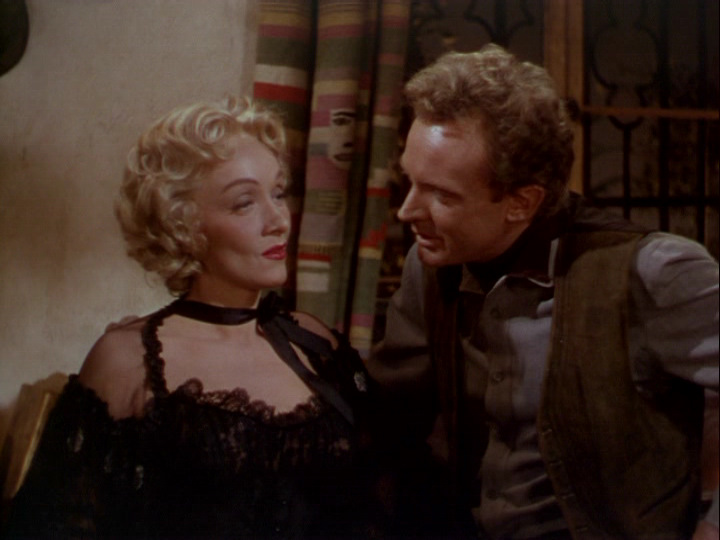
Vern Haskell (Arthur Kennedy) doesn't like you

All Haskell wants is revenge, so he quits the ranch and, with a posse, heads in the direction the bastards left town.  After hours of riding, the posse gives up, but Haskell refuses to stop, and soon comes across one of the men, Whitey, shot in the back by the other desperado, who only says the words "Chuck-a-Luck" to Haskell with his dying breath.  Haskell travels on, gathering clues about the mysterious word that refers to a spinning "wheel of fortune" in gambling houses and a former dance hall girl named Altar Keane (Marlene Dietrich), who made a fortune on her departing spin of the wheel, and left town on the arm of the outlaw "Frenchy" Fairmont (Mel Ferrer), never to be heard of again.

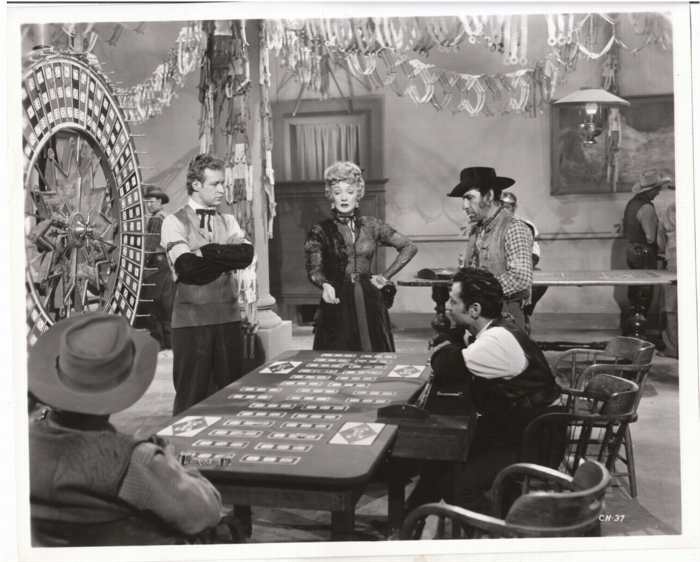
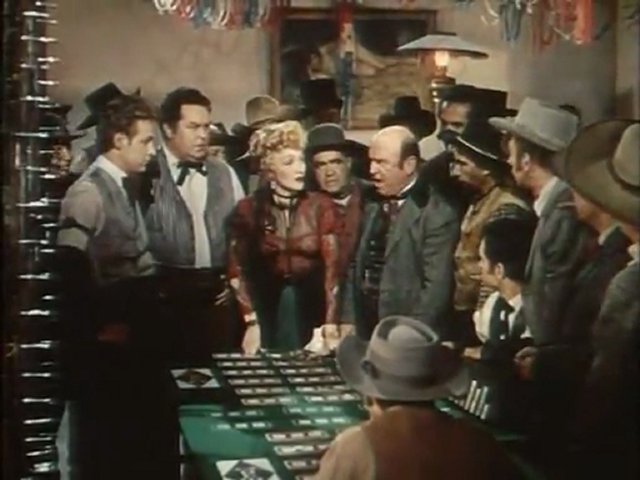
But, "Frenchy's" in jail, so Haskell gets himself arrested, and once behind bars, ingratiates himself with Fairmont, and gets sprung on his coat-tails. The two make their way to the Flying C Ranch, also known...as "Chuck-a-Luck," a working ranch legitimate to the world, but in secret is actually a hideout-for-hire for any outlaw willing to offer up a 10% share of their loot to Altar Keane. Quite the little operation the lady has there, and at the moment, she's full up.


But she makes room for Haskell, whom she describes as "a man who stands in doorways." All the better to survey the room, looking for clues.  Is it the guy who's fast with the ladies (George Reeves) with those tell-tale scars on his face?  Is it the guy who keeps looking at him funny (Lloyd Gough, not credited due to The Black List), or the guy who's just funny-looking (wall-eyed Jack Elam in an early role, looking lean and mean).  He decides to hang out at Chuck-a-Luck, picking up clues, laying low, making himself handy while not necessarily doing anything...illegal, until he can determine who's the right (by saying the wrong) man.  It's a little bit like Poirot in spurs with a nasty disposition.  Of course, today, Haskell would be expected to lay waste to the room and let God deal with the details.  Here, revenge is tempered by justice and not hormones.


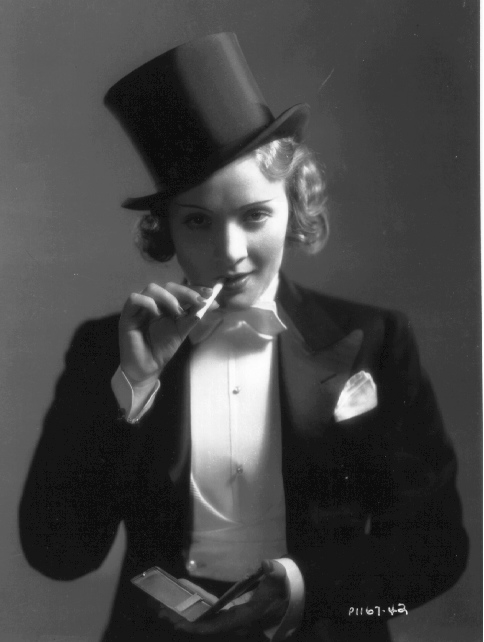
Russell Johnson and Marlene Dietrich in Rancho Notorious

Before we get onto the subject of Marlene Dietrich, we should probably discuss the wealth of character actors on the verge of hitting their defining roles: William Frawley, right before "I Love Lucy," George Reeves before "The Adventures of Superman," Mel Ferrer, only his fifth film and right before Scaramouche, Russell Johnson (Happy Birthday, sir), only his second movie, Jack Elam, Dan Seymour, John Doucette, the movie is top-heavy with great veteran character actors with recognizable faces.


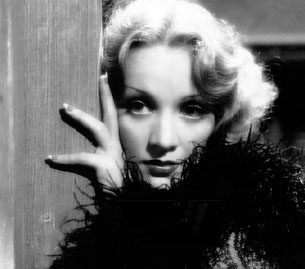
Then there's Dietrich.  For those of a certain age (anyone born post-Blazing Saddles), one may not recognize what a force she was and continued to be throughout her career.  She was the preternatural "other" woman, capable of seducing men and (pre-Code) women, one is always hesitant to call her the first feminist, but she might have been in movies, and she certainly was before it became "cool," (and she always was in the role).  Put it this way, you'd never see Dietrich in a western riding side-saddle.  Rancho Notorious is her slightly softened (although barely—when was the last time you saw a dance-hall girl riding the town sheriff like a horse?), in partnership with a man, and acting out of love or loyalty (always hard to say which with her), but it's her ranch and her operation, and that's something you rarely see in even the most hard-core of Westerns.   And it's weird, but, in Westerns, Dietrich (sorry but it's a spoiler) always seems to take a bullet, as if the genre won't accept her (or any woman) as ruling the ranch.  That would change, as film-makers got more bold.**

Rancho Notorious is one of those odd Westerns of the Mainstream that took a decided bend in the river to do something else with the form.  There's no pretense at naturalism (Lang wouldn't toy with that until Clash By Night), but used the familiarity of westerns to work out some interesting conflicts about gender roles (Others on that list are Nicholas Ray's Johnny Guitar, Samuel Fuller's Forty Guns, and, to a lesser extent, Hawks' Red River).


It's not your usual oater.  It's something different and it's recognizable from the first watch.


* The story goes that Howard Hughes wanted to change the title from "Chuck-a-Luck" and Lang wanted to know why.  "Nobody'll understand it" was the reply, even though it was a familiar gambling game in the Southwest.  "Okay, so what's your alternative?" Lang asked.  "Rancho Notorious." came the reply.  "Rancho Notorious?!  Nothing's called 'Rancho Notorious' in this movie!  You think anybody'll understand THAT?!"

** There was a shock for me: I remember Gloria Henry as the mother of "Dennis the Menace" on TV.  Her presence was only the first of a long line of TV stalwarts who were paraded throughout Rancho Notorious—"Hey! there's...fill in the blank..."

*** Ford's frontier women usually ran the ranch, but let the men think they did.

Saturday, August 10, 2013

Fantastic Voyage

Fantastic Voyage (Richard Fleischer, 1966) There has been a lot of talk recently of re-making 1966's Fantastic Voyage, a fairly interesting (if preposterous) science fiction movie of the 20th Century Fox strain, that did its damnedest to dumb down physiology and biology and make it a race against time with what were cool 60's scientific touchstones like lasers, computer typography, and Raquel Welch in a tight wet-suit (more than she apparently wore in one of the posters for the movie—oh, those mad marketing boys). 

The film is set (naturally) in the middle of the Cold War where Russian and American scientists are battling each other to develop a sustainable miniaturization process, presumably because they know small cars are in coming in the future.  Seems they can only keep things shrunk for a limited amount of time and both sides want the secret! And, as there always is, there's ONE MAN in the world who HAS THE SECRET and BOTH SIDES WANT IT!* 

<Aside> Am I just perverse or whenever one of these kinds of plots comes along, and both sides fight to get Dr. MacGuffin, wouldn't it be fun if it turns out that the guys a charlatan...or just simply wrong?** Maybe he just wanted to visit Chicago (in which case, the joke's on him)...or maybe the Russians just really wanted to get rid of him—"Here, this guy's single-handedly destroying our economy, let's give him to the Americans!!" Actually, I think some of that was in The Living Daylights</Aside>

Anyway, Dr. Benes has the secret, is defecting to the Americans and a botched Russian assassination attempt leaves him with a blood clot in his brain, and so, rather than giving him a shot of heparin (which would cost $70 in our time), our Best and Brightest Budget-Busters decide to inject a miniaturized submarine, The Proteus (designed by the Italian engineer Arturio Schlerosis), crewed by a team of experts to laser the blood clot, and book out of there before they de-miniaturize and give the guy a migraine the size of the military disbursement.

You read that and go "oh, that sounds so easy" but as with any operation, complications arise, even more than in your average Cialis commercial, and the crew must fight time, tides, detours (The Proteus didn't have Tom Tom), lack of oxygen, VERY LOUD NOISES, and a saboteur among them who's wrecked the laser-thingy—let's see, it could be Dr. Arthur Kennedy (except he was creepy in the 50's, scholarly in the 60's) or pilot William Redfield (who would be creepy in the 70's), "Rocky" couldn't play evil even if you gave her a dueling scar and a moustache to twirl, leaving only Donald Pleasence, who if agent Steve Boyd knew anything about pop culture, was every other bad guy and crackpot in movies during the 60's...when Steven Boyd wasn't playing them.


The crew has a few hang-ups removing PINK insulation whilst in an artery.
Or is that plaque?

They all get shrunk down to one micron, and are then injected into Benes' blood stream via hypodermic, and try and make their way up to the brain and its offending clot.  Arthur O'Connell and Edmond O'Brien monitor the problems of the crew in their control rooms with the obtuse monitors of blinking lights that go spitzin'/sparkin' if something goes wrong.  Sailin' along the old blood-stream, the crew wax philosophic and squabble and brainstorm and Fleischer and his actors all play this with straight faces, no matter how cheesy the sets—the ones involving full-sets look like a particularly tacky wall-paper pattern rather than a cell-wall, while the miniature travelling shots fare considerably better.  And there are red blood cells and nasty white ones, and in a Perils of Pauline moment, Raquel Welch is attacked by...either anti-bodies or cellulite, I forget which.

It's crazy stuff, and I remember reading the Isaac Asimov novel tie-in, and admiring how he worked herculean magic to make all the stuff plausible in a practical sense—for example, he wanted to make sure that every last bit of the Proteus gets out of Benes in order to prevent his head blowing up (in the movie they leave the laser rifle, the ship, all sorts of stuff), conjecturing a time differential between the shrinkees and the shrinkers, and making the issue of getting more oxygen from the lungs a LOT more complicated than the movie ever thought to do (the Proteus crew CANNOT breathe normal air, it has to be miniaturized along with them, as explained by Asimov).  It's goofy, but it was different from your typical space movie (while maintaining the tropes of sci-fi films).  I still remember it somewhat fondly, while also not taking it at all seriously.


A Fantastic Voyage poster promoting
its subject of biology


*Excuse me, I went into copywriting mode there...

** Actually, a variation of this "downer" ending was filmed—the Proteus crew did so much damage bumping into the defecting doctor's inner workings that he survives the process...but has forgotten his secret.  Insert Nelson Muntz "Ha-ha!" here.


Tuesday, December 18, 2012

The Man from Laramie

The Man From Laramie (Anthony Mann, 1955) "Hate's not becoming on a man like you." Hmm.  Then, they shouldn't have put this star and director again, as hate, obsession and (sometimes) disfigurement were the order of the screenplay. The last of the James Stewart-Anthony Mann pairings (the others being Winchester 73The Far CountryBend of the River, and The Naked Spur, all superior disturbing Westernsthat pushed Stewart's psychological boundaries in the Old West by pushing the traditional physical boundaries in the Old West.*

Stewart's Will Lockhart rolls into the town of Coronado with his small transport business delivering merchandise to the general store.  Along the way, he stops from his day job to indulge in his hobby—seeking revenge for his younger brother whose cavalry unit was ambushed by Apaches who were brandishing repeating rifles, too many to be acquired on raids.  The Apaches are another story.  He's after the man who sold them those rifles.

Coronado, though, is hardly welcoming.  He can't take a few steps into the street without being warned to leave the town the same way he went in—under his own power.  That advice, with intentions good or bad, stems from the town's controlling interest, a cattle baron by the name of Alec Waggoman (Donald Crisp), one of those autocratically protective father-figures who like things the way they are, are suspicious of any changes, and is a bit blind to how others see it.  He's particularly near-sighted when it comes to his entitled son Dave (Alex Nicol, in a thankless performance, rather dimly performed), a bully who's next in line to run the ranch—probably into the ground given his business acumen—and (as John Wayne used to put it) "if he lives."  To prevent those eventualities Waggoman has installed the only picket-wire he might approve of, his chief ranch-hand Vic Hansbro (Arthur Kennedy, who often provides the counterbalance in the Mann-Stewart westerns) as a nanny to keep Dave under control.


But Vic, with so much responsibility to the Old Man, always seems to be a day late and a dollar short, unable to keep Dave from single-handedly destroying Lockhart's business, burning his wagons and killing his mules, a rather contrary manner of getting him to leave town, by destroying the means.  And, of course, it just inspires Lockhart to get all-cussed and motivates him to stick his nose in everybody's business and his fists in Dave's mid-section.  Things don't get any better when Lockhart decides to take a job ranching for Waggoman's rival Kate Canady (Aline McMahon), a crusty woman-rancher who won't give an inch on territory or principle, or one hoof of cattle to the larger concern.


From any angle Lockhart is caught in the middle, guaranteeing a rise in tensions and an escalation of grievances.  And if the elder Waggoman wanted peace and quiet, he should have looked for the anarchy running wild in his own midst.   So, there's that familial element running through it.  And Mann and Stewart, through their collaborations, were exploring psychological depths that weren't mentioned between the gun-shots in the standard shoot-'em-up. All of their westerns involved Stewart's character going through a trial by fire—he's actually dragged through a campfire in this one—facing humiliation and crippling at the hands of the Waggoman's, the confrontations with the clan making up the best part of the film, with only Stewart's rather half-hearted interplay with Waggoman's neice (Cathy O'Donnell) seeming like time wasted, although it provides one more conflict for Lockhart to be distracted by.  Mann's use of location shooting is always imaginative and compositionally interesting, and he uses the Vistavision format to get as much horizon into the frame as possible.  Certainly worth a look-see, just don't go expecting Shakespeare.**

Maurice Thomas' Stewart portrait for some of the film's poster art.


  * The two also worked on the non-westerns Strategic Air Command and The Glenn Miller Story.

** Curiously, Shakespeare is on a lot of people's mind when they see this film, comparing it to "King Lear."  Um, okay, not the "King Lear" I'm familiar with, although there's a thematic string in there (actually there's a Shakespearean string in just about everything, isn't there?).  Actually, there's more "King Lear" in "Bonanza" than here (except that everybody gets along).   And, of course,  the movie Legends of the Fall has more than a bit of both in it.

Tuesday, March 6, 2012

Boomerang! (1947)

Boomerang! (Elia Kazan, 1947) Not to be confused with the Eddie Murphy vanity project made 45 years later.  No, this one is an Elia Kazan film when he was still learning the ropes in film-making and experimenting with what he could do.  This one was shot on location in a semi-documentary style and based on a Reader's Digest article (written by the author of The Greatest Story Ever Told and the book the film Boy's Town was based on) about a true incident involving a murdered priest, a vagrant scapegoated for the crime after a public outrage, and a prosecutor ethical enough to not follow "procedure."

Boomerang! tells the story of the murder in Connecticut of a popular minister, gunned down in the street on a pleasant evening.  There are many witnesses, but the description—medium-build man in a dark coat and light hat—creates few helpful leads.  But, the public outcry for "justice" (or something like it), considering the slow speed of the investigation, fueled by an ambitious newspaper publisher, puts government officials in panic mode, and the resulting pressure on the police department—chief investigator played by Lee J. Cobb—creates too many suspects and the arrest of a drifter (Arthur Kennedy) who protests his innocence.

When the District Attorney (Dana Andrews) goes over the facts of the case for trial, he is unconvinced, but instead of doing the politically expedient thing—try the case on the flimsy evidence anyway and mollify the city—he decides to present the facts of the case as he sees them, in effect shouldering the roles of both prosecutor and defense, attempting to prove that the defendant could not actually have committed the crime.

It's an unusual chapter in jurisprudence, but, in reality, it's how the process should work. The norm is for the culprit (alleged) to be in the dock and the prosecutor makes the case, presents the evidence, states the facts of what happened.  The defense must refute or explain.  But, even if the prosecutor doesn't stand behind the facts, it's only for political reasons, laziness, ego, or protecting his job that would compel the P.A. to go ahead with a flimsy case.  By rights, such a case shouldn't even be brought forth, wasting court costs and time.  It's only because of the incorruptibility of this D.A. that events unfolded as they did and in a way, demonstrated in court, that paralleled the risks the official was taking in his efforts.

Kazan seems an unlikely director for the project—his penchant for heightened drama only displayed in the citizen's cries for justice, if only trumped-up justice.  But, as produced by Darryl Zanuck (for whom story was everything), Kazan takes a docu-drama approach, taking it to the streets, as he would throughout his work in the '50's, emphasizing the grit, even in the well-scrubbed and groomed city-squares of Connecticut.  And Kazan assembled a low-key group of character actors—Andrews, Cobb, Karl Malden, Sam Levene, Ed Begley, Kennedy—to underplay the drama.  Only Jane Wyatt betrays any genteel theatricality.  It ain't noir—too many foot-candles—and it's not cinema verite, as in the style of some of the Fox pot-boilers of this type.  No, this one's set on "simmer," but it's a good preamble to the director's work as he transitioned from theater, outside into the real world.

Tuesday, August 11, 2009

Bend of the River

"Bend of the River" (Anthony Mann, 1952) "Any man can make a mistake" Take Glyn McLintock (James Stewart). He's scouting a trail for a wagon-train of farmers, led by Jeremy Baile (Jay C. Flippen) in the Northwest territories when he comes across an impromptu necktie-party and Emerson Cole (Arthur Kennedy) is the guest of dishonor. Maybe it's his sense of honor. Maybe it's the itch he feels in his neck. But he rescues Cole and finds that they're two peas in a morally questionable pod: both men have reputations loud enough to follow them through the virginal Oregon territory. They think the same, completing each other's sentences, they fight the same, pulling each other's fat out of the fire many a time—the two of 'em together is deadly. Put 'em at odds—over a girl or a deal—and the results could be equally deadly if the modicum of good shared between the two didn't delay the inevitable.

They're both likable bad men, looking for a good future away from civilization. It just depends how close their pasts follow them.
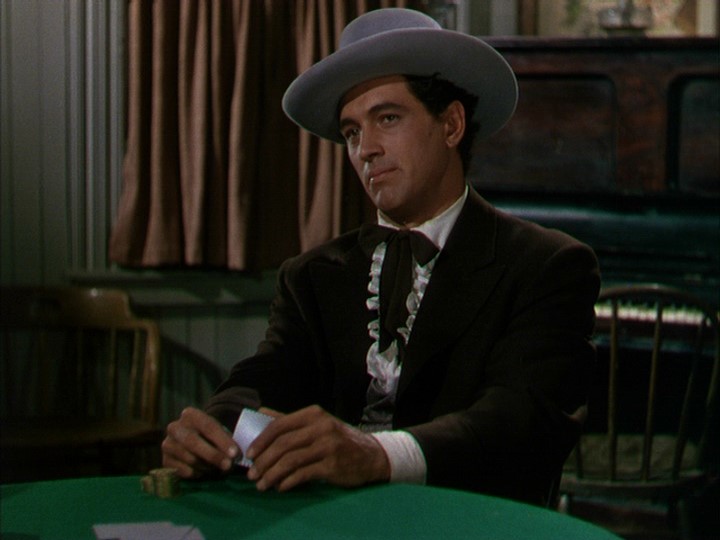
Baile has his own ideas on the subject: "A man like that don't change." McLintock hopes he's wrong, but just in case, he's going to keep that kerchief around his neck tied tight. Daughters Laurie (Julie Adams) and Marjie (Lori Nelson) think that the right woman can change a man. Gambler Trey Wilson (Rock Hudson, very good in an early role) who's "fast on the draw, but soft" and "not the marrying kind," thinks that's long odds. But the time will come when the two men so evenly matched are going to have to choose sides. And when they do...

You see a lot of Howard Hawks' "Red River" in "Bend of the River." That's because they share the same script and story-writer, Borden Chase. A lot of incidents and lines of dialogue reflect each other. Hawks joked his way out of "Red River's" volatile climax, but there's no chance of that here, even though both movies do share a heroine who gets hit, literally, with an arrow when they meet the man they're going to fall in love with. And where John Wayne found underplaying the line "One day you'll look back and I'll be there" most effective, James Stewart seethes it through his teeth. The Mann-Stewart Westerns had complicated psychologies with Stewart exploring his dark side in each of them (although not so much in their other collaborations in the '50's, "The Glenn Miller Story" and "Strategic Air Command"). "Bend of the River" is one of the best of them, with a vengeful Stewart picking off his enemies one by one, without a mind to the morality of an ambush.*

It is that razor's edge of sanity and judgement that makes "Bend of the River" interesting. At any time, one can imagine Stewart losing the veneer of good-guy and killing in hot blood or cold. It is that sense of real danger that Mann and Chase and Stewart bring to the conflict of being in a tight spot with no way out that makes "Bend of the River" one of the better Westerns ever made, and one that feels timeless in a genre considered past its time.


There's something you don't see every day: A cold-blooded Jimmy Stewart

* Oh, now here's a scary thought—the movie could play as a Westernized "Rambo"