Showing posts with label 1947. Show all posts

Friday, August 9, 2013

The Sin of Harold Diddlebock

The Sin of Harold Diddlebock (Preston Sturges, 1947) (aka Mad Wednesday, 1950) Sturges' first film out of his Paramount Studios contract, and with his film company California Films in partnership with millionaire polyglot Howard Hughes. Sturges adapted his script idea "The Sin of Hilda Diddlebock" (about a young girl's misadventures in Hollywood) for a favorite silent film star, Harold Lloyd—who was under the impression that he'd get to direct some sequences.  

It must have been "going around," as Sturges was under the impression he had free reign over the film.  But when it opened "soft," Hughes took over control of the film, re-editing it (in his painstaking way), finally releasing it in 1950 as "Mad Wednesday" (because a title with "sin" in it might not appeal to audiences throughout the nation—although it was probably that very enticing nature that led Sturges to title it that way in the first place).


The version we saw is the Sturges version, in desperate need of some sort of care and restoration—the black and white images are soft and dark looking, like it was shot in perpetual twilight, several splices mar the flow and interrupt a couple jokes here and there, and making one want to see the mangled version just to see if it's (ironically) in better shape.


It's hard to determine what "sin" Sturges is talking about. The film starts with a sequence from Lloyd's The Freshman (made in 1925) intercut with some recent scenes that act as bridging sequences as Lloyd's water boy manages to score a winning touchdown, impressing a business owner who (in new scenes filmed by Sturges) hires him on the spot.  Sturges keeps the sequence silent and primitive to mesh with the earlier filmed sequences and Lloyd looks young enough to pass for his younger self.


But, that's where the film starts.  Diddlebock's moment of glory results in his getting a job as an accountant for the man's firm.  Twenty years later, he's still there, passed by by other employees, including a series of sisters he admired and all moved on, leaving the youngest as Diddlebock's work colleague.  He's laid off, given a severance, and kicked out without prospects and no goal posts to run towards.


Already, the film is a commentary on American business, its spoiling of potential through pigeon-holing and compartmentalization, and the efficacy of "glory days."  But this is the first ten minutes.


Out on the street, Diddlebock gets way-laid by a racetrack tout (Jimmy Conlin) who sees him as a case of arrested development—one with a lot of disposable income—and after a two decades recess, Diddlebock goes back to school, as taught on the street.  First step: a bar, where he has his first adult beverage, an event that inspires the bartender (Edgar Kennedy)—"You arouse the artist in me"—to create a grand concoction of mixology, the sipping of which elicits a primal scream somewhere between the ubiquitously used red-tail hawk cry and a high-pitched ape roar.  A couple of toots of those and it's a trip to the barber's for a complete make-over, including a garishly nightmarish checkered suit, and the investment in short-term futures at the horse track, which pays off huge dividends, further inspiring high living, a blackout for an indeterminate length of time, and the investment in a defunct circus, including a menagerie of animals and one particularly cranky male lion that becomes Diddlebock's nearly constant companion and chief collateral throughout the rest of the movie.  Hilarity—and Sturges' unique brand of hysterical panic—ensues.


It's the maddest of screwball comedies with Diddlebock a cyclone of disruption wherever he goes, trying to unload the results of his bleary recent past and only finding himself with more problems, more prospects and an ever-growing number of acquaintances...the freak accidents of American success.

Even with Sturges' frenetic timing, the results are a bit off in tone and pace, as if somewhere along the way, the directorial edict became "faster..." (which, for Sturges, approaches the super-sonic).  Still, even though its uneven, it's still full of bizarre child-like invention and scrupulously drawn character types.

The dialogue is snappy and so is the lion—a couple of times making a lunge for LLoyd's hand, while the plucky silent star (probably to avoid further takes with the animal which he was terrified of) keeps going with the take, not missing a beat.  Amazing.

No, it wasn't successful; Sturges might have lost some of his homespun touch after so many frustrating years in Hollywood, despite his successes for Paramount.  Parallels can be found with Diddlebock, who hits the jackpot and keeps on hitting, despite being beset by day-to-day "small stuff" that he has to sweat.  But Sturges can still mine comedy gold out of his self-analysis, as he did with Sullivan's Travels.  He would continue to struggle, while still walking the thin line between message and entertainment.  He would only make three more films.


Wednesday, May 29, 2013

Kiss of Death (1947)

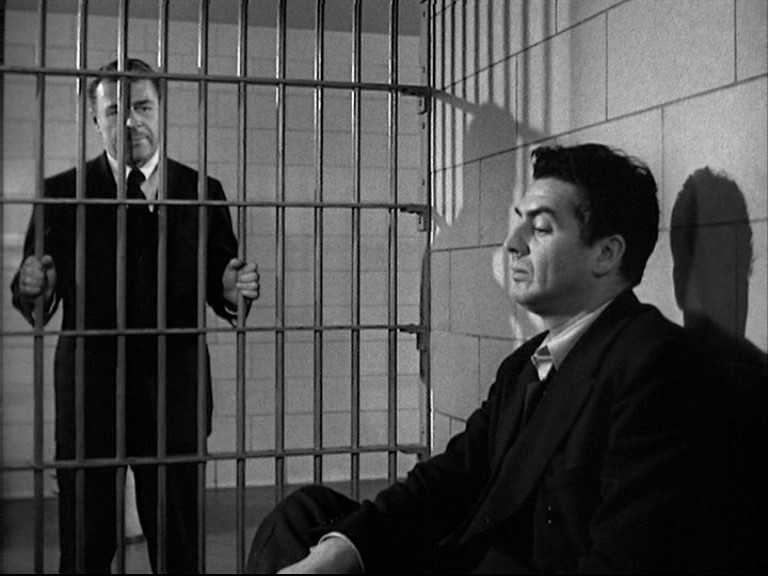
Kiss of Death (Henry Hathaway, 1947) Another of Henry Hathaway's neo-realist film noir's that aped the post-war Italian film penchant for shooting dark themes in real locations without glamour and emphasizing the grit.  This one, about the rise and fall and rise of heist-criminal Nick Bianco (Victor Mature), starts out in the sky-scrapers, jail-houses, and police offices that reverberate with the realistic sound that you can't acquire in a sound-baffled soundstage, but once the mayhem starts, the film scurries back to the safety of studio sets.  It's rough in the mean streets of noir.  Safer to make your own.

Bianco is an ex-con who can't find a job, and with a wife and two kids to support, he decides to make his own work—robbing a jewelry business in downtown Manhattan.  The job goes South and he ends up on the street with a police bullet in his leg and a stretch awaiting him at the gray-bar hotel.  He's offered a chance by assistant D.A. Louis D'Angelo (Brian Donlevy) to supply evidence on his cronies, but Bianco sticks to the criminal code—he won't squeal, sing, or rat, even when D'Angelo offers him an early parole so he can see his kids.  But Bianco won't bend.  His family is being "taken care of" by his sheister of a lawyer (Taylor Holmes), who visits him in prison to keep tabs on Bianco's loyalty.

But, in prison, Bianco gets wind that things aren't going so well.  And a visit to the prison library newspaper galleys tells him his wife has committed suicide, his kids are now orphans, and his silence has bought him nothing.

Hathaway's direction is no-nonsense throughout, but stylistic, anyway, and the scenes in the initial robbery, in the D.A.'s office and the lock-up have a drab, utilitarian look to them—the robbery has a nice touch in it, as the crooks' target is on the 44th floor of a Manhattan skyscraper, and the post stick-up elevator ride (with plenty of stops) provides a particularly teasing kind of tension.  Mature is fine, Donlevy's abilities aren't taken advantage of, and there are bit parts by Karl Malden and one of my character actors, the short-lived Millard Mitchell (who played Gene Kelly's producer buddy in Singin' in the Rain).

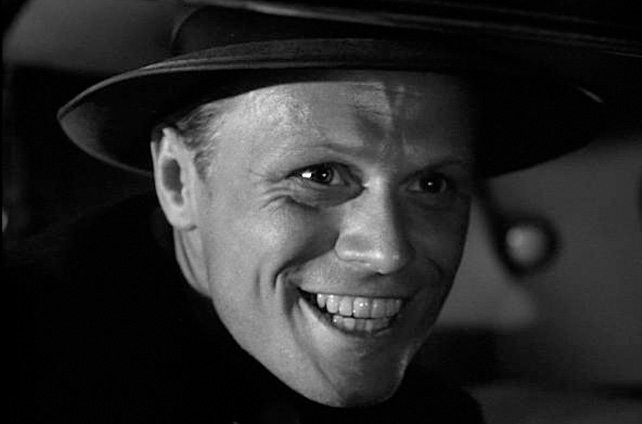
But Kiss of Death is also the feature debut of Richard Widmark, who plays the cheap gangster killer Tommy Udo.  You don't see him kill too many people, but one of them is indelible in its cruelty and vicious enthusiasm.  Widmark's performance is amazing, looking like a wire-thin Dan Duryea, with Cagney's ability to hold the eye in every scene he's in.  His dialogue isn't the greatest (even though the script is by Ben Hecht and Charles Lederer) and limited, and repeated over and over, but Widmark punctuates it with a goonish laugh that implies a sarcastic inner amusement that he knows he's stringing you along.  Hathaway, knowing what he was getting from the young actor, pulled out all the stops for his performance.  There's one scene where someone's waiting for udo, who's holding court in a curtained-off restaurant back-room.  Hathaway holds on the curtain, elongating the wait, then cuts to a close shot of the part in the curtains, where all you can see is the glint in Udo's eye before he gets up and makes his way to the camera,  It's an amazing shot and one that shows the director's confidence in his young actor's ability to hold an audience's attention, even when he isn't actually seen.


It's curtains for Widmark's Tommy Udo


Wednesday, August 22, 2012

Life With Father

Life with Father (Michael Curtiz, 1947) "Oh, GAD!" Another one of those movies I've always had the opportunity to see but never did.  A perennial for local television stations to have in their "libraries" for weekend programming (this was back in the day when local stations didn't fill their schedules with info-mercials), I had plenty of chances to catch this one on the tube, (and I would for fifteen minutes—tops—then move on) but I never did.  My bad.  This one needs to be taken in in one sitting, (preferably in a theater because the Technicolor is breath-takingly sharp), telephone off, and at full attention.

"I am the character of my household!" booms Clarence Shephard Day, as he's choosing the latest in a long line of maids, which he has chased out of his employ int he last few months, many of them in tears and some in hysterics.  Truer words were never spoken. He is the titular patriarch of Life with Father, from the hit Broadway play,* based on the remembrances of Clarence Day, Jr. of turn-of-the-century living with a father-figure who paces slowly in his own grooved path.  William Powell plays the role, one he actively petitioned for.

It's a charming film, full of easy irony about the mores and prejudices of the time, where male pomposity poses as dignity, and more separates people than unites them—easy excuses for keeping things nice and orderly on the surface, while underneath, they are broiling with chaos that is easily ignored and denied.   Clarence Gray, Sr. denies at the top of his lungs, and his monologues—against politics, taxes, unnecessary expenses, and organized religion (organized against him, it seems)—built individually in intensity and volume, are performances for an audience of one—himself.  His barely suffering wife (played by Irene Dunne as if she were singing the entire role) has more influence over him than he is willing to admit, or recognize...or even remember.  And his kid's are "mini-me's" of him, all boys, all carrot-tops, and as they age they morph further into miniature versions of The Old Man, down to his expletives and bluster.

Michael Curtiz directs formally and breezily, with his actors performing at top gear, and the director altering pace in editing and filling the frame with as much set decoration as it can hold.

The material doesn't need much else.  It's strongly forced, comically subtle and has an undercurrent of mature content, that you just don't see in movies nowadays.  Life with Father is from a far subtler era in which sub-texts flew over kid's heads, while the adults exchanged knowing glances and suppressed chuckles (that way you don't have to explain it to the youngsters with a simple "you'll understand some day").

And the sub-text is sex.  Clarence, Jr. is growing up, voice changed (but his violin playing still has noticeable cracks) and he's noticing girls—and when it's Elizabeth Taylor as a visiting friend's daughter, one can't help noticing.  At the time of the film, it was still early in Taylor's career and her performance is breathy, needy and comes from the same type of ingenue training that produced Marilyn Monroe's early performances.  Clarence wants to impress Taylor's Mary, but he can't do so in Dad's ill-fitting hand-me-down suits.  The excuse is they're practical, but, as he says, "I can't do anything in Dad's clothes."  But, the truth is he gets...uncomfortable...in Taylor's presence.  It's not bluntly said, it's danced around, implied, suggested, but never spelled out (as would be the norm today).  It's hilarious, charming, and pays off in some ironically comic laugh-lines throughout the film.

Yeah, they "don't make 'em like this anymore."  More's the pity.  Life with Father deserves its classic status—for some reason, it's not in the National Film Registry—because it's smart, pointed...and hilarious.  

GAD!


* It still holds the record for the longest run of a non-musical stage-play.

Friday, June 8, 2012

Lady in the Lake

Lady in the Lake (Robert Montgomery, 1947) Call it an experiment that fails—but a noble try.  Bob Montgomery took his opportunity to make a low-budget pot-boiler of Raymond Chandler's Philip Marlowe mystery and take it as close to the source as he could...in spirit, anyway.  Taking Chandler's first-person narration-style and translating it into cinematic terms.  Instead of reading inside Marlowe's head, we're seeing out of his eye-sockets—I didn't know Marlowe was monocular.  Nor did I know he was borderline schizophrenic—with cooing voices in the background, passing for a dramatic score (at least it's organic).

Chandler hated this one.  He'd written his own screenplay adaptation (that wasn't used) and thought the POV work...didn't work.  It doesn't, really.  In fact, it's creepy.  We, the audience, are constantly being talked to directly, with Marlowe's replies in voice-over—but because we don't see him, those replies are so "on-the-nose" as to be bluntly obvious.  In a way, this direct method robs us of actually seeing Marlowe's thoughts, playing across the face of the actor portraying him.  No, Marlowe has to say everything on his mind, making him the lamest of detectives—he's always telling people of his suspicions of them.  Nice detective work, shamus.

But, it does follow the story...in the same way a stage play might follow it.  We're kinda "stuck" inside Marlowe's head, and any investigation—the thing that distinguishes this story in the Marlowe canon is that it takes him out of L.A.  But, we never get out of rooms.  We lose some characters, and the bigger shocks (the discovery of "the lady in the lake," for instance, which they probably couldn't show as it's pretty gruesome in the book) are talked about happening off-camera.  Nope.  Everybody's standing around talking too each other...actually they're standing around talking to us.

Like I said, creepy.

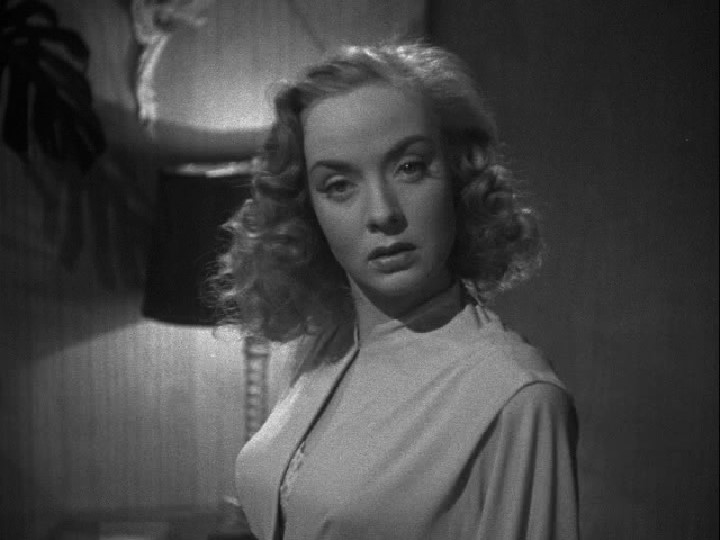
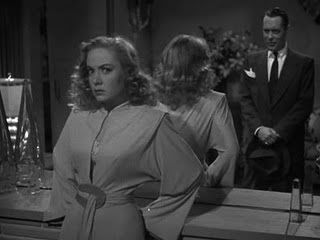
It also kills any momentum.  Because the camera is the only thing that has any action to it.  We see what he sees, following babes—rather obviouslyevery door-knob that is reached for (how exciting!), and only see our hero in the mirror.  It doesn't help the actors, either.  Montgomery might have been a great Marlowe—we just don't see it.  And poor Audrey Totter—her character doesn't even make any sense.  She whip-saws between emotions in a bi-polar performance, that when Marlowe's supposed to trust her, you just don't buy it...or buy him for doing it.  The technique works against everything here.  The only one who adapts well to it is Lloyd Nolan, but he'd already done an adaptation of Chandler's "The High Window" as the Marlowe stand-in, and already had the "cracking wise" patter down cold.

The thing is, POV can work.  It works to a certain extent in Dark Passage, and  Jonathan Demme  employed it amazingly well—and sparingly—in The Silence of the Lambs, where audience identification is only enhanced by our seeing the direct play of emotions across faces.  Montgomery was an actor, and a good one, so it's amazing that he would choose to do this experiment rather than trust his own craft; it's a hard lesson to learn, but an easy one when you think about it—you can tell an audience anything you like, but to use the medium of movies to its best extent—you should show them.

Robert Montgomery as Phillip Marlowe in the only way we see him
(except when addressing the audience)—in a mirror. 


Tuesday, March 6, 2012

Boomerang! (1947)

Boomerang! (Elia Kazan, 1947) Not to be confused with the Eddie Murphy vanity project made 45 years later.  No, this one is an Elia Kazan film when he was still learning the ropes in film-making and experimenting with what he could do.  This one was shot on location in a semi-documentary style and based on a Reader's Digest article (written by the author of The Greatest Story Ever Told and the book the film Boy's Town was based on) about a true incident involving a murdered priest, a vagrant scapegoated for the crime after a public outrage, and a prosecutor ethical enough to not follow "procedure."

Boomerang! tells the story of the murder in Connecticut of a popular minister, gunned down in the street on a pleasant evening.  There are many witnesses, but the description—medium-build man in a dark coat and light hat—creates few helpful leads.  But, the public outcry for "justice" (or something like it), considering the slow speed of the investigation, fueled by an ambitious newspaper publisher, puts government officials in panic mode, and the resulting pressure on the police department—chief investigator played by Lee J. Cobb—creates too many suspects and the arrest of a drifter (Arthur Kennedy) who protests his innocence.

When the District Attorney (Dana Andrews) goes over the facts of the case for trial, he is unconvinced, but instead of doing the politically expedient thing—try the case on the flimsy evidence anyway and mollify the city—he decides to present the facts of the case as he sees them, in effect shouldering the roles of both prosecutor and defense, attempting to prove that the defendant could not actually have committed the crime.

It's an unusual chapter in jurisprudence, but, in reality, it's how the process should work. The norm is for the culprit (alleged) to be in the dock and the prosecutor makes the case, presents the evidence, states the facts of what happened.  The defense must refute or explain.  But, even if the prosecutor doesn't stand behind the facts, it's only for political reasons, laziness, ego, or protecting his job that would compel the P.A. to go ahead with a flimsy case.  By rights, such a case shouldn't even be brought forth, wasting court costs and time.  It's only because of the incorruptibility of this D.A. that events unfolded as they did and in a way, demonstrated in court, that paralleled the risks the official was taking in his efforts.

Kazan seems an unlikely director for the project—his penchant for heightened drama only displayed in the citizen's cries for justice, if only trumped-up justice.  But, as produced by Darryl Zanuck (for whom story was everything), Kazan takes a docu-drama approach, taking it to the streets, as he would throughout his work in the '50's, emphasizing the grit, even in the well-scrubbed and groomed city-squares of Connecticut.  And Kazan assembled a low-key group of character actors—Andrews, Cobb, Karl Malden, Sam Levene, Ed Begley, Kennedy—to underplay the drama.  Only Jane Wyatt betrays any genteel theatricality.  It ain't noir—too many foot-candles—and it's not cinema verite, as in the style of some of the Fox pot-boilers of this type.  No, this one's set on "simmer," but it's a good preamble to the director's work as he transitioned from theater, outside into the real world.

Friday, March 26, 2010

Dark Passage

"Dark Passage" (Delmer Daves, 1947) Soapish film noir with "Bogey and Baby" that manages to have a few interesting things to recommend it, amidst some howler material.

The story isn't much: Vincent Parry (
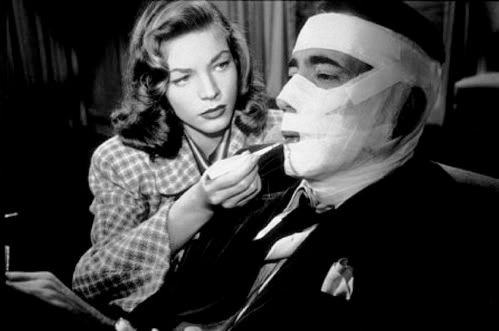
Humphrey Bogart, eventually), convicted of murdering his wife, escapes from San Quentin, and is able to make his way back to San Francisco with the help of Irene Jansen (Lauren Bacall), a rich-girl painter who knows all about Parry's case—because her own father was falsley accused of murdering her mother.

Small damn world.

Irene gives Parry a place to crash, and a change of clothes. Then, making his way to Frisco to meet an old buddy, his cab-driver gives him a line on
a disgraced plastic surgeon, who's not adverse to doing last-minute surgeries at 3 a.m. It takes Parry a week to heal, which he does at Irene's—something he didn't want to do, but seeing as his buddy was murdered and all...


Grave's-eye view of a post-op Bogart finding his musician-buddy dead.

Wait a minute! If you hadn't said that yet, what kept you? It would appear that San Francisco (nice location work, by the way) is the smallest town in America, as everybody knows everybody else and their business, besides. While convalescing at Irene's, Parry becomes aware that the place is being watched by a couple people, a potential blackmailer (Clifton Young) and Madge (Agnes Moorehead), the buttinsky friend of Irene's who used to go out with Bob (Bruce Bennett), Irene's current beau, but was also old friends with the Parry's back in the day. As Bogart would say, "Everything's starting to look nice and cosy..."

When the bandages come off,
we get to see The Man with Bogart's Face, but before then, all we're allowed to see of Parry was his picture in the paper, or his face in shadow. Daves employed a technique not much used in movies—the first-person subjective camera, so we see everything from Parry's point-of-view; there's a lot of people speaking right at us throughout the first part of the movie and answered back by Bogart's disembodied voice. Daves pulls off some miraculous inter-cutting between location-work and studio set-ups (in a moving car, yet!), and it's interesting to see how he gets himself out of jams of timing and transitions. He also employs an interesting angle every now and again, like the vantage point of a murder scene...from below the floor!

There's a lot to quibble about (did I mention the plastic surgery only takes an hour?), but any excuse to see Bogart-Bacall together again, and to see another of
Agnes Moorehead's unabashedly demonstrative performances. Those are enough reasons to give "Dark Passage" a watch.

Here's looking at you looking at me, kid.
Subjective POV of Lauren Bacall in "Dark Passage"

Wednesday, July 1, 2009

13 Rue Madeleine

"13 Rue Madeleine" (Henry Hathaway, 1947) There are several good movies to be made based on the exploits of the American and British Secret Service during World War II. The OSS wasn't all encrypters and code-breakers listening over wirelesses in sterile little offices. There were field agents, double agents, and mis-information spreaders and they had at their disposal all sorts of spy ledgerdemain that has been cobbled for many of the traditional thrillers that came out after the war. No one that I know has ever made a movie about Camp X, where training was done, papers forged and weaponry created.

But "13 Rue Madeleine" is, at least, a good start. Directed by Henry Hathaway in a slightly more flashy style than his true-life crime dramas earlier in the war, it still employed a lot of photography "
in the field" as the movie explains, "often in the actual locations."

The story follows the training of Group 077 (the writers had to change the name over script objections), each one in non-specific training until they're called upon for "a job" in whichever corner of the world they're dropped.
Heading the training is Robert Sharkey (James Cagney), who has one complication—one of his agents-in-training is a Nazi agent, and during the course of training he has to find out who it is to exploit him. The film is surprisingly cold-blooded, with many agents dying in the process of carrying out their missions, and there's one case of "burning the village in order to save it." There's also a lot of appearance by well-known actors in small roles at the beginning of their careers including Karl Malden, E.G. Marshall, and Red Buttons. But, towering over all of them is Cagney, who still manages to show off a lot of grace in a role that's pretty rough. But he's also the perfect actor who you believe could kill with impunity and laugh at the enemy in the face of torture.

Friday, May 9, 2008

Born to Kill

"Born to Kill" (Robert Wise, 1947) Pot-boiler based on James Gunn's "Deadlier Than the Male." Set in Reno and San Francisco it tells the story of Helen Brent, a "cold iceberg of a woman," who's "rotten inside" and thinks "most men are turnips," becomes attracted to a brick-wall of a psychopath named Sam Wild ("What I want, I take and nobody cuts in") who after killing two people in Reno, follows her like a bad stink all the way to 'Frisco, where he starts to horn in on her society pals, and eventually marries her foster-sister. It all sounds nice n' cosy, don't it?

But mokes like Sam (Laurence Tierney) are never satisfied. As one character says, he lets "every mad whim that enters (his) brain, whips (him) around." Once he gets a taste for the good life, he wants more. Pretty soon, Sam is pushing his wife to get him a job running her father's newspaper because "he can do it better" and once he gets real power, "I can spit in anybody's eye! I'll make 'em and break 'em!" Helen would only like Sam to get caught in his bull-headed machinations, but she's conflicted. Something inside her "right down to her roots" makes her want Sam for herself. This can't come to good. No way. No how.

Now, if only they'd listened to lumpy, aphorism-spouting private eye Albert Arnett (Walter Slezack) who, almost as soon as he's introduced, says, "As you grow older, you'll discover that life is very much like coffee - the aroma is always better than the actuality." Arnett is soon hired to find out who killed those two kids in Reno (one of whom is called "Laury Palmer"). Arnett's ethics are situational as far as his business is concerned, but his quoted philosophies come from the Bible and other Good Books. But in a town full of moral lepers (as the line goes in "The Two Jakes"), he's the guy with the most fingers.

Things get so triangulated in "Born to Kill" that the interlacing motivations resemble nothing so much as a spider's web, with Wild and Mrs. Brent being the two oddly-matched spiders--one cold and calculating, the other hot and bothering, and not thinking much. Wild's partner, Marty (the always reliable noir-second banana Elisha Cook, Jr.) "You can't just go around killing people when the notion strikes you. It's just not feasible!." He keeps saying that word a lot. I don't think he knows what that word means. Anything's feasible to Sam as Marty finds out to his regret. As everybody finds out.

The flowery noir dialog is there, but it's tamped down with issues of right and wrong, and there are less shadows in "Born To Kill," than there are in most film noirs, but it's directed to a finely crossed shadow by ever-tasteful Robert Wise ("The Sound of Music," "The Day the Earth Stood Still," "West Side Story"), here at the beginning of his career behind the camera, who could tackle any genre and make it seem like it was his specialty. Here, Wise rivals Michael Curtiz in filling his shots with odd details, and then, in momemts of high impact, dousing the screen in black simplicity. Wise pulls off the murders, evoking a building horror on the part of the audience, and he's ably abetted by a idiosyncratic cast of character actors who straddle the fence of right and wrong. Slezak, playing Arnett, is a rumpled dough-boy of a man who always cleaned his plate. His moral compass is more finely attuned despite appearances, and certainly more than those folks in their sharp suits and designer gowns.

But the two stars are Claire Trevor, who made a career and won Oscars for playing "bad" women, and Lawrence Tierney, in what amounted to his first starring role, and his last. Tierney was a rough character, who might have been the nastiest guy in Hollywood, when Otto Preminger wasn't in town. On the commentary track, noir student Eddie Muller talked about how, for most actors, stunt-men replaced them in fights to keep them from getting hurt. With Tierney, you replaced him because he didn't know when to stop (Muller has an amusing article on the evening he spent watching this film next to Tierney who, old and crippled, was even more feisty than in his youth). Tierney, the actor, had all the mannerisms of a silent-film star--not for the good, but you couldn't deny when he got angry he could provide an authentic "prison-yard stare." You may remember Tierney for his last major role--the concrete-voiced Joe Cabot in "Reservoir Dogs."

I remember him as Sgt. Jenkins, the night-watch commander of "Hill Street Blues." He has the last shot and the last words of the series finale.

Saturday, March 8, 2008

Monsieur Verdoux

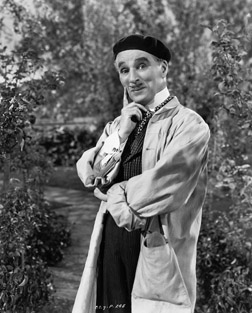
"Monsieur Verdoux" (1947, Charles Chaplin) I'm not the biggest fan of Chaplin, finding him self-indulgent and egotistical, but you don't get to be that way without accomplishing things that garner success, and every so often Chaplin does something that's so astoundingly eye-popping or funny that one has to acknowledge the very real genius behind it. Here his credits are huge compared to everybody else's--one nifty little bit of spin is the credit "Original Story by Charles Chaplin...based on an idea by Orson Welles," okay, which is it?--but he does give a big heart-felt all-to-herself credit to Martha Raye. One sees why in the film. Raye is a force of Nature, loud and brash and fast, and Chaplin is her perfect foil, having to raise his energy-level to meet hers, they're perfect sparring partners. The two of them together make the funniest scenes in the film, and it's pretty obvious Chaplin gave her more to do to perk his film up. Now that's genius. In "Verdoux" Chaplin abandons "The Little Tramp" character, and his "Verdoux" is a cultured bon-vivant. The difficult economic times have cost him his good bank-job, so now he has a modest furniture business, with a lucrative hobby: marrying and murdering rich widows, and investing the resulting liquidation of their property. The story-telling deck is stacked to gain our sympathies--Verdoux is a charming sweetheart with a crippled wife (for real) and the doomed wives are all ogres, but for all its blackness the film does display a moral center that guarantees an unhappy ending. And some bitter pills that don't go down that easily. When a reporter interviews Verdoux about his crimes, he obfuscates: "Wars, conflict - it's all business. One murder makes a villain; millions, a hero. Numbers sanctify, my good fellow!" And then there's the requisite ingenue part, portrayed semi-successfully by Marilyn Nash. And that brings us back to the beginning--the self-indulgent/egotistical thing. For all the joys of a Chaplin film, one can never watch too long before noticing that.

Monday, February 4, 2008

Road to Rio

"Road to Rio" (Norman Z. McLeod, 1947) I've got a weakness for the "Road" movies--those Paramount programmers with Hope, Crosby and Lamour--where the least excuse for a plot is thrown together (usually the boys are scammers on the run), Hope and Crosby do their best to ad-lib over the other one, and the fourth wall is practically nonexistent. In fact, one of my favorite jokes in this one, has Crosby and Hope do a 3/4-quarters-in recap of the plot and what has to happen to resolve everything, when suddenly there's an off-screen scream. "What was that?" says Bing, and Hope looks askew and says "It's the Warner Brothers--they're jealous." Right. This, the fifth in the "Road" series has the boys on the lam to Rio De Janeiro, where they hope to keep Lamour, hypnotized by her scheming aunt, from marrying a hand-picked ne'er-do-well. And with that much sophistication to the plot, you know Hope-Crosby have to get hypnotized, too. It ain't art-house material--more like burlesque-house--but it is entertaining.