Showing posts with label Michael Curtiz. Show all posts

Friday, October 11, 2013

The Sea Hawk (1940)

The Sea Hawk (Michael Curtiz, 1940) Thought I'd better get this one in before Captain Phillips dashes all our fantasies about pirates.  Or, in this case, "privateers."  

Captain Geoffrey Thorpe (Errol Flynn) is the captain of The Albatross, part of the Sea Hawks, a private fleet of Queen Elizabeth I (Flora Robson), taking "reparations" from the Spanish fleet of King Phillip II (Montagu Love—my new favorite actor name), who has plans to (dare I say it?) rule the World.


Well, not if Thorpe (rather loosely based on Sir Francis Drake in the Howard Koch-Seton I. Miller screenplay that has nothing to do with the Rafael Sabatini novel) can fire across their bow.  On a diplomatic mission to see the Queen, the ship carrying Don José Alvarez de Cordoba (Claude Rains) and his daughter Doña Maria (Brenda Marshall) is intercepted, fired upon and boarded by Thorpe and his all-too-eager crew.  Once there, they see that the oarsmen for the Spanish are former English sailors, who are freed and taken back to home and family.  Don José is allowed to keep his meeting with the Queen, but all puffed up and protesting about it, and he and the Queen's adviser, Lord Wolfingham (Henry Darnell) demand that Thorpe be arrested and thrown in the dungeon, or the brig, or the tower, or whatever gray-bar hotel they had in 16th century England.  The Queen puts on a stern public face, but is only too happy to let Thorpe command his ship to the isthmus of Panama to commandeer supplies from South America to the Spanish Armada.


But, the Queen's court has divided loyalties and Wolfingham is working with Don José to intercept Thorpe's plans, and the crew, once on land, and in a tinctured yellow setting, is trapped by Spanish forces and imprisoned as oarsmen on an enemy ship on its way back to Europe.  Can Thorpe and his men escape their fate and warn the Queen about the oncoming attack by the Spanish Armada?


What do you think?


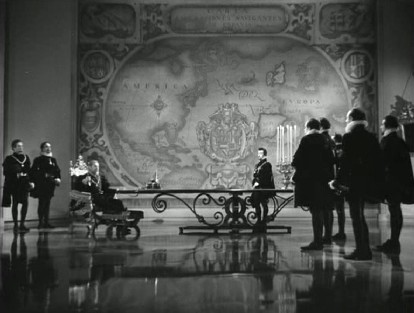
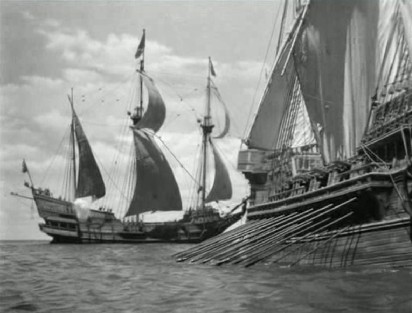
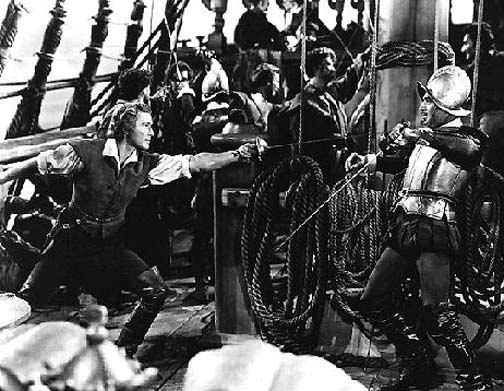
It's a grand epic, and director Curtiz, accustomed to filling the film-frame with detail has a lot of scenery to use.  The ships are big and impressive sets (especially when there are two next to each other), and the sea battles, some shots culled from Captain Blood (which is why this one is black and white and not Technicolor), are rousingly busy affairs starting with the chases, the cannon lobs, the swinging from ship to ship, then the sword-fights.  They're frenetic and fun, the stuff of our pre-Johnny Depp cultural memories, and blood-shed is kept to a minimum.  Curtiz and his designers also make the film feel a bit more gritty than one associates with a Hollywood studio film of the type (except of course in the Queen's court where everything is vast, spotless, and polished to the point of reflection).  But compare Curtiz's slave galley to the one Charlton Heston occupied in Ben-Hur, and although the effort displayed by the rowers in the latter seem more strenuous, the conditions in the former are far more depressing.  And Curtiz keeps it moving, no dawdling over the ironic dialogue or key sequences, as there's another just around the cut to get to.  The cherry on top is one of Erich Wolfgang Korngold's greatest film-scores, which in itself has an awful lot of swash-buckling just in the playing.  


Try to see the longer version, though.  For awhile, The Sea Hawk had its final scene plucked—The Queen's speech before the attack of the Spanish Armada, which may be the strangest speech a Queen has even been given: 


And now, my loyal subjects, a grave duty confronts us all: To prepare our nation for a war that none of us wants, least of all your queen. We have tried by all means in our power to avert this war. We have no quarrel with the people of Spain or of any other country; but when the ruthless ambition of a man threatens to engulf the world, it becomes the solemn obligation of all free men to affirm that the earth belongs not to any one man, but to all men, and that freedom is the deed and title to the soil on which we exist. Firm in this faith, we shall now make ready to meet the great armada that Philip sends against us. To this end, I pledge you ships - ships worthy of our seamen - a mighty fleet, hewn out of the forests of England; a navy foremost in the world - not only in our time, but for generations to come. 
"The earth belongs not to any one man, but to all men , and that freedom is the deed and title to the soil on which we exist."  What do mean "we," Queen E?  Fact is, Elizabeth didn't say this.*  But, as this film was released in 1940, it serves as its own little shot across the bow to another "one man" who wanted the map, not to be of Spain, but of the Third Reich—Herr Hitler.   The film, when first released, had that bit of rallying to it, in the days before The Blitz.  After the war, prints had that speech removed as unnecessary (and probably anachronistic, and not in a Queen's spirit.   


"...vast, spotless and polished to the point of reflection."


* She ACTUALLY said this: "My loving people, we have been persuaded by some that are careful of our safety, to take heed how we commit ourself to armed multitudes for fear of treachery; but I assure you, I do not desire to live to distrust my faithful and loving people ... I know I have the body but of a weak and feeble woman, but I have the heart and stomach of a king, and of a King of England too, and think foul scorn that Parma or Spain, or any Prince of Europe should dare to invade the borders of my realm."  "My" realm.  See that?  "My".

Wednesday, August 22, 2012

Life With Father

Life with Father (Michael Curtiz, 1947) "Oh, GAD!" Another one of those movies I've always had the opportunity to see but never did.  A perennial for local television stations to have in their "libraries" for weekend programming (this was back in the day when local stations didn't fill their schedules with info-mercials), I had plenty of chances to catch this one on the tube, (and I would for fifteen minutes—tops—then move on) but I never did.  My bad.  This one needs to be taken in in one sitting, (preferably in a theater because the Technicolor is breath-takingly sharp), telephone off, and at full attention.

"I am the character of my household!" booms Clarence Shephard Day, as he's choosing the latest in a long line of maids, which he has chased out of his employ int he last few months, many of them in tears and some in hysterics.  Truer words were never spoken. He is the titular patriarch of Life with Father, from the hit Broadway play,* based on the remembrances of Clarence Day, Jr. of turn-of-the-century living with a father-figure who paces slowly in his own grooved path.  William Powell plays the role, one he actively petitioned for.

It's a charming film, full of easy irony about the mores and prejudices of the time, where male pomposity poses as dignity, and more separates people than unites them—easy excuses for keeping things nice and orderly on the surface, while underneath, they are broiling with chaos that is easily ignored and denied.   Clarence Gray, Sr. denies at the top of his lungs, and his monologues—against politics, taxes, unnecessary expenses, and organized religion (organized against him, it seems)—built individually in intensity and volume, are performances for an audience of one—himself.  His barely suffering wife (played by Irene Dunne as if she were singing the entire role) has more influence over him than he is willing to admit, or recognize...or even remember.  And his kid's are "mini-me's" of him, all boys, all carrot-tops, and as they age they morph further into miniature versions of The Old Man, down to his expletives and bluster.

Michael Curtiz directs formally and breezily, with his actors performing at top gear, and the director altering pace in editing and filling the frame with as much set decoration as it can hold.

The material doesn't need much else.  It's strongly forced, comically subtle and has an undercurrent of mature content, that you just don't see in movies nowadays.  Life with Father is from a far subtler era in which sub-texts flew over kid's heads, while the adults exchanged knowing glances and suppressed chuckles (that way you don't have to explain it to the youngsters with a simple "you'll understand some day").

And the sub-text is sex.  Clarence, Jr. is growing up, voice changed (but his violin playing still has noticeable cracks) and he's noticing girls—and when it's Elizabeth Taylor as a visiting friend's daughter, one can't help noticing.  At the time of the film, it was still early in Taylor's career and her performance is breathy, needy and comes from the same type of ingenue training that produced Marilyn Monroe's early performances.  Clarence wants to impress Taylor's Mary, but he can't do so in Dad's ill-fitting hand-me-down suits.  The excuse is they're practical, but, as he says, "I can't do anything in Dad's clothes."  But, the truth is he gets...uncomfortable...in Taylor's presence.  It's not bluntly said, it's danced around, implied, suggested, but never spelled out (as would be the norm today).  It's hilarious, charming, and pays off in some ironically comic laugh-lines throughout the film.

Yeah, they "don't make 'em like this anymore."  More's the pity.  Life with Father deserves its classic status—for some reason, it's not in the National Film Registry—because it's smart, pointed...and hilarious.  

GAD!


* It still holds the record for the longest run of a non-musical stage-play.

Wednesday, July 4, 2012

Yankee Doodle Dandy

Yankee Doodle Dandy (Michael Curtiz, 1942) Of all the films in James Cagney's storied career, his favorite was his most unusual—not one of his gangster films (some of which revolted him) or his dramatic efforts, but this one, the one that won him his Best Actor Oscar, the musical biography (very loose) based on the life of George M. Cohan.  Cagney always described himself as "a hoofer," starting out as a dancer in vaudeville, and the athleticism did him well in Hollywood.  Cagney's energy, timing, and directness—his grace (even if he was playing a hood)—came from this background, and the compensatory toughness came from his growing up and observing the streets, providing "that unmistakable touch of the gutter," as he eloquently put it in his acceptance speech for the second AFI Lifetime Achievement Award.

Yankee Doodle Dandy begins with Cohan (Cagney) on Broadway playing Franklin Roosevelt in "I'd Rather Be Right" when he is summoned to the White House to receive the Congressional Gold Medal from FDR himself.  The visit gives him a chance to tell his life-story to the President, which is presented in flash-back form, from his early days to performing with his family (Walter Huston, Rosemary DeCamp, Jeanne Cagney) to the lean years when stubbornness gets him blackballed in the theater community, and he has to struggle back to the stage by song-writing,* eventually coming back and becoming the King of Broadway.

It's still startling to see Cagney's dance moves; loose, limber below the waste, and ramrod straight above, his movements alternate between drunken sloppiness that looks like it could severely snap tendons if gone wrong, and stiff-legged woodenness, giving the impression that he's a puppet with the strings cut—not really in control of his own movements (and, of course, he always was—that was the illusion of it all, the mastery of it), but compelled to dance for the sheer energy of it forced him to do so.  It's scary, but Cagney always is.  He is, after all, the guy who shoots people by pumping the pistol forward, as if the movement puts more energy in the bullet to kill faster, make it more definite, more personal.  His gangsters make the guns part of them, rather than just a tool.  

Some of the moves look archaic, compared with the gymnastics-as-dance school today—the leaping and bouncing off a wall (as if there wasn't enough room on stage) looks tame now, even though it amazed me as a kid, but the high kicks I appreciate more, the toe-steps, the tap—all amazing.  And they look spontaneous, which in itself is a marvel.*

It's a feel-good musical about celebrating the spirit of America, which we all do on the Fourth of July.  That it happened during war-time, added mightily to the propaganda potential of it (and, although it's always been denied, might've helped Cagney get rid of the "pinko" label he was being saddled with at the time—my, how times haven't changed).  But, it's a fine achievement, and Curtiz, who's known for hating unused space in a movie frame, overcrowds the stages—every theater-piece for this director was "SRO."  And, although something of an autocrat, with musicals he let loose the reins (something Cagney appreciated) and allowed spirit to flow.  Maybe that's why Yankee Doodle Dandy still seems fresh.


It was voted into the National Film Registry in 1993 for being "culturally, historically, and aesthetically significant."


* Cagney could relate.  He was constantly battling the Warner Brothers brass, at one point suing the production company and staying away.  Jack Warner called him "The Great Againster."

** Evidently Cohan's final tap down the White House staircase at the end, was improvised.