Thursday, October 10, 2013
The Last of Mrs. Cheyney (1937)
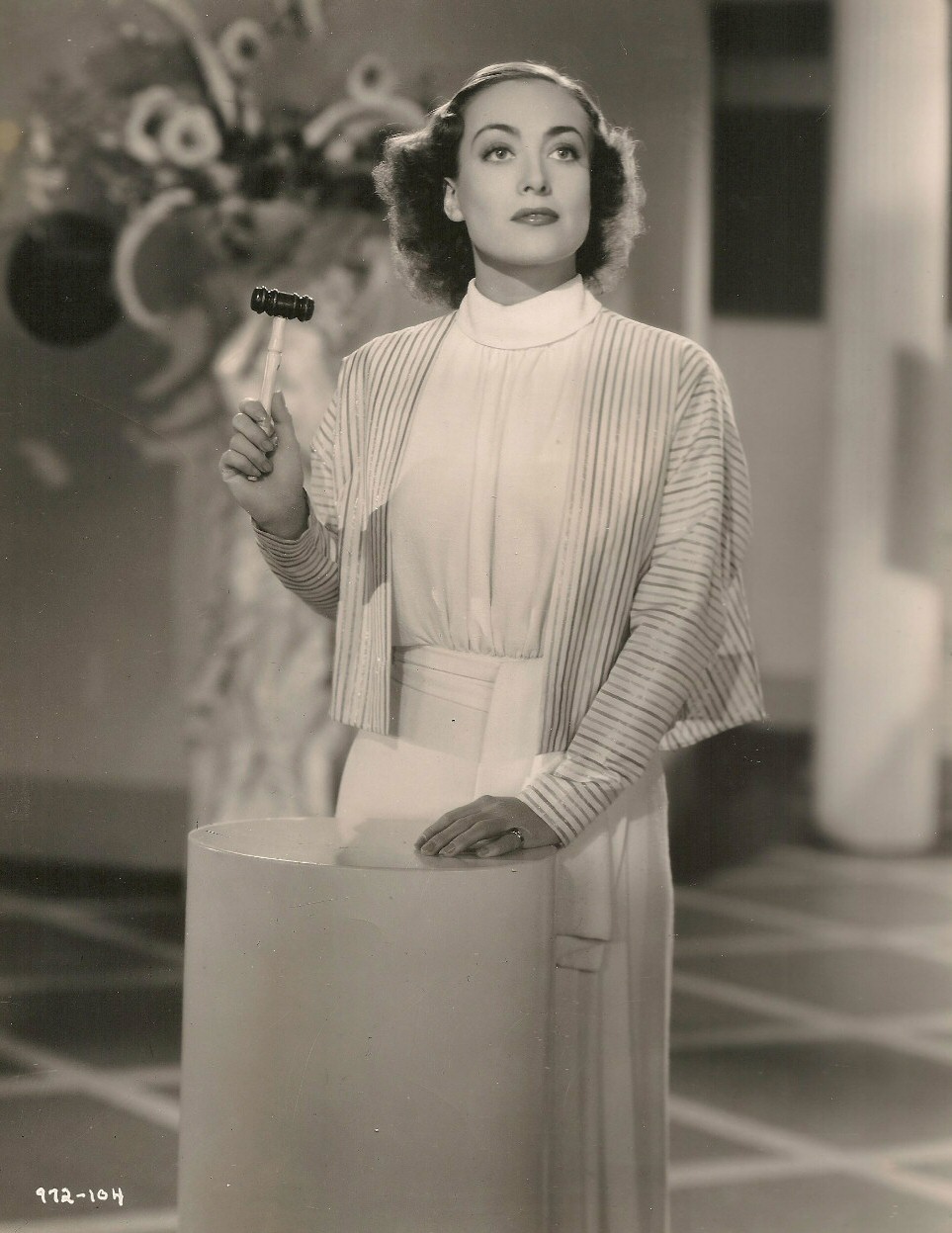
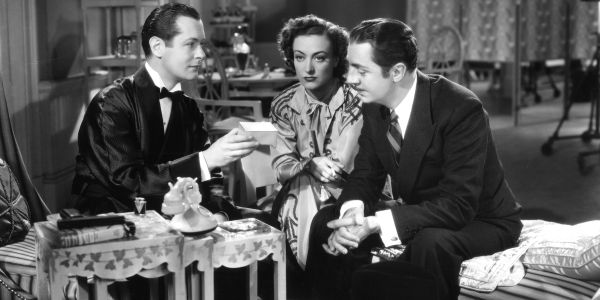
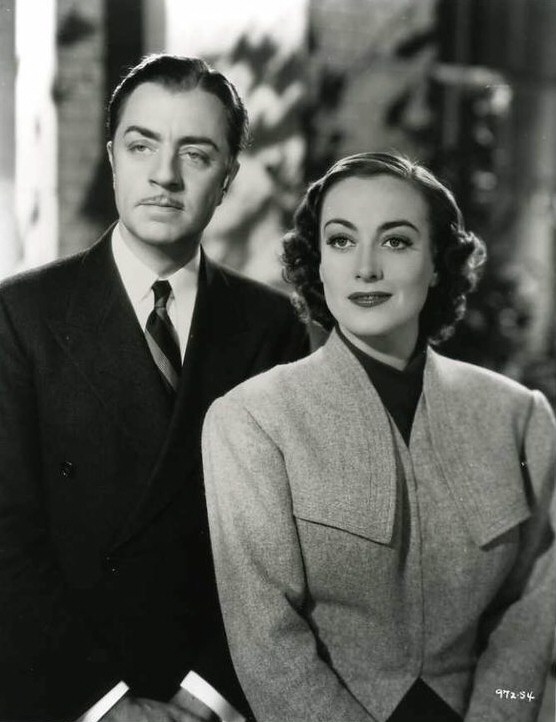
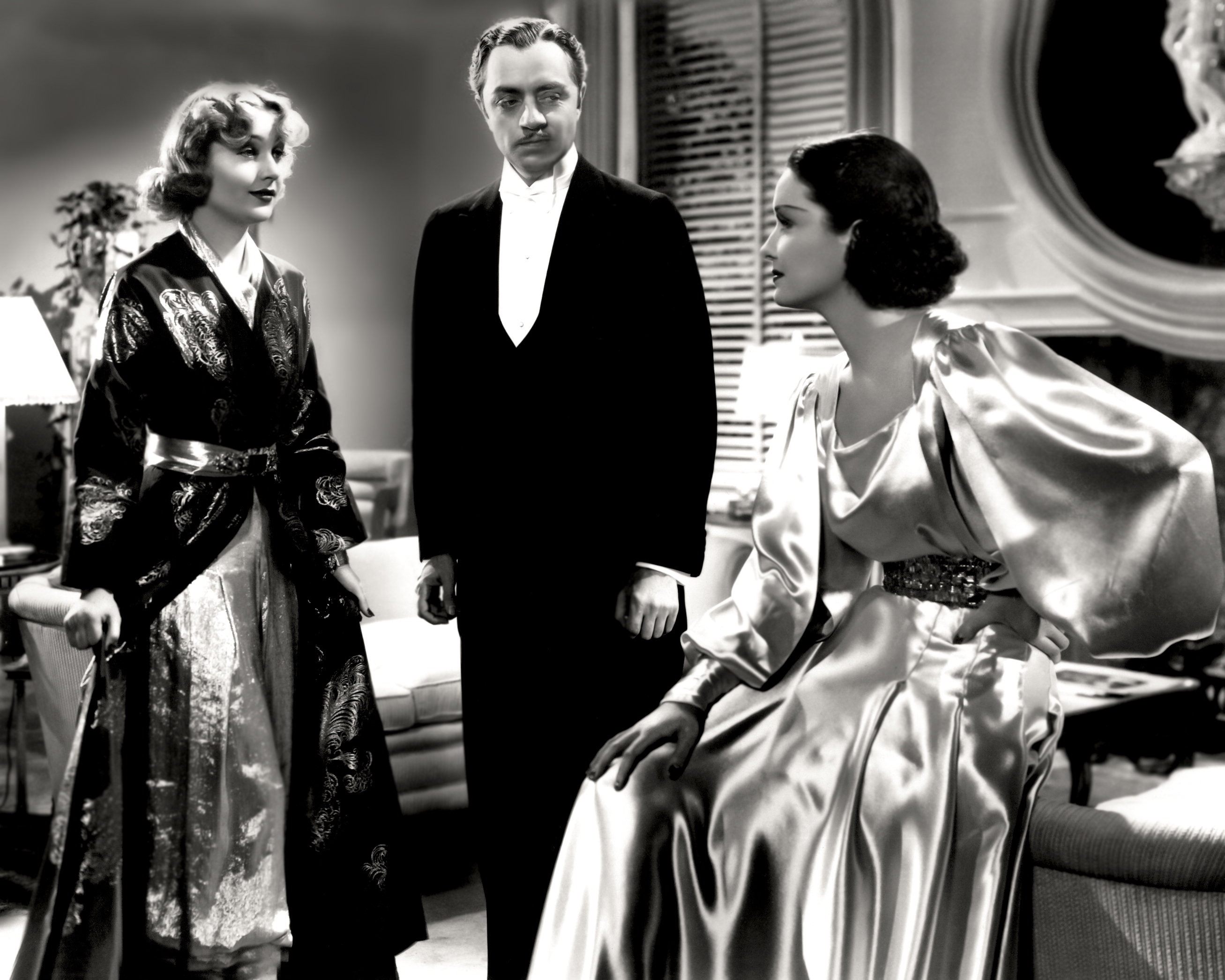
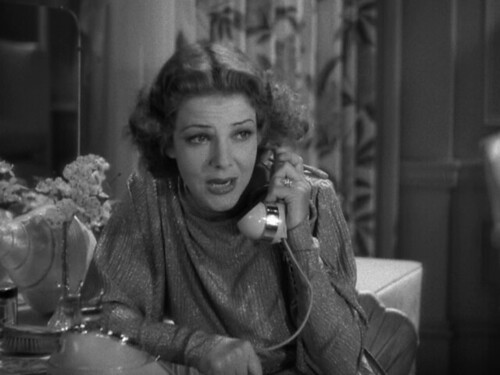
The movie starts stodgily with Montgomery's Lord Arthur Dilling meeting and becoming entranced with widower Mrs. Fay Cheyney (Crawford) on a transatlantic sail. He's intrigued that she takes a fancy to the equally rich, more elderly (and more susceptible) Lord Francis Kelton (Morgan), and keeps an eye on her when they disembark, for though he's smitten, he's curious to see if she might be a gold-digger.
She's not. She's an international jewel-thief in cahoots with Charles (William Powell), the man posing as her butler.
It's hard to pin-point, but around the time the cast all gets together at the estate of Lady Embley (Ralph) after a charity event, the tone suddenly lightens and everybody, especially Montgomery, get several notches better. Now, at some point, the original assigned director Richard Boleslawski died of a heart attack, to be replaced by Hollywood's only working female director at the time, Dorothy Arzner, and while one is hesitant to say this is entirely due to a change in directors, it is unarguable that the film starts to take off, whereas before it has a strained and stuffy feeling to it. Maybe, it's the presence of Powell—though it's doubtful because Crawford starts to light up, too—maybe because the entire cast is pinging off each other, there's more cross-talk between them and more energy zapping between each and every player. Maybe it's the script because the last half is where the change-up's, turn-around's and surprises in character and situations are clustered, a perfect case of the tail wagging the dog (without a chase, explosion or clinch to be seen). But it makes one want to check out Dorothy Arzner, the lone woman in the field (besides Leni Riefenstahl) to be making films at the time. Not to be sexist or anything, but it does make a difference.
Wednesday, December 5, 2012
Sherlock Holmes (1922)
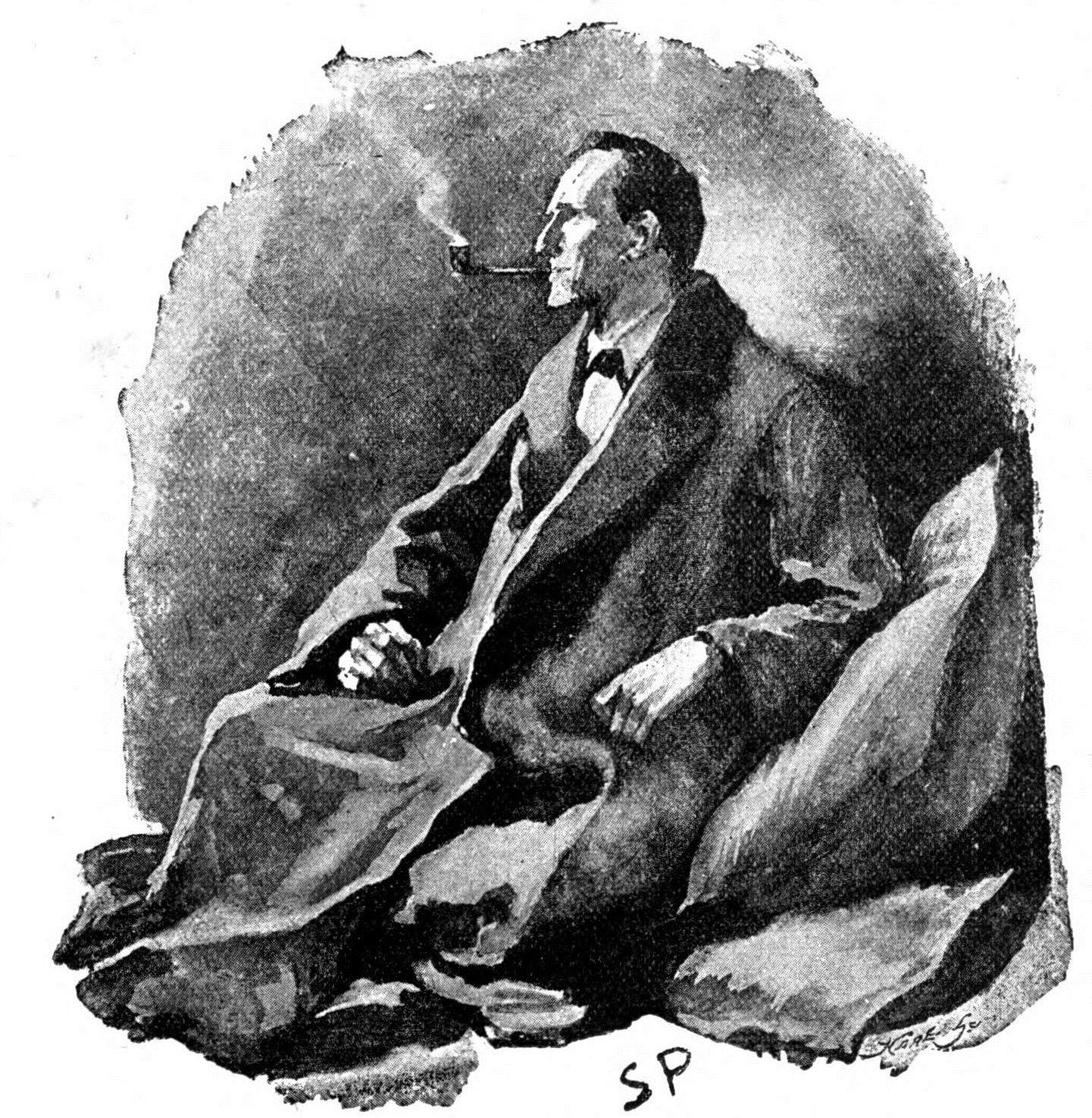
First things first, Barrymore is great, looking the very image of Holmes as seen in the original Sidney Paget drawings that accompanied the first publication of the cases in The Strand Magazine. His Holmes is cunning, contemplative and very rarely wears a deerstalker. The story presents a complicated tale (actually several mysteries in one) spanning years of evil deeds perpetrated by Holmes' nemesis, Professor Moriarty (played by an actor with the wonderful name of Gustav von Seyffertitz) on the more young, innocent members of British society (including a young William Powell—this was his first film). It's up to Holmes (and to a much lesser extent, Roland Young's Watson) to get to the bottom of the case.
It's based primarily on the first Holmes story "A Scandal in Bohemia" (which presents Holmes in full flower and deals with the one opponent he could not best and whom he came to admire, Irene Adler. But that's all changed here. There's no Adler, but instead the Faulkner sisters, both of whom Holmes becomes infatuated with, first in his youth at the the time of his first encounter with Moriarty, and later, after the one's sister's death, and the other sister's possession of her love letters that could result in scandal and repercussions for a European King's reign. But, it is Moriarty and his network of thugs and assassins that want to seize the letters. The extant Faulkner sister is merely keeping them hidden. And Moriarty is set on both getting the letters and assassinating Holmes, the latter done in rather melodramatic ways, luring him into a trap, or shooting him at 221B Baker Street.
It's a silent film, the particulars told in title cards, which is problematic as Holmes, once coerced to reveal the methodology of his deducations, can be a verbose creature. So it falls on the title card authors to show the process in a kind of dense short-hand. Those moments are few and far between. Mostly, it's standard melodramatic fare, without the Doyle back-stories that tie everything together, and explain the gears that set the whole thing in motion (This is done at the beginning and inserting Holmes into it). It's all pretty surface-stuff, befitting a stage presentation (although Parker manages to cross the Victorian era and motor car era in his production design), with Barrymore's performance breaking the silent tradition by being more interior, more cerebral, setting Holmes' detective apart from the usual over-emoting that was the tradition and chief weapon in communicating emotions during the silents.
Granada's Holmes, Jeremy Brett, used to talk about a conversation he'd had with Robert Stephens, who played the role in Billy Wilder's The Private Life of Sherlock Holmes, where Stephens commented "There's nothing there inside the character, just a big empty space that you must fill any way you can." Essentially, he's right. There are lots of Sherlock's who are bland and impenetrable—in fact, the BBC had a rough time with a revolving door of actors who couldn't live up to Brett's version, even when the actor was deathly ill, and didn't until the character was revamped in modern times and played by Benedict Cumberbatch. A "silent" Holmes makes the portrayal even tougher to pull off, as Holmes' theatricality is easiest portrayed with his voice and phrasings, weapons not available in silent films. But Barrymore still manages to make a memorable Holmes, if slightly diluted by a tendency to become romantically involved with his clients. Gillette did so in his play to win audiences and make Holmes a more romantic hero. And although it's slightly unnerving to see, Barrymore makes it acceptable.
Wednesday, August 22, 2012
Life With Father
"I am the character of my household!" booms Clarence Shephard Day, as he's choosing the latest in a long line of maids, which he has chased out of his employ int he last few months, many of them in tears and some in hysterics. Truer words were never spoken. He is the titular patriarch of Life with Father, from the hit Broadway play,* based on the remembrances of Clarence Day, Jr. of turn-of-the-century living with a father-figure who paces slowly in his own grooved path. William Powell plays the role, one he actively petitioned for.
It's a charming film, full of easy irony about the mores and prejudices of the time, where male pomposity poses as dignity, and more separates people than unites them—easy excuses for keeping things nice and orderly on the surface, while underneath, they are broiling with chaos that is easily ignored and denied. Clarence Gray, Sr. denies at the top of his lungs, and his monologues—against politics, taxes, unnecessary expenses, and organized religion (organized against him, it seems)—built individually in intensity and volume, are performances for an audience of one—himself. His barely suffering wife (played by Irene Dunne as if she were singing the entire role) has more influence over him than he is willing to admit, or recognize...or even remember. And his kid's are "mini-me's" of him, all boys, all carrot-tops, and as they age they morph further into miniature versions of The Old Man, down to his expletives and bluster.
Michael Curtiz directs formally and breezily, with his actors performing at top gear, and the director altering pace in editing and filling the frame with as much set decoration as it can hold.
The material doesn't need much else. It's strongly forced, comically subtle and has an undercurrent of mature content, that you just don't see in movies nowadays. Life with Father is from a far subtler era in which sub-texts flew over kid's heads, while the adults exchanged knowing glances and suppressed chuckles (that way you don't have to explain it to the youngsters with a simple "you'll understand some day").
And the sub-text is sex. Clarence, Jr. is growing up, voice changed (but his violin playing still has noticeable cracks) and he's noticing girls—and when it's Elizabeth Taylor as a visiting friend's daughter, one can't help noticing. At the time of the film, it was still early in Taylor's career and her performance is breathy, needy and comes from the same type of ingenue training that produced Marilyn Monroe's early performances. Clarence wants to impress Taylor's Mary, but he can't do so in Dad's ill-fitting hand-me-down suits. The excuse is they're practical, but, as he says, "I can't do anything in Dad's clothes." But, the truth is he gets...uncomfortable...in Taylor's presence. It's not bluntly said, it's danced around, implied, suggested, but never spelled out (as would be the norm today). It's hilarious, charming, and pays off in some ironically comic laugh-lines throughout the film.
Yeah, they "don't make 'em like this anymore." More's the pity. Life with Father deserves its classic status—for some reason, it's not in the National Film Registry—because it's smart, pointed...and hilarious.
GAD!
* It still holds the record for the longest run of a non-musical stage-play.
Tuesday, May 22, 2012
My Man Godfrey (1936)
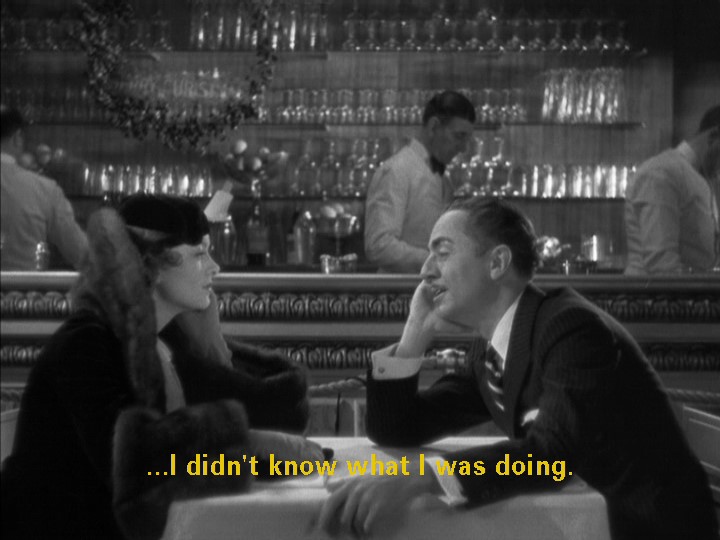
He attracts the attention of Irene Bullock (Carole Lombard, formerly Mrs. Powell) probably because he's different, a genuine "find," and he does stick out like a sore, if well-manicured, sore thumb among the derelicts. Articulate and dignified, he's quietly worldly-wise, politely sarcastic (neat trick to pull off, that) and keeps a cool eye on the rich partiers for whom he's an oddity, a curiosity—like watching a car wreck—and slightly discounted, although he's probably better than all of them as a human being. Mentored by Irene, he assumes a position as a gentleman-butler for her family, a job that's bested a steady stream of other men. But he does the job well, keeping his opinions to himself, the most sane man in a palatial asylum.
And an asylum it is, with the father (the foghorn-voiced Eugene Pallette, staple of Capra comedies) the only one with any sense (or schedule), and who has long given up on his family making any steps to adulthood. Mother (Alice Brady) is a drama queen, who can only be distracted by her protege Carlo (Mischa Auer) and other daughter Cornelia (Gail Patrick) has to fill her empty life with schemes and conspiracies.
But Irene is a dreamer. In Godfrey, she finds a competent supplement, practical, in marked contrast to her flibbertigibbet, caring to her carelessness.
Such a creature, alien to her environment, makes her fall in love with old boy, while he still tries to make his way through Society, and back to the life he has previously abandoned.
It's all high-style and fast-paced. And even though Lombard's society gal is a comic cry-baby notched up to "11" on a scale of "10," she is leavened somewhat by the tolerating, sly performance by Powell—who insisted that Lombard, his ex-wife, get the part.
Powell was the epitome of well-mannered play-acting, while never, ever betraying a dull moment. He made style which, when done in the hands of amateurs, can look confining, seem effortless, while also being insouciant, and fun.
Tuesday, February 28, 2012
After the Thin Man
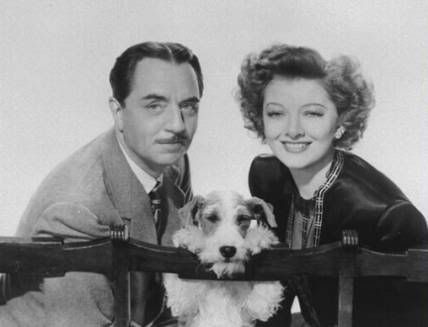
After the Thin Man (W.S. Van Dyke, 1936) Follow-up to the popular The Thin Man, which took the Dashiell Hammett novel and characters and ramped up the entertainment value. Although it has become the most popular of the series over the years (which might be due to the fact that the young and future star, but at the time MGM contract-player James Stewart is featured prominently in the cast), it suffers from a slight case of "sequelitis," with more arbitrary schtick—songs and production numbers that stick out like a milk-shake served in a speakeasy, much more attention and comic anthropomorphism attached to the dog, Asta—as well as making detective Nick Charles a perpetual lush (although there are flashes of the character's talents, as when after avoiding a low-life that has been tumbled down the stairs, he casually mentions "He has a gun under his left arm"). William Powell is an unsung, perhaps merely undersung, master of the throw-away and even though the performance is an amusing "drunk act," he manages to keep the character's thin veneer of dignity intact throughout the shenanigans, and the prim and unproper Myrna Loy lends enormous support in that regard by the obvious affection her character affords her husband.
But, still...we're talking Hammett here. Sure, "The Thin Man," the author's last novel, was lighter than the mystery-master's "The Maltese Falcon," or "The Glass Key," but the screenplay's authors, Frances Goodrich and Albert Hackett* seem to have lost some of the original's dark roots, trading mystery for naughtiness, wit for "cute." I quibble here—after all, the movie-James Bond isn't really Ian Fleming's character, either—for the movie's a solid romp—Nick and Nora investigate another disappearance,** this time the disappearance of Nora's cousin Selma's good-for-nothing husband, which not only involves low-life's, but the other end of the spectrum in Nora's unproperly prim side of the family. Hijinks ensue, bullets fly (and complicate things while simplifying the cast), and it all ends with the "reveal" in a room full of suspects. Van Dyke keeps the thing moving by staying out of the way—there are long, long takes where the actors do such involved business and are merely cramming as much fun into the scene as possible that they make the current cut-and-snip style of acting and film-making appear stodgy (compare this to The Tourist,*** for instance). It's a fine time—save for some Asian racism that curdles the proceedings for a time—and another example of showing why "they don't make 'em like they used to" is a valid argument when it comes to movie-making quality.
* The pair also worked on the screenplays of Father of the Bride, Easter Parade, The Diary of Anne Frank, and It's a Wondeful Life—which, is extraordinarily impressive—all classics, all great, dense scripts.
** The first movie's disappearance was of "the thin man" of the novel's title, it didn't refer to the character of Nick Charles, at all.
*** Speaking of which, Johnny Depp and Rob Marshall are planning their own version of The Thin Man. One hopes that Depp doesn't overdo the drunk bit (as he is wont to do), and the casting of Nora will be absolutely critical.
Tuesday, August 12, 2008
Olde Review: The Thin Man
This Friday's ASUW films in 130 Kane are examples of "The Thriller," and they are W.S. Van Dyke's "The Thin Man" and Roman Polanski's "Chinatown."
"The Thin Man" (W.S. Van Dyke, 1934)
First of all, let's clear up a falsehood: the name "The Thin Man" does not refer to detective Nick Charles as it has been thought, but to a murder suspect in the film. You have been informed, trivia fanatics!* Well, now the film. It was released in 1934 (approximately the time that "Chinatown" is set) and so the film will certainly appear dated, and this shows more prominently in some of the stereotyped "suspects," for instance the young couple that are usually included in the films of this period (they quite regularly disrupt Marx Brothers movies--which isn't the easiest thing to do!) But then, you might be surprised by some of the risque dialog, the very funny verbal sparring that goes on between Nick and Nora Charles, and the extremely light touch that inhabits what is supposed to be a murder mystery (the same thing was attempted in "Murder on the Orient Express," but didn't work due to Sidney Lumet's heavy-handedness). The late James Wong Howe's expert cinematography provides the mystery. The loony script by Goodrich and Hackett, and the "let's-do-this-fast" direction of W.S. Van Dyke provide the seeming effortlessness of the humor.
And one can't ignore the superb talents of William Powell as the perpetually soused Nick Charles, or Myrna Loy, the woman with the iciest glare you could wish to see (or even Asta, for that matter). Effortlessness is their best asset. It is also the film's.
A thriller? No. But good? Yes!
Broadcast on KCMU-FM November 11th and 12th, 1975
"The Thin Man" is, and always will be, an entertaining film. Based on Dashiell Hammett's last novel (some have speculated Nick and Nora were inspired by Hammett and constant companion, Lillian Hellman) it skirts the issue of alcoholism (the two drink CONSTANTLY but are always witty and entertaining--The magic of Hollywood) but other than that, it is one of the perpetual crowd-pleasers that came out of Hollywood's glamorous age.
Screening it again with K was interesting--she remarked that all the female characters seemed to be semi-hysterical (they are) and that the costuming for the women never ceased to be flamboyant (it doesn't). I took note of James Wong Howe's amazing cinematography, especially his night shooting, and how the rhythm of the thing might be better served if there weren't insert shots of shocked reactions to bon mots. Still the best thing about it is William Powell's seeming ability to make things up as they go along, and Myrna Loy's vivaciousness and innate ability to play it straight no matter how outrageous.
* But that's about as useful to folks calling it "The Thin Man" series, as it is to fans of Boris Karloff's Frankenstein. And...it's not entirely accurate.