Showing posts with label Mystery. Show all posts

Thursday, October 31, 2013

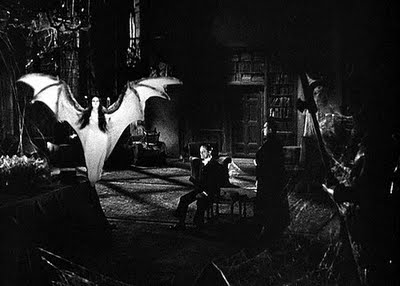
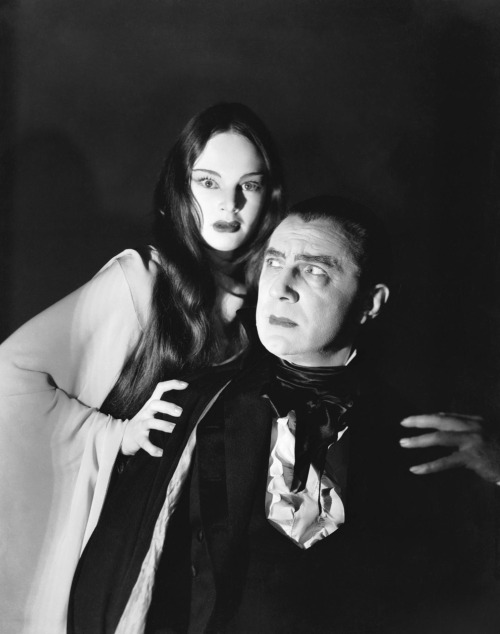
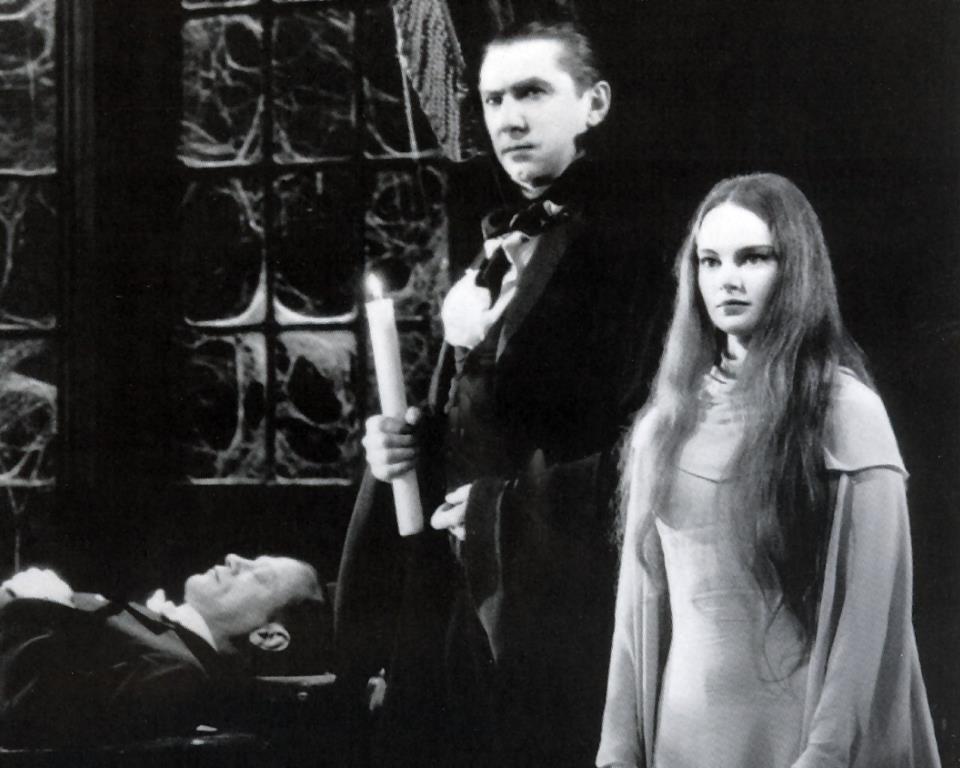
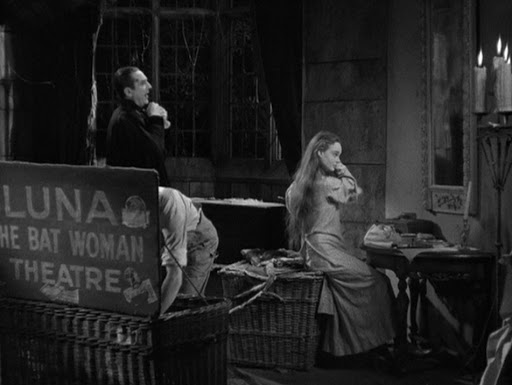
Mark of the Vampire

Mark of the Vampire (Tod Browning, 1935) Oooh!  Here's a Hallowe'en nugget!  Bela Lugosi as a vampire in a film directed by the original director of Dracula, Tod Browning? What could be better than that?

Well, just about anything, but all is not lost.  The film is full of Browning's atmospheric touches—which made Dracula so creepy—and he does himself better here with extensive fog effects, a "real" flying vampire, and a hot she-vampire that's creepier than Lugosi, himself.


A remake of Browning's London After Midnight (a Lon Chaney silent film classic considered lost), this version is re-set in Prague. Plans for the wedding of Irena Borotyn (Elizabeth Allan) and Fedor Vincenti (Henry Wadsworth) are dampened when her father, Sir Karell Borotin (Holmes Herbert) is found murdered, two holes in his neck and his body drained of blood.  The police are baffled, but not the townspeople, who blame it all on Count Mora and his daughter Luna (Bela Lugosi and Carol Borland), who the locals think reside in the Borotyn castle near town, despite being dead for many, many years. 


The marriage is postponed, the case, being investigated by Inspector Neumann (Lionel Atwell), goes cold and Irena goes to live with her guardian, the Baron Otto van Zinden (Jean Hersholt).  And, wouldn't you know it?  Right before the wedding can occur again, another attack occurs—this time Fedor turns up double punctured after walking by the Borotyn castle.  Then, Irena is attacked.  Things are getting to be a real pain in the neck, so the inspector brings in noted vampire specialist Professor Zellen (Lionel Barrymore), who suggests a two pronged attack (naturally), they'll dig up the body of Sir Karell to see if he in thrall to the vampire, and they'll search the Borotyn castle for Mora and Luna.


There's more to this than meets the eye, and far less with a twist ending that makes horror fans see red. 


Still, before they stake these vampires, Browning's atmospherics are fun, effective and slightly risible and although it disappoints for toying with the audience (and for the many 20/20 hindsight "but if..." questions after), it's genuinely creepy.


Thursday, October 3, 2013

Suddenly, Last Summer

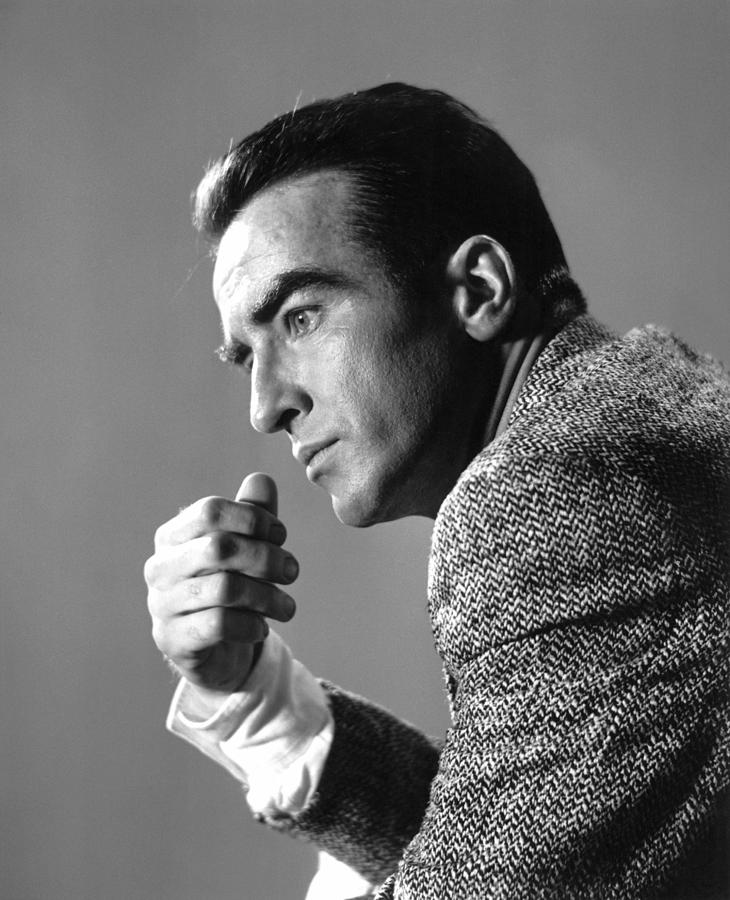
Suddenly, Last Summer (Joseph L. Mankiewicz, 1957) Tawdry gothic-noir that was so compromised by concessions to the moral powers-that-be that nobody associated with its production ended up liking it, not the original author of the play, Tennessee Williams, not his co-screenwriter Gore Vidal, nor the director Joe Mankiewicz.  Pity, as its an example of how Mankiewicz could juice up material directorially in a truly unsettling way when given the chance.  And he had a great cast in Katherine Hepburn, Montgomery Clift (even in the semi-drug-addled condition he was in), Elizabeth Taylor and Mercedes McCambridge.

What's missing is the person everyone talks about—the late Sebastian Venable, (poet and narcissist) who died (suddenly) last summer, ostensibly of a heart attack, as the whispers state, but has nothing to do with the truth, which is damaging enough that his doting mother Violet (Hepburn) will do anything to keep it secret, even if it means lobotomizing her niece Catherine Holt (Taylor) who witnessed his death and has blanked it from her memory. Mother Violet entreats the local psychiatric hospital and its brilliant lobotomist Dr. Cukrowicz (Clift) to see if Catherine is a suitable case for treatment, with the promise of a large endowment if she can be "cured."  "Cured" of the memory stuck in her head, and if not cured, silenced, whether institutionally or medically.

But what those memories are of that led to Sebastian's death "suddenly, last Summer" are only implied for the first 3/4 of the movie.  In the first couple of movements battle lines are drawn as Cukrowicz first gets Vi's version of things (as he investigates why she wants to donate so much money to his institute), then, once questions are raised, tries to coax it out of the mostly comatose Catherine without success.  The gist of it is that Catherine, at Sebastian's request, had replaced his mother as his travelling companion on his world-travelling jaunts from which he would produce his yearly published book of poems.  That Summer, in the town of Cabeza De Lobo, Sebastian died, leaving no book and no issue.

Except for Catherine.  The play's third scene is the explanation in the drawing room scene if this were a detective novel, where Catherine, under the influence of sodium pentathol reveals all (from her point of view), and Mankiewicz goes to directorial town (his point of view) in a weird silent flashback that threatens to crowd out Taylor from the frame, and that veers wildly from realism to German expressionism to surrealism within the course of its run, containing some of the most bizarre imagery just outside the horror realm (or Salvadore Dali's dream sequence from Spellbound).


To tell you what it all means ruins the ending, except that the movie itself doesn't come right out and say anything, owing to the tenor of the times (meaning you couldn't be) and to the so-called community standards that this particular era of film-making was challenging.  This was before ratings systems—G, PG-13, M, R, X and NC-17—but there was The Legion of Decency, over-run by the Catholic Church, that crossed itself, said five "Hail Mary's" and then banned your movie from being advertised.  You couldn't talk about homosexuality, procurement, prostitution, drug use, pedophilia, and cannibalism except in closeted code, and the "Truth Serum" sequence obfuscates with what's going on to the point of obtuseness.  Williams wasn't entirely guilt-free of this; he was just as capable of pulling the shade over a naked light-bulb or turning pleurosis into "blue roses"—he made an art of it.  But here, the mother-love perversity at the heart of so many of his plays runs on the hysterical side, and try as he might Mankiewicz can't make more of the empty book of poems than he can. All he can do is try and push Hepburn over the brink of sanity, after she's been doing wheelies near the edge the entire movie (Vivien Leigh nearly played the part; can you imagine?)

How far we have come since then—except, of course, for the cannibalism part (unless you were voted to the House of Representatives in 2010).

P.S. there's an excellent breakdown of the film, courtesy of The Last Drive-In, that did an excellent job of pulling screen-caps-two of which I cribbed above.

Liz Taylor glamour shot draped over the rail of an asylum


Wednesday, July 3, 2013

Ministry of Fear

Ministry of Fear (Fritz Lang, 1944) So, here's the joke: a man walks out of an insane asylum and finds the world is crazier than he is.  

But, then, it usually is in Lang's films.  The forces of evil or nature are such that we don't stand a chance unless our own better natures or our just plain "stick-to-it-ive-ness" allows us to survive and move through.  And in Lang's directorial vision, the film frame is as much a trap as anything else, one that can be violated by unseen dangers that will drop into frame as if materialized by a malicious God out of nowhere to threaten those within it.


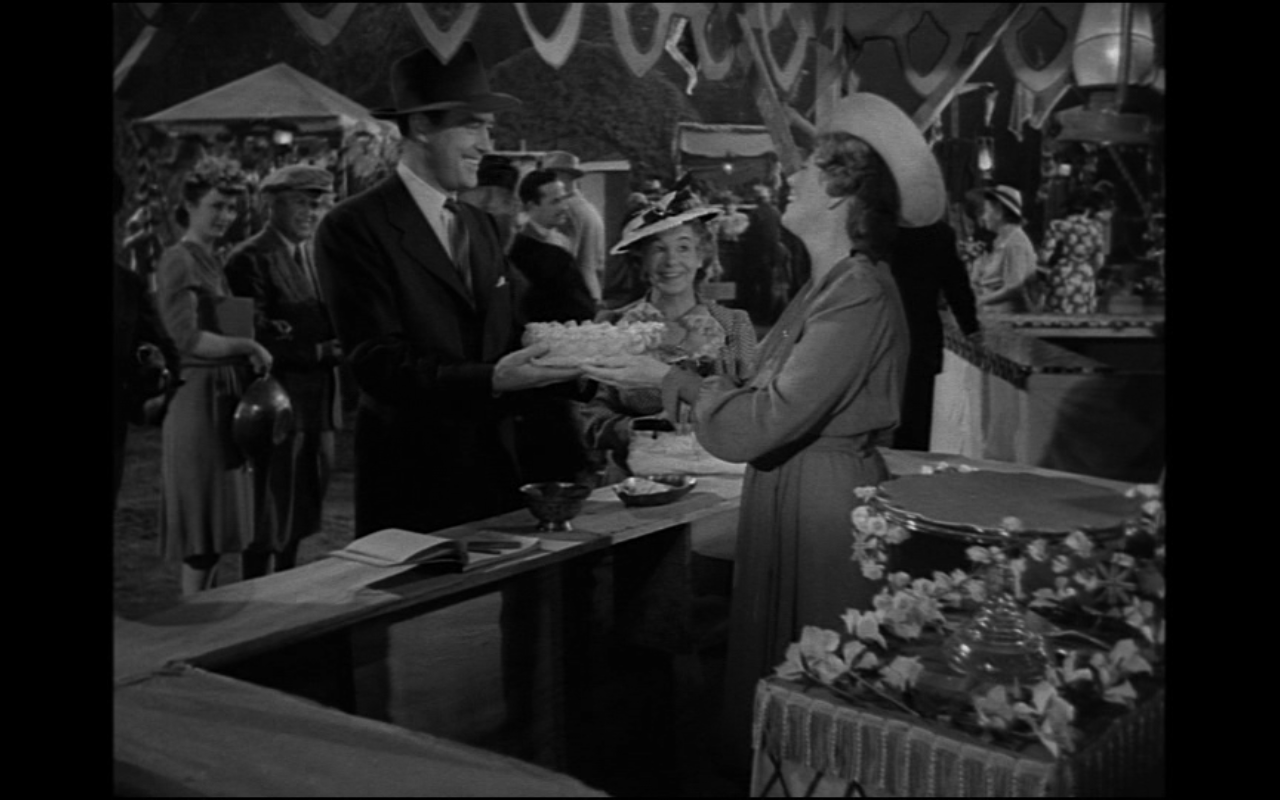
Ministry of Fear, based on a Graham Greene novel published the previous year, follows the dogged tracks of Stephen Neale (Ray Milland) as, having been released from Lembridge Asylum, he awaits a train to London and decides to pass the time at a charity fête supporting "The Mothers of Free Nations" where there is a booth for guessing the weights of cakes.  After dropping a shilling on a wrong guess, his next stop is a fortune teller's booth, where he's astonished to find the woman giving him the exact weight of one of the cakes at the booth across the way.  Neale can't resist using his knowledge (and testing the medium's prediction) and is astonished to find that he's guessed correctly and won.  


Everything's a little off-kilter in Fritz Lang's world.

Off to his train he goes, not knowing that his taking the cake has caused a commotion back at the tents and exhibits.  The cake has "gone" to the wrong man, intended for another (Dan Duryea).  On the train, Neale's cabin-mate is a blind man to whom he offers a slice.  But, Neale is astonished to find that instead of eating his portion, he's crumbling it in his hands.  The blind man is no blind man, and he attacks Neale, steals the cake and jumps off the train, pursued by Neale.  But it is the time of the Blitz, and as the two chase through a field in the night, bombs begin dropping, targetting their train.

Okay.  We'll stop there.  But, already, things are not what they seem, people are not who they say they are, and nobody can be trusted...not even a damn pastry.  It's not a cake, at all.  It's a MacGuffin, the movie-making slang for the object that the players in a movie seek (and has a sliding scale of relevance and importance*). 

The subsequent fandango has Neale involved with "The Mothers of Free Nations," a seance, dodging bullets with the police and secret service, and all sorts who pretend to be something they're not.  It's enough to drive a sane man crazy—if one hadn't already left an asylum.  That time in crazy-land might actually have steeled Neale for his subsequent adventure, which is no piece of cake.  Lang was the master of the paranoid thriller (at least until Alan J. Pakula teamed up with Gordon Willis in the post-Watergate 70's) and his ordinary man caught in the extraordinary is the very DNA of a Hitchcock thriller—in fact, Ministry of Fear might have been one of those that "got away" from The Master of Suspense.  With its seances, wolves in bureaucratic clothing and things that go boom in the night, all it needs is a national monument to be pure Hitchcock.  It's a fun, terrible ride, well worth seeking out.


*

Thursday, June 20, 2013

The Maltese Falcon (1931)

The Maltese Falcon (Roy Del Ruth, 1931) One of the "other" "Maltese Falcon" adaptations (the other is the Falcon-less Satan Met a Lady starring Bette Davis, which we'll look at tomorrow), before John Huston got it right and turned the Hammett story into a classic of the detective genre in 1941.

This one follows the story-line well enough—Brigid O'Shaunessy, the death of detective partner Miles Archer, rumors of a legendary jewel-encrusted black bird statue, and the motley trio of swindlers, Cairo and Guttman and Wilmer, a shade more flamboyant in this version. The story runs its course.

Where it differs—and all the "Falcon" versions differ—is in the character of Sam Spade, of Spade and Archer Detective Agency, soon to be "Sam Spade, Detective." The Bogart persona is familiar: tough guy, cynical, has the image of disrepute, but a resolute moral compass—like the Falcon itself, you have to scrape away layers of hardened lacquer before you get to the stuff that's valuable. That's Bogart, imprinting Spade and the image of detectives—but movie detectives—with the same template ever since.  

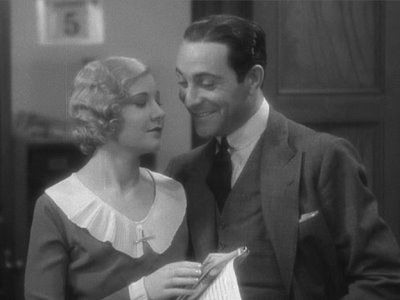
But, the first version of The Maltese Falcon was this pre-Code version starring Ricardo Cortez, and the top-billed Bebe Daniels as client "Ruth Wonderly." Don't let Cortez's latin name fool you; he was born Jacob Krantz, raised in the Bronx, but his name was changed to attract audiences during the "Rudolph Vaentino" phase of leading men. His Sam Spade is openly a lothario, a charmer and ladies' man, quick with a leering smile and altogether too happy in his work. You have no sense of Spade actually thinking, but going through false motions among other finaglers. He's unreadable to the audience except he's the guy "in charge," and enjoying himself.

There's much more sexuality to this one, featuring a scene with Bebe Daniels talking on the phone in the bath, and when a thousand dollar bill goes missing in the exchange scene, Daniels is forced to strip-search before Spade concludes that Caspar Guttman might have withheld it. This Sam Spade, one has the impression of making her do it just for the "fun" of it.

And the trio of con-men/murderers after the black bird?  When Spade's secretary, Effie, introduces a new walk-in as "gorgeous," Spade assumes it's a woman, but it's "Dr." Joel Cairo (Otto Matieson) in the first allusion to the veiled homosexuality of Cairo, Guttman and Wilmer.  The latter is openly referred to as Guttman's "boyfriend" and is played by Dwight Frye, the manic character actor from so many of the Universal horror films, including Frankenstein and Dracula. 

The film includes a coda of Spade visiting O'Shaunessy, making it known that Spade has gone "legit," working for the D.A.'s office which, although it may be intended to show Spade more in a "good guy" role, it paints a rather poor picture of the San Francisco district attorney (especially considering the police's earlier suspicions about Spade).

The steamy elements forced Warners to shelve this Maltese Falcon once the Hays Office opened its doors. The studio then made another version, Satan Met a Lady, played with a lighter tone, but which met the newly-imposed standards of the Motion Picture "Code." That's tomorrow.
Ricardo Cortez as the first Sam Spade

Tuesday, December 27, 2011

The Girl With the Dragon Tattoo


"The Girl With the Dragon, Take Two"
or
"Once More...with Feeling"

"We come from the land of the ice and snow
from the midnight sun where the hot springs FLOW

How soft your fields so green,
can whisper tales of gore,
Of how we calmed the tides of war.

We are your overlords.
On we sweep with threshing oar,

Our only goal will be the western shore."

"Immigrant Song"  Led Zeppelin


The American production of The Girl with the Dragon Tattoo advertised itself (amusingly) with the tag-line "The Feel Bad Movie for Christmas."  Compared to the Swedish-TV version (with Michael Nyqvist and Noomi Rapace), it's actually, if one can believe it given the subject matter, a "kinder, gentler" version.

So, what's different?  For those familiar with the first version, many of the locations reveal themselves to be the same.  Resolutions are slightly different. The casting certainly is (and more on that later).  Editors Kirk Baxter and Angus Wall keep things moving very fast, sometimes abruptly, and scripter Steven Zaillian delivers punchy dialogue dripping with icyclic irony, while keeping the circumstances equally savage and shocking (what else can you expect from from a murder mystery involving in-bred families crusty with krona, corruption, Nazi affiliations, serial killers, sexual violence and "men who hate women"—the original title of the book when published in Sweden?).  It's how director David Fincher (Se7en, Zodiac, The Social Network) approaches the tone that's slightly different, and though still mordantly frigid, this version is a bit more clever in presentation, adding a darkly humorous slant.  Sure, the violence is still sickening, but blunted, even handled at times more discretely, making the impact contrarily even more squeamy, while, at the same time, counter-pointing with sly musical choices.*

But, it's the casting where the main differences occur.  Daniel Craig, no less intense, but muted and reduced to human scale with a world-weary familiarity, plays Mikael Blomqvist, co-publisher and chief reporter for an investigative magazine, Millennium.  Disgraced by a libel suit gone against him and to shake off the publicity and the hit to his reputation and bank account, he takes on a murder investigation for the patriarch of the industrialist Wanger family (Christopher Plummer)—a literal cold case of the forty year old disappearance of the elder Wanger's granddaughter, although distinctive clues point to her either being alive, or the killer is cleverly taunting the old man.

It's soon clear that Blomqvist may be over his head and he calls on an "assistent"—the same background investigator who cleared him for the job for the Wangers.  She's the titular "girl with the dragon tattoo"—Elisabeth Salander and "she's different."  "In what way?" asks Wanger's lawyer, Frode (Steven Berkoff).

"In every way," says her employer.

Too true, not only in terms of Society, but also from the actress who previously took the role (Noomi Rapace, currently starring in Sherlock Holmes: A Game of Shadows).  She's still the same Salander, the goth-punk, vegan, pierced, bi-sexual hacker-savant who becomes the focus of the series, zipping around the bleak Swedish countryside on her black-on-black motorcycle, but this movies version, in the form of Rooney Mara, is slight (she had to be starring opposite the 5'10" Craig), tiny and even more startling in appearance than Rapace.  There's still the same shock of hair, but with her elfin face, shaved eyebrows and eyes sunk deep into her face, she has the appearance of the walking dead, her head looking often like a skull, and speaking in a dull, listless monotone.  Rapace looked like she could kick serious ass (and did in the Swedish productions), but Mara is deceptively tiny, even looking sickly frail, so when she goes on the attack, it's doubly alarming. 

We learn more about the little spit-fire in the second and third books of the series (hopefully they'll have their own versions with this cast—as with the Swedish films—because this cast is too good to waste, but the film's poor box-office showing—"The Feel-Bad Movie of Christmas," remember?—may make that unlikely), but Mara's dead-inside interpretation, that only slightly blossoms through the film, is an interesting take, doubly tragic, keenly felt and puts both her character and Blomqvist's into an interesting perspective.

I actually like this version better than the first.

The Girl with the Dragon Tattoo is a Full-Price Ticket.


Not the actual main title, but the video of the Trent Reznor/Karen O version of the Led Zep song.
It's somewhat in the same visual style, and might consist of "outtakes.".


* The best being what was used in the initial trailers—Led Zeppelin's "Immigrant Song," subtly adapted by producer-composer Trent Reznor (the perfect guy to score this film) for female vocal, while keeping the brutal orchestrations of the original intact.  The Main Title sequence accompanying it, is visually arresting, suggestive and creepy, almost a mission statement in tone—black and white, reflecting the film's dark muted color scheme—while suggesting minds, trapped, tortured and squirming like toads. 

Thursday, December 22, 2011

Sherlock Holmes: A Game of Shadows

Bullet-Time
or
"Forewarned is Fore-armed (and Don't Call Me 'Shirley')"

"'Well, well,' said he, at last. 'It seems a pity, but I have done what I could. I know every move of your game. You can do nothing before Monday. It has been a duel between you and me, Mr. Holmes. You hope to place me in the dock. I tell you that I will never stand in the dock. You hope to beat me. I tell you that you will never beat me. If you are clever enough to bring destruction upon me, rest assured that I shall do as much to you.'

"'You have paid me several compliments, Mr. Moriarty,' said I. 'Let me pay you one in return when I say that if I were assured of the former eventuality I would, in the interests of the public, cheerfully accept the latter.'

"The Final Problem" Sir Arthur Conan Doyle


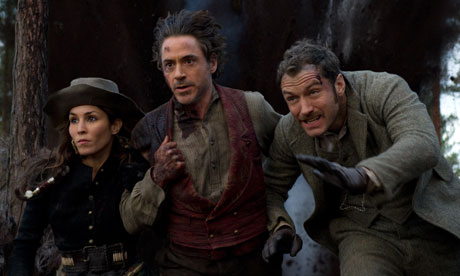
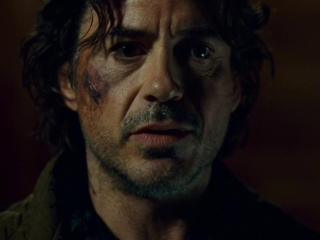
Sherlock Holmes: A Game of Shadows is the inevitable (and one should say quick-on-its-heels) follow-up to Guy Ritchie's Sherlock Holmes, and as an adaptation of Conan Doyle's "The Final Problem," It has as much source-relationship as the later Bond films have to Fleming—the bare-bones structure is there, but it's pumped, plumped, and trumped-up to fulfill the needs of action, humor and modern audience identification.  Really, "The Final Problem" is enough, we don't need the world-conquering machinations of Professor Moriarty (The Napoleon of Crime, the Scourge of London, and Holmes' best match) to make him a worthy adversary.  He merely needs to be omnipresent by means of his web of chicanery, rather than an omniscient history-maker.  In fact, Conan Doyle's Moriarty would rather his bad work went undetected, as opposed to this movie's version producing a shattering World War.  Here, in the words of Robert Downey Jr.'s Holmes, the plot is "so overt, it's covert," involving twins who aren't twins, TB, the Romany, anarchists, darts for various purposes, intricate explosive devices and not-so-intricate shell-firing ones, countries that can't be named ("although they speak French and German"), and the prospect of "war on an industrial scale."

20/20 hindsight always looks like genius when set in the past.

Actually, it's pretty clever how the doom-laden inevitability of "The Final Problem" is translated into the fore-shadowing of the war-torn 20th Century (the screen-writers are the wife-husband team Michele Mulroney and Kieran Mulroney*), and its focus on large artillery and semi-automatic "machine-pistols" has a nice hard edge as opposed to the original film's emphasis on the psuedo-occult.  But, director Ritchie seems to have lost of his somewhat, the fight-sequences (there are many) are nicely fore-shadowed with flash-cut Holmsian cognitive pre-functioning, but when the fisticuffs and baritsu moves start flying, the action is hard to follow, even when the action is slowed to a crawl—there is far too much ramp-editing and Matrix-y "bullet-time" FX in the film for no good purpose other than to slow down the practical and digital effects and give us the illusion of "wow, that was close." (Thanks, we assume that fire-fights and shellings are dangerous things).  However fast the editor can manipulate images, one still gets the impression of the film being a bit too "fussy" for its own good, delaying information or simply obfuscating it for a later time, giving one the impression that one is seeing a lot of the movie twice.  Efficient, it ain't, even if the titular character is supposed to be the heighth of it.

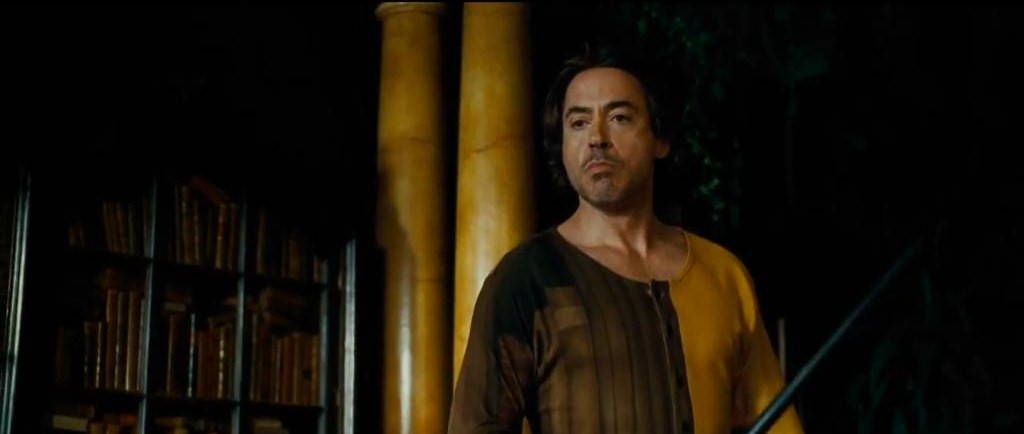
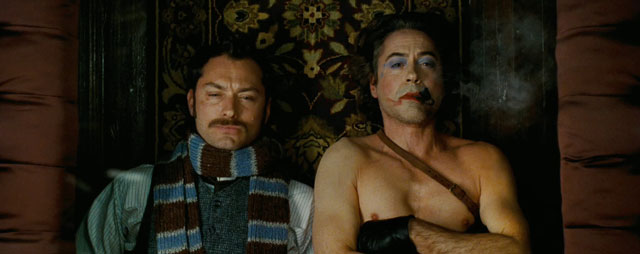
Also, although the first of Downey's adventurings could be seen as being a nicely nuanced (if scruffy) interpretation of The Great Detective, here the character is allowed to go a little more broad, dressing in comedic drag ("I admit, it's not my best disguise") and another, which is actually taken from The Pink Panther series (mind you, Steve Martin's "Pink Panther" series), the comedy is played up and not necessarily in character, and Holmes is seen to be practically infallible—even his getting seriously hurt is all part of his plan.  

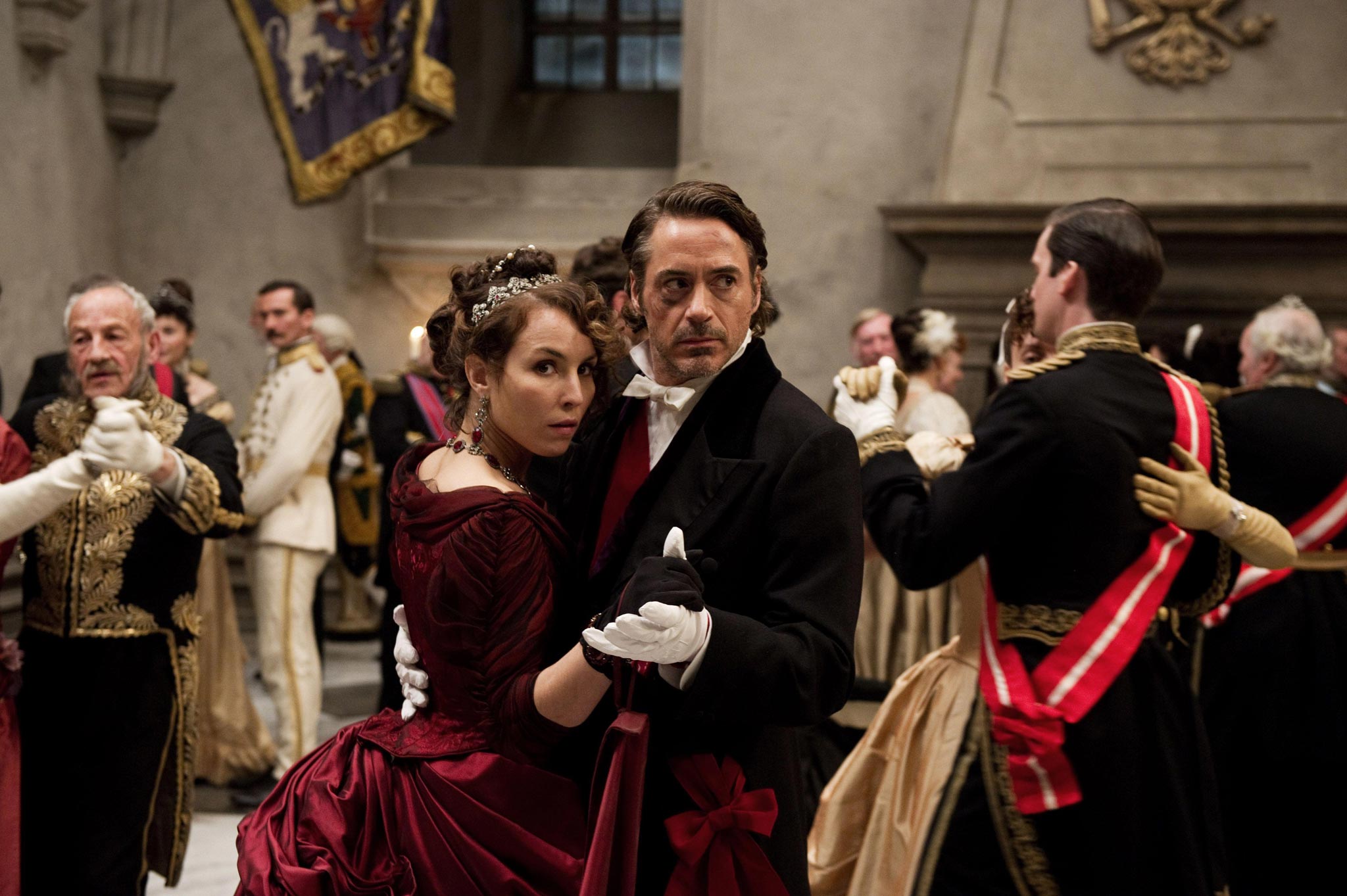
Downey, Jr. is great at playing this, even if it's a more absurd version of Holmes, and Jude Law again plays Dr. Watson (now with a severe limp and who is only now about to be married to Mary Morston, again played by Kelly Reilly) and it's one of Law's best performances, quick as Downey and capable of the slowest of "burns." Law's role is expanded somewhat and he makes the most of it.  The two are joined (briefly) by Rachel McAdams, reprising her role as "the woman" Irene Adler, but is soon replaced by Noomi Rapace's gypsy princess Simsa.  Aiding and abetting is Stephen Fry, as Holmes' smarter, drier brother Mycroft (it might actually be considered type-casting), with Jared Harris as the coolest of Moriarty's (Brad Pitt was initially considered for the role), as well as being one of the youngest.

As fun as it is, one can't help but look at it as a step down—the filmmakers are getting further afield of the Holmes characterization, and it's only a matter of time before the Downey, Jr. version is locked into buffoonery and slapstick, and it comes perilously close to teetering off the edge here.  As it is, this plot is more reminiscent of the Basil Rathbone films set during WWII, entertaining if anachronistic fluff.

Sherlock Holmes: A Game of Shadows is a Matinee.


Paget's Strand Magazine illustration of the first of two Holmes-Moriarty encounters.

* Kieran is the brother of Dermot Mulroney, husband of Michele, and you may best remember him from "Seinfeld" as the fellow who gets bent out of shape at a funeral reception when he see George Costanza double-dipping a chip.

Thursday, July 21, 2011

The Double Hour

"Wishing Doesn't Make It So"

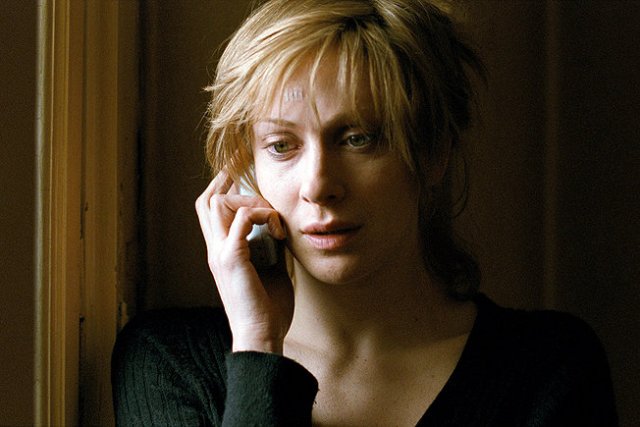
Sonia (Kseniya Rappoport) is a chambermaid in a Turin hotel.  It's dull work, broken by the creepy tenants, the staff gossip and the occassional suicide out the window.  This certainly doesn't cheer up Sonia's life and makes things particularly difficult at a speed-dating service where she meets (mercifully quickly) a bunch of losers all of whom are attracted to her. Last (but not least) is Guido (Filippo Timi), ex-cop now security guard, widower and sound-junkie.  They seem to hit it off, at least in speed-dating terms, and soon, they're taking the first tentative steps to...uh...slow-dating, I guess.*

Guido takes Sonia to the palatial res' he is currently monitoring, shows her his recording equipment which he uses to tape nature sounds, then takes her for a walk around the grounds.  As Fate would have it, that's just the moment that the mansion becomes the setting for a robbery and Guido is knocked unconscious, Sonia taken hostage and the place ransacked of its antiques and valuable paintings.  It is when one of the thieves decides to have some fun with Sonia that Guido jumps the guy, head-butts him...and then the gun goes off.

Fade to Black.

It is some time later.  Sonia is sporting a nasty scar on her forehead, the result of a bullet wound.  Guido is dead, killed by the same bullet, and Sonia mourns.  She misses him.  Well, more acurately, she is haunted by him...because she hears him speak her name every so often.  And then there are his ghostly appearances, and the strange booming noises that periodically elevate the audience out of their seats.  What is going on?

I can't tell you because it would spoil the movie.  It is enough to say that the film is a Möbius strip of twists and turns of both the mind and the heart, with a Hitchcockian identification shift that's disorienting, disheartening and damned clever.  There are enough red herrings to burst a fishing net, some of them necessary and some of them just distractions.  For instance, the title: Guido mentions on their first extended talk his own curious wish-myth of "the double hour"—when the hour and minutes are the same (like 12:12 am), make a wish and it might come true.  "Does it work?" asks Sonia.  "No," says Guido. 

Funny, but unnecessary.  It's used as a touch-stone for the entire movie, a call-back that ultimately adds little, one of a number of details that cloud the issue and distract (which may be the point).  A little buttoning-up of some of these elements might have made this one a better film.

Still, at its core, The Double Hour (La doppia ora) is a neat little conceit, and director Giuseppe Capotondi and his writers keep you guessing the whole way, bending, shaping and twisting the plot...and your mind along with it.

The Double Hour is a Rental.


* The slowest of which is Carbon-14 dating (....sorry).  

Friday, July 1, 2011

Incendies

"The Mystery of 'The Woman Who Sings' and 'Nihad of May'"
or
"Doing the Math"

Incendies (aka Fire, although I doubt it will ever go by that name) looked so intriguing in the trailer that when it rolled around, I had to go see it.  A Candian film by Denis Villeneuve, it previewed like a political thriller, when it is more of mystery story and a family drama.  But, as it is set primarily in the Middle East, things are only a stone's throw from getting political.

It begins with the reading of a will.  Twins Jeanne (Mélissa Désormeaux-Poulin) and Simon (Maxim Gaudette) are the only ones in attendance at the reading of the legacy of their mother Nawal Marwan (Lubna Azabal, a very nice performance) at the offices of Notary Jean Lebel (Rémy Girard), who was her employer for 18 years.   The will has some odd requests, which is just further proof to Simon that his mother was crazy.  They are each given an envelope, one to be given to their father—thought killed in battle in the Middle East long ago—and the other to their brother, which neither child knew they had.  When those tasks have been accomplished, then they will receive another envelope, at which time they will be allowed to put a stone on her unmarked grave.  Until then, there is to be nothing to mark her passing.  The twins part ways, Simon bitter over their mother's perceived foolishness, while Jeanne, a theoretical mathematician by trade—"no problem is unsolvable" says her mentor—goes off to find the answer to the mother of all mysteries.

It is then that Villaneuve starts telling twin stories—of Jeanne's trip to her mother's Palestine homeland, and the mother's journey, leaving her village in disgrace and becoming an activist against the far-right Christian militia.  As with everything in the Middle-East the stories Jeanne gets are polarizing when she actually does find some of the elders who remember her mother, and her investigation picking through the rubble of her mother's past lags slightly behind the flash-back sequences as we get the full details that Jeanne is not privy to.  Despite getting a clearer picture, the film has so many twists and turns that no one gets the full story until the end, to a solution that negates the basic premise of Jeanne's quest in the grand scheme of things.

Villaneuve's film is a little disorienting—you have to really pay attention as the locales and personae shift betwen stories, as there's usually a little initial disorientation between transitions—and there is one superfluous section that could have been edited with no harm done to the story.  And there is a stretch of credibility that can only be rationalized if you buy into the inevitability of the dramatically circuitous path of the tale.  If you can make that leap, it is an interesting mystery that concludes with another—the mystery of the heart.

Incendies is a Matinee.

Wednesday, April 6, 2011

Kaboom

"What Kind of Guy Are You?"
or
"Madeleine O'Hara, What Do You Know About the Animal-Mask Men?"

I was trying to concoct some bogus review for a non-existent movie to play as an April Fool's Prank, but Gregg Araki's Kaboom will do just as well.

A farcical paranoid comedy/sex-romp,* it revolves around two 18 year old college students, Smith (Thomas Dekker) and his "partner-in-crime," "'vag-itarian' best friend" Stella (Haley Bennett), who are both experiencing odd disruptions in their sex-lives.  Smith is "undeclared" sexually, attracted to all sexes, but right now, specifically, to his meat-head surfer roommate Thor ("Like the comic ... shyeah!"), and Stella is gay (even if her attitude is anything but).  Both are majoring in go-nowhere subjects (she in Art and he in Cinema Studies), which is alright as a) Stella wryly (as per usual) says "college is just a pit-stop between High School and the rest of your life," and b) what they're learning outside of class is far more relevant, if not entirely explainable. 

At one particular mixer, Stella hooks up with Lorelei (Roxane Mesquida) who claims to have "special powers"—she's a witch and not a nice one (of course, witches can become clingy and domineering, they're witches!)—while Smith falls victim to a hallucinogenic appetizer and a one night stand with London (Juno Temple)—they have a lot in common, such as both losing their fathers early, being fascinated with each other, and being amateur sleuths to all the odd occurrences happening on campus.**  "Strange seems to be the new normal," says Smith, as he copes with flashes of dreams involving people he hasn't met (yet), and the suspicion that while in his drugged state he was witness to a brutal cult-murder.  Smith has a hard time deciding whether he's in reality or fantasy-mode, something that will stand him in good stead for the adventure to come.

Kaboom is fast, cheap, and out-of-control (but good-naturedly so), fairly well-acted (which is surprising, although "slacker" isn't the toughest acting challenge to pull off), the comedy is fresh, funny, nicely played in a Buster Keaton-ish dead-pan and comes from very unexpected places.  Araki's direction, meanwhile, whirls around and gets in the faces of his "'Friends' with benefits," wheeling between blinking-in-your face close-ups, and disorienting fever-dreams.  Every few minutes there's a flash of weirdness that has nothing to do with sex--which is all very casual, as opposed to more hung-up directors who like to set it up, telegraph it, and underline it with high-lighter.***

It almost feels like a bizzarro "Scooby-Doo" episode, with no dog and where everybody has the convoluted "friends share" sexual history of Fleetwood Mac.  Even the last movie-ending scene has a whiff of "if it wasn't for those darny nosey kids" to it.

Not everbody's recipe for a fresh time at the movies, but a good, goofy, twisted diversion.

Kaboom is a Rental.

* One place calls it "Sci-Fi," but I don't see it.  It's much more in the "innocent caught in the intrigue" sub-category of Mystery-Thrillers.

** What can I say, it's set at a California college, all sci-fi architecture of open-air teutonic concrete.  Great place for a mystery.

** All the better to make their own chapters on the DVD menu...anyway, Araki makes no big deal of it.  Sex happens.  And in California, so do cult-murders.

Friday, January 14, 2011

The Secret in their Eyes


The Secrets in Their Eyes (aka El secreto de sus ojos) (Juan José Campanella, 2009) Argentinian film that won the 2010 Academy Award for Best Foreign Film.  It is difficult to say, after the fact, exactly what The Secret in Their Eyes actually is: is it fiction, deposition, fever dream, memory, fantasy, wish-fulfilment...any of them, all of them a bit.  And yet, it is a mystery with a conclusion, a love story with a happy ending, a character study, a psychological thriller—all of it.

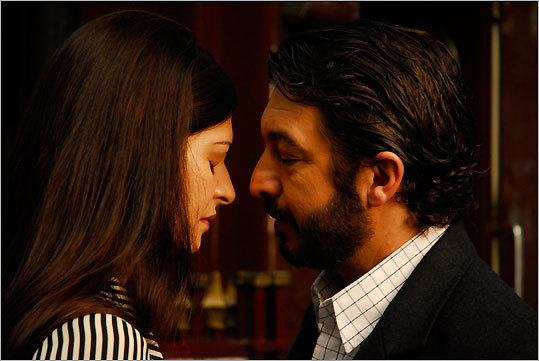
It begins as a blur: a writer is trying to begin his novel...and begins it many times: a hazy, blurred separation of lovers at a departing train; the last memory of a woman soothing an ailment with tea and lemon; a brutal rape.  All facets of the story, but not one facet, above all.  The author, Benjamin Esposito (Ricardo Darín) a former legal counselor in retirement, is trying to write a novelization of a case that he can't shake for the life of him: what he calls the Morales case—the sexual assault and murder of Liliana Coloto (Carla Quevedo), new bride of Ricardo Morales (Pablo Rago).  It is a case that he got by default, but it haunts him: the way the girl appears crumpled at the crime scene, the devastation of the husband, the utter lack of clues—and that a rival counselor (Mariano Argento) has arrested and beaten a confession out of two construction workers who could not have been there at the time.  Determined to find the real killer, if only to bring peace to Morales, Esposito breaks a few rules, goes by his own instinct on the slimmest of leads, consequently landing him in hot water with his immediate superior Irene Menedez-Hastings (Soledad Villamil) and her boss.

That he is holding an unspoken love for her is only part of the complicated story, a facet.

At one point in the story it is observed that you can change anything about a person...but you can't change their passion.  And that's what The Secret in their Eyes is all about: passion.  Passions that define us, and might undo us.  For Esposito, passion is what drives him to write the story of this one case that led him to fear for his life and go into exile, the results of a deliberate miscarriage of justice that has nothing to do with passion, but only a cynical machination of wielding power to one's own ends.  His return to discover, to begin the investigation again and see it through to its inevitable conclusion...in all facets...drives the film along its complicated time-line, to a satisfying resolution.

But, the journey, and what it says about people...and passion...will haunt you for days.