Showing posts with label 1958. Show all posts

Thursday, October 3, 2013

Suddenly, Last Summer

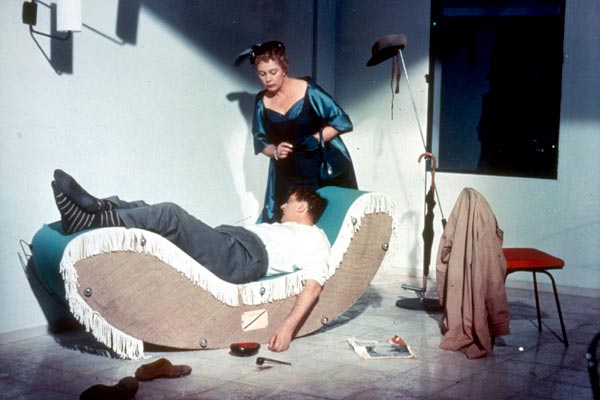
Suddenly, Last Summer (Joseph L. Mankiewicz, 1957) Tawdry gothic-noir that was so compromised by concessions to the moral powers-that-be that nobody associated with its production ended up liking it, not the original author of the play, Tennessee Williams, not his co-screenwriter Gore Vidal, nor the director Joe Mankiewicz.  Pity, as its an example of how Mankiewicz could juice up material directorially in a truly unsettling way when given the chance.  And he had a great cast in Katherine Hepburn, Montgomery Clift (even in the semi-drug-addled condition he was in), Elizabeth Taylor and Mercedes McCambridge.

What's missing is the person everyone talks about—the late Sebastian Venable, (poet and narcissist) who died (suddenly) last summer, ostensibly of a heart attack, as the whispers state, but has nothing to do with the truth, which is damaging enough that his doting mother Violet (Hepburn) will do anything to keep it secret, even if it means lobotomizing her niece Catherine Holt (Taylor) who witnessed his death and has blanked it from her memory. Mother Violet entreats the local psychiatric hospital and its brilliant lobotomist Dr. Cukrowicz (Clift) to see if Catherine is a suitable case for treatment, with the promise of a large endowment if she can be "cured."  "Cured" of the memory stuck in her head, and if not cured, silenced, whether institutionally or medically.


But what those memories are of that led to Sebastian's death "suddenly, last Summer" are only implied for the first 3/4 of the movie.  In the first couple of movements battle lines are drawn as Cukrowicz first gets Vi's version of things (as he investigates why she wants to donate so much money to his institute), then, once questions are raised, tries to coax it out of the mostly comatose Catherine without success.  The gist of it is that Catherine, at Sebastian's request, had replaced his mother as his travelling companion on his world-travelling jaunts from which he would produce his yearly published book of poems.  That Summer, in the town of Cabeza De Lobo, Sebastian died, leaving no book and no issue.


Except for Catherine.  The play's third scene is the explanation in the drawing room scene if this were a detective novel, where Catherine, under the influence of sodium pentathol reveals all (from her point of view), and Mankiewicz goes to directorial town (his point of view) in a weird silent flashback that threatens to crowd out Taylor from the frame, and that veers wildly from realism to German expressionism to surrealism within the course of its run, containing some of the most bizarre imagery just outside the horror realm (or Salvadore Dali's dream sequence from Spellbound).


To tell you what it all means ruins the ending, except that the movie itself doesn't come right out and say anything, owing to the tenor of the times (meaning you couldn't be) and to the so-called community standards that this particular era of film-making was challenging.  This was before ratings systems—G, PG-13, M, R, X and NC-17—but there was The Legion of Decency, over-run by the Catholic Church, that crossed itself, said five "Hail Mary's" and then banned your movie from being advertised.  You couldn't talk about homosexuality, procurement, prostitution, drug use, pedophilia, and cannibalism except in closeted code, and the "Truth Serum" sequence obfuscates with what's going on to the point of obtuseness.  Williams wasn't entirely guilt-free of this; he was just as capable of pulling the shade over a naked light-bulb or turning pleurosis into "blue roses"—he made an art of it.  But here, the mother-love perversity at the heart of so many of his plays runs on the hysterical side, and try as he might Mankiewicz can't make more of the empty book of poems than he can. All he can do is try and push Hepburn over the brink of sanity, after she's been doing wheelies near the edge the entire movie (Vivien Leigh nearly played the part; can you imagine?)

How far we have come since then—except, of course, for the cannibalism part (unless you were voted to the House of Representatives in 2010).

P.S. there's an excellent breakdown of the film, courtesy of The Last Drive-In, that did an excellent job of pulling screen-caps-two of which I cribbed above.

Liz Taylor glamour shot draped over the rail of an asylum


Saturday, February 26, 2011

My Favorite: Hitchcock

A recent Facebook Note request asked me to pick my fifteen favorite films.   The usual "Anytime movies" were there, and a few others that have crossed my path since starting LNTAM.  But as with any list, what was most fascinating to me was...the ones that were missing.  I've noticed this before when I did the "Anytime Movie" series; there were so many things not there—it's always the frustration I feel when making lists (and thus, why I refrain from doing them).  This led me to considering the film-artists who did not make the cut, and highlighting those films that have had such an impact on me—that I've fallen in love with, that have stayed with me, burrowing into my brain, and eliciting thoughts and emotions unique to those films.  The observations are purely personal (aren't they all?), and why I call this new series of neglected films "My Favorites."

Due to the nature of this particular movie, this article will contain SPOILERS that will actually destroy your enjoyment of the first-time viewing experience.  If you haven't seen Vertigo (and, really... what is keeping you?), you should not proceed further.  And to paraphrase Hitchcock's favorite tease: "No one will be seated after the article has begun." This is your last warning.


"What Is This Thing Called Love" asks the old song (a favorite of mine).  And I especially love the inclusion of the word "thing" to describe it.  What IS Love?  Why is it so powerful?  Why is it an obsession for film-makers, and their audiences, ...and for that matter, the scribes of centuries past...to the point where when we think about Love, it's the kind "like in the movies," (which should set off alarm bells to anyone doubting film's veracity—ever seen an accurate movie on a true story you love?).  And Love in the movies is all-good, an all-consuming passion, "the bestest thing in the world," that makes us better people (better-looking, too), sweetens our coffee, shines our shoes, puts a spring in our step, and makes us orgasm simultaneously, while the metaphorical ocean-waves crash over us.  Orchestral swell and fade to black (before the complications happen).

'Kay...  But it's become SUCH a movie-cliché (and aren't cliché's supposed to be such because they're true?) that movie-makers now "cut to the chase"...almost literally.  In the weaker efforts, people in movies fall in love willy-nilly, without doubt, without resistance, and without staring at the phone for hours at a time—wondering "why aren't they calling?"  It is effortless love, like falling off a love-log, with no pain, no pangs, no problems. 

As Randy Newman (or Joe Cocker) warbles "They don't know what love is."

I like movies that question love.  I like movies that question anything, but questioning love makes me sit up and take notice...which happens rarely.  I generally just slump in my movie-seat, ticking off the "meet-cute," the "song-montage," "the-rough-road," and the "happily-ever-after," so rare is the occurrence.

Alfred Hitchcock made movies in an era where cinematic love was that kind of easy, but he usually liked to sprinkle some salt in with the sugar.  There was no easy path for love in his films, in fact he liked to set up complications for the lovers to overcome—be they heterosexual or homosexual—and his least "typical" film, Mr. & Mrs. Smith, is all about a married couple divorcing and trying to find the path back together, as much as they don't want to.
So, here's Vertigo, which is as pure a love story as Hitchcock ever made despite its deceptively fantastical thriller plot, and it finds the director adapting a novel by the authors of Diabolique (which Hitchcock wanted to film), who might have been writing it precisely for this director, so emblematic of his work are their themes.  Hitchcock took a story of a man hampered with weakness (in this case, acrophobia, fear of heights and thus, fear of falling), and combined it with his own penchant for re-shaping actresses in his own singular fetishistic way to make one of the most personal films.  He'd hoped to lure his favorite actress, Grace Kelly back from Monaco to star in it, but she was dedicated to her fairy-tale marriage to a handsome prince, and declined.  Hitchcock never liked fairy-tales, but this is as close as his sensibilities would go.  But, it is more than that.  It is a mystery.  It is a thriller.  It is a psychological study.  It is a ghost story.  But, most of all, it is a love story...with a bottomless void at its heart.


The first shot of the story—a straight line bi-sects the screen...

A hand comes up in mid-frame and breaks that line—a man climbs a ladder.


Vertigo-proper—aside from the hallucinogenic Title sequence—begins with an undefined image; a murky sky bisected horizontally by a line.  In the first movement of the shot, a hand comes up and grabs it; it is the rung of a ladder, the hand belonging to a criminal making an escape from the police and the protagonist, police detective "Scottie" Ferguson (James Stewart).  A straight-lined pursuit across roof-tops is only temporarily interrupted by the chase-participants' leap across a void—over an open alley-way between buildings.  Everybody makes it with some difficulty, except Scottie.


He is caught suspended, on the brink of a bending gutter on a crumbling cornice, and we experience what he experiences—a change of perception.  It is "the vertigo shot"—an ingenious combination of optics and camera movement, that bends the image creating a telescoping tunnel-image.  Foreground and background separate and stretch, taking a rudimentary shot down, and making it collapse downward—a suspended fall that increases the distance between Scottie and his death.  The shot represents fear and the character's frailty, vertigo, in which heights cause a disorienting dizziness.  Scottie watches in horror as a police officer, who offers a helping hand, loses his footing and falls to his death. 

The sequence ends with Scottie, still hanging, the situation unresolved.  We never see how he gets out of it.

It is some time later, and Scottie's vertigo has forced his retirement from the San Francisco police force.  Out of friendship, curiosity, and a detectives love of a mystery, he takes on a freelance job for an old school chum he's lost track of, Gavin Elster (Tom Helmore). Elster thinks his wife Madeleine (Kim Novak) is going insane; she's become obsessed, maybe even possessed, by an ancestor, Carlotta Valdez, who committed suicide.  The job is simple: follow the wife, find out what he can and report back to Elster.  One look at Madeleine is all Scottie needs.  He follows her obsessive path seeking Carlotta, and follows her, and follows her...


...seemingly to the ends of the Earth, or, in this case, Golden Gate Park.  he is horrified to find Elster's worst fears confirmed: Madeleine jumps into the bay.


Scottie plunges in to save her, and like so much of his path in Vertigo, it's a straight line right to his heart, as his occupational obsession turns into identification and romantic obsession—the curse of so many movie detectives.  He falls in love with Madeleine.  Falls...in love.  And along the way, the straight lines and lateral paths that Scottie travels then become supplanted by something else throughout his investigation—a spiral.


We see that emblematic glyph within the very first moments of the movie (and Bernard Herrmann's cyclical music suggests it, as well), but it shows up throughout the movie in many forms.  Here are some of them:


Madeleine's hair ends in a spiral...
...inspired as it is by the dead Carlotta Valdez's portrait.
The embrace of Scottie and Madeleine suggests a spiral
And, of course, Hitchcock's "vertigo" shot in the steeple is a spiral.


What is a spiral?  A spinning form, its spinnakers flowing out from implied centrifugal force, but at its center...is nothing.  A void...a negative space usually placed by Hitchcock near the center of the screen, unavoidable to the eye.  And as the love between Scottie and Madeleine deepens, their embraces take on a spiral of their own, Hitchcock placing them in the center of the screen, linking the vertiginous "falling" and the lovers' dance.

(This is your last chance to leave before a major spoiler)

It all comes to naught, though.  Madeleine breaks their embrace and, compelled, runs up a Mission tower, which Scottie, in his acrophobia cannot climb.  He watches, horrified, as his love plunges to her death—a reflection of his own horror made real.  He could not stop it, and his life consists of a void.  He's walking down the avenues of grief and depression, at the corners of lust and need, and so much of his self-worth is wrapped up in it, the strong man he wants to be, the weakling he despairs over.  As Carlotta haunted Madeleine, her death haunts him. 

Scottie's nightmares after the death of Madeleine are of such voids...that he could fall into.


He is plunged into a crippling depression, institutionalized, broken.  We can "gussy" it up with hearts and flowers, but Love is chemistry, not the the man/woman variety (and its variations), but specifically, brain chemistry.  Anyone who's had depression or other mental schism, like impulse control or attention deficit disorder, knows that it boils down to chemicals—something's deficient in the attic, some missing ingredient that needs to be augmented.  Our brains are sparking stews of meat and chemicals, serotonin, hormones, pheremones, endorphins, testosterones and oxytocins.  Love lights them up, decreasing and increasing with attraction, pursuit and mating.

So, is Love a mental illness?  Like Scottie's fear?  His depression?  His vertigo?  Is his fear of falling tied to his fear of falling...in love?

Released from the sanitarium, Scottie sees a woman one day, Judy Barton (played, as with Madeleine, by Kim Novak).  He is compelled to pursue her, seeking his lost love.  But, what he does not know, what Judy never wants him to know, is that Judy was Madeleine, duped by Gavin Elster as an accomplice to murder his real wife.  Her love for Scottie is real, so, against her better judgement, she allows Scottie to re-make her—once again—in the image of Madeleine, the clothes, the hair, the make-up (as Hitchcock cast his actresses and made them coiffed blondes in tight grey suits).  Only when the transformation is complete, and Scottie and Judy embrace, does the camera begin to spin around them, creating its own spiral, this time the background changing between the hotel room and the site—a horse-barn—where the earlier love-scene happened.  For Scottie the illusion is complete.  He has found his lost love.

Or, has he?  The fascinating thing about Vertigo to me, aside from the association of Love to mental illness—is that Scottie's love is very real, but attached to, essentially, nothing.  Judy was Madeleine—a role she played for Gavin Elster.  Madeleine, vulnerable, suicidal, in need of rescuing, never existed.  Scottie is in love with an illusion, a figment, a zephyr.  He can re-capture—cruelly to Judy—the love.  But, Judy can never completely be Madeleine to him (despite that she actually is).  He is in love with an idea, a dream of perfection, that actually never existed—a ghost.

This is why I love Vertigo—it is a love story that questions the very nature of what love is, rather than just accepts it.  If you can love an illusion...what is this thing called love?

Whatever it is, Fate steps in.  Scottie is forced, and forces Judy, to relive the fateful steps up the Mission steeple, a move that cures him of his vertigo.  But does it cure his love, as well?  Scottie becomes truly unhinged in this scene, cruelly forcing Judy up the stairs and it is the apex of Stewart's acting career, challenging the beloved image of the "aw shucks" mid-westerner that marked so much of his interesting work in the 1950's.  At the end, we, and Scottie have come full-circle.  He is left on the edge, vertigo cured, but the situation, like his hanging from the gutter at the beginning of the film, is editorially unresolved.  He is left, his arms, like his image in the falling silhouette in his nightmare, slightly apart from his body, not reaching per se, but only slightly outstretched.

And empty.

What is this "thing" called love?  Is it part and parcel of the stew that makes up Scottie's mind, the confluent forces of worth and doubt, hope and despair, pleasure and pain, lust and heart-ache?  Is it part of the depression he feels, or the cause?  What is love, really?

We don't know.  We cannot know.  But the question is raised.  And, like the character of Scottie, we are left—every one of us—on the brink.

Again. And again.


Saturday, February 13, 2010

Thunder Road

"Thunder Road" (Arthur Ripley, 1958) A B-movie curiosity that has gained cult status, especially in the southeast corner of the U.S., usually neglected by Hollywood. Although beloved by its corps of loyalists (there are "Thunder Road" fests every year), most folks only know it from writer-producer-composer-star Robert Mitchum's driving recording of the film's theme song. He co-wrote that song, as well as it's love ballad "The Whipoorwill," sung in the film by Keely Smith, the exotic—if dead-pan—wife-chanteuse of the Louis Prima Band.

The film, based on Mitchum's story-idea,
concerns an ex-con Luke Doolin (Mitchum), who drives a souped-up Ford delivering moonshine hootch throughout Kentucky and Tennessee. The story has Luke as the hub of several tugs-of-war: there's the struggle between the still-men and the Treasury boys (represented by Gene Barry); a territorial tussle between the loose association of mountain-folk and the smuggling kingpin (Jacques Aubuchon) who wants control of their routes, by any way possible; then, he's caught between two girls after his affections—singer Francie Wymore (Smith), who wants him to settle and stop rum-running, and the girl who looks up to him (Sandra Knight), whether he's running or not. She's probably more suited to Luke's younger brother Robin (played by Mitchum's son, Jim—when Col. Tom Parker wanted too much money for Elvis Presley to play the part), who wants to be a part of the family business.

The film's directed by Arthur Ripley a B-movie veteran who'd started doing television work, but whose lasting legacy is as one of the industry stalwarts who established the UCLA film school. The film looks much older than it is, as it employs filming techniques that emphasized economy over spectacle, or even consistency, as in one scene where Gene Barry's monologue starts on location and ends up in a studio.

But dang! Some of the racing scenes are amazing, especially in some of the daylight scenes where it's readily apparent no camera tricks were used to speed things up—those hulking roadsters are really go that fast.

Mitchum is great in it—he rarely stepped out of his personal cruise control when acting, employing the same effective techniques as he had since "
The Story of G.I. Joe," but he stands out like a professional thumb in this film. Keely Smith has a startling look, but her acting ill-becomes her, as she's at her best at stillness—the more lines you give her, the worse she is. Barry is terrific in his "Just the Facts, Ma'am" mode, and Peter Breck and Mitchell Ryan are around to off-set some of the halting, amateurish acting of some of the cast.

"
Thunder Road" is beloved as a cult film, but it's one of those films where love is blind and looks past the faults. One of those "not a great movie, but it's 'our' movie" movies.

Is the song in it? Yup. But it's sung as a ballad with just an acoustic guitar accompaniment, like it was being trilled on the porch, a part of memory and maybe of legend.


Wednesday, August 19, 2009

The Last Hurrah

"The Last Hurrah" (John Ford, 1958) It seems unlikely that two of the most prominent Irishmen in Hollywood—John Ford and Spencer Tracy—would make only two movie together.* Whatever the reasons (and Hollywood legend claims that this one nearly didn't happen**), the two drinking buddies seemed to spark great work from each other.

Frank Skeffington, former governor and current mayor of "an unnamed New England town," has decided to run for Mayor for an unprecedented fifth term.
Ably supported by his mostly Irish Mafia (although other burrough leaders are alluded to, the only one who has any speaking lines is Ricardo Cortez*** playing a Jewish bureau chief), and shunned and reviled by a WASP chamber of commerce (portrayed by veteran actors Basil Rathbone and John Carradine as cantankerous dried-up husks), Skeffington finagles and blarneys his way through getting his way (resorting to blackmail every once in awhile). But Skeffington isn't so full of hubris that he thinks he can go on forever. This campaign, he's decided, is his "last hurrah," and he wants his nephew, newsie Adam Caulfield (Jeffrey Hunter) to get a taste of the "old-style politics" of the glad-hand and the smoked film room before radio and television do away with the personal touch—a prescient idea if ever there was one!

Pointedly, veteran Jane Darwell has more zeal than youngster Jeffrey Hunter

The film ingeniously shows the passing of an era with its scenes of vibrant oldsters and shallow youth and of the personal touch versus the cathode ray tube (Ford has a grand time lampooning staged political broadcasts that are only slightly clumsier than the spit-polished productions of today, a neat summing up of '50's TV usage in politics—everything from Kennedy's carefully cherry-picked history to Nixon's "Checkers" speech). For Ford, approaching his twilight years, emboldened by the fearlessness of age and determined to speak truth, it seemed like a good bet to take on politics and the changing landscape that media played in that change. "The Last Hurrah," directed and produced by Ford, seemed a bit of a return to the old Ford films starring Will Rogers and the film is stacked, overstuffed, with character actors of Hollywood's past parading before the camera—specifically Ford's Hollywood past. Pat O'Brien, Donald Crisp, James Gleason, Jane Darwell, Anna Lee, John Carradine, Wallace Ford, Frank McHugh—all veterans of past Ford films—cast adrift by the failing studio system that kept them employed, in an era of the independent production company. It is not insignificant that a good deal of the film takes place at a boisterous wake.
"The Parade's Gone By" — Skeffington's walk home

Much is made of the long shot of Skeffington's walk home through the park after his election defeat, while in the background a loud celebratory parade for the opposition marches down the street in the other direction, it's klieg lights brashly blasting the camera on occasion. No one could miss that message. But more significant—and more indicative of the kind of deep visual poetry that Ford brought to the screen—is the carefully composed last shot of Skeffington's leaderless contingent, shadows of men, marching up the stairs to pay their respects, but, just as surely, following their leader heavenward.


* Those being "Up the River" (1930), which also featured Humphrey Bogart—I can't imagine Ford and Bogart getting along— and "The Last Hurrah" 28 years later. The two men were under contracts with competing studios until independents in the '50's made their second collaboration possible.

** Orson Welles claimed that John Ford talked to him about playing Skeffington (Welles and Ford were an intense mutual admiration society—their first fires across each others' bows is a story that will wait for another time), but while Welles was out of the country, his agent turned the offer down.

*** Ricardo Cortez played the original Sam Spade in 1931's version of "The Maltese Falcon." In fact, "The Last Hurrah" could be seen as a lot of last hurrah's for many veterans of Hollywood movies. This cast is so top-heavy with so many scene-stealing character actors you'd think you were watching a Frank Capra movie!


The boisterous wake scene for an unloved fellow—all the burroughs are heard from.
Ford might be talking about Hollywood's efficient (but artist-reviled) studio system.

Friday, August 7, 2009

Mon Oncle

"Mon Oncle" (Jacques Tati, 1958) French comedy (the director's first in color) that won the Oscar for Best Foreign Film that year. Tati had been making comedy films for 20 years by this time, and he was startling to settle his silent anarchic character Mr. Hulot as something of a stick-in-the-mud in the French landscape, preferring the noisy, quaint ramshackle of city life to the encroachment of pre-fab, angular concrete and steel slab-homes.

You know whose side he's on immediately with the first three shots as the first two pan down from a construction crane to reveal the contractors (only in a neat wrinkle they're the film's credits,
with the title scrawled like graffiti on a stone wall in an alleyway that becomes the early morning run for a pack of dogs who pee on everything in sight and raid the garbage receptacles for food. Immediately the messy brick and mortar of old France is linked to the natural and everything just beyond its broken metal fence is restrictive, mechanical, and regimented. The "yard" is landscaped sand and pebbles, with paver stones as path-ways although what they're protecting other than orderliness is hard to fathom.

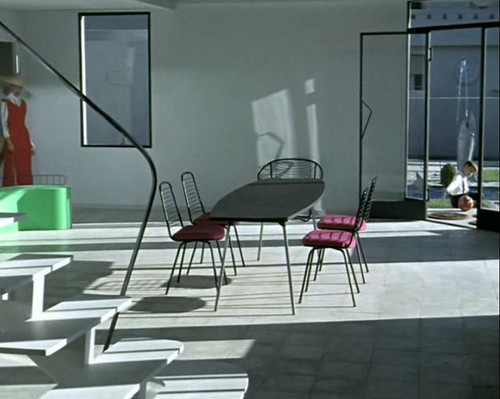
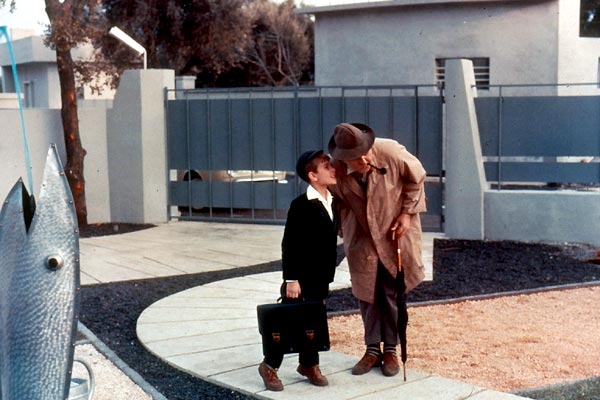
The house itself, the main set of the film, is a square monstrosity with bug-eyed windows on the second floor, which will be used to hilarious effect later in the film. And the interior is spartan with uncomfortable metal furniture that appears never to have been sat on. The kitchen has every sort of gadget you could imagine and some for comedy of the automated variety. It is here that Hulot's sister lives with her family, her husband working in "coal derivatives" (though the company's main function seems to be the manufacture of plastic hoses) and her son chaffing against the sterile environment.

He'd much rather be with his Uncle (
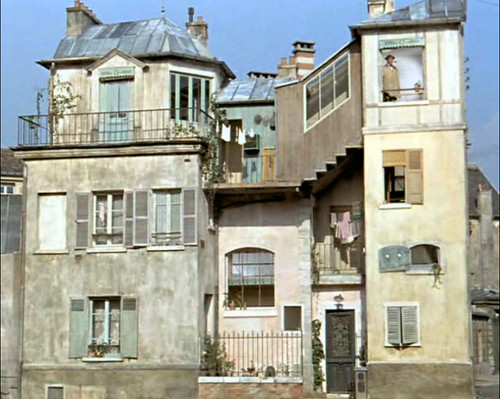
Tati), who by contrast lives in a rooftop apartment from which he can watch the city. To get there, he must make his way through a most circuitous 3-dimensional maze of stairs and hallways before reaching his front door. The life he lives is unorganized without the benefit of car or clock and the open neighborly village life suits him, rather than living behind the locked gates (remote controlled, naturally) of her sister's domicile.

By this time in his career, Tati could milk comedy out of every situation embracing chaos in a clickety-clack, buttoned-up synthetic world. "Mon Oncle," with its narrow focus has all the cover-the-comedic-bases charms of Chaplin, but especially the mechanical engineering of Keaton, while maintaining it all in a limited space. And with each film, Tati was becoming more adept at integrating sound into a silent world (Hulot is always silent but still manages to get his point across to the chattering populace anyway). The plastic offices have a perpetual hum, the factory is hermetically sealed by hydraulic doors and every gadget and goo-gah has its own personality and rhythm. Hulot's neighborhood is an uneven sprawl of city-sounds, dogs barking and kids playing. Tati is starting to become a welcome habit with me as he recalls the delights of the silent stars, but also the most disciplined of the "Looney Tunes" sensibility (Isn't that ironic?)

Saturday, April 25, 2009

Big Deal on Madonna Street

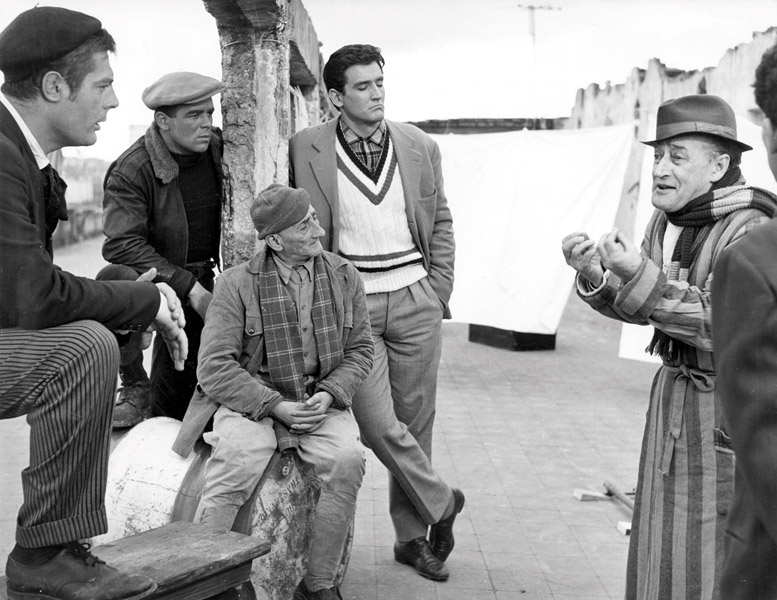
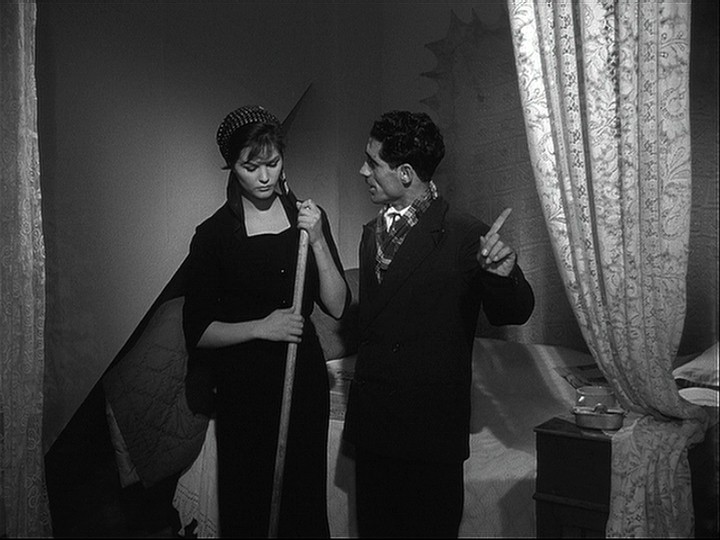
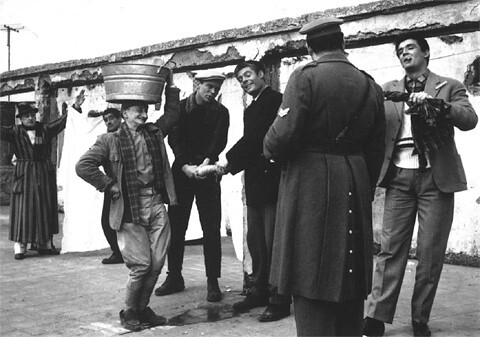
"Big Deal on Madonna Street" aka "I Solti Ignotti" (Mario Monicelli, 1958) Italian caper film that's as much a spoof of caper films as it is the real deal. Neighborhood heisters team up to break in to a pawn-shop and the usual complications ensue between clashes of ego's, incompetence, prison stints by proxy, art-film reconnaissance of the target and the very real treasure of a virgin's love.

"Big Deal on Madonna Street" (the "big deal" is meant to be sarcastic, as in "Big Deal, you know how to operate a camera!") is filled with established and future stars of the Italian cinema (Totò, Marcello Mastroianni, Renato Salvatore, Vittorio Gassman, Claudia Cardinale, many of whom became stars because of this film) and is done in the neo-realist style of post-war Italian classics as "The Bicycle Thief" (a style that is spoofed in the course of the film, as well). Coming as it did, following the sensation that "Rififi" generated, resuscitating the career of Jules Dassin (Dassin made his own caper spoof "Topkapi" six years later). Like links in an elaborate knock-over plot, films influence films and keep the genre going to such contemporary examples as "Mission: Impossible," "Reservoir Dogs," and Steven Soderbergh's "Ocean" movies.

Tuesday, June 10, 2008

Eyes Without a Face

"Eyes Without a Face" aka "Les Yeux Sans Visage"* (Georges Franju, 1959) Bizarre French horreur film about a mad surgeon who, after disfiguring his daughter in an auto accident, resorts to radical plastic surgery, killing attractive women and surgically removing their faces and reattaching them to his daughter's.

There's a funny story of how Franju got the job. Impressed with the revenues being generated by Hammer Studios' roster of horror films, producer Jules Borkon decided that there should be a french equivalent. He hired film scholar Franju to make it "but not too much blood, or the French censors will get upset." Fine. "And no torturing of animals, it'll upset the British." Sure. "And no mad scientists--the Germans are a bit sensitive to that." Right.

So here's the story: a mad scientist who tortures animals and cuts off women's faces. Yeesh. Good luck with them censors.

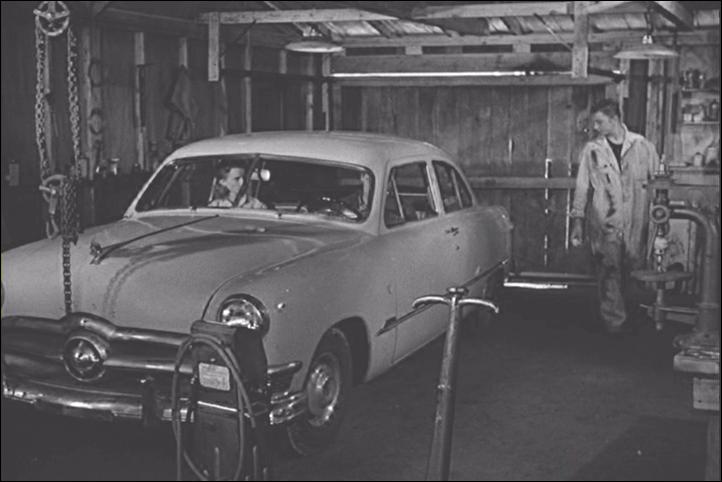
The script couldn't have a better team of writers--Pierre Boileau and Thomas Nacejac, the authors of "Diabolique," and the book Hitchcock adapted "Vertigo" from--and Franju milks the suspense while keeping you on tenderhooks about actually seeing "the operations" (of course, you do). He also casts Alida Valli, the "find" of David O. Selznick who figures prominently in Hitchcock films, and "The Third Man," and here, her cool lack of expression is used to creepy advantage. Also there's a brilliant stroke casting Edith Scob as the daughter, even though she wears a mask through the majority of the film, the expressiveness of her eyes, and her balletic body-language creates a memorable character.

And Franju, with his minimalist sets and clinical eye, keeps you watching no matter how horrific the image gets, because he manages to create just as much lyricism as he does ugliness. You have to go back to the hey-day of Universal's monster movies and the films of Tod Browning and James Whale to find something similar. Along with "La Belle et la bête" and "Les Diabolique," "Eyes Without a Face" are at the top of the list when looking for creepy French films.

* Originally released in the U.S. as "The Horror Chamber of Dr. Faustus" (1962)

Sunday, February 3, 2008

The Hound of the Baskervilles (1958)

"The Hound of the Baskervilles" (Terence Fisher, 1958) I'll go see any Sherlock Holmes story (as long as it's not a spoof), not so much because the story's are compelling--they're fascinating for the glimpse of salaciousness in Victorian England, but the story-template is rarely altered--but because the portrayal of Holmes is an actor's showcase. Holmes by Doyle is something of a blank slate, so an actor can infuse him with whatever qualities they choose to emphasize: Basil Rathbone, the heroic; Jeremy Brett, the neurotic; and on down the line to the worst--Stewart Granger who was content to make Holmes merely British (we won't get into Hugh Laurie as "House"). So, it's interesting to see the Hammer Studios' "take" on Holmes. Hammer was the British equivalent of Roger Corman's AIP, but with a distinct advantage. They also purloined classics in the public domain, but they had Terence Fisher, with his flawless eye of direction (and cleavage) and a repertory cast that included Peter Cushing and Christopher Lee. Here Cushing plays Holmes and he's obviously devoured the Doyle stories for Holmes quirks, stabbing documents into his mantelshelf and writing notes on his cuffs. His Holmes is energetic and flinty, bordering on rude with a relish of the melodramatic. His skull-like face even recalls Sidney Paget's original drawings. Until Brett came along, Cushing, to this Baker Street Irregular, was the best of the Holmes portrayals. Christopher Lee plays the put-upon Henry Baskerville, and as the actor is quick to point out in a "Special Features" interview, it's one of a handful of romantic leads that he's played in his long, long career. What makes this "Baskervilles" different from the countless others? Holmes is absent for less time, a lurid flash-back acquaints us with the origins of the Baskerville curse, there is a romance (of sorts) and the death by quicksand is given to someone entirely different. It is, though, faithful in spirit, if not in detail.