Showing posts with label L. Show all posts

Thursday, October 17, 2013

Lady-Killer (1933)

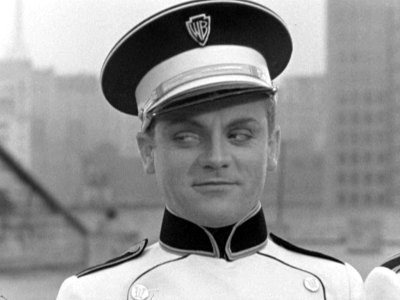
Lady-Killer (Roy Del Ruth, 1933) Light-hearted gangster picture in the same manner as the Humphrey Bogart All Through the Night.  Cagney plays Dan Quigley, an entrepreneur of sorts, who when we first see him is "in the picture business"—he's an usher in a Big Apple movie theater, in trouble for disappearing and running crap games on the side. He gets fired for telling a patron what she can do with her toy poodle, and out on the street, notices a dame (Mae Clarke) losing her billfold.  Nice guy Dan follows her to her apartment, returns it and finds a nickle-ante poker game in the back.  He helps himself, gets cleaned out and on his way out the hall, runs into a rube...returning another billfold.  It's a racket, but rather than getting sore, Dan laughs it off, and uses it to parlay himself in on the deal.

Before long, he and the girl, Myra, and the four poker grifters are running a crooked speak-easy, the 7-11 Club, while also doing some knockovers of ritzy swells from the casino on the side.  Dan stages traffic accidents outside the manses, gets himself taken inside to case the joint, then gets taken out on a stretcher and the other four do the same for the loot.  But, during one of the capers a maid gets her skull caved in and eventually (as they say in the movie) "croaks." The Club gets raided on the word of a stoolie and soon the whole bunch is on the lam.


Quigley and Myra high-tail it to L.A., only to have Dan picked up on suspicion by the LAPD, and when he calls Myra to cough up his bail, she's skipped, along with gang-leader Spade Maddock (Douglass Dumbrille).  With nothing to hold him on, the cops release Quigley and eventually he finds work as an extra in the movie business, at which point, life starts to get good, especially with frequent co-star Lois Underwood (Margaret Lindsay), until his old partners start making trouble for him.


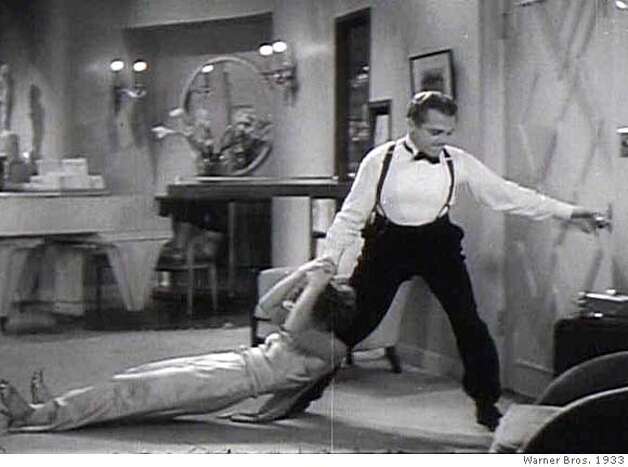
Very fanciful, but Cagney is lighter on his feet here than he is playing his "heavies," in fact, this movie is full of wise-acre slang and a lot of good laugh-lines, most of them coming from Cagney's Quigley, who laughs at every joke. He's a good-time charlie, not meaning any harm, but not wanting to do too much good, either.  And Cagney's paired with his co-star from The Public Enemy, Mae Clarke, who gets more than a grapefruit pushed in her face here. At one point, Cagney alarmingly grabs her by her hair and drags her out of his room and throws her bodily into the hallway.  The makers also have a lot of fun at Hollywood's expense, sending up the movie business and the extravagant lifestyle.  It's almost a romp for Cagney, only a couple years removed from The Public Enemy, and goes some way—but not too much—in rehabilitating his public image.  Still a tough guy, but not pure evil, either.


Thursday, October 10, 2013

The Last of Mrs. Cheyney (1937)

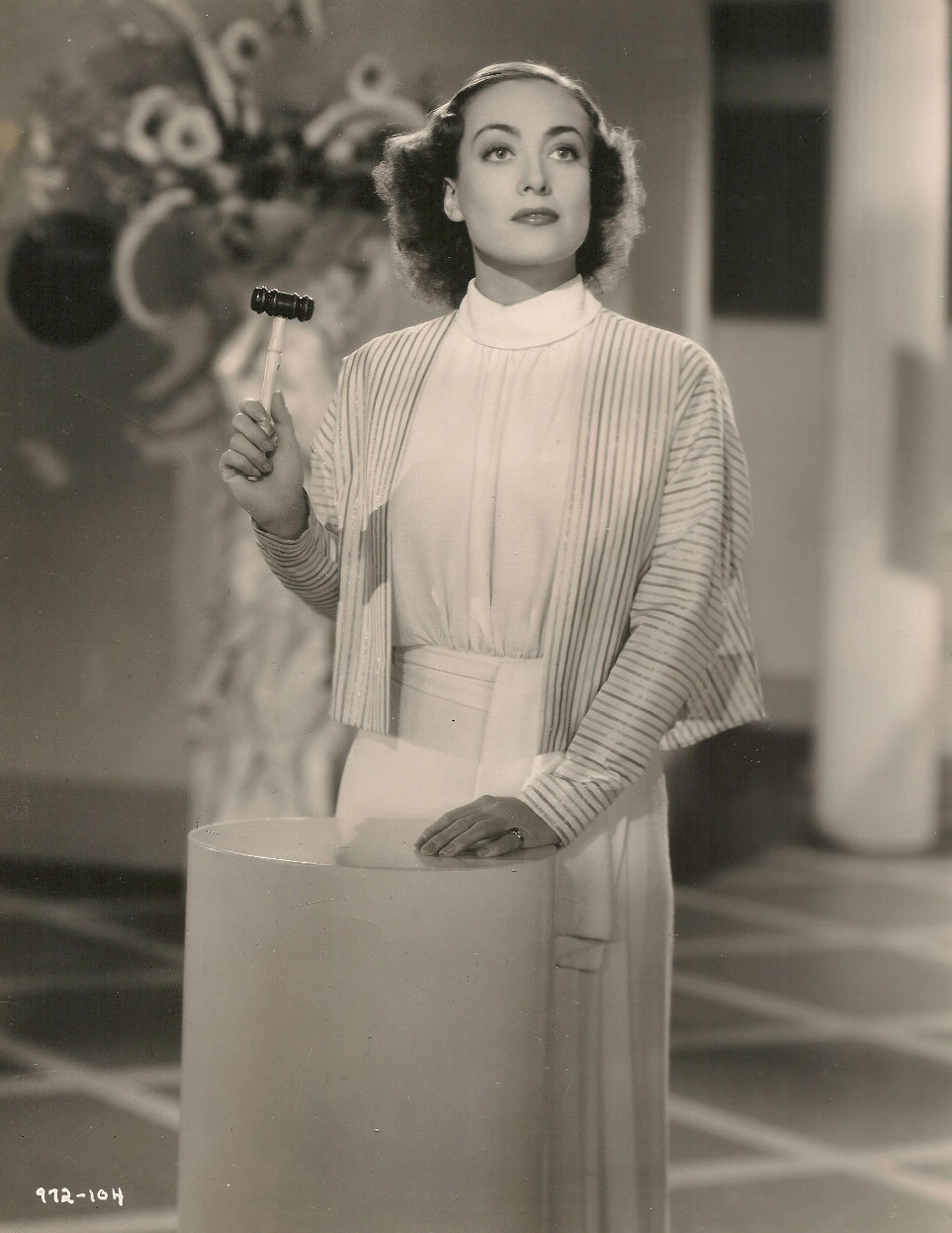
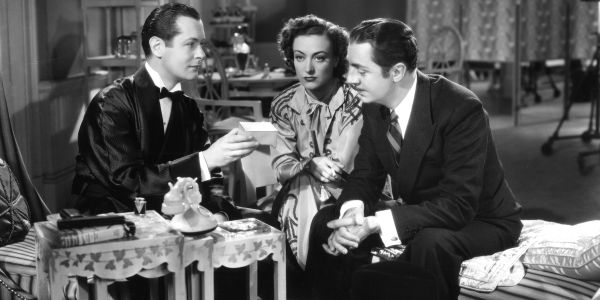
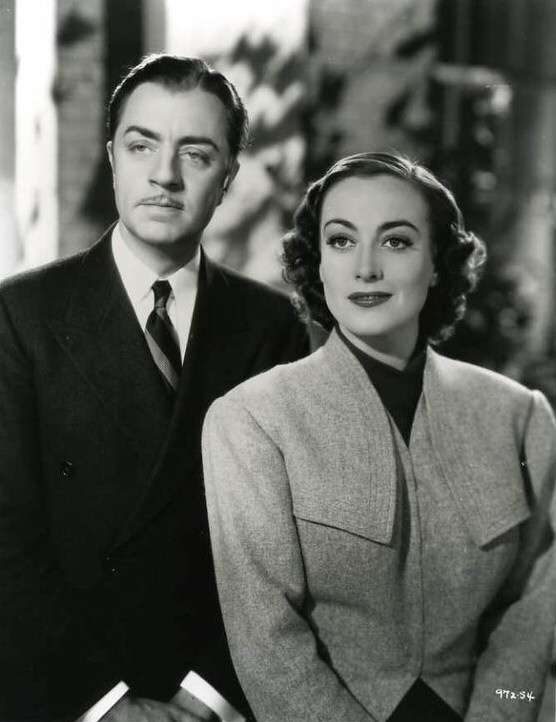
The Last of Mrs. Cheyney (Richard Boleslawksi and Dorothy Arzner, 1937) Remake of the 1928 stage adaptation with Norma Shearer and Basil Rathbone, this one has a little bit more of the star-wattage of M-G-M behind it with Joan Crawford (rarely better) as well as William Powell, Robert Montgomery, Frank Morgan, Nigel Bruce and Jessie Ralph. 

The movie starts stodgily with Montgomery's Lord Arthur Dilling meeting and becoming entranced with widower Mrs. Fay Cheyney (Crawford) on a transatlantic sail.  He's intrigued that she takes a fancy to the equally rich, more elderly (and more susceptible) Lord Francis Kelton (Morgan), and keeps an eye on her when they disembark, for though he's smitten, he's curious to see if she might be a gold-digger.

She's not.  She's an international jewel-thief in cahoots with Charles (William Powell), the man posing as her butler.  

It's hard to pin-point, but around the time the cast all gets together at the estate of Lady Embley (Ralph) after a charity event, the tone suddenly lightens and everybody, especially Montgomery, get several notches better. Now, at some point, the original assigned director Richard Boleslawski died of a heart attack, to be replaced by Hollywood's only working female director at the time, Dorothy Arzner, and while one is hesitant to say this is entirely due to a change in directors, it is unarguable that the film starts to take off, whereas before it has a strained and stuffy feeling to it.  Maybe, it's the presence of Powell—though it's doubtful because Crawford starts to light up, too—maybe because the entire cast is pinging off each other, there's more cross-talk between them and more energy zapping between each and every player.  Maybe it's the script because the last half is where the change-up's, turn-around's and surprises in character and situations are clustered, a perfect case of the tail wagging the dog (without a chase, explosion or clinch to be seen).  But it makes one want to check out Dorothy Arzner, the lone woman in the field (besides Leni Riefenstahl) to be making films at the time.  Not to be sexist or anything, but it does make a difference.  

Saturday, July 20, 2013

The Loved One

The Loved One (Tony Richardson, 1965)  Director Tony Richardson "does" Hollywood, and it ain't pretty.  There are lots of Tinsel Town screeds out there, mostly about personal mania (Sunset Boulevard, What Makes Sammy Run?), but few—like Day of the Locust—where the craziness seems endemic to the region and its excesses.  The Loved One has an air of pretense with sanctimonious chortling while it shoots its fish in a barrel, casting the film with "types"—Liberace as a coffin salesman, Milton Berle as a crass businessman—that might be a little too leaden in its intent.

Flush from his success with the multi-Oscar-winning Tom Jones, after toiling away over the British "kitchen-sink" industry, Richardson returned to black and white cinematography (by Haskell Wexler) in an adaptation of Evelyn Waugh's novel adapted by Terry Southern and Christopher Isherwood.  Waugh's book was inspired by a disappointing trip to Hollywood on the pretense of making a film of "Brideshead Revisited," and his twining of the film industry with the funeral business has a natural feel to it, as both have a lot to do with presentation, and the construction of artifice, all in the name of comfort (while robbing them blind).  


But that was in the 40's.  The film was made in the early 60's on the cusp of "mod" and in the nuclear shadow of Dr. Strangelove.  Both films have that Southern exposure in common, but where Kubrick made his film with a gargoylishly straight face, Richardson can't help gilding the mourning lily.


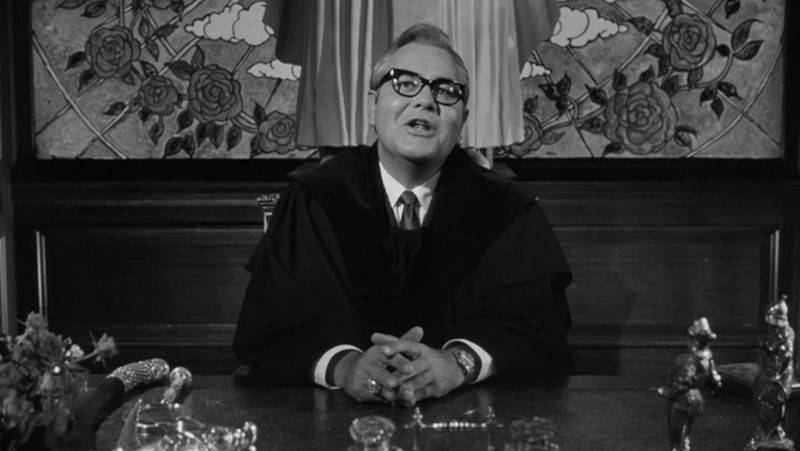
Poet Dennis Barlow (Robert Morse, post-dubbed with a wavering British accent) wins a literary competition, the first prize being a trip to Hollywood, where he stays with his uncle, Sir Francis Hinsley (John Gielgud) who works at a film studio.  Hinsley is soon fired by the studio's boss DJ, jr. (Roddy McDowell) and commits suicide.  The British community (led by Robert Morley) insists that Hinsley's funeral be as grand as possible, bankrupting the old man's estate, and forcing Barlow to stay in Hollywood and taking a job at a pet cemetery run by Henry Glenworthy (Jonathan Winters), whose brother, the Reverend Wilbur Glenworthy (also Jonathan Winters) runs the Whispering Glades cemetery and mortuary, the establishment handling Hinsley's solemnities.  There, Barlow meets Aimee Thanatogenous (Anjanette Comer), a corpse beautician and Mr. Joyboy (Rod Steiger), the Whispering Glades embalmer, who competes with Barlow for her affections.  


There is a lot of brilliant stuff here: a sequence at another chapel has a wedding (ministered by Ed—the original "You're in good hands with Allstate" Reimers) that is run like a television production, so that everyone can be ushered out, and a funeral ushered in; the "keeping up appearances" haranguing of the British enclave in Hollywood; Jonathan Winters, not really given free rein to his inner demons in the roles, but showing how he might have been our Peter sellers; and (okay) Liberace as a coffin salesman, there's something utterly apropos about that; a visit to Ms. Thanatagenous' under-construction cliff-house that is constantly rumbling with the threat of sliding to the highway below (a nice visual representation of her fragile doe-eyed innocence); Lionel Stander as newspaper advice columnist Guru Brahmin—a study in contrasts; the creepily loving reverence of the Whispering Glades workers for "the loved ones," as opposed to how the stiff pets at the pet cemetery are tossed into a freezer.


It's all very ghoulish and naughty (even flirting with pornography towards the end, discretely edited by Hal Ashby) but something of a misfire in its presentation.  Morse is energetic and fun (and he has the teeth to play British), but in the same way The Wrong Box has the timing wrong to evoke humor, The Loved One never quite convinces you that you're supposed to be laughing, even guiltily.  Instead, it has the air of stuffy indignation even as it's trying to regale.  And one can sympathize with the sentiments, but one wishes it was done better, less fire and more mockery.  What's the quote? "There's nothing I like less than bad arguments for a view I hold dear."


Thursday, July 11, 2013

Disney's The Lone Ranger

...A Cloud of Dust...
or
Depp in the Heart of Texas

The last time "The Lone Ranger" hit the big screen (1981's The Legend of the Lone Ranger, directed by cinematographer William A Fraker), it hit with a resounding thud.  It's not that the story wasn't any good, or that the basic idea isn't ripe for story-telling—it's just that the movie was dull, dull, dull, even as it was trying to be more "politically correct," giving John Reid's "Indian companion," Tonto, a bit more respect and hewing a little closer to a generically Native culture.

That was then.  This is now.  John Ford made the first modern Western in Stagecoach.  Sergio Leone and Sam Peckinpah made the "post-modern" Western in the 60's.  Then, after post-modernism came death.  People stopped making Westerns entirely, with hold-outs like Eastwood and Costner and Kasdan and Harris, the tropes of the genre falling into use in, cop movies and martial arts and space fantasy films.  But the form stayed pretty much dead and buried.  Given the history of the form, and with its emphasis on the spirit world, resurrection of dead men, and its manic quality (especially as its de rigeur for the creatures these days) maybe Gore Verbinski's film of The Lone Ranger (now Disney's) is the first zombie Western.

It fits.*  One of the themes galloping through this one is that "nature is out of balance," what with the "Wild" West being invaded by iron horses, the presence of "spirit horses," villains who will eat the hearts of their victims and manically carnivorous jack-rabbits out on the plains.  Zombies, okay.  But it's a bit of a Frankenstein monster, as well, made up of parts of what has gone before.  The final credits say that it was filmed "from Moab to Monument Valley," mostly Utah, and its true, with shots in Zion, Arches National Park, and the Monuments (looking slightly different from the time John Ford filmed them—the calved spires seem to have been digitally erased—although Verbinski has taken a lot of Ford's specific angles several times in the film). 


Verbinski's The Lone Ranger on the left; Ford's The Searchers on the right

But it seems like Nature isn't the only one with the problem.  The Lone Ranger is a Western out of balance, tipping from side to side and waving its arms frantically while standing on a line between olde Westerns and the post-modern varieties, with full-stops at the Leone era** and the silent era of comedic Westerns, specifically Buster Keaton's The General (not technically a Western, but go with me here) in the film's final bursts of energy.  The movie veers from queasy nastiness to whimsy to outright comedy and slapstick, without taking a break for water.  The villains are played absolutely straight, from Tom Wilkinson's rail baron to his nasty co-hort, Butch Cavendish  (a greasily unrecognizable David Fichtner), while the heroes are bumblers with good intentions, like Armie Hammer's rube of a Ranger,*** and top-billed (above the character and movie title) Johnny Depp's bizarre take on Tonto—well, it's bizarre for Tonto, but not for Depp, as this "Indian companion" would line up well with his other pasty-faced odd-balls like Edward Scissorhands and Barnabas Collins.  And, in action, his Tonto acts more like the Sam character in Benny & Joon, there's some Chaplin, but a lot of Buster Keaton in his stone-faced, article-challenged Tonto (the make-up for which is inspired by a painting by Kirby Sattler entitled "I Am Crow," which is neither authentic or historically accurate, but it looks distinctive, which suits Depp's purposes, I suppose). 

The movie runs on two parallel tracks of revenge—the Ranger, John Reid's, and Tonto's—as the two end up joining forces to deal with the guys who ambushed the Ranger's brother and posse, and the guys who wiped out Tonto's village, for which he feels responsible.  It's a little late in the game to plead weariness of the revenge scenario—it seems like every movie hero has to have a personal grudge as a pilot light, rather than to "do what they gotta do" through some sense of altruism.  Possibly that heroic quality is passé or considered foolish in today's culture, or maybe there's no sense of audience involvement if it isn't seen why the protagonists stand up for what's right.

But, it spends most of its running time moseying through origin stories and the whittling away at the uneasy alliance between Reid and Tonto.  Then, once things get going, there's an extended chase sequence featuring the two trains involved in the driving of the golden spike uniting the nation's railways, an "Indiana Jones" type of marathon that explores everything that you can possibly do with two trains running on occasionally parallel tracks (when did they find time to lay all that extra track, one wonders?).  The sequence would make the silent comedians gape, and propelled by variations of "The William Tell Overture," provides a lot of entertainment.  It's fun for quite awhile and Verbinski constructs some Rube Goldbergian scenarios that are, once or twice, ingenious.

But, instead of coming at the nick of time, it comes a might too late.  The focus there at the end comes after a lot of wandering aimlessly through the desert, looking for something to do.  Granted, its not as dull as the 80's attempt to put the spurs to the franchise, and in parts its entertaining, if one isn't looking for native axes to grind**** or is approaching the material with an already jaundiced eye.  One wonders if it was worth doing, or whether "The Lone Ranger" should be allowed to pass into legend, a relic of the thrilling days of yesteryear.

The Lone Ranger is a Rental.


My favorite appearance of Clayton Moore and Jay Silverheels as
The Lone Ranger and Tonto.
Kind of reminds me of how the movie plays them.*****


* Yeah, but one can see that as a strain running through Verbinski's work, especially considering the "Pirates" movies and Rango, where folks are coming back from the dead, or at least the crossing back from whatever spirit-world seems to fit the project.

** Composer Hans Zimmer does a lot of riffing off Ennio Morricone, the most notes taken from For a Few Dollars More (with its tinkling chime contrasting with a heavy-handed forward momentum theme), but also in the comedic grace notes that follow Tonto's shenanigans with a punctuating trill that Leone used for Eastwood's "Man with No Name" in A Fistful of Dollars.

*** Hammer is introduced like Jimmy Stewart's Ransom Stoddard in The Man Who Shot Liberty Valance, the "duded" pilgrim who stands out far too much in the rough West, in a suit so formal he's mistaken for a missionary...by a missionary.  It's one of his better performances, showing that he's at his best, comedically, despite (and maybe because of) his blandly handsome looks, in a way that's similar to Cary Elwes. 

**** Most of the talk is focused on Depp and his "white-face" portrayal of Tonto and how authentic it is (not very), which with the existing suspicions people have of the character as demeaned and inferior, has been mostly negative, because, like skin color, its very easy to see and remark upon with what one thinks of as authority.  One wonders if such a rehabilitation is possible, given the character's man-servant past, like Robinson Crusoe's "Friday," or The Green Hornet's "Kato" (although it certainly helped if Bruce Lee was in the role, bringing the character up several notches just on ability and charisma—should we mention that Brit "The Green Hornet" Reid is a descendant of The Lone Ranger?), and whether its even worth it to right the past's wrongs.  The alternative is to stay in place, and be content—although grousing—with the way things were and just leave it aside.  I think it says something that Depp thought Tonto was the more interesting character to play, as for authentic...is anything Depp does very authentic?  Short answer: No.  As for the whole racial thing, I thought the best line was Depp's Tonto griping about the ranger being a "stupid white man," and the Chinese railroad workers grinning and nodding in agreement at him—he's just another American...to them.  Now, that's some funny ethnic humor there.

**** It also is inherently racist as it paints Tonto in a bad light, obviously Natives are gluttonous. (*cough*)

Wednesday, November 28, 2012

Life of Pi

"The One with the Tiger..."
or
The Ocean in a Universe/The Universe in an Ocean

“The most terrifying thing about the universe is not that it is hostile but that it is indifferent; but if we can come to terms with this indifference and accept the challenges of life within the boundaries of death--however mutable man may be able to make them--our existence as a species can have genuine meaning and fulfillment. However vast the darkness, we must supply our own light.”  -- Stanley Kubrick

"It's a story that will make you believe in God" --Pi Patel

Life of Pi, Ang Lee's new film is the best film I've seen all year, and it will take something very spectacular to displace it (which I doubt will happen).  A children's film that children probably should not see, its themes are so adult—having to do with survivor's instinct (and that only reveals itself at the end)—and is presented with such a visionary sense of wonder that it is quite overwhelming.  It's the most glorious, funny, amazing film that ever made me weep at the end.

Based on Yann Martel's Booker Prize winning novel, it tells of the story of young Piscine Patel, who grows up affluently in Pondicherry, India in a resort-zoo run by his family.  Growing up inquisitively, surrounded by animals, he begins a personal search for God that links him with several religions and interpretations of God.

He'll need all of them on his journey.

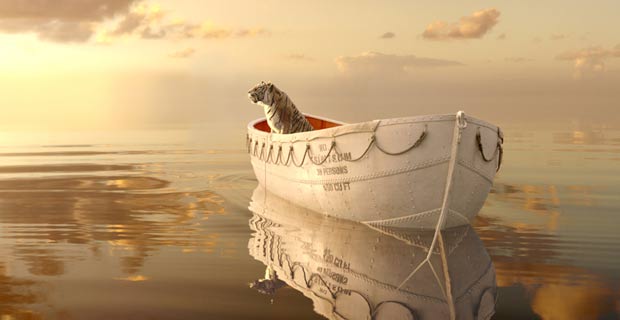
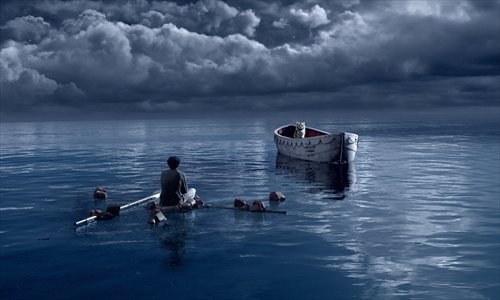
Political struggles in India leads the father to sell the zoo and embark for work in Canada, taking many of the animals with them on a Japanese freighter.  The crossing becomes disastrous, the ship being capsized in a storm, leaving Pi, Ishmael-like, on a life-raft with a few stowaways that he rescues after the sinking.  But, before long, it's just him and a Bengal tiger.

The journey then becomes a struggle for the two to survive, learning to cope with the hardships of surviving, stranded at sea, without killing each other.


That much you can glean from the previews and the poster, and to say anything else will spoil a lot of the charm of the story-telling.  This is Ang Lee playing with film-making in God's paint-box.  Forget that the film is seemingly impossible to pull off with the elements—filming on open water, with animals, some of them dangerous—Lee manages to make an amazingly entertaining film where the real and CGI flow seamlessly together, just as the story elements and philosophical arguments do, and done in such an imaginative way that one is frequently breathless as it unspools before your eyes.  

Lee has done wonders with CGI before, but (like Cameron and Scorsese before him), he also manages to make the 3-D element become an integral and, (this is a surprise), necessary function of the film, weaving it into the narrative, like tapestry, and giving the film a sense of scope and scale across time and space that, frankly, I've never seen anyone try before.


Now, the film is controversial in some parts: the critic for "People" magazine has written they "just hate" the ending, and I've read a few other reviews that have praised the film to the heavens, with some hedging about the ending not fulfilling the promise of the rest of the movie.  They're missing the point, and in their defense, the visuals have a way of seducing and comforting, but also distracting from what is important (like any good belief system).  The ending is part and parcel of what the movie is about, which is finding the path to make peace with the world by any means necessary, even if it is by using a little imagination and the application of myth and story-telling—to see things a little differently and make sense of an indifferent Universe.  Pi's search for God in his youth prepares him for the trials of surviving the ship-wreck, submerging his grief, and the movie's story of his 221 day journey—a speck in the vast ocean—is a fable reflecting the life-journey for all of us, adrift or under sail, whether charting our course by our stars, our God, or our selves.


Life of Pi is a Full-Price Ticket-see it in 3-D.


Tuesday, November 20, 2012

Lincoln

Noisy and Messy and Complicated
or 
WWLD?

At the end of John Ford's Young Mr Lincoln, "the jack-legged country lawyer" (as played by Henry Fonda) walks up a blighted horizon in the darkening gloom, as thunder rolls in the background, the rough-hewn fence he trudges along taking on the look of military barricades, as the young Lincoln walks with his long stride into the storm of history awaiting him.  Steven Spielberg's Lincoln starts where Young... left off—with the sound of thunder over credits, which evolves into cannon-fire before placing us straight on in the middle of the Civil War, blue-on-gray, white-on-black (and the reverses) amid the blood and the mud of the Earth.  The shots of the battlefield are tight, confusing, with no sense of place, no horizon—just a frame filled with humans killing each other by any means.  No glory.  No higher purpose.  Just the immediacy of conflict.  War is the point at which politics breaks down, and politics is where Spielberg's film is concerned to compare and contrast with today's stew of chicanery, graft, and playing fast and loose with the facts to the purpose of getting your way.  'Twas ever thus, and it was no different in Lincoln's time—they just didn't have cameras documenting everything then.

The approach is as good a starting place as any—that is, ending with Ford's last gambit—linking the two, as both films' main goal is to take the monument out of the man, and put him within reach of attainability, wart and all.  The canonization of Lincoln began at the moment of his death with the pronunciation "now he belongs to the ages" and his visage, homely, homespun, ragged sunken and contemplative, has been preserved in nickel, bronze, marble, granite to the point where one can hardly imagine it as flesh and blood anymore. 


Young Mr. Lincoln: walking into a History still to occur.
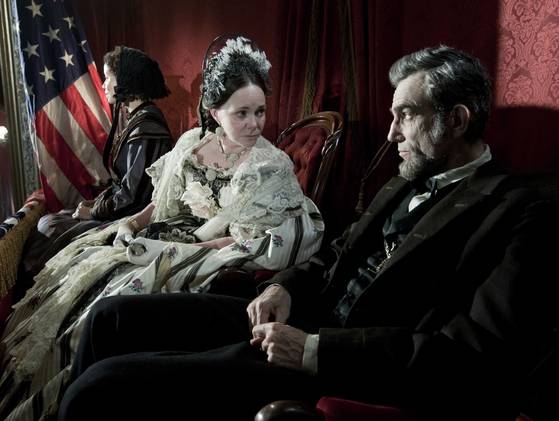
As portrayed by Daniel Day-Lewis, Lincoln is pitch-perfect, not only in his make-up, but his high tenor rasp of a voice, and—the remarkable part for me—in his still-legged gait that kicks and plants itself on the earth, not too steps away from the ragged dance of Wyatt Earp (Fonda, again) in My Darling Clementine.  It's a big, robust cast—I had error alerts for all the names I tried to cram into this article's meta-data labels—but the hub of it all is Day-Lewis' Lincoln.  Soldiers (including Lukas Haas) quote his Gettysburg Address back to him (which the President tries to staunch: "Been there, delivered that."*)  His wife (Sally Field) constantly badgers him—but then she consistently badgers everybody, his cabinet is frequently frustrated by him, by his prevarications, his story-telling that constantly derails conversations to his agenda, and his thought processes which annoy them.  "Actually," says Secretary of State Seward (David Straithairn) after Lincoln quotes verse, "I have no idea what you mean by that."

What he means may be too pragmatic for them, it's just how he expresses it that confounds.  In one exceptional scene—Tony Kushner worked on this script for a long time and it shows—Lincoln explains in minute, often harsh, detail how he employed his newly granted War Powers Act and it comes down to what he thought he could get away with, legally.

His concern, in the waning days of the war, is to pass the 13th Amendment, thereby abolishing slavery, and it takes every trick, every dodge, every promise and appointment in the middle of a lame-duck Congress before the war could end.  The timetable is critical: Lincoln has just been re-elected and is riding a wave of popularity; a crucial number of Congressmen are in their last days of their jobs and are looking to their futures and not to the wishes of their constituents; and, if the war ends, the urgency to pass the Amendment will dwindle, amidst the rebuilding of the Nation.  Lincoln's Republicans will vote for it, but they need to tone down their rhetoric.  The Democrats are dead-set against it, but getting Democrats to agree on anything is like herding cats and Lincoln wants to exploit the party's fractures into fissures.  

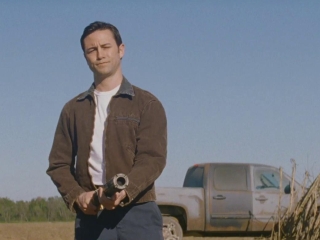
So, the problem is attacked from several fronts (if only the war had started that way): Preston Blair (Hal Holbrook), prominent Republican and journalist, is sent to the South to negotiate a Southern settlement, which the South is anxious to do (although Lincoln is reluctant).  Meanwhile, he wheels and deals with the largesse of power, offering appointments, threats, anything to curry votes, and unleashes a trio of stooge-lobbyists (James Spader, John Hawkes, and Tim Blake Nelson) to press the flesh and pass the greenbacks (not "officially," though).  Votes are critical.  On the home-front, Lincoln's son Robert (Joseph Gordon-Levitt) is back from college, but feeling the weight of his kinship with the President and wants to enlist, which sends wife Mary Todd into another accusatory tailspin as she has barely survived the death of their son, Tad.

Throughout, Lincoln keeps his counsel. but sometimes erupts into spasms of frustrationwith "Molly" (as he calls her), the congress and his cabinet, choosing his moments and pressing his advantage, knowing no peace except what he can create for himself.

As good as Day-Lewis is, he's matched by Tommy Lee Jones as House Republican Thaddeus Stevens.  In chambers, Stevens sits and fumes, then reaches his limit and bursts out in loud insulting harangues, just in control enough to get his point across, and even smiling tightly—very tightly—when when dressed down by Mary Lincoln over his tight reins over The White House purse strings.  Jones finds different ways to make his speeches crackle, while never betraying any sense that the words haven't sprung originally from his head.  And Spielberg has given special attention to casting key roles with the like of great character actors like Bruce McGill, Michael Stuhlbarg, and Lee Pace who make their relatively small parts punch out and become memorable.

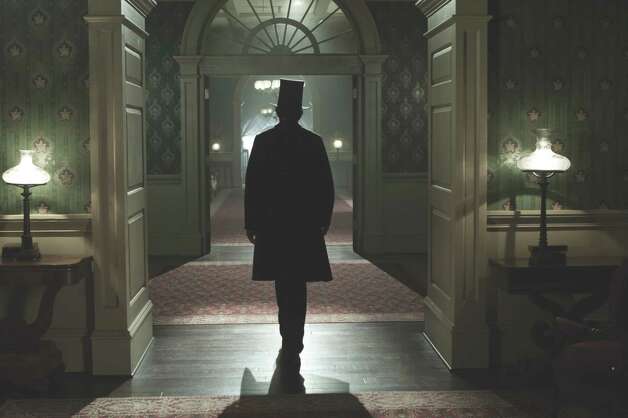
And Spielberg's eye for painterly detail shines, as Lincoln moves through the gloomy corridors of The White House or sets up an eerie dream sequence for the President.  And in one lovely scene, between Lincoln and Ulysses S. Grant (Jared Harris), where the war's toll on Lincoln is expressed in Day-Lewis' exhausted eyes and the shadows of a long rank of soldiers trudging in front of a setting sun play across his face.  

You can't see the moving shadows...
Spielberg's regular team of artists: Kaminski, Kahn, Carter, and Williams construct a great quilt of imagery and dynamics, making Lincoln a fascinating display of historical intimacy writ large.  It would make a superb triple bill sandwiched between Young Mr. Lincoln and The Conspirator.

Lincoln is a Full-Price Ticket.


* There's a nice contrast of Licoln delivering a dedication at a flag-raising ceremony that lasts a measly few lines.  "That's my speech" he says as he tucks his paper back into his stove-top hat.  They can't all be gems.

Thursday, October 4, 2012

Looper

Killing Time
or
Maybe You; Möbius

The trouble with time-travel movies is the really good ones (that is, the plausible ones—if such a thing exists) require a flow-chart to make any sense, and once you're doing that, you take a lot of the fun out of it.  That would be the problem with going back in time—you'd be spending so much time making sure you didn't disturb anything and cleaning up after oneself that you'd hardly have any time reliving the past in the present if you hope to have any future.  As one of the characters says "This time-travel crap, it fries your brain like an egg."

Fortunately, Rian Johnson (who made the rather precious Brick, and the entirely commendable The Brothers Bloom) has already done the muck-work for Looper, a tough-as-nails-time-travel noir set in the year 2044, where thirty years hence (2072) time-travel will be invented...and instantly made illegal.  Well, if time-travel is outlawed, only outlaws will have time-travel, and so organized crime uses it—not to increase the fortunes, but to dispose of their garbage.  "You can't dispose of a body in the future," narrates Joe (Joseph Gordon-Levitt in the long explanatory opening voice-over).  "I dispose a body that technically doesn't exist."  The future-hoods (dressed like Leone gunfighters) kidnap a "disposable," throw a hood over his head, hog-time him in a vest lined with silver bars, and toss him in the time machine, where he quickly appears in 2044, is just as quickly "whacked" and the silver mined as payment by the executioner, called a "looper"—local-time kids, who are given rich rewards, a steady cache of drugs, and rental of a woman of his choice.  They live like sociopathic kings in a Karl Rove dreamscape, where the meek don't inherit nuthin'—the middle class roaming the streets, pushing shopping carts, while the killers drive jet-cycles.  Overseeing this mob is Abe (Jeff Daniels), recruited from the future to manage the loopers and keep them in line, which include a rather draconian retirement policy (don't these guys read their hiring contracts?) that forces them to "retire" their older selves when they are sent back in time for disposal—you get your gold-watch at the start of your career and a gold lined cement overshoes at the end.  

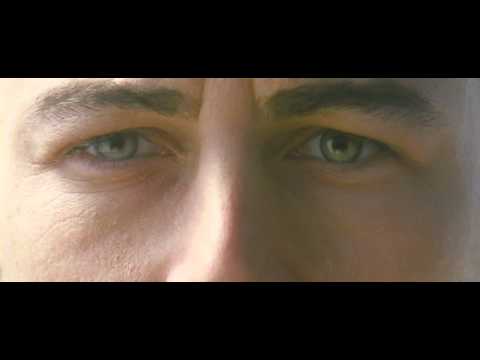
That's the set-up.*  Things get complicated, when Joe stands in his chosen field, waiting for the body-to-be to show up on the blood-tarp, and when it does, there's no hood, and when he looks into his target's eyes, they're his.  Joe has to kill himself from the future.

You know that already.  You've seen the set-up, read the poster.** But the implications, why that is, why "Old Joe" shows up with no hood, and what comes next...and next...and next...and then back...then next, would be revealing any of the surprises the film has in store.  It's enough to say that, in surface detail, it's quite an ingenious little ride, and the plot-holes are kept cleverly out of sight and out of mind, and one has to assume a lot, such as evidently time-travel only exists as a form of going back to the past, and not forward into the future, as one of the characters does it "the old-fashioned way."  And one has to accept a lot of "fuzzy mechanism" mumbo-jumbo for things happening to Joe that ultimately affects "old Joe"—for instance the rather painful form of communication between the two, that is further demonstrated in the extreme by another looper (played by Paul Dano), which is just a damned clever device, but also grisly to the queasy point.

Lots of violence...in some interesting forms, and one of the alarming things is how fast people get shot in 2044—you appear(BOOM!), and Johnson is doing some very clever things with the camera these days that aren't so derivative of other directors.  That's good.  His sense of timing in editing is still as razor sharp as it has always been, and he's not afraid to mess with aspect-ratios for effect.  The ideas are good, and one thing Johnson has always had is a clever way with dialogue, which is where Looper shines, time after time.

Looper is a Matinee.  And it might be worth seeing again some time.


* ...except for one little tidbit of information that some of us have mutated to have telekinesis, but it doesn't amount to much—"no superhero stuff." says Joe  "We can float quarters.  That's it."  Yeah, but...  It wouldn't BE there if it wasn't necessary.  And it is, but only semi-so.

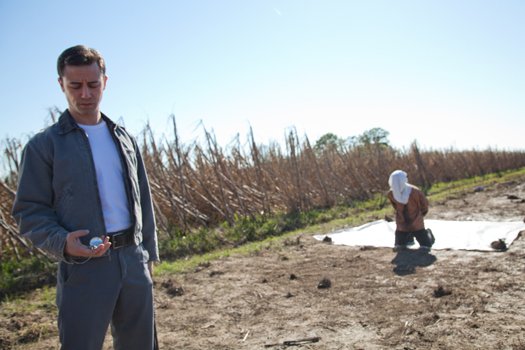
** And if anybody is wondering why JoGo-Levitt looks weird in this movie, it's because he's been given a prosthetics make-over so he has Willis' nose, eyes, lip-line, and theinning hair and does a rather inspired Willis-routine throughout the movie, especially in an interview with Abe where the resemblance and mannerisms are uncanny. 

Wednesday, August 22, 2012

Life With Father

Life with Father (Michael Curtiz, 1947) "Oh, GAD!" Another one of those movies I've always had the opportunity to see but never did.  A perennial for local television stations to have in their "libraries" for weekend programming (this was back in the day when local stations didn't fill their schedules with info-mercials), I had plenty of chances to catch this one on the tube, (and I would for fifteen minutes—tops—then move on) but I never did.  My bad.  This one needs to be taken in in one sitting, (preferably in a theater because the Technicolor is breath-takingly sharp), telephone off, and at full attention.

"I am the character of my household!" booms Clarence Shephard Day, as he's choosing the latest in a long line of maids, which he has chased out of his employ int he last few months, many of them in tears and some in hysterics.  Truer words were never spoken. He is the titular patriarch of Life with Father, from the hit Broadway play,* based on the remembrances of Clarence Day, Jr. of turn-of-the-century living with a father-figure who paces slowly in his own grooved path.  William Powell plays the role, one he actively petitioned for.

It's a charming film, full of easy irony about the mores and prejudices of the time, where male pomposity poses as dignity, and more separates people than unites them—easy excuses for keeping things nice and orderly on the surface, while underneath, they are broiling with chaos that is easily ignored and denied.   Clarence Gray, Sr. denies at the top of his lungs, and his monologues—against politics, taxes, unnecessary expenses, and organized religion (organized against him, it seems)—built individually in intensity and volume, are performances for an audience of one—himself.  His barely suffering wife (played by Irene Dunne as if she were singing the entire role) has more influence over him than he is willing to admit, or recognize...or even remember.  And his kid's are "mini-me's" of him, all boys, all carrot-tops, and as they age they morph further into miniature versions of The Old Man, down to his expletives and bluster.

Michael Curtiz directs formally and breezily, with his actors performing at top gear, and the director altering pace in editing and filling the frame with as much set decoration as it can hold.

The material doesn't need much else.  It's strongly forced, comically subtle and has an undercurrent of mature content, that you just don't see in movies nowadays.  Life with Father is from a far subtler era in which sub-texts flew over kid's heads, while the adults exchanged knowing glances and suppressed chuckles (that way you don't have to explain it to the youngsters with a simple "you'll understand some day").

And the sub-text is sex.  Clarence, Jr. is growing up, voice changed (but his violin playing still has noticeable cracks) and he's noticing girls—and when it's Elizabeth Taylor as a visiting friend's daughter, one can't help noticing.  At the time of the film, it was still early in Taylor's career and her performance is breathy, needy and comes from the same type of ingenue training that produced Marilyn Monroe's early performances.  Clarence wants to impress Taylor's Mary, but he can't do so in Dad's ill-fitting hand-me-down suits.  The excuse is they're practical, but, as he says, "I can't do anything in Dad's clothes."  But, the truth is he gets...uncomfortable...in Taylor's presence.  It's not bluntly said, it's danced around, implied, suggested, but never spelled out (as would be the norm today).  It's hilarious, charming, and pays off in some ironically comic laugh-lines throughout the film.

Yeah, they "don't make 'em like this anymore."  More's the pity.  Life with Father deserves its classic status—for some reason, it's not in the National Film Registry—because it's smart, pointed...and hilarious.  

GAD!


* It still holds the record for the longest run of a non-musical stage-play.

Friday, June 8, 2012

Lady in the Lake

Lady in the Lake (Robert Montgomery, 1947) Call it an experiment that fails—but a noble try.  Bob Montgomery took his opportunity to make a low-budget pot-boiler of Raymond Chandler's Philip Marlowe mystery and take it as close to the source as he could...in spirit, anyway.  Taking Chandler's first-person narration-style and translating it into cinematic terms.  Instead of reading inside Marlowe's head, we're seeing out of his eye-sockets—I didn't know Marlowe was monocular.  Nor did I know he was borderline schizophrenic—with cooing voices in the background, passing for a dramatic score (at least it's organic).

Chandler hated this one.  He'd written his own screenplay adaptation (that wasn't used) and thought the POV work...didn't work.  It doesn't, really.  In fact, it's creepy.  We, the audience, are constantly being talked to directly, with Marlowe's replies in voice-over—but because we don't see him, those replies are so "on-the-nose" as to be bluntly obvious.  In a way, this direct method robs us of actually seeing Marlowe's thoughts, playing across the face of the actor portraying him.  No, Marlowe has to say everything on his mind, making him the lamest of detectives—he's always telling people of his suspicions of them.  Nice detective work, shamus.

But, it does follow the story...in the same way a stage play might follow it.  We're kinda "stuck" inside Marlowe's head, and any investigation—the thing that distinguishes this story in the Marlowe canon is that it takes him out of L.A.  But, we never get out of rooms.  We lose some characters, and the bigger shocks (the discovery of "the lady in the lake," for instance, which they probably couldn't show as it's pretty gruesome in the book) are talked about happening off-camera.  Nope.  Everybody's standing around talking too each other...actually they're standing around talking to us.

Like I said, creepy.

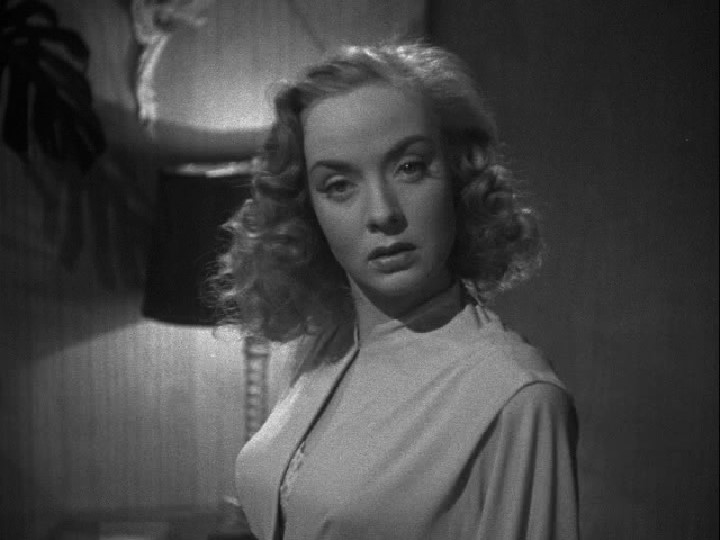
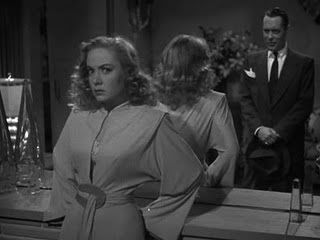
It also kills any momentum.  Because the camera is the only thing that has any action to it.  We see what he sees, following babes—rather obviouslyevery door-knob that is reached for (how exciting!), and only see our hero in the mirror.  It doesn't help the actors, either.  Montgomery might have been a great Marlowe—we just don't see it.  And poor Audrey Totter—her character doesn't even make any sense.  She whip-saws between emotions in a bi-polar performance, that when Marlowe's supposed to trust her, you just don't buy it...or buy him for doing it.  The technique works against everything here.  The only one who adapts well to it is Lloyd Nolan, but he'd already done an adaptation of Chandler's "The High Window" as the Marlowe stand-in, and already had the "cracking wise" patter down cold.

The thing is, POV can work.  It works to a certain extent in Dark Passage, and  Jonathan Demme  employed it amazingly well—and sparingly—in The Silence of the Lambs, where audience identification is only enhanced by our seeing the direct play of emotions across faces.  Montgomery was an actor, and a good one, so it's amazing that he would choose to do this experiment rather than trust his own craft; it's a hard lesson to learn, but an easy one when you think about it—you can tell an audience anything you like, but to use the medium of movies to its best extent—you should show them.

Robert Montgomery as Phillip Marlowe in the only way we see him
(except when addressing the audience)—in a mirror.