Showing posts with label Detective. Show all posts

Friday, June 8, 2012

Lady in the Lake

Lady in the Lake (Robert Montgomery, 1947) Call it an experiment that fails—but a noble try.  Bob Montgomery took his opportunity to make a low-budget pot-boiler of Raymond Chandler's Philip Marlowe mystery and take it as close to the source as he could...in spirit, anyway.  Taking Chandler's first-person narration-style and translating it into cinematic terms.  Instead of reading inside Marlowe's head, we're seeing out of his eye-sockets—I didn't know Marlowe was monocular.  Nor did I know he was borderline schizophrenic—with cooing voices in the background, passing for a dramatic score (at least it's organic).

Chandler hated this one.  He'd written his own screenplay adaptation (that wasn't used) and thought the POV work...didn't work.  It doesn't, really.  In fact, it's creepy.  We, the audience, are constantly being talked to directly, with Marlowe's replies in voice-over—but because we don't see him, those replies are so "on-the-nose" as to be bluntly obvious.  In a way, this direct method robs us of actually seeing Marlowe's thoughts, playing across the face of the actor portraying him.  No, Marlowe has to say everything on his mind, making him the lamest of detectives—he's always telling people of his suspicions of them.  Nice detective work, shamus.

But, it does follow the story...in the same way a stage play might follow it.  We're kinda "stuck" inside Marlowe's head, and any investigation—the thing that distinguishes this story in the Marlowe canon is that it takes him out of L.A.  But, we never get out of rooms.  We lose some characters, and the bigger shocks (the discovery of "the lady in the lake," for instance, which they probably couldn't show as it's pretty gruesome in the book) are talked about happening off-camera.  Nope.  Everybody's standing around talking too each other...actually they're standing around talking to us.

Like I said, creepy.

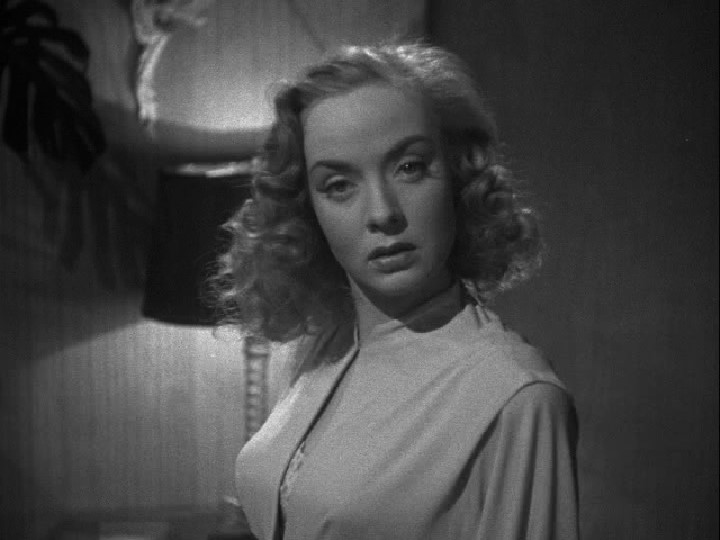
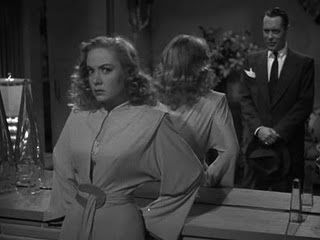
It also kills any momentum.  Because the camera is the only thing that has any action to it.  We see what he sees, following babes—rather obviously—every door-knob that is reached for (how exciting!), and only see our hero in the mirror.  It doesn't help the actors, either.  Montgomery might have been a great Marlowe—we just don't see it.  And poor Audrey Totter—her character doesn't even make any sense.  She whip-saws between emotions in a bi-polar performance, that when Marlowe's supposed to trust her, you just don't buy it...or buy him for doing it.  The technique works against everything here.  The only one who adapts well to it is Lloyd Nolan, but he'd already done an adaptation of Chandler's "The High Window" as the Marlowe stand-in, and already had the "cracking wise" patter down cold.

The thing is, POV can work.  It works to a certain extent in Dark Passage, and  Jonathan Demme  employed it amazingly well—and sparingly—in The Silence of the Lambs, where audience identification is only enhanced by our seeing the direct play of emotions across faces.  Montgomery was an actor, and a good one, so it's amazing that he would choose to do this experiment rather than trust his own craft; it's a hard lesson to learn, but an easy one when you think about it—you can tell an audience anything you like, but to use the medium of movies to its best extent—you should show them.

Robert Montgomery as Phillip Marlowe in the only way we see him
(except when addressing the audience)—in a mirror. 


Friday, June 3, 2011

The Usual Suspects


"The Usual Suspects" (Bryan Singer, 1998) A truck hi-jacking occurs.  As a result, a motley collection of grifters are called together for a police line-up in an effort by U.S. Customs Agent Dave Kujan (Chazz Palminteri) to frame one of them, Dean Keegan (Gabriel Byrne). Instead of proving there's no honor among thieves, the five criminals decide to collaborate on a defiantly ingenious crime-spree, which eventually runs afoul of a major international organization run by the legendary crime boss Keyser Söze.  Before too long all but one of the collaborators is dead, and the remaining is in police custody, for once unwilling to talk for fear of his life.  Ironically, his name is Verbal.  Verbal Kint (Kevin Spacey).

It is only when Söze's name becomes known to the police that Verbal begins to babble, filling in the many gaps that Kujan and local police sergeant Rabin (Dan Hedaya) don't know, starting with that fateful line-up of Keaton, McManus (Stephen Baldwin), the almost-incomprehensible small-timer Fenster (Benicio Del Toro), smart-ass chopper Hockney (Kevin Pollak, never better), and Kint, and the ever-more elaborate coups they pull off, ending with the death of nearly everyone on a freighter that has blown up the night previous.  As Keaton has eluded him before, Kujan is convinced that he's the one behind it all, but Kint swears he's wrong, as he was the only surviving witness to Keaton's death at the hands of Keyser Söze.  And Kint's tale is the proof of it.  Keaton is dead.  Keyser Söze lives.  And Kint is terrified, convinced that, now that Söze's name is known, he'll be accused of being a rat.  And because he's seen Söze's face, he won't be allowed to live.

Meticulously cast, directed just-so, with a ribald sense of language, irony and black humor, The Usual Suspects is a fine example of editorial legerdemain, one of the neatest tricks to pull off in the movies—especially considering that audiences to mystery films are usually five steps ahead of the movie.  How can they not, as the director Sammy Michaels (Peter Bogdanovich) says in Targets: "All the good movies have been made," and all the plots have been used, and all the tricks have been revealed.

Well, almost.


IF, gentle reader, you have not yet seen The Usual Suspects, PROCEED NO FURTHER, please. As much as I try to dance around the issue not revealing too much, I have to concede that, beyond this line and, indeed, for the rest of today's post, THERE BE SPOILERS, and they will irreparably destroy any first viewings of The Usual Suspects. Trust me on this, I am not kidding, and don't come whining to me if you are so unwise as to not heed this warning!!!  (The only worse fate would be having to transcribe Benicio del Toro's dialogue).


"The greatest trick the devil ever pulled was convincing the world he did not exist."


There are a lot of great lines in The Usual Suspects, but that one is a key one. What is it saying, actually?  It's hard to penetrate its meaning, and after staring at it and parsing it (but not going so far as to "diagram" it), I finally gave up with an aching head and just said "It's a black-hole of a sentence."

But, then, so is the movie.  All of it.  A double-negative with a marked-for-dead "X" at its center, The Usual Suspects is constructed like a tight thriller, when it really is not.  The answer to the riddle is there, almost from the beginning.  But, we, the audience, never see, it even though we have.  And we probably don't even realize we were told after the movie is over.  It comes down to one shot.  One shot at the center of the situation, and like a black-hole, and like any unsolved mystery, there is nothing there...but what we put into it.


It is a pull-in of wharf jetsam—pallets, rope and crab-pots discarded pell-mell on the San Pedro dock occupied by the freighter, as it, and what remains of the Keaton gang, goes up in a big ball of flame, illuminating the night-sky and the junk on the dock.  The shot continues slowly boring in on the circle of ropes in the center of the frame.  What we see is junk, complicated, random, but the devil is in the details.  Since the director is taking us there, this shot must be of some import.  It is, for the movie (why wouldn't it be?).  I remember, sitting in the theater, watching this stretch of film, as it moved ever closer, thinking: "Who's behind the ropes watching this?"  At the end of the shot, it might even be revealed who it was, behind this, the witness to the events, the guy with the knowledge of the events that were unfolding in the heat and the flash. 

Nothing is revealed, ultimately.  The scene goes into a long, slow, lingering transition to Verbal being interrogated.  We won't be told why we're there until later in the picture, once all the names are known, and the ultimate triumph of Söze is at its end-game.  For the moment, though, that empty shot is just another piece of the puzzle at its center.  A lot more pieces must be placed before we can be given the context of what lies at the empty center of this shot.


We have a compact—we, the audience and the creators of movies.  Their job is to re-create a reality and ours is to accept it as truth.  We come to "buy," not only our tickets, but also the verisimilitude of the flickering images on the screen (itself an illusion, a series of still images run at a speed to fool the eye into thinking it a seamless reality).  That compact is an agreed contract.  We accept that it is not reality ("It's only a movie," "No, honey, the blood isn't real..."), but for the sake of drama we put that aside for entertainment.  It is the director's intention to fool us—presenting artifice as reality.  Yet, to fulfill the expectations of entertainment, audiences must offer a suspension of dis-belief, while, at the same time, having absolute faith in the veracity of the writer-director.  If we are shown something, it must be important, not only to the story, but also the story-telling.  If we are presented something on the screen, it must be for a good reason.  If not, the director has broken his contract.  He has gone beyond manipulating the images...and manipulating us.


But, that is their job from the beginning.  To calculate the equation of Artifice = Reality.  But, it takes a director with the true knowledge of how powerful film is in its effect on the audience to go beyond the usual movie-magic of presenting Reel Life as Real Life, to presenting fiction as fact and getting away with it—to mis-lead us—to break the trust between director and audience and make us smile at the subterfuge.


Like the shot in Rear Window of Torvald escorting his wife (with luggage) on a trip that goes unnoticed by the protagonist, it is superfluous, intended not for the story...but for the viewing audience. It's a little seed of doubt sewn by the director to keep us guessing. Or, in another case of Hitchcock, the elaborate crane shot that follows Norman Bates up the staircase to retrieve his mother in Psycho, a move designed to call attention to itself and not to what is going on on-screen.  A feint.  A slight-of-hand (and camera).


So, what of that empty image that must stand for (or in front of) something in The Usual Suspects? Later in the film, director Singer will take us back to this place.  To put words to the image, as Kint describes his flight from the carnage of the freighter and watches Keegan's execution at the hands of Söze—the only reliable witness to the act.


Kujan doesn't believe it.  He's convinced that Keegan is Söze, the criminal plays all leading to a supposed drug-deal at the freighter—just a ruse for Söze to kill the one man capable of identifying him.  Söze's deals with the Keegan gang are small-time, just so he can slip unnoticed onto that one ship and assassinate the man who has seen him.  His ends justify the means, creating a subterfuge for the ultimate goal.  And director Singer, does the same thing, using our trust and knowledge of movies to include a shot that tells us nothing, and is, for all intents and purposes except of its own, meaningless.

The lesson that we ultimately learn (as also, too late and to a lesser extent, does Kujan in the film) is the undeniable fact of this story, and of movie-making itself:  The devil does exist, and he is in the details.

Even if we don't see him.


"The greatest trick the devil ever pulled was convincing the world he did not exist."


Saturday, October 3, 2009

The Two Jakes

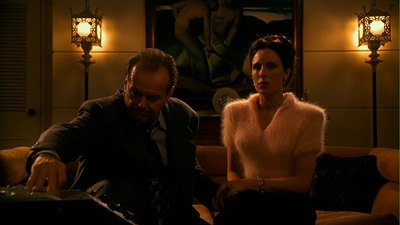
"The Two Jakes" (Jack Nicholson, 1990) The second part of a planned "Jake Gittes" L.A. trilogy (that had started with "Chinatown") was snake-bit almost from the start. Centered around the three great California swindles (water, oil, and transportation), the second film, to be entitled "The Two Jakes"—involving real estate and related oil grab—was set in the post-war 40's. Robert Towne, who wrote the original "Chinatown," was set to direct his old friend Jack Nicholson for the sequel, and for the real estate baron Jake Berman, it was agreed to cast executive producer Robert Evans, who hadn't appeared in a movie since 1959.

Something happened. The particulars are hazy, but the story is that
Towne was unhappy with Evans' performance, and Evans being the executive producer was unhappy with that (his autobiography is, of course, "The Kid Stays in the Picture"). The production was shelved until 1989 when Nicholson himself took the director's chair, Harvey Keitel in Evans' spot and a new production began, with a script that wasn't done to Nicholson's satisfaction and was being re-written while shooting.

What emerged was something of a mess. "Chinatown" was a complicated film, but "The Two Jakes" had the added burdens of a complicated plot and a carry-over theme from the previous film. Some sections seem well thought out and designed, and others rushed to the point of obtuseness. To patch the bare spots and try and salvage the dramatic flow, Nicholson wrote and recorded a narration—not an unusual thing to find in a detective movie—that had more to do with character points than clarity.

The other thing is casting:
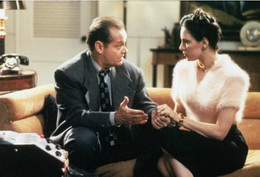
Meg Tilly was a bit too young to be playing Berman's philandering wife, her acting makes her character something of a blank spot, and her motivations are never hinted at—and she's absolutely critical to the story. On top of that, her presence makes Gittes appear to be pretty stupid for not spotting what is revealed in the story, and the plot-machinations a bit contrived. This is apparent if you've seen "Chinatown." If you haven't, 'The Two Jakes" leaves you high and dry, it's plot about the diversion of water to the city an integral part of the information needed to get anything out of the film. It tries to do too much, introduce too many incidental characters, and ultimately fails to congeal as a coherent movie rather than a roughly assembled series of scenes and ideas. If Towne had been around to tighten the script, it might have been different. If he had directed it, rather than Nicholson, it might have been more cohesive as Towne is a fairly strict director. But the important part is that the three essentials for the project—Nicholson, Towne and Evans could not compromise, and so "The Two Jakes" was compromised, taking the third film in the trilogy—the much-rumored "Cloverleaf"—along with it. It's what happens when hubris replaces professionalism.

Wednesday, July 8, 2009

The Long Goodbye

"The Long Goodbye" (Robert Altman, 1973) Wise-acre. Ass-hole. Cutie-pie. Philip Marlowe's called a lot of names, but in Robert Altman's version of "The Long Goodbye," he's also "The Marlboro Man, The Duke of Bullshit."

As
Elliott Gould's Phillip Marlowe says again and again "It's okay with me."

It was supposed to be a straight-ahead adaptation of the
Raymond Chandler novel. Leigh Brackett, who had written a lot of Howard Hawks' films (including his adaptation of Chandler's "The Big Sleep") changed the ending, added some characters and complications and Hawks was contacted to direct. Nope. Then Peter Bogdanovich, who also passed, but who mentioned Robert Altman for director. Altman loved the new ending, mentioned Elliott Gould for Marlowe and a deal was made.

And that's where the changes come in. Because the last adaptation of a Chandler Philip Marlowe story was the somewhat irrelevent "Marlowe" starring laconic James Garner in the title roll. Created deep in the 60's, that film feels old-fashioned and a bit musty (even with Bruce Lee kicking apart Marlowe's office!). But for "The Long Goodbye," Altman was going to drop Marlowe into early 70's era Los Angeles, where everybody wore caftans and bushy sideburns, were into macrobiotics, EST and pot—a post-hippie era of conspicuous consumption that had trickled down from Marlowe's beat (problems with the rich) to the exotic dancers and truck-drivers of the pre-disco era.* Marlowe and his code of honor would seem out-of-touch in such a world.

Then throw in
Elliott Gould's rat's nest interpretation of the character and you get a completely other sensibility—one begins to suspect Marlowe of being incompetent in such a world, unable to function (he can't even find his own cat), but he does, snapping to whenever some dies (or is about to). And another nice touch is Gould's mumbling patter along the way, supplying his own first-person narrative, ala Chandler.

L.A. in twilight is still the same and the supporting cast of hoods and thugs as menacing as the time the Marlowe books encapsulated (late '30's to mid-50's), but now they're more than just socially deviant, they're demonstrably sociopathic in the form of Marty Augustine (director Mark Rydell), with twisted justifications for their actions, which can sometimes be just a sadistic play of power. And that's what makes Leigh Brackett's screenplay a bit different than the tone she took away back in 1945 when she and William Faulkner adapted Chandler's "The Big Sleep" for Howard Hawks and Bogey and Bacall: there's no sense of right and wrong, it's a sense of right and wrong for "me." And Brackett allows Marlowe to make a final statement condemning that world. It's the only way that this Marlowe...in this world...can "make it right."

There are problems—some stunt-casting—
Nina Van Pallandt (mistress of Howard Hughes scammer Clifford Irving) and Jim Bouton (former Seattle Pilot and author of "Ball Four!")—call more attention to the actors than the characters and Altman regular Henry Gibson has no steel core to speak of for his predatory doctor, but throughout, Altman and ace cinematographer Vilmos Zsigmond bring a formal off-the-cuff look to everything in L.A., culminating in two beach shots reflected in windows that present two perspectives on conversations, while in a push-focus the audience is clued in to happenings going on at the surf's edge, one inconsequential, the other, irretrievable. It's a fine example of Altman's ability as a seamless film-maker making his movie in the camera and relying less on the unique art to film-making of editing.

Two posters/One film: Two stories
The original film-poster that confused L.A. audiences into thinking they'd be seeing a straight-ahead thriller. The film was withdrawn for six months and re-instated with the above
Jack Davis-designed "Mad" style poster for the New York run, where it was very successful.

* And in a running gag, the percolating presence of a mordant "Long Goodbye" theme (written by Johnny Mercer and John "T." Williams--two years before "Jaws") pervades everything in Los Angeles—right down to the mantras and door-bells. Good thing there weren't cell-phones back then.

Tuesday, June 9, 2009

Goodbye Solo

"The Silent Act"

"Goodbye Solo" begins "in media res"—at exactly the point when the subject matter of the film (a promised taxi fare to Blowing Rock, North Carolina at 8:00 am October 20, 1997) is first proffered to Senegalese cabbie "Solo" (Souleymane Sy Savane) by regular passenger William ("Memphis Mafia" member Red West). Solo, smile-at-the-ready, eager-to-please-and-profit, wants to know why—it's not like William's regular trip from his apartment house to the Majestic movie-house. Solo's good at his job. He knows all the routes in Winston-Salem, offers riders exclusive service, and wants the best for his growing family—his wife Quiera (Carmen Leyva), precocious step-daughter Alex (Diana Franco Galindo) and one on the way.

But he's never had an offer like this and his curiosity is peaked, especially when William (whom Solo calls "Big Dog")is less than forthcoming with details about the trip and his life, preferring to sit in the back of the cab purposefully, not hostile exactly, but not giving away anything. William plays his cards close to the vest, playing the silent act. Usually, Solo is content to let things be, his rotating passengers passing fancies. But not William. William becomes an obsession.

What director
Ramin Bahrani (who has generated a lot of interest in his young career with the films Man Push Cart and Chop Shop) is presenting is a simple detective story. There's a mystery and a time-limit and Solo is the man on a mission. That Solo is usually the guy who's cut out of transitions in detective stories makes up the sociological aspect of the film and the attractive spin to the story. As played by Savane, he's a guy in transition and, as per his job, always on the move, hustling and bargaining and angling for a job as a flight attendant.

William couldn't be more different: a good old boy with the "good" in question, his face lined with creases of a lived-hard life and the two men are marked contrasts: Solo, starting out, climbing the ladder, gregarious, looking for angles; William, perpetually checking out, keeping his council, on a set path. Savane's playing a role and West has lived it.
Those contrasts provide a rich vein of drama and comedy, but provide the taxi-man with a common question: where are we going?

The answer is, of course,
the same place. But how they get there is marked in contrasts, too. Savane is a wonder. He has the tough job in the movie, whether starting out with a constant stream of "Hail-fellow-man-well-met" pleasantries, then as his investigation starts producing clues, the smile begins to fade and his eyes start to go back 5,000 years. After a fashion the performances begin to merge as Savane's eyes take on the same dewey ancientness of West's. It's incredible work (and it's only his second film).

They buzz about Bahrani is true—his films seem simple, and could frustrate the casual film-goer ("What was that about?") but they are dark, complex and stay with you long after you leave the theater. There are no cheap metaphors that wave their hands and say, "I'm important." Just strong characters with lives in flux that wonder and worry about when Bahrani abruptly denies access (which in itself reflects on the film's themes). "I wonder what she'll become?" is why there are such things as long goodbyes.

"Goodbye Solo" is a Full-Price Ticket

Thursday, April 23, 2009

Murder, My Sweet

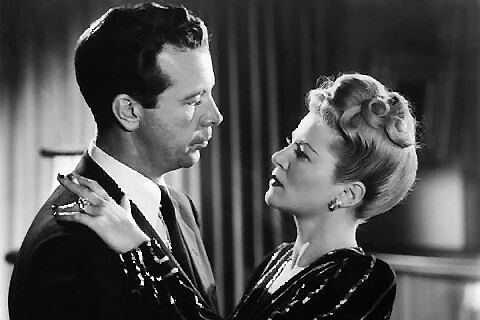
"Murder, My Sweet" (Edward Dmytryk, 1944) A neat trick, this. Although the third Chandler adaptation to make it to the screen—the first being "The Falcon Takes Over" (taken from the same source novel as this—"Farewell, My Lovely") co-opted as a story-line in the George Sanders "Falcon" movie series, and the second "Time To Kill" (based on "The High Window") featuring Lloyd Nolan's Michael Shayne character, it is the first to feature Raymond Chandler's slumming angel, Philip Marlowe*

Dmytryk and writer John Paxton do a fair job of keeping the first-person narration intact (Marlowe is being grilled by the usual suspicious police and he's giving his side of it), and although they didn't use Chandler's exact phraseology, they do a nicely watered down, tightened-up version of it for cinema audiences for whom thinking too much of the cleverness of a metaphor as it passes might slow down a film's momentum. Call it "Chandler Lite."

It works, especially for the speed of this film. For Marlowe, an odd choice:
Dick Powell, an A-lister in musicals. He's got a lived-in face, like a hound's, not a matinee idol's, slightly doughey (as is his body-type, depite being told he's "in good shape"—that's Marlowe to a wife-beater "T."), and you believe that Powell would be a reflexive weisenheimer—something about the hoofer background.

And Dmytryck has the noir feeling down, being as he was one of the architects of the style. Begin your movie in transition so the audience has a lot of questions it has to answer, go heavy on the atmosphere and always exit the scene with a sardonic quip. You already know you're in the hands of a master with
the sequence that introduces "Moose" Malloy (Mike Mazurki) who just suddenly appears. It's as disconcerting...well, as disconcerting as a tarantula on an angel food cake, thank you very much! Dmytryck also has fun dancing around the brim of the Hayes Code in the two knock-out sequences of Marlowe being knocked out—always a hallmark of Marlowe stories and fans of inky pools of blackness, Long Goodbyes and Big Sleeps (or "Big Lebowski's," if you'd rather, later).

Indispensible in the mix is a high concentration of sass which is provided by that queen of the form, Claire Trevor, whose performance as an evil step-monster is almost too much of a good thing. "Murder, My Sweet" would have been a rich enough story without her. Her presence and its tilting of the sexual equation slams this one deep onto the classic shelf. Powell would play Marlowe again on television, but this initial outing made him definitive...until Bogart came along.


* "The Big Sleep" with Bogart as Marlowe was made the same year, but not released until two years later.

Monday, January 14, 2008

Chinatown

This is the first of “Anytime Movies” that falls into the category of “Lost Causes and the Futility of Good Intentions,” but lest anyone think these films are depressing, they’re not.

Well, okay, this one is.


It’s also perfect. Given the nature of the trio of men who oversaw its creation—screenwriter
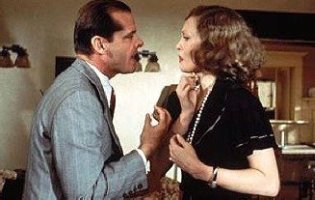
Robert Towne, director Roman Polanski, and producer Robert Evans—the thing could have self-destructed like a fragment grenade. And, in fact, the planned trilogy of films featuring detective JJ “Jake” Gittes investigating three big California crimes (water, land, and nuclear) stopped after the personality clashes that derailed the first attempt at filming “The Two Jakes.” Polanski couldn’t set foot on American soil due to rape charges, and Evans (who was producing and co-starring) and Towne (writing and directing) clashed on the set. The combination of expanded roles and ego following the first film’s success shut down production, and it was only the efforts of star Jack Nicholson, who took over directing, that allowed the film to be made. They say that great films need a miracle – “Chinatown” had it, but “The Two Jakes” didn’t have a prayer.

“Middle of a drought and the water commissioner drown. Only in L.A., huh?”

Based loosely on the construction of the
William Mulholland designed aqueduct, and the real estate swindles it engendered, “Chinatown” starts out as a mystery even more steeped in the locale of L.A. than Chandler’s Marlowe stories. Here, the very city is a part of the crime and corruption is steeped in its soil and water. Water is the heart of “Chinatown.” Its ebbs and flows are constantly monitored –the original object of investigation is the city’s head of the Department of Water and Power who then becomes the victim of a grisly murder. Water is never too far from the surface of the story. Even Jerry Goldsmith’s shimmering score suggests water in its low harp trills, and the sighing of, yes, water phones.

“Chinatown” gets all its details right—the language, the costumes—
Richard Sylbert’s period work is amazing, and a perfect cast makes the most of Robert Towne’s wise-acre dialog. A perfect cast? Right down to the smallest part. There’s a favorite moment of mine when Gittes, after badgering the secretary of the new head of Water and Power, is distracted by an odd squeaking noise. He, of course, has to investigate, and opens the outside door on the two work-men who are scraping the dead man’s name off the door. The one guy looks irritated—the other guy smiles, nods, and as the door is closing shakes his head ruefully—“Happens every time.” It’s a tiny little moment that feels so authentic, so much more than a mere movie might provide, it provides a moment of truth in a continuous string of truths.

But, that is a moment you can appreciate as it happens. “Chinatown” lives on in the memory. After the mystery is solved, moments come back, as the pieces come together and the journey to the conclusion coalesces. They haunt. On repeat viewings, “Chinatown” is a treasure trove of call-backs and foreshadowing’s.* Little things, like the odd cadence of a name, mispronunciations that can be traced back, a birth-mark—lead you downstream to a resolution that you should, in retrospect, have seen all along. Like Gittes, its only at the end that you get the full story. Of course, like him, you follow the most obvious things that seem out of place or arouse suspicions. ** But the world is a more complicated place and long after the film is finished does it strike you that the two most suspicious people while watching the film are actually the most decent and altruistic ones acting with the best of intentions. Of course, in this world they come to a bad end.


“Do you know how long I've been in this business?”

And here’s where that mix of personalities comes in. Towne’s screenplay is very grey—Jake Gittes at the beginning of the film—the very beginning—gets angry and abusive with his moaning client, Curly (In the film, there’s only an impatient irritation). Later dialog casts a sympathetic spin on water magnate Noah Cross. The original screenplay ends with, if not a happy ending, then a triumphant one. Evans loved the screenplay (though he didn’t quite get it), but in one of those odd bursts of inspiration that sustained him throughout an eccentric career as a producer, decided that the film needed a European sensibility, and so, brought in Polanski, who had left the country and Los Angeles following the murder of his wife Sharon Tate by the Manson family. His perverse take on the city and the material focused it, and made a stronger delineation between good that is good and evil that is truly evil—and provided the ending that doomed those most in need of rescuing. “Chinatown” ends in shock, and with a sense of tragic inevitability. That Jake, in a moment of selfishness and hubris, sets up a series of events that ends up completely bollixing up his good intentions, completes a circle and a character arc that had been percolating below the surface the entire time. He ends up ignoring the lessons he learned in Chinatown (the district, not the film), and paying the same consequences. The final words are ironic--“Forget it, Jake. It’s Chinatown.” Forgetting isn’t his problem. Remembering is. Towne would hammer the point home with the last line of “The Two Jakes”—“Kitty! You never get over it.”

But by that time it wasn’t necessary to say.


Jake wants the truth.
He can't handle the truth.


* On my most recent viewing, I noticed a moment that shocked me. After Jake and Evelyn flee a scene in her car amidst a hail of gunfire, the superbly coiffed Evelyn touches her left eye—as if she has something in it. Whether it was Polanski’s or Dunaway’s choice, it’s a brilliantly sick one.

** Towne’s screenplay is so fully formed that, unlike Chandler’s Marlowe stories, a first person narrative isn’t necessary. We are always aware of what Gittes is doing, and thanks to Nicholson’s performance, what he’s thinking.


Anytime Movies are movies I can watch anytime, anywhere. If I see a second of it, I can identify it. If it shows up on television, my attention is focused on it until the conclusion. Sometimes it's the direction, sometimes it's the writing, sometimes it's the acting, sometimes it's just the idea behind it, but these are the movies I can watch again and again and never tire of them. There are ten. This is Number 7.


IV: -Only Angels Have Wings

V: The Searchers

VII: Chinatown
VIII: American Graffiti


X: Goldfinger