Showing posts with label 1973. Show all posts

Wednesday, April 18, 2012

The Mackintosh Man

The Mackintosh Man (John Huston, 1973) One of the best kept secrets (until 1974, anyway) of the second World War was Project Ultra, the British operation centered in Bletchley Park tasked with breaking the German Enigma codes that scrambled their communications so as to be undecipherable.  What the Germans did not know (because the British kept it secret) was that their dispatches were being regularly decoded and read, and their plans made known to forces in the field.  This was a great boon to the generals who took advantage of the intel—many, including General Patton, did not—but there were times when the messages were merely shelved.  The most egregious example might be the Coventry Blitz, although the facts are in dispute.  Some authors (including the man who first shed light on Ultra) have claimed that Churchill knew of the devastating November 14, 1940 raid by the Luftwaffe, but did nothing to warn the populace or take counter-measures, lest it tip off the Germans that the code had been cracked, thus nullifying an important source of information and intelligence.  If the Nazis knew their messages were being decoded, they might (probably would) make new measures to keep their transmissions secret.  And so (the story goes) Coventry burned in order to keep the secret.  War is not logical, and spycraft even less so, but there's an absurd madness there that parallels the VietNam-era quote stated "we had to destroy the village in order to save it."

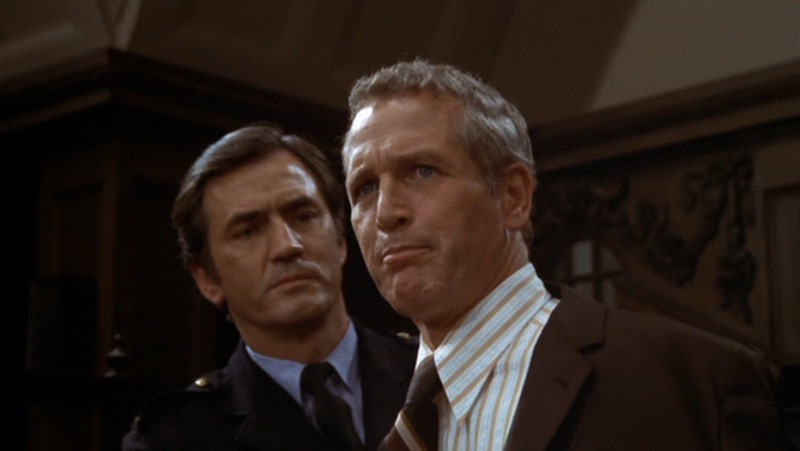
That logic (or lack of it) is much in display in Huston's film of The Mackintosh Man (written by Walter Hill),* a spy thriller the director made in Britain and Malta with Paul Newman.  In it, a British Intelligence agent (Newman) is framed and sent to prison, in order to infiltrate a criminal organization.  But, unknown to him, the deceit goes much deeper, as his superior, Mackintosh (Harry Andrews), is using the mission to ferret out a leak in information in the British government.  Once the agent, named Rearden, is sprung from prison by the conspirators, overseen by an enigmatic figure named "Mr. Brown" (Michael Hordren).  Rearden and another prisoner, Blake (Ian Bannen), are spirited away to an unknown location, drugged and held until the police activity surrounding the prison break cools down.  The escape causes a row in Parliament, led by a law-and-order lord, Sir George Wheeler (James Mason), who rails against the bumbling way in which the prisons and the law are handling it, until he is persuaded to cool down the rhetoric by Mackintosh, himself.

Things get complicated when Mackintosh is run down in the street, and the operation taken over by his deputy, Mrs. Smith (Dominique Sanda), who is now charged with a double mission—Rearden's and the murder of Mackintosh.

Huston barely takes any of this seriously, even if Newman plays it straight, and Sanda—well, it's hard to tell if she plays it at all, her character being so enigmatic as to be undecipherable.  But, it's all staged well (and photographed by the legendary Oswald Morris), especially a car chase through winding Irish country roads that looks dangerous as Hell, and Huston ends on a typically ambiguous note.  But, he's made much better films about duplicity and duty (as has Hill, for that matter), and this one feels like a minor effort before tackling much more ambitious projects.  His next film would be his long-planned adaptation of The Man Who Would Be King.


* This was around the era where Huston was no longer adapting classics, but beginning to take advantage of the scripts of the new college-class of film-makers, including Hill and (for his previous film) John Milius.

Wednesday, January 19, 2011

The Day of the Jackal


The Day of the Jackal (Fred Zinnemann, 1973) Not to be confused with the lousy 1997 retread (rather than remake)The Jackal with Bruce Willis and a ludicrously accented Richard Gere "acting the maggot" that was dumbed down for its target audience (Assassinate General DeGaulle?  Who's that?  Make it the First Lady, instead).

This one actually is based on the Frederick Forsythe best-seller, and done in as nondescript a way as possible, almost a prettified documentary style lacking stars (although Michael Lonsdale and Edward Fox would emerge from it with solid character-actor careers), but adhering stoically to the plot and its amoral assassin (Fox), both as cold as they come.

The Jackal is teflon—never been photographed, only rumors to his existence, but, he is hired to take out France's President by a cadre of disgraced French Foreign Legion Generals.  Their own clumsy attempt having, failed they turn to an outsider, anonymous, unknown but to have been involved with earlier assassinations.  Because it is a once-in-a-lifetime "hit," he demands half a million dollars on which to retire.

The movie then runs along two parallel paths of suspense, as the Jackal arms, plans, and sneaks his way into France, while the authorities, led by the cool-as-a-cucumber-sandwich Lebel (Lonsdale), after hearing rumors about an attempt, try to find information within their own circle about a man that no one has seen.

They might as well be chasing a ghostThe Jackal assumes identities, habits and companions, then discards them like an unneeded skin as he moves inexorably to a point in time and place that only he knows, with murderous equipment well-hidden, to meet his target.  He is one man.  But, the police and government authorities are many, though at times it seems less an advantage.  What is fascinating is the amoral methods of the two opponents, Jackal and Lebel.  The former is a determined sociopath, leaving a trail of bodies that are found only days behind him, while Lebel, entrusted with the life of the most powerful man in France, has no qualms about disrupting those of others, refusing to let decorum, jurisdiction, or bureaucratic bumbledom stand in his way.  He is, after all, fighting someone he doesn't know to prevent a crime he doesn't know where or when.

The script (by Kenneth Ross) is also morally ambiguous—not commenting either way on the actions of hunter and hunted.  In one astounding scene (only in that it is not astounding at all), The Jackal discards a temporary lover in a manner that seems like an embrace, only her stillness informs that she is, in fact, deceased.  Cerebrally chilly, and damned clever, the absence of stars might have made it less successful at the box-office (Michael Caine, Jack Nicholson, and Roger Moore were considered potential Jackals, but the producers went with the less-well-known Fox so he could "blend"), but The Day of the Jackal is still a film exercise in meticulous suspense, and becomes the novel well.


Thursday, October 28, 2010

The Spirit of the Beehive

"The Spirit of the Beehive" (Victor Erice, 1973) Victor Erice is the Terrence Malick of Spain (though to be correct it should be the other way around). His films are precise and planned so carefully that he has made three films since 1972's "The Spirit of the Beehive." "Spirit" tells the story of two children; Father is a bee-keeper, Mother is a repressed housewife. The children go to see a matinee of James Whale's "Frankenstein," which deeply affects the youngest, Ana. She wonders why, in a pivotal scene, the monster kills a young child (in the film it's never seen) and if the monster is real. She's told by her older sister that the monster is a spirit who will come at her call--"Hello, I am Ana." This sets in motion a series of events that juxtaposes life and freedom, identity and society, death and repression. This film was made in the last echoes of the Franco regime and the people walk around in a form of zombie-state, their expressions impossible to read. That the Frankenstein monster is seen in this context as a symbol of life and freedom shows what a palpable symbol it remains, and how malleable.


Thursday, October 15, 2009

Serpico

"Serpico" (Sidney Lumet, 1973) Early on, Frank Serpico (Al Pacino, famously) fresh recruit in the NYPD, is asked what made him want to be a cop, (fergahdsake!). He tells the tale of an incident in his neighborhood when the cops arrived and the curious youngster kept looking at them asking himself, "They know! What do they know?"

Immediately, the NYPD is established as "the other,"* an elite fraternity apart from the common citizens. And
Frank Serpico wants to be a part of that group apart. He wants to know what they know.

He'll be sorry when he finds out.

The film starts at the worst point in Serpico's career: in an ambulance, hovering between life and death after being shot in the face during a bust-gone-wrong, in which his partners stood by while his arm caught in a door, he must stand and wait for the bullet to come.**

We flash back to the start of his career—
literally, his graduation from the police academy—fresh with accomplishment and theory and homilies about service, that become shattered as soon as he hits the streets for real. The shattering of illusions is what the story of "Serpico" is all about. The illusions of the streets, the illusions of the work, the illusions of honor, and the brasses' ability to do something about the bribe-taking that seemingly infests the entire NYPD. What starts out as a quest for Truth ends up being a continual confrontation with lies, and it is only at the point of death that the detective stops believing the best and taking actions against the worst. A naive belief in "The System" keeps his protests within the echo chamber of the Department. And it's only when The System tries to have him killed, that he turns to the outside agencies with the information.

For Serpico, it's a journey that comes full-circle, starting as an outsider who joins the elite group, only to find himself considered an outsider within it, even though he now knows "what they know."

In that search for truth, Lumet shot the film almost documentary-style in every borough of New York, excepting Staten Island.
The character of Serpico was romanticized, somewhat, but the facts are fairly close to the truth as outlined by Peter Maas in his book, about Serpico's career and his cooperation with The Knapp Commission. Timelines were shuffled and people combined to simplify the story.

You can read Serpico's blog here.


* Part of Serpico's work as a detective involved breaking down that "otherness," by working in street-clothes, rather than a respectable suit and tie, tipping suspects off to their identity.

** It might seem unfair to say that the cops deliberately held back for Serpico to be shot, but consider: of the three cops on the bust with him, not one of them called in the shooting, or made the "officer down" call. A tenant in the apartment building made the emergency call, and Serpico was taken to the hospital by a second squad car of cops—who did not know his identity at the time they did it.

Thursday, August 27, 2009

Olde Review: Sisters

This was part of a series of reviews of the ASUW Film series back in the '70's. Except for some punctuation, I haven't changed anything from the way it was presented, giving the snarky, clueless kid I was back in the '70's a break. Any stray thoughts and updates I've included with the inevitable asterisked post-scripts.

This is a companion piece to last week's Olde Review of "Purple Noon."

This Saturday's films in 130 Kane at 7:30 pm are thrillers: one sophisticated; the other unsophisticated, but God, it's neat, and they are Rene Clement's "Purple Noon" and Brian DePalma's "Sisters"

"Sisters" (Brian De Palma, 1973) 1976 was a banner year for Brian DePalma. Two of his films, "Obsession" and "Carrie" were released (within five months of each other) and were critically acclaimed. Not only that, they made a lot of bucks. And so, Brian DePalma has achieved financial success. More power to him. I've been a DePalma fan since way back, and from "Sisters" to "Phantom of the Paradise" to "Obsession" and "Carrie," my respect and admiration for his film-making skills has only grown. Last quarter, DePalma's "Phantom of the Paradise" was shown. And from reports of the attendance too many of you blew the chance to see it. Don't miss the chance to see "Sisters"—his first feature film.* I'm not even going to hint at the plot because one of its joys is that the plot turns and twists into a maze of incidents in which the protagonists are lead. **

"Sisters," like "Obsession," borrows very liberally from the films of
Alfred Hitchcock in themes and incidents. In fact, DePalma even borrows Hitchcock's long-time musical accomplice, Bernard Herrmann, for the energetic film score. The ironies, the quirky characters, the quality of the grotesque in humor and incidents make "Sisters" thoroughly entertaining, as is Hitchcock's films, but DePalma leads them on to his own bizarre sense of humor and film-making. ("Sisters") is very much DePalma's film, no matter how many ideas he may have borrowed. And just as Hitchcock holds a fascination with special effects, so, too, does DePalma who has as much love for the devices of split-screen and the like (which he uses brilliantly) as he does in making blood spurt from a murder victim (something he does like no other director—a fact which has led one newspaper reviewer to give it the special category of "DePalmaesque Violence"). This violence, though it has a horrible humor, may upset the more sensitive in the audience. But DePalma gives you all the hints and time in the world to cover your eyes. So I hope you don't miss the brilliance of the film for the violence. At such a low budget, it is such a great movie.

Broadcast February 12, 1977

It is a good movie—but it's not a great one, as the Nervous Nellie I was in college wrote. DePalma would surpass it, and eventually lose the Hitchcock fetish he had going for a long while, and be more of his own cine-man for good or ill. But "Sisters" has a demented sense of humor that is just as sick as a ruptured (or deliberately severed) artery that even Hitchcock would try to staunch. Combined with Herrmann's mad bell-clanging, theremin-stabbing score it is one of the loopiest horror movies to shuffle spasmodically down the mausoleum corridor, with its mad scientist (William Finley), its homicidal maniac (Margot Kidder), as well as a mother-harassed girl detective (Jennifer Salt) with a dogged assistant (the wonderful Charles Durning). DePalma has calmed down quite a bit in his style, and his social conscience (which he displayed in some the features I neglected to mention he made before "Sisters"*) has come back, when he's not making fetishistic erotic thrillers with a "hook." "Sisters" was the initial stab at the movie-market outside of art films, the lowest common denominator to make a name for its film-maker in the mainstream—the same route that so many film-makers, both auspicious and inauspicious, have taken to "break in." "Sisters" is among the most ingeniously devilish of those freshman horrors and one film-maker's affectionate tribute to another.

* Those being "Murder à la Mod," "Greetings," "The Wedding Party," "Dionysus," "Hi, Mom!," and "Get to Know Your Rabbit."

** Well, I'm pretty much spoiling it in my later comments.

Wednesday, July 22, 2009

Triple Dillinger

"Pretty Boys and Baby Faces: The Romancing of John Dillinger"

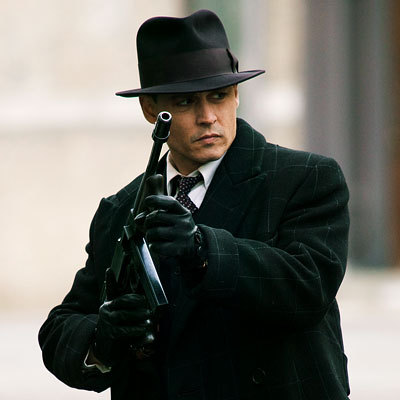
John Dillinger had enough publicity during his short* reign on the Most Wanted List, a lot of it generated by the man himself and his way of painting himself a folk-hero (he even saved his press clippings), so it seems like gold-plating a tommy-gun to make another movie lionizing him (see below). But Michael Mann—the director who created "Miami Vice" and has made a good movie or two ("Manhunter," "The Last of the Mohicans," "The Insider," and "Collateral") felt the need to make a new telling of the Dillinger legend—this one gussied up with Mann's usual stylish flair (although on more than one occasion the stylish suits and the familiar Chicago locations made me mindful of Brian De Palma's "The Untouchables"). Let us put aside for awhile the argument that the movie is morally wrong-headed to paint Dillinger as more sympathetic than his "Public Enemy" in the FBI, Melvin Purvis. Let's just examine where the movie goes wrong.

The opening break-out from the Indiana State Pen portrayed in the film has some relation to truth—guns were smuggled into the shirt-making shop in shipments of thread—but Dillinger wasn't there. He'd been paroled early due his step-mother's imminent death and was sitting in a jail-cell at the time from a small series of robberies that had been planned with his earlier cell-mates at Indiana. He was picked up at his girl-friend's house, which was being staked out by police. That hardly fits the legend of John Dillinger that
"Public Enemies" insists on pushing forward.

But then, the movie is less an accurate crime drama than a period romance. The film makes "
Billie" Freschette (Marion Cotillard) the love of Dillinger's life—the case could be made for Dillinger's wife who divorced him while he was serving his initial stretch in prison, breaking his heart and subsequently making him distrustful of long relationships with women. The absurdity is taken to an extreme case with a coda that is completely unbelievable, considering that Dillinger was famously gunned down in the company of a new prostitute girlfriend Polly Hamilton (Leelee Sobieski) and madam Anna Sage (Branka Katic)—the legendary "lady in red."** Still, one of the interesting stories about Dillinger is that the FBI staked out his boyhood home, hoping to arrest him the day he brought Freschette home to meet his folks. When the party broke up, three cars left the farm-house. The Feds followed the wrong one. It is true, as the movie shows, that Dillinger watched as Freschette was arrested and "cried like a baby" when he left the scene. He wasn't so broken up that he wouldn't take up with somebody else, though. And last words? Horseradish. Barbara Cartland could have written such sentimental sop.

The problems began from the beginning, when Leonardo DeCaprio was set to star as Dillinger, then when the project stalled,
Johnny Depp signed on. Neither of these boy-men make a credible Public Enemy #1. Depp's performance is fine, but wrong-headed, his Dillinger looking more dyspeptic than criminal. It's a romantic's fantasy of John Dillinger, as is the concept of Dillinger being a one-woman man.

Still, Mann does some good things. Shot on video (by
Dante Spinotti) the film is crystal-sharp, and looks great, even during its numerous hand-held sequences. The shoot-out at the Little Bohemia Lodge is completely inaccurate—the movie would have you believe that "Baby Face" Nelson died in the action as well as the two FBI agents who were killed—but the sequence is rip-roaring at times with Christian Bale's Melvin Purvis riding the running board firing a tommy-gun at the fleeing bandits.*** There are interesting cameo's—Billy Crudup does a fine impression of a young John Edgar Hoover, pugnacious, brittle and paranoid, and Lili Taylor shows up as Sheriff Lillian Holley. A made-up scene of Purvis and Dillinger taunting each other while the robber's in prison allows the two stars to have a scene together, but sacrifices the fact that Dillinger looked right at Purvis while walking out of the Biograph Theater his last night and did not recognize him.

But the film is as much fiction as fact, getting a lot of period facts wrong (there was no FDIC at the time of Dillinger's robbing career, yet a sign announcing the fact is displayed prominently, probably for comic effect, during a heist sequence) and the story a Disney version of actual events. It's a disappointment, considering a lot of the Dillinger story is stranger than fiction.

"Public Enemies" is a Rental.

There have been other versions of the story****

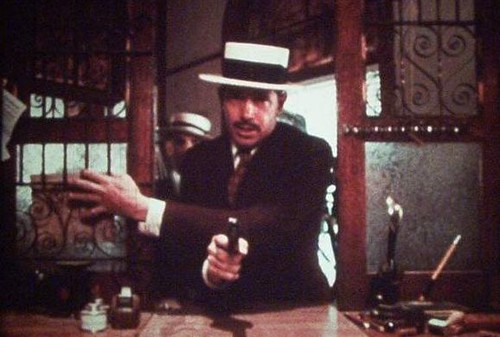
"Dillinger" (John Milius, 1973) Produced at a time when American International Pictures was actually putting some money into their films, it gave USC maverick director Milius a chance to direct. There's a lot of "Bonnie and Clyde" in this "Dillinger," and Milius indulges in some Peckinpavian slow-mo blood-spurting, but on the whole it's an interesting account of the Dillinger years. Milius also uses two members of the Peckinpah stock-company: Ben Johnson is too old to play Melvin Purvis, but the man lends considerable weight and history to the role and the movie which made a folk-hero out of Purvis on a par with Dillinger.***** In the title role, there could be no one better than Warren Oates, who not only looked like the real thing, but was a more pragmatic, less idealized version of the gangster. Along with Oates' better performance, Milius' film is a grittier, sparer version of things, not as glossy and feeling much more ambivalent toward both cops and robbers.

And look at that cast!
Richard Dreyfuss (over the top as "Baby Face" Nelson), Michelle Phillips (late of "The Mamas and the Papas") as Billy Frischette (though she's present at Dillinger's death), Cloris Leachman as Anna Sage, and a wealth of character actorsHarry Dean Stanton, Geoffrey Lewis, Steve Kanaly, Frank McRae, and Roy Jenson.

This is the one to see, despite (and maybe because of) the protestations of J. Edgar Hoover at the credits' end.


"Dillinger" (Max Nosseck, 1945) Low-budget exploitation film that took the Dillinger notoriety and regurgitated the legends, fictionalizing the story and changing names (winning an Academy Award nomination for screenwriting in the process!). The film starred Lawrence Tierney, Hollywood bad boy, who had a long career as a hood-type up to and including "Reservoir Dogs." But there are some good actors on hand like Marc Lawrence, Elisha Cook Jr., and Edmund Lowe. But the film is strictly of the "Calling All Cars" school, laughably simple-minded, with none of the style of the gangster movies of the previous decade, and Dillinger portrayed as a romantic figure—the female lead (Anne Jeffreys) refuses to pick Dillinger out of a line-up because she's got "the hots" for him. Not much to recommend it, other than you can watch it for free on Hulu.

Just to let you know this lionization still exists (as if "Public Enemies" wasn't enough), today is traditionally "John Dillinger Day" and members of the "John Dillinger Died For You" Society will be doing their traditional walk from the Biograph Theater, commemorating his death 75 years ago.

* Dillinger's crime career (following his prison sentence by unsuccessfully cold-cocking a local grocer) lasted all of 14 months.

** Even that story's not true—Sage told Purvis she would wear a white blouse and orange skirt—which appeared red in the Biograph's marquee lights. The trio went to the movies to escape a hot apartment and the Biograph was air-conditioned; the movie—"Manhattan Melodrama," a gangster film with Clark Gable, William Powell and Myrna Loy (she's given quite a tribute in "Public Enemies," and Marion Cotillard does resemble her).

*** Bale does a good job as Purvis, but he's a bit too dapper to portray the Special Agent. He is, however, one of the few actors who can fire a large caliber weapon without blinking. Purvis' story is an interesting one: charged by J. Edgar Hoover to "get Dillinger," when the press lionized the Agent, Hoover became jealous of the attention paid to him, making life miserable until Purvis left the Bureau a year later. Unable to find further work in law enforcement (due to alleged interference from Hoover), Purvis became a private businessman, married and fathered three sons. He died in 1960 of a gun-shot wound to the head from the revolver given to him by his FBI colleagues upon his retirement from the Bureau. Hoover's FBI ruled it a suicide (and Purvis was suffering from cancer at the time), but others have speculated he was killed accidentally trying to pry a tracer bullet out of the gun. When the legend becomes fact...

**** Not including "Young Dillinger" starring Nick Adams, sort of an "I was a Teen-Age Dillinger."

***** Milius padded Purvis' resume a great deal, having him in charge of the captures of "Pretty Boy" Floyd and Dillinger, but also "Baby Face" Nelson (as does "Public Enemies"), and "Machine Gun" Kelly, "Handsome Jack" Klutis, and Walter Underhill.


Wednesday, July 8, 2009

The Long Goodbye

"The Long Goodbye" (Robert Altman, 1973) Wise-acre. Ass-hole. Cutie-pie. Philip Marlowe's called a lot of names, but in Robert Altman's version of "The Long Goodbye," he's also "The Marlboro Man, The Duke of Bullshit."

As
Elliott Gould's Phillip Marlowe says again and again "It's okay with me."

It was supposed to be a straight-ahead adaptation of the
Raymond Chandler novel. Leigh Brackett, who had written a lot of Howard Hawks' films (including his adaptation of Chandler's "The Big Sleep") changed the ending, added some characters and complications and Hawks was contacted to direct. Nope. Then Peter Bogdanovich, who also passed, but who mentioned Robert Altman for director. Altman loved the new ending, mentioned Elliott Gould for Marlowe and a deal was made.

And that's where the changes come in. Because the last adaptation of a Chandler Philip Marlowe story was the somewhat irrelevent "Marlowe" starring laconic James Garner in the title roll. Created deep in the 60's, that film feels old-fashioned and a bit musty (even with Bruce Lee kicking apart Marlowe's office!). But for "The Long Goodbye," Altman was going to drop Marlowe into early 70's era Los Angeles, where everybody wore caftans and bushy sideburns, were into macrobiotics, EST and pot—a post-hippie era of conspicuous consumption that had trickled down from Marlowe's beat (problems with the rich) to the exotic dancers and truck-drivers of the pre-disco era.* Marlowe and his code of honor would seem out-of-touch in such a world.

Then throw in
Elliott Gould's rat's nest interpretation of the character and you get a completely other sensibility—one begins to suspect Marlowe of being incompetent in such a world, unable to function (he can't even find his own cat), but he does, snapping to whenever some dies (or is about to). And another nice touch is Gould's mumbling patter along the way, supplying his own first-person narrative, ala Chandler.

L.A. in twilight is still the same and the supporting cast of hoods and thugs as menacing as the time the Marlowe books encapsulated (late '30's to mid-50's), but now they're more than just socially deviant, they're demonstrably sociopathic in the form of Marty Augustine (director Mark Rydell), with twisted justifications for their actions, which can sometimes be just a sadistic play of power. And that's what makes Leigh Brackett's screenplay a bit different than the tone she took away back in 1945 when she and William Faulkner adapted Chandler's "The Big Sleep" for Howard Hawks and Bogey and Bacall: there's no sense of right and wrong, it's a sense of right and wrong for "me." And Brackett allows Marlowe to make a final statement condemning that world. It's the only way that this Marlowe...in this world...can "make it right."

There are problems—some stunt-casting—
Nina Van Pallandt (mistress of Howard Hughes scammer Clifford Irving) and Jim Bouton (former Seattle Pilot and author of "Ball Four!")—call more attention to the actors than the characters and Altman regular Henry Gibson has no steel core to speak of for his predatory doctor, but throughout, Altman and ace cinematographer Vilmos Zsigmond bring a formal off-the-cuff look to everything in L.A., culminating in two beach shots reflected in windows that present two perspectives on conversations, while in a push-focus the audience is clued in to happenings going on at the surf's edge, one inconsequential, the other, irretrievable. It's a fine example of Altman's ability as a seamless film-maker making his movie in the camera and relying less on the unique art to film-making of editing.

Two posters/One film: Two stories
The original film-poster that confused L.A. audiences into thinking they'd be seeing a straight-ahead thriller. The film was withdrawn for six months and re-instated with the above
Jack Davis-designed "Mad" style poster for the New York run, where it was very successful.

* And in a running gag, the percolating presence of a mordant "Long Goodbye" theme (written by Johnny Mercer and John "T." Williams--two years before "Jaws") pervades everything in Los Angeles—right down to the mantras and door-bells. Good thing there weren't cell-phones back then.

Friday, June 6, 2008

Olde Review: The Exorcist

This was part of a series of reviews of the ASUW Film series back in the '70's. Except for some punctuation, I haven't changed anything from the way it was presented, giving the kid I was back in the '70's a break. Any stray thoughts and updates I've included with the inevitable asterisked post-scripts.


"The Exorcist" (William Friedkin, 1973) When Ellen Burstyn was in Seattle last year, she was asked why she had chosen to star in "The Exorcist." She replied by calling attention the film's first scene after the blood-red titles--the scene which is predominated by an Iraqi morning prayer. That, Ms. Burstyn said, was what she thought the film was about--a call to prayer. Now, Ellen Burstyn struck me as being a brilliant and sensitive individual. But I'm afraid she was duped, as a lot of us were, by the writer and director of "The Exorcist," and by the Warner Brothers promotion department. When "The Exorcist" came out we were pummelled by newsaper and magazine articles on the authenticity and "religious significance" of the movie. A major "debate" erupted amongst Christian theologians about the devil's existence and the validity of the movie as a "Christian" document.

Well, in the three years since the film was released the furor has died down, so I think I can say what I'm about to say without fear of ex-communication: "The Exorcist" is nothing more than a horror movie. What is worse it's a horror movie with religious pretensions. This isn't to say that religious ideas can't enter into a horror movie. It can and can be done well. James Whale turned Frankenstein's Monster into a psuedo-Christ figure in "The Bride of Frankenstein," and the religious or anti-religious qualities of "Dracula" have been dealt with very extensively in the Hammer films with Christopher Lee. But these films' religious associations were in the background of the film, or atleast are cliche items with the genre so we don't notice them so much. There were also done by directors who knew what they were doing. William Friedkin is so hap-hazard about things in this film that he badly slips up with one of his "devices" - a medallion that keeps cropping up in the film, something Friedkin said in an interview would give his film "resonances," has since been the subject of an intelligent article that, because of the medallions' sloppy useage, sees "The Exorcist" as a marriage between Satan and the Church, exactly opposite to the film's supposed religious intentions. Hap-hazard work and a definite lack of thought on Friedkin's part are to blame.

So, "The Exorcist" is a horror movie with religious pretensions, not unlike 1976's "The Omen." The writer of "The Exorcist" (William Peter Blatty) stated that the film's intention was to "waken" our dormant fear of Satan and sleeping love for God and the innate goodness of man. Instead, "The exorcist" sent a number of people to mental institutions and sickened many to the point of vomiting in the theater. Blatty said that the sickness was "healthy, for the film worked on these people's guilts." Many clergymen, notably those who appeared in the film leapt to the film's defense.

One can see by this how religious pretensiousness can pile up like manure in a stable. People didn't throw up because of their sins, they threw up because the film was revolting, disgusting, and at the very least, unsubtle in its depiction of demonic possession and although one can admire the performances of the actors and the very original use of sound in the film, those are about the only things for which the film can be praised.

And looking at the film as a Catholic, I can say that the film did not make me change the belief that there is no personified evil, only the innate evil in various degrees within ourselves. But it did make me lose the belief I held since "The French Connection" that William Friedkin was a brilliant director.


Broadcast on KCMU-FM on January 21, 1977

Not much to add here, except to say that I am shocked, SHOCKED that Warner Bros. would try to legitimize their little puke show rather than just come out and say "We wanted to scare you so much that you'd plotz, and make a LOT of money!" "The Exorcist" seems tame these days. The film has had, what, four sequels? (two of them prequels, from the same source material--one from Renny Harlin after Paul Schrader's directed version was considered "not very marketable" and both were ultimately released to video so folks could judge for themselves, plus there was a "re-possessed" version of the original, with a minimum of new material released domestically which made $40 million) and any number of rip-off's and devil-tail riders. The immediate sequel was an unintended laff-riot directed by John Boorman, and Exorcist III was written and directed by Blatty himself, and was quite good--in fact, the best of the series. All of them experienced studio interference to up the "split-pea soup factor." Christian Document. Call to prayer. Right. Pass the collection plate.

Disclosures about the pedophilic activities of priests and their cover-up by Church authorities does make it seem like there's been a marriage between the Church and Satan to me, and made me lose Faith in any organized religion. Rather than a "lapsed" Catholic, I consider myself a "recovering" Catholic. More fervor was created watching "Deliver Us From Evil" than "The Exorcist." And not the good kind.

And Ellen Burstyn practices Sufism.

Meet the New Boss...

Sunday, February 3, 2008

The Spirit of the Beehive

"The Spirit of the Beehive" (Victor Erice, 1973) Victor Erice is the Terrence Malick of Spain (though to be correct it should be the other way around). His films are precise and planned so carefully that he has made three films since 1972's "The Spirit of the Beehive." "Spirit" tells the story of two children; Father is a bee-keeper, Mother is a repressed housewife. The children go to see a matinee of James Whale's "Frankenstein," which deeply affects the youngest, Ana. She wonders why, in a pivotal scene, the monster kills a young child (in the film it's never seen) and if the monster is real. She's told by her older sister that the monster is a spirit who will come at her call--"Hello, I am Ana." This sets in motion a series of events that juxtaposes life and freedom, identity and society, death and repression. This film was made in the last echoes of the Franco regime and the people walk around in a form of zombie-state, their expressions impossible to read. That the Frankenstein monster is seen in this context as a symbol of life and freedom shows what a palpable symbol it remains, and how malleable.