Showing posts with label Thriller. Show all posts

Saturday, June 29, 2013

Stoker

"Creepy Carrie, Creepy Carrie"
or
There's Just One Hitch...

There is such an air of oppression in Chan-wook Park's Stoker ("from the acclaimed director of Oldboy") that it completely tractors over any pretensions of accomplishing what the intent is...to make a film in the style of Alfred Hitchcock.

Well, to do that you have to have an understanding of what Alfred Hitchcock did as a director...and you also have to have an understanding of what "style" is.  Not the stylization of what we see here—all oblique angles  and off-kilter cutting, movie-making that "suggests" a story rather than just coming right out and saying it in movie terms.  But, also you have to know that Hitchcock's "thrillers," when he made them, took the opposite tack of Stoker, presenting "normal" life invaded by aberration, rather than making it the norm.  Hitchcock might have been obsessed with the creepy, but the gourmand in him knew that a steady diet of it would make it dull.


Which is what Stoker is.


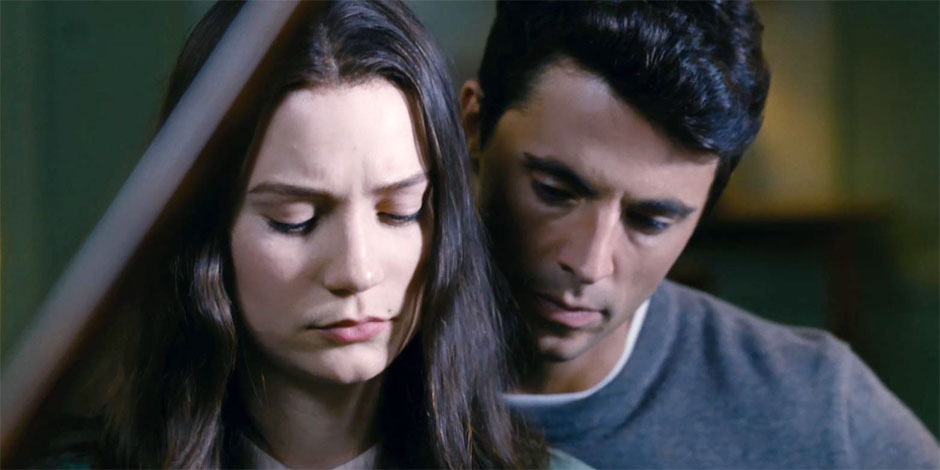
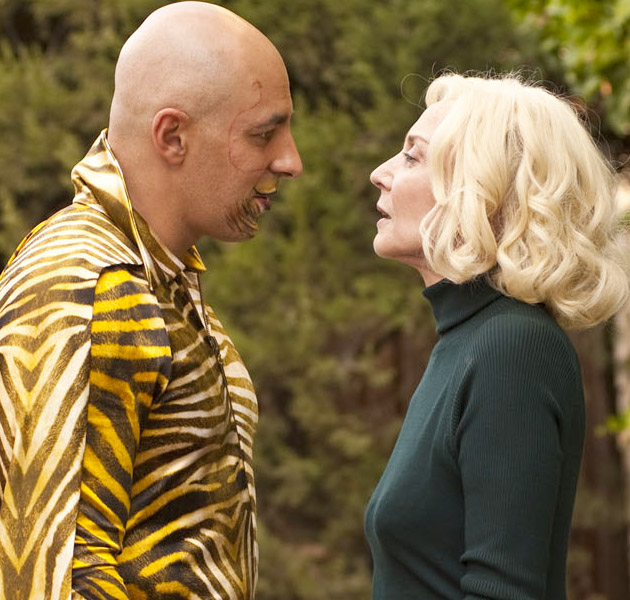
On her 18th birthday, the father of India Stoker (Mia Wasikowska) is killed in an automobile accident, devastating her family, and introducing to them her father's brother "Uncle Charlie" (Matthew Goode) at the funeral.  Charlie stays with the family inserting himself into every aspect of the Stoker household, still in shock over Richard Stoker's (Dermot Mulroney) death, taking a particular interest in gardening, the servants, and mother Evelyn (Nicole Kidman).  Soon, the head caretaker goes missing, as does great-aunt Gwendolyn (Jacki Weaver), explained away by Charlie, who then turns his laser-like gaze on India.  As is the trait of Uncle Charlies, he sees a kindred spirit in his brother's daughter, and if the man had any sense, he'd be afraid of that, which is the only aspect of Stoker that doesn't pay homage to the Master of Suspense—this is a movie that has no redemption and no hope.


There's a child's primer of Hitchcock throughout: bad "mother" relationships, a creepy "Uncle Charlie," odd dispassionate deaths, the callow, uncomfortable-making young man, the swinging light, the "secret" basement, the masquerading gardening activities, the imposing staircase (circular), the rather irrelevant but "convenient" ability of India.  It's a Hitchcock movie for those who've only seen Psycho, and are stuck in that film's deliberate pace and motivation.  It's designed to shock, but not to move (and not even out of one's seat...unless of course, it's to walk out).

And there's no humor.  Not even a nervous titter.  Oh, sure, there is dark "irony" scattered hither and yon with all the subtlety of a hammer swing, but there is no lightness of touch anywhere, not even as an antidote to all the mock serious portent that shrouds the thing, that makes it travel the dead man's walk from too-heavy seriousness to unintended self-parody.  It's as if Alan Ball had written Shadow of a Doubt, directed by a too-eager-too-please director who knows nothing about sub-text, and the fun ways that one can infuse the abnormal into normal, or what passes for it.

Stoker is a Cable-Watcher.


It's all in the trailer, kids.

Tuesday, May 7, 2013

Side Effects

First, Do No Harm
or
Physician, Heal Thyself


One of my great joys in life is watching happy-pharm' commercials that spend ten of their thirty seconds extolling the virtues of their chemicals ("It stops your brain from telling you you're SAD!"), then the last 20 of them warning about all the dire side effects of said chemicals up to and including death (and maybe beyond).  That's comedy gold right there, masquerading as serious medical advice, wrapped in ad hucksterism.*

Now, prolific director Steve Soderbergh, who started his career twenty four years ago with Sex, Lies, and Videotape is saying he will end his commercial film career** with Side Effects, an odd mixing of genres that has as its basis all those little warnings for the mystery "miracle" pills that are being foisted on the public for the slightest of symptoms and moods, with the tentative approval of the FDA, and a library of law-suits, concerning their consequences on real human beings.  In that way, it plays on a public's paranoia and trust of just what kind of human experiments might be being financed by the drug cartels, in much the same way as Hitchcock messed with our minds with our basic fears in his long career.  Soderbergh has never been this direct in his work before, making something akin to a traditional suspense-thriller, instead of a character study with sociological underpinnings (The Informant!,  Contagion,  S, L, and V, Traffic) as we're used to from his previous work.

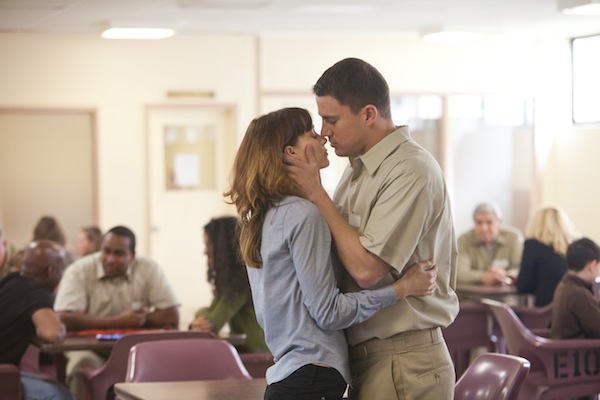
It's a pretty basic story, with some nicely diverting echoes of recent headlines:  Emily Taylor (Rooney Mara) works for a New York marketing agency and is dealing with a lot of stress in her life.  Her husband (Channing Tatum) is being released from prison after four years for insider trading.   She's been struggling with these issues for awhile, and being treated for depression over the circumstances.  But, once husband comes home, things take a turn for the worst.  

Or actually, don't take a turn—Emily drives her late-model car directly into a garage wall—rather than heading for the "Exit" arrow, she runs INTO the "Exit" arrow.


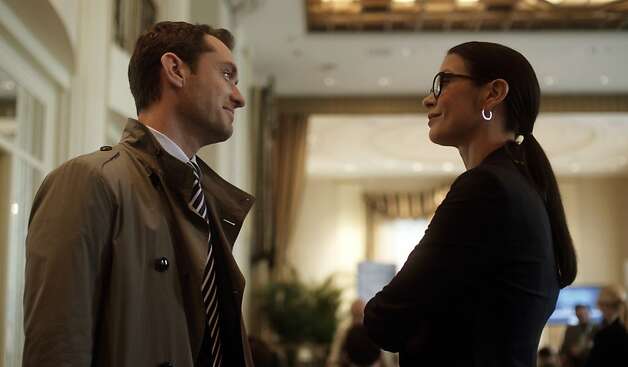
She suffers a concussion and is taken to the hospital, where she comes under the watchful eye of Dr. Jonathan Banks (Jude Law) who knows exactly what's wrong by deducing "usually when someone hits a brick wall, there are skid marks."  Emily doesn't want to be a bother, and bargains her way out of the E.R. by promising to visit Dr. Banks for therapy.


At this point, a responsible reviewer should say: "Warning: complications may occur, consult your physician."  Let's just say "things get messy" and merely suggest that a nasty case of medical ethics can turn into...a really nasty case of all kinds of ethics.  To say any more would spoil the bumpy ride the film provides, but one doesn't risk too much by sharing a particularly nifty exchange around which the whole film hinges: "Did the person do it?  Are they guilty?" "In the present case, those are two very different things."  Nice little piece of writing, that.  


The screenwriter is Scott Z. Burns (who also wrote Contagion and The Informant!) and he's constructed a medical thriller that takes a few hairpin turns and manages to avoid the guardrails of audience expectations and movie cliches.  And Soderbergh (who shot and edited the film) has cast it impeccably with folks he's worked with before: Law, who's usually fared better at smaller character parts, here finally shows he can carry off a "leading man" role, dominating the film, while making "normal" interesting; Catherine Zeta-Jones shows (again) how versatile she can be in a small but crucial role as a consulting shrink; Channing Tatum makes the most of his part as the husband caught up in a world that he's just re-entered but can't understand.  And Soderbergh rookie Rooney Mara gives a complex performance that's more than a little unpredictable (not surprising, given her history of moving from a straight performance in The Social Network to anything-but in Fincher's version of The Girl with the Dragon Tattoo) looking like what you'd imagine Sandra Bullock's creepy little sister might look like, Mara convincingly pulls off mood shifts that might require an exorcist rather than a prescription.

In many ways, Side Effects is the film many expected last year's Flight to be: instead of a straight-forward look at addictions and their crises, a lot of viewers were expecting there to be some mystery that would neatly tie loose ends and vindicate its protagonist.  But, Side Effects plays with societal responsibility and legalities in a time when the very nature of people's natures is being altered, in the same way that Michael Crichton used to explore science's impacts on us in his books and films, provoking such tough questions and "Are we prepared for this?" "Just because we can do this, should we, and how will we deal with the fall-out?"

In any case, in the theater or after-movie discussions, Side Effects will not cause drowsiness.

Side Effects is a Matinee.


Jude Law learns his practice isn't perfect in Side Effects

* SNL did a fine parody of this type of advertising with a fictional toy-product, the generically-labelled "Happy Fun Ball:"


**  We'll see how long that lasts, but Soderbergh has long grated against turning out commercial product (the one-two punch last year of Haywire and Magic Mike, notwithstanding) for the sake of commercial product, wanting to experiment with non-box-officey topics and distribution avenues.

Friday, April 27, 2012

The Skin I Live In


The Skin I Live In (aka La Piel Que Habito) (Pedro Almodóvar, 2011) The Spanish director sets up an intriguing situation before he provides any explanation: a woman, Vera (Elena Anaya) in a skin-tight body-suit spends her days in a safe-room of a palatial estate, overseen by an older woman (Marisa Paredes) who keeps her isolated, delivering meals by dumb-waiter.  Yoga, stretching exercises make up the bulk of her day, but there are the occasional distractions and tantrums, like ripping up every dress in her closet, the appearance of the older woman's crazy son (who stages a violent attack on the premises and her) and the visits of Dr. Robert Ledgard (Antonio Banderas), brilliant, obsessed plastic surgeon, who is doing research on synthetic skins, able to resist fire and insect bites.  Interesting research, if slightly peculiar, and a lot of it seems to encompass Vera, who has a cordial, distant relationship with the man on the other side of the monitor.

The questions swirl around the set up: Who is she?  What's she to him?  Why her?  Why the security and isolation?

What's the story?

Almodóvar will provide the explanation, certainly, in due time (even if we have to wait for the end of the movie, in some of his cases), but the answers will come eventually, making the director a firm practitioner of the mystery genre. But The Skin I Live In also touches on horror themes (with one particular horror film reverberating throughout), with a touch of science-fiction thrown in this time, while still firmly housed in the twisted vine of a villa that house Almodovar's interests: love, sex, obsession, sexual identity, generational influence, and the definition of "self."  At the same time, Almodóvar shows once again that he is the true inheritor of the Hitchcock mantle, as he explores many of the same themes of The Master of Suspense, but going places Hitchcock (or even Brian De Palma, for that matter!) wouldn't dare go.

For Ledgard (I keep wanting to call him "Lodger"—Hitchcock again) is using the subject to reclaim the past in the same way that, say, Scottie Ferguson does in Vertigo.  It's not love that drives him, it's not even revenge, it is obsession, and that Vera is tied up (or tied down) in all of it, as the answer to his dreams and nightmares...and fantasies, for good or ill, wraps things up in one tidy, stitched together, bandaged package.  That he has a  doppelgänger, and mother issues (as most of  Almodóvar 's protagonists do) only cements him further in the Hitchcockian basement.  And that he's played by Banderas, outwardly controlled—although he's played his share of crazies—shows that same pathology that Sir Alfred would wring out of his star-name actors...just under the skin.  

And as great as Banderas is here, though submerged, the lion's share of the movie belongs to, and is shouldered by, Elena Anaya.  It's only when the movie's done that you realize the fine line she had to walk, and the issues she had to skirt, in order to make the movie work as well as it does.  It's tough to pull off a role this emotional while remaining something of a cypher...and a mystery.

This one will have you thinking for a long time afterwards, and not just in piecing it together.  There are themes, sub-themes, and subcutaneous layers that fold and crease and support each other, that will surprise and even crrep you out.  And it will make you ask questions. And make you think.

As any good horror movie should.

Thursday, September 15, 2011

Body of Lies

This week, we're re-publishing some reviews of the films from the post 9-11 environment.

"Killing the Future with the Past"
There have been a great-many films about The Iraq War; emphasis on the "many," not so much on the "great." None have penetrated the box-office top five, and the movie-going public, with a constant dose of it (when things are going badly) on the news, have made the conscious decision to avoid paying attention at every opportunity. It may seem a disparaging thing to note, but, the public seems to have better sense than the government representing it.
Body of Lies with the one-two star punch of DiCaprio/Crowe, under the direction of Ridley Scott did manage to gain an audience (though not enough to topple the reigning champ, Beverly Hills Chihuahua), and it's just as well—it's a summation of just about every "Bush-war" film that has gone before, without adding anything new.

Part of the problem is
Ridley Scott, who more often cares about how his films look than what they say. Part of the problem is William Monahan's script (which covers much of the same ground as the other films dealing with a high-tech war in a low-tech country, where boots on the ground see more than eyes in the sky--it just got there last, is all). And the other problem is that the war has gone on so long, that we might be running out of things to say about it, at least until some of the secrecy veil is lifted about the machinations going on in the marble halls and scrub rooms of Washington and Virginia.

Not to say the film doesn't have a lot to say. At one point--with a tight deadline to meet--I checked my watch to see if the film was about to wrap up, it being so full of incident and detail, and was shocked to see that an hour hadn't even gone by yet. There was still another hour to go! There is such a flood of realistic sounding information that it probably resembles the tsunami of information Homeland Security has to sift through with their Cray's. All of that research, all that sound and fury and the all the movie comes up with is "Tell the Truth."

Thanks. We knew that going in.

The points writer and director make are obvious:
DiCaprio, in the Sandbox, has more of a grasp of what's happening, despite his getting marching orders from puppet-master Crowe in Langley. Scott repeatedly makes the point as DeCaprio curses at Crowe over his ear-bud, while Crowe's character is dealing with domestic needs at home. While Dicaprio's Robert Ferris is doing wet-work, Crowe's Ed Hoffman is SUV-ing the kids to school, with all the icy coolness of the uninvolved. And that happens frequently.

Ultimately, it's a waste of time, and is another of the many Ridley Scott projects that looks good, but doesn't add up to much in the long run. We've seen this story before.

Now, give us a good ending.


Body of Lies is a rental


Tuesday, September 13, 2011

Traitor

This week, we're re-publishing some reviews of the films from the post 9-11 environment.

"I Wouldn't Make Any Plans, Man..."

Traitor is a taut, tough little thriller about the FBI (yes, the FBI) trying to track down a group of Islamic jihadists with plans to pull off a continuing string of bombings throughout the world. Their focus is one Samir Horn (Don Cheadle), born in the Sudan, and who disappeared while working for the government in Afghanistan. Word is that he found his faith working for the mujahadin, and now he's been tracked selling detonators to a terrorist faction in Yemen.

There, two FBI agents, Clayton (Guy Pearce, this time with a convincing soft Southern accent) and Archer (Neal McDonough) are tracking the faction's movements, and during a raid, Horn is captured, but will not turn over any evidence to help the investigation. In prison, he is doubted by the jihadists as a possible informer to the U.S., and a target by some of the prisoners. Outside, he is not trusted at all, but as long as he's detained, he's not a threat.

Then, he breaks out.

At this point, to reveal any more of the plot might be unfair to anyone who wants to see a well-done "War on Terror" thriller, done in the shakiest "Bourne" style, with powerhouse performances by Cheadle, Pearce, McDonough and Jeff Daniels. Real tension is achieved throughout the story, as the stakes get increasingly higher. And writer-director Jeffrey Nachmanoff, working from a story by Steve Martin* (yes, that Steve Martin) keeps things simple and straight-forward--pretty amazing, given that his last credit was for screen-writing The Day After Tomorrow. Without much on his resume to indicate that he was capable of this, it will be interesting to see what he does in the future.

The other neat thing is seeing Don Cheadle in full "action-star" mode--tight, lean and fast, he pulls off several well-done fight scenes, while never sacrificing the wariness and intelligence in his eyes. At this point, it should be pretty obvious that Cheadle can play just about anything, and have the audience with him the whole way.

"Traitor" is a Matinee


* Sleeping on it, Martin's participation seems apt, rather than surprising. The denouement is the product of a Master of the Absurd, and thinking further on it, in the War on Terror, Absurdism is only a realization away from the insanity of the unthinking zealot. Maybe in the War on Terror, we need fewer strategists and more comedians. "Laugh? I killed 'em!"

Thursday, July 21, 2011

The Double Hour

"Wishing Doesn't Make It So"

Sonia (Kseniya Rappoport) is a chambermaid in a Turin hotel.  It's dull work, broken by the creepy tenants, the staff gossip and the occassional suicide out the window.  This certainly doesn't cheer up Sonia's life and makes things particularly difficult at a speed-dating service where she meets (mercifully quickly) a bunch of losers all of whom are attracted to her. Last (but not least) is Guido (Filippo Timi), ex-cop now security guard, widower and sound-junkie.  They seem to hit it off, at least in speed-dating terms, and soon, they're taking the first tentative steps to...uh...slow-dating, I guess.*

Guido takes Sonia to the palatial res' he is currently monitoring, shows her his recording equipment which he uses to tape nature sounds, then takes her for a walk around the grounds.  As Fate would have it, that's just the moment that the mansion becomes the setting for a robbery and Guido is knocked unconscious, Sonia taken hostage and the place ransacked of its antiques and valuable paintings.  It is when one of the thieves decides to have some fun with Sonia that Guido jumps the guy, head-butts him...and then the gun goes off.

Fade to Black.

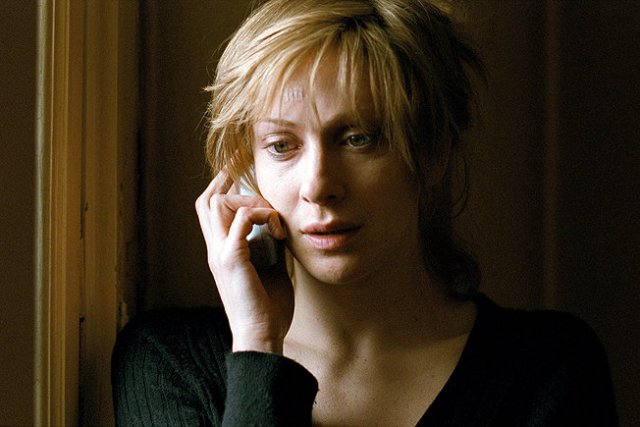
It is some time later.  Sonia is sporting a nasty scar on her forehead, the result of a bullet wound.  Guido is dead, killed by the same bullet, and Sonia mourns.  She misses him.  Well, more acurately, she is haunted by him...because she hears him speak her name every so often.  And then there are his ghostly appearances, and the strange booming noises that periodically elevate the audience out of their seats.  What is going on?

I can't tell you because it would spoil the movie.  It is enough to say that the film is a Möbius strip of twists and turns of both the mind and the heart, with a Hitchcockian identification shift that's disorienting, disheartening and damned clever.  There are enough red herrings to burst a fishing net, some of them necessary and some of them just distractions.  For instance, the title: Guido mentions on their first extended talk his own curious wish-myth of "the double hour"—when the hour and minutes are the same (like 12:12 am), make a wish and it might come true.  "Does it work?" asks Sonia.  "No," says Guido. 

Funny, but unnecessary.  It's used as a touch-stone for the entire movie, a call-back that ultimately adds little, one of a number of details that cloud the issue and distract (which may be the point).  A little buttoning-up of some of these elements might have made this one a better film.

Still, at its core, The Double Hour (La doppia ora) is a neat little conceit, and director Giuseppe Capotondi and his writers keep you guessing the whole way, bending, shaping and twisting the plot...and your mind along with it.

The Double Hour is a Rental.


* The slowest of which is Carbon-14 dating (....sorry).  

Wednesday, July 20, 2011

Vantage Point


Vantage Point (Pete Travis, 2008) An American news crew sits in their van in Salamanca, Spain, technically coordinating coverage of a Presidential visit.  No sooner does POTUS (William Hurt) take the podium when two shots ring out, sending him flying, to the horror of the news-people, the Secret Service, the crowded throng and the millions who are (probably not) watching at home.  For a split-second, there is reaction all around, and then the confusion starts: where did the shots come from, who's that running guy, get the president to the hospital, foot-chase.  At the end of it, a lot of people are dead, and the ramifications are huge, while the news channels try to play catch up...and one suspects never will.

This one's just plain crazy.  The same 15 minutes, played out, rewound, clock started again, and POV switched.  Technically, it's a daunting challenge, with all the shots of things that have gone before shifted into the background, and having to match what went before in the same time-frame that it did before, although one later incident seems to be fudged a little longer to allow some exposition in one segment (all the better to build suspense).  The director, Pete Travis, mostly known for his British television work) does one thing that always drives me nuts in pot-boiler novels—he takes you to one pop-eye inducing moment...and then...stops and goes back.  Next chapter.  We'll get back to that...

That would make it "a relentless page-turner" if it had a spine, but you're stuck watching the movie, wondering, "Yeah, but what about..."  Annoying.  But, not enough to make you hit the "Eject" button.

Source Code did this a little better this year, and had the decency to make all the populace in it more than innocent by-standers.  Most of the characters are there to serve a function in the plot, rather then being motivated, save for Dennis Quaid's Secret Service agent, who has just come back to active duty after taking a bullet for this President six months earlier.  The speculation is that he might be a little gun-shy (if so, he wouldn't be put on active duty, now would he?)

This is the problem with the film.  Good concept (even if it is Akira Kurosawa's), but the deeper we go into the movie and the more we find out about this 15 minutes, the situation becomes less and less likely, and more and more contrived.  It has the kinetic feel of an episode of "24" compressed and spread out over a ninety minute running time.  And, it isn't even "The Rashomon Effect," where (when it's done well) the differing perspectives are colored by the person telling the story.  Here, facts are facts—it just happens from different angles, how the person feels about it doesn't enter into things.  In that regard, Vantage Point is just a standard detective thriller, more about information dissemination in an electronic 24 hour news cycle, rather than saying anything about the human condition—besides the obvious jumping to conclusions.  The film begins and ends in that van and the broadcast of events, making the point that there's a photon-filter between truth and knowledge.  At the end, the news audience does not know, and may never know exactly what went down.  But, given what we already know about the efficacy of reporting "while it happens," the endless speculation and rumor-airing and other apocrypha and opinion that's offered as journalism, it is a bit of a hollow exercise, a "gimmick" movie without that much to offer.

Is it a good movie? I don't know.


Wednesday, January 19, 2011

The Day of the Jackal


The Day of the Jackal (Fred Zinnemann, 1973) Not to be confused with the lousy 1997 retread (rather than remake)The Jackal with Bruce Willis and a ludicrously accented Richard Gere "acting the maggot" that was dumbed down for its target audience (Assassinate General DeGaulle?  Who's that?  Make it the First Lady, instead).

This one actually is based on the Frederick Forsythe best-seller, and done in as nondescript a way as possible, almost a prettified documentary style lacking stars (although Michael Lonsdale and Edward Fox would emerge from it with solid character-actor careers), but adhering stoically to the plot and its amoral assassin (Fox), both as cold as they come.

The Jackal is teflon—never been photographed, only rumors to his existence, but, he is hired to take out France's President by a cadre of disgraced French Foreign Legion Generals.  Their own clumsy attempt having, failed they turn to an outsider, anonymous, unknown but to have been involved with earlier assassinations.  Because it is a once-in-a-lifetime "hit," he demands half a million dollars on which to retire.

The movie then runs along two parallel paths of suspense, as the Jackal arms, plans, and sneaks his way into France, while the authorities, led by the cool-as-a-cucumber-sandwich Lebel (Lonsdale), after hearing rumors about an attempt, try to find information within their own circle about a man that no one has seen.

They might as well be chasing a ghost.  The Jackal assumes identities, habits and companions, then discards them like an unneeded skin as he moves inexorably to a point in time and place that only he knows, with murderous equipment well-hidden, to meet his target.  He is one man.  But, the police and government authorities are many, though at times it seems less an advantage.  What is fascinating is the amoral methods of the two opponents, Jackal and Lebel.  The former is a determined sociopath, leaving a trail of bodies that are found only days behind him, while Lebel, entrusted with the life of the most powerful man in France, has no qualms about disrupting those of others, refusing to let decorum, jurisdiction, or bureaucratic bumbledom stand in his way.  He is, after all, fighting someone he doesn't know to prevent a crime he doesn't know where or when.

The script (by Kenneth Ross) is also morally ambiguous—not commenting either way on the actions of hunter and hunted.  In one astounding scene (only in that it is not astounding at all), The Jackal discards a temporary lover in a manner that seems like an embrace, only her stillness informs that she is, in fact, deceased.  Cerebrally chilly, and damned clever, the absence of stars might have made it less successful at the box-office (Michael Caine, Jack Nicholson, and Roger Moore were considered potential Jackals, but the producers went with the less-well-known Fox so he could "blend"), but The Day of the Jackal is still a film exercise in meticulous suspense, and becomes the novel well.


Wednesday, June 30, 2010

The Silence of the Lambs

The Silence of the Lambs  (Jonathan Demme, 1994) "I will NOT go see a movie like THAT!"

My client was adamant. I knew what he meant. I was repulsed by the idea, myself. After all, it was based on a novel by
Thomas Harris, the most ghoulish and cruelest of thriller writers. I'd read "Black Sunday" and it had an image I wish I could sand-paper out of my mind. I'd read "Red Dragon" (and seen it's Michael Mann movie adaptation, Manhunter), but I hadn't read "The Silence of the Lambs." After "Red Dragon" I swore off his novels. Harris went places I just didn't want to go...ever...not even in a pulp entertainment.

But the "buzz" about
The Silence of the Lambs was so good, I had to go. My wife didn't want to see it ("UH-uh"). But a female colleague heard I was going (and her husband was "in no way" going to see it), so we agreed to meet up at the theater—almost like a dare—and satisfy our morbid personalities.

See, I'd seen
Manhunter (starring pre-"CSI" William Petersen and Joan Allen), and the most intriguing thing about it was the introduction of a character named Dr. Hannibal Lecter* (played in Manhunter by Brian Cox). Lecter was an über-villain, like Dr. Mabuse. An insane genius psychiatrist, far more twisted than his clients, and he seemed unstoppable, uncontainable. Indeed, he was portrayed as a criminal so dangerous, he was kept in an impenetrable transparent cage of perspex. Cox played him agitated, and as a cannibal, he perpetually chewed gum, as if to satisfy a craving (or to keep his jaw strong).


A study in contrasts: Brian Cox (left) and Anthony Hopkins (below) as their respective Lecters


Anthony Hopkins famously played him in The Silence of the Lambs as an unblinking, supremely confident being of stillness.  When we first see him (after an extended build-up talking about how dangerous he is), the camera slides him into view—and he's already waiting for us.  That's a bravura move (done in silence, purely visually, pure cinema) in collaboration between Hopkins and director Jonathan Demme (who has never been so "to-the-bone" instinctual in his set-ups).  Our first sight of Hopkins is a shock; he's not doing anything. Nor does he have to.  In a dungeon-cage with a tranparent front (not bars, as they're too penetrable, but more like a zoo for observation), he still is in control of the situation and knows it, and his "laser-like intellect" has already begun profiling his prey, FBI Agent Clarice Starling (a bird's name, indicative of small, tremulous life), played by a subtly vibrating Jodie Foster (who's brilliant).


This is a horror movie.  And the best horror movies don't just scare us.  They touch a nerve, grab on tight and slither up into our brains and take root, never leaving us.  They know what scares us, right down to the DNA in our collective alligator brains, and individually to our unbidden (but specially created) nightmares.  And like Jaws, The Silence of the Lambs serves up one of the special horrors to our conqueror species:  fear of being eaten...consumed.  It's not just the dying and the reduction to meat, but it's taking away ourselves, our "souls," our specialness and uniqueness (like Gene Hackman's Sheriff in Unforgiven blurting down the echoing cave of a gun-barrel: "I was building a HOUSE!"). "Deserves got nothing to do with it."

And that's a horror.  A true horror.  A viscerally twisting fear of humankind, that we don't matter, everything that we are, that we do, can't hold off Death.  Any Death.  Every "snuff" makes us just dust in the wind.  And everything we are amounts to nothing.  "Tell her to paint an inch thick.  To this favour, she must come."

"Make her laugh at that."

Sure, it's a horror movie.  But becoming carrion is one thing.  This is about skin-suits. Bad enough to be turned into a meal, yes.  But apparel? 

Yeee-EEE-eee!

So, that's the reason so many people might NOT want to go see The Silence of the Lambs.  What is there, of such value, to see it?  To face your fears and walk into the darkened theater to face these horrors?


There is a subtle sub-text in the film and a not-so-subtle-visual one.  One of the travails of Agent Starling is to go through her rigorous FBI training, the obstacles, the paths, includes making her way through a traditional world (and institutuion) of men.  She is often under-estimated (except by, of all people, Lecter, who is intrigued and challenged by her: "People will say we're in love" is his witty reversal on it) and must point out to the officious males she's dealing with (and it is dealing) that they are treating her in a subordinate manner ("You know, we get a lot of detectives here, but I must say I can't ever remember one as attractive."), even though she calls everyone—her superior Jack Crawford (Scott Glenn), Lecter, even the serial killer she's seeking (the terrific Ted Levine, whose brave work in this film should never be unacknowledged in any review) "sir."  


Foster's Starling is a victim, too, although she won't succumb to victimization.  She fights it.  And she fights the battle for the women whose lives have been lost through the pathological extension of that subjugation, and, with her work, might be saved.  Reduction of the human being is the tough theme that runs through The Silence of the Lambs, and it is perpetrated by serial killers and officials alike, anyone who assumes more authority than they are due.  Or more superiority than they deserve.  We all covet that to some degree.  Look in the mirror.

What looks back?


"The eyes are the window to the Soul" they say (although it's difficult to trace who originally said it).  And director Demme makes sure we see them, both eyes and souls.  Frequently, even in conversations, he will photograph the actors looking straight on, their eyes on a direct axis with the center of the camera lens (and thus, the audience).  A lot of directors do that (Spike Lee and Woody Allen, for instances), but more often than not, those uses are to have the characters speak directly to the audience, breaking the fourth wall between player and played.  Not Demme (and this is what makes Silence unique).  Whole conversations happen, with the actors looking out at us, as if we are the ones having the conversation—we connect with them, those flickering phantoms on the screen, making them more than casual phantoms, the ones we merely observe as if they were any passer-by on the street.  We look into those windows, see the Souls (even those of the Soulless) and immediately those beings have value and worth, not just victims of our gaze, but true intimates, more than the mere shells that envelop their spirits.

And this is what separates The Silence of the Lambs from the many serial-killer/slasher movies that stalk through the genre—separates it a full 180° from the other films, in fact.  So many of those use the POV subjective shot of the killer observing and hunting its prey (and Demme uses it, too, in the nerve-jangling final confrontation between Starling and "Buffalo" Bill).  So many used it, in fact, that it became a cliché of the type, putting us in the uncomfortable position of seeing the world through the victimizer's vision, rather than the victim's—the hunter's, rather than the hunted's—accompanied by the rasping inhuman breath of the coveting, rather than the pleadings of the coveted.  "The Silence of the Lambs" breathes new life into the form, elevating the victim, the genre...and us.  It gives value to the human being, and in so doing, raises itself up, as well.

---------------------------------------------------

"So," the client began tentatively. "I went to go see Silence of the Lambs... 

"And?" I offered. "Wha'd ya think?"

He blurted. "Ya know, that was a REALLY GOOD movie."

Yes, it is.  Still is. Repulsive, still, certainly. But a great movie.


And it still has the distinction of being the only horror movie to win the Best Picture Oscar, and, even rarer, to win the Big Five categories (Best Picture, Director, Actor, Actress, Screenplay), all deservedly so.


* In Mann's film, he's Hannibal Lecktor, a more oral-associated mad scientist name.

Friday, April 16, 2010

Chloe

"We Used to Do Everything Together"

Atom Egoyan's "Chloe" (based on the movie "Nathalie...") is a throwback to the '70's, and that cusp of movie-making history before cable began making the sexually-charged obsession films that used to draw folks into the cinemas. Take a theme of Hitchcockian prurience (including a bit of his fashion sense), slime it with some DePalma directness (without the use of power-tools) and spice it with just a pinch of Kubrickian cruelty and that's "Chloe."

Dr. Catherine Stewart* (
Julianne Moore) has a successful practice as a clinical OB/GYN—very clinical. "It's just the contraction of muscles," she informs a patient who's never had an orgasm. "There's nothing mysterious or magical about it."

In any Hitchcock thriller, such expert dismissal clamors for a cum-uppance.

Fact is, she's worried about her marriage to classical music scholar David (
Liam Neeson). There's not a lot of communication in it. For instance, she throws a surprise party for him, which he misses completely, when he fails to catch a shuttle from New York. Smartie, smartie has a party... She's hurt, embarrassed, vulnerable, and suspicious. David's evasiveness and a happened-upon text message lads her to suspect he's having an affair, despite his protestations (well, she can see him flirting with anything in a skirt!). The couple may be talking, but nobody's listening.

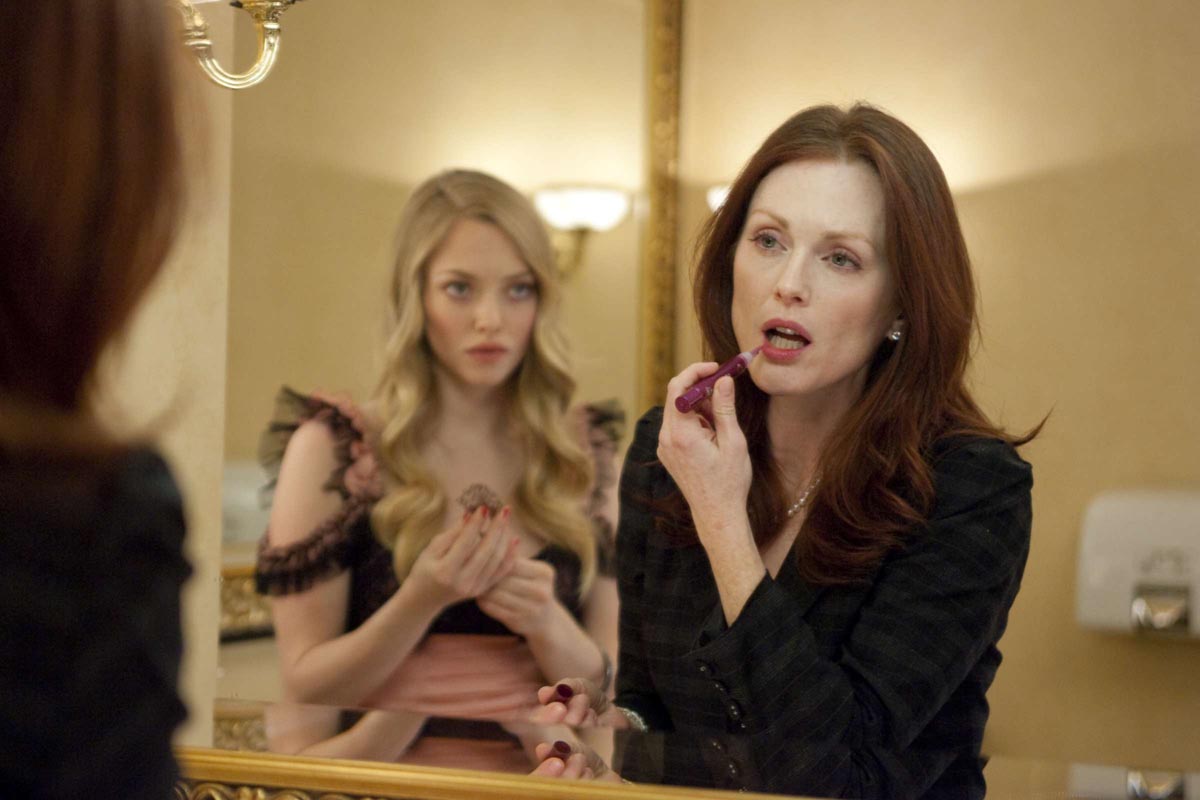
A chance encounter with student-aged escort Chloe Sweeney (Amanda Seyfried, all eyes and lips) gives her an idea; she hires the young hooker to flirt with David—just to see what happens (just to confirm what she suspects in her mind). "What's the client's name?" asks the girl. "He's not the client," the doctor orders.

Of course not. That would imply somebody else has control. The situation is about her, willing to tempt fate
to tempt her husband, and make concrete her suspicions. An arranged casual meeting at lunch confirms her fears—David is interested in the girl. Very interested.

This creates a series of triangulations that are liable to hurt somebody with its knife-like edges. The issues become the usual ones in sexual politics:
who's in control, what's the motivation, what's the risk, who has the headache.

This would be a great deal of fun if it was more...fun. For all the frank-talk and
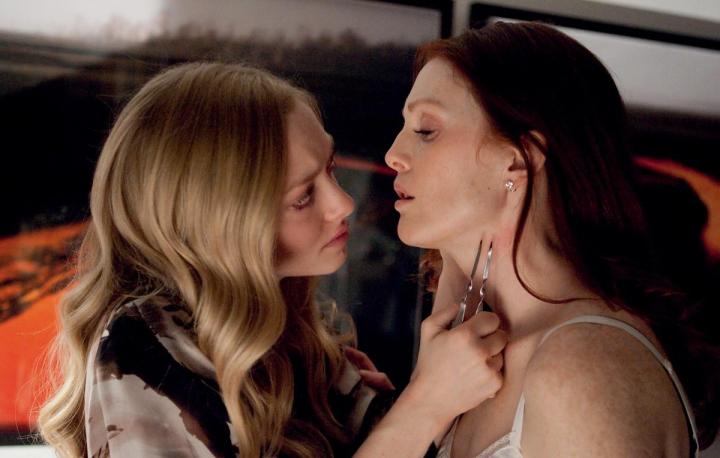
the abundant nudity on the part of Seyfried and Moore, especially in a girl-on-girl love-making sequence—this movie will be remembered only on the pages of "Mr. Skin"—little is left to the imagination. And imagination is what the film is all about...or should be. In her voice-over, young Chloe boasts that she is skilled enough to become "your living, breathing...unflinching dream." It's an example of how the screenplay is clever with its words and quite precise in its usage. But it has no wit. It takes everything so seriously to the point of ludicrousness, and can't even laugh at its own contrary prudishness. It's like a partner more concerned in acting the part in their performance than with the act itself. It's not fun. Kinky for awhile, but not fun.

Some of Hitchcock's naughty sense of humor would be nice, even some of his comic mother issues,
as opposed to the earnestly oppressive ones here, would have been fine. Hell, I wouldn't have minded a power-tool or two—just something a little over the top, or off of it. Something that might make it a shade more ironic, iconic or comic. It shouldn't be such a conscientiously cautionary tale. What fun is that?

Ultimately, "Chloe" is simply cloying. As disappointing and tasking as a bad date.

"Chloe" is a Rental.

* Stewart. Get it?