Showing posts with label Nicole Kidman. Show all posts

Saturday, June 29, 2013

Stoker

"Creepy Carrie, Creepy Carrie"
or
There's Just One Hitch...

There is such an air of oppression in Chan-wook Park's Stoker ("from the acclaimed director of Oldboy") that it completely tractors over any pretensions of accomplishing what the intent is...to make a film in the style of Alfred Hitchcock.

Well, to do that you have to have an understanding of what Alfred Hitchcock did as a director...and you also have to have an understanding of what "style" is.  Not the stylization of what we see here—all oblique angles  and off-kilter cutting, movie-making that "suggests" a story rather than just coming right out and saying it in movie terms.  But, also you have to know that Hitchcock's "thrillers," when he made them, took the opposite tack of Stoker, presenting "normal" life invaded by aberration, rather than making it the norm.  Hitchcock might have been obsessed with the creepy, but the gourmand in him knew that a steady diet of it would make it dull.


Which is what Stoker is.


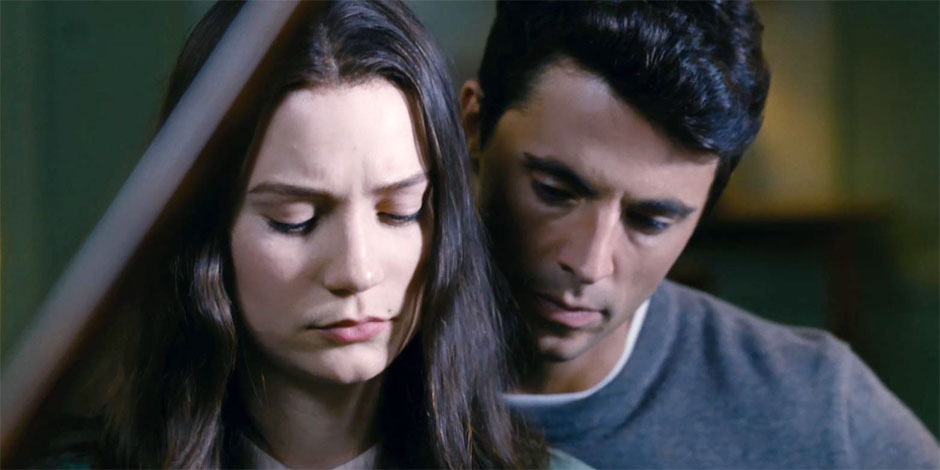
On her 18th birthday, the father of India Stoker (Mia Wasikowska) is killed in an automobile accident, devastating her family, and introducing to them her father's brother "Uncle Charlie" (Matthew Goode) at the funeral.  Charlie stays with the family inserting himself into every aspect of the Stoker household, still in shock over Richard Stoker's (Dermot Mulroney) death, taking a particular interest in gardening, the servants, and mother Evelyn (Nicole Kidman).  Soon, the head caretaker goes missing, as does great-aunt Gwendolyn (Jacki Weaver), explained away by Charlie, who then turns his laser-like gaze on India.  As is the trait of Uncle Charlies, he sees a kindred spirit in his brother's daughter, and if the man had any sense, he'd be afraid of that, which is the only aspect of Stoker that doesn't pay homage to the Master of Suspense—this is a movie that has no redemption and no hope.


There's a child's primer of Hitchcock throughout: bad "mother" relationships, a creepy "Uncle Charlie," odd dispassionate deaths, the callow, uncomfortable-making young man, the swinging light, the "secret" basement, the masquerading gardening activities, the imposing staircase (circular), the rather irrelevant but "convenient" ability of India.  It's a Hitchcock movie for those who've only seen Psycho, and are stuck in that film's deliberate pace and motivation.  It's designed to shock, but not to move (and not even out of one's seat...unless of course, it's to walk out).

And there's no humor.  Not even a nervous titter.  Oh, sure, there is dark "irony" scattered hither and yon with all the subtlety of a hammer swing, but there is no lightness of touch anywhere, not even as an antidote to all the mock serious portent that shrouds the thing, that makes it travel the dead man's walk from too-heavy seriousness to unintended self-parody.  It's as if Alan Ball had written Shadow of a Doubt, directed by a too-eager-too-please director who knows nothing about sub-text, and the fun ways that one can infuse the abnormal into normal, or what passes for it.

Stoker is a Cable-Watcher.


It's all in the trailer, kids.

Saturday, January 14, 2012

Trespass

Trespass (Joel Schumacher, 2011) Two A-listers in this thing and it goes straight to video?  A casual viewing can see why.  It's a dimly written variation on the typical home-invasion story (The Desperate Hourseither version, Panic Room, Firewall), with more than a smattering of Michael Haneke's cruel Funny Games (also either version) directed by that "master" of subtlety, Joel Schumacher. 

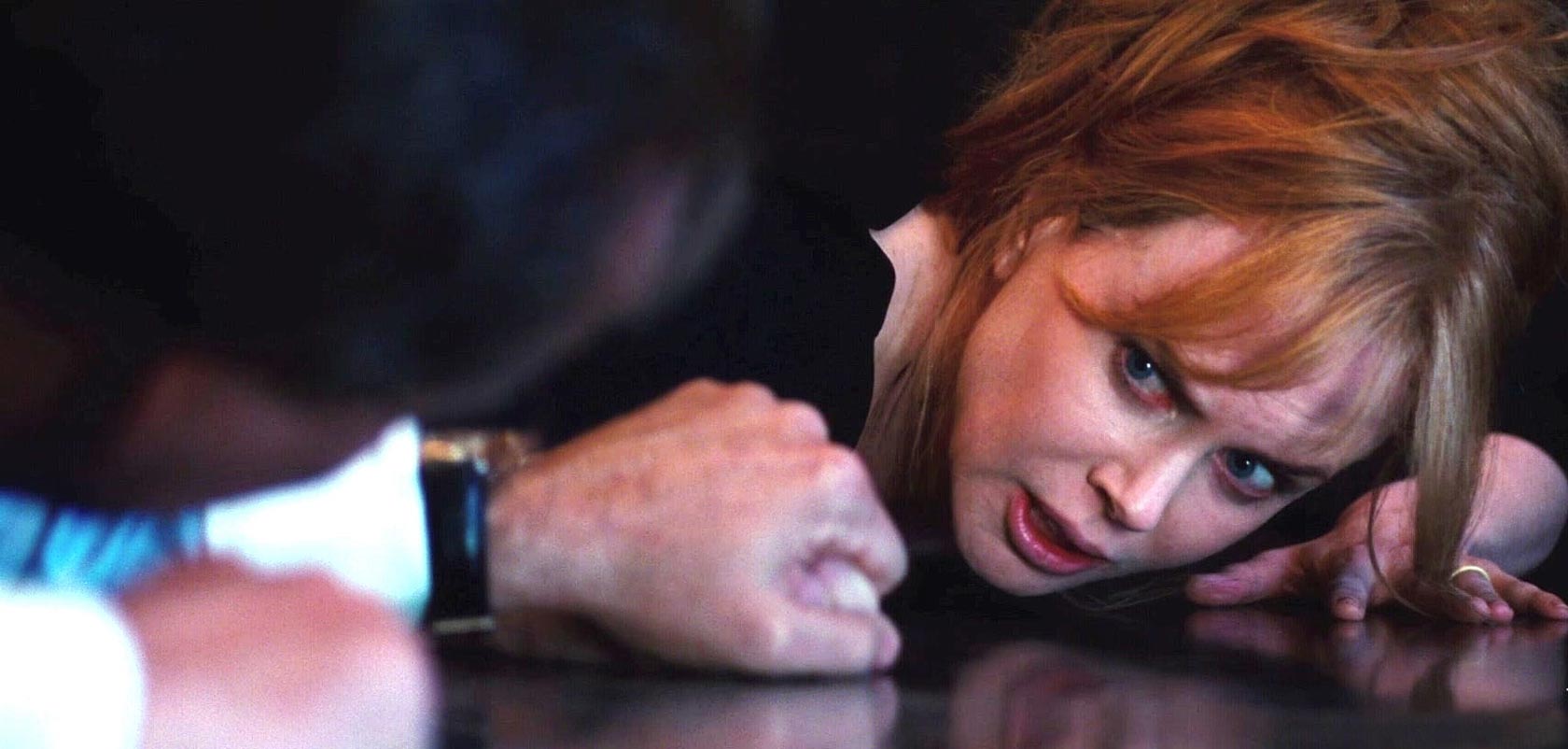
Kyle Miller (Nicolas Cage) is a diamond broker with a security fortress for a house, a tense marriage with his wife, Sarah (Nicole Kidman) and a teenager (Liana Liberato) who's a shade on the rebellious side.  While the kid is off sulking in her room (actually, she runs off with a friend to a party—fine security system that house has), the home is invaded by a gang of three guys and a girl, who threaten the Millers and want the diamonds that Kyle has squirrelled away in an elaborate safeKyle won't do it, even at the threat of a pistol aimed at his temple or his wife'sKyle is arrogant enough that he starts to negotiate with the burglars over what they want and what an alternative take-away might be.  Cash?  Sarah's jewels?  Insurance money?  And the thieves are the type that hesitate at every negotiating point.  Pretty soon, it turns into a competitive play-off of who's the greediest and the slimiest, the crooks or the capitalists?  It would be entertaining if there was anybody worth rooting for.

Fact is, the burglars are stupid.  Most criminals are, but these guys aren't even competent to take the cake.  They're the three "D's"—dumb, dysfunctional and (a)ddicted, and pretty soon, everybody is squabbling, the burglars with the Millers, the burglars amongst themselves, and the Millers against each other (Thanks, if I wanted to watch something like this, I'd watch the Republican primaries coverage).  It's one of those movies where you sit, staring at the screen (when you're eyes aren't rolling back in their sockets) and you think "why doesn't everybody just get a good night's sleep" (and, in fact, Miller even suggests that at one point).

The only engaging question about the whole enterprise is why would Cage and Kidman appear in such a poorly executed "bottle" movie, in the first place.  After all, there is no brilliance in Karl Gajdusek's script, not even something juicy for the two thesps to sink their acting chops into.  The only reason must be is that they owed director Schumacher a favor: Cage for appearing in Schumacher's earlier 8MM, and Kidman for having her career emerge from Tom Cruise's shadow due to Batman Forever.  Loyalty is fine and all, but if they'd moved on to other projects and let this one rest in the dumper, the rewards would have been far greater—they'd have done the rest of us a favor.

Tuesday, February 22, 2011

Rabbit Hole

"Ghost-busting"
or
"Coping Mechanisms"

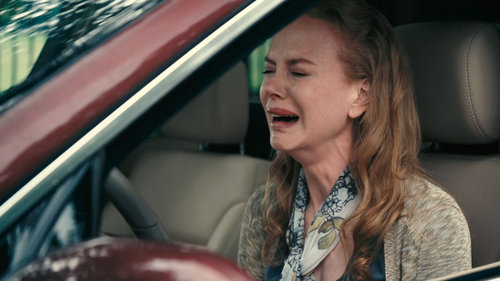
'Becca (Nicole Kidman) is going through the motions.  She's doing everything expected of her and dutifully.  The planting of new flowers in the garden, the making of stringent recipes of comfort food, the grief support group.  All those motherly instincts and nothing to mother, and everything—absolutely everything—reminds her of the void in her life.  Her child is dead, a victim of a car-pedestrian accident.  Her sister (Tammy Blanchard) is pregnant, her mother (Dianne Wiest) keeps bringing up her own dead child—Becca's brother, friends with kids avoid her as if death were communicable, the flowers get crushed, the pans go empty.  Life goes on, horribly.

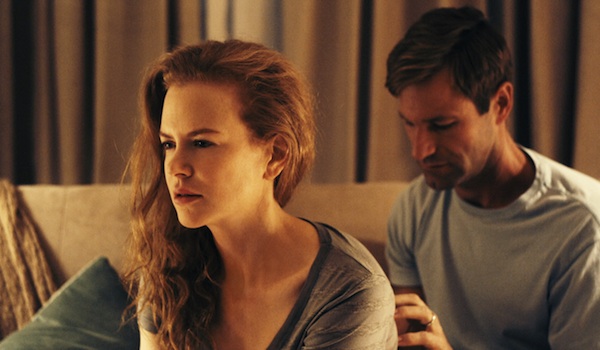
Husband Howie (Aaron Eckhart, all clenched jaw and knotted body language) can't let go, sitting up every night endlessly watching a phone-video of little DannyThis frustrates 'BeccaSo do the "professional wallowers" of the support groupShe's avoiding grief, while Howie and the others are embracing it, and both sides are going too farShe starts to find ways of relieving herself of Danny's things, each one precious to Howie.  They start to splinter, the pressures of the void hammering them from both sides.

Life goes on, horribly.

Audiences have been avoiding Rabbit hole like those parents avoid Becca, the subject matter presuming to be a downer. More's the pity as there is enough humor in the cracks of the angst to make it worth seeing and nod appreciatively at the simulations of life and death and the grief that comes between.  Director John Cameron Mitchell stays out of the way, mostly, merely observing the struggles from sympathetic angles, while not making a big thing of the POV—making him a far subtler director than, say, Tom Hooper of The King's Speech.  The performances are pitch-perfect along the scale of emotional expression, from buried thought to screaming match, with Kidman sublimating technique for organic feeling to Wiest's haunted portrait of mother love.  You pull for these people as they learn to live with death, even if they only get a "C" average.

It would be unfair to say too much of the plot other than the set-up, but it touches briefly on comics and concepts of parallel universes and alternate realities—an alternate form of Heaven and the possibility that somehow, somewhere, things are different and that the cosmic dice might roll a different way.  Possibilities erode the concept of the concrete reality, and sometimes the best way out of a trap is to imagine the way out, rather than accept that there isn't.

A downer?  Maybe.  But I found something heartening in a film that suggests that the only way to fill the void of death is with larger doses of life.  And that the holes those voids leave can only be healed—not so much in reality—but, in another dimension, the warrens of our soul.

Rabbit Hole is a Matinee.

Saturday, October 9, 2010

Bewitched


"Bewitched" (Nora Ephron, 2005) The all-star movie version of the TV classic "Bewitched" left me bothered and bewildered.

Yeah, yeah. Cute line and all that, but essentially true; How on God's green Earth could Ephron and her sister-conspirator in this crime have screwed up a sure thing like "Bewitched?"

The show, which debuted on ABC in the early 60's was fairly inspired for the first four years, then ran on auto-broom for the rest of its run, largely on the spell of star Elizabeth Montgomery's spunkiness, and an ever-decreasing number (due to age and death) of eccentric co-stars.  It may seem like stretching the social point a bit, but "Bewitched" was a flighty, goofy examination of the trials of a "mixed" marriage...without risking the wrath of any of the Southern States!*  And on top of that, despite piggish (more like ape-ish) husband Darrin's constant attempts to repress her heritage, house-witch Samantha Stevens always managed to display female empowerment, while being blithely supportive of her wage-slave husband.  Like she couldn't "twitch" herself a mink coat whenever she wanted.  I know an awful lot of women, who, as little girls, looked up to Samantha as a symbol of power under wise restraint, superior in all things man-world, and only able to be "super-mom" because she had what all mom's have...a touch of magic.  These girls wanted to be Samantha: charming, but flinty, capable of holding all the power in the world, but only when necessary—holding the Power, but dispensing it with Wisdom.

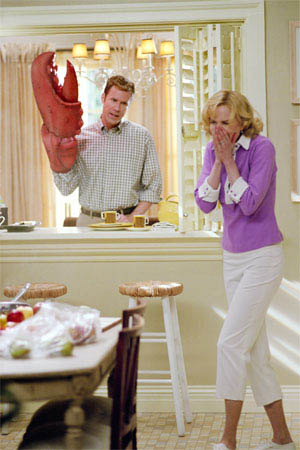
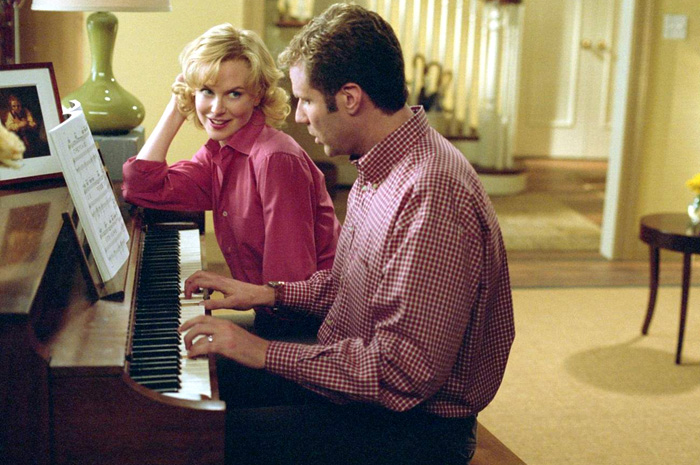
So, with all that going for it, why did the Ephron sisters have the effrontery to completely ignore what worked about "Bewitched," and toss it in favor of a complicated scenario in which a real-live witch (Nicole Kidman, playing her second witch after "Practical Magic") wants to live in the "muggle" world, free of witchcraft (rebelling, in other words), and, despite this, manages to get herself cast in a real-life return to television of a "Bewitched" TV show (live action, with an audience?  With all those effects?!!), which stars two perfectly awful co-stars (Will Farrell and Shirley MacLaine, playing, respectively, "the guy who plays Darrin" and "the old bat who plays Endora"), with conjured-up egos who are stark contrasts to Kidman's magical neophyte actress.  Of course, the lead actors are fire and brimstone, but somehow manage to "fall in deep" with each other, thus scraping the edge off Ferrell's blow-hard, and completely nullifying any respect the audience might have been feeling for Kidman's good little witch.  The scenario, frankly, makes her look like a moron, nose-twitch or no.**

The movie is off-balanced anyway, with more attention payed to Ferrell's actor than to Kidman's character.***  And the revelations about certain characters are too easy and too pat.  Some hipster-cred is afforded by the casting of "The Daily Show's" two Steve's: Stephen Colbert as a too-full-of-himself tv scripter, and Steve Carell as a hyper-intense Uncle Arthur (played on the series by Paul Lynde)—a part that feels like a desperation-move.

It is only at the end, when art-imitating-life-imitating art comes full-circle and begins chomping on it's own lizard-tail, and witch and human settle in for wedded bliss in the backlot house from the series, that the potential nears the target, aided immeasurably by the casting of Richard Kind and Amy Sedaris as the prying neighbors, the Kravitz's, that the movie seems comfortably familiar...and funny.  You know, like, if you're going to remake a TV show, why not actually re-make the TV show—only better?  This movie is such a mis-fire one wonders if bumbling Aunt Clara (played by the perpetually befuddled Marion Lorne) had a hand in conjuring.

Rather than being released, this one should have been torched in the village square.


"Sam, is there some sorta hex you can put on that movie?"
"We-ell..."

*Actually, it did.  ABC was wary of how elements of the "occult" would go down in the Bible Belt.  Fortunately, they had on their side the very religiously conservative Agnes Moorehead, who had no problems playing a satanic mother-in-law of a witch...to the hilt of her broom-handle.

** Kidman practiced the Samantha nose-twitch until she was expert at it.  The secret?  Montgomery never twitched her nose—she twitched her upper lip.

*** Why?  The script was extensively re-written to court the actor considered to be a natural Darrin, Jim Carrey.  But despite beefing up the character's worth, and providing a transformative character arc from man-child to human adult—the only substantial character arc in the movie—Carrey passed.  Smart move on his part.  Bad move on the producer's part, then, to keep the Carrey part as written and shoe-horn Farrell into it.  They should have just rewritten the script and returned the focus to witchcraft rather than the making of a television show.  Total mis-calculation.

Tuesday, March 30, 2010

To Die For

"To Die For" (Gus Van Sant, 1995) Nicole Kidman plays Suzanne Stone, a local tv weather-girl with a particularly aggressive addiction to celebrity. Her new-found fame conflicts with her ordinary home-life and her marriage to a mechanic. So she plots to murder her husband (Matt Dillon), as his lack of status might hold her back her fortunes. She recruits three teenage misfits (Joaquin Phoenix, Casey Affleck, Alison Folland) to carry out the homicide and when her in-law's attempt to pin the murder on her, she turns on the kids with blackmail.

A black comedy
mixed with film-noir (that pairing almost never works as it tends to pile on the ironies) on the sociopathy of celebrity, it was written by Buck Henry (based on a novel by Joyce Maynard, which in turn was inspired by the Pamela Smart case) and directed by Gus Van Sant. Those who had seen her in "BMX Bandits" and "Dead Calm" knew that Kidman was more than "Mrs. Tom Cruise," but it wasn't until "To Die For," that she emerged from her superstar husband's shadow and began creating a separate career. An arch performance just shy of camp, it was the first of many of the actress' forays into aberrant personalities that have subsequently dominated her career, and proved troubling to her audience base.

But as time has moved on and
the bar for celebrity has gone as low as a snake's belly, the film looks positively prescient. And Kidman etches an indelible portrait of a femme fatale, hot-blooded in her manipulation and cold-blooded in her abandonment. Making an audition tape, Kidman's Stone looks right into the camera with knowing seductiveness and invites the watcher in on her little dark secrets and fervent desires for tv work. The wileyness of the actress playing the character is matched by the character's own wickedness and the two seem to fuse. Reason enough to watch the film, but Kidman is nearly matched in ferocity by the fine Illeana Douglas, as the Dillon character's sister, who is equally capable of killing for love. It's a movie that will keep you unnerved until the final black comic cold-hearted image.

Thursday, December 31, 2009

Nine

"How Do You Solve a Problem Like Fellini?"
or
"There Ought To Be Clowns (Don't Bother, They're Here)"


There is a great movie, I'm sure, to be made of the Tony Award winning musical "Nine." But this isn't "it." Nor, I think, was "it" an intention for the production company to do so.

In fact, it is hard to determine what "it" is, and what "it" intends to do. Is it a musical adaptation of
Fellini's "8 1/2," or of Fellini's life? Is it even an adaptation of the original musical, as there are far more songs left out of it than are in it?* Locations are changed, circumstances and motivations are sliced and diced. One wonders what was so wrong about a hailed musical confection that the late Anthony Minghella and Michael Tolkin (who wrote the script), current director Rob Marshall, and the producers seem to be running away from it.

They aren't the only ones, merely they slowest of the pack.
Daniel Day-Lewis was a last minute first tier replacement for the more suitable Javier Bardem when Bardem walked off the project pleading "exhaustion"—but not exhausted enough to flee, evidently. Bardem makes very wise career choices. Nicole Kidman replaced Catherine Zeta-Jones after the producers wouldn't accomodate her demands to expand her part. One wonders why they'd balk about making any more changes for their "Chicago" Oscar-winner after making so many of their own.

But, truth be told, the thing is a sorry, sorry mess. Not true to its source, its inspiration, or even to itself, one reads the description of the original musical and wonders why it is not the movie. But one gets an inkling.
Fellini's film, made about a creator's inability to create a harmonious chorus of the voices in his head, his muses, his collaborators and backers all clamoring for attention had a structure, a purpose and an approach. But it did not have a lift, a creative inspiration until Fellini made it about a director rather than a writer. Fellini had no trouble making it, letting his conscience and unconscious be his guide (or Guido, if you will). On the contrary, he was energized by it. His "film that got away" would not occur until a bit later in his career.

The creators of "
Nine" saw it as about themselves, and the difficulty of achieving a vision. One sees the disconnect with the Fellini inspiration as soon as the musical Guido's obsession with the Folies Bergiere is brought to song. Folies Bergiere? Mama Mia! Where's the Circus? Fellini equals circus! Comprende? But, "Nine" the musical—not the film, that gets even worse—is glitz and spangles and presentation with a smattering of psychological insight embroidered in a mash-up (one can't call it a mixture) of half-inspired and un-inspired songs.

"Nine," the movie, is a whoring down of that concept.
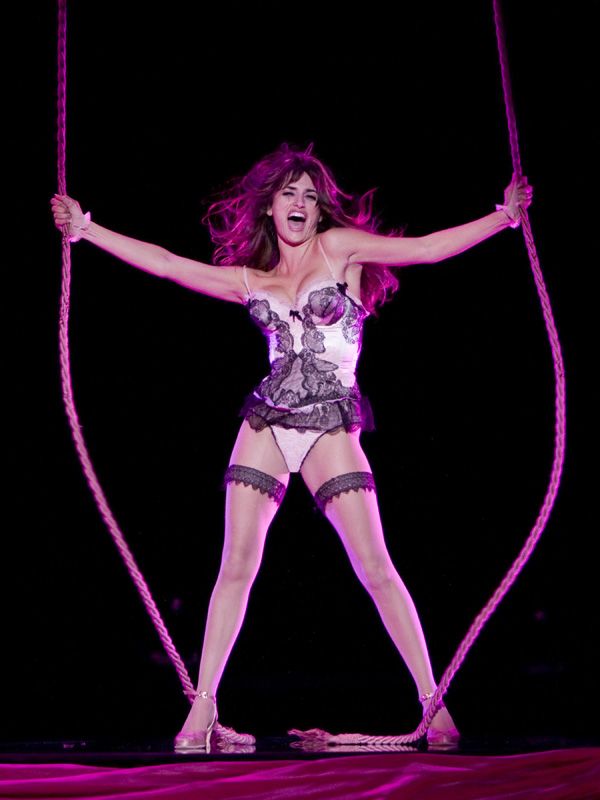
Big stars. Small ideas. A polyglot of a tribute to a movie it doesn't understand, and the broadway production that the money-men didn't feel had enough pizzazz** to put keisters in the seats (Because nothing makes you want to "Fosse, Fosse, Fosse" and booty-shake like ennui and creative stagnation!***). So, we've got Day-Lewis (he's fine—not too believable, but at least he's not doing a John Huston imitation this time).**** We've got Nicole Kidman and PenĂ©lope Cruz (wonder what they had to talk about on-set?), Kate...Kate Hudson (??), and....Fergie?(!!). Then, to give it some ethnic legitimacy they throw in Sophia Loren***** and Miramax staples Judi Dench and Marion Cotillard. Cotillard is heart-breaking as the Giulietta Massina look-alike wife—played by Anouk AimĂ©e in Fellini's film (she's even got Massina's brave smile down). Dench does fine by her number, silly and irrelevent as it is, but as if to gin up any excitement, they work over-time trying to make it entertaining. Cruz gets a sizzling number as director Guido Contini's mistress-played by Sandra Milo in the original film. Kidman plays Contini's past star Claudia (based on the Claudia Cardinale character in "81/2"—which would have tied in with Zeta-Jones' participation, but goes back to the original inspiration, "ice queen" Anita Ekberg for Kidman's participation). Loren plays Contini's domineering Mamma, usually a grotesque in Fellini's films.

Director Rob Marshall undercuts the material by over-cutting, editing all the momentum out of the music, which veers from worthwhile ("Be Italian" given a rip-roaring rendition by...give her credit, she's the best thing here...Fergie of "The Black Eyed Peas") to the filler ("Cinema Italiano" given sass by Kate Hudson, but shot and edited like an MTV version of the old '60's "Shindig!" program).

I was looking forward to this one, but very high expectations leave the biggest craters when they fall. Not a fan of musicals, "Nine" only confirmed why I've rarely enjoyed them, as they can be false and irrelevent to anything resembling life or the inpulse to song that it might evoke.

This adaptation of an adaptation of a somewhat autobiographical work by the artist, even though titularly and musically adjusted for inflation, just isn't worth as much as the original. Artistically, it is bankrupt.

"Nine" is a Cable-Watcher.

* Three new songs were written for it, all of them unmemorable—in a bid to score more Oscar nominations for The Weinstein Company which oversaw this sorry mess.

** Imagined conversation: "Y'know? Everybody's singing about their feelin's an' everything! There's not enough dancing with women with big bazooms, and Alfa Romeo's and Fiat's!! Know what I'm sayin'?"

*** Although Fosse did make a musical based around a heart attack!

****...which reminds me, the last movie I've seen that ended (like "Nine") with the director-figure saying "Action" was Clint Eastwood's "White Hunter, Black Heart"—where Eastwood was playing (and imitating) John Huston!

***** Did it occur to the makers that the only Italian in their film celebrating Italian cinema is Loren? And that she didn't work with Fellini?

Thursday, July 16, 2009

Saving Stanley Kubrick

A Slight Alteration to "Eyes Wide Shut" (10 Years After the Fact)

Today marks the tenth anniversary of the release of Stanley Kubrick's final film, "Eyes Wide Shut." He died after delivering his first cut of it, and because emotions were running high and it was the director's own initial assemblage of the film he'd spent two years making with the two most bankable stars in Hollywood (who'd formed a familial bond with the Kubrick family), it was declared that that assemblage—rough, with obvious redundancies and a bit pedantic—would be Kubrick's final word on the subject.

The movie went through its scheduled post-production process (where it actually was digitally altered to achieve a contract-specified "R" rating in America), and opened to some of the most blistering reviews of Kubrick's storied career (filled with blistering reviews). Some even went so far as to say "
Eyes Wide Shut" cast a pall over Kubrick's life-work—as if this one film could negate the effect of his earlier ones. The sad fact of the matter is there's only one thing wrong with "Eyes Wide Shut."

Stanley Kubrick died.

He was found, sprawled at his editing table by his family, his meticulous sleepless schedule finally proving to be too much for his 71 year old body. He was warned to pace himself and to take it easier. But, Stanley Kubrick rarely took anyone's advice without an overriding dose of his own input. He worked around the clock.
Just as he would have if he'd lived.


"Wait a minute, Nick.  I'm sorry.  Am I Missing Something Here?"

All of Stanley Kubrick's films went through a rigorous and brutal post-production process, which usually involved previews and the disciplined editing of sequences that slowed the film down or, in retrospect, undercut the movie. The list is legendary: The final pie-fight in the War Room as Armageddon enveloped the world in "Dr. Strangelove"; several sequences in "2001" of life on-board the Discoverythe daily routine, and a slightly altered shot-for-shot recreation of Frank Poole's prepping for his fatal EVA (which came right after the Intermission); "Barry Lyndon" lost a candle-lit sex scene between Ryan O'Neal and Marisa Berenson; "The Shining" lost an entire performance by the great Anne Jackson (I managed to see this before orders came down to cut that part out), as well as an enigmatic coda hospital scene between Danny, Wendy and Mr. Ullman (the late Barry Nelson); large chunks of "Full Metal Jacket" were shot and never used. Kubrick would work on his final cut of the film up through and even after the film opened in theaters—gauging audience reactions, looking for that perfect length that told the story he wanted to tell without causing audience-impatience in theaters.

"You're a Long Way from Home..."

And "Eyes Wide Shut" was a special case to the point where the audience lost the point. It's taken me nearly ten years to figure out "Eyes Wide Shut," because the Truth of it (appropriately) was looking me right in the face. "Eyes Wide Shut" is a dream-movie in which a jaded husband is confronted with the shocking news that his attractive wife...might actually be attracted to other men. Over the next few days, he risks everything—his marriage and his life—in the obsessive quest to...what? To make real—for him—what his wife just imagined. The rest of the movie is a yin-yang in which Cruise's Dr. Harford (named, according to scripter Frederic Raphael, because they were writing it with Harrison Ford in mind) nearly has extra-marital sex, and seemingly the rest of the world tries to prevent it—in any way possible.* But nothing gets through. As the title implies, his eyes are, literally, wide shut.** Deliberately not seeing.***

When I say it's a dream-movie, I'm not being film-theorist florid—the film is a repeating set of the self-obsessed Dr. Harford walking down long corridors of his own mental maze of mirrors that reflect internally in scenes (paintings on the wall reflect the situation in the rooms), or with other scenes (the film takes place at Christmas and one constant of the set-design is Christmas lights, whether they are string of multi-colored lights, or curtains of white lights their appearance reflects on scenes taking place in similarly illuminated places). But, again, no matter how well-lighted the areas, Harford is not seeing. The Rosetta Stone for this one is the late scene with Cruise and Sydney Pollack where Pollack's Victor Ziegler tells Harford to very bluntly knock it off, let it go, go any further and you're going get hurt, and the scene takes place in Ziegler's rec room. The center-piece of this room is a red pool table. You can't help but notice it, and notice that the color is wrong—not the traditional green. Why did Kubrick do that? He obviously did it on purpose; it was no accident. He did it so that YOU would notice it. "It's not green, it's red!"


"Guys, you're looking at me. You're looking at each other. You need to look at the table!"
 

And in films, as in that other means of public manipulation—traffic, "Green" means "Go," "Red" means "Stop" (Next time you look at Hitchcock's "Vertigo," keep that in mind). And in this scene, something traditionally green is deliberately red. Something that should say "go," says "stop." And for much of the scene, Dr. Harford is staring straight at it, but not seeing it, or paying too much attention to the explanations of Ziegler. He only becomes aware of just how self-destructive his path is when he goes home, and a symbol of his outings—the mask he wore to the elite orgy at which he very nearly lost his life—is on the pillow next to his sleeping wife (instead of him, it doesn't need to be pointed out).

His errant search has come home to roost. It is then—and only then—that he breaks down and 'fesses up. In the final scene, we're not sure of the fate of the Harfords on a family outing (to presumably
F.A.O. Schwarz, though the entire movie was filmed on British sound-stages) as they surreptitiously talk around what they both finally know about each other. Alice sums up her feelings: "I do love you and you know there is something very important we need to do as soon as possible." What's that, says the cowed Harford.


"What's that?" Wait a minute. Hold that thought.

Have sex, basically. But that's not what she says. She uses the common term for it, and for some reason (for me, at least) it's a groaning let-down. After all the dancing and the cloaked conversations and the surreptitious "I'm not going to say what I mean, but I mean to say it" talk, the last line thuds down with the hammer-like subtlety of an "F-bomb."

Which is what is. Honest it may be, yes, (which makes it stand apart from the whole of Harford's dialogue), but in a movie that toys (ahem) with an ephemeral dream-state, that plays with the Mystery of Sex and by delineation the Mystery of Women, and the Mystery of the Mind, to end on so blunt an anglo-saxon term is not only wrong-headed, it seems inadequate as the last word for the movie, subject and director. There's something...dissatisfyingly ordinary about it.

To me, as brilliant as the movie may have been before, that last moment feels disappointing and hollow, things that rarely could be said for the endings of Kubrick movies. It so hits the nail on the head (while seeming oddly prudish) that it feels like it should end another movie, the one that the preceding (mystery-explaining and literal) red pool-table scene (in the form it stands now) is trying so desperately to deflate.

And so, I would—meekly, humbly, still an acolyte of Kubrick's—suggest an alternate ending. It's barely an alternative. It's merely a substitution.

I suggest it knowing that, as a solution to my qualm, it's problematic to be sure and for audiences it may have been disappointing, but rather than Alice's direct reply, it might have been better to just hold on her face and fade into a sequence that is already dropped fairly innocuously and somewhat counter-intuitively into the assemblage—the teaser-trailer footage of a naked Alice in front of the mirror, to be joined by a naked Harford and their subsequent love-making which ends with the enigmatic look of Alice's as she considers them both in the mirror...

...giving the Kubrick stare at the camera, the mirror, herself—the ultimate private Unknowable, the one thing that Dr. Harford shouldn't take for granted (and does/is still doing/will always do). That eye—that window to the Soul—that he cannot know and will never know...and in the typical Kubrickian maze-trap, is destined to keep circling again...and again...and probably again. Cut to black. The scene's song-backdrop "Baby Did a Bad Bad Thing" (a song suggested to Kubrick by Kidman) takes us to the end of the Main Credits, ending with one of Kubrick's silent "thud's" and the credits are finished up with what's there now—the Shostakovich "Waltz 2 from Jazz Suite."

That's my solution to a problem that a great many people feel doesn't exist. They feel that "Eyes Wide Shut," as is, is what the director intended and are content with that. I may feel that way some day. But I still wonder what Kubrick would have done further, given the one thing even a perfectionist like Kubrick couldn't control—time. Maybe it's my own way of mourning his loss.

It's like the story about
Billy Wilder and William Wyler leaving director Ernst Lubitsch's funeral. "Well, no more Lubitsch," said Wilder. "Worse than that," said Wyler. "No more Lubitsch pictures."

No more
Kubrick pictures
, either.

It's less direct to be sure. And it ends on what the audience expected to see—"Tom and Nic' gittin' it on,"**** but ends with that most appropriate of images: an askance angle of Kidman


Kidman channelling Kubrick himself for her less-challenging "Kubrick Stare"

* The movie's central trap for the hero is, as always, one of his own making. But, this time, as in "2001" the Universe is attempting to rescue him from it.

** The title comes from a buried phrase in, of all things,
John le Carré's "Tinker, Tailor, Soldier, Spy" (le Carré , or I should say David Cornwell, was a close friend of Kubrick's).

*** Kubrick shows his hand early. We're allowed to see Kidman naked in the title sequence, and then when the Harfords are dressed and on their way to Ziegler's Christmas party, she asks him "How do I look?" "Perfect!" he says, not looking.

**** It may be a bit of a cheat—Kubrick used the sequence as a teaser trailer—a great one—that probably oversold the movie as a sexy romp (after all, wasn't "
Full Metal Jacket?" *ahem*).


Large Association of Movie Blogs


Thursday, June 18, 2009

Margot at the Wedding

"Margot at the Wedding" (Noah Baumbach, 2008) Margot (Nicole Kidman) is a short-story author living in Manhattan with her estranged husband Jim (John Turturro). For reasons best known to herself, she takes a train upstate to attend the wedding of her estranged sister Pauline (Jennifer Jason Leigh) to Malcolm (Jack Black), an "artist" of no specific discipline. With Margot is her son Claude (Zane Pais), who along with a scrptwriting colleague (the great CiarĂ¡n Hinds), are probably the only people she's not estranged from.
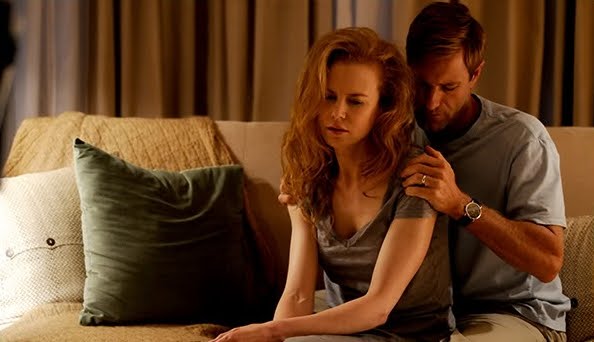
There's no pleasing Margot. If you try, she'll think you're trying to pull something over on her. Everything's a plot. Nothing is satisfactory. She is brutally honest, even when she's not being honest about it. If she can't probe a weakness, she'll create one to provoke one. And she's only too happy to purloin life-incidents for her fiction.

Although one wonders if she recognizes what fiction might be.

Noah Baumbach's last film was the critically acclaimed "
The Squid and the Whale" which astutely recreated the eddies and shoals and snags of conversations that are the dripping water torturing a marriage or any relationship. Things either wear down or they break under such a test, there is no middle ground, and there is no respite from the constant flow. In "Squid" the human beings were just trying to survive. Here, with Margot, survival's a foregone conclusion, it's just a matter of how many people she can take down in the process. There is no tying her down, it'd be like nailing Jell-o to the wall or having a pleasant conversation with Ann Coulter—it's not done.

You can't reason with a sociopath.

This sort of stuff is indie film gold, and Baumbach is a master at the circular conversation that goes nowhere, and the humor that can be found in absurd power struggles. But there's almost too much of a bad thing here, you can probably time the intervals between the incidents of cast-members breaking down, getting slapped, or getting punched. And Baumbach also is alarmingly unsubtle about the glaring Big Symbol of It All—another "Nature" metaphor that threatens to literally knock the audience over the head with its obviousness. But Baumbach gets one thing exactly right—the only one with any sense is the family dog.

The cast is uniformly excellent and unselfish in spreading the unpleasantness around. If there is one weak link it's Jack Black, but only because he will hammer the joke home, rather than let the words speak for themselves. Everyone else excells at leaving things unsaid when their characters can't leave well enough alone.

Saturday, February 7, 2009

The Invasion

"The Invasion" (Oliver Hirschbiegel, 2007) Every era gets "The Invasion of the Body Snatchers" it deserves; every adaptation reflects the times it was made—it's just how you interpret the message of the movie is key. Don Siegel's 1950's original could be either an allegory for Communists in our midst, or the sheep-like betrayal of those naming names in the McCarthy (Joe, not Kevin)hearings. Philip Kaufman's 1970's remake featured intellectuals who succumbed to like-minded behavior, not unlike a cult, speaking in alien tongues. The 90's saw Abel Ferrara's version simply called "Body Snatchers," and treated the plot like it was an epidemic, or an AIDS allegory.

Now, we get (simply) "The Invasion" and it has a slightly different spin. Post-Iraq occupation,
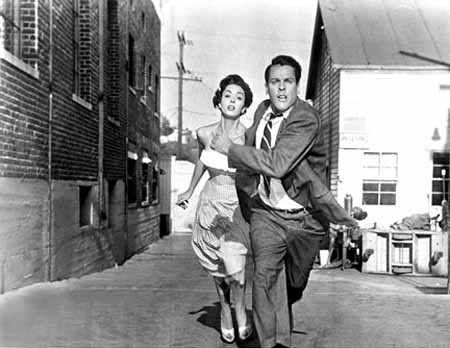
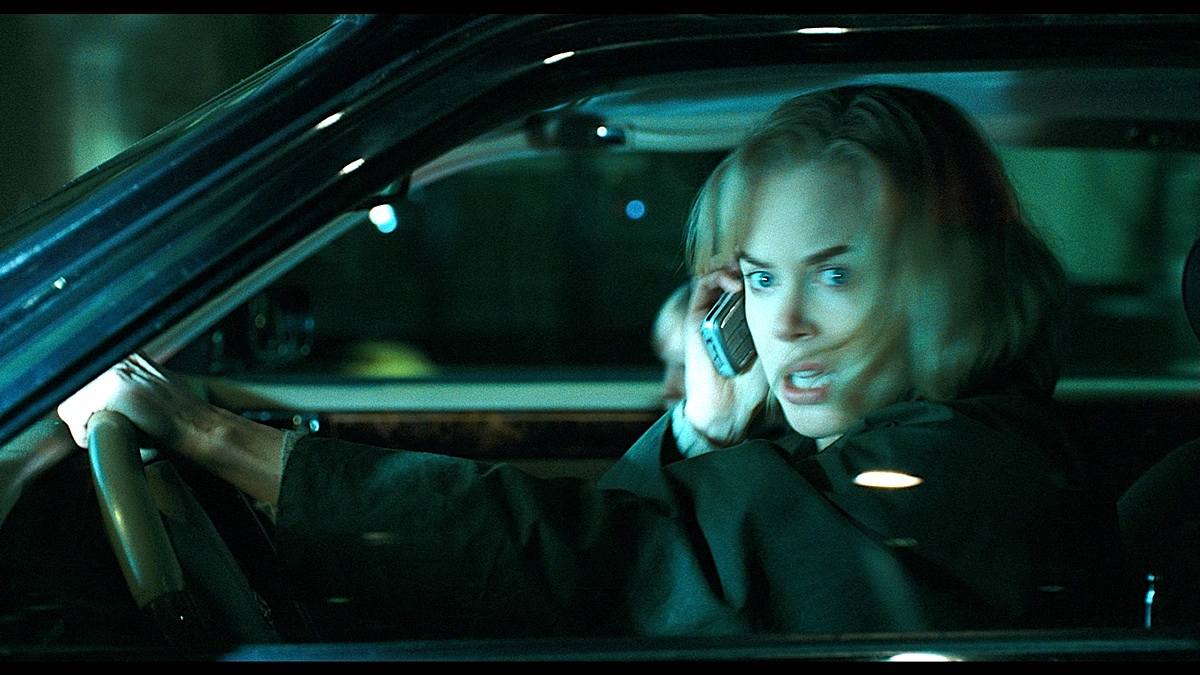
the feeling of paranoia and subsequent running through the city streets are accompanied by the intermittent soundtrack of world tragedy that tallies just how much of a mess we've made of it. These particular "pod-people" (humans are not replaced, cloned, or supplanted, but spores infect their DNA, affecting their "genetic expression,"* putting the human host to sleep, and allowing the alien spores to live through the host, unemotionally, except for an aggressive tendency to regurgitate to multiply their numbers) indoctrinate, coming to your door, using the police to forcibly take people to clinics to be converted. One can make comparisons to Iraq, but also terrorist sleeper-cells "in our midst." But, just so you know which side the film-makers are coming down on, one of the converted makes an un-impassioned speech to Dr. Bennell (Nicole Kidman) about embedded pod-ification being a better life—a more tranquil life...except, of course, for all the chasing around, the deliberate traffic accidents and projectile vomiting, the kind of which culminates in an extremely loopy sequence where Benell and her child have hijacked a car and go tearing around the streets with pod-people clinging to it while its hood is on fire. Prretty hard to make an intellectual case for "Better World" stick with that evidence.

Except for the emphasis on strong women protecting their brood this time around, the changes are mostly cosmetic. Instead of pods, which would imply cloning or replacement (so last century!), these spores infect you, then while you sleep encase you in a caul-like casing (evidently of the junk you take out of your eye in the morning, supplying the necesary "Ewww" factor).

But, there's an added creepiness to this movie and it belongs to star, Nicole Kidman, who seems decidely plasticene—almost "Barbie-like" in this film. I'm not talking about that huge shiny forehead that she wears during awards show. Here's she's rail thin, and her costumer has fitted her with extremely tight ensemblesso tight, in fact, that (how do I put this delicately?) no part of her anatomy moves when she's in motion, if you get my drift. One begins to suspect that she has already been taken over, or she's the same character who escaped from "The Stepford Wives." Whatever the reason, it's a bit creepy.

* The poor guy saddled with the "Basil Exposition" gobbledy-gook dialogue is the brilliant Jeffrey Wright, who does a yeoman's job of making it seem like he's actually thinking of all this tech-speak off the top of his head, although he looks a tad uncomfortable doing it.