Showing posts with label Penelope Cruz. Show all posts

Friday, November 15, 2013

The Counselor (2013)

Couples Therapy
or
How to Get a Head in Business

The Counselor is not "The Worst Movie Ever Made" (as some would have it) nor should such a withering condemnation (from a critic? *pfft*) warrant it any sort of pity-praise to escalate it above what it deserves.  Pity is the last thing on the mind of The Counselor.

What it is is the first original screenplay by Cormac McCarthy—he also exec-produced—and directed, with a lavish budget for just about everything, including dirt, by Ridley Scott, who one should now probably call a "stylist," rather than a director. Everything looks great.  But, again, one wonders if Scott read the script beyond descriptions.  


Like so much of McCarthy's work, it is dark and gritty and nihilistic—in a hopeful, moral kind of way; in other words, it's a story or very bad people doing very bad things from the point of view of a person who is tsk-ing in the background.  Perfect director for this would have been Martin Scorsese.  But, it's Ridley Scott who, given his past, seems to have a lot of sympathy for the devil (Blade Runner, Legend, Hannibal, Matchstick Men, American Gangster, Prometheus), indeed, in his last movie, the hero was, once again, a synthetic human being with its own sense of ethics.  That synth was played, rather brilliantly, by Michael Fassbender, which is why he's the titular lead.


The thing about novelists doing screenplays and writing for the movies is they're slumming, unless they see themselves as legitimate film-makers (see the Coen Brothers or John Sayles).  Maybe McCarthy couldn't flesh out his characters for the novel form.  Maybe he wanted to see what a film-maker wanted to do with a work he wasn't happy with and see what the collaborative process would produce.  Maybe he wanted to make some money.  But, for whatever reason, McCarthy chose to do this as a film, and not a fully thought out novel.


"...red in tooth and claw"
Maybe he just didn't like it.  It's extraordinarily simplistic—The Counselor spends the first half warning its protagonist "Don't do this" and casually mentioning ways in which people can be killed, usually involving decapitation ("it's just business").  Once he's "locked in," it spends the second half eliminating most of the cast in precisely the ways that have been described in the first half.  It answers the question that is contained in a couple iof questions in that first half—"Why am I telling you this?"  Obviously, so we can anticipate it being used later and knowing what's happening.  In other words, literally, the first half of The Counselor is a prolonged "you just don't get it, do you?" speech.  The second half, he gets it (I'd warn about spoilers here, but everything is telegraphed fairly early on, even "the surprise" puppet-master of the thing).

One interesting aspect of The Counselor is the cast...or, at least, the cast as it once was.  Fassbender was always going to be in it, evidently, but the others were going to be real-life couples Brad Pitt and Angelina Jolie and Javier Bardem and Penélope Cruz, but slightly scrambled so that Bardem and Jolie would be a couple and Fassbender and Cruz would be paired.  At some point, Jolie dropped out and Cameron Diaz was cast in her role.  She's as fine as everybody else in the cast, but the dialog is difficult for swallow.  Take for example, this:


I suspect that we are ill-formed for the path we have chosen. Ill-formed and ill-prepared. We would like to draw a veil over all the blood and terror that have brought us to this place. It is our faintness of heart that would close our eyes to all of that, but in so doing it makes of it our destiny... But nothing is crueler than a coward, and the slaughter to come is probably beyond our imagining.
I remember a scene from the Elia Kazan film of The Last Tycoon where movie mogul Monroe Stahr in a fit of pique exits a screening saying "'And I, you...' nobody TALKS like that."  Everybody talks like that in The Counselor, everybody's vocabulary is up to snuff, and everybody has the time to ponder and philosophize.  But what their philosophy centers around is Nature, "red in tooth and claw."  But Nature doesn't have the time to think about what it is doing, except strategically.  If there is a slaughter to come for the human race, the meek won't inherit the Earth, but evidently the pretentious will. 

Everybody talks a good game in The Counselor, but it makes a bad movie.

The Counselor is a Cable-Watcher. 

Thursday, July 19, 2012

To Rome with Love

Around the World in Woody's Malaise
or
The Ozymandius Melancholia Gambit ("Turbulence!  My Favorite!")

Far be it for me to suggest that Woody Allen might actually be comfortable in his own skin as a storyteller. but when it has come time for him to do his own "Roman Holiday" film, To Rome With Love, there's not a hint of Fellini in it (Been there, done that—specifically, way back in 1980, when he made his Stardust Memories in tribute to the great Italian film-maker).  Truth to tell, his latest has more in common with the Italian "anthology" films of the 1960's, where directors would tackle similar themes in short personal films.

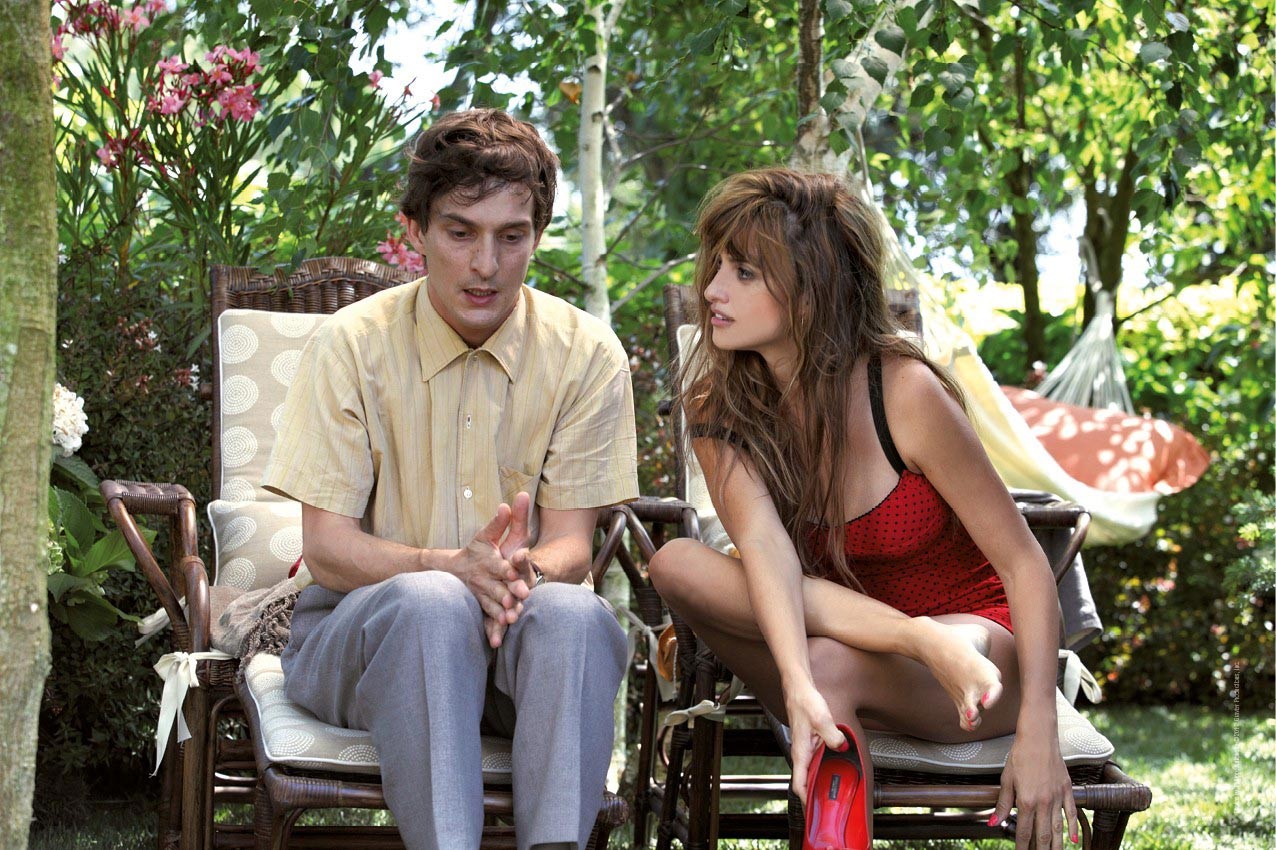
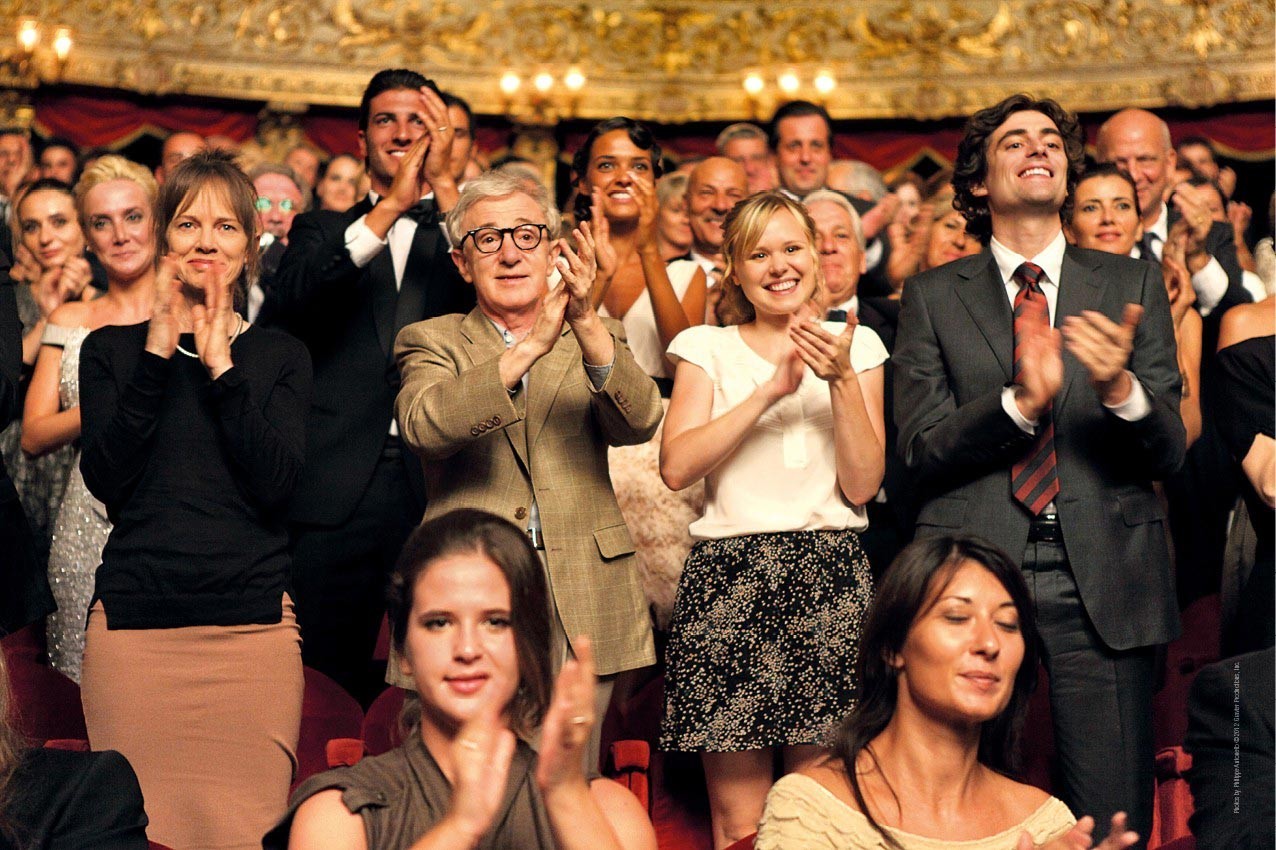
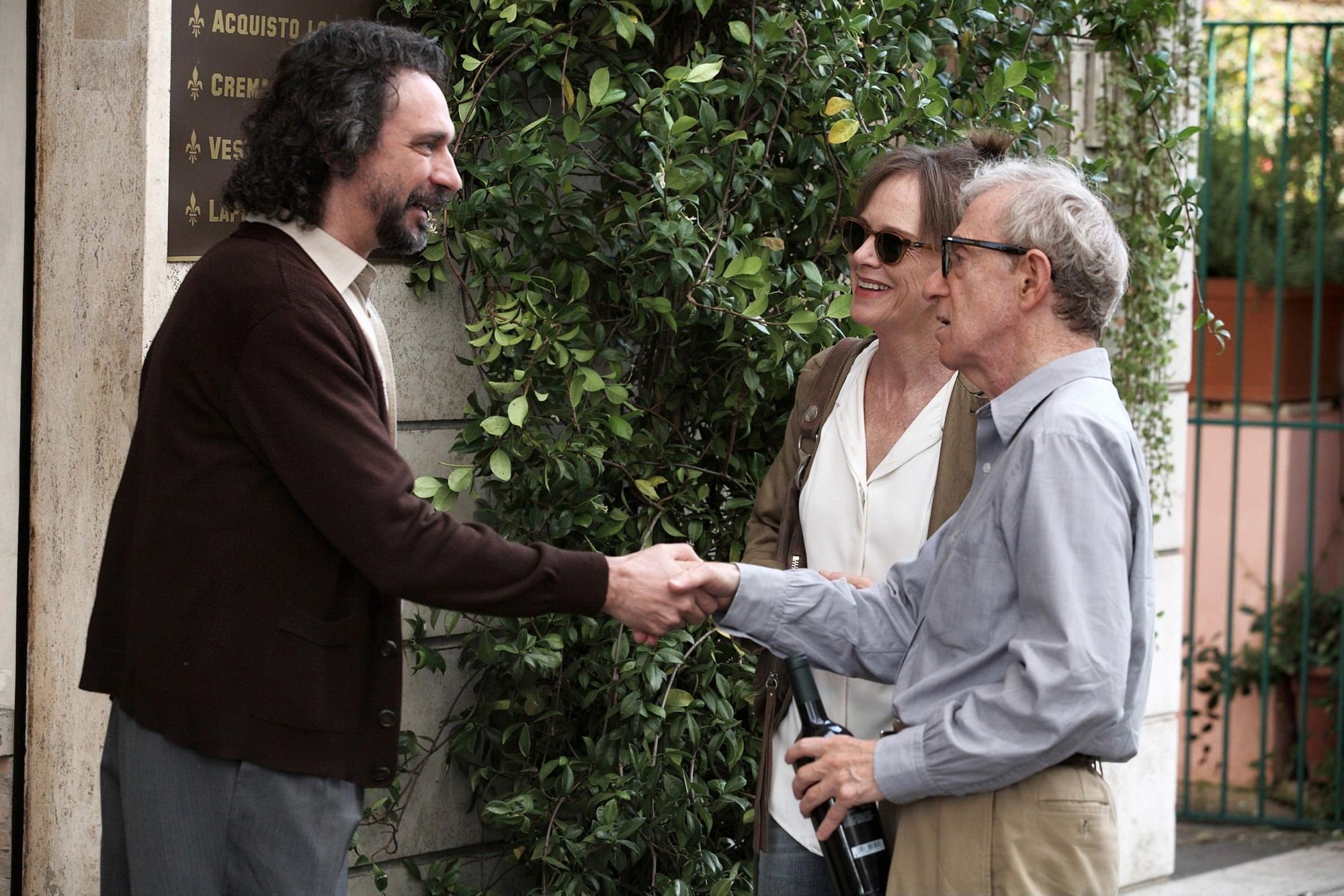
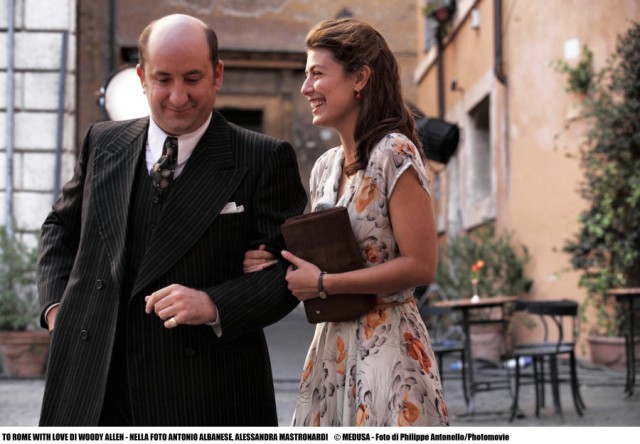
To Rome With Love has four interlocking fantasias about love and personal dissatisfaction: in the first, a young married couple (Alessandro Tiberi and Alessandra Mastronardi) come to Rome, where he is to be introduced to his new work situation—eager to make a good impression, the wife goes shopping and ends up getting lost and involved with an Italian film-star, and hubby, thanks to a case of mistaken identity, must go to his functions in the company of a pre-arranged hooker (Penelope Cruz); the second involves two architects, one seasoned (Alec Baldwin), the other just starting out (Jesse Eisenberg) who become each other's fantasy figures (of a sorts) when the young architect, already attached to Sally (Greta Gerwig), falls for her best friend Monica (Ellen Page), a self-involved, if fascinating, actress; the third involves a "normal member of the middle class" in Rome (Roberto Benigni) who suddenly becomes "famous for being famous," and is pursued and interviewed by an indiscriminate paparazzi; the fourth involves a former classical music executive (Allen), who discovers a great opera singer (Fabio Armiliato) in the family of his potential son-in-law..with conditions.

The setting is Italian, but the themes are pure "Allen-town."  Each of the characters get a brief glimpse of "life on the other side," gingerly placing their toes where the grass is greener, and find it wanting, but themselves enriched from the experience, survived without harm or consequences paid.   Baldwin's architect gets to play devil's advocate (much the same way as Bogart did in Play It Again, Sam) with a realist's wisdom, as opposed to a romantic's fool-hardiness—a good cure for his nostalgia.  The Italian couple experience romantic fantasies before settling down to domestic bliss, not older but wiser.
Benigni's civil-functionary briefly enjoys cultural significance, with all the invasiveness and dissection of minutiae, before returning to anonymity and the value of a private life, and Allen's retiree gets to witness a fulfillment of his dreams by providing a channel for another, and, having achieved it, returning to his normal life.

Any of these stories could be set anywhere.  Rome provides a nice catalyst for these quick short pieces that summarize the Allen world-view: "Life is terrible, but it beats the alternative."  And it's buttressed by the standard "Volare"...which mean "to fly."  

Happy landings.


To Rome With Love is a fine Matinee. 


Tuesday, January 19, 2010

Broken Embraces

"Raising Caine" or "Eyesight to the Blind"

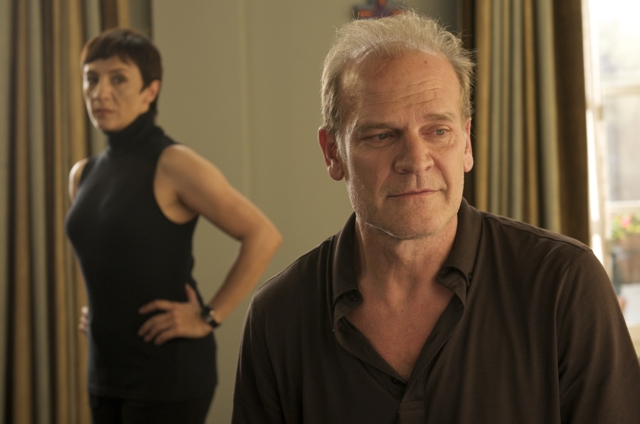
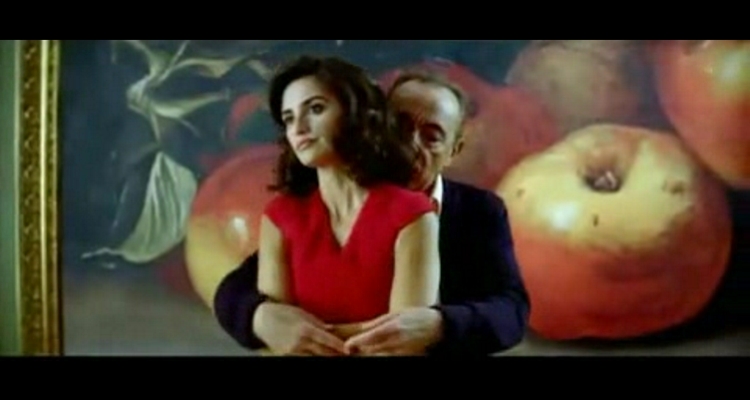
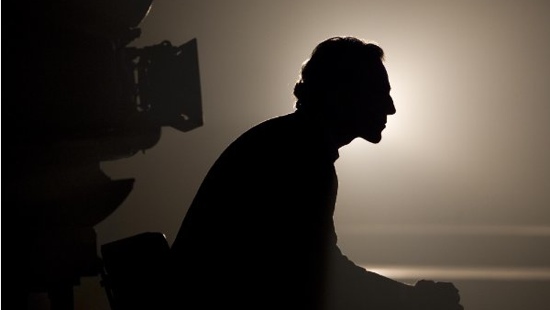
Harry Caine (Lluís Homar) is a writer of screenplays in Madrid, semi-content to take on the occasional assignment his former production assistant Judit (Blanca Portillo) gives him and to pick up the occasional stranger who helps him across the street. Harry happens to be blind, and that he writes for a visual medium is just one of the ambiguities that inform "Broken Embraces" (or "Los Abrazos Rotos"), the latest film of Pedro Almodóvar that, like Quentin Tarantino's "Inglourious Basterds," is a valentine to the movies.

Maybe it's more like a box of dark chocolates. Multi-layered, with movies within movies and a story told mostly in flashbacks and first-person narration,
it's a film noir in candy-colors (like the Andy Warhol prints of firearms in the heavy's house), and interlocking human triangles that make up the chain of the movie.* Running throughout are the Almodovar themes of dual identity, parental issues and role-playing (but no sexual ambiguity here, he keeps this story fairly hard-boiled), but it comes back to the art of seeing, and illusion, and seeing and creating illusion.

And Penelope Cruz. But, let's back-track.

On the day when a wealthy industrialist, Ernesto Martel (
José Luis Gómez) dies, Harry gets an appointment with a film-maker (he claims to have made a documentary fourteen years ago) named Ray X (Rubén Ochandiano), who wants Harry to collaborate on a screenplay. Given the scenario, Harry refuses and X is tossed out by Diego (Tamar Novas), Harry's assistant and typist (and Judit's son). An accident to Diego while his mother is away, puts the two men together in a mutually care-giving relationship, and Diego asks him about Mateo Blanco.

Mateo Blanco, you see, was another life. "Harry Caine" is a pseudonym that Blanco lives and writes under now. And over the course of the film, "Harry" tells Diego about the complicated story that led up to the day that Blanco lost his sight, his life and his love. It involves Magdalena Rivas (
Penélope Cruz), secretary to Martel, and in a past life, a call-girl. A family crisis puts "Lena" in Martel's debt and she becomes his mistress, and he provides her anything money can buy...except freedom. Lena desires to be an actress, and one day she auditons for Mateo, who becomes enchanted with her.

There's a lot more to tell,
but you can probably guess a lot of it, if you've seen a few movies out of the past. Almodovar isn't breaking any new ground this time, but he is tilling rich story-telling soil, the kind that binds screenwriters to Fate, for Good or Ill, and produced the films that made him fall in love with The Movies.

And movie-making. The film that the film's Mateo is fussing over is highly reminiscent of one of Almodovar's own films (right down to the...uh...cast), and his perverse humor knows there's not much difference between a controlling lover and a controlling director. Lena is a pawn in both men's game, and when being pulled in two directions something's gotta give...or be taken.

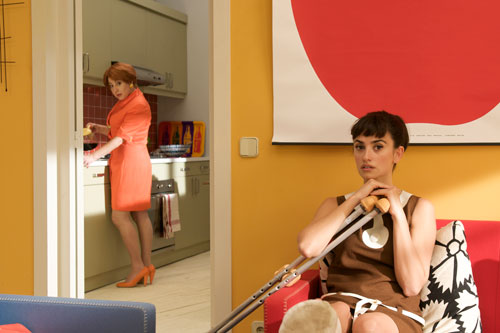
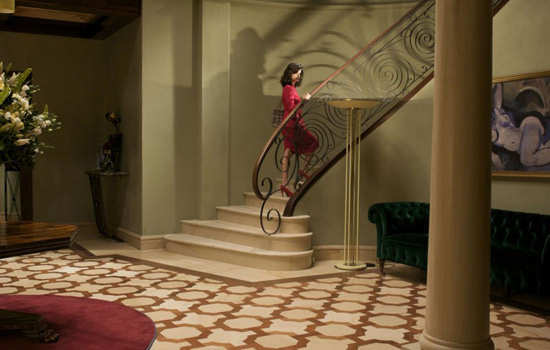
It's familiar stuff, but one more opportunity for Almodovar to have fun with the house of mirrors that is cinema. And one more opportunity to work and reflect a different aspect of his current Muse, Penelope Cruz. In his last film, "Volver," Cruz was an earthy Sophia Loren. Here, she's Audrey Hepburn...well, that's how Mateo molds her for the film (in a scene highly reminiscent of this blog-post by Almodovar about the film's prep). There's another more tragic icon that's touched on. One that the public embraced, and who loved the attention it brought her. And who learned too late that to be embraced also means to be held, constricted and restricted. Things cost.


Cruz and Almodovar show how it's done.

* At one point, Penelope Cruz is festooned with the most elaborate gold jewelry that almost looks like an elaborate horse harness. Makes one consider whether any jewelry is a form of "tack."

Thursday, December 31, 2009

Nine

"How Do You Solve a Problem Like Fellini?"
or
"There Ought To Be Clowns (Don't Bother, They're Here)"


There is a great movie, I'm sure, to be made of the Tony Award winning musical "Nine." But this isn't "it." Nor, I think, was "it" an intention for the production company to do so.

In fact, it is hard to determine what "it" is, and what "it" intends to do. Is it a musical adaptation of
Fellini's "8 1/2," or of Fellini's life? Is it even an adaptation of the original musical, as there are far more songs left out of it than are in it?* Locations are changed, circumstances and motivations are sliced and diced. One wonders what was so wrong about a hailed musical confection that the late Anthony Minghella and Michael Tolkin (who wrote the script), current director Rob Marshall, and the producers seem to be running away from it.

They aren't the only ones, merely they slowest of the pack.
Daniel Day-Lewis was a last minute first tier replacement for the more suitable Javier Bardem when Bardem walked off the project pleading "exhaustion"—but not exhausted enough to flee, evidently. Bardem makes very wise career choices. Nicole Kidman replaced Catherine Zeta-Jones after the producers wouldn't accomodate her demands to expand her part. One wonders why they'd balk about making any more changes for their "Chicago" Oscar-winner after making so many of their own.

But, truth be told, the thing is a sorry, sorry mess. Not true to its source, its inspiration, or even to itself, one reads the description of the original musical and wonders why it is not the movie. But one gets an inkling.
Fellini's film, made about a creator's inability to create a harmonious chorus of the voices in his head, his muses, his collaborators and backers all clamoring for attention had a structure, a purpose and an approach. But it did not have a lift, a creative inspiration until Fellini made it about a director rather than a writer. Fellini had no trouble making it, letting his conscience and unconscious be his guide (or Guido, if you will). On the contrary, he was energized by it. His "film that got away" would not occur until a bit later in his career.

The creators of "
Nine" saw it as about themselves, and the difficulty of achieving a vision. One sees the disconnect with the Fellini inspiration as soon as the musical Guido's obsession with the Folies Bergiere is brought to song. Folies Bergiere? Mama Mia! Where's the Circus? Fellini equals circus! Comprende? But, "Nine" the musical—not the film, that gets even worse—is glitz and spangles and presentation with a smattering of psychological insight embroidered in a mash-up (one can't call it a mixture) of half-inspired and un-inspired songs.

"Nine," the movie, is a whoring down of that concept.
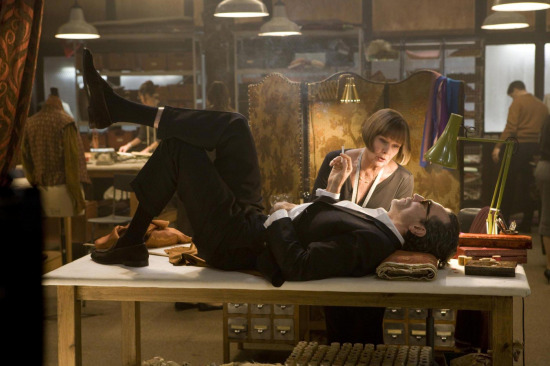
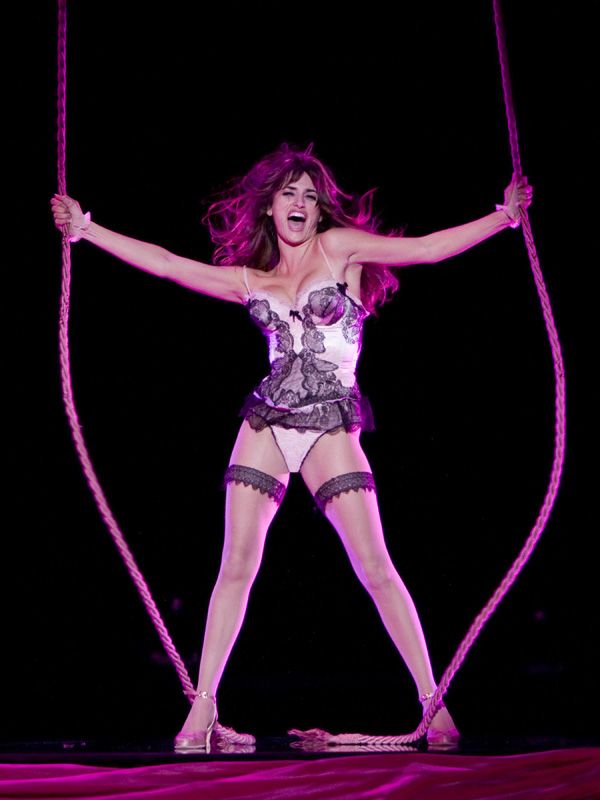
Big stars. Small ideas. A polyglot of a tribute to a movie it doesn't understand, and the broadway production that the money-men didn't feel had enough pizzazz** to put keisters in the seats (Because nothing makes you want to "Fosse, Fosse, Fosse" and booty-shake like ennui and creative stagnation!***). So, we've got Day-Lewis (he's fine—not too believable, but at least he's not doing a John Huston imitation this time).**** We've got Nicole Kidman and Penélope Cruz (wonder what they had to talk about on-set?), Kate...Kate Hudson (??), and....Fergie?(!!). Then, to give it some ethnic legitimacy they throw in Sophia Loren***** and Miramax staples Judi Dench and Marion Cotillard. Cotillard is heart-breaking as the Giulietta Massina look-alike wife—played by Anouk Aimée in Fellini's film (she's even got Massina's brave smile down). Dench does fine by her number, silly and irrelevent as it is, but as if to gin up any excitement, they work over-time trying to make it entertaining. Cruz gets a sizzling number as director Guido Contini's mistress-played by Sandra Milo in the original film. Kidman plays Contini's past star Claudia (based on the Claudia Cardinale character in "81/2"—which would have tied in with Zeta-Jones' participation, but goes back to the original inspiration, "ice queen" Anita Ekberg for Kidman's participation). Loren plays Contini's domineering Mamma, usually a grotesque in Fellini's films.

Director Rob Marshall undercuts the material by over-cutting, editing all the momentum out of the music, which veers from worthwhile ("Be Italian" given a rip-roaring rendition by...give her credit, she's the best thing here...Fergie of "The Black Eyed Peas") to the filler ("Cinema Italiano" given sass by Kate Hudson, but shot and edited like an MTV version of the old '60's "Shindig!" program).

I was looking forward to this one, but very high expectations leave the biggest craters when they fall. Not a fan of musicals, "Nine" only confirmed why I've rarely enjoyed them, as they can be false and irrelevent to anything resembling life or the inpulse to song that it might evoke.

This adaptation of an adaptation of a somewhat autobiographical work by the artist, even though titularly and musically adjusted for inflation, just isn't worth as much as the original. Artistically, it is bankrupt.

"Nine" is a Cable-Watcher.
* Three new songs were written for it, all of them unmemorable—in a bid to score more Oscar nominations for The Weinstein Company which oversaw this sorry mess.

** Imagined conversation: "Y'know? Everybody's singing about their feelin's an' everything! There's not enough dancing with women with big bazooms, and Alfa Romeo's and Fiat's!! Know what I'm sayin'?"

*** Although Fosse did make a musical based around a heart attack!

****...which reminds me, the last movie I've seen that ended (like "Nine") with the director-figure saying "Action" was Clint Eastwood's "White Hunter, Black Heart"—where Eastwood was playing (and imitating) John Huston!

***** Did it occur to the makers that the only Italian in their film celebrating Italian cinema is Loren? And that she didn't work with Fellini?

Tuesday, September 9, 2008

Vicky Christina Barcelona

"Juan is the Loneliest Number That You'll Ever Do"
or
"To Javier and Javier Not"

"Vicky Christina Barcelona" (Woody Allen, 2008) The latest film in what will, no doubt, be called Woody Allen's "Scarlett" period, "Vicky Christina Barcelona" was shot almost totally in Spain, and benefits from the change of location. It's a large part of what drives the plot and the two women who vacation in Spain for different purposes.

Vicky (Christina Hall) is studying Catalan architecture (particularly Gaudi), and spends the time in Spain as a prelude to getting married to staid, reliable Doug (Chris Messina). Christina (Scarlett Johansson) has just written and directed an 18 minute film starring herself, and broken up with the latest in a series of men in impetuous affairs. She has no business in Spain, but goes to spend time with Vicky and get away. Vicky values the safe and dependable. Christina is searching, "certain only of what she doesn't want," as explained by a ubiquitous Narrator (Christopher Welch), whose constant comments make the film feel less a visual experience than a story with pictures.
While in Spain, the two women are approached by darkly handsome artist Juan Antonio (Javier Bardem) who offers to fly the women to the town of Oviedo for the weekend to view the Gaudi works, drink wine, and make love. Vicky thinks Juan is a creep. Christina is intrigued, but both women end up going, Vicky to protect her impetuous friend.

Juan is soulful, attentive, but it is obvious he is in love with his ex-wife Maria Elena (
Penelope Cruz), despite the fact a) they couldn't make it work, and b) she stabbed him in a rage. ("Oh, that..." she says dismissively when it's brought up)
Things get complicated, but never enough for the Narrator to be lost for words or explanations, and when Maria Elena shows up again in Juan Antonio's life, the movie turns, at equal turns poetic, and dangerous. Despite the mannered ways that Allen's films can frequently turn out, this group of actors is particularly well-suited to working outside of Allen's tic's and rhythms. The closest any of the characters come to the Allen neurotic persona (a staple in Allen's films, either played by Allen or a stand-in) is Vicky, but she's much more sure of herself, if not her situation.

Bardem is sadly, relaxed in the film, but Penelope Cruz is a force of nature, this generation's Sophia Loren. After being stuck in some unmemorable films with some straight-jacketed performances, the last few years and films have displayed a bravura presence, and she runs a gamut of emotions in this one to full effect. It's a tough role to pull off--she's held up as an icon until she appears, and when she shows up later in the film, arriving bedraggled from the hospital after a suicide attempt, Cruz more than fills the bill, with her extremes of behavior never seeming contrived or phony. And Johansson has rarely been better represented on-screen--one close-up in particular of Christina listening to Juan Antonio explaining his love for his ex-wife fairly burns on the screen with resentment.

It may ultimately prove to be a minor Allen film, but as a change of pace and an expansion of style it couldn't be more successful.

"Vicky Christina Barcelona" is a matinee.


Thursday, April 3, 2008

Volver

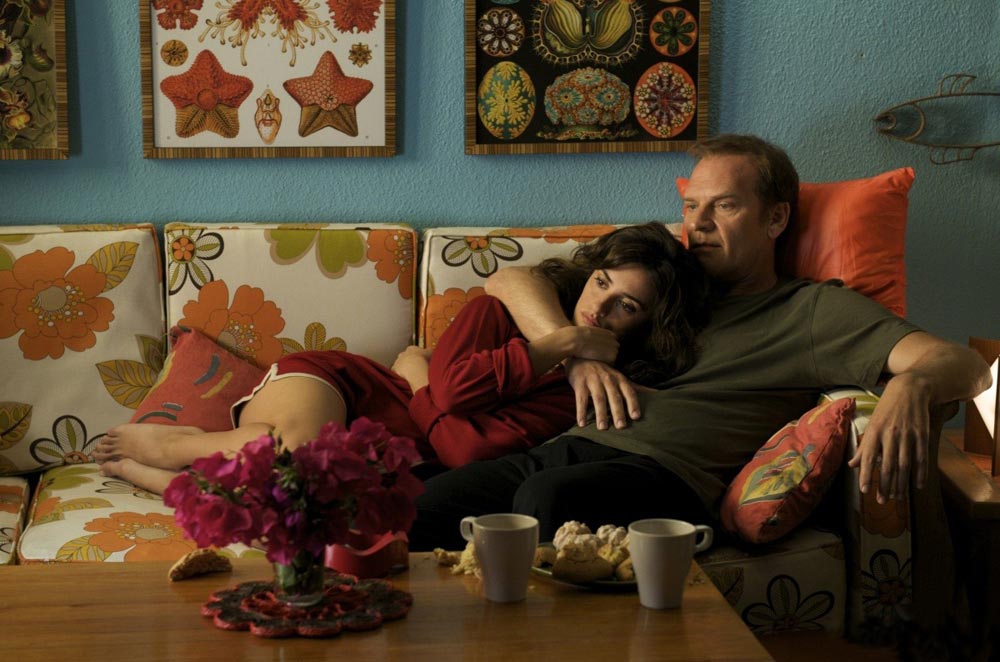
"Volver" (Pedro Almodovar, 2006) Almodovar film about the prevailing myth-making of Family, and the resiliency and strength of women. In the course of it, Raimunda (Penelope Cruz, far better and livelier than any of her Hollywood films) has her entire world--her ENTIRE world--turned upside down, as her family structure--maybe that should be stricture--crumbles around her, and she must turn her back on tending to the dead--except for that pesky secret in the freezer downstairs--and concentrate on the living by, ironically, embracing the past. Then, and only then, can she be prepared for a miracle of sorts, the "coming back" of the title. It's a film that celebrates independence and family and is far less controversial than a lot of Almodovar's past work, but full of great film-making choices, including some sequences of suspense that rival those of Hitchcock.