Showing posts with label 2006. Show all posts

Wednesday, October 10, 2012

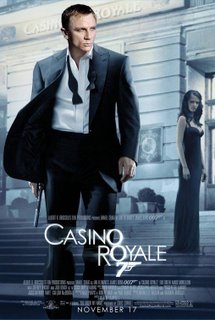
Casino Royale (2006) Revisited

Breaking Bonds

Is it that good?
Short answer: yes.
Is he that good?
Yeah. He's the best thing about it. There are other good things as well, but let's look at Bond 6.0.


Not conventionally handsome, not the Arrow-shirt version of Bond, Craig has a multi-planed face that's great to watch whether it's jammed up against a shattered bathroom mirror considering just how much pressure it's going to take to strangle an assailant* or, half-a-movie later in another bathroom mirror, clearly satisfied with himself in a newly-tailored tuxedo jacket. His acting choices are subtle, nicely measured. His atypical look is just one of the many breaks from the past in a series that has not only embraced clichés, but luxuriated in them, and would even occasionally ham-string a promising entry to accommodate them (quite opposite from the early intentions of the producing team, which was to go against the grain of conventional thrillers--something not to far afield from Fleming's literary intentions--and surpass them, and in that regard, Casino Royale is the first film since Goldfinger to actually improve on its source.) The films are, after all, about Bond, so you'd better have somebody interesting in the lead, and Craig's Bond, his face becoming criss-crossed with scars as the movie progresses, makes you care just how much of a toll the mission is taking on him, both physically and psychologically. When was the last time anybody gave a damn about James Bond's soul in the movies?

In this "reboot" the clichés are dusted off, their origins shown and exposed for the good ideas they once were. The stunts and longish action sequences are still there, but they're used, at their best, to expose character.** There are gadgets, but nothing you couldn't find in catalogs this Christmas (technology has long since caught up to Bond with cell-phones, GPS tracking and personal defibrillators). "The James Bond Theme" is merely hinted at in the body of the film and in the "Secret Agent Man"-ish title song*** (growled by home-boy Chris Cornell), and saved for the end with a fully formed (for good and ill) Bond.

As good as Craig is, he's matched by his co-stars. Mads Mikkelson as LeChiffre has a nice, oily quality to him, and certainly projects the most danger to Bond since Robert Shaw's Red Grant (in From Russia With Love), The only cast member retained (so far) from the Brosnan films is Dame Judi Dench, whose "M" is finally given the authoritative role over Bond that Bernard Lee once had, rather than seeming like Bond's subordinate.

And the Bond-"girls?" Well, there is Ivana Milicevic, who's there mostly for decoration. But Caterina Murino certainly can act, and brings a nice world-weary resignation to the role as a terrorist's wife out for some revenge. But the revelation here is Eva Green, who's Vesper Lynd manages to flesh out the cypher that Fleming created. A mystery in the book, Green conveys a genuine human being, and her scenes with Craig are some of the best written exchanges (and are cracklingly well delivered) in the series, and includes one heart-breaker of a scene, after a brutal fight in a stairwell. It's so moving and so well-done that it's surprising to see it in a Bond movie.

And that's the thing: there has always been a great deal of disparity between what constitutes a "Good James Bond Movie" and a genuinely "Good Movie." And this is a "Good Movie"...which happens to have James Bond in it...that can stand as a fine drama, AS WELL AS holding its own in the adventure/action aisle. I didn't cringe at a performance or roll my eyes at a joke once and if there was one thing I was dissatisfied with it might be the small amount of screen-time given to Jeffrey Wright...and maybe tweak the ending a bit. Credit the writers (regulars Purvis and Wade and the ubiquitous Paul Haggis), the director (Martin Campbell, who did "Edge of Darkness") and super-editor Stuart Baird. This is going to be a fun one to watch slowed down on DVD. Oh, and "Cubby" Broccoli's kids, who followed up one of the most profitable movies in the series (the loud, obnoxious video-gamer Die Another Day) with this one, that challenged, re-wrote, and kept the edge of Fleming's writing, when the temptation might have been to cash in on what worked before with just more of the same. 

Talk about gambling...

Casino Royale (2006) is a Full-Price Ticket to be chased by a large tumbler of Scotch and a warm, comforting shower

The View from 2012:  It still holds up, and if there are three great Bond films, Casino Royale would be firmly there, hovering near, if not holding, the top spot.  Craig has proven to be a boon to the series, raising the bar, advising, bringing in top-drawer talent, and raising the entire series' image in the larger movie community.  One might even consider him indispensable (but that idea has been disproven before), which is a far cry from the derision that was tossed out when his choice was first announced.


* Oh, did I say "strangled?" There's a lot of very brutal violence in this movie (not just card-playing in tuxedos) that managed to skirt by with an inexplicable PG-13 rating, including a scene where Bond is stripped naked, tied to a seat-less chair, and has his testicles beaten with a very heavy, very gnarly knotted rope--a scene that should send any 13 year old boy running for the bathroom. This is not the clean "one-shot/no-blood" violence of past Bonds. Here the violence is fast, painfully brutish and bloody. Be warned.

** There is a wonderful moment when Bond has just (barely) foiled an attempt at industrial espionage, where he cocks his head, exhausted, at the untouched target and quietly marvels at what he's done.

*** The title sequence is also unique--gone are the writhing go-go girls--but it should delight anyone who grew up with the imaginative main titles of many a 60's spy series.

Tuesday, September 11, 2012

United 93

United 93 (Paul Greengrass, 2006) "The War on Terror" turned the tide before it was even declared.  The efforts of the crew and passengers of United flight 93 insured that, as they assessed the situation quickly, made decisive plans and executed them unselfishly, in the process saving an unimaginable number of lives.  Who knows, besides the dishonored dead, what the target was?  We don't know.  We can't know.  But, after that, every airline passenger became more vigilant, and everybody who didn't put their seats in an upright position (or try to light their shoes) was seen with suspicion.  Anyone who attempted anything—short of hogging the overhead compartments, blocking the aisles in conversation, stealing somebody else's honey-nuts, or (god forbid) talking incessantly about themselves THE ENTIRE FLIGHT—against the common good, would be taken down and taken down hard, if not by security officers, then by the passengers themselves (and you had better luck with the security officers).  Flight 93 was when the terrorists started losing 55 minutes after the battles had begun.

Greengrass' ingenious attempt to recreate the events on 9-11 leading up to and during that horrific flight (in real time, one might add) crackles and pops with a cinema verite energy that makes the most mundane of the circumstances take on an ironic heft.  We all know how the story went-only if merely how it ends—and it makes all the participants victims and their every action and utterance weighted with irony, their moments, being finite, that much more important.  The dawning realization that their rudimentary transport had become part of an organized plot to turn their flight into a weapon of targetted destruction is both horrific and inspiring, moving fast through the stages of grief, they decide to make the best of the situation in which they suspected they would not survive, and acted unselfishly to at least stop any further loss of life wherever they were heading, and, maybe, doubtfully, save their own.  In an unfolding world of uncertainty, they acted for the greater good.  


It's an amazing story—civilians becoming warriors, victims not settling for that role.  And Greengrass' version is done without stars, no grand-standing, just the director's insistence on verisimilitude and energy, not enhancing the story with false heroics, but only the genuine ones, enhanced by its own choice not to editorialize.


Tuesday, July 10, 2012

Directed by John Ford

Directed by John Ford (Peter Bogdanovich, 1971, 2006) Bogdanovich's primer is a "viewer's digest" of some big things that that made John Ford such a powerful director not only in individual films, but also across a career of experience.  Generous clips from throughout his acreer illustrate points, punctuated by talking head clips from the '71 version including Ford himself (who is not very helpful, to say the least—by saying the least*—and is deliberately dismissive of the doing the whole critical analysis thing, much like a comedian hates to explain a joke, or a magician a trick), John Wayne, Henry Fonda, and James Stewart.  The 2006 update folds in Harry Carey, Jr., Maureen O'Hara, and analysis from Clint Eastwood, Martin Scorsese, Walter Hill, and Steven Spielberg, as well as Bogdanovich.  

The update has everything from the original re-jiggered to add more points, but there's more of a "legacy" feel to the thing, now, as the casts Ford depended on have dwindled—Ford was still alive during the first version—and so the next generation who grew up and learned their craft sitting in the theater watching Ford's images talk about "what John Ford means to me."  Also, as the man is gone now, there's a bit more psychological analysis and more delving into the man's irascible personality, already on full display in his interview.


But there is one troubling aspect to this "new" version, something that stuck in my craw when I saw it (and no doubt would result in Ford caning Bogdanovich if he got wind of it).  There is a brief (very brief) examination of Mary of Scotland, Ford's only film with Katherine Hepburn, and the subject of much speculation over what their relationship was.  A sound clip is played of Hepburn's visit to Ford days before his death.  The tape was allowed to run continuously, and their parting words to each other are played, words that they had no way of knowing were being recorded, and words that might not have been said if known they'd been overheard (Ford specifically asks her "Are they gone?").  It's nothing scandalous or huge.  Ford merely says "I love you," and Hepburn says "it's mutual."  But it feels like a violation of the departed by the parties that recorded it and who have re-presented it.  And far too much is made of it (Really?  It was the inspiration for the names of O'Hara's and Wayne's characters in The Quiet Man?) in a gossipy, speculative fashion. These were, after all, words from people who must have known they'd never see each other again, and it's nice and it's lovely. But it's beneath the film, beneath Bogdanovich, and undercuts whatever scholarly impact the film might otherwise enjoy to make anything more of than the sweet parting gesture it is.  The worst part is...there's no one to rebut, no one to protest, no one to defend...or even better yet, to correct the speculation. Even Ford's maxim of "When the legend becomes fact, print the legend" doesn't cover this.

That aside (and it's my quibble, really), it's an invaluable first toe-dip into the films of Ford, and enriches the experience and appreciation of every film of his seen afterwards.  One thing Bogdanovich did right (besides getting Turner Classic Movies to bank-roll it, so more people would see it, the various clips from many sources being very expensive) is he kept the original's essential narration by Orson Welles, Ford fan and student.   The voices and faces and memories out of the past have as much weight and bearing as the films do, reverberating throughout history and time, feeling immortal and universal.


*

Saturday, September 17, 2011

The Lucky Ones

This week, we're re-publishing some reviews of the films from the post 9-11 environment.


The Lucky Ones (Neil Burger, 2008) Every war, every "police action," seems to have its "re-patriation" film.  World War 1 had The Razor's Edge, 2—The Best Years of Our Lives, VietNam—Coming Home.  The Lucky Ones involves returning troops in the ongoing Iraq War, different from their cinematic (and real) fellow troops in that they're not coming home.  They're on a 30 day leave before going back as part of the "stop-loss" program.  So, this takes place as more of an interruption to their service.  What happens when the environment is not so regimented, or as dangerous.  The three come back from the war altered, and all have specific goals in mind, all of which change when they actually touch boots to ground in the States.

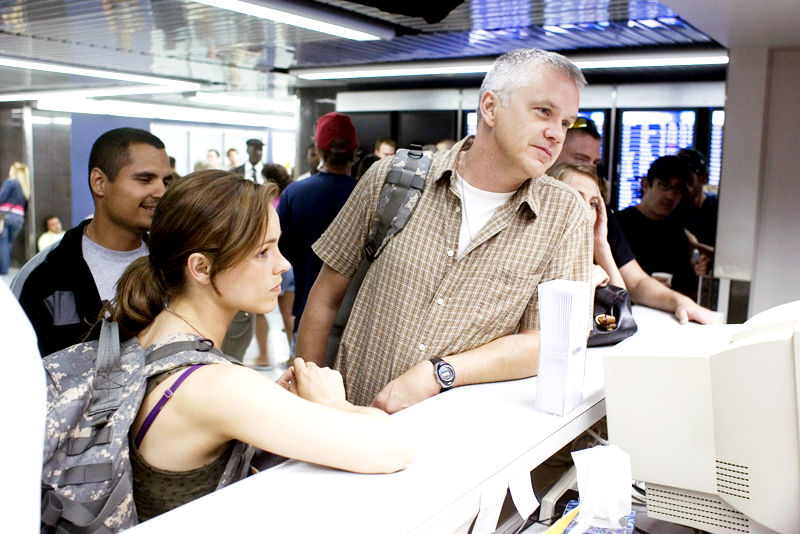
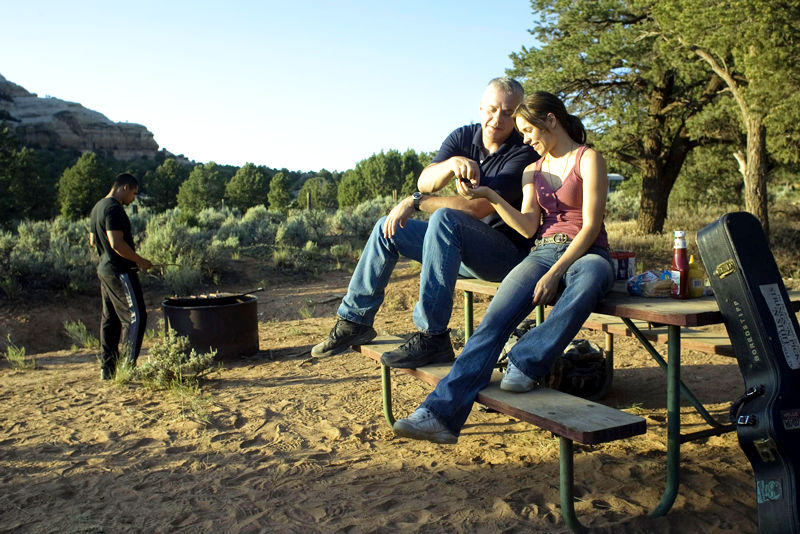
It follows three vets—Cheaver (Tim Robbins), an older sergeant just off his third and last tour, T.K. (Michael Peña), wounded, but gung-ho about going back, and Colee (Rachel McAdams), a neophyte coming back with a mission and a hole in her leg.  They're all damaged: Cheaver is psychologically out-of-whack; T.K.'s purpose is to get back to his fiancee to see if "his equipment" still works after being wounded; Colee wants to find the family of the guy she hooked up with there and return his guitar to them.  Meeting on the flight state-side, they decide to pool resources to get where they're heading.  But, like any road-trip, there are detours, changes of plan, and the occasional loss of bearingsStability is not to be found at home for any of them, and the trip only reinforces the perception that their fellow soldiers are the only ones who've "got their back."

Some of the episodes reach a bit, while some feel natural, and mostly the film avoids easy answers—less than it avoids mention of the war, except for a brief opening scene.  The Lucky Ones is less concerned with Iraq, than it is with the soldier's plight, caught in the demilitarized zone of not fitting in either here or there.  Putting them on the road—in transit—reflects that sense of rootlessness (as most road-movies do) that these perpetual soldiers must have that is unique to this era's soldiers.  The film never really tackles that subject head-on, as it almost has a duty to do, instead relying on the various "missions" and destinations to define the characters.  Ultimately, the film has nowhere to go once those stories are used up, and the film ends on a logical melancholy note. 

Where it shines is in the performances.  As with the war, Burger and his co-writer Dirk Wittenborn are quiet about the soldiers, presenting them as rather independent pawns in a much bigger game, their choices on the road sometimes unconventional, and not S.O.P.  But McAdams, Pena, and especially Robbins (this is some of his subtlest work in the past decade and nice to see), breathe a likable humanity into their characters, buffering the moments of manipulation and contrivance.  You like these guys and want them to succeed, even if they are a bit unreadable—enough so that some of their choices surprise, even deep into the movie.  That The Lucky Ones manages to do that is no small accomplishment. 


Wednesday, January 26, 2011

The Lucky Ones


The Lucky Ones (Neil Burger, 2008) Every war, every "police action," seems to have its "re-patriation" film.  World War 1 had The Razor's Edge, 2—The Best Years of Our Lives, VietNam—Coming Home.  The Lucky Ones involves returning troops in the ongoing Iraq War, different from their cinematic (and real) fellow troops in that they're not coming home.  They're on a 30 day leave before going back as part of the "stop-loss" program.  So, this takes place as more of an interruption to their service.  What happens when the environment is not so regimented, or as dangerous.  The three come back from the war altered, and all have specific goals in mind, all of which change when they actually touch boots to ground in the States.

It follows three vets—Cheaver (Tim Robbins), an older sergeant just off his third and last tour, T.K. (Michael Peña), wounded, but gung-ho about going back, and Colee (Rachel McAdams), a neophyte coming back with a mission and a hole in her leg.  They're all damaged: Cheaver is psychologically out-of-whack; T.K.'s purpose is to get back to his fiancee to see if "his equipment" still works after being wounded; Colee wants to find the family of the guy she hooked up with there and return his guitar to them.  Meeting on the flight state-side, they decide to pool resources to get where they're heading.  But, like any road-trip, there are detours, changes of plan, and the occasional loss of bearingsStability is not to be found at home for any of them, and the trip only reinforces the perception that their fellow soldiers are the only ones who've "got their back."

Some of the episodes reach a bit, while some feel natural, and mostly the film avoids easy answers—less than it avoids mention of the war, except for a brief opening scene.  The Lucky Ones is less concerned with Iraq, than it is with the soldier's plight, caught in the demilitarized zone of not fitting in either here or there.  Putting them on the road—in transit—reflects that sense of rootlessness (as most road-movies do) that these perpetual soldiers must have that is unique to this era's soldiers.  The film never really tackles that subject head-on, as it almost has a duty to do, instead relying on the various "missions" and destinations to define the characters.  Ultimately, the film has nowhere to go once those stories are used up, and the film ends on a logical melancholy note. 

Where it shines is in the performances.  As with the war, Burger and his co-writer Dirk Wittenborn are quiet about the soldiers, presenting them as rather independent pawns in a much bigger game, their choices on the road sometimes unconventional, and not S.O.P.  But McAdams, Pena, and especially Robbins (this is some of his subtlest work in the past decade and nice to see), breathe a likable humanity into their characters, buffering the moments of manipulation and contrivance.  You like these guys and want them to succeed, even if they are a bit unreadable—enough so that some of their choices surprise, even deep into the movie.  That The Lucky Ones manages to do that is no small accomplishment. 


Tuesday, January 18, 2011

Dr. Bronner's Magic Soapbox


Dr. Bronner's Magic Soapbox (Sara Lamm, 2006) I've used Dr. Bronner's pure castile peppermint soap for more than ten years.  It's cleansing, it tingles, and it smells nice.  It helps wake one up in the morning, along with the five cups of coffee, the energy drink, and the oatmeal with fruit (and the viewing of errors once your daily review is posted).


But, you can't use it without a more-than-casual look at the label.  Where most soap companies might have directions, or ingredients, or, even warnings—such as, don't drink this stuff, you idiot—Dr. Bronner's soap bottle is surrounded by a daunting label of small type that contains a rambling, repetitive, almost encyclopedic treatise espousing a unified God theory, and "the Moral A-B-C's."  Every inch of the label is utilized, even the margins, completely ignoring the "white space" rule or easy scanning strategies, and invoking Jesus, Mohammad, Buddha, Thomas Paine, Rudyard Kipling, Albert Einstein, Rabbi Hillel, even Carl Sagan in its scatter-shot "All-One" philosophy.


Two things come to mind: his heart's in the right place, though his mind, not so sure; and...should I be using this stuff?


Hey, the soap's great.  It's completely natural, organic, non-synthetic, "vegan," and "Fair-Trade."  I use it every day, and I've stopped reading the label—there's no warning for eye-strain, only from squirting it into your orbs, even by accident.  Plus, it's in most health-food stores...most stores, in fact, and these things get tested.  Plus, I like it.

But, the label had me curious.  I'd done some research, which was inconclusive, but the news that a documentary, Dr. Bronner's Magic Soapbox, was circulating around the movie-drain allowed me to pop two soap bubbles with one poke.  I put in a request at Netflix...they'd never heard of it.  That's okay.  They'd never heard of Chaplin, either.  A year later, it was available, and when it came in the queue, I snapped it up.

And what a tale it is: Bronner, a German Jew and fifth generation soap-maker, whose family died in the Nazi concentration camps emigrated, made it over the U.S. and established the first of four soap-making companies, and began developing his personal philosophy.  Married four times, institutionalized for a time (in the 50's, he got very loud, ranting at a lecture, and when you hear it in a German accent...well, people get nervous...especially during the 50's), escaping and hiding out in California, where another soap-making venture (out of his apartment!) caught on, and became huge with the counter-culture in the 1960's, who were rather accepting of the "out-there" (as long as you listened to their crazy ideas, too).

He had three kids, two of whom died before him, the youngest tours the country delivering lectures about his father,* and promoting the soap, doing out-reach, and checking outlets.  Nice guy, living what he learned from his father about "never judging people," but, in marked contrast, he actually listens as much as he talks (there's an interesting interview with the doctor's last wife, where Bronner is in the background, still babbling away—blind as a bat—and unaware that the camera is no longer on him).  Bronner's other son, built up the soap business, standardized the processing, bottling and distribution, doing it cheaply and in a non-polluting way—no pumps, just gravity—and was utterly disdainful of his dad's "All-One" jazz: for one, it scared off customers, and for two, Bronner would leave the kids for months at a time on his "lecture circuit," the kids often becoming subject to orphanages and foster-homes.   Now, the grandsons run the business efficiently, and with even more focus on making the company as green and fair as possible (their salaries are capped, so no one makes more than five times what the lowliest worker makes, and donating a whopping 70% of their net profits to charity).   And they make a LOT of money, bemused by the reputation of their grandfather/creator, who had lots of crazy ideas, one of which worked like gang-busters.

Not unlike Henry Ford.

Lamm's documentary is quirky, gossipy, empathetic, but not afraid to exploit the "woo-woo" side of the story.  She also has access to a lot of previously filmed material that gives context to the overall story, that is just weird enough to be an American success story.


Dr. Emmanual Bronner, his soap, and the Universe


* He has a great line in his lectures: "Eccentric geniuses cannot be good fathers...At dinner, he'd be (doing his work), and we'd say, "Dad, we're waiting," and he'd say, "What's more important: eating or uniting Spaceship Earth?"...and, well, he's got you there...."

the reply, of course, is: "Hey, Mr. 'Health,' starving your kids is gonna look GREAT in the papers..."

Thursday, December 30, 2010

Idiocracy


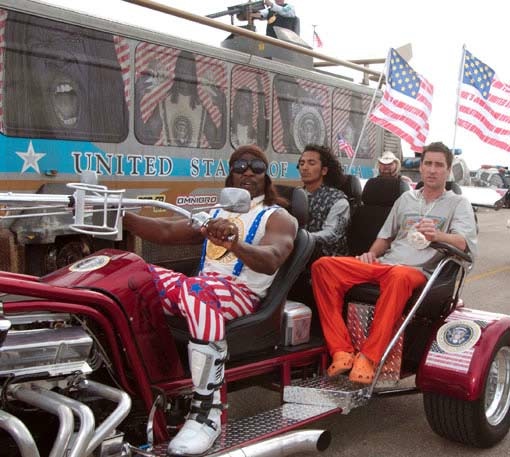
Idiocracy (Mike Judge, 2006) The concept is so ingenious in this variation of Planet of the Apes, that one wishes it were a better film; an absolutely average Army recruit (Luke Wilson) is selected to participate in a cryogenics experiment (along with an average intelligence prostitute—played by Maya Rudolph—as apparently there are no average women in the military), which due to hierarchical mis-management is abandoned and forgotten, until the year 2505.  During the course of 500 years, the process of natural selection reaches the conclusion of its "survival of the fittest" mode and sails right on past.  Higher IQ couples are slow to reproduce (if they do at all), and are soon outrun in population by the lower IQ populace, who are ready to procreate (whatever the hell THAT means) at the drop of a beer can.

When circumstances are such that Wilson's recruit is awakened, he finds himself in a planet of morons, self-obsessed and ADD, the world is a corpochracy (clothing is made up of logo patches), dysfunctional, and appallingly apathetic.  He struggles through the legal and penal system (one dimly Kafkaesque, and the other startlingly easy to circumvent) to emerge as President of the United States...because he's the smartest guy in the country.

I'd be happy if I thought that would really happen.  But I've been through enough election cycles to know that people (whatever their intelligence) are not most likely to vote for the best and the brightest—even actively resenting the more intelligent candidate, voting against them.  The inherent cynicism of the concept, thus, has no follow-through, and is merely circumvented to reach and end-point.  That, and the inherent cheesiness of the production-design (which I could actually buy given a corporate mentality and an apathetic consumer-society) work against the film, which starts out so promisingly, and has flashes of ingenuity throughout.  I just wish it might have gone farther, and opted for a less easy way out

Friday, February 5, 2010

Paris Je'taime

"Paris, Je'taime" (Various, 2006) You give 22 directors two days in a particular quartier of Paris to film a "love story" and watch what happens.* The results are varied in tone and success, but all are unique in story-line and subject matter and look. If ever there was a movie to show the specialness of the individual creator, despite their GPS position, this movie is it.

The cluster of films is like reading a good collection of short stories, all with just enough "hook" to make an impression, and in some cases, leave you wanting more. There is no continuity between them, save for a film-ending coda that combines several of the stars in brief tableaux while the segments are buttressed by nicely composed documentary shots of the city. That's merely the cartilege holding segments together. The soul of the thing are the many segments and the many takes on the city and its reputation.


1) Montmartre (Bruno Podalydès) The writer-director stars in his own contribution of a motorist who finally finds a parking space at the exact moment he's needed the most. Told mostly from the driver's perspective.

2) Quais de Seine (Gurinder Chadha) Cultural sensitivity is helped by mutual attraction as a young man (Cyril Descours) leaves his slacker pals and comes to the aid of a Muslim girl (Leïla Bekhti) on her way to the Mosque.

3) Le Marais (Gus Van Sant) a young man (Gaspard Ulliel) approaches a worker (Elias McConnell) at a printing press and stammers through a conversation about soul-mates that doesn't quite get through.

4) Tuileries (Joel and Ethan Coen) Contrarians The Coen Brothers spend their time in the Museum District inside the tube as a tourist (Steve Buscemi) has several culture clashes in Paris' seat of culture. Amazing how much story-line the Coens can cram into a short film...and how much animosity towards the French.

5) Loin du 16e (Walter Salles and Daniela Thomas) A nanny (Catalina Sandino Moreno of "Maria Full of Grace") makes a long commute to her charge and finds in it a moment of self-reflection.

6) Porte de Choisy (Christopher Doyle) Paris' Chinatown is given a Hong-Kong movie-maker's flair (by the cinematographer of, among others, "Shanghai Express") as a beauty products salesman (director/actor Barbet Schroeder) makes a call on a tough customer (Li Xin) running a salon. Stylized and witty, with equal parts sweet and sour.

7) Bastille (Isabel Coixet) A straying husband (Sergio Castellitto) meets his wife (Miranda Richardson) for lunch and instead of breaking up with her, finds himself devoting himself to her, utterly. Coixet has fun with a tragic story set in, pointedly of all places, Paris' prison district.

8) Place des Victoires (Nobuhiro Suwa) A grieving mother (Juliette Binoche) is given a last chance to make peace with her dead child with the help of a spectral cowboy (Willem Dafoe)

9) Tour Eiffel (Sylvain Chomet) "The Triplettes of Belleville" animator shows he's just as talented in "live action" doing a stop-motion film of a young boy relating the story of how his parents, both despised mimes, met and fell in love. Magical.

10) Parc Monceau (Alfonso Cuarón) Told in one continuous take, an older man (Nick Nolte) and younger woman (Ludivine Sagnier) meet at a pre-arranged place and speak of their worries about what will come next. Economical and sly, Cuarón also plays tributes to the other directors of "Paris, Jetaime" while he's at it.

11) Quartier des Enfants Rouges (Olivier Assayas) An American actress (Maggie Gyllenhaal) acting in a period drama, develops an addiction for her drug-supplier (Lionel Dray).

12) Place des fêtes (Oliver Schmitz) A Nigerian busker (Seydou Boro) gets his wish to have coffee with a woman he has fallen for (Aïssa Maïga). Told in brief flash-back with all the qualities of a dream.

13) Pigalle (Richard LaGravenese) Fanny Ardant and Bob Hoskins play a couple who are also players, creating a scenario on their anniversary to put a little spark into the act.

14) Quartier de la Madeleine (Vincenzo Natali) Gothic vampire tale of a tourist (Elijah Wood) who stumbles upon the activities of a beautiful vampiress (Olga Kurylenko). Love sucks.

15) Père-Lachaise (Wes Craven) Of course, Wes Craven gets the cemetery! But, he makes a simple film about love between a bickering couple (Rufus Sewell and Emily Mortimer) with a bit of poetic justice from Oscar Wilde (Alexander Payne).

16) Faubourg Saint-Denis (Tom Tykwer) Tykwer manipulates cinematic time and space chronicalling a love affair with an American drama student (Natalie Portman) passing before the blind eyes of a young musician (Melchior Beslon).

17) Quartier Latin (Gérard Depardieu and Frédéric Auburtin) Written by Gena Rowlands, who also stars with fellow Cassavettes Company alum Ben Gazzara, as a long-estranged couple who meet for a drink before finalizing their long-delayed divorce.

18) 14e arrondissement (Alexander Payne) An American (the wonderful Margo Martindale) on her first trip to Europe gives a report to her French class (in the language) of her trip.

Is there a favorite of mine? Yes. But like a French meal of many courses, if you're dissatisfied with any of the items, they're brief enough that another will come along shortly. What's interesting is that so many end with the turn of a franc that you don't realize just how well-done they are until they're gone...and a memory.

* There are 20 districts, but two of the pieces didn't make the cut.

Thursday, July 2, 2009

Junebug

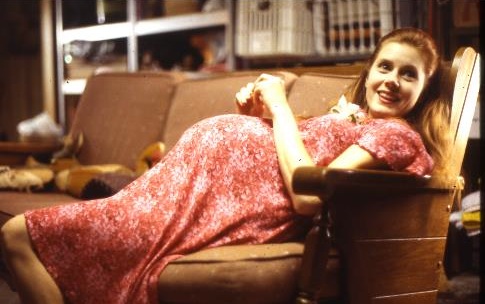
"Junebug" (Phil Morrison, 2006) Indie drama about a newly-married couple (Embeth Davidtz, Alessandro Nivola) who take advantage of a business trip to visit his emotionally stunted family in South Carolina, where the worldly Davidtz character must learn to cope. There's the sad, sweet father (Scott Wilson) who offers nothing. The matriarch (Celia Weston) who rules the roost. Brother Johnny (Ben McKenzie) is a diffident passive-agressive jerk with anger-control issues, and his wife Ashley (Amy Adams), nine months pregnant and with a natural ADD that has nothing to do with hormones.

Director
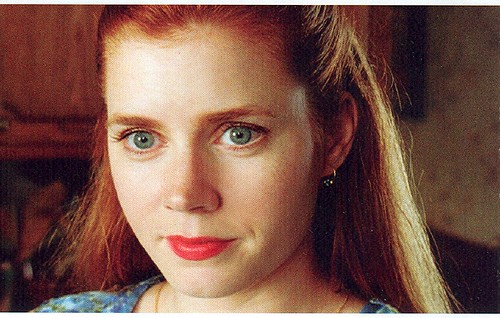
Morrison knew that he caught lightning in a bottle with Amy Adams—her character is introduced with a humongous close-up that conceals the character's pregnancy, but can't contain the aggressively up-with-people attitude of the one vibrant person in the house. You just know that given a huge pile of manure, she'd start digging through, looking for a pony. Adams takes the script and whip-saws from subject to subject along high emotional peaks—watching her performance is a bit unnerving and thrilling at the same time, like watching someone drive fast around precipitous mountain curves.

You also know, that, like they said in high school, she's cruisin' for a bruisin,'
such a bubble of high-spiritedness has to be popped in a drama, especially in the subgenus of indie dramas that thrive on lessons learned from disappointment.

The movie isn't disappointing, though.
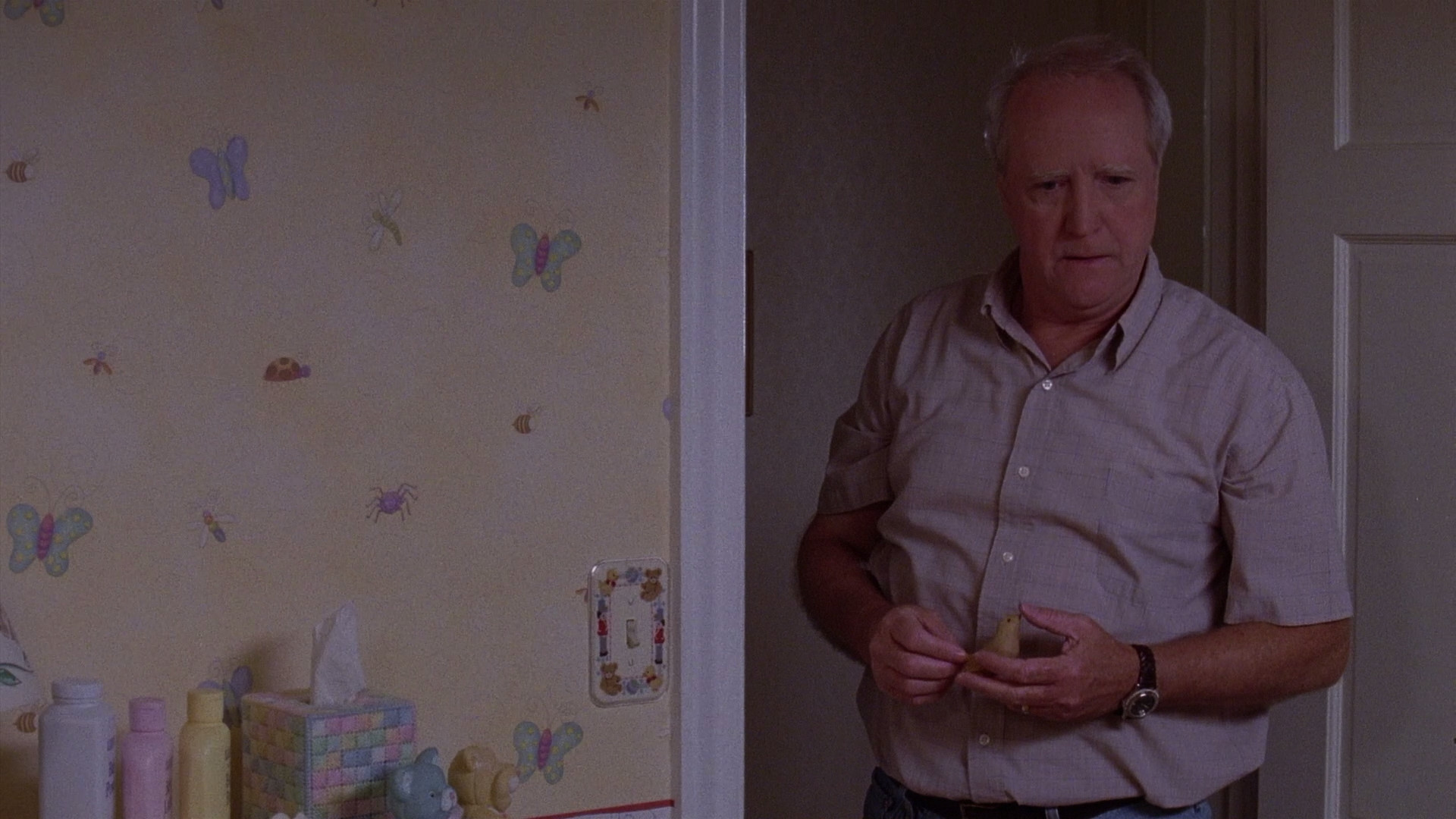
Morrison has created an austere environment for his piece giving a sense of everything being "just so" on the surface. In the meticulous casting there are delights of nuance and subtlety across the board that reveal hidden truths behind the "settled" behaviors. I was particularly charmed with character actor Scott Wilson (he played Richard Hickock to Robert Blake's Perry Smith in Richard Brooks' "In Cold Blood" and has made a career of playing distressed rural types), whose sad-eyed father appears to be a study in lethargy, but is quietly aware of everything that goes on in the house. When his wife wants him to have a "talking to" with Davidtz's Madeleine, he greets her entrance with a hand-wave that's more warning than greeting. A tiny moment, in a movie bristling with them, fleeting truths that arrive and disappear...like the seasonal annoyances the movie is named for.


Coming Attractions: We're going to change things up a bit schedule-wise, making this a short review week due to the long July 4th week-end. Tomorrow, we're going to present an Independence Day "Don't Make a Scene" that will last through the weekend—and it's an interesting one, consisting mostly of screen-shots, and a bit of dialogue with the most unlikely screen-credit I've applied in the series. Then, owing to that three-day Scene, we'll start off afresh Monday with a review of a new film, and there will very likely be others...maybe even four new releases reviewed. But, even if new reviews don't get posted, the future line-up of reviews is going to be eclectic...in the extreme.

Friday, June 5, 2009

Bubble

"Bubble" (Steven Soderbergh, 2005) Billed as "Another Steven Soderbergh Experience," this low-budget, shot on video, story of a love-triangle at a doll-making factory is more experimental than experiencial.

The business-end of the film is that it was released simultaneously in theaters, on Pay-per-View, and DVD...just to see what would happen. With the theater-life of films to DVD approaching four months and closing, business analysts were interested in what this new paradigm would look like. The costs on "
Bubble" being reasonable, they had nothing to lose, allowing them the freedom to experiment. "Bubble," however, was probably not the best film to do it with, as the entire film is unconventional, with no stars, no pyrotechnics, and the innovations behind the scenes for the most part.

Soderbergh had executive-produced (with
George Clooney, his "Section Eight Productions" partner) a cable series called "K Street", centered around Washington D.C. politics that mixed real actors with politicians, and Soderbergh became fascinated with the split-dynamics in the performances of thespians and politico's—sometimes preferring the latter. "Bubble" was then designed to accomodate non-professionals before the camera: there was no formal script, taking memorization out of the equation, and the film was designed as a series of "Tableuax," freeing performers and crew from having to "hit their mark." Filmed locally in the twin-cities of Belpre, Ohio and Parkersburg, West Virginia with locals culled from an interview process, Soderbergh made great picks for the principles with contrasting personalities and body-types and histories, informing their performances with the DNA of their lives. Line-readings are out of the equation, so the acting is reduced to reactions, flat-toned conversation, and tamped-down emotions.

And their eyes. "It's all in the eyes, really," said
Laurence Olivier, and this trio's "windows to the soul" are doing 80% of the work with fascinating results. Pretty soon, story is reduced to reaction and eyes that sparkle, harden, and hide...and betray inner thoughts, even un-scripted ones. It may not be the most dynamic film in the world, but for taking the mystery out of the film-making, and film-acting process, it makes for a very interesting watch.

Wednesday, April 22, 2009

OSS177: Cairo—Nest of Spies

"OSS117: Cairo—Nest of Spies" aka "OSS 117: Le Caire nid d'espions" (Michel Hazanavicius, 2006) If I may speak collectively (and unfairly) for a moment, the French have a singularly exclusive sense of humor running precisely, if more broadly, along the Mel Brooks dictum: "Tragedy is when I cut my finger; Comedy is when you fall down a man-hole and die!"
The French love to laugh at other people. But, like a lot of conservatives, they seem incapable of laughing at themselves. When they make comedies, their sense of the absurd tends to be mixed with the noble—
Jacques Tati's films are restrained manner-comedies mixed with slapstick. Maurice Chevalier was a charming rogue, but never less than charming.

But when
Jean Renoir tried to be satirical about French aristocracy, the citizenry rebelled and Renoir had to cut one of the greatest films ever made, The Rules of the Game, down to a short subject. Don't mention Blake Edwards' Inspector Clouseau to them; they'll throw their dinner plates at you—if only there was enough food on them to cause damage.

The French are farceurs, not comedians.

Now, along comes this charming bon-bon of a spy movie, where they can have their cake and let them eat it, too.

The "
OSS117" series is a long-running series of adventure spy novels from Jean Bruce—there's no Bond rip-off here, OSS117 predates "007"—featuring the adventures of the plucky French spy in globe-totting adventures. During the spy-craze of the 60's, there were many OSS films riding the swinging spy tux-tails, starring, among others, Ivan Desny, Luc Merenda, Kerwin Mathews (The Seventh Voyage of Sinbad), Frederick Stafford (Topaz), and pencilled-in Bond John Gavin,* made cheaply in Europe, and successful enough to achieve its own series. But by 1973, with abuses by CIA operatives around the globe, spies went out of favor. The books continued, carried on by the next generation of Bruce's.

And now, the movies have as well, taking the formula that the
Bond producers used to keep Bond jogging in bell-bottom tuxes through the 70's—make it more of a comedy, dammit! But where the Broccoli family has seemed incapable of recreating the glory days of Bond—the epitome being "From Russia With Love," directed by Terence Young, director Hazanavicius takes the style, the look, and the air of brazen world-weariness that Young injected into that film, and does a fairly transparent job of spoofing the misogyny and arrogance of those initial Bond films.

And it's funny as hell. It takes a while to recognize what "
Cairo—Nest of Spies" is doing and get into the rhythm of the thing: is it serious, is it merely being archly ironic, or is this actually trying to be funny? Because there's no big joke in the opening black and white sequence, you might take the cockiness for real rather than the first signs that Agent OSS117 (the remarkably sunny Jean Dujardin) is remarkably clueless, so caught up in himself and his own shining brilliance that he's too dazzled to realize that things around him have gone horribly wrong. Many situations find him waking up from the distractions of himself to find that he's blown it and has to back-track a bit. It's one of the givens of the Bond series that audiences like a "007" film when the agent is enjoying himself. And Hubert Bonisseur de La Bath travels in an impenetrable bubble of self-satisfaction. He even has submerged homosexual urges that he doesn't recognize and that he mis-reads, anyway. He lives in the best of all possible worlds—his own—and his rules are simple: if he doesn't like it, he kills it, seduces it, or ignores it and moves on.

Fortunately, his enemies are just as adept at carrying out a world-enveloping conspiracy: they're not. Where the gears, switches and machinations of most movie-cabals perform flawlessly, this team of neo-Nazi's are more than likely to blow a fuse, or get trapped behind their own secret entrance. As such, there's not an awful lot of suspense (but there isn't in a Bond movie, is there?), and the only concern is how big the explosion will be at the end. "OSS117: Cairo—Nest of Spies" even manages to do that cheerily.

"OSS117" will return. Can't wait.

* Gavin, who starred in "Spartacus" and "Psycho" among others, was set to star in "Diamonds Are Forever" (1971) until Sean Connery was coaxed back with a record salary. He was paid off to fade into the background, and Ronald Reagan later appointed him Ambassador to Mexico. The best gadget any spy can have is a golden parachute.