Showing posts with label Michael Peña. Show all posts

Thursday, January 24, 2013

Gangster Squad

Manifest Density
or
The War for the Soul of Los Angeles (such as it is)

Ruben Fleischer's third film (after the very good Zombieland and the excremental 30 Minutes or Less) is Gangster Squad, a Hollywoodized version of the efforts by the LAPD to take down the efforts of Mickey Cohen, the lieutenant of Bugsy Siegel's Jewish mafia, who took over Siegel's interests when the mob kingpin was murdered in 1947.

If one is looking for a history lesson, one should look elsewhere.  This is a glamorized, fictionalized version of the events set in some art-deco post-war version of Los Angeles that doesn't seem to have existed anywhere except the Warner Brothers gangster films and Brian de Palma's The Untouchables, to which this film owes a great debt.  The gangsters all wear dark clothes with long coats (the better to identify them) and are all greasy and ugly, while the police are all good-looking guys in nice suits who bend the rules a bit (with the possible exception of Chief Parker, played with a gruff somnambulance by Nick Nolte, who headed up the similar "Hat Squad" in Lee Tamahori's Mulholland Falls).*

It all feels very false, from how the gangsters rarely hit anything despite the thousands of rounds shot from tommy guns, and the Gangster Squad "hit" ratio usually fares better.  The Squad (hand-picked by the leader's wife, played by Mireille Anos, for being rough-necks and not promotion-headed top-of-their-classers) consists of boss John O'Mara (who did exist, but did not run the unit) as played by Josh Brolin, Jerry Wooters (played by Ryan Gosling), Max Kennard (Robert Patrick)—a sharpshooter, Conway Keeler (Giovanni Ribisi) a surveillance/electronics expert, as well as two PC members for the 21st century audience—Anthony Mackie (so good in The Adjustment Bureau) and Michael Peña.   Their target is Mickey Cohen (Sean Penn in a make-up that makes him look like he walked out of Warren Beatty's Dick Tracy), who's reputation is movie-inflated to make him seem like he's an empire-building Al Capone, rather than the cheap hood with star connections he ultimately was.

Fleischer is more interested in flash than being true to the source.  His fights are surprisingly well-staged, one shot per flying fist, but not Bourne-edited so one can easily follow it—an early fight in an elevator borrows heavily from a similar scene in a James Bond movie but actually goes places the 007 film merely used for suspense.  Once in awhile, he'll go for a Matrix-y slo-sloo-slooo-mo effect (rather than a fleeting Peckinpah image) just to make a point of something, like cartridges flying out of a machine gun, or a Christmas ornament exploding due to gunfire, but it's just slowing things down as opposed to telling a story.  Brolin's fine, nuanced even, but Gosling's McQueen-ish hipster act is wearing a little thin, and the chemistry exhibited between he and Emma Stone from Crazy, Stupid Love is completely missing here.  Mackie, Peña, and Patrick are far more engaging probably because they don't fit the established mold. 

It's entertaining, to a certain extent, but one gets the feeling, after patterns have been set that bring to mind other films, that one is being sold a bill of goods, and we are.  

The real-life Cohen was convicted of tax evasion (not murder) in 1950, serving four years.  Upon his release, he established several businesses (the ones portrayed in the film) and was again convicted of tax evasion in 1961 and released (again) in 1972.  Cohen died in his sleep in 1976.


Gangster Squad is a Rental.


The real Mickey Cohen, photographed in 1950
The real "Gangster Squad"


* Amusingly, his driver is Officer Darryl Gates (played by Josh Pence) who would be Chief from 1978 to 1992.

Tuesday, October 16, 2012

End of Watch

Cops, the Home Movie
or
"...More Capers in One Deployment Than Most Cops Will See Their Entire Career."

It's a war out there "once upon a time in South Central."  And Officer Brian Taylor (Jake Gyllenhaal) is the front-line reporter documenting the whole thing "for a project."  He's carrying a camera—not that he really needs it, the dashboard cam will pick up everything needed for an investigation.  But that camera can only look forward—it's myopic.  It can't see around you, it can't check the perimeter.  And it can't look into your soul.  It can look at your back, but it can't have it.

It starts with one of those dash-cam chases, so familiar to "reality" chase shows.  No overlayed sound, save for Gyllenhall's narration, said in a monotone as if he was giving you your Miranda.  


I am the police and I am here to arrest you.  You have broken the law.  I did not write the law.  I may even disagree with the law.  But I will enforce it.  No matter how you plead, cajole, beg or attempt to stir my sympathy, nothing you do will stop me from putting you in a steel cage with gray bars.  If you run away, I will chase you.  If you fight me, I will fight back.  If you shoot at me, I will shoot back.  By law I am unable to walk away.  I am a consequence.  I am the unpaid bill.  I am fate with a badge and a gun.  Behind my badge is a heart like yours. I bleed, I think, I love, and yes, I can be killed. And although I am but one man, I have thousands of brothers and sisters who would die for me and I for them.  We stand watch together.  The thin-blue-line, protecting the prey from the predators, the good from the bad. We are the police.

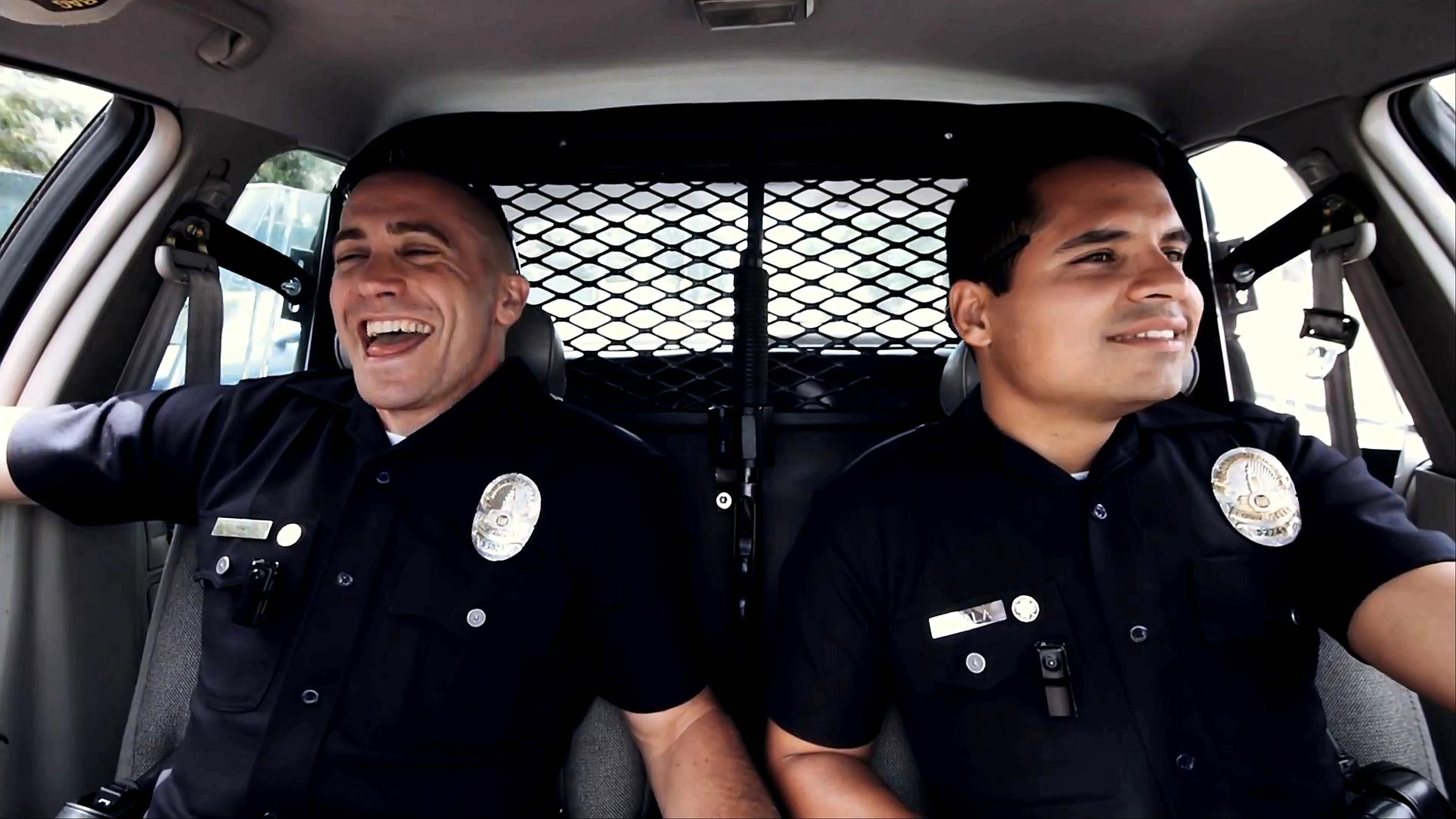
And with that, the law of the film is layed down.  The dash-cam goes away and the camera goes into cinema verité, the camera pointing from inside Taylor's locker as he goes through basic introductions—himself, his partner Mike Zavalla (Michael Peña, never better), his equipment (and a conversation from Rio Bravo pops into one's head: "That all you got?"  "That's what I got."), and the beginning of the look inside—the harsh joshing, the tensions, the coolness and coldness and camaraderie of the corps. Joseph Wambaugh had an apt phrase for them in his book (and subsequent film), "The New Centurions."  But Rome was never like this.

The turf in South Central is tough and hard-scrabble.  Poverty is on display on every street corner, and behind the boarded-up windows of the houses in various states of disrepute are secrets for the outside world not to know, but will see the light of day once the front door is kicked in.  The war is in the streets, but inside cook the warning signs that something is about to explode, the stakes rising, the limits of human degradation dropping, the calibers of the weapons increasing, the risks increasing and the only good side of it being that they're not increasing exponentially.


It's a tough film, directed and written by the guy who wrote Training Day and the original The Fast and the Furious, David Ayer, who has a knack for keeping things on the down-trodden path no matter who's behind the camera or what the subject matter is.  It's not a film for continuity buffs, who will be driven crazy if they think "Okay, who's taking that shot?" with every change of perspective.  Very quickly, the strictures of the snatch-and-grabbed shot are forgotten to gain perspective.  The film would have been a pretentious (and claustrophobic) confusion if the conceit was maintained throughout, (I can see the review headline now: "The Blair Watch Project"), but as it is, breathes enough air into it while maintaining a feeling of impromptu recording—keeping the spirit of the law, rather than the letter of it.  That, along with the ad-libbed spark of the dialogue gives it an edgy immediacy that, again, "seems" right, while never fully escaping the feeling of planned manipulation (not that it ever could).  Game try, though.  And manages to show the life—long stretches of tedium punctuated by moments of terror—that one imagines the life to be, even though blown up with steroids to fulfill the needs for melodrama and tension.

End of Watch is a Matinee.


Saturday, September 17, 2011

The Lucky Ones

This week, we're re-publishing some reviews of the films from the post 9-11 environment.


The Lucky Ones (Neil Burger, 2008) Every war, every "police action," seems to have its "re-patriation" film.  World War 1 had The Razor's Edge, 2—The Best Years of Our Lives, VietNam—Coming Home.  The Lucky Ones involves returning troops in the ongoing Iraq War, different from their cinematic (and real) fellow troops in that they're not coming home.  They're on a 30 day leave before going back as part of the "stop-loss" program.  So, this takes place as more of an interruption to their service.  What happens when the environment is not so regimented, or as dangerous.  The three come back from the war altered, and all have specific goals in mind, all of which change when they actually touch boots to ground in the States.

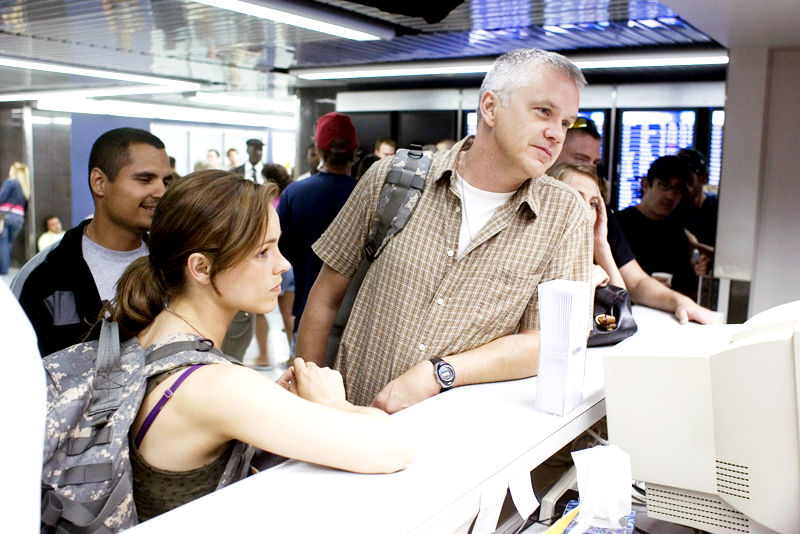
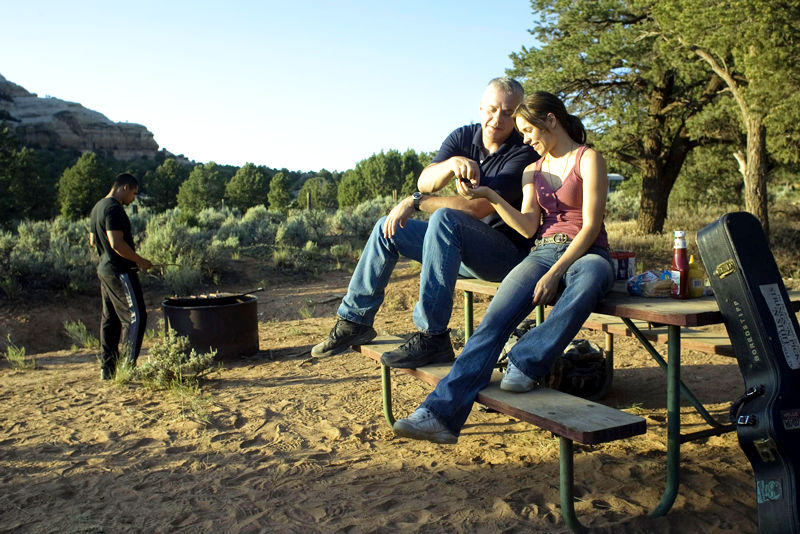
It follows three vets—Cheaver (Tim Robbins), an older sergeant just off his third and last tour, T.K. (Michael Peña), wounded, but gung-ho about going back, and Colee (Rachel McAdams), a neophyte coming back with a mission and a hole in her leg.  They're all damaged: Cheaver is psychologically out-of-whack; T.K.'s purpose is to get back to his fiancee to see if "his equipment" still works after being wounded; Colee wants to find the family of the guy she hooked up with there and return his guitar to them.  Meeting on the flight state-side, they decide to pool resources to get where they're heading.  But, like any road-trip, there are detours, changes of plan, and the occasional loss of bearingsStability is not to be found at home for any of them, and the trip only reinforces the perception that their fellow soldiers are the only ones who've "got their back."

Some of the episodes reach a bit, while some feel natural, and mostly the film avoids easy answers—less than it avoids mention of the war, except for a brief opening scene.  The Lucky Ones is less concerned with Iraq, than it is with the soldier's plight, caught in the demilitarized zone of not fitting in either here or there.  Putting them on the road—in transit—reflects that sense of rootlessness (as most road-movies do) that these perpetual soldiers must have that is unique to this era's soldiers.  The film never really tackles that subject head-on, as it almost has a duty to do, instead relying on the various "missions" and destinations to define the characters.  Ultimately, the film has nowhere to go once those stories are used up, and the film ends on a logical melancholy note. 

Where it shines is in the performances.  As with the war, Burger and his co-writer Dirk Wittenborn are quiet about the soldiers, presenting them as rather independent pawns in a much bigger game, their choices on the road sometimes unconventional, and not S.O.P.  But McAdams, Pena, and especially Robbins (this is some of his subtlest work in the past decade and nice to see), breathe a likable humanity into their characters, buffering the moments of manipulation and contrivance.  You like these guys and want them to succeed, even if they are a bit unreadable—enough so that some of their choices surprise, even deep into the movie.  That The Lucky Ones manages to do that is no small accomplishment. 


Wednesday, May 18, 2011

Everything Must Go

"Priced To Move"
and
"'Bye-Bye' Says the Junk in the Yard"

Job had it easy.

After being fired from his job for some sexual malfeasance that he was too drunk to remember, Nick Halsey (Will Ferrell) drives home—stopping on the way to get a case and a half of PBR—and finds that all of his belongings are on the front lawn, strewn about, the flotsam and jetsam of a life that's hit a reef.  The house locks have been changed.  The garage code is different.  There's a note on his door from his wife saying she's leaving him and "Don't Call." His credit cards don't work.  His bank account has been frozen.  His cell-phone is disconnected. 

That solves the "don't call" problem.

Then, his company car gets repossessed.

What else can happen?  Well, his next-door neighbor (Stephen Root) can pass by and say "...saw this coming a mile off."

"Thanks for warning me..." says Nick, simmering.

There's a nice tone-shift to Everything Must Go.  It stars Ferrell, who goes dramatic here, but the doofus-slob-schtick that he has honed over the years serves him well as he goes through humiliation after humiliation—as a performer, he's never steered clear of making himself appear foolish.  He has, in fact, embraced it.  The physical comedy looks nicely unplanned, but still has a chortling superior sting to it.  Ferrell can be a cruel comedian but it's mostly self-imposed, the barbs on the wires facing inward like a crown of thorns.  And he has a nice explosive quality that makes you wonder when he's going to go offThe fuse between comedy and drama is enticingly short.  There's a bit of Peter Sellers to Ferrell at his best that makes you want to laugh almost defensively.  That's in good play here.

Everything Must Go is based on Raymond Carver's short story "Why Don't You Dance?"* (you can read the whole thing here—go ahead, it'll only take five minutes) and writer-director Dan Rush has done yeoman's work taking the author's slice of a story and expanding it to feature length.  In fact, the couple that dominate the story don't even appear.  Rush has taken the bare-bones carcass of the story and reconstructed it, focussing on the pain—and the emotional journey—of the man with the rummage sale of a life, laid bare for all the world to see...and eventually, pick over.

I love Carver's writing.  He makes kernels of story that feel emotionally real, of lives tipped over and spilling, the contents of privacy exposed to the air and either flowering or rotting.  A little push and we could all go there, his situations just a happenstance, a coin-toss, away.  Would we act that way?  Do we recognize ourselves in such circumstances?  And Rush takes the premise and goes back in time and forward, filling the gaps, creating the world of the man who, at first, drunkenly, defiantly lays his past bare...and then, lets it go.

Most of Everything Must Go works.  There is a logical progression to what Rush has put together to get to the point of the Carver story, although it may seem a little bottled up with some contrivance—a side-track to a story involving Laura Dern probably wasn't necessary, but it opens the movie up a bit and it's always nice to see Dern.

But it's all Ferrell, with some nice work by Michael Peña, Rebecca Hall, and Christopher Jordan Wallace, who has the most to do (besides Ferrell), as the kid who hangs around and gets sucked in to the situation, and like others, manages to gain something from the deconstruction of a marriage.  One wonders if the comedian, fearing that he might be found out by going sentimental, doesn't hold back some effort, thereby bringing more of a sense of peace...or closure...to the character by the film's end.  But, then, maybe that hesitancy is the punch-line he wanted, walking away leaving the audience wanting more.  It's a far cry from Land of the Lost.  And admirable.

Everything Must Go is a Matinee.


Yeah.  No.  It doesn't feel like this chirpy trailer at all.


* Since writing this, I've discovered there is a short Australian film based on the story, and following Carver's story far more closely called Everything Goes. It stars Hugo Weaving and Abbie Cornish.
You can find it on the web.

Saturday, April 2, 2011

Battle: Los Angeles


"Limited Intel"
or
"That is Some John Wayne Shit"

There is a great movie here somewhere. Unfortunately, Steven Spielberg already made it with his version of War of the Worlds.  Spielberg took the H.G. Wells concept of Martians tearing up the bucolic English countryside, made it urban U.S.A. (via the "War of the Worlds" broadcast of the Mercury Radio Theater) and took it in a decidedly post-9/11 direction, focussing on an enemy's bewilderingly unfathomable "other"-ness, the utter devastation of a hi-tech civilization's infrastructure, and forced American viewers to confront a vision they might not have broached during the quiet desperation of their daily lives: this country's version of refugees.

At the same time, he completed a trilogy of stories (started with Close Encounters of the Third Kind and E.T.: The Extra-Terrestrial) in which men-children must confront their sense of wonder (or disbelief) and use the knowledge of worlds not their own (and the beings in them) to jump-start their consciousness beyond their limited world-view, and, in a sense, grow young with the Universe by growing up and accepting the responsibilities of their positions.  The Heavens conspire to ground them.   

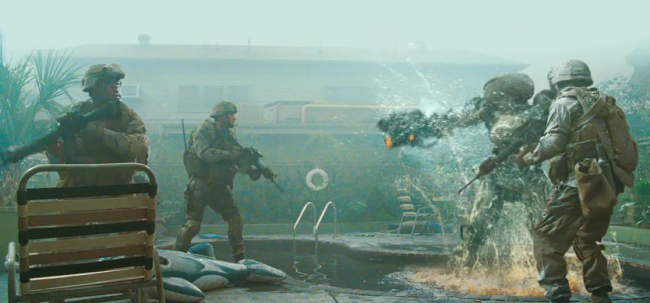
There is nothing like this kind of deep-thought in Battle: Los Angeles.  This is a war-movie of the modern era (but only technologically, the script is cliched with "boo-ya-speak") with Transformers instead of Talliban.  The film-makers (director Jonathan Liebesman and writer Christopher Bertolini) hedge their bets (and budget) by narrowing the focus of the story to one regiment fighting an armada of Erector Set exo-skeletoned aliens through the back allies of Santa Monica, California, attempting to secure a lone offensive while evacuating a handful of civiliansThe global conflict happens in the background on television monitors (the reason for the attack is some pundit-theorist's idea that they want our water, but it's only lip-flap for a half-hearted rationale), we just get to see the street skirmishes of this rag-tag clutch of war-hardened dog-faces as they battle the 'bots and each other not far from the pier.*

The action looks like Iraq and Afghanistan (and now, God help us, Libya), filmed in a confused snatch-and-grab style, but Liebesman gives you little context or overview, so it all just looks confused, as opposed to caught in realitythings only chill out for FX-heavy vista shotsRestrepo between Pico and Pier StreetAnd try as they might to make it feel authentic with shouted overlapping dialogue, there's just too much jargon of what Full Metal Jacket author Gustav Hasford called "the phony-tough and the crazy-brave."  It may walk and shake like CNN, but it talks like The Sands of Iwo Jima.  It's not relatable.  It's not personal.  It's not horrifying.  You don't feel this war.  You don't dodge the heat-rays and tracer rounds in your theater-seats.  It's as engaging as watching it on Fox News.  That is, not at all.  Eat your popcorn and wait for the armistice.

And I could quibble about the Intelligence gathering here.  Sure, they figure out that the sudden meteor showers are an invasion force pretty quickly, but the fighters fall as quickly as George Lucas' storm-troopers and battle-droids.  The attacks happen fast and devastatingly, but the things look electricity-based; one overhead nuclear pulse would take everything out.  Game Over.  It's shooting tin-cans then.  But, that never happens.  Instead, each city has an alien Command Central that controls everything in its area.  Isn't there a signal that can be jammed?  The only time Battle: LA gets interesting is when one of the "spam-in-a-can" fighters gets captured, and Staff Sergeant Nantz (Aaron Eckhart, trying very hard to rise above) and a civilian veterinarian (Bridget Moynahan) start a triage vivisection to answer the question "Okay, how do you kill one of these things?"  Now, that feels about right, practical strategy and the horrors of war combined in one icky sequence.  The rest just seems like contrivance, a recruitng feature for the Marines that won't offend any minority group.  A war movie shouldn't feel that safe.

A little bit better than the excremental Skyline, but not good.

Battle: Los Angeles is a Cable-Watcher.


* Inspired by the P.A. announcemnts from M*A*S*H

Wednesday, January 26, 2011

The Lucky Ones


The Lucky Ones (Neil Burger, 2008) Every war, every "police action," seems to have its "re-patriation" film.  World War 1 had The Razor's Edge, 2—The Best Years of Our Lives, VietNam—Coming Home.  The Lucky Ones involves returning troops in the ongoing Iraq War, different from their cinematic (and real) fellow troops in that they're not coming home.  They're on a 30 day leave before going back as part of the "stop-loss" program.  So, this takes place as more of an interruption to their service.  What happens when the environment is not so regimented, or as dangerous.  The three come back from the war altered, and all have specific goals in mind, all of which change when they actually touch boots to ground in the States.

It follows three vets—Cheaver (Tim Robbins), an older sergeant just off his third and last tour, T.K. (Michael Peña), wounded, but gung-ho about going back, and Colee (Rachel McAdams), a neophyte coming back with a mission and a hole in her leg.  They're all damaged: Cheaver is psychologically out-of-whack; T.K.'s purpose is to get back to his fiancee to see if "his equipment" still works after being wounded; Colee wants to find the family of the guy she hooked up with there and return his guitar to them.  Meeting on the flight state-side, they decide to pool resources to get where they're heading.  But, like any road-trip, there are detours, changes of plan, and the occasional loss of bearingsStability is not to be found at home for any of them, and the trip only reinforces the perception that their fellow soldiers are the only ones who've "got their back."

Some of the episodes reach a bit, while some feel natural, and mostly the film avoids easy answers—less than it avoids mention of the war, except for a brief opening scene.  The Lucky Ones is less concerned with Iraq, than it is with the soldier's plight, caught in the demilitarized zone of not fitting in either here or there.  Putting them on the road—in transit—reflects that sense of rootlessness (as most road-movies do) that these perpetual soldiers must have that is unique to this era's soldiers.  The film never really tackles that subject head-on, as it almost has a duty to do, instead relying on the various "missions" and destinations to define the characters.  Ultimately, the film has nowhere to go once those stories are used up, and the film ends on a logical melancholy note. 

Where it shines is in the performances.  As with the war, Burger and his co-writer Dirk Wittenborn are quiet about the soldiers, presenting them as rather independent pawns in a much bigger game, their choices on the road sometimes unconventional, and not S.O.P.  But McAdams, Pena, and especially Robbins (this is some of his subtlest work in the past decade and nice to see), breathe a likable humanity into their characters, buffering the moments of manipulation and contrivance.  You like these guys and want them to succeed, even if they are a bit unreadable—enough so that some of their choices surprise, even deep into the movie.  That The Lucky Ones manages to do that is no small accomplishment.