or
"...More Capers in One Deployment Than Most Cops Will See Their Entire Career."
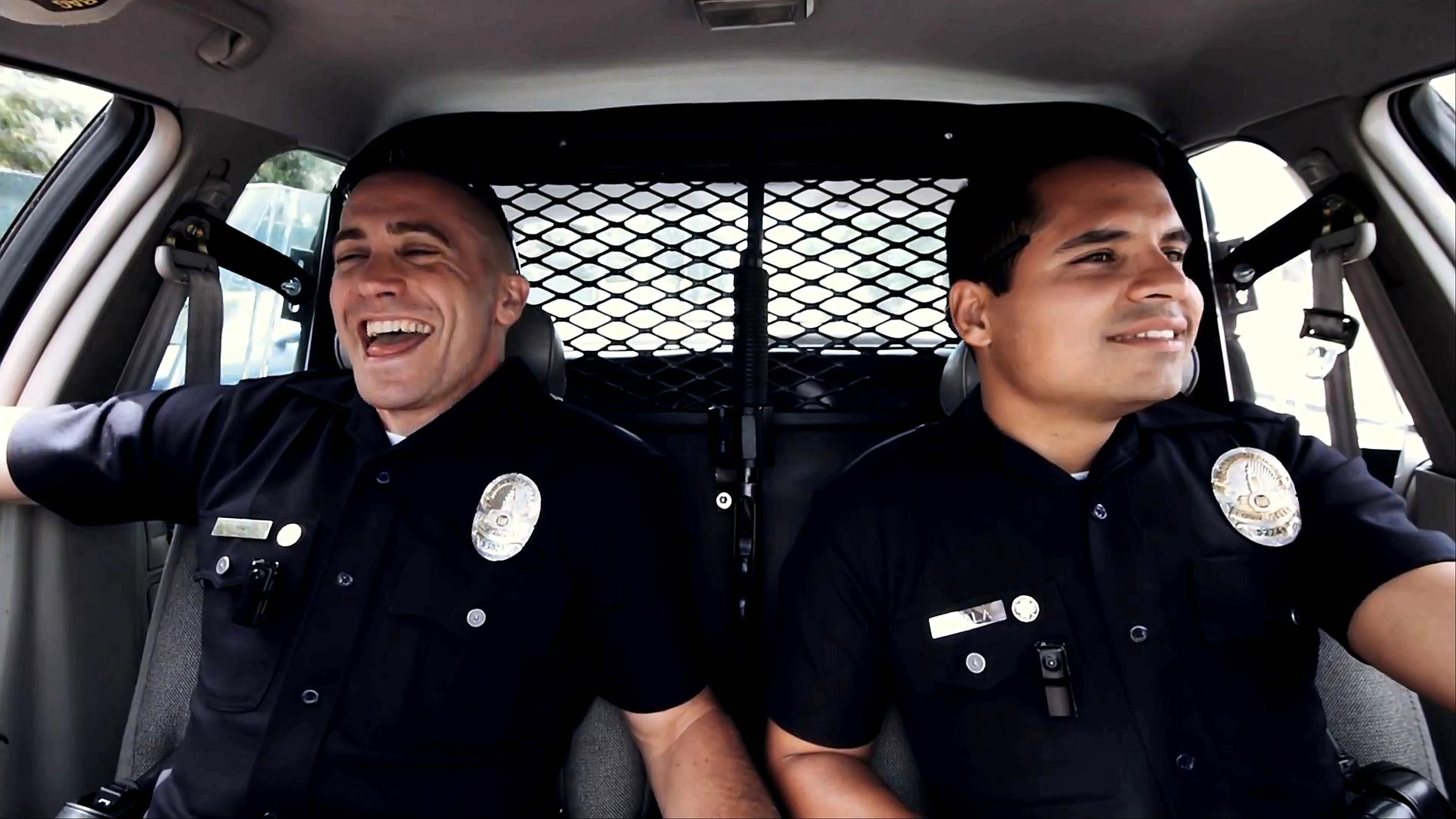
It's a war out there "once upon a time in South Central." And Officer Brian Taylor (Jake Gyllenhaal) is the front-line reporter documenting the whole thing "for a project." He's carrying a camera—not that he really needs it, the dashboard cam will pick up everything needed for an investigation. But that camera can only look forward—it's myopic. It can't see around you, it can't check the perimeter. And it can't look into your soul. It can look at your back, but it can't have it.
It starts with one of those dash-cam chases, so familiar to "reality" chase shows. No overlayed sound, save for Gyllenhall's narration, said in a monotone as if he was giving you your Miranda.
I am the police and I am here to arrest you. You have broken the law. I did not write the law. I may even disagree with the law. But I will enforce it. No matter how you plead, cajole, beg or attempt to stir my sympathy, nothing you do will stop me from putting you in a steel cage with gray bars. If you run away, I will chase you. If you fight me, I will fight back. If you shoot at me, I will shoot back. By law I am unable to walk away. I am a consequence. I am the unpaid bill. I am fate with a badge and a gun. Behind my badge is a heart like yours. I bleed, I think, I love, and yes, I can be killed. And although I am but one man, I have thousands of brothers and sisters who would die for me and I for them. We stand watch together. The thin-blue-line, protecting the prey from the predators, the good from the bad. We are the police.
And with that, the law of the film is layed down. The dash-cam goes away and the camera goes into cinema verité, the camera pointing from inside Taylor's locker as he goes through basic introductions—himself, his partner Mike Zavalla (Michael Peña, never better), his equipment (and a conversation from Rio Bravo pops into one's head: "That all you got?" "That's what I got."), and the beginning of the look inside—the harsh joshing, the tensions, the coolness and coldness and camaraderie of the corps. Joseph Wambaugh had an apt phrase for them in his book (and subsequent film), "The New Centurions." But Rome was never like this.
The turf in South Central is tough and hard-scrabble. Poverty is on display on every street corner, and behind the boarded-up windows of the houses in various states of disrepute are secrets for the outside world not to know, but will see the light of day once the front door is kicked in. The war is in the streets, but inside cook the warning signs that something is about to explode, the stakes rising, the limits of human degradation dropping, the calibers of the weapons increasing, the risks increasing and the only good side of it being that they're not increasing exponentially.
It's a tough film, directed and written by the guy who wrote Training Day and the original The Fast and the Furious, David Ayer, who has a knack for keeping things on the down-trodden path no matter who's behind the camera or what the subject matter is. It's not a film for continuity buffs, who will be driven crazy if they think "Okay, who's taking that shot?" with every change of perspective. Very quickly, the strictures of the snatch-and-grabbed shot are forgotten to gain perspective. The film would have been a pretentious (and claustrophobic) confusion if the conceit was maintained throughout, (I can see the review headline now: "The Blair Watch Project"), but as it is, breathes enough air into it while maintaining a feeling of impromptu recording—keeping the spirit of the law, rather than the letter of it. That, along with the ad-libbed spark of the dialogue gives it an edgy immediacy that, again, "seems" right, while never fully escaping the feeling of planned manipulation (not that it ever could). Game try, though. And manages to show the life—long stretches of tedium punctuated by moments of terror—that one imagines the life to be, even though blown up with steroids to fulfill the needs for melodrama and tension.
End of Watch is a Matinee.




.jpg)