Showing posts with label 2008. Show all posts

Thursday, November 21, 2013

Hancock

Hancock (Peter Berg, 2008) The premise (for a super-hero movie) is interesting, the stars are all competent, and in some cases exceptional (Charlize Theron puts in quite a surprising turn in her role), and the writing sometimes refreshing.  

What kills Hancock is the direction.  Berg's snatch-and-grab semi-documentary style worked gangbusters for Friday Night Lights, but for the super-heroics of Hancock, you just get the impression that they're trying to hide some flaw in the effects from you, especially in the inevitable fisticuffs that these things seem to depend on (although the cleverer ones find ways around it).


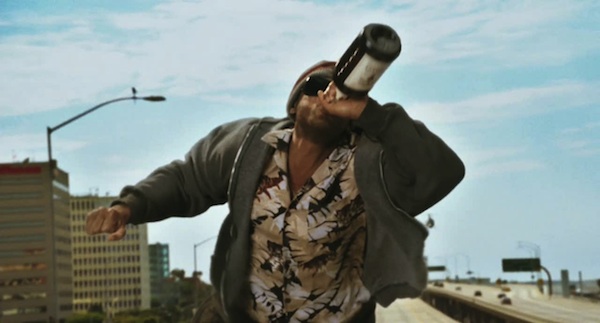
Will Smith plays John Hancock, who can bend steel in his bare hands, but would rather bend his elbow.  He's alcoholic, down and out and super-depressed. Most super-heroes are high and flying, but Hancock takes it the wrong way, so rather than looking up in the sky for him, chances are the best place to find him is the gutter.  He has powers and abilities far beyond mortal men, but no idea who he is, how he got that way, and there's no messianic father-figure to tell him the back-story.  And yeah, he'll do all that super-heroic stuff, but he's too stoned out of his mind to do anything carefully—he's like a bull in a china shop, and every time he does some good, he does a lot more harm in property damage.


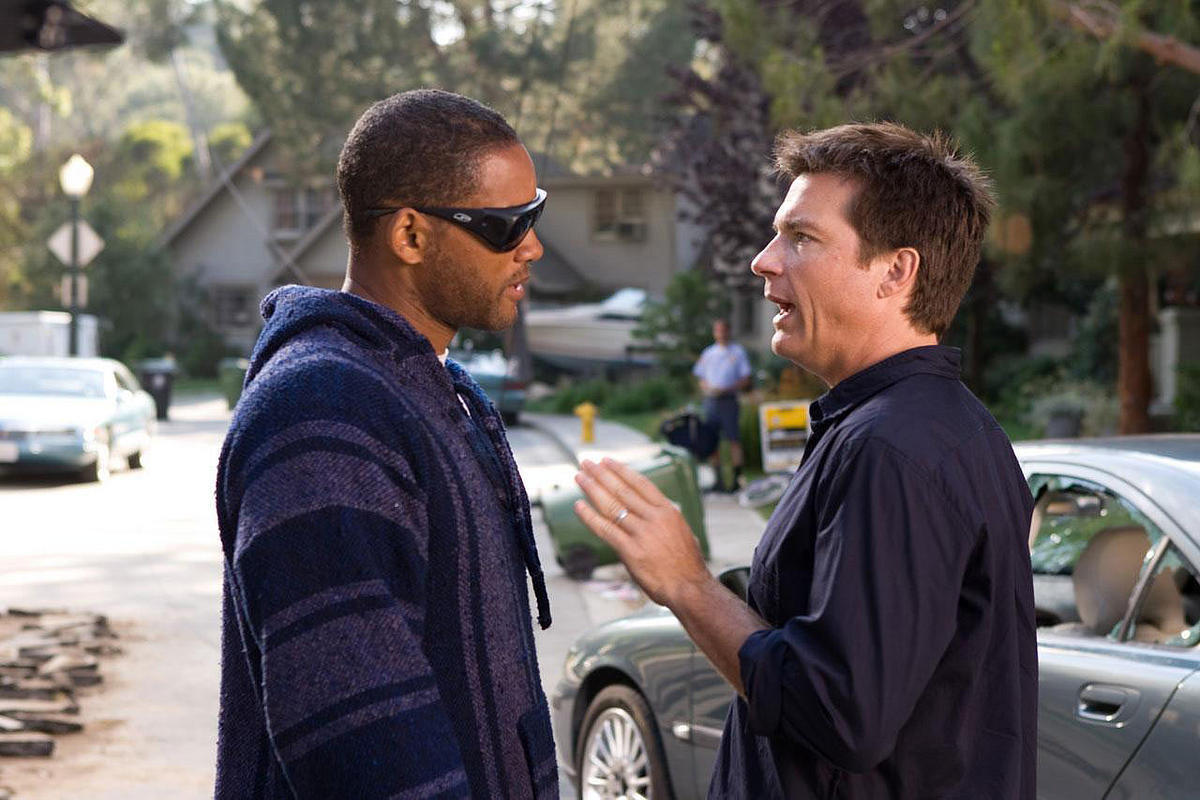
After saving the life of marketing maven Ray Embrey (Jason Bateman), Hancock is taken under wing, sobered up, read the "with great power comes great responsibility speech," and given a better public image (rather than a secret identity), a leather "sooper-suit," and is supervised in his derring-do so that he first does no harm.


Hancock isn't very good, but it has an interesting take on things "Superman-ish," and when you see Man of Steel, the latest "official" Superman movie, you'll see some of the ideas brought back to the source—the colliding bodies, the city-wide collateral damage, and the hard edge of sci-fi aspect to things that most super-hero movies tend to miss for the musculature and myth-making.  Also, the script has a literal vulnerability for the super-dude that's far more ingenious than sticks and kryptonite-stones.  You wanna reduce Superman's effectiveness?  Attack him through his loved ones.  Hancock takes that one step further by making his loved ones his true weakness, making him vulnerable, and shortening his life, taking the "apart-ness" of the super-hero, bringing it from the sub-text to the foreground, and lending the whole thing a nice melancholy touch that's missing from the genre as a whole.  It also brings Will Smith nicely down to earth, as well.


Saturday, September 14, 2013

The Great Buck Howard

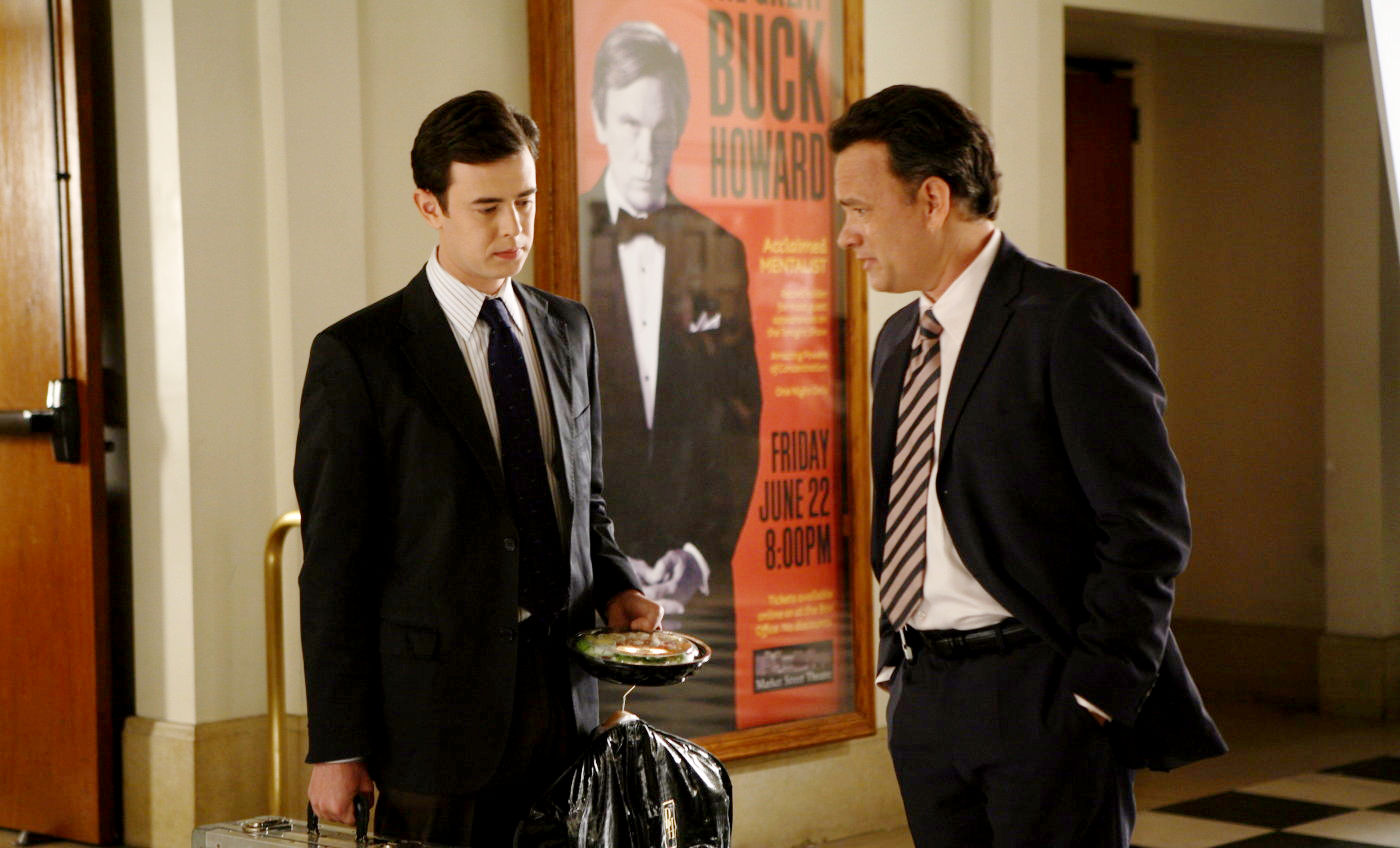
The Great Buck Howard (Sean McGinley, 2008) Writer-director McGinley spent some time as the road-manager to The Amazing Kreskin and that formed the basis for his script for this, a production of Tom Hanks' Playtone Pictures.

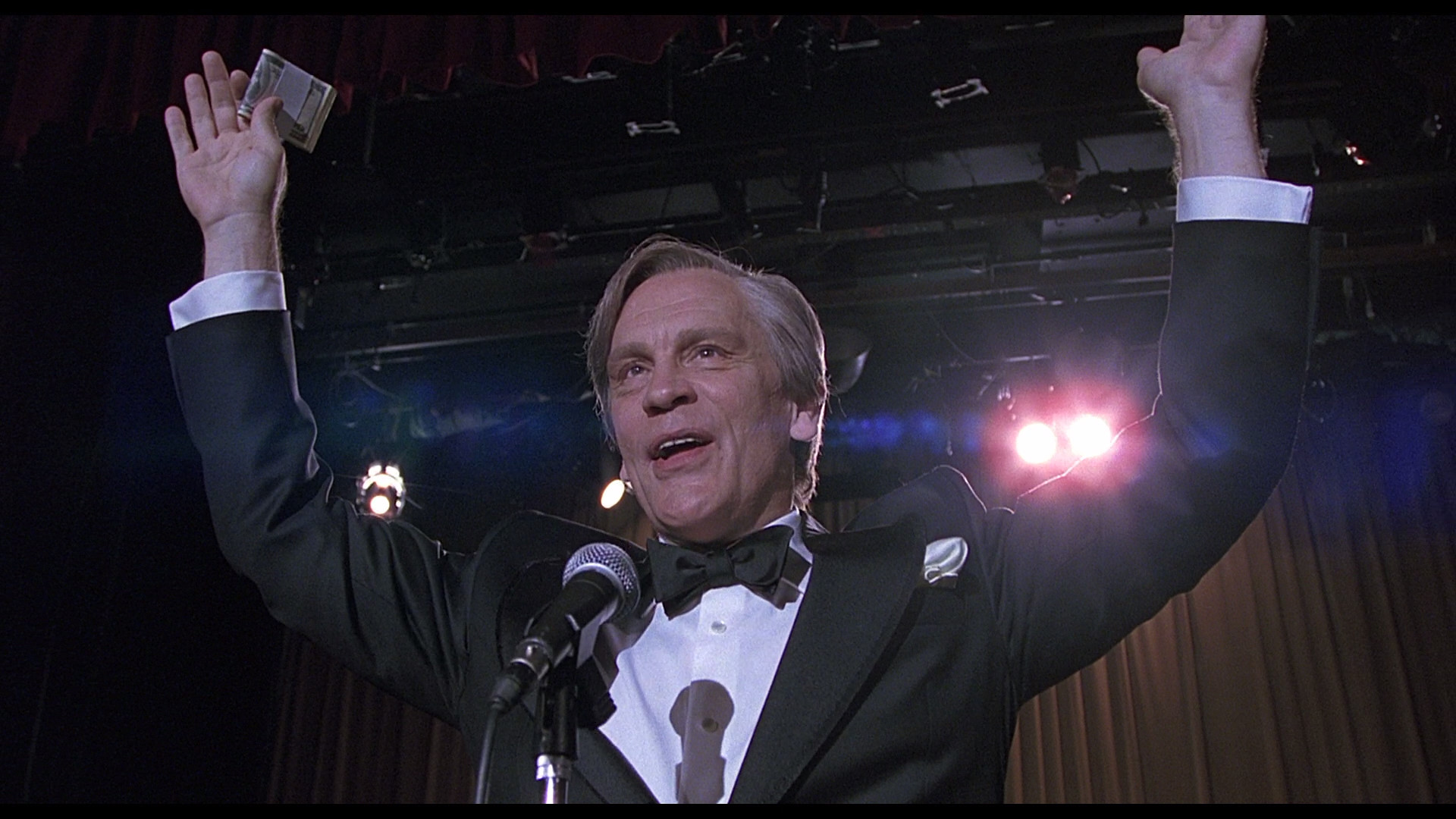
Looking at the promotional videos associated with the DVD, it would appear that Kreskin is fine with this, even though, in details, McGinley strikes rather close to the psychic bone here—yes, Kreskin in his hey-day appeared 61 times on "The Tonight Show with Johnny Carson."  Yes, he would close his shows by guessing where an audience member had hidden his pay-check (and he always got paid). That's all duly served up as quirks of "The Great Buck Howard," played somewhat petulantly by John Malkovich.  But are the other things in the movie like this—the grandiose ego, the out-sized self-importance, the schticky "I love this town" facile platitudes, the dismissive photo distribution, the intolerance for deviation from formula, and the truculence that borders on vengefulness.  Oh, Buck can be a good guy...on occasion...but mostly he's in one big perpetual snit that you don't need a mentalist to see coming.  Which makes one wonder why someone would take the job in the first place.


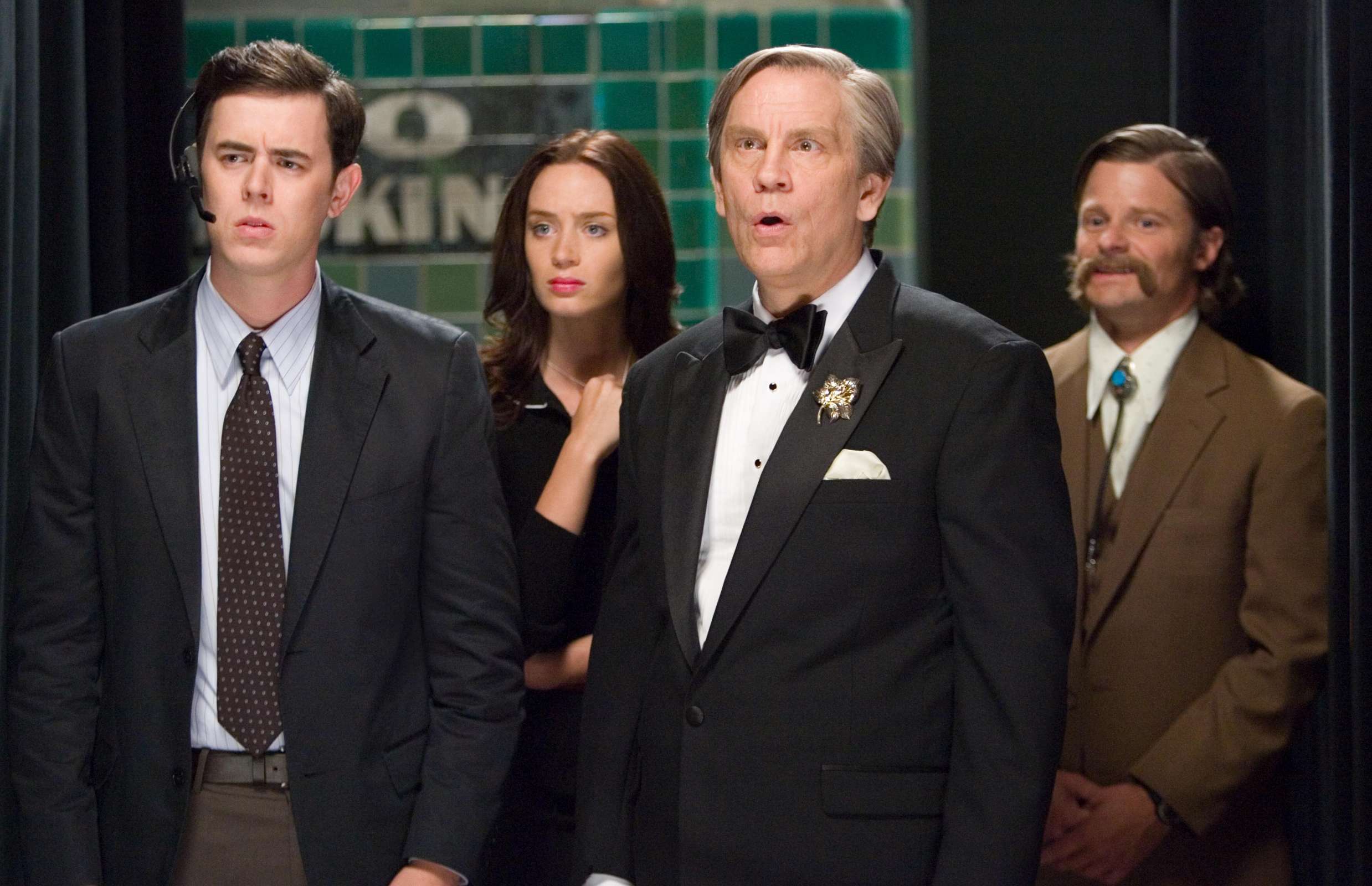
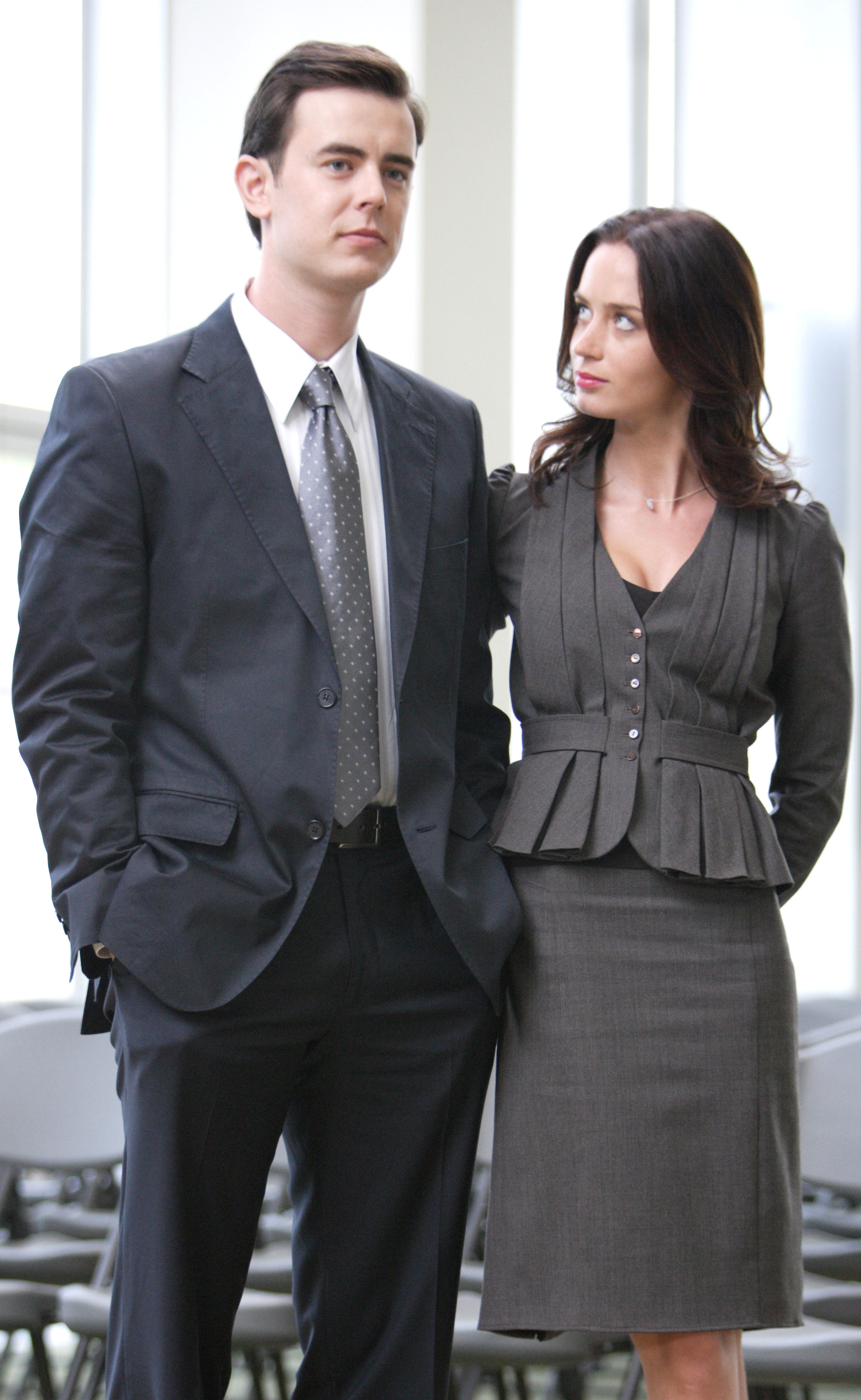
Troy Gable (Colin Hanks) drops out of law-school to be the personal assistant for "The Great Buck Howard," who is doing a cross-country tour of small town America, hoping to re-kindle some of the old magic of his mentalist show, when he was more famous...or famous at all.  A publicity agent (Emily Blunt) is hired as point-person for interviews and "events" that tend to fizzle out, but she's only as effective as her sorcerous subject and he works best in a controlled environment, one under his control and can anticipate, and any deviation might throw him off.


The film has its charms for a one-sided coming-of-age story, mostly in the casting with Hanks the younger (Hanks the older plays his skeptical father in a nicely subdued and flinty cameo) as a fine, callow presence (most of his performance has to be done in the eyes in the course of observing the shenanigans, and, appropriately, Troy never takes his eyes off Howard, when the job might more appropriately call for his attention to be elsewhere.  Blunt is great, as always, even if she isn't doing much more than 'love interest," and Malkovich does a tender walk between comedy and psychosis, cruel and entertaining in one flow.  There's also some nice touches by Steve Zahn (a favorite of mine) and Ricky Jay, as bumps on the road-trip.


Still, the Kreskin connection bothers me, especially as the movie's mentalist is a bit of a jerk, never himself coming of age.  I remember the film coming out and listening to Hanks (the younger) and McGinley do "press" and never once mentioning Kreskin.  Nor did I hear anything else about the man through the film's admittedly short run.  To see him come up so specifically and directly on the DVD was a bit of a surprise.

In fact, I don't remember him ever mentioning it, before I saw that supplemental feature.

Hmmm.  Perhaps he is a clairvoyant, after all.


Wednesday, October 10, 2012

Quantum of Solace Revisited

Cutting to the Chase
or
"Once More into the Cuisinart, Dear Friends"


When last we left James Bond, newly double-0'd agent On Her Majesty's Secret Service, he was nursing a broken heart and the betrayal by his lover, by the one way that he knew to ease the pain--shooting someone in the leg with an assault rifle.

After the success of
Casino Royale, the last complete James Bond novel not to be given an "official" film version, and the revival of the franchise with the casting of Daniel Craig, one had to wonder what the producers would do for an encore.


Or a sequel.
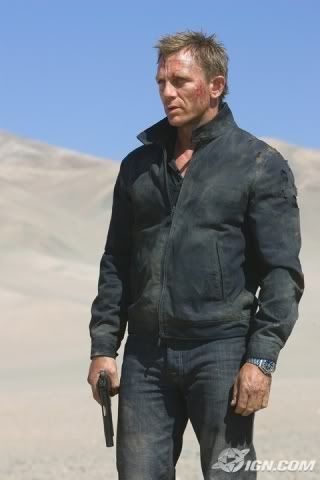
Quantum of Solace* takes place 30 minutes after the ending of Casino Royale, (in mid-car-chase) with Bond going "rogue" and seeking revenge.**
It's the first "true" sequel in the Bond series--all of them previously being stand-alone stories, where for budgetary or scheduling reasons, the secondary characters --like CIA agent Felix Leiter--would be played by different people from movie to movie.

Here, things are consistent: Jeffrey Wright again plays Leiter, Giancarlo Giannini returns as Rene Mathis as does Judi Dench as "M." And the mysterious Mr. White (Jesper Christensen), behind so much of Bond's troubles last film is in the rather bumpy custody of MI6, where he drops the news that there's a world-wide criminal organization that the Brits aren't even aware of, presumably the one financing the bombing of the Skyway jet, the funding of "freedom fighters," and high stakes poker games from the last film. Apparently these activities are so "under the radar" that the world's network of spies--and in this film even Bolivia has a Secret Service--hasn't noticed. But that is just a wild goose chase to Bond achieving that quantum of solace about the events of Casino Royale.

One could go on and on with the trivial aspects of QOS, but in broad strokes, one can answer the entreaties of those who couldn't wait for the next installment last time. No, it isn't as good as the last one;  Casino Royale was one of the best film in the series (this is No. 22 of the "official" Bond films), even after the perspective of a couple years.

Does Bond find out the answers to the questions he's seeking? Yeah, for all the good it does us. We spend 95% going down a blind alley--at 90 miles an hour, with a shaking camera pointed aimlessly and an average edit length of half a second. More on that in a moment.


Does Daniel Craig take off his shirt? Yes, all too briefly for some, I'm sure.

The dialog is crisp and also very, very brief. The acting is uniformly good, with particular mention of Craig,
Dench, and Giannini. Even the "Bond girls," traditionally where the Bond films fall down in the presentation category, can act: former model Olga Kurylenko is quite good, using a cat-walk scowl as the basis of her performance; and Gemma Arterton is pert, spunky...and sadly disposable. Mathieu Amalric--so good in The Diving Bell and the Butterfly--makes the most of his reptilian looks, as a sort of bug-eyed Roman Polanski.***


All well and good. The film feels like a less goofy version of the Roger Moore Bonds where outlandishness is the order of the day, but without the obvious winking. There are some lighter moments (and Craig makes the most of them) but most of it is played with deadly earnest. One expects to get lost in some details along the way by the orange light of the explosions. Indeed, two of the major players in this film are brought up and never mentioned again.****

But there is a major problem with Quantum... which dims the viewing experience, that being the slap-dash way that director Marc Forster and his second unit director Dan Bradley (who stunt coordinated the "Bourne" and last couple "Spiderman" movies) have staged and assembled the action sequences--and there are a lot of them--on land, sea, air, and fire, by foot and all manner of motorized vehicles. These sequences are nearly incomprehensible, with a rapid pace that does not allow the distinguishing of any participant or the context in which they're being done. A good action director allows the time to register surroundings and environment, and provides the context of relationship--who's doing what to whom and where. It's that information that provides suspense. Without that information, it's just fleeting images that don't add up—in other words, a trailer. What Forster and Bradley may be trying to do is put the audience in the same dizzying, disoriented position as Bond, but even then, there are times when there isn't enough context to inspire alarm. At one point, in one of the hand to hand fights it becomes apparent that, suddenly, one of the combatants has acquired an axe. There was just enough time for me to register that perhaps the film would be better if it were edited with that. The shame is that a lot of work went into these sequences--QOS is the most expensive Bond film while simultaneously being the shortest--and a couple of marvelous shots that literally tumble along with Bond merely disorient, rather than thrill, as you're not allowed to see the original position from where these shots start. At the end of it all, you're left with a battered Bond but absolutely no idea how he got that way.

This is a major mis-step. These are suspense films, after all. But in pushing the envelope of how fast to take these action sequences, post-Bourne, the film-makers have reached the point where they are no longer telling a story, no longer communicating with the audience, at which point they've failed in their own mission.

I'm not even sure what is to be gained by seeing Quantum of Solace in a theater, even in the back row. The best way to get anything out of the action is to watch it at a slower speed on DVD.


Hence, "Quantum of Solace" is a Rental.


Two of examples of the subliminal editing style of Quantum of Solace.


* The name is taken from a Fleming Bond short story in which Bond merely sits and listens to a tale of a marriage turned ruinous, and a "quantum of solace" is the smallest particle of comfort one can derive to keep it going. The only Bond titles left to be used are "Risico," "The Property of a Lady," "The Hildebrand Rarity," and "James Bond in New York," none of which is a "grabber" of a title, or would make a good song. But then, who thought you could do anything with Thunderball? Passing a reader-board for another theater en route to the Cinerama, it read simply "007."

** "What, he's gone 'rogue' again?" is what a friend said after seeing the trailer. Bond had already done something similar in the Timothy Dalton-starring Licence To Kill, which combined equal parts "Miami Vice," Yojimbo, and elements of the Fleming novel, "Live and Let Die."'


*** Director Marc Forster used directors Guillermo del Toro and Robert Rodriguez as voice-actors on this film, and the "director" connection applies to a henchman called "Elvis" who reminds one of Quentin Tarentino. What with the "colorful" names of the villains, ala Resevoir Dogs and the producers' history with QT--he famously announced that he wanted to make "Casino Royale" with Pierce Brosnan and griped about not getting the chance--it wouldn't be too far afield to think he was being tweaked.


**** I've since been told by one of the "Opening Night Regulars" I see the Bond's with, that a sequence resolving their stories (all one minute of it) was left on the cutting room floor, giving the producers a chance to start afresh next film, rather than continue with yet another sequel
.


Thursday, February 23, 2012

Bottle Shock

Bottle Shock (Randall Miller, 2008) Miller has been making cheap, exploitation comedies (Class Act, Houseguest, The Sixth Man) for awhile now—alternating with some TV-directing work on shows with more on their mind ("Northern Exposure," "thirtysomething,") but Bottle Shock was made with his own money and he distributed it himself. One can imagine why: it's an intelligent, slightly loopy movie about pursuing your dreams despite being told (by the entire world) that you can't achieve them. It's also about wine— A sort of Rocky of the vineyards.  But, it's also a fictionalized version of true events.

The occurrence was a tectonic shift in the wine industry, which was monopolized in terms of quality by the French vintners of the Bordeaux region.  In 1976, a wine connoisuer and merchant Steven Spurrier, conducted a blind taste test between various products wine-producing areas.  It was assumed that the French would, of course, come out on top, but when labels were revealed, the clear winner of the competition were upstarts, from, frighteningly, California.  The wine-world was shocked (aghast!) that the center of the world vineyards became the neighborhood of Gallo (now owned, by the way, by Francis Coppola).

The facts are loose, and Spurrier has gone on record saying that he is less than thrilled with his portrayal—with sly, and, dare we say, dry alacrity—by Alan Rickman (personally, I'd be honored, but then I guess my taste is questionable) and with how the film tinkers with them, but Miller managed to make an okay film about grapes, waiting, sugar-chemistry, waiting, snobbery, waiting, and...obsession.

The main subject of the film (which might have spit in Spurrier's chardonnay) is Jim Barrett (played by Bill Pullman), a financial guru who has tired of dollars and sense to concentrate on nose and bouquet.  For the youth market, there are the required diversions of the chances-taking son (played by Chris Pine), who is not sure of following in his father's grape-stomping foot-steps, but is sure of making time with the UC Davis student (Rachael Taylor) who's decided to Summer working the fields...and playing them.  While wine-inspired lust simmers in the background, Pine's restless son manages to smuggle Dad's wine into the competition, a move the father staunchly disapproves of, despite being leveraged to the cork.

It's amiable, pleasant, with no harsh after-taste (despite the squabbling that was going on in the background of the film's making among the subjects and film-makers), and will more than satisfy any film-watcher's desire to see sun-dappled vineyards in long-shot.


Grin and Barrett

Thursday, September 15, 2011

Body of Lies

This week, we're re-publishing some reviews of the films from the post 9-11 environment.

"Killing the Future with the Past"
There have been a great-many films about The Iraq War; emphasis on the "many," not so much on the "great." None have penetrated the box-office top five, and the movie-going public, with a constant dose of it (when things are going badly) on the news, have made the conscious decision to avoid paying attention at every opportunity. It may seem a disparaging thing to note, but, the public seems to have better sense than the government representing it.
Body of Lies with the one-two star punch of DiCaprio/Crowe, under the direction of Ridley Scott did manage to gain an audience (though not enough to topple the reigning champ, Beverly Hills Chihuahua), and it's just as well—it's a summation of just about every "Bush-war" film that has gone before, without adding anything new.

Part of the problem is
Ridley Scott, who more often cares about how his films look than what they say. Part of the problem is William Monahan's script (which covers much of the same ground as the other films dealing with a high-tech war in a low-tech country, where boots on the ground see more than eyes in the sky--it just got there last, is all). And the other problem is that the war has gone on so long, that we might be running out of things to say about it, at least until some of the secrecy veil is lifted about the machinations going on in the marble halls and scrub rooms of Washington and Virginia.

Not to say the film doesn't have a lot to say. At one point--with a tight deadline to meet--I checked my watch to see if the film was about to wrap up, it being so full of incident and detail, and was shocked to see that an hour hadn't even gone by yet. There was still another hour to go! There is such a flood of realistic sounding information that it probably resembles the tsunami of information Homeland Security has to sift through with their Cray's. All of that research, all that sound and fury and the all the movie comes up with is "Tell the Truth."

Thanks. We knew that going in.

The points writer and director make are obvious:
DiCaprio, in the Sandbox, has more of a grasp of what's happening, despite his getting marching orders from puppet-master Crowe in Langley. Scott repeatedly makes the point as DeCaprio curses at Crowe over his ear-bud, while Crowe's character is dealing with domestic needs at home. While Dicaprio's Robert Ferris is doing wet-work, Crowe's Ed Hoffman is SUV-ing the kids to school, with all the icy coolness of the uninvolved. And that happens frequently.

Ultimately, it's a waste of time, and is another of the many Ridley Scott projects that looks good, but doesn't add up to much in the long run. We've seen this story before.

Now, give us a good ending.


Body of Lies is a rental


Tuesday, September 13, 2011

Traitor

This week, we're re-publishing some reviews of the films from the post 9-11 environment.

"I Wouldn't Make Any Plans, Man..."

Traitor is a taut, tough little thriller about the FBI (yes, the FBI) trying to track down a group of Islamic jihadists with plans to pull off a continuing string of bombings throughout the world. Their focus is one Samir Horn (Don Cheadle), born in the Sudan, and who disappeared while working for the government in Afghanistan. Word is that he found his faith working for the mujahadin, and now he's been tracked selling detonators to a terrorist faction in Yemen.

There, two FBI agents, Clayton (Guy Pearce, this time with a convincing soft Southern accent) and Archer (Neal McDonough) are tracking the faction's movements, and during a raid, Horn is captured, but will not turn over any evidence to help the investigation. In prison, he is doubted by the jihadists as a possible informer to the U.S., and a target by some of the prisoners. Outside, he is not trusted at all, but as long as he's detained, he's not a threat.

Then, he breaks out.

At this point, to reveal any more of the plot might be unfair to anyone who wants to see a well-done "War on Terror" thriller, done in the shakiest "Bourne" style, with powerhouse performances by Cheadle, Pearce, McDonough and Jeff Daniels. Real tension is achieved throughout the story, as the stakes get increasingly higher. And writer-director Jeffrey Nachmanoff, working from a story by Steve Martin* (yes, that Steve Martin) keeps things simple and straight-forward--pretty amazing, given that his last credit was for screen-writing The Day After Tomorrow. Without much on his resume to indicate that he was capable of this, it will be interesting to see what he does in the future.

The other neat thing is seeing Don Cheadle in full "action-star" mode--tight, lean and fast, he pulls off several well-done fight scenes, while never sacrificing the wariness and intelligence in his eyes. At this point, it should be pretty obvious that Cheadle can play just about anything, and have the audience with him the whole way.

"Traitor" is a Matinee


* Sleeping on it, Martin's participation seems apt, rather than surprising. The denouement is the product of a Master of the Absurd, and thinking further on it, in the War on Terror, Absurdism is only a realization away from the insanity of the unthinking zealot. Maybe in the War on Terror, we need fewer strategists and more comedians. "Laugh? I killed 'em!"

Tuesday, August 2, 2011

What Just Happened

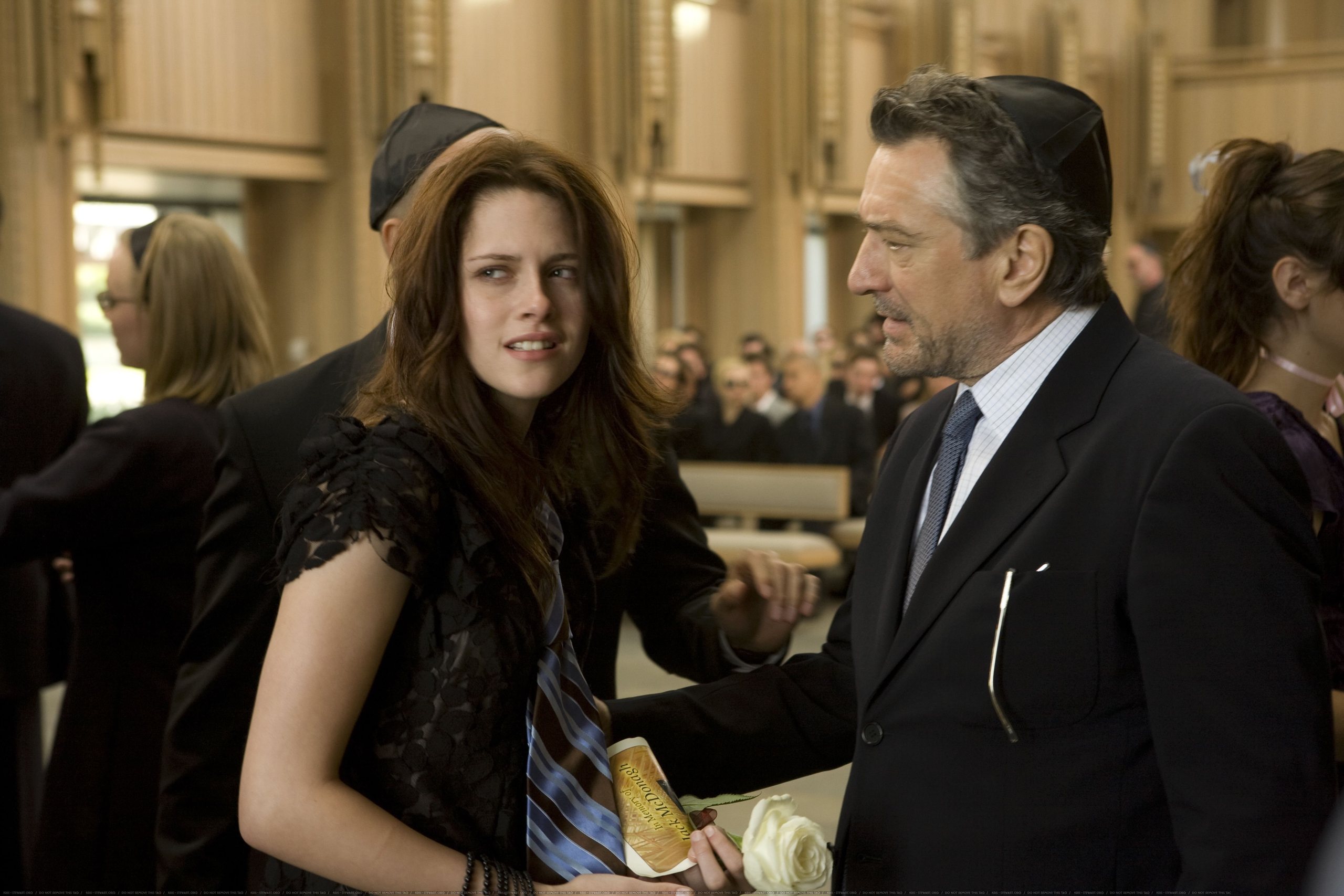
What Just Happened (Barry Levinson, 2008) Ben (Robert De Niro) is a producer in Hollywood and he has a tough life.  His new movie starring Sean Penn just previewed and the cards don't look good.  The director, wanting to be "edgy," has a scene where the bad guys shoot Penn's dog, then kill Penn.  Audiences are upset about the dog.  The studio (run by Catherine Keener) is upset about the audiences and wants to re-cut the film, the director is upset about his "vision" being changed and refuses to cooperate.  Ben wants the to keep the director happy, the studio happy, the audiences happy, the two ex-wives (including Robin Wright) and three ex-children (including Kristen Stewart) happy, while still worrying about where he's standing in a Vanity Fair "Power in Hollywood" photoshoot.

On top of that, he's got a big budget movie starting its shoot on Friday and the star (Bruce Willis playing Bruce Willis) is being payed $20 million to star in it, but there's one little hitch—he's grown "a Grizzly Adams" beard, and the studio is panicking—people want to see Bruce Willis when they see Bruce Willis and they want Ben to coax the temperamental star to shave it off, which he refuses to do for "artistic reasons."*  Ben's life is an endless soliloquy of superficial arguments, hastily-composed rationalizations and insincere ego-stroking in the gamesmanship of Hollywood, played over a Blue-Tooth behind the wheel of a constantly in-motion Lexus. 

Based on producer Art Linson's book (sub-titled "Bitter Hollywood Tales From the Front Line") and adapted by him for this film, it's a nice study of how removed from reality, logic and best practices the industry is.  But, at the same time Barry Levinson's film of it, while duly making note of the sliding loyalties Ben displays, also seems to expect you to feel sorry for him.  One would, if one didn't want to have this life.  There is no tragedy here, merely minor inconveniences that whittle away at Ben's soul and career.  But, he still has a roof over his head.  He has a car (and the insurance for it), a cell-phone, a blue-tooth, a fancy-schmancy espresso machine, the ear of many Hollywood players, and the phone numbers of ambitious actresses.  Boo to the Hoo.  Yes, Hollywood's crazy...but it's not homeless and crazy.

That's why backstage dramas in tinsel-town are really only good when played for laughs, and should only be reserved when the writer-director-producer has completely run out of ideas (and when that happens, they should read a book, instead).  You look at movies like The Oscar, or The Big Knife, with the hand-wringing of the elite, and you can look right into the soul of industry people who have lost touch with their audiences**...like Norma Desmond screeching about her woes.  It's why Sunset Blvd. is such a classic gem of a movie.  Norma is crazy...and pathetic...and clueless.

Howard Hawks had it right.  After awhile, he was making movies about making movies—but, they were well-veiled allegories.  Anytime Hawks had a group of disparate people coming together with a single goal in mind, he was talking about what he and his crew did for a living...only they were flying the mail, or capturing live rhinos, driving the cattle, getting the headline, or battling the monster at the research station...anything but making movies.  That would be as much fun as watching sausages being made.  If you want to complain about being in the entertainment industry, try pumping gas...then, have a drink or climb onto the shrink's couch.  Don't get "meta" on the audience.  They go to the movies to escape their troubles, not hear about yours.

But, like Fellini, pretty soon the writers start penning their autobiographies.  Linson might be thinking that he did a good job changing the names to protect the innocent, but listening to  his DVD audio commentary with director Levinson, one hears the vagueness, the "rote"-ness of his expressions, as if he's just passing through, and once the credits come up, he's already out the door (he's gone before the "A Barry Levinson Film" credit comes up).  The two were in separater facilities recording their tracks, and as Linson gets up he says "Good seein' ya, Barry" "uh...talking to ya," says Levinson.  "Oh.  Yeah...well..." says Linson.  "We should get together when you come to New York."

Yes, we "really" should.


* True story, although I won't mention the movie or the star (it's easily found, actually).  But, it reminds me of the struggles Richard Donner had while making Superman, the Movie—making a man fly was easy compared to star-negotiations.  Donner had a meeting with Marlon Brando, where the actor was pitching character ideas that would keep him from having to appear on camera, like playing Superman's kryptonian father as a suitcase or "a green bagel," and Gene Hackman didn't want to shave his moustache to play Lex Luthor.  Donner finally said to Hackman on-set. "Look, Gene, you shave yours off and I'll shave mine off."  Hackman agreed, shaved and came back on-set.  "Okay, now it's your turn."  Donner then peeled off the fake moustache he's been wearing, which delighted Hackman.

** (The same could be said for politicians—anybody in Washington looking at cutting the health-plans for those in the legislative branch...if not, why not?)

Wednesday, July 20, 2011

Vantage Point


Vantage Point (Pete Travis, 2008) An American news crew sits in their van in Salamanca, Spain, technically coordinating coverage of a Presidential visit.  No sooner does POTUS (William Hurt) take the podium when two shots ring out, sending him flying, to the horror of the news-people, the Secret Service, the crowded throng and the millions who are (probably not) watching at home.  For a split-second, there is reaction all around, and then the confusion starts: where did the shots come from, who's that running guy, get the president to the hospital, foot-chase.  At the end of it, a lot of people are dead, and the ramifications are huge, while the news channels try to play catch up...and one suspects never will.

This one's just plain crazy.  The same 15 minutes, played out, rewound, clock started again, and POV switched.  Technically, it's a daunting challenge, with all the shots of things that have gone before shifted into the background, and having to match what went before in the same time-frame that it did before, although one later incident seems to be fudged a little longer to allow some exposition in one segment (all the better to build suspense).  The director, Pete Travis, mostly known for his British television work) does one thing that always drives me nuts in pot-boiler novels—he takes you to one pop-eye inducing moment...and then...stops and goes back.  Next chapter.  We'll get back to that...

That would make it "a relentless page-turner" if it had a spine, but you're stuck watching the movie, wondering, "Yeah, but what about..."  Annoying.  But, not enough to make you hit the "Eject" button.

Source Code did this a little better this year, and had the decency to make all the populace in it more than innocent by-standers.  Most of the characters are there to serve a function in the plot, rather then being motivated, save for Dennis Quaid's Secret Service agent, who has just come back to active duty after taking a bullet for this President six months earlier.  The speculation is that he might be a little gun-shy (if so, he wouldn't be put on active duty, now would he?)

This is the problem with the film.  Good concept (even if it is Akira Kurosawa's), but the deeper we go into the movie and the more we find out about this 15 minutes, the situation becomes less and less likely, and more and more contrived.  It has the kinetic feel of an episode of "24" compressed and spread out over a ninety minute running time.  And, it isn't even "The Rashomon Effect," where (when it's done well) the differing perspectives are colored by the person telling the story.  Here, facts are facts—it just happens from different angles, how the person feels about it doesn't enter into things.  In that regard, Vantage Point is just a standard detective thriller, more about information dissemination in an electronic 24 hour news cycle, rather than saying anything about the human condition—besides the obvious jumping to conclusions.  The film begins and ends in that van and the broadcast of events, making the point that there's a photon-filter between truth and knowledge.  At the end, the news audience does not know, and may never know exactly what went down.  But, given what we already know about the efficacy of reporting "while it happens," the endless speculation and rumor-airing and other apocrypha and opinion that's offered as journalism, it is a bit of a hollow exercise, a "gimmick" movie without that much to offer.

Is it a good movie? I don't know.


Wednesday, June 8, 2011

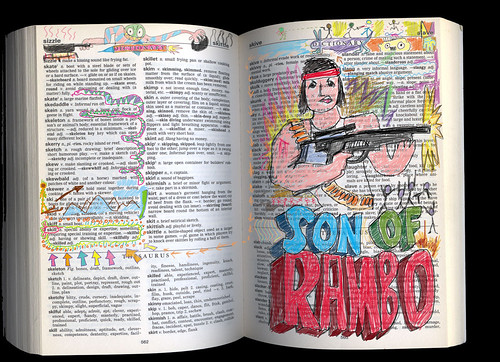
Son of Rambow

Son of Rambow (Garth Jennings, 2008) Odd, quirky childhood comedy—how could it not be coming from the guy who made the movie of The Hitchhikers Guide to the Galaxy?  You have two kids—Will (Bill Milner) fatherless son of a strict religious mother (Jessica Hynes), and Lee Carter (Will Poulter), a wild, almost sociopathic kid with a little too much freedom (his parents are travelling, his brother—played by Ed Westwick—is a slacker who ignores him, except for the occasional punch-up).  The two kids couldn't be more different, but they're both kids occupying the same position downstream, stuck at the mouth of the river, at the bottom of the food-chain.  Will is eager to please and Lee is eager to please himself.  Pretty soon, Will is recruited to be a part of Lee's film making aspirations, playing stuntman in Lee's camcorder action filmThe stunts are horrifically dangerous, but God must be on Will's side because he bounces back faster than Wile E. Coyote.  Then, inspired by a bootleg copy of First Blood that Lee makes—it's sort of a side-job for his brother—Will turns himself into the "Son of Rambo," a fantasy persona that allows him to charge into the stunts with a macho brio far removed from his religious up-bringing.

It's an odd "coming-of-age" movie because the boys really don't come of age.  At most, their character arcs merely are glancing parabolas, where Will learns to become a little bit more of his own man and Lee finds out that, yeah...he's really not much in control of his life as he thinks.  They come to a separate peace, but it is not easy-going with the one seeing life as suddenly full of possibilities, and the other full of consequences.

I got a lot of raised eyebrows and curled lips mentioning this movie for the perception is that its an homage to the testosteromps of the Stallone era (amusingly, the clips that are used from First Blood are the same ones over and over), but it couldn't be more different—for one thing, Son of Rambow actually has a sense of humor (which, I believe, is one of the casualties of steroid use).  The other is that the Stallone movies are essentially retellings of the "Frankenstein" myth*—the ostracising of "the Other."  Will and Lee are, instead, learning how to cope in a society, rather than fighting it, and there are a lot of nice touches about the "herd" instinct of individuals that gets down to some primal stuff more akin to the forests and jungles that are Rambo's survivalist killing grounds.

But, in the end, they do have one thing in common—it's about survival.  And the Son and progenitor approach the goal in completely different ways.  Nicely thought out.  Nicely done.


* Kirk Douglas was in talks to play the Trautman part (that eventually went to Richard Crenna), but when he heard that Rambo was going to survive, turned his back on the project: "He has to die.  It's the 'Frankenstein' story."  Exactly.  And Rambo's plight is far more poignant if he has been trained to be a killing machine and isn't allowed to live by the very government that created him.   As with the Vietnam conflict, the U.S. is complicit in the tragedy—setting up a bad situation and then walking away from it.  Instead, Rambo is allowed to live, and no amount of sentimental Stallone re-writes can be as powerful as what should have been.  Also, in Hollywood's dream factory franchise potential trumps story. 

Saturday, May 14, 2011

Righteous Kill


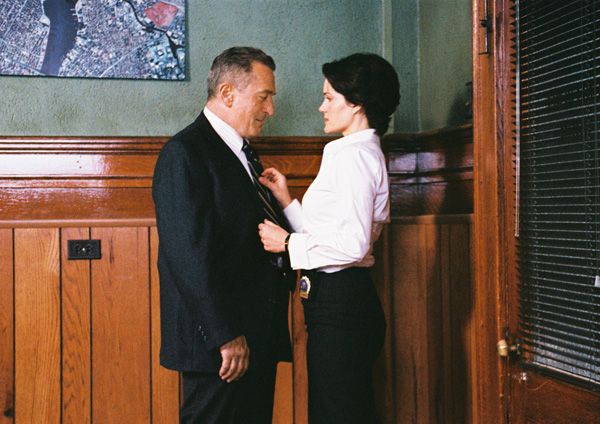
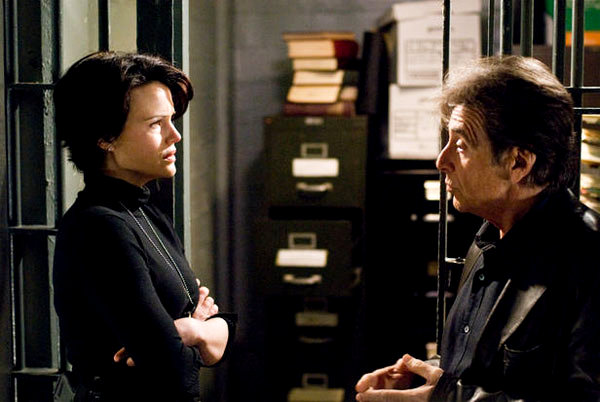
Righteous Kill (Jon Avnet, 2008) Someone is killing Scott Free's—those scum-bags that you just know are guilty but have some smooth-talking fancy-pants lawyer or some milque-toast judge who lets 'em walk, sneering, to prey on Society again...until they show up with a bullet-hole in the middle of their forehead.  Two buddy cops, Turk (Robert De Niro) and Rooster (Al Pacino) start to add things up when one of the perps they arrested shows up deader than a Keanu Reeves performance.  Looks like it's murder "and somebody's responsible."  A vigilante?  Certainly.  But, if its revenge they're after, why are so many of these guys showing up dead?  It's then that they think that the killer may be a cop.

But who?

Complicating matters is that most of the cops, including De Niro, Pacino, plus Carla Gugino, John Leguizamo, plus Donnie Wahlberg-o are creeps, so it could be any of 'em, except for the Captain of the squad (Brian Dennehy) but only because you couldn't believe Dennehy could sneak up on anybody but a bed-ridden quadriplegic.

So the question is: which of the crazy actors is playing the crazy character killing all these people?

The answer: who cares?  With a movie this terrible, and victims painted so sneeringly evil they're cartoons it's hard to work up much sympathy or even interest in finding their killer.  That's the problem of the writer.  But director Avnet is so ham-fisted, he can't seem to hold a shot or light a set without sabotaging the drama of a scene.  He's so busy "nuancing" things that you have trouble following the plot.  He's not even talented enough to get out of the way of De Niro and Pacino (or, God forbid, rein them in) to make a scene play.

And, let's face it, having those two legends on the screen should be a treat: they didn't work together in The Godfather: Part II (obviously), but their scenes in Michael Mann's Heat were tantalizingly short.  Here, they're in almost every scene together (although Avnet can't seem to find the wherewithal to keep them in the same shot), and you realize they're like oil and water, or Mumbles and Loudmouth—they're two actors who've known each other for years, but their characters don't seem to.  Or else the movie would be over in five minutes.  But no, the suspicions and subsequent doubts must be fully explored, the red herrings must stink up the joint, and the script-writer must throw in a couple of feints that make no sense once the movie is over—they're there just to con the audience.*

What a waste.  The big mystery is given this script, how could it attract two of the most iconic, respected and (when paired) legendary actors?  Sounds like the biggest con was going on behind the scenes. Righteous Kill is the last thing you would expect a film starring De Niro and Pacino would be—a very pedestrian run-of-the-mill movie.

* Now, movies are by nature, the manipulation of reality—and the audience—to tell a story.  But, there's doing it well, and there's doing it the Righteous Kill way.  This week, we'll look at a movie that stylishly—and very slyly—does it right.

Wednesday, April 27, 2011

Miss Pettigrew Lives for a Day (Take Two)

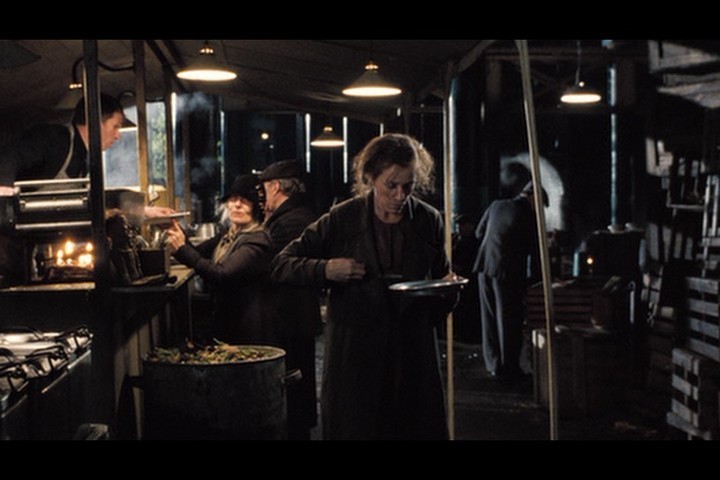
Miss Pettigrew Lives for a Day (Bharat Nalluri, 2008) A bon-bon.  A truffle.  A "ladies' pic" with just enough naughtiness to raise the blood pressure a little and maybe bring some color into the cheeks and the blue hair.  Done to a fine "fare-thee-well" and all, but at the heart of the confection is a little piece of grit that could chip a tooth if you're not careful—"careful" being the operative word here.

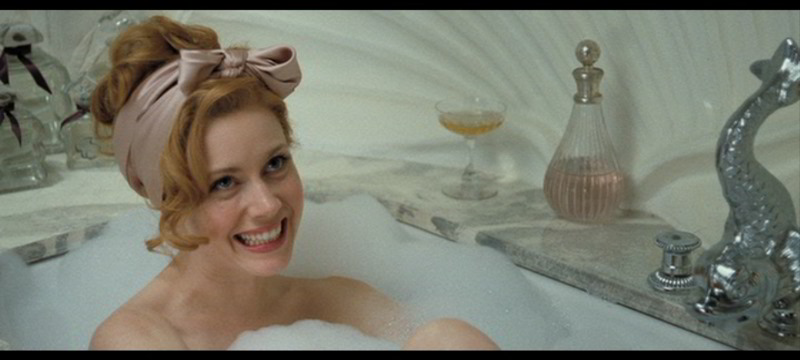
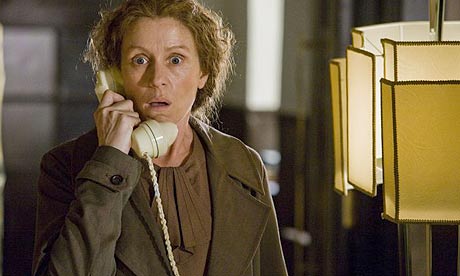
Miss Guinevere Pettigrew (Frances McDormand—what a treasure) has just been given the sack in the days before England is going to war with the Germans; the headlines are bold and the Wellingtons are flying eastward.  But Miss Pettigrew is without situation and penniless, cast adrift like the leaves scattering in the wind (which the Main Titles are animated to resemble).  She is desperate, so when she applies for another position and is roundly given the brush-off, she steals a business card and arrives unannounced at the residence of Miss Delysia Lafosse (Amy Adams)—nee Sarah Grubb "of the Pittsburgh Grubbs"—actress, semi-songstress, floozy and ditherer.

She couldn't have arrived at a better time.

Delysia is only dressed in a flimsy robe after entertaining a boy-producer (Tom Payne) in order to gain the lead in his new production, and she's doing so in the lavish love-nest of her boyfriend Nick (Mark Strong), who should be returning at any minute.  As should her other boyfriend, Michael (Lee Pace), who has just been released from prison after trying to nick a diamond for Delysia's engagement ring (the occurrence of which left Guinevere with only the clothes on her back—"small world").

It becomes immediately apparent that Miss LaFosse should not be acting but juggling and she needs a third hand to do so. 

And that's where Miss Pettigrew comes in, and quite literally.

Over the course of the day, everyone is in everyone's "business" if not in the very same room and the various conflicts conspire to creates "scenes" in glamorous settings and scandals if the back-biting and sniping become less passive and more aggressive.  The surface glitter, though, is shadowed by the twin horsemen of war and poverty and Pettigrew, who has known both, manages to be the voice of priority and reason, without completely throwing cold water on everybody's hot jazz.

It's a smart, funny screenplay, played well by an expert cast, even if the the direction gets a little swoopy and frenetic sometimes, and the music soundtrack is selected meticulously to given the film a rhythm and momentum that it desperately needs, even if some of the music chosen isn't precise to the period.

So, what's the "grit" that threatens to tarnish the gold that seems to permeate every one of Adams' costumes in this thing?  The unmistakable whiff of safety that wafts every so often.  That sentiment that everything will be alright, as long as "the right man" comes along.  Sure, the movie toys with "wrong" men, just as surely as Delysia does, but the flirting with "danger" is always casual, the consequences never showing themselves.  There are valid points that "love is not a game," and "you must not waste a second of this precious life," and particularly "there are times when decisions just have to be made, or you certainly will miss out."  All too true.

But, the insistence that all will be well with the subjectively agreed-upon "right" pairing between male and female?  Would it have been so sinful to have the ladies of the story be a little more independent as a solution as opposed to it seeming like a problem that needs to be cured?  As delightful as a movie may be, if those thoughts crop up, it has the tendency to spoil the party.