Showing posts with label R. Show all posts

Tuesday, November 12, 2013

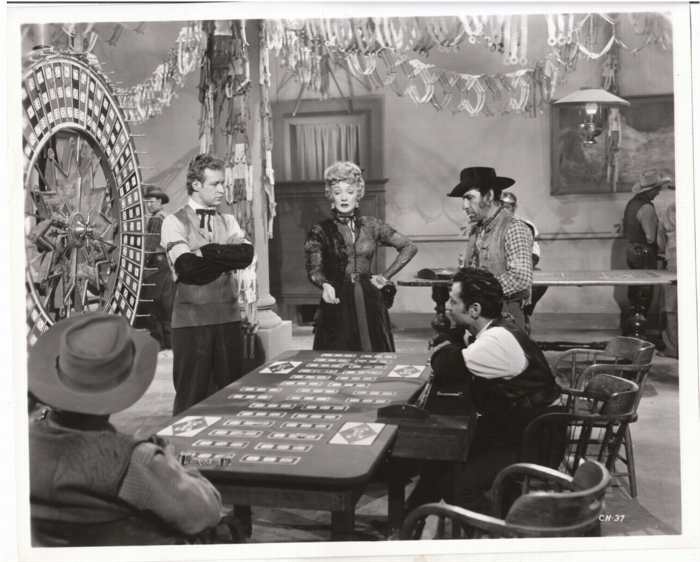
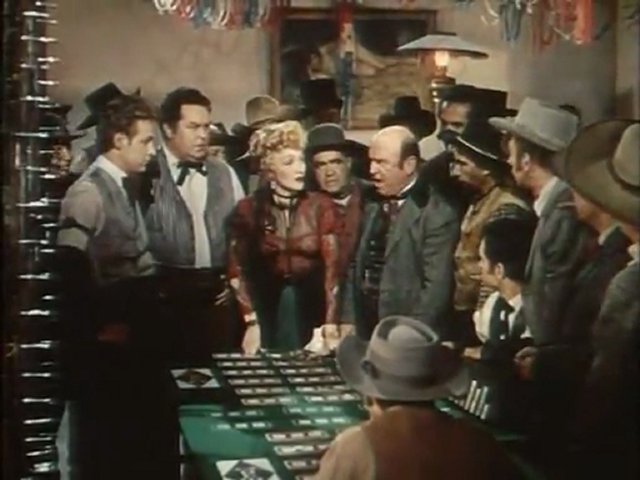
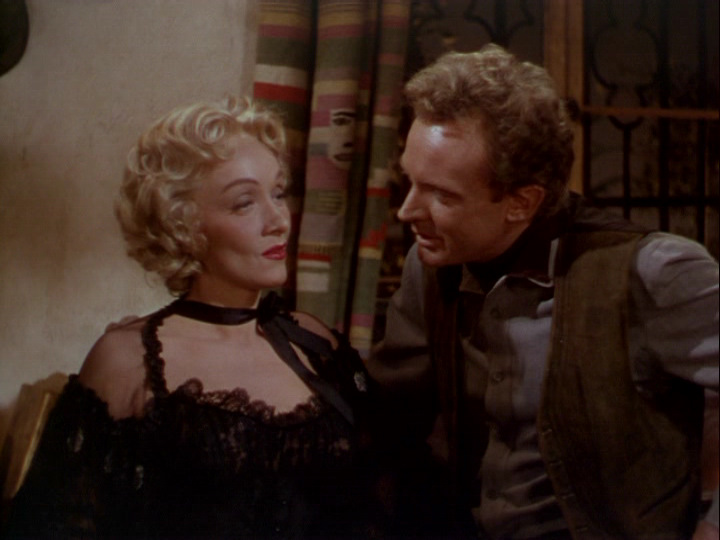
Rancho Notorious

Rancho Notorious (Fritz Lang, 1952)  Hate!  Murder!  and Revenge!

After hearing about this one for oh-so-many years, I finally got a chance to sit down and luxuriate a while with Rancho Notorious, a film that offers so many surprises—subtleties and Big Statements—that work-outs were had by both my jaw (dropping) and the remote, which afforded me the essential ability to go back and "look at that again."

Rancho Notorious offers opportunities a-plenty for both.  You don't see very many movies where people are actively snarling at each other, but then there aren't many movies like this wildly expressionistic main-stream Western directed by the master of German Expressionism Fritz Lang. Preceding High Noon by a matter of months, it also has a song-based score, but an odd one, not so "on the nose" as "Do Not Forsake Me...", but one's that's haunting and echoes through your head like a warning (as it did mine) for days.

The song is "The Ballad of Chuck-a-Luck," (that was supposed to be the movie's title and there's a story for ya*) written by Ken Darby and plays over the titles and interstitially during the murder investigation that lasts the entire movie, each stanza ending with those words "Hate.  Murder.  And revenge."

So, what's the story, pilgrim?


Vern Haskell (Arthur Kennedy) is a ranch-hand in a small town in Wyoming and he only has eyes for Beth Forbes (Gloria Henry**), the girl who runs the counter at the dry-goods store.  But, right after he comes a-courtin' two strangers come into town, with an eye to robbing the store, and when the one sees Beth, things go too far.  She's raped and murdered by the outlaw when she screams and the two cowards escape.


Vern Haskell (Arthur Kennedy) doesn't like you

All Haskell wants is revenge, so he quits the ranch and, with a posse, heads in the direction the bastards left town.  After hours of riding, the posse gives up, but Haskell refuses to stop, and soon comes across one of the men, Whitey, shot in the back by the other desperado, who only says the words "Chuck-a-Luck" to Haskell with his dying breath.  Haskell travels on, gathering clues about the mysterious word that refers to a spinning "wheel of fortune" in gambling houses and a former dance hall girl named Altar Keane (Marlene Dietrich), who made a fortune on her departing spin of the wheel, and left town on the arm of the outlaw "Frenchy" Fairmont (Mel Ferrer), never to be heard of again.

But, "Frenchy's" in jail, so Haskell gets himself arrested, and once behind bars, ingratiates himself with Fairmont, and gets sprung on his coat-tails. The two make their way to the Flying C Ranch, also known...as "Chuck-a-Luck," a working ranch legitimate to the world, but in secret is actually a hideout-for-hire for any outlaw willing to offer up a 10% share of their loot to Altar Keane. Quite the little operation the lady has there, and at the moment, she's full up.


But she makes room for Haskell, whom she describes as "a man who stands in doorways." All the better to survey the room, looking for clues.  Is it the guy who's fast with the ladies (George Reeves) with those tell-tale scars on his face?  Is it the guy who keeps looking at him funny (Lloyd Gough, not credited due to The Black List), or the guy who's just funny-looking (wall-eyed Jack Elam in an early role, looking lean and mean).  He decides to hang out at Chuck-a-Luck, picking up clues, laying low, making himself handy while not necessarily doing anything...illegal, until he can determine who's the right (by saying the wrong) man.  It's a little bit like Poirot in spurs with a nasty disposition.  Of course, today, Haskell would be expected to lay waste to the room and let God deal with the details.  Here, revenge is tempered by justice and not hormones.


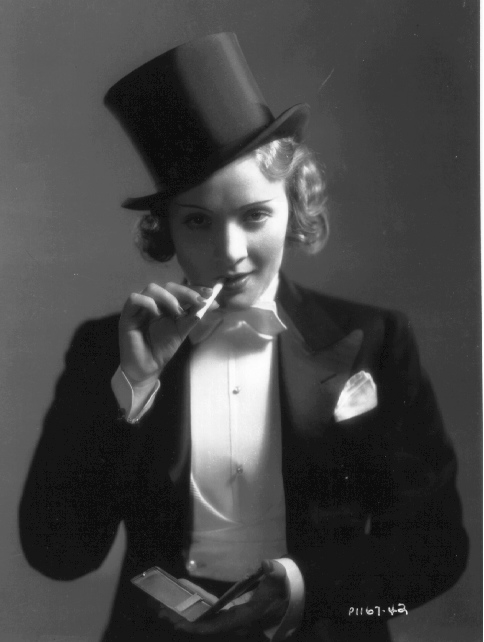
Russell Johnson and Marlene Dietrich in Rancho Notorious

Before we get onto the subject of Marlene Dietrich, we should probably discuss the wealth of character actors on the verge of hitting their defining roles: William Frawley, right before "I Love Lucy," George Reeves before "The Adventures of Superman," Mel Ferrer, only his fifth film and right before Scaramouche, Russell Johnson (Happy Birthday, sir), only his second movie, Jack Elam, Dan Seymour, John Doucette, the movie is top-heavy with great veteran character actors with recognizable faces.


Then there's Dietrich.  For those of a certain age (anyone born post-Blazing Saddles), one may not recognize what a force she was and continued to be throughout her career.  She was the preternatural "other" woman, capable of seducing men and (pre-Code) women, one is always hesitant to call her the first feminist, but she might have been in movies, and she certainly was before it became "cool," (and she always was in the role).  Put it this way, you'd never see Dietrich in a western riding side-saddle.  Rancho Notorious is her slightly softened (although barely—when was the last time you saw a dance-hall girl riding the town sheriff like a horse?), in partnership with a man, and acting out of love or loyalty (always hard to say which with her), but it's her ranch and her operation, and that's something you rarely see in even the most hard-core of Westerns.   And it's weird, but, in Westerns, Dietrich (sorry but it's a spoiler) always seems to take a bullet, as if the genre won't accept her (or any woman) as ruling the ranch.  That would change, as film-makers got more bold.**

Rancho Notorious is one of those odd Westerns of the Mainstream that took a decided bend in the river to do something else with the form.  There's no pretense at naturalism (Lang wouldn't toy with that until Clash By Night), but used the familiarity of westerns to work out some interesting conflicts about gender roles (Others on that list are Nicholas Ray's Johnny Guitar, Samuel Fuller's Forty Guns, and, to a lesser extent, Hawks' Red River).


It's not your usual oater.  It's something different and it's recognizable from the first watch.


* The story goes that Howard Hughes wanted to change the title from "Chuck-a-Luck" and Lang wanted to know why.  "Nobody'll understand it" was the reply, even though it was a familiar gambling game in the Southwest.  "Okay, so what's your alternative?" Lang asked.  "Rancho Notorious." came the reply.  "Rancho Notorious?!  Nothing's called 'Rancho Notorious' in this movie!  You think anybody'll understand THAT?!"

** There was a shock for me: I remember Gloria Henry as the mother of "Dennis the Menace" on TV.  Her presence was only the first of a long line of TV stalwarts who were paraded throughout Rancho Notorious—"Hey! there's...fill in the blank..."

*** Ford's frontier women usually ran the ranch, but let the men think they did.

Tuesday, October 15, 2013

Rush (2013)
Winning Isn't Everything...
or
Keep Your Friends Close, But Your Enemies in the Rear-View Mirror (They May be Closer Than They Appear)

The main reason I wanted to see Rush was that it has a script by Peter Morgan, whose work from The Queen, The Last King of Scotland, Frost/Nixon, The Damned United, Hereafter* have all been thought-provoking, literate screenplays and one wondered how he could provide that in a racing film, a sub-genre focused more on visceral momentum and the visual and where the weakest sections have always been those outside of the cars and off-track.

This one, though, it completely opposite in the tradition of Howard Hawks' race-track movies. And it's all true (except for a lie or two).  It tells the story of two (eventual) Formula 1 drivers, Niki Lauda (Daniel Brühl), Austrian, teutonic, disciplined, engineer and James Hunt (Chris Hemsworth), British, louge, seat-of-your-pants, tactician. They couldn't be more different except that both want to be the best and will do anything, risk anything to get there.


And they're both damned good drivers.**

Both are bad boys in their own ways.  Lauda comes from a prominent Austrian family, but does not want to go into the family business, which disowns any acceptance of Niki's ambitions to drive professionally.  So, he finds a race-team going bankrupt, buys it cheap by cashing in his life insurance policy, and takes over, re-building the car's engine from scratch.  Hunt knows a rich boy, Lord Hesketh (Christian McKay) with money to throw away and a party every hour.  In the film, the two despise each other immediately.  The first time Hunt sees Lauda at a Formula Two race (one of those examples of "a lie or two"), director Ron Howard throws a rainbow refraction from Hunt's POV, bringing a mysticism over the moment that might be a bit too much.


That first race, they bump and spin.  Hunt can't pull himself back into the race, his engine conks out, but Lauda, with some difficulty, throws himself the right way and is able to race his way to victory.  Hunt starts to berate Lauda about it, but the Austrian is dismissive—it was the car, not the driver, Lauda had the better car and was able to get back in.  Hunt's still pissed, insults Lauda by saying he looks like a rat, then goes off and parties with Hesketh, the crew and any woman within arm's length, as is his habit.  It's the start of a rivalry that will have its up's and down's, but that is the character-arc that both drivers have, and will have throughout the entire movie.  Their focused competition will push each of them to doing crazy things on and off the track.

It makes a good story.  Except for a lie or two.

It may not seem like much, but it's the Ron Howard way to make movies. Like a good race-track, eliminate any bumps in the road that might add dimension, nuance, or raise a question in the mind that might distract.  If you set up a joke, show the pay-off at the next cut.  If there's a building-up montage, make sure you show the results first thing.  If you want to show the treadmill of being famous, put David Bowie's "Fame" on the soundtrack (released in 1975, it fits the period). 


A shot like this is used quite a bit: it makes you go "hmmm."

In Rush, there's no ambiguity, no wasted shot, not a moment of contemplation or self-doubt.  It runs the rule of every Howard movie (that I've seen, at least, which is all except two) of being so audience friendly that it barely needs an audience, as there is no room for interpretation. At all.

It's not manipulation (all movies are manipulative, even documentaries), so much as keeping it very, very simple—least-common-denominator simple.  It makes a better movie to have Hunt and Lauda just despise each other throughout the movie until the crisis of Lauda's accident.  And even then, the bantering between them has a nice nasty streak running through it.  It would have completely messed up that story through-line if (say) Hunt and Lauda were closer than Morgan and Howard impress...which they were—they were flat-mates for awhile, and enough that Rush would have resembled The Odd Racing Couple if they had shown it—but that would have ruined the all or nothing, go for broke, all-in, simple kind of impression the film-makers are trying to evoke.  If it feels good, why complicate it?  And Howard's films, even the depressing ones, are feel-good movies (I mean, A Beautiful Mind is about schizophrenia and he still managed to bring forth a teary-smile at the end...and won an Oscar for it!).


Really, this is just to increase my Internet "hits."
Olivia Wilde as model Suzy Miller—she's in the film for as long as you're looking at this picture.

So, what am I saying, that it isn't "arty" enough?  No.  It's plenty arty, with a humorous set design and costuming that will make anyone under 30 think we were all mad (and we were, hey, but don't linger at the mirror, yourself). Howard and his cinematographer Anthony Dod Mantle (he bounces between Lars von Trier and Danny Boyle, so of course it's arty), manage to shoot making left turns repeatedly interesting to look at, without becoming fetishistic about it (more Grand Prix than Le Mans, more Frankenheimer, less Katzin), and they have a tendency to repeat a lot of good shots, rather than trying to find every possible angle with which you can photograph a moving car.  So, there's a consistency there of quality over quantity.  And the core of the story—of these two outliers, both unlikable but admirable, racing to the drumming of their own pistons, finding inspiration in each other and realizing it, makes it an interesting movie, and worth seeing.

Rush is a Matinee.


Niki and James, when Lauda came back to racing six weeks after his accident.


*  He was also involved in the early stages of Tinker, Tailor, Soldier, Spy and Skyfall.

** Here's a Lauda quote (a real one) about Hunt:"We were big rivals, especially at the end of the [1976] season, but I respected him because you could drive next to him—2 centimeters, wheel-by-wheel, for 300 kilometers or more—and nothing would happen. He was a real top driver at the time."  That's the sort of admiration Lauda would allow himself—an appreciation of undeniable skill.

Wednesday, February 6, 2013

Rust and Bone

Last Man Standing
or
You Don't Know What You Got 'Til It's Gone 

Jacques Audiard's new film De Rouille et le D'os  (Rust and Bone, in English) is as far afield from his last film, The Prophet, as could be.  That film was a mini-Godfather, that showed the traps a criminal puts himself into, whether he's in prison or the King of the Hill.  

Rust and Bone, though, is a love story about the transitory nature of selfishness and the numbing vacuousness of complacency, which sounds like it'd be a a dull film, or a pedantic English theme.  Combine it, though, with kick-boxing and killer whales chewing your legs off, and it becomes a different animal altogether.


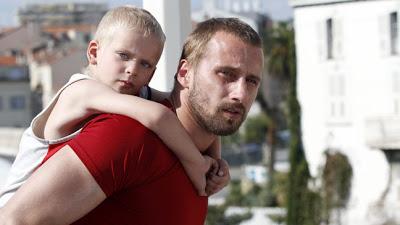
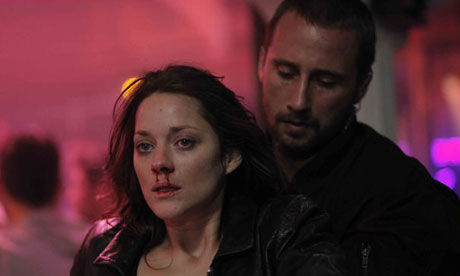
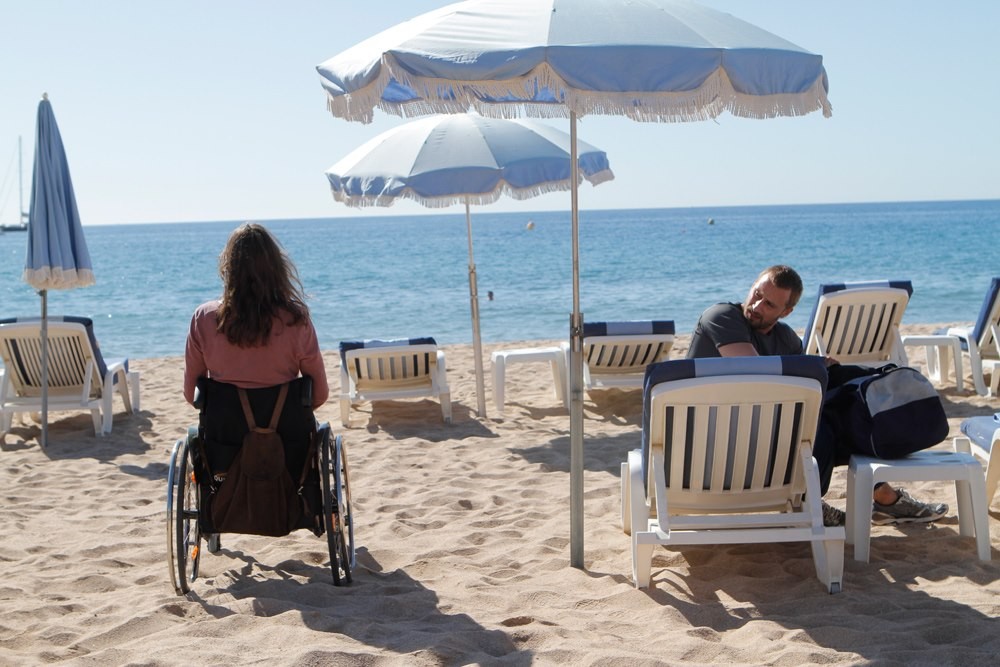
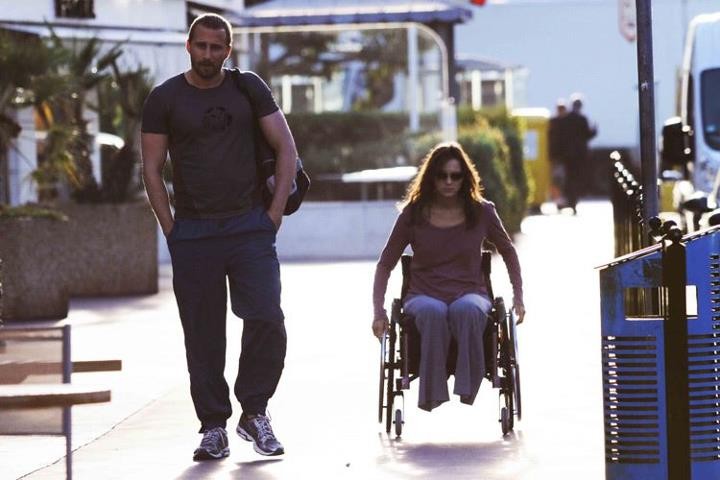
Ali (Matthias Schoenaerts), unemployed father of Sam (Armand Vendure), crashes with his sister in Antibes, while he tries to get his act together.  He jogs, he works out at the gym, dreams of being a kick-boxer, but the best he can do is bounce at a night-club, where he meets Stéphanie (Marion Cotillard), or rather rescues her, from an altercation.  She's a performer with a local Marineland park, directing killer whales through stunts and tricks, before a live audience.  Everything is going well during one performance when an accident happens and, as a result, Stéphanie loses both legs below the knees.  Submerged in depression, contemplating suicide, she calls Ali for help (it would be another of his string of odd jobs to earn money), where he starts to help her with therapy, specifically carrying her down to the wheelchair-inaccessible beach, so she can swim.


Ali is so deeply rooted in his own needs, that almost by osmosisStéphanie begins to care more about herself, and stops living in the past.  The sex helps.  But Ali is entirely self-absorbed and wants to keep things casual.  For further money, he starts participating in paid street-fight competitions, while Stéphanie takes the plunge and decides that she'll invest in artificial limbs and learn to walk again.

It's such a lop-sided story of co-dependency that it may seem like a frustrating film, but the performances of the two leads, Cotillard and Schoenaerts, go a long way in keeping interest.  Cotillard, in particular, seems to be oozing this performance out of some deep, dark place in her core (either that or she didn't sleep for a week) that is painful but fascinating to watch, while Schoenaerts is such a non-expressive performer, you might think that he is so completely internalized that he just walked off the street.  

And it's the performances that balance this film out, making the paths the actors take even necessary to sell the circumstances when the movie veers into melodrama, making an emotional course correction to get to an ending that...well, might have a point, even if a conventional one.

Meanwhile, Audiard does some impressive work with merely images, as the character of Ali is somewhat uncommunicative, and subtle shadows over people's faces suggest a shift in attitude between them.  And the whole Marineland sequences are like a sensory-overload nightmare—music constantly blaring, a robotic response-non-response from the performers to the audience, the pure, dumb folly of it all is quite an amazing sequence of textures and tones that provide a great deal of foreshadowing, even though you don't know what's coming—you just know that the place is on the knife-edge of panic and chaos.

So, an interesting film once it gets started, but then suffers a shift-tone that leads to some mighty convenient changes of heart, and makes Rust and Bone get all gooey inside, without (thank God) anthropomorphizing the whales.

Rust and Bone is a Matinee.


Friday, September 14, 2012

Robot & Frank

Future Tense: Past Imperfect
or
Wiping the Memory

Frank (Frank Langella) is a "retired" jewel thief, and getting old.  By day, he sits around the house, getting up late and reading a book—that old, antiquated form of reading in the future.  When he has half a mind to, he'll wander into town and visit the library, and flirt with librarian Jennifer (Susan Sarandon), and do a little light shop-lifting.  At night, he indulges in some light lock-picking...a man has to have a hobby.

But, living isolated, 30 years divorced with two grown kids with their own lives, he's solitary...and failing.  It's tough for son Hunter (James Marsden) to keep an eye on him, so he gets Frank the latest thing...a robot caretaker (performed by Rachael Ma, voiced by Peter Sarsgaard*) to get Frank on a regulated schedule, cook him healthy meals, clean, and program some beneficial activities.

To Frank, the robot is one big rectal thermometer, and he spends the initial first few days trying to find a way to turn the thing off or, at least, a way to get under its metal skin (those lock-picks might come in handy!).  Frank grouses, kvetches, protests and Robot (he never gets around to naming it) re-directs, gently persuades, all according to a program that looks for improvement, adjusts its approach and gently pushes.  It is altogether clear that Robot is more capable of change than Frank.  But, they're stuck with each other, in sickness and in health, until the old thief notices the precision and flexibility of the robot.  Maybe they might be of some use to each other, after all.

It's a great idea for a story, and the capacity for old dogs and programs to learn new tricks.  It might be a little too "out there" to make Frank a jewel thief, as the tale would be just as compelling, the interactions (the best part of the film) as interesting without it, but without that angle there wouldn't be much of a plot.  And the movie falls flat in the same area most speculative movies fall flat  the sociological aspect.  Oh, they get little technology details fine (there's one futuristic electric car, all the others are very contemporary) and the fashions are a little forward (but not hysterical ala The Hunger Games), but everything feels exactly the same as now.  There are no details, beside the talk of "brain-centers" and the demise of the bound book, about what the effect of these mechanical man-servants on people's lives, or the plight of the mentally challenged in this world.  This future does not look compelling, and after saying the film is set in "the near future," the idea is pretty much abandoned.**

But, that's the details.  For the most part, Robot & Frank clanks along, with a nicely done performance by Langella, the central interaction between the titular characters being the heart, soul and well-greased gears of it.

Robot & Frank is a Matinee.

* Sarsgaard's performance is in the same soft, reedy, solicitous manner that, I suppose, is de rigeur post-HAL 9000Kevin Spacey did the same thing in Moon—but one wonders if one can do anything else with it, besides, of course,  fussy butlers.

** I could also quibble about one relationship being a little too neatly tied together, but to say anything else would be spoiling things.

Wednesday, August 29, 2012

Rififi

Rififi (aka "Du Rififi Chez Les Hommes") (Jules Dassin, 1955)


It's not a word that people use/
Among the "swells" and "Who's Who"/
Rififi
It's the lingo of the streetwise/
The battle cry of real tough guys/
So don't try your brain and grumble/
All it means is "rough and tumble"
Rififi

A vital missing piece (in my viewing, anyway) in the career of Jules Dassin (of Middleton Connecticut, Harlem and the Bronx—it's pronounced "Dass'-in,") is this second European film of his exile from America and the Hollywood Black List.  "Rififi" is not well regarded as literature (Francois Truffaut said at the time of its release "Out of the worst crime novels I ever read, Jules Dassin has made the best crime film I've ever seen."), and Dassin was not the first choice as director (that was Jean-Pierre Melville-I'll have to look at Le Samouraï one of these days), but he needed a job, and managed to turn the book (which he also didn't like) into a cracklingly dark caper movie about a motley crew of thieves knocking over a jewelry store.  The leader, Tony le Stéphanois (Jean Servais in a nicely played, tubercular performance that recalls Humphrey Bogart) isn't interested, having just served a stretch in prison for a previous crime, but relents after finding his girl having taken up with a local gangster.  Rather than the fast snatch-and-grab proposed to him, though, he ups the ante, going all in only if, rather than just grabbing some jewels, the group steals the entire contents of the store's safe, the latest in security.

The scheme is elaborate, involving casing the joint for police walk-by's, then doing a home-invasion of the apartment above it, and drilling through the floor/ceiling to gain access in order to disarm the high-tech, high-sensitivity alarm system.  This sequence, which works out to nearly half an hour of screen-time is unscored, reliant on natural sound...and as the heist occurs in the middle of the night, every screeching, tearing, hammering sound could betray the enire operation.  It's a nail-biter, one of the better crimes in film history, and the model for every highly planned knock-over since.

The robbery is the big set-piece, but it's merely the middle of the film.  It's buttressed by the set-up and subsequent fall-out resulting in a rival gang's extortion, a kidnapping, and the gradual dissolution of the gang, a section that, after the tension of the robbery, becomes more and more free-wheeling, taking off, playing on the relationships established in the film's first third, the audience's complicity in the robbery, by itself, becoming a tour de force.  At the same time, it makes an interesting change-up from the rest of the film as "le Stéphanois" becomes a one-man wrecking crew, balefully upholding his criminal code while also trying to "do the right thing," culminating in a desperate drive through Paris that has a thrilling manic intensity with nary a car crash nor explosion (why, they don't even crash through a fruit-stand).

Rififi is a showcase for Dassin's talents as an adapter and director, taking the noir film back to the place where the phrase was first coined, by one of "da guys" who created and perfected the dark mysteries of the form, no matter which city streets are drenched with rain.  


Saturday, April 14, 2012

The Rising of the Moon

When Orson Welles was asked what movies he studied before embarking on directing Citizen Kane he replied, "I studied the Old Masters, by which I mean John Ford, John Ford, and John Ford."  Over the last three days we've been looking at little-seen films from The Old Master, each different in tone, temperament and subject matter, but all unmistakably the work of America's storied film-maker, the irascible, painterly, domineering, sentimental puzzle that was John Ford, John Ford, and John Ford.

The Rising of the Moon (John Ford, 1957) Interesting, charming anthology film from Ford, featuring three short stories (of approximately thirty minutes each) from the Emerald Isle.

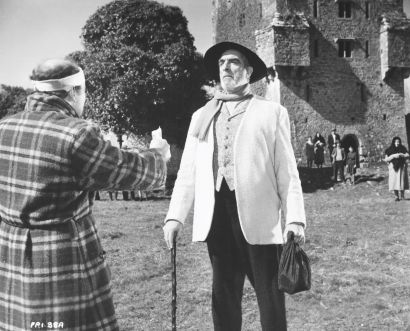
Ford was able to parlay his success with The Quiet Man—made on a shoe-string (and with a Western in the bargain for Republic Pictures) and reaping a pot of gold—to make this labor of love to promote the Irish film industry, with a cast of actors from the country's Abbey Theater (which figures prominently in the film's third sequence).  As a carrot for American audiences, Ford uses Tyrone Power as a presenter for each of the stories, each different in tone and style, but bearing Ford's ability to bring out the best in his cast, while also keeping a reign on several threads of character arc interlacing throughout each tale, to make a verdant pattern full of blarney.  Each one also has a distinct style of shooting, one landscaped, one close-quartered, one urban and chiaroscuro, that slyly reflect themes and moods of the story, even if the whimsy is a constant factor.

The three stories are thus: 

"The Majesty of the Law"—A police inspector (Cyril Cusack) ventures to the country-side, wind-blasted and rough-hewn to arrest a man for assault.  He attracts the interest of some locals, briefly toys with a rapscallion (Jack McGowran) who is trying to avoid him, then visits an old friend to shoot the breeze.  Things are not what they seem, and the segment ends on a complicated note.

"A Minute's Wait"—A busy, typical day at Dunfail station.  A brief stop-over opens the bar and the train empties of passengers.  Then things get complicated involving a match-making minister, a honeymooning British couple, young lovers, a goat, and a ghost story-in-passing.  Just when things get resolved, more complications ensue, and the train is delayed another "minute's wait."  The train empties again...and again...and again, as places change, stories get crossed, and get schedules get thrown out the window, while everyone gets increasingly drunk.  Man schedules, God laughs, and life gets in the way...and nothing is stationary.

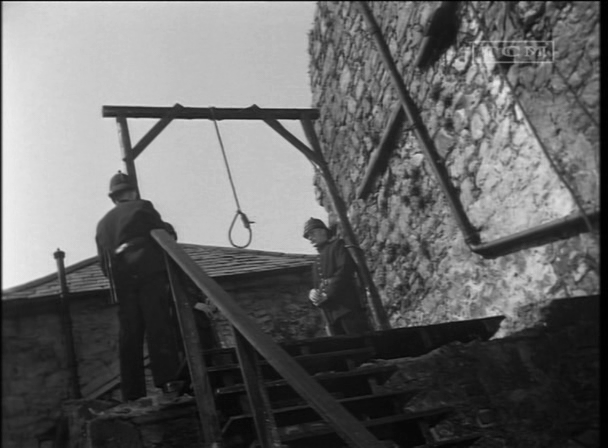
"1921"—The entire world seems to be a little off-kilter and threatening to fall into the abyss in this story set during the Black and Tan Wars, and the height of the British/Irish conflict.  Sean Curran (Donal Donnelly) is set to be hung for treason.  A snaking queue of townspeople parades in protest in front of the prison as the scaffold is prepared  ("That step is loose.  Fix it or he'll break his neck before he falls" says the Irish prison functionary in a display of gallows humor) Curran is set to hang and the Brit overseers are feeling the pressure keeping the lid on a situation that could quickly get out of hand.   A visitation by nuns, one of them Curran's sister inflames events and the intrigue moves to the streets as the Army presence builds up and loyalties are tested.  "There's a little treason in all of us," says a local bobby working for the Brits, summing up the situation and the tale.

It's great story-telling all the way through, with nothing familiar in the Ford crowd-pleasing arsenal: no John Wayne hook, no western fallback, no Ford stock company dependence, just the Old Master weaving his magic, with an artist's eye and a director's sense of pace, detail, and theatricality, each episode given its own look and feel, everything fresh, but rooted in the man's   presentation and gifts, unfamiliar, yet unmistakably Ford country.

Psycho is not my favorite Hitchcock film, but I revere it as a display of the director at the top of his story-telling gifts and mastery of the form.  In the same way, The Rising of the Moon shows Ford's abilities to play with the arts of tale and film, and is the purest example of the director's gifts..and his craft.   

Tuesday, March 20, 2012

Red Tails

Why We Fight
or
The Brother Gets It First*

Like Francis Ford Coppola's Tucker: The Man and His Dream (which he also financed), Red Tails is the movie that George Lucas has waited the longest to make.  In development even before the "Star Wars" prequels, the story of the Tuskeegee Airmen has been on Lucas' mainframe for over 20 years.  And as with most director "Dream Projects," this one had the potential to soar into great summits of excellence or tail-spin into an exercise of excess and pretentiousness.
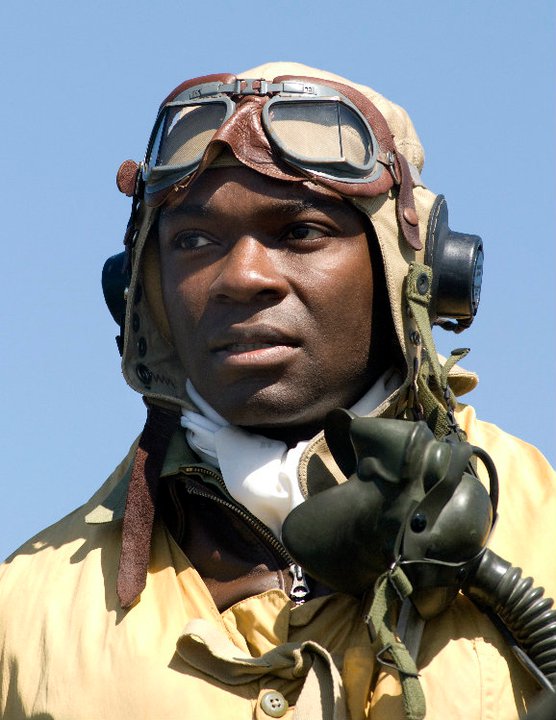
Red Tails is neither one of those, but it does do some interesting things along the way.  Respectful of the airmen, and "gung-ho" enough to end with "America The Beautiful" playing out over the End Titles,  it does remind one, in spirit, of the old war films, that appeared during and immediately after the second world war,** tough, haggard, slightly cranky, and all-too-willing to bring up some risky aspects of the vet's experience that would be tossed under the rug of homilies that later "recruitment" war films would present.  At the same time, it plays things a bit safe, dramatically, while, in subtle ways, taking chances that modern audiences—thank God—might not be aware of.***  It follows a typically diverse group of air-men with defining cliches—the "hot-shot" (David Oyelowo), the alcoholic (Nate Parker), "the kid" (Tristan Wilds"the yokel" (Ne-Yo)—through their story-arcs, fighting on two fronts—against the Nazis and their own brass and fellow soldiers, who, if not wanting to shoot the pilots out of the sky, didn't want them in the air in the first place.

One good thing that sets Red Tails apart from the other "yes, they fought too" films is there's no "white-wash" element (as one finds in a good effort like Glory, where a forgotten story about the participation of black soldiers in the Civil War, has to feature Matthew Broderick and Cary Elwes over Denzel Washington, Morgan Freeman, and Andre Braugher). These guys are on their own. There's no angelic white-devil's advocate that has to make the condescending "these are men" speech and, if anything, here, the white guys are pushing against back, making this film a lot more dramatic than your standard "liberal guilt" trip, where everybody's mind miraculously changes once "they're" "given a chance."****  The pressure never lets up on them and the only time they don't have to be on the defensive is in the air, fighting. Their inclusion in the war effort is a convenience, taking pressure off the other guys, and nothing noble. Doesn't matter to the pilots, though, as long as they're free of Earthly bonds, fingers on the triggers and Nazi Aryans in their sights.

And the battle scenescomplex, nasty and dangerous as the dog-fights are— are where Red Tails excels.  The same visceral energy of the Death Star battles (which were pre-visualized with edited WWII dogfight footage) is here, but with a rougher edge, bumpier, and more of a sense of true danger than a battle in space could provide.

Why'd it take so long?  Probably because Lucas wanted to do this one right (and also because studios were reluctant to finance a movie this black-centric), so he took the back-seat producer job, wrote the frame-work, hired John Ridley to write it and director Anthony Hemingway to film it, then doing some re-shoots (reportedly written with "Boondocks" creator Aaron McGruder) to do some dramatic streamlining.*****  Usually, it works with Lucas projects, especially when the director is strong, like Spielberg; there's a dramatic frisson that happens when it's not a "one-man/one-vision" project—something that was missing from the "Star Wars" Prequels, which suffered from too many "yes-men"—and Lucasfilms always seem to be better when he has to compromise and think off the top of his head...or someone else's.

One still gets a sense, though, of pandering.  The film Tuskeegee's don't need the "hey, these guys are good" comments that drop like leaden bombs throughout the film's second half.  As an audience, we can see it, we don't need to have it re-inforced by the white pilots they're escorting, especially considering those flight sequences are the best thing in the film.  The energy, thrills and derring-do (with their frequent "Yahoo" moments) are far more emotionally satisfying and communicative of the pilots' excellence.  Those sequences make Red Tails reach great heights, when everything else is trying to keep it grounded.  They didn't play it safe.  There's no good reason the film should.

Red Tails is a Rental.

The first wave of Tuskegee pilots

* A variation of the "trope" "Black Dude Dies First," which is a truism in "easy" drama and always struck me as being seminally racist.  In a war situation, with an all-black cast, it isn't true, and feels far less manipulative than in most war films.  In this war film, people die because "war is dangerous and people die in war."  It's random, unfair, and serves no purpose—not even dramatically.  That was an important take-way from this particular war film.

** This was in the 1940's, kids.


*** It's a bit soapish, but there's a romance between "hot-shot" pilot "Lightning" and an Italian girl, where nothing (blissfully) is mentioned about race, making the sequence seem idyllic, but also not clueing modern audiences in to the fact that if the same events happened in the country the pilots were fighting for, he would have stood a good chance of going to prison or being lynched for it.  It passes without comment or explanation, which might be dramatically risky, but sure feels good.  Real progress is made when the un-usual becomes commonplace and antique words like "miscegenation" disappear like disgarded, rusty tools.  Racial prejudice is SO "last century."

**** Even so, there's still a little too much of it, done mostly in voice-over behind masks, as if in post-production after-thought.  The screen-actions speak louder than any number of patronizing words.

***** Not sure where those sequences are—I'd only be speculating—but at one point "the kid" is shot down and put in a Nazi POW camp—the same camp that was the origination of the events and the film of The Great Escape.  Amusingly, there is one sequence that looks shot-for-shot like a sequence from the John Sturges film with "the kid" in the role played by Steve McQueen!  Heh.

Saturday, January 7, 2012

Red State

Red State (Kevin Smith, 2011) You could actually call this an indie cult film, independently financed with an auction to distribute at Sundance (which Smith harpooned to distribute himself), only running in major markets to qualify for unlikely Oscar nominations (Michael Parks, maybe; John Goodman, possibly but not likely), then quietly announced "special showings" throughout the country, presumably because the subject matter—about a homicidal religious cult, making the "cult film" literal—is so "hot" that moving, circus-like, from town to town for a limited time will discourage the "crazies" (of whatever stripe) from making the scene, making A Scene and picketing theaters.*

Needn't have bothered, really.  Any media coverage would have actually helped this film, even if it doesn't really deserve it.  It's Smith stepping out of his comfort zone (and just about everybody's) making a horror film about a religious cult that attracts lustful men on a web-site, doping them, and killing them for their homosexual tendencies that are targeting America (and the world—cited examples being African AIDS, Thailand tsunamis, and Sin City hurricanes) for rapturous Armageddon.

Forget the fact that these guys are hetero's looking to score, but, now you're getting all logical on us.

The Five Points Trinity Church, led by Abin Cooper (Michael Parks, doing the Smith-riffing like it was exploding out of his head and having fine, venal fun with it) is so bent on destruction and self-destruction there's no reasoning with them or the cache of automatic weapons kept in a vast catacomb-like basement, required for your "gotta-have-'em" horror film chases. They're all wild-eyed zealots, none more creepy than daughter Sarah (last year's Oscar winner Melissa Leo, going a bit over-the-top), who's the boy-bait for the serial-sacrifices.

An evening's services (with communal execution) goes a bit south, and when a deputy is killed (oops), the ATF is called out in the reduced form of Joe Keenan (Goodman, who's lost a lot of weight) and ASAC Brooks (Kevin Pollak, a natural to be in a Smith movie, I think), who roll their eyes with memories of Waco backlash in mind.  They don't want to be there.  They know there will be no negotiation, the best they can do is keep the carnage down, which is not what the Church is interested in (nor, frankly, is the audience).  And as interesting as a dialogue-crazy Smith directed hostage-negotiation might be, this is designed for horror audiences, so things go to hell quickly.

So, there's enough real-world identification with David Koresh and Fred Phelps** for Smith to get on his soap-box (and he does with a particularly annoying teacher character at the beginning of the film, who would no doubt lose her job for saying what she does in the film), but he's a little restrained in the wise-ass department here (other than coming up with the idea in the first place and he doesn't mention Star Wars once).  He takes his template from Night of the Living Dead with the church members as both zombies AND barricaded potential victims, with a cascading story-line that starts with predators turning into victims, and their persecutors in turn turning into victims.*** Shooting on the pure-video Red camera system (maybe that's where title comes from?), the film can go just about anywhere and attach itself to anything on the run, which Smith, who also edited, hacks and slashes to cut out the transitional fat and keep the film moving unpretentiously fast.  Should have cut a little faster and a bit more, as Smith uses the low-dig' horror format to make up for his short-comings as a shot-planner, but still keeps "the precious words" of his script intact.  Too bad.  There's a few things that could have easily gone in the out-takes bin that were redundant or not helpful.  And then, just when things start turning really interesting, Smith pulls the rug out on the film, never venturing past its "potential."  But it seems to me if you're going to be a barn-burner, you might as well burn it to the ground, rather than having the bucket-brigade near by to douse it half-way through. 

Which is sad to me.  Smith's career as the slacker's "geek-fantasy-movie-maker" still suffers from the poor execution of good ideas.  A not terribly good film-maker, he still has potential as a superb script-writer.  Problem is, he fancies himself a troubadour, a singer-songwriter, even though he can't carry a tune.  Another director might be able to take a Smith script and hone it, polish it, and adjust it, so there are no slow spots, has a good sense of pace, and some actual composition to the frame, all things that Smith seems incapable of doing.  He has a filmmaker's brio, but no taste and no judgement (especially where his own work is concerned). 

His best film is the early-in-the-going Chasing Amy, but sadly, like Silent Bob and the protagonist in that film he's been incapable of doing anything better, in effect, ever since he's been chasing Chasing Amy.  Still, if Billy Wilder's counter-maxim of "You're only as good as your BEST film, not your last" is to be embraced, so, too, is the career of Kevin Smith, just so we can have that one film added to the library of great films.


* Actually, Smith, whose humor has never kept him out of a fight (he joined a Catholic protest picket of his own film, Dogma) showed it to the daughter of Fred Phelps' daughter when he took it to Kansas City.  Phelps brought her under-age kids, and Smith warned her that the film was "R"-rated and pretty raw.  Didn't matter.  But, predictably, she walked out 20 minutes in, saying the film was "filth."  Um, yeah, wasn't that what Smith was saying?

** The Waco references are for the Koresh family, which was merely Messiah-based and collected weapons like lost souls with triggers, but Phelps (which is composed—if one can use that term—largely members of his family, and is mentioned in the film, so no one can say that they're being directly targetted), the guy who protests at funerals for slain American soldiers, is so extreme—and media-whorish—that Jerry Falwell called him outright "a first class nut," and the Ku Klux Klan has participated in counter-pickets, declaring Phelps' church "hatemongers."  And you know how much the KKK hates that!

*** Smith's original idea would have taken the idea even further to a Higher Plain, that actually would have been pretty neat to see.  But, it would have required expensive special effects for a film done on a shoe-string (the entire effects budget was $5k).  And it gives Smith a chance to have that all important tag that wraps up his film in one good line: "People just do the strangest things when they believe they're entitled. But they do even stranger things when they just plain believe."

Wednesday, September 14, 2011

Restrepo

This week, we're re-publishing some reviews of the films from the post 9-11 environment.


"Where the Road Ends, The Taliban Begins..."

There have been two exceptional documentaries coming out of the Bush War years, No End in Sight, the clinical analysis documenting the rememberances of the caring people who were stymied trying to bring some stability to the Iran conflict, and this, Restrepo, filmed by Tim Harrington and author Sebastian Junger ("The Perfect Storm"), about one year in the life of a troop in the deadliest section of the Afghanistan War, the Korengal Valley.

It's what they call a "killing zone" in war, the lowest spot in a valley surrounded by treacherous hills and mountains that defy any sense of uniqueness, with just enough green-belt to defy easy targetting.  When the soldiers of Battle Company first see it, their response is sickeningly bleak, their brio dissipating in the dust kicked up by the rotors of the Chinook delivering them to the sight.  "This is a shit-hole," says one of the men (boys, really), "And I thought 'I am going to die here.'"

They deploy with such bravado, broken and stripped down in basic training to become efficient weapons of our nation, only to see themselves further broken down by the constant beat-down of war.

And then the casualties come.  First one, and then Juan "Doc" Restrepo, who we meet at the beginning of the film, drunkenly, defiantly flexing his war-attitude on the way to deployment, a demoralizing blow to the Corps, as he was considered the best, most capable of the troop.  "Not this guy.  Not this guy.  Not this guy," mantras one of the soldiers in the post-rotation interviews.  If the Enemy could kill their best, what chance did they have?

To get more of an upper-hand, the soldiers, under the cover of night and snipers, hurriedly build a new operational post on high-ground, an "eagle's nest" with rudimentary protection—shells of dirt, basically—and their most powerful weapons to give them a vantage point, and an advantage to take them out of the bowl of death the original outpost is, strategically.  An Alamo, if you will. In simultaneous respect and defiance, they named the outpost after Restrepo, bringing a sense of permanence to his sacrifice, his first memorial, which is described as an up-raised middle digit to the unseen forces trying to kill them.

The shots are extreme hand-held moving with the nervous panic of war and long, carefully composed telephoto shots of the countryside, the plumes of explosions, while, in a reminder of where it all stands in The Scheme of Things, predator-birds glide through the shots.  Ever want to see what it's like to be inside an armored vehicle when it's up-ended by an IED?  It's here.  The language is raw as are the emotions, the cinematography iffy, often filmed in low-light conditions that defy clarity.  But, this is a necessary document of the Armed Forces in Afghanistan, showing how hope is also a casualty of war, and the evidence of it are in the haunted, even dead, eyes of the men in post-deployment interviews.  One can't look into them, without thinking that governments should be careful...as a sanctified task...to avoid such situations in the future.

In The Big Red One, Samuel Fuller's end statement was that the only victory in war was surviving it. True enough, simple as that is. But, it goes deeper than that, and is more complex. For war does more than kill the living, it also kills the future of the survivors, the wounds are internal, festering, healing far too slowly, leaving them—if total victory is not achieved—with the sense of no accomplishment, despite throwing their all, their "last full measure" into the blades of the abattoir.

Restrepo is often difficult to watch, but as an unvarnished, declassified document in the on-going revelation of the effect of war on men (and women), it is the kind of tough love it takes to quell the savage beast.

Restrepo is a Matinee.

His buddies and the filmmakers made sure he would not be forgotten.
May none of them be...

Co-director Tim Harrington was killed April 20, 2011 in Misrata, Libya
covering the uprising there.