Showing posts with label Liv Tyler. Show all posts

Friday, September 14, 2012

Robot & Frank

Future Tense: Past Imperfect
or
Wiping the Memory

Frank (Frank Langella) is a "retired" jewel thief, and getting old.  By day, he sits around the house, getting up late and reading a book—that old, antiquated form of reading in the future.  When he has half a mind to, he'll wander into town and visit the library, and flirt with librarian Jennifer (Susan Sarandon), and do a little light shop-lifting.  At night, he indulges in some light lock-picking...a man has to have a hobby.

But, living isolated, 30 years divorced with two grown kids with their own lives, he's solitary...and failing.  It's tough for son Hunter (James Marsden) to keep an eye on him, so he gets Frank the latest thing...a robot caretaker (performed by Rachael Ma, voiced by Peter Sarsgaard*) to get Frank on a regulated schedule, cook him healthy meals, clean, and program some beneficial activities.

To Frank, the robot is one big rectal thermometer, and he spends the initial first few days trying to find a way to turn the thing off or, at least, a way to get under its metal skin (those lock-picks might come in handy!).  Frank grouses, kvetches, protests and Robot (he never gets around to naming it) re-directs, gently persuades, all according to a program that looks for improvement, adjusts its approach and gently pushes.  It is altogether clear that Robot is more capable of change than Frank.  But, they're stuck with each other, in sickness and in health, until the old thief notices the precision and flexibility of the robot.  Maybe they might be of some use to each other, after all.

It's a great idea for a story, and the capacity for old dogs and programs to learn new tricks.  It might be a little too "out there" to make Frank a jewel thief, as the tale would be just as compelling, the interactions (the best part of the film) as interesting without it, but without that angle there wouldn't be much of a plot.  And the movie falls flat in the same area most speculative movies fall flat  the sociological aspect.  Oh, they get little technology details fine (there's one futuristic electric car, all the others are very contemporary) and the fashions are a little forward (but not hysterical ala The Hunger Games), but everything feels exactly the same as now.  There are no details, beside the talk of "brain-centers" and the demise of the bound book, about what the effect of these mechanical man-servants on people's lives, or the plight of the mentally challenged in this world.  This future does not look compelling, and after saying the film is set in "the near future," the idea is pretty much abandoned.**

But, that's the details.  For the most part, Robot & Frank clanks along, with a nicely done performance by Langella, the central interaction between the titular characters being the heart, soul and well-greased gears of it.

Robot & Frank is a Matinee.

* Sarsgaard's performance is in the same soft, reedy, solicitous manner that, I suppose, is de rigeur post-HAL 9000Kevin Spacey did the same thing in Moon—but one wonders if one can do anything else with it, besides, of course,  fussy butlers.

** I could also quibble about one relationship being a little too neatly tied together, but to say anything else would be spoiling things.

Friday, April 29, 2011

Super

"The Weed of Crime Bears Bitter Fruit"
or
"Boltie!  NO!"

There will be four major super-hero movies coming out this Summer (starting with Thor next week, Green Lantern, X-Men: First Class, and Captain America: The First Avenger), plus a smattering of graphic novel adaptations and such.  Next year, The Avengers, Spider-man, Batman and Superman movies will be released.  Comic Books are hot in the movies because they're easily digestible, easy to adapt, and they skew young in the audience demographics.

It's just too bad that so many of them are terrible, and they've created a lazy back-lash of "Oh, I'm so sick of super-hero movies" to any blogger who can put two words together.  Sure, you're sick of them.  Too much of anything gets dull after awhile. 

So, stop going to them.  That's not so hard.  With great power comes great responsibility.  Super-hero movies have a lot of power right now and you're responsible.

Meanwhile, there is an antidote to all this nefarious meta-human poisoning, a tonic to the wish-fulfillment fantasy that the genre unquestioningly presents: Super, written and directed by James Gunn, former Troma writer-director.  Notice that it doesn't say "Super-hero," as that label doesn't really apply—it stops just short of the "hero" as the "vigilante" aspect of the crime-fighter takes center-stage along with its brother-in-arms, revenge.

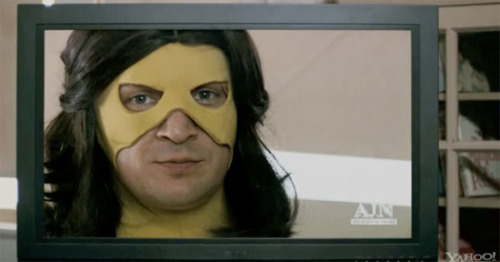
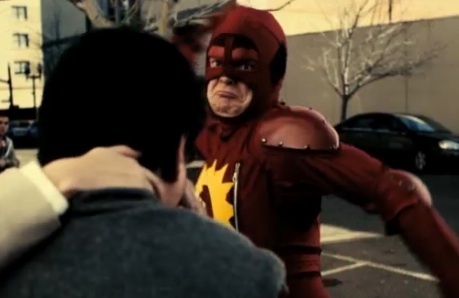
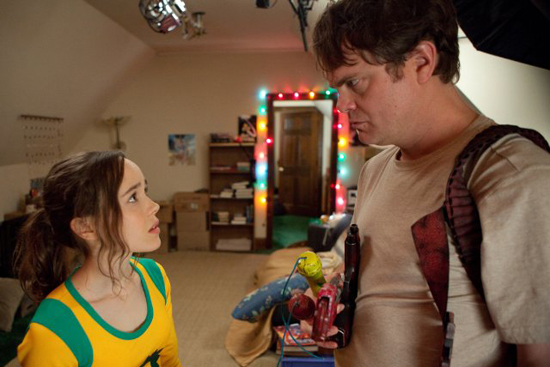
Frank D'Arbo (Rainn Wilson) is a short-order cook/man-child and the best thing that ever happened to him was marrying Sarah Helgeland (Liv Tyler), a waitress at the diner who's just come out of re-hab and is trying to get her life back in order.  Things are fine (at least from Frank's perspective) until Sarah runs off with Jacques (Kevin Bacon), a sleazy drug-dealer and then Frank melts down.  Despairing, angry and confused he's inspired by a religious station's superhero program "The Holy Avenger" (played by a smirking Nathan Fillion) and by having his brain "touched by the finger of God," to set his spinning-out-of-control back on track by taking on a vigilante role as The Crimson Bolt—his only weapons being his innate sense of "right" (no drug-dealing, no pedophilia, no butting-in in line) and a large pipe-wrench.  There are no fancy moves, no elegant acrobatic abilities pulled off with ease, just a schlumpfy guy in a leotard blundering into situations and clocking people with a big spanner.  Realistic, right down to the cranium-cracking that such action produces.  It's funny, but also slightly cringe-inducing as you see the damage that such blunt trauma can produce.  At that point, the "heroism" aspect becomes secondary to the thuggish behavior such actions create—the line between "do-gooder" and freakish assault becomes blurred and squishy.

Squishy being the operative word here.  Gunn is from Troma, the cheerily exploitative grind-house that's created such films as The Toxic Avenger, so no holds are barred in the presentation of violence with its resulting blood-splatter and meat-manufacturing.  When "The Bolt" increases his armory with guns, pipe-bombs and accelerant, things turn explosively ugly.  And that's where Super has it all over such juvenile exercises in juvie crime-fighting glorification as Kick-Ass.  However much that film tried do disguise its brutishness with smooth moves and well-choreographed stunt-work, it played fast-and-loose with the consequences of such actions, making it all 'look cool" and distracting from the carnage.  There's nothing smooth about this film; it's down and dirty and doesn't even look heroic so much as desperate and geekish, the results of adrenaline mixed with no skill whatsoever.  There's more danger in Super than anything simulated in Kick-Ass.

Things get complicated.  "The Bolt" starts to attract attention from the press and the local police, particularly one detective (Gregg Henry) who puts one and one together and connects the addled D'Arbo with the increased attacks around town.  Then, "The Bolt" gains a side-kick, the cute chick Libby (Ellen Page) at the comics store where he does his research.  A comics junkie, she also has a hyper-intense fantasy jones that makes her latch onto D'Arbo's crusade with an unhealthy zeal, becoming his junior partner, Boltie.  It's an unhealthy relationship, as Frank tries to mentor Libby ("That's inappropriate, Boltie!") in her adrenal-rush to take things too far.  And they go too far, to the point where Super jumps the genre line to become more like Taxi Driver than a super-hero film.

Super is not rated, simply because it wants to skirt the issue of taming the gore and present its message uninhibited by catering to the unfathomable whims of the MPAA.  So, the violence is squishy and upsetting, the language is pervasive ("Oh, maaan!  The Bolt-mobile is kinda fucked up!") and the places it goes only occurring to those who are seriously aware of the psychological twistedness of the genre (like Alan Moore).  It may look funny and goofy, but caution is advised if you're easily traumatized, or holding out for a hero.  Super isn't playing games or taking hostages.

Super is a rental.  Shut up, Crime! 


"This is how you fight crime...sit here and wait for it to happen?  It's so BORING!!"

Tuesday, June 24, 2008

The Incredible Hulk

The "Maybe-Not-So-Much-Incredible-But-Certainly-An-Improvement-Over-The-Last-Time" Hulk

Don't get me wrong. I admired what Ang Lee tried to bring to the, by now, here-to-stay "Superhero" sub-species (meta-species?) of action-adventure films. Taking his cue from Bryan Singer's "no, it's really about something" furrowed-brow approach to the "X-men," Lee (no relation to Smilin' Stan) made an examination of the rigors of the scientific mind, battling inner demons brought on by a repressed memory of child abuse, and made manifest in the form of a big green berserker id, The Hulk, equal parts Mr. Hyde and the Frankenstein monster.

Good thoughts. But we're talking "
The Incredible Hulk" here. These films should take their cues from the "Superhero" epithets espoused by the characters, like Superman's affirmative "Up, Up and Away" or Batman's introspective "criminals are a superstitious, cowardly lot" (these days he just says "Hrn."). "The Hulk" (in one of his incarnations) never got beyond "Hulk SMASH!" He's not the most sophisticated of heroes,* he's as pure a power-fantasy for nerds as can be--a three-year old with super-strength. So to pile on the daddy-complex psychology, when what people basically went to see was the Big Guy punch holes in things was putting a lace doily on a trash-compactor. Lee had fun bringing back split-screen to simulate comic panels (which was nifty), but "Hulk" was depressing...and not in a good way, like the "Batman" films. If you want angst, best take it only as far as "The Seven Samurai."

So, three years later, with "
Marvel Studios" in control of (most of) their characters, and an eye towards creating an "Avengers" film in the future, comes a re-vamped "Hulk," with Ed Norton replacing Eric Bana, Liv Tyler for Jennifer Connelly, and William Hurt (made ruddy and silver-maned) for Sam Elliott. As good as those performers can be, the substitutions are all improvements. And this "Hulk," has no other agenda than to be a chase-and-fight film, and succeeds quite well in its humble goals.

Some Hulking thoughts:

The credit sequence re-writes the Hulk's origin-story (always a drag on these films, and is patterned after the TV-series), and gets going with Banner on the run. He's hiding in Brazil, working at a bottling plant in the densley populated box-city of "Rocinia Favela," in computer contact with a research scientist, and working on breathing disciplines to make sure he "don't go changin.'" It makes Banner a less helpless character than the last film, and gives him a goal.

Norton's re-write of the script (by Zak Penn--who wrote the last two "X-men" films and "
Elektra" and gets full script credit on the film), is clever, detailed, and plays to the actor's calculating strengths. Plus, his Bruce Banner is a sickly-thin, not buff, scientist--in good shape, but not super-hero material. Nice contrast with the uber-defined Hulk.

The cameos all work terrifically, are integrated well, and show obvious affection for their subjects:
Stan Lee (though not a drooling fan of his, one has to admit this is his best cameo, and he's terrific in it), Lou Ferigno (he looks great!), and, in an "Aw!" moment, the late Bill Bixby. Plus, Robert Downey, Jr. makes an appearance as Tony Stark (Iron Man).

Tyler and Norton do wonders with the stormy (heh) Betty Ross-Bruce Banner romance. Connelly and Bana never seemed to connect in the first film, and seemed quite diffident to each other. Not here.

Hulk does more than roar and punch. Here he is quite capable of using collateral damage as a defense and weaponry (and kudos to the sound design team for the police car sequence). There is one scene of Hulk being attacked by "sonic-blast" weaponry that is as enjoyably "comic-booky" as in any of these films.

Tim Roth makes a very effective villain, green with envy for The Hulk's power, and the simple monster a monster plot is stream-lined and moves along while not feeling very draggy (as the battle sections of "Iron Man" did).

Director
Louis Leterrier keeps the pace going, as one would expect of a director of the "Transporter" films, and there are extended chases through that Brazilian slum-town that recall the run-downs of the "Bourne" series and the parkour scenes of "Casino Royale."

Leterrier also treats the Hulk like the shark in "
Jaws" (or "Batman" in "Batman Begins"); we only get glimpses of him in the dark, as big pieces of machinery go hurtling through the air, placing the audience in the same disoriented mode as the "wet" squad sent to capture him.

Bruce Banner has a Blue Heeler like I do. How cool is that?

It made me happy, right? I enjoyed myself, right? So, why not as high a rating as, say, "
Indiana Jones?" Because, as fun as it is, the effects scenes tend to look a bit shoddy on the big-screen. The Hulk, himself, looks a bit too much like one those plasticene statues of "the Hulk" you see at comic-shops, and things like helicopter inserts have a video-game quality to them. Everything about it is fine, but I don't think the film will suffer on the small screen. You don't need to spend full-bore on "The Incredible Hulk" to get the most out of it. The decision is economical, rather than artistic, and for that, "The Incredible Hulk" goes down a notch.

"The Incredible Hulk" is a rental--he'll look better on the small screen, and you won't miss much.

* Face it, "The Incredible Hulk" is "Dr. Jekyll and Mr. Hyde" (in the comic book and the first film, the transformation is accidental, while in the tv series and this film, Banner does it to himself). And it's always creeped me out a bit that you could make a "hero" out of "Hyde." But combined with the "poor, poor monster" aspects of Frankenstein (Kirby's early flat-topped Hulk looked an awful lot like Karloff), and the tv series' driving it further, by using "The Fugitive's" running victim conceit, you could tame the brute.