 "Love Sucks (A Cautionary Tale)"
or
"It Takes a Village (To Make a Divorce)"
The sad thing about romantic-comedies, circa the 21st Century, is their dependence on formula: Boy Meets Girl/Boy Loses Girl/Complications Ensue/Boy Wises Up/Happy Ending; or Girl Meets Boy/Girl Loses Boy/Girl's Self-Worth Depends on Boy/Romantic Rival Meets Terrible Demise/Happy Ending (of a sorts). The last few I've seen of the genre have depended on hitting these plot-points, no matter what city, what occupation, or what sex the film centers around. Even Bridesmaids, for all its wit and wildness, still ended with the assumption that everything will be alright if "the girl" gets "a man." The "by-the numbers" dance steps that most rom-coms boogie to have the ability to regress me back to the five-year old boy I was who hated "kissing scenes;" the final rosy fade-out inevitably spoils the most romantic of comedies for me, failing to warm my the cockles of my heart or make me feel all-gooey-fuzzy. Instead, I walk away cheerlessly cynical. Been there. Done that. A fish needs a bicycle.
So, it's a nice surprise, bordering on the revolutionary, when a romantic-comedy turns the formula on its ear enough that I enjoy it. Don't get me wrong, Crazy, Stupid, Love* has a "happy ending," but there is also a nice glowing lack of resolution. This is a movie that dares to say that Love is hard work, and, yeah, it sucks, but it could be worth it, because, like Life, it beats the alternative.
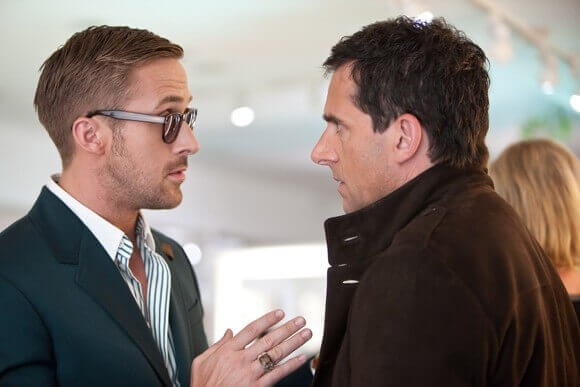
This is not where it starts, but where it starts to get interesting: Chick-magnet Jacob (Ryan Gosling,** he has a nicely subtle double-take for comedy) is in a bar in mid-closer with his latest fling when he takes the time to call over a half-stewed Cal Weaver (Steve Carell, showing exactly why he deserves to be out of TV and in films, something that doesn't happen nearly enough). The reason? Cal's moaning is throwing off Jacob's technique. Cal's been doing that a lot lately (at the office he's told: "Amy heard you crying in the bathroom - we all thought it was cancer.") No, it's not cancer. After 25 years of marriage, Cal's wife (Julianne Moore—she's great) has revealed she wants a divorce AND she's slept with another man (Kevin Bacon, he's also great). This offends Jacob's self-absorbed sensibilities: "Seriously, I don't know whether to help you or euthanize you."
So, Jacob helps Cal to "man up"—a younger "Obi-Wan" to the elder's bowl-cut Luke with credit cards as lightsabers, and this, if not turning Cal's life around, at least making it busier. And complicated.
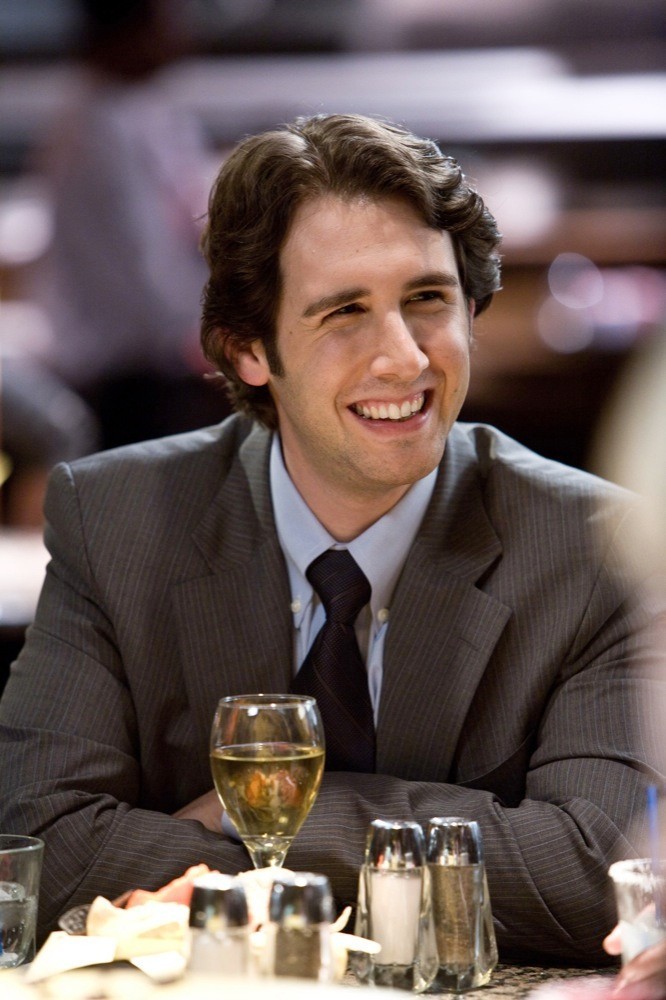
Running parallel to the story is Hannah's (Emma Stone, big-eyed waif) relationship problems ("You're life is so PG-13!" says her token-Asian friend, Liz). That's because she wants to be engaged to office co-worker Richard (Josh Groban—rather risky of him to look so bad in this movie) and is focused on that, so much so that she plays ignorant to Jacob's innuendos when he approaches her while trolling in a bar.
And, at this point, to say anything more would be saying too much, spoiling the fun and sending the whole Jenga-construction of the film crashing to the rec-room floor (In fact, I've probably said too much already). Just when you think everything is going as smooth as satin sheets, the film-makers throw you an extra wrinkle, and it's been a log, long while since a rom-com has done that. The dialogue is fresh though the situations seem familiar—everyone's conceptions of Love and Romance seem to be based on The Movies and directors Glenn Ficarra and John Requa *** and writer Dan Fogelman **** are only too happy to skewer them, while paying some respect—the complications teetering on the sit-comish, then resolving with the most graceless of dismounts. Applaud anyway because if they're not the best of executions (the performances help here), there are extra points for "artistic" and "difficulty."
Adding to the fray are the effects all this confusion have on "the kids" (Jonah Bobo, Joey King) and the friends (John Carroll Lynch—he's becoming one of my favorite character actors—and Analeigh Tipton). It, after all, takes a village to make a divorce...very uncomfortable. And special mention should be made to the movies' best utility player, Marisa Tomei, who surprises with just about every performance these days (Okay, okay, Marisa, you DESERVED that Oscar, okay?).
Highly enjoyable. Bravo.
Stupid, Crazy, Love is a Full-Price Ticket.
* Yes, it has the superfluous comma, you English Majors, but if you see the title as a list rather than "adverb, adjective, subject," it makes a bit of sense, and the film actually earns the charity for considering the possibility.
** Gosling is an odd bird. It's taken awhile for me to warm to him (I'm one of the few people to have seen his awful work in Fracture, but he has a nice laid-back dead-pan style of comedy—as displayed in Lars and the Real Girl—that hews closely to his dramatic work. Just a nudge, either way determines comedy or tragedy. He's dangerously good.
*** Okay, this is scary, but hear me out: Ficarra and Requa have written such films as the remake of Bad News Bears, Cats & Dogs, Bad Santa (a bit raw, but actually rather sweet) and...wrote and directed the little seen gay romance, I Love You Phillip Morris—as subversive and weirdly sweet movies to be seen in a long time. Forgive the early credits—these guys are good.
**** Okay, now REALLY hear me out: Fogelman wrote the screenplay for Cars and the screen-story for Cars 2, wrote Fred Claus...but did fine work on both Bolt and Tangled for Disney. Seems he can write for real people, too, and not just 'toons.
Tuesday, August 23, 2011
Crazy, Stupid, Love






Tuesday, June 7, 2011
X-Men: First Class
 "The X Factor"
or
"Don't 'X,' Don't Tell"
Movies from Marvel Studios seem to be running the pattern of "Star Trek" movies (at least in my eyes), the "even"-numbered ones tend to be best, while the "odd"-numbered ones are a little clunky.* That's certainly the case with the "X-Men" franchise. Bryan Singer's first film did a lot of heavy lifting adapting the comic to the screen, but there was a virulent strain of exposition, and some jostled positioning of the characters in what is essentially an action soap opera. The best thing about it was its casting, but its big confrontation was poorly done. X-II, also directed by Singer, with all the introductions out of the way, concentrated on story and moved along smoothly with an emotional end-point that seemed to matter. Singer left to complicate the "Superman" movies, and left X-III in the hands of Brett Ratner, who produced a very expensive film that looked cheap, felt cheap and really screwed up the X-Men line-up. Ratner was required to use an expensive cast which ate up a lot of the film's budget, and the results on-screen suffered, despite the audience familiarity of the stars. There really didn't seem to be anywhere for another film to go, without some heavy gene-splicing of the cast.
So, here's the fourth "X-Men" Movie (we won't talk about X-Men Origins: Wolverine—we already have) X-Men: First Class, a sort of re-boot of the series, although keeping elements from the original films that everybody seems to like. They could have easily made it an "X-Men Origins" film. It starts where the first film began—at a concentration camp in Poland as Erik Lensherr (here Bill Milner, but he'll grow up to be Michael Fassbender**) watches helplessly (for the moment) as his parents are imprisoned in a concentration camp.*** The parallel story is of young Charles Xavier (Laurence Belcher, then James McAvoy ) who finds a metamorph in his kitchen (Morgan Lily, but she'll be played as a young adult by the ubiquitous Jennifer Lawrence), whom, recognizing a fellow mutant-traveller, he takes in as a sister. Their lives progress and Lensherr, who has developed powers over metal, hunts down the Nazis (particularly Kevin Bacon) who killed his parents and tortured him, while Xavier attends Oxford with his "sister" Raven, achieving top honors—and why wouldn't he, as he can read minds and project thoughts.
What is nice about X-Men: First Class is it takes real-world events of the time that Lee and Kirby were creating the series in the early 1960's—in this case, the nuclear gamesmanship of 1962 when the U.S. planted missiles in Turkey, which was then challenged by the Russians planting nukes in Cuba, thus lighting the match for the Cuban Missile Crisis in October of that year, which came within a sub-crew's breath of a nuclear X-change between the two very real "super-powers." Singer is credited with the story, and however counter-intuitive it might have been to place it there (and it does create a couple of continuity errors), it "works" and works gang-busters. With Singer's story and the direction of Matthew Vaughn (getting stronger and stronger with each movie), it feels more like a 60's groovy spy story than your standard super-hero fare, and for once—save for a poignant moment in X-II—the consequences of the plot really seem to matter.
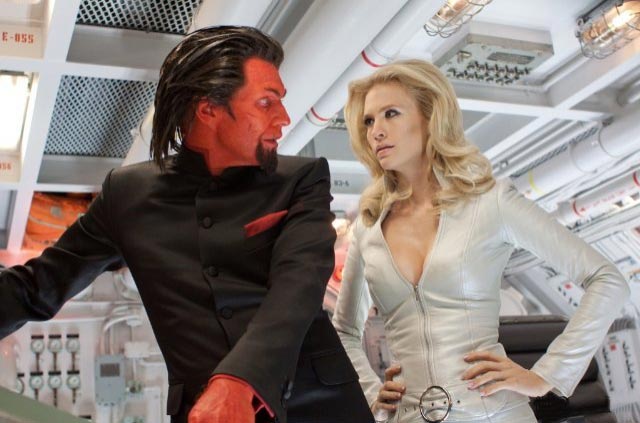
Those familiar with the "X-Men" comics will know of "The Hellfire Club"**** and it turns out that organization of nefariousness and debauchery fits in well with the swinging '60's. Led by Sebastian Shaw (Bacon), with henchmen Azazel (Jason Flemyng), Riptide (Álex González) and Emma Frost (January Jones), they've pulled the mental strings of military puppets on both sides to set up the nuclear stand-off, and as Shaw absorbs energy, a nuclear holocaust wouldn't kill him, it would only make him stronger. Banding together with the CIA, (uneasily, except for agent Moira McTaggert—Rose Byrne and another played by Oliver Platt), Xavier joins forces with Lensherr, in classic "the enemy of my enemy is my friend" style, and begin recruiting other mutants to form a secret society of operatives hiding in the shadows to do undercover work against the Hellfire Club. Pretty soon, things become dire enough that they must come out of the cold and overtly take a stand, certainly taking their place among "the best and the brightest."
It's your classic "oppressed minority" story (something Lee and Kirby knew all too well when they were doing the comics—both were Jews, which was common among the pioneers of the creators of the superhero comics genre), but during the 60's it was a civil rights metaphor that only became more overt as the years went on. Singer pitched his initial The X-Men concept as a "meeting between Martin Luther King and Malcolm X," but it was more than that; Singer gave it a "hiding in plain sight" slant towards gay rights that involved not only opposition to the mutants but out-right hysteria (something the scenario buys into with the "recruitment" angle, long a charge of anti-gay paranoia).
So, you have a superhero flick that acknowledges its comics roots by employing a style from the movies of its origin's time-frame, with a rather clear-eyed look at a real-life crisis (mutants weren't involved, although I've always had my suspicions about Robert McNamara), some nice performances, grand-standing direction, good action set-pieces, and a few nice surprises for fans of both the comics and the previous films. X-Men: First Class manages to be more than the sum of its parts, certainly the best of the series and among the best of the genre, thanks to its scope and style and its own undefinable, uncanny "X"-factor.
X-Men: First Class is a nifty Matinee. "First Class," indeed.













 |
| The First "X-Men" comic (from 1963) |
* Iron Man being an exception.
** Fassbender is terrific, playing contained rage and menace throughout, but when he lets go with the emotional histrionics, there is just enough control to it to make you worry what would happen if he "really" let go.
*** They even use Michael Kamen's music from the first film in the scene.
**** Although writer Chris Claremont and artist John Byrne site "A Touch of Brimstone"—a controversial episode of the British TV series "The Avengers" (and it's important to make that distinction with Marvel)—there's been a long history of actual Hellfire Clubs.
Friday, April 29, 2011
Super
 "The Weed of Crime Bears Bitter Fruit"
or
"Boltie! NO!"
There will be four major super-hero movies coming out this Summer (starting with Thor next week, Green Lantern, X-Men: First Class, and Captain America: The First Avenger), plus a smattering of graphic novel adaptations and such. Next year, The Avengers, Spider-man, Batman and Superman movies will be released. Comic Books are hot in the movies because they're easily digestible, easy to adapt, and they skew young in the audience demographics.
It's just too bad that so many of them are terrible, and they've created a lazy back-lash of "Oh, I'm so sick of super-hero movies" to any blogger who can put two words together. Sure, you're sick of them. Too much of anything gets dull after awhile.
So, stop going to them. That's not so hard. With great power comes great responsibility. Super-hero movies have a lot of power right now and you're responsible.
Meanwhile, there is an antidote to all this nefarious meta-human poisoning, a tonic to the wish-fulfillment fantasy that the genre unquestioningly presents: Super, written and directed by James Gunn, former Troma writer-director. Notice that it doesn't say "Super-hero," as that label doesn't really apply—it stops just short of the "hero" as the "vigilante" aspect of the crime-fighter takes center-stage along with its brother-in-arms, revenge.
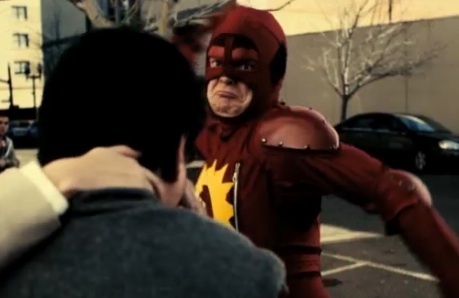
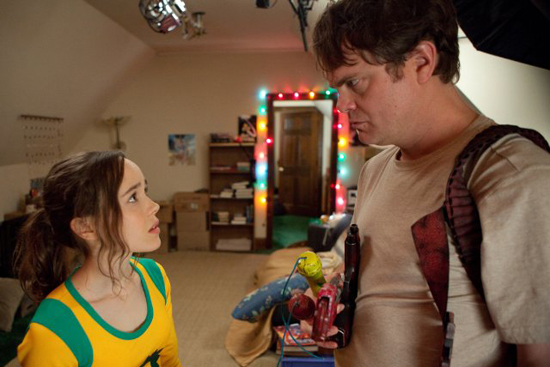
Frank D'Arbo (Rainn Wilson) is a short-order cook/man-child and the best thing that ever happened to him was marrying Sarah Helgeland (Liv Tyler), a waitress at the diner who's just come out of re-hab and is trying to get her life back in order. Things are fine (at least from Frank's perspective) until Sarah runs off with Jacques (Kevin Bacon), a sleazy drug-dealer and then Frank melts down. Despairing, angry and confused he's inspired by a religious station's superhero program "The Holy Avenger" (played by a smirking Nathan Fillion) and by having his brain "touched by the finger of God," to set his spinning-out-of-control back on track by taking on a vigilante role as The Crimson Bolt—his only weapons being his innate sense of "right" (no drug-dealing, no pedophilia, no butting-in in line) and a large pipe-wrench. There are no fancy moves, no elegant acrobatic abilities pulled off with ease, just a schlumpfy guy in a leotard blundering into situations and clocking people with a big spanner. Realistic, right down to the cranium-cracking that such action produces. It's funny, but also slightly cringe-inducing as you see the damage that such blunt trauma can produce. At that point, the "heroism" aspect becomes secondary to the thuggish behavior such actions create—the line between "do-gooder" and freakish assault becomes blurred and squishy.
Squishy being the operative word here. Gunn is from Troma, the cheerily exploitative grind-house that's created such films as The Toxic Avenger, so no holds are barred in the presentation of violence with its resulting blood-splatter and meat-manufacturing. When "The Bolt" increases his armory with guns, pipe-bombs and accelerant, things turn explosively ugly. And that's where Super has it all over such juvenile exercises in juvie crime-fighting glorification as Kick-Ass. However much that film tried do disguise its brutishness with smooth moves and well-choreographed stunt-work, it played fast-and-loose with the consequences of such actions, making it all 'look cool" and distracting from the carnage. There's nothing smooth about this film; it's down and dirty and doesn't even look heroic so much as desperate and geekish, the results of adrenaline mixed with no skill whatsoever. There's more danger in Super than anything simulated in Kick-Ass.
Things get complicated. "The Bolt" starts to attract attention from the press and the local police, particularly one detective (Gregg Henry) who puts one and one together and connects the addled D'Arbo with the increased attacks around town. Then, "The Bolt" gains a side-kick, the cute chick Libby (Ellen Page) at the comics store where he does his research. A comics junkie, she also has a hyper-intense fantasy jones that makes her latch onto D'Arbo's crusade with an unhealthy zeal, becoming his junior partner, Boltie. It's an unhealthy relationship, as Frank tries to mentor Libby ("That's inappropriate, Boltie!") in her adrenal-rush to take things too far. And they go too far, to the point where Super jumps the genre line to become more like Taxi Driver than a super-hero film.
Super is not rated, simply because it wants to skirt the issue of taming the gore and present its message uninhibited by catering to the unfathomable whims of the MPAA. So, the violence is squishy and upsetting, the language is pervasive ("Oh, maaan! The Bolt-mobile is kinda fucked up!") and the places it goes only occurring to those who are seriously aware of the psychological twistedness of the genre (like Alan Moore). It may look funny and goofy, but caution is advised if you're easily traumatized, or holding out for a hero. Super isn't playing games or taking hostages.
Super is a rental. Shut up, Crime!








 |
| "This is how you fight crime...sit here and wait for it to happen? It's so BORING!!" |
Friday, January 2, 2009
Frost/Nixon
 "That Was the Crook That Was"
or
"David vs. Go-lie-eth"
Well, it was hardly "An Epic Battle for the Truth." It was a stunt put on by David Frost and Richard Nixon to jump-start their respective careers. I remember those interviews and the hoopla they generated. there was a lot of heat in the media about "checkbook journalism," and it was being kind to call it "journalism"—Frost's go-to question always was "What is your definition of love?"* It was, in fact, the news-equivalent of opening Al Capone's vault, or the Billy Jean King-Bobby Riggs tennis match.
But it did happen, quite a bit of the way "Frost/Nixon" scribe Peter Morgan presents it. The legal wranglings, the rejection by the networks leading to syndication, the sponsorships by the new-tech "Weed-Eater" and Alpo dog food (Lorne Green was the spokesperson). I remember the stories of the exploding light, Nixon's remarks of Frost being his "Grand Inquisitor," even the "Did you do any fornicating?" line that (although it didn't occur right before taping as the movie would have you believe) Nixon threw at Frost when the cameras weren't running.
But there's enough difference to make it suspect. The interviews were not as packed with drama as the movie would have you believe (see the video below). They were quite benign affairs, and Nixon didn't betray any secrets that he didn't want to betray--the movie doesn't tell you that Nixon's deal included 20% of the royalties of the syndication, which made him Frost's partner in the enterprise, and the former president knew that throwing in some red meat would garnish more money for him.
The furthest afield that Morgan goes is the most interesting. The playwright/screen-writer invents a late-night phone-call between Nixon (Frank Langella--after a while you buy him, but his Nixon speaks like a dilletante) and Frost (Michael Sheen—his Frost is vocally perfect) before the final interview, the one involving Watergate. Frost, ill-prepared and feeling in over his head, is caught in a moment of self-doubt when Nixon, with a couple drinks in him, calls and has a heart-to-heart comparing Frost's history to his own—of being shunned by the privileged kids, the ones who got all the breaks. Finally, Nixon builds to a fevered pitch and becomes the ranting monster everyone imagines him to have been, yelling that "all those (expletives deleted) can choke!"
And this is the problem: that phone-call never happened.** It's an invention of Morgan's to transtion Frost from defeated to fighting, and although it dramatically works, it's a cheat. The truth of the matter is that Nixon is never the monster that the dramatists and speculators want him to be—as threats to democracies go, he was a rather dull one, but, as with "Secret Honor," the fictional Nixon, drunk, raving like a bitter lunatic, vengeful and self-pitying (which he was), but dramatically incapable of being Lear, just isn't good enough to square with the man who used his office like a club against his political enemies, and set up his own police force to carry out the dirty work that even J. Edgar Hoover disapproved of. One suspects "The Queen" isn't nearly as accurate a picture of Elizabeth II. Reality just isn't dramatic enough.
Still, it's a great cast with Kevin Bacon as Nixon's Chief of Staff, Matthew Macfadyen (blonde Beatle-wigged as Frost's producer), Oliver Platt and Sam Rockwell as Frost's researchers, Toby Jones as a perfect Irving "Swifty" Lazar, and the original "Bad Seed " Patty McCormack plays a frail Pat Nixon.
It's certainly Ron Howard's most subtle film in years—there's no evidence of the grand-standing direction that weakens a lot of his out-put, and his asides and cut-aways aren't distractions, but part of the fabric. He merely provides the arena, and lets the actors do their work. It shows just how good a director he is, when he's not trying to show how good a director he is.
"Frost/Nixon" is a Matinee.


 Reality and Fiction: Frost and Nixon and "Frost/Nixon"
* My favorite answer was Richard Burton's: "Love is staying up all night with a very sick child...or a very healthy adult." Barbara Walters' go-to question was "If you were a twee, what kind of twee would you be?"
** And Morgan does some obfuscating on the point: Nixon doesn't recall making the phone-call, although Frost assures him that he did.